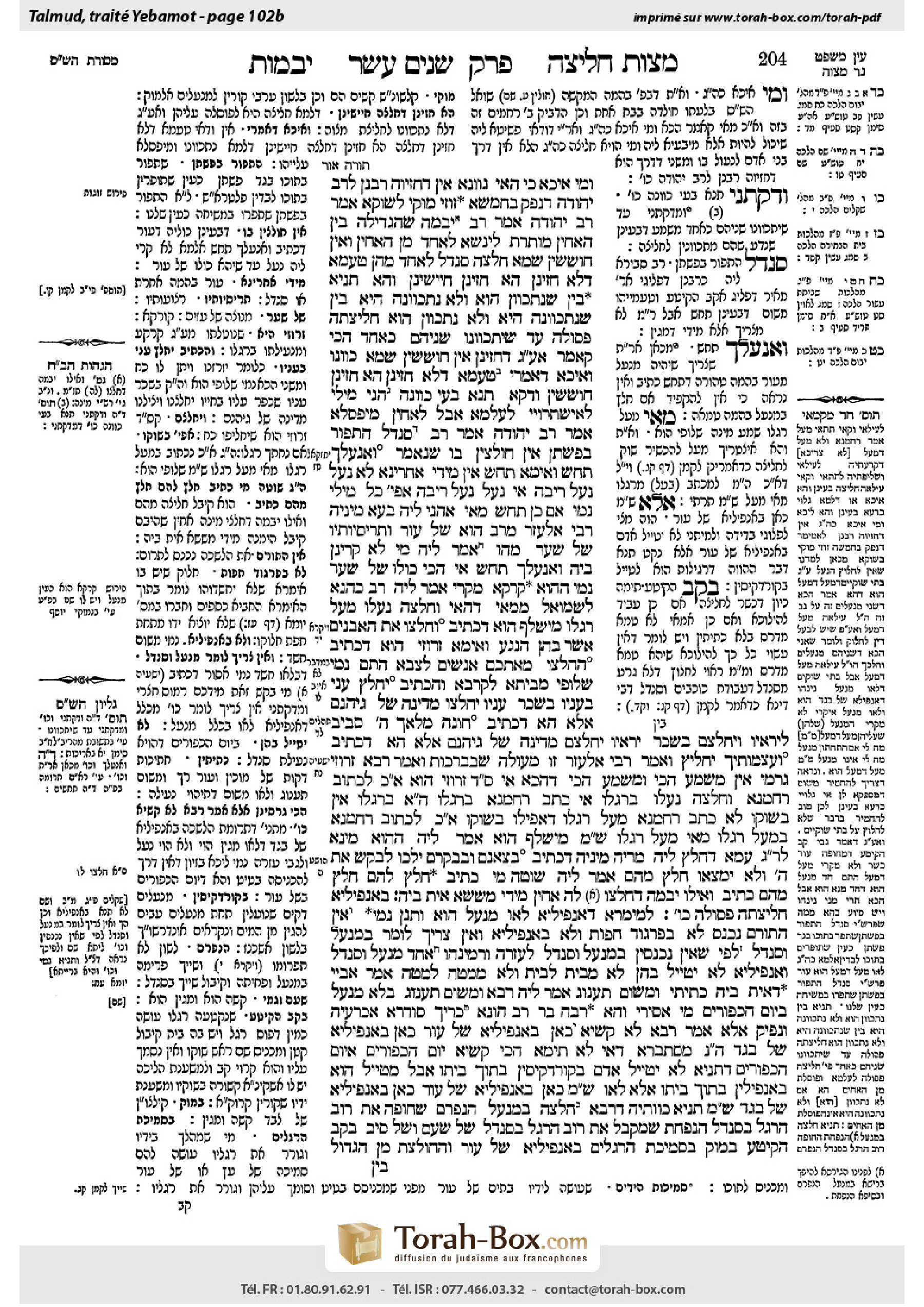
Yevamot 102b: Talmud study for Daf Yomi
Daf Yomi is the daily study of one Talmud folio. Explore 37 tractates with scans, Hebrew text, Sefaria English and AI-generated French translations where annotated.
Passage selection and English or AI-generated French translation are available where the scan has annotations. Daf Study is independent of Torah-Box and Sefaria.
Browse Yevamot · יבמות · All tractatesYevamot 102b text and translations
This page of Yevamot includes the Aramaic text, an English translation and an AI-generated French translation, alongside the scan above.
יבמות ק״ב ב · Aramaic and Hebrew text
וּמִי אִיכָּא כִּי הַאי גַוְונָא? אִין, דְּחַזְיוּהּ רַבָּנַן לְרַב יְהוּדָה דִּנְפַק בְּחַמְשָׁא זוּזֵי מוֹקֵי לְשׁוּקָא.
אָמַר רַב יְהוּדָה אָמַר רַב: יְבָמָה שֶׁהִגְדִּילָה בֵּין הָאַחִין — מוּתֶּרֶת לִינָּשֵׂא לְאֶחָד מִן הָאַחִין, וְאֵין חוֹשְׁשִׁין שֶׁמָּא חָלְצָה סַנְדָּל לְאֶחָד מֵהֶן. טַעְמָא, דְּלָא חָזֵינַן, הָא חָזֵינַן — חָיְישִׁינַן.
וְהָא תַּנְיָא: בֵּין שֶׁנִּתְכַּוֵּון הוּא וְלֹא נִתְכַּוְּונָה הִיא, בֵּין שֶׁנִּתְכַּוְּונָה הִיא וְלֹא נִתְכַּוֵּון הוּא — חֲלִיצָתָהּ פְּסוּלָה, עַד שֶׁיִּתְכַּוְּונוּ שְׁנֵיהֶם כְּאֶחָד! הָכִי קָאָמַר: אַף עַל גַּב דַּחֲזֵינַן — אֵין חוֹשְׁשִׁין שֶׁמָּא כִּוְּונוּ.
וְאִיכָּא דְּאָמְרִי: טַעְמָא, דְּלָא חָזֵינַן, הָא חָזֵינַן — חוֹשְׁשִׁין. וּדְקָא תָנֵא בָּעֵי כַּוּוֹנָה — הָנֵי מִילֵּי לְאִישְׁתְּרוֹיֵי לְעָלְמָא, אֲבָל לְאַחִין מִיפַּסְלָא.
אָמַר רַב יְהוּדָה אָמַר רַב: סַנְדָּל הַתָּפוּר בְּפִשְׁתָּן — אֵין חוֹלְצִין בּוֹ, שֶׁנֶּאֱמַר: ״וָאֶנְעֲלֵךְ תָּחַשׁ״. וְאֵימָא: תַּחַשׁ — אִין, מִידֵּי אַחֲרִינָא — לָא! ״נַעַל״ ״נַעַל״ רִיבָּה.
אִי ״נַעַל״ ״נַעַל״ רִיבָּה, אֲפִילּוּ כֹּל מִילֵּי נָמֵי! אִם כֵּן, ״תָּחַשׁ״ מַאי אַהֲנִי לֵיהּ?
בְּעָא מִינֵּיהּ רַבִּי אֶלְעָזָר מֵרַב: הוּא שֶׁל עוֹר, וּתְרֵיסִיּוֹתָיו שֶׁל שֵׂעָר, מַהוּ? אֲמַר לֵיהּ: מִי לָא קָרֵינַן בֵּיהּ ״וָאֶנְעֲלֵךְ תָּחַשׁ״? אִי הָכִי, כּוּלּוֹ שֶׁל שֵׂעָר נָמֵי! הָהוּא קֻרְקָא מִקְּרֵי.
אֲמַר לֵיהּ רַב כָּהֲנָא לִשְׁמוּאֵל: מִמַּאי דְּהַאי ״וְחָלְצָה נַעֲלוֹ מֵעַל רַגְלוֹ״ מִישְׁלַף הוּא — דִּכְתִיב: ״וְחִלְּצוּ אֶת הָאֲבָנִים אֲשֶׁר בָּהֵן הַנָּגַע״.
וְאֵימָא זָרוֹזֵי הוּא, דִּכְתִיב: ״הֵחָלְצוּ מֵאִתְּכֶם אֲנָשִׁים לַצָּבָא״! הָתָם נָמֵי — שַׁלּוֹפֵי מִבֵּיתָא לִקְרָבָא.
וְהָכְתִיב: ״יְחַלֵּץ עָנִי בְעׇנְיוֹ״! בִּשְׂכַר עׇנְיוֹ, יְחַלְּצוֹ מִדִּינָהּ שֶׁל גֵּיהִנָּם.
אֶלָּא הָא דִּכְתִיב: ״חֹנֶה מַלְאַךְ ה׳ סָבִיב לִירֵאָיו וַיְחַלְּצֵם״! בִּשְׂכַר יְרֵאָיו יְחַלְּצֵם מִדִּינָהּ שֶׁל גֵּיהִנָּם.
אֶלָּא הָא דִּכְתִיב: ״וְעַצְמֹתֶיךָ יַחֲלִיץ״, וְאָמַר רַבִּי אֶלְעָזָר: זוֹ מְעוּלָּה שֶׁבַּבְּרָכוֹת, וְאָמַר רָבָא: זָרוֹזֵי גַּרְמֵי! אִין, מַשְׁמַע הָכִי וּמַשְׁמַע הָכִי. דְּהָכָא, אִי סָלְקָא דַעְתָּךְ זָרוֹזֵי הוּא, אִם כֵּן, לִכְתּוֹב רַחֲמָנָא ״וְחָלְצָה נַעֲלוֹ בְּרַגְלוֹ״!
אִי כְּתַב רַחֲמָנָא ״בְּרַגְלוֹ״, הֲוָה אָמֵינָא: ״בְּרַגְלוֹ״ — אִין, בְּשׁוֹקוֹ — לָא, כְּתַב רַחֲמָנָא ״מֵעַל רַגְלוֹ״ דַּאֲפִילּוּ בְּשׁוֹקוֹ. אִם כֵּן, לִכְתּוֹב רַחֲמָנָא ״בְּמֵעַל רַגְלוֹ״. מַאי ״מֵעַל רַגְלוֹ״ — שְׁמַע מִינַּהּ מִישְׁלַף הוּא.
אֲמַר לֵיהּ הָהוּא מִינָא לְרַבָּן גַּמְלִיאֵל: עַמָּא דַּחֲלַץ לֵיהּ מָרֵיהּ מִינֵּיהּ, דִּכְתִיב: ״בְּצֹאנָם וּבִבְקָרָם יֵלְכוּ לְבַקֵּשׁ אֶת ה׳ וְלֹא יִמְצָאוּ חָלַץ מֵהֶם״.
אֲמַר לֵיהּ: שׁוֹטֶה, מִי כְּתִיב ״חָלַץ לָהֶם״? ״חָלַץ מֵהֶם״ כְּתִיב, וְאִילּוּ יְבָמָה דְּחָלְצוּ לָהּ אַחִין — מִידֵּי מְשָׁשָׁא אִית בֵּיהּ?
בְּאַנְפִּילְיָא חֲלִיצָתָהּ פְּסוּלָה כּוּ׳. לְמֵימְרָא דְּאַנְפִּילְיָא לָאו מִנְעָל הוּא?
וּתְנַן נָמֵי: אֵין הַתּוֹרֵם נִכְנָס לֹא בְּפַרְגּוֹד חָפוּת וְלֹא בְּאַנְפִּילְיָא, וְאֵין צָרִיךְ לוֹמַר בְּמִנְעָל וְסַנְדָּל, לְפִי שֶׁאֵין נִכְנָסִין בְּמִנְעָל וְסַנְדָּל לָעֲזָרָה.
וּרְמִינְהוּ: אֶחָד מִנְעָל וְסַנְדָּל וְאַנְפִּילְיָא, לֹא יְטַיֵּיל בָּהֶן, לֹא מִבַּיִת לְבַיִת וְלֹא מִמִּטָּה לְמִטָּה!
אָמַר אַבָּיֵי: דְּאִית בֵּיהּ כְּתִיתֵי, וּמִשּׁוּם תַּעֲנוּג. אֲמַר לֵיהּ רָבָא: וּמִשּׁוּם תַּעֲנוּג בְּלֹא מִנְעָל בְּיוֹם הַכִּפּוּרִים מִי אֲסִירִי? וְהָא רַבָּה בַּר רַב הוּנָא כָּרֵיךְ סוּדָרָא אַכַּרְעֵיהּ וְנָפֵיק! אֶלָּא אָמַר רָבָא: לָא קַשְׁיָא, כָּאן בְּאַנְפִּילְיָא שֶׁל עוֹר, כָּאן בְּאַנְפִּילְיָא שֶׁל בֶּגֶד.
הָכִי נָמֵי מִסְתַּבְּרָא, דְּאִי לָא תֵּימָא הָכִי, קַשְׁיָא יוֹם הַכִּפּוּרִים אַיּוֹם הַכִּפּוּרִים. דְּתַנְיָא: לֹא יְטַיֵּיל אָדָם בְּקוֹרְדָּקֵיסִין בְּתוֹךְ בֵּיתוֹ, אֲבָל מְטַיֵּיל הוּא בְּאַנְפִּילִין בְּתוֹךְ בֵּיתוֹ! אֶלָּא לָאו שְׁמַע מִינַּהּ: כָּאן בְּאַנְפִּילְיָא שֶׁל עוֹר, כָּאן בְּאַנְפִּילְיָא שֶׁל בֶּגֶד — שְׁמַע מִינַּהּ.
תַּנְיָא כְּווֹתֵיהּ דְּרָבָא: חָלְצָה בְּמִנְעָל הַנִּפְרָם שֶׁחוֹפֶה אֶת רוֹב הָרֶגֶל, בְּסַנְדָּל הַנִּפְחָת שֶׁמְּקַבֵּל אֶת רוֹב הָרֶגֶל, בְּסַנְדָּל שֶׁל שַׁעַם וְשֶׁל סִיב, בְּקַב הַקִּיטֵּעַ, בְּמוּק, בִּסְמִיכַת הָרַגְלַיִם, בְּאַנְפִּילְיָא שֶׁל עוֹר, וְהַחוֹלֶצֶת מִן הַגָּדוֹל,
Yevamot 102b · English translation
The Gemara asks: Is there really a case like this where people wear one shoe on top of another? The Gemara answers: Yes, for the Sages saw Rav Yehuda, who went out once to the market wearing five pairs of shoes, which were similar to slippers, one on top of another.
Rav Yehuda said another halakha that Rav said: An underage yevama who grew up among her husband’s brothers before any ḥalitza was performed is permitted to marry one of the brothers through levirate marriage, and we are not concerned about the possibility that during the time she was in the company of her yevamin she removed a sandal from one of them, and thereby she would have already performed ḥalitza. The Gemara infers from this statement: The reason it is permitted to perform levirate marriage now is specifically that we did not see her remove one of their shoes, but if in fact we did see her do so, we are concerned and treat her as a yevama who already performed ḥalitza and is thereby forbidden to all the brothers.
The Gemara challenges: But isn’t it taught in a baraita: Whether he intended to perform ḥalitza and she did not intend to, or whether she intended to perform ḥalitza and he did not intend to, the ḥalitza is invalid, unless they both intended it as one to perform a proper act of ḥalitza? The Gemara answers: This is what Rav said: Even if we did see that she removed a shoe from one of them, we are not concerned that perhaps they intended to perform ḥalitza.
And there are those who say the inference from Rav’s statement should be made in the opposite manner: The reason it is permitted for her to perform levirate marriage now is specifically that we did not see her remove a shoe from one of the brothers. But if we did see, we would be concerned and would treat her as a yevama who already performed ḥalitza, despite our knowledge that she did not intend to perform ḥalitza. And with regard to that which was taught in the baraita, that intention is required, this applies only as far as validating the act of ḥalitza in order to permit her to marry a stranger. But performing an act of ḥalitza even without intention is sufficient to disqualify her for the brothers, rendering prohibited an act of levirate marriage afterward.
Rav Yehuda also said that Rav said: One may not perform ḥalitza using a sandal that was sewn together with threads made of flax, as it is stated: “And I made you shoes of taḥash skin” (Ezekiel 16:10), which is the skin of an animal, implying that a shoe is something made entirely of leather. The Gemara challenges: If the source is “taḥash,” let us say: A shoe made of taḥash skin, yes, it is valid; but if made of anything else, no. The Gemara rejects this: Because “shoe” and “shoe” are written in the Torah multiple times, this amplifies and includes all types of shoes crafted from leather skins as valid for performing ḥalitza.
The Gemara asks: If the inclusion of the words “shoe” and “shoe” amplifies, then should one include as valid for performing ḥalitza shoes crafted from even any other materials as well, including those not produced from leather at all? The Gemara answers: If so, what purpose does “taḥash” serve, as nothing is learned from it? Rather, from the word taḥash it is derived that the shoe must be crafted entirely of leather, but all types of leather are included because the word “shoe” is repeated in the Torah numerous times.
Rabbi Elazar asked Rav: What is the status of the following type of sandal used for performing ḥalitza? In a case where it, the shoe itself, is made of leather, and the sections that hold its straps [tereisiyyot] are made of hair, as they were woven together with goat’s hair, what is the halakha? He said to him: Do we not refer to such a sandal as: “And I made you shoes of taḥash”? Since it is crafted from material that comes from an animal it is valid. The Gemara asks: If that is so, i.e., that anything derived from an animal is valid, then even if it is fashioned entirely of hair it should also be valid. The Gemara answers: That would be called a slipper, not a shoe.
Rav Kahana said to Shmuel: From where is it known that this phrase: “And she shall remove [ḥaltza] his shoe from on his foot” (Deuteronomy 25:9), means to remove? As it is written: “Then the priest shall command, and they shall take out [ḥiltzu] the stones in which the plague is” (Leviticus 14:40), indicating that the word ḥaltza means that they shall remove the stones from their place.
The Gemara asks whether the word ḥaltza can be interpreted differently based upon its apparent meaning in other contexts: But could you say it is a term for strengthening, as it is written: “Arm [heḥaletzu] men from among you for the army” (Numbers 31:3), meaning that men among you will be strengthened and take up arms to prepare for battle? The Gemara answers: There too, the meaning of the word is referring to taking something from its place, as it means removing people from their houses in order to go out to war.
The Gemara challenges: But isn’t it written: “He delivers [yeḥaletz] the afflicted by His affliction [be’onyo]” (Job 36:15)? This indicates that the afflicted one becomes stronger due to his affliction, as, if the intention was to deliver him from his affliction, it should have said: From His affliction, rather than “by His affliction.” The Gemara answers that the verse should be interpreted as follows: Be’onyo, in other words, as reward for his suffering from affliction, He shall deliver him from the judgment of Gehenna, as is understood from the term be’onyo, through the reward due to his affliction.
The Gemara challenges further: But with regard to that it is written: “The angel of the Lord encamps around those who fear Him and delivers them [vayeḥaltzem]” (Psalms 34:8), doesn’t vayeḥaltzem rather mean: He shall strengthen them? The Gemara answers: The verse means: As a reward for those that fear Him, He shall deliver them from the judgment of Gehenna. Therefore, the Gemara interprets vayeḥaltzem as “delivers them,” not as: Strengthens them.
The Gemara challenges further: But with regard to that which is written: “And the Lord will guide you, and satisfy your soul in drought, and make your bones strong [yaḥalitz]” (Isaiah 58:11), and Rabbi Elazar said regarding that verse: This is the greatest of blessings, and Rava said it means: Strengthening of bones. This seems to indicate that the root of the word ḥalitza is referring to strengthening. The Gemara answers: Yes, it has this connotation, and it has this connotation, i.e., the root ḥ-l-tz sometimes connotes removal and sometimes connotes strengthening. But here, only one meaning is possible, as, if it enters your mind that ḥalitza here connotes strengthening, then let the Merciful One write in the Torah: She shall strengthen [ḥaletza] his shoe on his foot [beraglo], indicating that she should tighten the shoe on his foot, rather than stating: “From on his foot [me’al raglo],” which indicates that she is removing something from his foot.
The Gemara responds: If the Merciful One had written in the Torah: On his foot [beraglo], I would have said she must strengthen and tighten the shoe on his foot, yes, but on his calf, no; and if his foot were amputated she may no longer perform ḥalitza. Therefore, the Merciful One writes in the Torah: “From on his foot [me’al raglo],” to teach that she may strengthen the shoe even on his calf, which is part of the leg, or regel, above the foot. The Gemara answers: If so, and ḥalitza really means strengthening, let the Merciful One write in the Torah: She shall strengthen his shoe on the upper part of his foot [beme’al raglo], indicating that the shoe can also be tightened on the area of the calf. What then is the meaning of “from on his foot [me’al raglo],” which is written in the verse? Learn from here that in this context the word ḥalitza clearly indicates removal, meaning that the mitzva of ḥalitza is for the yevama to remove the shoe of the yavam and not to tighten it on his foot.
Parenthetical to this discussion, the Gemara relates: A certain heretic said to Rabban Gamliel: You, the children of Israel, are a nation whose Master removed [ḥalatz] Himself from them, for God has left you in much the same way in which a yavam would perform ḥalitza with his yevama, as it is written: “With their flocks and with their herds they shall go to seek the Lord, but they shall not find Him. He has removed [ḥalatz] Himself from them [meihem]” (Hoshea 5:6). The heretic tried to use this verse as scriptural support that God has performed ḥalitza with the Jewish people.
He, Rabban Gamliel, said to him: Imbecile, does it say: He performed ḥalitza to them [lahem]? Rather, it says “ḥalatz from them [meihem],” meaning it is as if they, the Jewish people, performed ḥalitza on Him. But if a yevama had her shoe removed by her yevamin, does this have any significance? Here too, the meaning of the verse is that the nation of Israel abandoned God by removing themselves from Him, and this abandonment has no significance.
The Gemara analyzes the phrase used in the mishna that discusses the types of shoes that can be used for ḥalitza. It was taught in the mishna that if he was wearing a soft shoe [anpileya] made of cloth for ḥalitza, her ḥalitza is invalid. The Gemara explains: That is to say that an anpileya is not considered a shoe.
And we also learned similarly in a mishna (Shekalim 3:2): The one who collects the funds of shekels donated to the Temple from the chamber and puts them into baskets in order to be used may not enter to collect the funds wearing a garment [pargod] that is cuffed [ḥafut], nor wearing an anpileya, and needless to say that he may not enter wearing a shoe or a sandal, because one may not enter the Temple courtyard wearing a shoe or a sandal. It is prohibited for the one collecting funds from the chamber to enter the chamber wearing a garment or footwear in which money could be hidden, lest people come to suspect that he hid in them funds collected from the chamber. In any case, the wording of the mishna indicates that an anpileya is not considered a type of shoe, since it is permitted to enter the Temple wearing an anpileya when there is no reason for suspicion, unlike a shoe or sandal, which can never be worn in the Temple.
And the Gemara raises a contradiction from a baraita concerning what footwear is permitted on Yom Kippur, which seems to indicate otherwise: The halakha is the same for a soft leather shoe, and a hard leather sandal, and an anpileya, as one may not walk in them from one house to another, nor from one bed to another on Yom Kippur, due to the prohibition against wearing shoes, indicating that at least as far as Yom Kippur is concerned, an anpileya is considered a shoe.
Abaye said: There, with regard to Yom Kippur, it is referring to an anpileya that has cushioning, and this is forbidden due to the pleasure that one derives from cushioned footwear on a day when people are commanded to afflict themselves. Rava said to him: But is footwear that is not considered to be shoes forbidden on Yom Kippur due to the pleasure one derives from wearing them? But Rabba bar Rav Huna would wrap a scarf on his feet and go out on Yom Kippur so his feet would not be injured, implying that there is no prohibition against wearing something comfortable on one’s foot, as long as it is not defined as a shoe. Rather, Rava said: This is not difficult. Here, when they said that an anpileya has the status of a shoe, it is referring to an anpileya made of leather. There, when they do not consider it a shoe, it is referring to an anpileya made of cloth.
The Gemara adds: And so too, it is reasonable to distinguish in this manner, as, if you do not say so, it is difficult to reconcile the seeming contradiction between one statement about Yom Kippur and another statement about Yom Kippur. As it is taught in a baraita: A person shall not walk while wearing slippers [kordakisin] within his house on Yom Kippur, but he may walk while wearing an anpileya within his house. This would imply that wearing an anpileya is permitted, but the baraita quoted above taught that it is prohibited. Rather, must one not conclude from here that here, where it indicates that an anpileya is forbidden, it is referring to an anpileya made of leather, as they are considered like a shoe, and there, where an anpileya is permitted, it is referring to an anpileya made of cloth? The Gemara concludes: Indeed, learn from here that it is so.
It is taught in a baraita in accordance with the opinion of Rava: If she performed ḥalitza using a shoe whose seams were opened up, which still covered most of the foot; or if she performed ḥalitza with a sandal whose sole was partially opened that still held most of the foot; or if she performed ḥalitza with a sandal made of cork [sha’am], or of fibers from a tree; or with a prosthetic foot of an amputee; or with a felt shoe [muk]; or with a leg blanket that an amputee makes for his feet as a covering in which to put the stumps of his legs, which is not an actual shoe; or with a leather anpileya; and likewise, a woman who performs ḥalitza with her yavam when he is an adult man,
Yevamot 102b · Traduction française (IA)
La Guemara demande : existe-t-il vraiment un cas où l’on porte une chaussure par-dessus une autre ? La Guemara répond : oui, car les Sages ont vu Rav Yehouda sortir un jour au marché en portant cinq paires de chaussures semblables à des pantoufles, l’une par-dessus l’autre.
Rav Yehouda a également rapporté une autre halakha au nom de Rav : une yevama mineure qui a grandi auprès des frères de son mari avant qu’aucune ḥalitsa ait été accomplie peut épouser l’un des frères par lévirat. On ne craint pas qu’au cours du temps passé en compagnie de ses yevamin, elle ait retiré la chaussure de l’un d’eux et ait ainsi déjà accompli la ḥalitsa. La Guemara déduit de cette déclaration que si elle peut maintenant contracter un mariage léviratique, c’est précisément parce qu’on ne l’a pas vue retirer la chaussure de l’un d’eux ; mais si on l’avait vue le faire, on le craindrait et on la considérerait comme une yevama ayant déjà accompli la ḥalitsa, ce qui la rendrait interdite à tous les frères.
La Guemara objecte : mais n’est-il pas enseigné dans une baraïta que, que l’homme ait eu l’intention d’accomplir la ḥalitsa et qu’elle ne l’ait pas eue, ou qu’elle ait eu l’intention de l’accomplir et que lui ne l’ait pas eue, la ḥalitsa est invalide, à moins qu’ils n’aient tous deux eu l’intention de l’accomplir ensemble, comme un acte de ḥalitsa valide ? La Guemara répond : voici ce que Rav a dit : même si nous l’avons vue retirer la chaussure de l’un d’eux, nous ne craignons pas qu’ils aient peut-être eu l’intention d’accomplir la ḥalitsa.
Certains transmettent la déduction de la déclaration de Rav dans le sens inverse : si elle peut maintenant contracter un mariage léviratique, c’est précisément parce qu’on ne l’a pas vue retirer la chaussure de l’un des frères. Mais si on l’avait vue le faire, on le craindrait et on la considérerait comme une yevama ayant déjà accompli la ḥalitsa, bien que nous sachions qu’elle n’avait pas l’intention de l’accomplir. Quant à l’enseignement de la baraïta selon lequel l’intention est nécessaire, il ne s’applique qu’à la validation de l’acte de ḥalitsa, afin de lui permettre d’épouser un étranger. Mais un acte de ḥalitsa accompli même sans intention suffit à la rendre interdite aux frères et à empêcher tout mariage léviratique ultérieur.
Rav Yehouda a également rapporté au nom de Rav la halakha suivante : on ne peut pas accomplir la ḥalitsa avec une sandale cousue au moyen de fils de lin, comme il est dit : « Je t’ai fait des chaussures en peau de taḥash » (Ézéchiel 16:10), c’est-à-dire en peau d’animal, ce qui implique qu’une chaussure est entièrement faite de cuir. La Guemara objecte : si la source est le mot « taḥash », ne faut-il pas dire qu’une chaussure en peau de taḥash est valide, mais qu’une chaussure faite de toute autre matière ne l’est pas ? La Guemara rejette cette objection : puisque le mot « chaussure » apparaît plusieurs fois dans la Torah, ces occurrences élargissent la règle et incluent tous les types de chaussures confectionnées en peau de cuir parmi celles qui sont valides pour la ḥalitsa.
La Guemara demande : si la répétition du mot « chaussure » élargit la règle, ne faut-il pas aussi inclure parmi les chaussures valides pour la ḥalitsa celles qui sont confectionnées dans n’importe quelle autre matière, y compris celles qui ne sont pas du tout faites de cuir ? La Guemara répond : dans ce cas, à quoi sert le mot « taḥash », puisqu’on n’en tirerait rien ? On déduit plutôt du mot « taḥash » que la chaussure doit être entièrement confectionnée en cuir ; toutefois, tous les types de cuir sont inclus, car le mot « chaussure » apparaît à plusieurs reprises dans la Torah.
Rabbi Elazar demanda à Rav : quel est le statut du type de sandale utilisé pour la ḥalitsa dans le cas suivant ? La chaussure elle-même est en cuir, mais les parties qui retiennent ses lanières [tereisiyyot] sont en poil, car elles ont été tissées avec du poil de chèvre. Quelle est la halakha ? Rav lui répondit : ne désigne-t-on pas une telle sandale par les mots « Je t’ai fait des chaussures en peau de taḥash » ? Puisqu’elle est confectionnée avec une matière provenant d’un animal, elle est valide. La Guemara demande : si tel est le cas, c’est-à-dire si toute matière d’origine animale est valide, une chaussure entièrement faite de poil devrait également l’être. La Guemara répond : on appellerait cela une pantoufle, et non une chaussure.
Rav Kahana dit à Shmuel : d’où sait-on que l’expression « et elle retirera [ḥaltza] sa chaussure de son pied » (Deutéronome 25:9) signifie « retirer » ? Car il est écrit : « Le prêtre donnera l’ordre, et l’on enlèvera [ḥiltzu] les pierres où se trouve la plaie » (Lévitique 14:40), ce qui indique que le mot ḥaltza signifie qu’on enlèvera les pierres de leur emplacement.
La Guemara demande si le mot ḥaltza peut être interprété autrement, d’après son sens apparent dans d’autres contextes : ne pourrait-on pas dire qu’il signifie « renforcer », comme il est écrit : « Armez [heḥaletzu] des hommes parmi vous pour l’armée » (Nombres 31:3), c’est-à-dire que des hommes parmi vous seront fortifiés et prendront les armes pour se préparer au combat ? La Guemara répond : là aussi, le mot désigne le fait de prendre quelque chose de son emplacement, car il signifie qu’on fait sortir des hommes de leurs maisons pour partir à la guerre.
La Guemara objecte : mais n’est-il pas écrit : « Il délivre [yeḥaletz] le malheureux par sa souffrance [be’onyo] » (Job 36:15) ? Cela indique que le malheureux est fortifié par sa souffrance, car si le verset voulait dire qu’Il le délivre de sa souffrance, il aurait dû dire « de sa souffrance », plutôt que « par sa souffrance ». La Guemara répond que le verset doit être interprété ainsi : be’onyo, c’est-à-dire qu’en récompense de sa souffrance, Il le délivrera du jugement de la Géhenne ; autrement dit, be’onyo indique que cette délivrance lui est accordée en récompense de sa souffrance.
La Guemara objecte encore : mais à propos de ce qui est écrit : « L’ange de l’Éternel campe autour de ceux qui le craignent et les délivre [vayeḥaltzem] » (Psaumes 34:8), vayeḥaltzem ne signifie-t-il pas plutôt « Il les fortifiera » ? La Guemara répond : le verset signifie qu’en récompense de leur crainte de Lui, Il les délivrera du jugement de la Géhenne. La Guemara interprète donc vayeḥaltzem comme « Il les délivre », et non comme « Il les fortifie ».
La Guemara objecte encore : mais à propos de ce qui est écrit : « L’Éternel te guidera, rassasiera ton âme dans les lieux arides et fortifiera [yaḥalitz] tes os » (Isaïe 58:11), Rabbi Elazar a dit que ce verset évoque la plus grande des bénédictions, et Rava a dit qu’il signifie le renforcement des os. Cela semble indiquer que la racine du mot ḥalitsa renvoie au renforcement. La Guemara répond : oui, cette racine a ce sens-là, mais aussi un autre sens ; autrement dit, la racine ḥ-l-tz désigne parfois le retrait et parfois le renforcement. Mais ici, un seul sens est possible : si tu pensais que ḥalitsa signifie ici « renforcer », alors que le Miséricordieux écrive dans la Torah : « Elle renforcera [ḥaletza] sa chaussure sur son pied [beraglo] », indiquant qu’elle doit resserrer la chaussure sur son pied, plutôt que « de son pied [me’al raglo] », qui indique qu’elle retire quelque chose de son pied.
La Guemara répond : si le Miséricordieux avait écrit dans la Torah « sur son pied [beraglo] », j’aurais dit qu’elle doit bien renforcer et resserrer la chaussure sur son pied, mais pas sur son mollet ; et si son pied avait été amputé, elle ne pourrait plus accomplir la ḥalitsa. Le Miséricordieux écrit donc dans la Torah « de son pied [me’al raglo] » pour enseigner qu’elle peut renforcer la chaussure même sur son mollet, qui fait partie de la jambe, ou regel, au-dessus du pied. La Guemara répond : dans ce cas, si ḥalitsa signifiait réellement « renforcer », que le Miséricordieux écrive dans la Torah : « Elle renforcera sa chaussure sur la partie supérieure de son pied [beme’al raglo] », indiquant que la chaussure peut aussi être resserrée sur la région du mollet. Que signifie alors « de son pied [me’al raglo] », qui est écrit dans le verset ? Il faut en conclure que, dans ce contexte, le mot ḥalitsa signifie clairement « retirer » : la mitsva de ḥalitsa consiste pour la yevama à retirer la chaussure du yavam, et non à la resserrer sur son pied.
À propos de cette discussion, la Guemara rapporte incidemment : un certain hérétique dit à Rabban Gamliel : « Vous, les enfants d’Israël, êtes un peuple dont le Maître s’est retiré [ḥalatz], car Dieu vous a abandonnés, tout comme un yavam accomplirait la ḥalitsa avec sa yevama », comme il est écrit : « Avec leurs troupeaux et leurs bêtes, ils iront chercher l’Éternel, mais ils ne le trouveront pas. Il s’est retiré [ḥalatz] d’eux [meihem] » (Osée 5:6). L’hérétique tentait de se servir de ce verset comme preuve scripturaire que Dieu avait accompli la ḥalitsa avec le peuple juif.
Rabban Gamliel lui dit : « Imbécile, est-il écrit : “Il leur a fait la ḥalitsa [lahem]” ? » Non, il est écrit : « Il s’est retiré d’eux [meihem] », ce qui signifie que c’est comme si eux, le peuple juif, avaient accompli la ḥalitsa à son égard. Mais si les yevamin d’une yevama lui retiraient sa chaussure, cela aurait-il la moindre signification ? Ici aussi, le verset signifie que le peuple d’Israël a abandonné Dieu en se retirant de Lui, et que cet abandon n’a aucune signification.
La Guemara analyse la formulation employée dans la Michna, qui traite des types de chaussures pouvant être utilisées pour la ḥalitsa. La Michna enseigne que si l’homme portait une chaussure souple en tissu [anpileya] pour la ḥalitsa, celle-ci est invalide. La Guemara explique : cela signifie qu’une anpileya n’est pas considérée comme une chaussure.
Nous avons également appris une chose semblable dans une Michna (Shekalim 3:2) : celui qui prélève dans la chambre les fonds des shekalim donnés au Temple et les dépose dans des paniers en vue de leur utilisation ne doit pas entrer pour prélever ces fonds vêtu d’un vêtement [pargod] dont les manches sont retroussées [ḥafut], ni chaussé d’une anpileya ; à plus forte raison ne doit-il pas entrer avec une chaussure ou une sandale, car il est interdit d’entrer dans le parvis du Temple chaussé d’une chaussure ou d’une sandale. Il est interdit à celui qui prélève les fonds de la chambre d’y entrer avec un vêtement ou des chaussures où de l’argent pourrait être caché, de peur que l’on ne le soupçonne d’avoir dissimulé sur lui des fonds prélevés dans la chambre. En tout état de cause, la formulation de la Michna indique qu’une anpileya n’est pas considérée comme un type de chaussure, puisqu’il est permis d’entrer dans le Temple avec une anpileya lorsqu’il n’y a pas lieu de soupçonner quoi que ce soit, contrairement à une chaussure ou à une sandale, que l’on ne peut jamais porter dans le Temple.
La Guemara soulève une contradiction à partir d’une baraïta sur les chaussures permises à Yom Kippour, qui semble indiquer le contraire : la halakha est la même pour une chaussure souple en cuir, une sandale rigide en cuir et une anpileya : on ne peut marcher avec aucune d’elles d’une maison à une autre, ni d’un lit à un autre, à Yom Kippour, en raison de l’interdiction de porter des chaussures. Cela indique que, du moins pour Yom Kippour, une anpileya est considérée comme une chaussure.
Abaye dit : là, concernant Yom Kippour, il s’agit d’une anpileya rembourrée ; elle est interdite en raison du plaisir que procurent des chaussures rembourrées, un jour où l’on a l’obligation de s’affliger. Rava lui dit : mais des chaussures qui ne sont pas considérées comme telles sont-elles interdites à Yom Kippour en raison du plaisir qu’elles procurent ? Or, Rabba bar Rav Huna s’enveloppait les pieds d’un foulard et sortait ainsi à Yom Kippour pour ne pas se blesser les pieds, ce qui implique qu’il n’est pas interdit de porter quelque chose de confortable au pied, tant que cela n’est pas défini comme une chaussure. Rava dit plutôt : il n’y a pas de difficulté. Ici, lorsqu’on dit qu’une anpileya a le statut d’une chaussure, il s’agit d’une anpileya en cuir. Là, lorsqu’on ne la considère pas comme une chaussure, il s’agit d’une anpileya en tissu.
La Guemara ajoute : il est également raisonnable de faire cette distinction, car si tu ne l’admets pas, il est difficile de concilier une déclaration sur Yom Kippour avec une autre déclaration sur Yom Kippour. En effet, il est enseigné dans une baraïta : une personne ne doit pas marcher chez elle avec des pantoufles [kordakisin] à Yom Kippour, mais elle peut y marcher avec une anpileya. Cela implique qu’il est permis de porter une anpileya, alors que la baraïta citée plus haut enseigne qu’il est interdit d’en porter une. Ne faut-il donc pas conclure d’ici que, là où il est indiqué qu’une anpileya est interdite, il s’agit d’une anpileya en cuir, considérée comme une chaussure, tandis que là où l’anpileya est permise, il s’agit d’une anpileya en tissu ? La Guemara conclut : en effet, il faut en conclure qu’il en est bien ainsi.
Une baraïta est enseignée conformément à l’opinion de Rava : si elle a accompli la ḥalitsa avec une chaussure dont les coutures étaient ouvertes, mais qui couvrait encore la majeure partie du pied ; ou avec une sandale dont la semelle était partiellement ouverte, mais qui tenait encore à la majeure partie du pied ; ou avec une sandale en liège [sha’am] ou en fibres d’arbre ; ou avec un pied artificiel porté par un amputé ; ou avec une chaussure de feutre [muk] ; ou avec une enveloppe pour la jambe qu’un amputé confectionne pour couvrir ses pieds et y glisser les moignons de ses jambes, qui n’est pas une véritable chaussure ; ou avec une anpileya en cuir ; et de même, lorsqu’une femme accomplit la ḥalitsa avec son yavam, si celui-ci est un homme adulte,
Traduction française générée par IA à partir de l’édition anglaise de Sefaria. Vérifie toujours un passage avec le texte source.
Text from Sefaria: William Davidson Edition - Vocalized Aramaic (CC BY NC); William Davidson Edition - English (CC BY NC).