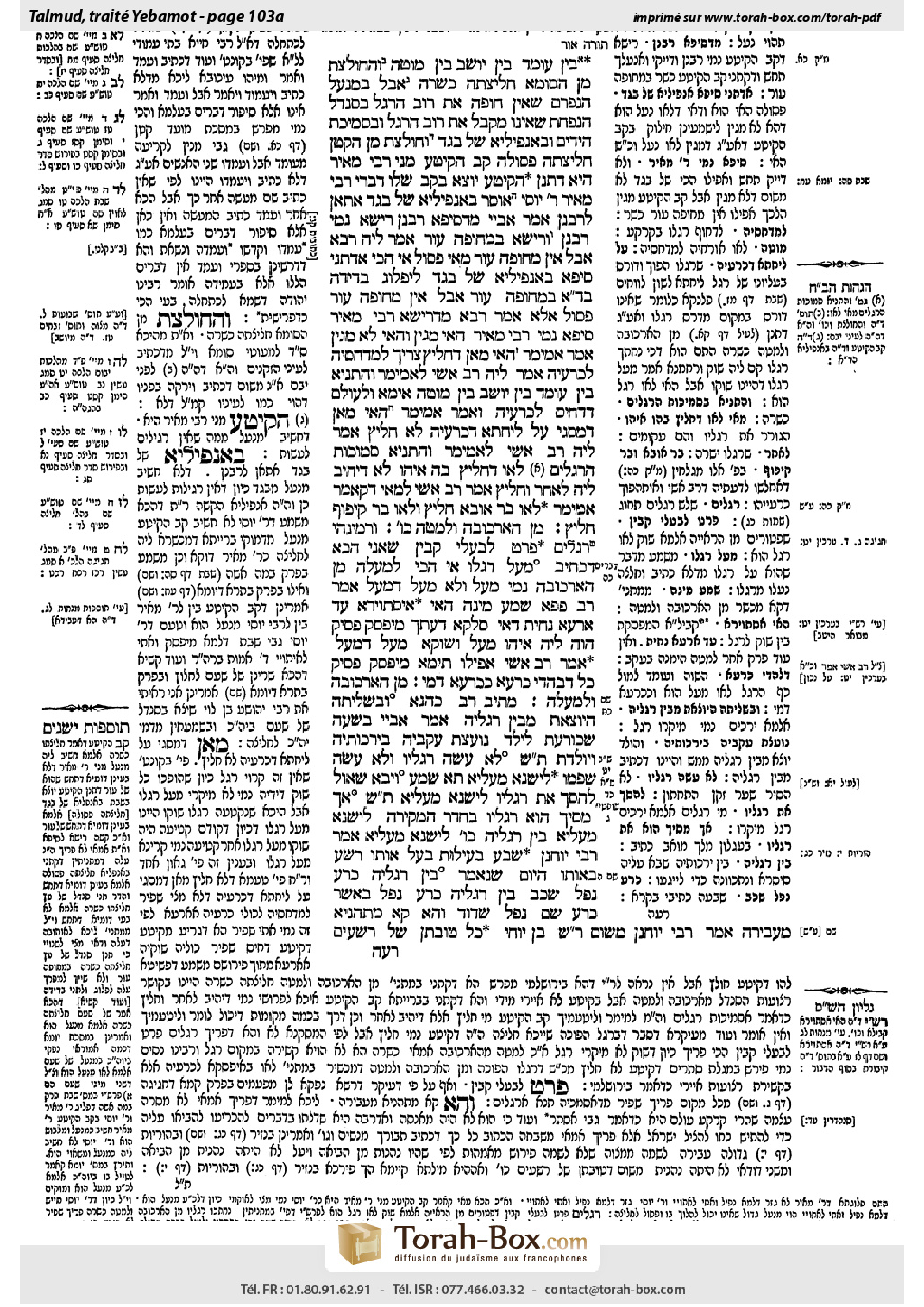
Yevamot 103a: Talmud study for Daf Yomi
Daf Yomi is the daily study of one Talmud folio. Explore 37 tractates with scans, Hebrew text, Sefaria English and AI-generated French translations where annotated.
Passage selection and English or AI-generated French translation are available where the scan has annotations. Daf Study is independent of Torah-Box and Sefaria.
Browse Yevamot · יבמות · All tractatesYevamot 103a text and translations
This page of Yevamot includes the Aramaic text, an English translation and an AI-generated French translation, alongside the scan above.
יבמות ק״ג א · Aramaic and Hebrew text
בֵּין עוֹמֵד, בֵּין יוֹשֵׁב, בֵּין מוּטֶּה, וְהַחוֹלֶצֶת מִן הַסּוֹמֵא — חֲלִיצָתָהּ כְּשֵׁרָה. אֲבָל בְּמִנְעָל הַנִּפְרָם שֶׁאֵין חוֹפֶה אֶת רוֹב הָרֶגֶל, בְּסַנְדָּל הַנִּפְחָת שֶׁאֵינוֹ מְקַבֵּל אֶת רוֹב הָרֶגֶל, וּבִסְמִיכַת הַיָּדַיִם, וּבְאַנְפִּילְיָא שֶׁל בֶּגֶד, וְחוֹלֶצֶת מִן הַקָּטָן — חֲלִיצָתָהּ פְּסוּלָה.
קַב הַקִּיטֵּעַ, מַנִּי — רַבִּי מֵאִיר הִיא, דִּתְנַן: הַקִּיטֵּעַ יוֹצֵא בְּקַב שֶׁלּוֹ, דִּבְרֵי רַבִּי מֵאִיר. רַבִּי יוֹסֵי אוֹסֵר.
בְּאַנְפִּילְיָא שֶׁל בֶּגֶד, אֲתָאן לְרַבָּנַן!
אָמַר אַבָּיֵי: מִדְּסֵיפָא רַבָּנַן, רֵישָׁא נָמֵי רַבָּנַן. וְרֵישָׁא, בִּמְחוּפֶּה עוֹר.
אֲמַר לֵיהּ רָבָא: אֲבָל אֵין מְחוּפֶּה עוֹר, מַאי — פָּסוּל? אִי הָכִי, אַדְּתָנֵי סֵיפָא בְּאַנְפִּילְיָא שֶׁל בֶּגֶד, לִיפְלוֹג בְּדִידַהּ: בַּמֶּה דְּבָרִים אֲמוּרִים: בִּמְחוּפֶּה עוֹר, אֲבָל אֵין מְחוּפֶּה עוֹר — פָּסוּל!
אֶלָּא אָמַר רָבָא: מִדְּרֵישָׁא רַבִּי מֵאִיר, סֵיפָא נָמֵי רַבִּי מֵאִיר: הַאי — מַגֵּין, וְהַאי — לָא מַגֵּין.
אָמַר אַמֵּימָר: הַאי מַאן דְּחָלֵיץ, צָרִיךְ לְמִדְחֲסֵיהּ לְכַרְעֵיהּ.
אֲמַר לֵיהּ רַב אָשֵׁי לְאַמֵּימָר, וְהָתַנְיָא: בֵּין עוֹמֵד, בֵּין יוֹשֵׁב, בֵּין מוּטֶּה! אֵימָא: וּלְעוֹלָם דְּדָחֵיס לְכַרְעֵיהּ.
וְאָמַר אַמֵּימָר: הַאי מַאן דִּמְסַגֵּי עַל לִיחֲתָא דְּכַרְעֵיהּ, לָא חָלֵיץ. אֲמַר לֵיהּ רַב אָשֵׁי לְאַמֵּימָר, וְהָתַנְיָא: סְמִיכוּת הָרַגְלַיִם, לָאו דְּחָלֵיץ בַּהּ אִיהוּ? לָא, דְּיָהֵיב לֵיהּ לְאַחֵר וְחָלֵיץ.
אָמַר רַב אָשֵׁי: לְמַאי דְּקָאָמַר אַמֵּימָר, לָאו בַּר אוֹבָא חָלֵיץ, וְלָאו בַּר קִיפוֹף חָלֵיץ.
מִן הָאַרְכּוּבָּה וּלְמַטָּה כּוּ׳. וּרְמִינְהִי: רְגָלִים — פְּרָט לְבַעֲלֵי קַבִּין!
שָׁאנֵי הָכָא, דִּכְתִיב: ״מֵעַל רַגְלוֹ״. אִי הָכִי, לְמַעְלָה מִן הָאַרְכּוּבָּה נָמֵי! ״מֵעַל״, וְלָא מֵעַל דְּמֵעַל.
אָמַר רַב פָּפָּא: שְׁמַע מִינַּהּ, הַאי אִיסְתָּוִירָא עַד אַרְעָא נָחֵית. דְּאִי סָלְקָא דַעְתָּךְ מִיפְסָק פָּסֵיק, הָוֵה לֵיהּ אִיהוּ ״מֵעַל״, וְשׁוֹקָא מֵעַל דְּמֵעַל! אָמַר רַב אָשֵׁי: אֲפִילּוּ תֵּימָא מִיפְסָק פָּסֵיק, כֹּל דְּבַהֲדֵי כַּרְעָא — כְּכַרְעָא דָּמֵי.
מִן הָאַרְכּוּבָּה וּלְמַעְלָה. מֵתִיב רַב כָּהֲנָא: ״וּבְשִׁלְיָתָהּ הַיּוֹצֵאת מִבֵּין רַגְלֶיהָ״! אָמַר אַבָּיֵי: בְּשָׁעָה שֶׁכּוֹרַעַת לֵילֵד, נוֹעֶצֶת עֲקֵבֶיהָ בְּיַרְכוֹתֶיהָ וְיוֹלֶדֶת.
תָּא שְׁמַע: ״לֹא עָשָׂה רַגְלָיו וְלֹא עָשָׂה שְׂפָמוֹ״! לִישָּׁנָא מְעַלְּיָא. תָּא שְׁמַע: ״וַיָּבֹא שָׁאוּל לְהָסֵךְ אֶת רַגְלָיו״! לִישָּׁנָא מְעַלְּיָא.
תָּא שְׁמַע: ״אַךְ מֵסִיךְ הוּא רַגְלָיו בַּחֲדַר הַמְּקֵרָה״! לִישָּׁנָא מְעַלְּיָא. ״בֵּין רַגְלֶיהָ כּוּ׳״! לִישָּׁנָא מְעַלְּיָא.
אָמַר רַבִּי יוֹחָנָן: שֶׁבַע בְּעִילוֹת בָּעַל אוֹתוֹ רָשָׁע בְּאוֹתוֹ הַיּוֹם, שֶׁנֶּאֱמַר: ״בֵּין רַגְלֶיהָ כָּרַע נָפַל שָׁכָב בֵּין רַגְלֶיהָ כָּרַע נָפָל בַּאֲשֶׁר כָּרַע שָׁם נָפַל שָׁדוּד״. וְהָא קָא מִתְהַנְיָא מֵעֲבֵירָה! אָמַר רַבִּי יוֹחָנָן מִשּׁוּם רַבִּי שִׁמְעוֹן בֶּן יוֹחַי: כׇּל טוֹבָתָן שֶׁל רְשָׁעִים —
Yevamot 103a · English translation
whether the yavam is standing or sitting or leaning; and a woman who performs ḥalitza on a blind yavam; in all of these cases her ḥalitza is valid. But if she performs ḥalitza when he is wearing a shoe that is so torn that it does not cover most of the foot; or using a broken sandal that does not hold most of the foot; or using a hand blanket that the amputee wears on his hands, similar to a leather shoe, in order to drag himself using them; or using a soft shoe [anpileya] made of cloth; or a woman who performs halitza with a yavam who is a minor; in all these cases her ḥalitza is disqualified.
The Gemara comments: Who is the tanna who holds that an amputee’s prosthetic is considered a shoe? It is Rabbi Meir, as we learned in a mishna (Shabbat 65b): One with an amputated leg may go out on Shabbat with his wooden leg, as it has the legal status of a shoe; this is the statement of Rabbi Meir. He reasons that the prosthesis functions like the shoe of any other person, indicating that Rabbi Meir is not especially concerned about the material from which the shoe is made. And Rabbi Yosei, on the other hand, prohibits the amputee from going out on Shabbat with his wooden leg, as he does not consider it a shoe that is being worn, but rather a wooden object that is being carried.
The Gemara asks how Rabbi Meir can be the tanna of the baraita, as the continuation of the baraita states ḥalitza is disqualified if performed with an anpileya made of cloth, as this cloth shoe is not to be considered a shoe. If so, have we come to the opinion of the Rabbis, who rule in accordance with Rabbi Yosei, and render it prohibited to use any shoes for ḥalitza that are not made of leather?
In an attempt to resolve the contradiction Abaye said: Since the latter clause of the baraita is in accordance with the Rabbis, who rule like Rabbi Yosei, the first clause is also in accordance with the Rabbis. And therefore the first clause, which permits the amputee’s prosthesis, is referring to a prosthetic foot covered in leather, as it constitutes a shoe due to its leather exterior.
Rava said to him: But according to your explanation, if the prosthesis is not covered in leather, what would its status be? It would be unfit. If so, rather than teaching in the latter clause: Anpileya made of cloth is invalid for ḥalitza, let it distinguish within the matter itself and say: In what case is this statement that a wooden prosthesis is fit said? It is in the case of a prosthetic leg covered in leather, but if it is not covered in leather, it is unfit.
Rather, the fact that the baraita was not taught in that manner indicates that Abaye’s explanation is incorrect. Therefore, Rava said that the contradiction should be reconciled in another way: Since the first clause of the baraita is in accordance with the opinion of Rabbi Meir, that the shoes need not be made of leather, the latter clause is also taught in accordance with the opinion of Rabbi Meir, and the distinction between a wooden prosthetic and an anpileya of cloth is: This prosthesis protects the foot, and that soft shoe does not protect the foot, as it does not have a hard sole. Rabbi Meir does not require that the shoe be of leather, but he does require that it be protective footwear.
With regard to the statement in the baraita that indicates that ḥalitza may be performed even if the yavam is not standing, Ameimar said: The one who performs ḥalitza by having his yevama remove his shoe must press his foot to the ground, and while in this position the yevama will remove his shoe.
Rav Ashi said to Ameimar: But isn’t it taught in the baraita above: She may perform ḥalitza whether he was standing or sitting or leaning? One who is leaning cannot easily press his foot into the ground. He answered him: Say that the man may perform ḥalitza while in any of these positions, but that actually this is true only if he presses his foot to the ground, which is admittedly more difficult to do while leaning.
And Ameimar also said about this issue: Someone who walks on the backs of his feet, meaning he is clubfooted and his foot is twisted upside down, cannot perform ḥalitza. Rav Ashi said to Ameimar: But isn’t it taught in a baraita: Leg supports can be used for ḥalitza. Does this not mean that this lame individual performs ḥalitza using these supports on his knees? This would indicate that even one with twisted feet can perform ḥalitza. The Gemara answers: No, the intention is that if he gave these supports to another whose foot is shaped normally and he wore them while performing ḥalitza, it is valid. That other one is allowed to perform ḥalitza while wearing these supports because they are also considered shoes, but one whose foot is misshapen may not perform ḥalitza with them, as it functions for him as a foot, not a shoe.
Rav Ashi said: According to what Ameimar said, bar Uva cannot perform ḥalitza and bar Kipof cannot perform ḥalitza, as these two, who were famous eulogizers in Rav Ashi’s generation, had feet that became so crooked that they were unable to walk normally.
It was taught in the mishna that if one’s leg was amputated from the knee down and his yevama performed ḥalitza with him, the ḥalitza is valid. The Gemara raises a contradiction from a baraita that comments on the pilgrimage one makes to Jerusalem during a Festival. The Torah states: “Three Festivals [regalim] you shall celebrate for Me in the year” (Exodus 23:14). The baraita comments on the verse: Festivals are referred to in the verse as regalim, which literally means feet, indicating that one must actually make the pilgrimage to Jerusalem by foot [regel] during the Festival, which comes to exclude people who have prostheses. This indicates that a prosthetic foot is not called a regel, which seems to contradict the mishna that allows ḥalitza on a prosthetic from the knee down.
The Gemara answers: It is different here, with respect to ḥalitza, as it is written: “She removes the shoe from on his foot [me’al raglo]” (Deuteronomy 25:9), which indicates that not only can his actual foot be used for performing ḥalitza, but also the part above it, i.e., the calf. The Gemara objects: If that is so, that one may use a part of his leg above his foot to perform ḥalitza, then if one’s leg was amputated from above the knee, he should also be eligible for ḥalitza; and yet, the same mishna taught that only one with a leg amputated from below the knee is eligible for ḥalitza. The Gemara answers that the verse states: “From on his foot,” meaning above his foot, but not: From on that which is on his foot; the wording indicates that it can be above his foot until the knee, but not any further above that.
Rav Pappa said: Learn from here that the heel bone [istavira] reaches to the ground where it connects to the foot, for if it enters your mind to say that it is separate and divided, and there is another bone in between, then that ankle bone is “from on the foot” and the calf would be prohibited for ḥalitza, as it would be considered: From on that which is on his foot. Rav Ashi said: Even if you say that it is separate and divided from the calf, because anything that is connected with the sole of the foot is considered like the foot, then the ankle is certainly part of the foot, making the calf the area that is “from on the foot.”
It was taught in the mishna that if one’s legs were amputated from the knee and above, the ḥalitza is invalid. This implies that the regel includes the calf but not the thigh. Rav Kahana raised an objection from the verse: “And against her afterbirth that emerges from between her legs [ragleha]” (Deuteronomy 28:57), implying that regel includes even the thighs. Abaye said: The verse actually means between her feet, as when a woman crouches to give birth, she pushes her heels into her thighs and she gives birth, so it appears as if the fetus emerges from between her feet.
The Gemara continues its challenge. Come and hear another verse: “He had neither dressed his feet [raglav], nor trimmed his beard” (II Samuel 19:25). The phrase “dressed his feet [raglav]” is referring to treating his pubic hair, implying that even the area around the thigh is referred to as regel. The Gemara answers: This is a euphemism. The Gemara attempts another challenge: Come and hear from another verse: “And Saul went in to cover his feet [raglav]” (I Samuel 24:3), meaning: To urinate, implying that regel refers even to the thighs. The Gemara answers: This is also a euphemism.
Come and hear the meaning of: His feet, from the following verse regarding the Moabite king, Eglon, which states: “Surely he is covering his feet [raglav] in the cabinet of the cool chamber” (Judges 3:24). The Gemara answers: This is a euphemism. The Gemara attempts another proof from a verse regarding Sisera’s encounter with Yael: “At her feet [ragleha] he sunk, he fell” (Judges 5:27), which indicates that they had sexual intercourse, and implies that regel includes the thigh. The Gemara answers: This is also a euphemism.
The Gemara elaborates on what happened when Sisera was in Yael’s tent. Rabbi Yoḥanan said: That wicked man, Sisera, had sexual intercourse with Yael seven times that day, as it is stated: “At her feet he sunk, he fell, he lay; at her feet he sunk, he fell; where he sunk, there he fell down dead” (Judges 5:27). Each instance of the terms “sunk,” “fell,” or “lay” in the verse indicates an act of intercourse, as Yael sought to tire and weaken Sisera to enable her to kill him. The Gemara asks: But how could Yael do this even for the noble purpose of killing the wicked Sisera, as she derived pleasure from the transgression of licentious sexual relations with a gentile? Rabbi Yoḥanan said in the name of Rabbi Shimon ben Yoḥai: Every act that is a benefit for the wicked
Yevamot 103a · Traduction française (IA)
que le yavam soit debout, assis ou appuyé ; et si une femme accomplit la ḥalitsa avec un yavam aveugle, sa ḥalitsa est valide dans tous ces cas. En revanche, si elle accomplit la ḥalitsa alors qu’il porte une chaussure si déchirée qu’elle ne couvre pas la majeure partie du pied, avec une sandale cassée qui ne maintient pas la majeure partie du pied, avec une sorte de moufle dont l’amputé se couvre les mains, semblable à une chaussure de cuir, pour s’en servir afin de se traîner, avec une chaussure souple [anpileya] en tissu, ou avec un yavam mineur, sa ḥalitsa est invalide dans tous ces cas.
La Guemara commente : Quel est le tanna qui considère que la prothèse d’un amputé a le statut d’une chaussure ? C’est Rabbi Meïr, comme nous l’avons appris dans une Michna (Chabbat 65b) : Celui qui a été amputé d’une jambe peut sortir pendant Chabbat avec sa jambe de bois, car elle a le statut d’une chaussure ; telle est l’opinion de Rabbi Meïr. Il estime que la prothèse remplit la fonction de la chaussure de toute autre personne, ce qui montre qu’il ne se soucie pas particulièrement de la matière dont la chaussure est faite. Rabbi Yossi, en revanche, interdit à l’amputé de sortir pendant Chabbat avec sa jambe de bois, car il ne la considère pas comme une chaussure portée, mais comme un objet en bois transporté.
La Guemara demande comment Rabbi Meïr pourrait être le tanna de la baraïta, puisque la suite de celle-ci enseigne que la ḥalitsa est invalide si elle est accomplie avec une anpileya en tissu, cette chaussure de tissu n’étant pas considérée comme une chaussure. Serions-nous donc arrivés à l’opinion des Rabbins, qui suivent Rabbi Yossi et interdisent d’utiliser pour la ḥalitsa toute chaussure qui n’est pas en cuir ?
Pour résoudre la contradiction, Abayé dit : Puisque la dernière partie de la baraïta est conforme à l’opinion des Rabbins, qui suivent Rabbi Yossi, sa première partie est également conforme à leur opinion. Par conséquent, la première partie, qui autorise l’utilisation de la prothèse de l’amputé, concerne un pied prothétique recouvert de cuir, dont le revêtement en fait une chaussure.
Rava lui dit : Mais selon ton explication, quel serait le statut de la prothèse si elle n’était pas recouverte de cuir ? Elle serait inapte. Dans ce cas, plutôt que d’enseigner dans la dernière partie qu’une anpileya en tissu est invalide pour la ḥalitsa, la baraïta aurait pu distinguer les cas et enseigner : Dans quel cas a-t-on dit qu’une prothèse de bois est apte ? Lorsqu’il s’agit d’une jambe prothétique recouverte de cuir ; mais si elle n’est pas recouverte de cuir, elle est inapte.
Or, le fait que la baraïta n’ait pas été enseignée ainsi indique que l’explication d’Abayé est incorrecte. Rava dit donc qu’il faut résoudre la contradiction autrement : Puisque la première partie de la baraïta est conforme à l’opinion de Rabbi Meïr, selon laquelle les chaussures n’ont pas besoin d’être en cuir, sa dernière partie est également enseignée conformément à son opinion. La différence entre une prothèse de bois et une anpileya en tissu est la suivante : la prothèse protège le pied, tandis que cette chaussure souple ne le protège pas, car elle n’a pas de semelle rigide. Rabbi Meïr n’exige pas que la chaussure soit en cuir, mais il exige qu’elle protège le pied.
Au sujet de l’enseignement de la baraïta selon lequel la ḥalitsa peut être accomplie même si le yavam n’est pas debout, Ameimar dit : Celui qui accomplit la ḥalitsa en laissant sa yevama lui retirer sa chaussure doit appuyer son pied contre le sol ; sa yevama lui retirera alors sa chaussure dans cette position.
Rav Achi dit à Ameimar : Mais n’est-il pas enseigné dans la baraïta précédente qu’elle peut accomplir la ḥalitsa qu’il soit debout, assis ou appuyé ? Or, celui qui est appuyé ne peut pas facilement appuyer son pied contre le sol. Ameimar lui répondit : Comprends que l’homme peut accomplir la ḥalitsa dans chacune de ces positions, mais qu’en pratique il doit appuyer son pied contre le sol, ce qui est certes plus difficile lorsqu’il est appuyé.
Ameimar dit également à ce sujet : Celui qui marche sur le dos des pieds, c’est-à-dire qui est bot et a les pieds tournés vers l’arrière, ne peut pas accomplir la ḥalitsa. Rav Achi dit à Ameimar : Mais n’est-il pas enseigné dans une baraïta que des supports de jambe peuvent être utilisés pour la ḥalitsa ? Cela ne signifie-t-il pas qu’un homme boiteux accomplit la ḥalitsa en portant ces supports sur ses genoux ? Cela indiquerait que même celui qui a les pieds tournés vers l’arrière peut accomplir la ḥalitsa. La Guemara répond : Non, cela signifie que s’il a donné ces supports à un autre, dont les pieds ont une forme normale, et que celui-ci les a portés en accomplissant la ḥalitsa, celle-ci est valide. Cet autre homme peut accomplir la ḥalitsa avec ces supports, car ils sont eux aussi considérés comme des chaussures ; mais celui dont les pieds sont déformés ne peut pas accomplir la ḥalitsa avec eux, car pour lui, ils font office de pieds et non de chaussures.
Rav Achi dit : Selon ce qu’a dit Ameimar, bar Uva ne peut pas accomplir la ḥalitsa, pas plus que bar Kipof, car ces deux hommes, célèbres orateurs funèbres de la génération de Rav Achi, avaient les pieds si déformés qu’ils ne pouvaient pas marcher normalement.
La Michna enseigne que si la jambe d’un homme a été amputée sous le genou et que sa yevama accomplit la ḥalitsa avec lui, celle-ci est valide. La Guemara soulève une contradiction à partir d’une baraïta portant sur le pèlerinage à Jérusalem lors d’une fête. La Torah écrite dit : « Tu célébreras pour Moi trois fêtes [regalim] dans l’année » (Exode 23:14). La baraïta commente le verset : les fêtes y sont désignées par le terme regalim, qui signifie littéralement « pieds », indiquant qu’il faut réellement se rendre à pied [regel] à Jérusalem pendant la fête. Cela exclut les personnes qui portent des prothèses. Il en ressort qu’un pied prothétique n’est pas appelé regel, ce qui semble contredire la Michna, qui autorise la ḥalitsa avec une prothèse allant jusqu’au-dessous du genou.
La Guemara répond : Le cas de la ḥalitsa est différent, car il est écrit : « Elle lui retire la chaussure de dessus son pied [me’al raglo] » (Deutéronome 25:9), ce qui indique que la ḥalitsa peut être accomplie non seulement sur son pied proprement dit, mais aussi sur la partie située au-dessus, c’est-à-dire le mollet. La Guemara objecte : Si l’on peut accomplir la ḥalitsa sur une partie de la jambe située au-dessus du pied, alors celui dont la jambe a été amputée au-dessus du genou devrait également pouvoir l’accomplir ; pourtant, la même Michna enseigne que seul celui dont la jambe a été amputée sous le genou peut l’accomplir. La Guemara répond que le verset dit « de dessus son pied », c’est-à-dire au-dessus de son pied, mais non « de dessus ce qui est sur son pied ». Cette formulation indique que la zone concernée peut se trouver au-dessus de son pied jusqu’au genou, mais pas plus haut.
Rav Pappa dit : Apprends d’ici que l’os de la cheville [istavira] atteint le sol à l’endroit où il rejoint le pied. Car si tu pensais qu’il est distinct et séparé, et qu’un autre os se trouve entre les deux, alors cet os de la cheville serait « de dessus le pied », et le mollet serait inapte à la ḥalitsa, puisqu’il serait considéré comme situé « au-dessus de ce qui est sur son pied ». Rav Achi dit : Même si tu dis que l’os de la cheville est distinct et séparé du mollet, puisque tout ce qui est relié à la plante du pied est considéré comme faisant partie du pied, la cheville en fait certainement partie ; le mollet constitue donc la zone « de dessus le pied ».
La Michna enseigne que si les jambes d’un homme ont été amputées au niveau du genou ou au-dessus, la ḥalitsa est invalide. Il en ressort que le terme regel inclut le mollet, mais pas la cuisse. Rav Kahana objecte à partir du verset : « Et contre son placenta qui sort d’entre ses jambes [ragleha] » (Deutéronome 28:57), ce qui laisse entendre que regel inclut même les cuisses. Abayé dit : En réalité, le verset signifie « entre ses pieds », car lorsqu’une femme s’accroupit pour accoucher, elle appuie ses talons contre ses cuisses et donne naissance ; il semble alors que le fœtus sorte d’entre ses pieds.
La Guemara poursuit son objection. Écoute un autre verset : « Il n’avait ni soigné ses pieds [raglav], ni taillé sa barbe » (II Samuel 19:25). L’expression « soigné ses pieds [raglav] » désigne le soin de sa pilosité pubienne, ce qui implique que même la zone autour de la cuisse est appelée regel. La Guemara répond : C’est un euphémisme. La Guemara tente une autre objection : Écoute un autre verset : « Saül entra pour couvrir ses pieds [raglav] » (I Samuel 24:3), c’est-à-dire pour uriner, ce qui implique que regel désigne même les cuisses. La Guemara répond : C’est également un euphémisme.
Écoute le sens de l’expression « ses pieds » dans le verset suivant, à propos du roi moabite Églôn : « Il est certainement en train de couvrir ses pieds [raglav] dans le cabinet de la chambre fraîche » (Juges 3:24). La Guemara répond : C’est un euphémisme. La Guemara tente une autre preuve à partir d’un verset concernant la rencontre de Sisera avec Yaël : « À ses pieds [ragleha], il s’affaissa, il tomba » (Juges 5:27), ce qui indique qu’ils ont eu des relations sexuelles et laisse entendre que regel inclut la cuisse. La Guemara répond : C’est également un euphémisme.
La Guemara détaille ce qui s’est passé lorsque Sisera se trouvait dans la tente de Yaël. Rabbi Yoḥanan dit : Ce méchant, Sisera, a eu sept rapports sexuels avec Yaël ce jour-là, comme il est dit : « À ses pieds, il s’affaissa, il tomba, il resta étendu ; à ses pieds, il s’affaissa, il tomba ; là où il s’affaissa, là il tomba mort » (Juges 5:27). Chaque occurrence des termes « s’affaissa », « tomba » ou « resta étendu » dans le verset désigne un acte sexuel, car Yaël cherchait à épuiser et à affaiblir Sisera afin de pouvoir le tuer. La Guemara demande : Mais comment Yaël a-t-elle pu faire cela, même dans le noble but de tuer le méchant Sisera, alors qu’elle tirait du plaisir de la transgression que constituait une relation sexuelle débauchée avec un non-Juif ? Rabbi Yoḥanan dit au nom de Rabbi Shimon ben Yoḥai : Tout acte qui constitue un avantage pour les méchants
Traduction française générée par IA à partir de l’édition anglaise de Sefaria. Vérifie toujours un passage avec le texte source.
Text from Sefaria: William Davidson Edition - Vocalized Aramaic (CC BY NC); William Davidson Edition - English (CC BY NC).