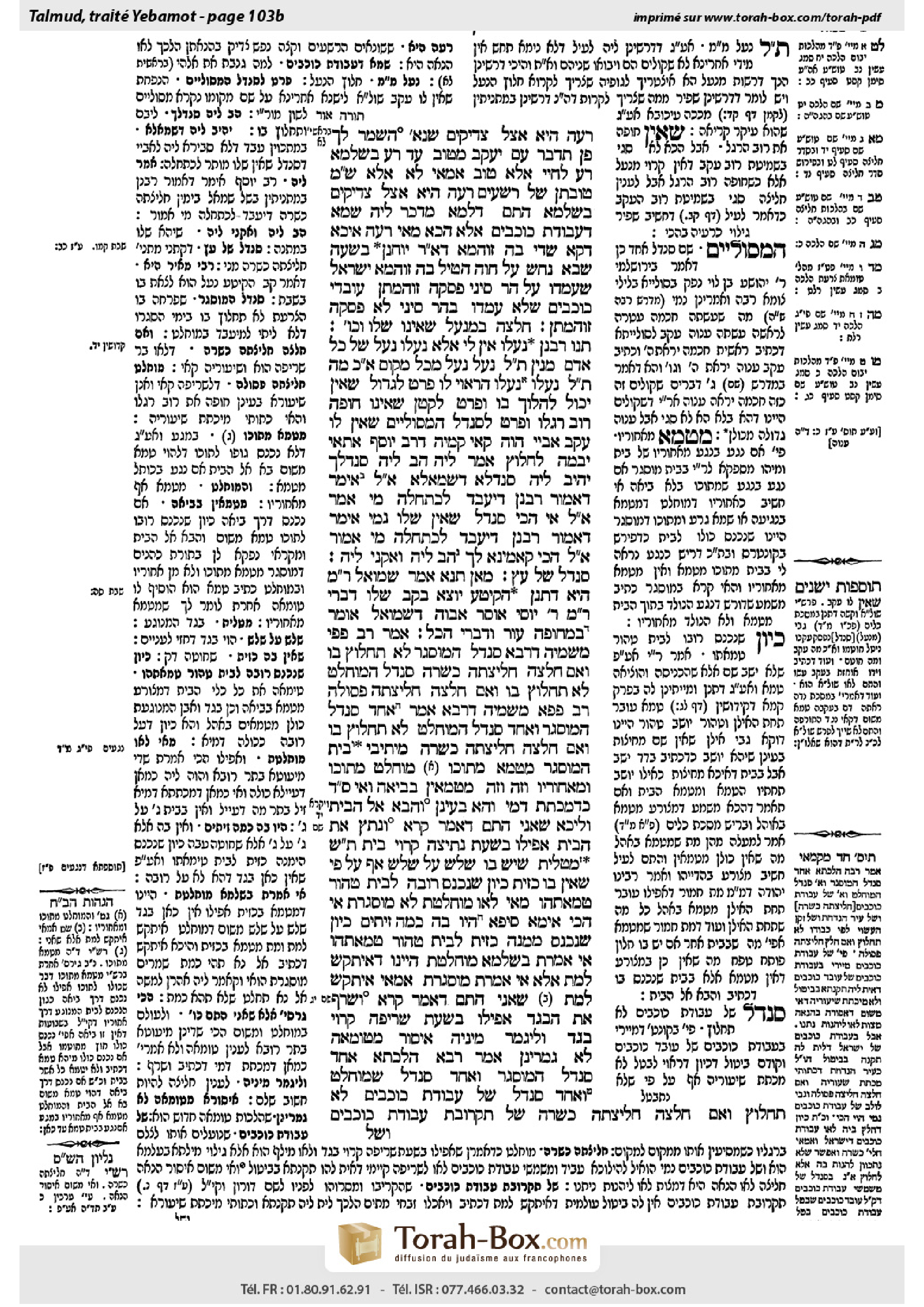
Yevamot 103b: Talmud study for Daf Yomi
Daf Yomi is the daily study of one Talmud folio. Explore 37 tractates with scans, Hebrew text, Sefaria English and AI-generated French translations where annotated.
Passage selection and English or AI-generated French translation are available where the scan has annotations. Daf Study is independent of Torah-Box and Sefaria.
Browse Yevamot · יבמות · All tractatesYevamot 103b text and translations
This page of Yevamot includes the Aramaic text, an English translation and an AI-generated French translation, alongside the scan above.
יבמות ק״ג ב · Aramaic and Hebrew text
רָעָה הִיא אֵצֶל צַדִּיקִים. שֶׁנֶּאֱמַר: ״הִשָּׁמֶר לְךָ פֶּן תְּדַבֵּר עִם יַעֲקֹב מִטּוֹב עַד רָע״, בִּשְׁלָמָא רַע — לְחַיֵּי, אֶלָּא טוֹב אַמַּאי לָא? אֶלָּא שְׁמַע מִינַּהּ: טוֹבָתָן שֶׁל רְשָׁעִים — רָעָה הִיא אֵצֶל צַדִּיקִים.
בִּשְׁלָמָא הָתָם, דִּלְמָא מַדְכַּר לֵיהּ שְׁמָא דַּעֲבוֹדָה זָרָה. אֶלָּא הָכָא, מַאי רָעָה אִיכָּא?
דְּקָא שָׁדֵי בָּהּ זוּהֲמָא. דְּאָמַר רַבִּי יוֹחָנָן: בְּשָׁעָה שֶׁבָּא נָחָשׁ עַל חַוָּה הֵטִיל בָּהּ זוּהֲמָא. יִשְׂרָאֵל, שֶׁעָמְדוּ עַל הַר סִינַי — פָּסְקָה זוּהֲמָתָן. גּוֹיִם, שֶׁלֹּא עָמְדוּ בְּהַר סִינַי — לֹא פָּסְקָה זוּהֲמָתָן.
חָלְצָה בְּמִנְעָל שֶׁאֵינוֹ שֶׁלּוֹ וְכוּ׳. תָּנוּ רַבָּנַן: ״נַעֲלוֹ״, אֵין לִי אֶלָּא נַעֲלוֹ. נַעַל שֶׁל כׇּל אָדָם, מִנַּיִן? תַּלְמוּד לוֹמַר: ״נַעַל״ — נַעַל מִכׇּל מָקוֹם.
אִם כֵּן, מָה תַּלְמוּד לוֹמַר ״נַעֲלוֹ״? נַעֲלוֹ הָרָאוּי לוֹ. פְּרָט לְגָדוֹל שֶׁאֵין יָכוֹל לַהֲלוֹךְ בּוֹ, וּפְרָט לְקָטָן שֶׁאֵינוֹ חוֹפֶה רוֹב רַגְלוֹ, וּפְרָט לְסַנְדָּל הַמְסוּלְיָים שֶׁאֵין לוֹ עָקֵב.
אַבָּיֵי הֲוָה קָאֵי קַמֵּיהּ דְּרַב יוֹסֵף, אֲתַאי יְבָמָה לַחְלוֹץ. אֲמַר לֵיהּ: הַב לֵיהּ סַנְדָּלָךְ, יְהַיב לֵיהּ סַנְדָּלָא דִשְׂמָאלָא, אֲמַר לֵיהּ: אֵימַר דַּאֲמוּר רַבָּנַן, דִּיעֲבַד, לְכַתְּחִלָּה מִי אֲמוּר?
אֲמַר לֵיהּ: אִי הָכִי, סַנְדָּל שֶׁאֵין שֶׁלּוֹ נָמֵי: אֵימַר דַּאֲמוּר רַבָּנַן דִּיעֲבַד, לְכַתְּחִלָּה מִי אֲמוּר? אֲמַר לֵיהּ: הָכִי קָאָמֵינָא לָךְ: הַב לֵיהּ וְאַקְנִי לֵיהּ.
סַנְדָּל שֶׁל עֵץ. מַאן תַּנָּא? אָמַר שְׁמוּאֵל: רַבִּי מֵאִיר הִיא, דִּתְנַן: הַקִּיטֵּעַ יוֹצֵא בְּקַב שֶׁלּוֹ, דִּבְרֵי רַבִּי מֵאִיר. רַבִּי יוֹסֵי אוֹסֵר. אֲבוּהּ דִּשְׁמוּאֵל אוֹמֵר: בִּמְחוּפֶּה עוֹר, וְדִבְרֵי הַכֹּל.
אָמַר רַב פַּפִּי מִשְּׁמֵיהּ דְּרָבָא: סַנְדָּל הַמּוּסְגָּר — לֹא תַּחֲלוֹץ בּוֹ, וְאִם חָלְצָה — חֲלִיצָתָהּ כְּשֵׁרָה. סַנְדָּל הַמּוּחְלָט — לֹא תַּחֲלוֹץ בּוֹ, וְאִם חָלְצָה — חֲלִיצָתָהּ פְּסוּלָה.
רַב פָּפָּא מִשְּׁמֵיהּ דְּרָבָא אָמַר: אֶחָד סַנְדָּל הַמּוּסְגָּר וְאֶחָד סַנְדָּל הַמּוּחְלָט — לֹא תַּחֲלוֹץ בּוֹ, וְאִם חָלְצָה — חֲלִיצָתָהּ כְּשֵׁרָה.
מֵיתִיבִי: בַּיִת הַמּוּסְגָּר — מְטַמֵּא מִתּוֹכוֹ. מוּחְלָט — מִתּוֹכוֹ וּמֵאֲחוֹרָיו. וְזֶה וָזֶה מְטַמְּאִין בְּבִיאָה.
וְאִי סָלְקָא דַעְתָּךְ כְּדִמְכַתַּת דָּמֵי — וְהָא בָּעֵינַן: ״וְהַבָּא אֶל הַבַּיִת״, וְלֵיכָּא!
שָׁאנֵי הָתָם, דְּאָמַר קְרָא: ״וְנָתַץ אֶת הַבַּיִת״, אֲפִילּוּ בִּשְׁעַת נְתִיצָה קָרוּי בַּיִת.
תָּא שְׁמַע: מַטְלֵית שֶׁיֵּשׁ בּוֹ שָׁלֹשׁ עַל שָׁלֹשׁ, אַף עַל פִּי שֶׁאֵין בּוֹ כְּזַיִת, כֵּיוָן שֶׁנִּכְנָס רוּבָּהּ לְבַיִת טָהוֹר — טִמְּאַתְהוּ. מַאי לָאו, מוּחְלֶטֶת? לָא, מוּסְגֶּרֶת.
אִי הָכִי, אֵימָא סֵיפָא: הָיוּ בָּהּ כַּמָּה זֵיתִים, כֵּיוָן שֶׁנִּכְנַס מִמֶּנָּה כְּזַיִת לְבַיִת טָהוֹר — טִמְּאַתְהוּ,
אִי אָמְרַתְּ בִּשְׁלָמָא מוּחְלֶטֶת, הַיְינוּ דְּאִיתַּקַּשׁ לְמֵת. אֶלָּא אִי אָמְרַתְּ מוּסְגֶּרֶת, אַמַּאי אִיתַּקַּשׁ לְמֵת?
שָׁאנֵי הָתָם, דְּאָמַר קְרָא: ״וְשָׂרַף אֶת הַבֶּגֶד״, אֲפִילּוּ בִּשְׁעַת שְׂרֵיפָה קָרוּי בֶּגֶד.
וְלִיגְמַר מִינֵּיהּ! אִיסּוּר מִטּוּמְאָה לָא גָּמְרִינַן.
אָמַר רָבָא, הִלְכְתָא: אֶחָד סַנְדָּל הַמּוּסְגָּר, וְאֶחָד סַנְדָּל הַמּוּחְלָט, וְאֶחָד סַנְדָּל שֶׁל עֲבוֹדָה זָרָה — לֹא תַּחְלוֹץ, וְאִם חָלְצָה — חֲלִיצָתָהּ כְּשֵׁרָה. שֶׁל תִּקְרוֹבֶת עֲבוֹדָה זָרָה,
Yevamot 103b · English translation
is a disadvantage for the righteous, as a righteous individual gains no pleasure from this so-called beneficial act. As it is stated by God to Laban: “Take heed to yourself that you speak not to Jacob either good or bad” (Genesis 31:24). Granted, speak no bad; this is rightly so, i.e., understandable. But speak no good? Why not? Rather, learn from here that even something that would be a good benefit to the wicked like Laban, is a disadvantage for the righteous.
The Gemara asks: Granted, there, in Laban’s words to Jacob, it is understandable that there could be a certain repulsive aspect to a wicked man speaking nicely to a righteous individual, as perhaps he will mention to him the name of the idol he worships and even though he means well, it still would repulse Jacob. But here, what disadvantage is there if she derives benefit from licentious relations with a wicked man?
The Gemara answers: He implants filth in her and contaminates her, as her body accepts his semen. As Rabbi Yoḥanan also said, based on his understanding that the serpent seduced Eve into having sexual relations with him: When the serpent came upon Eve, he infected her with moral contamination, and this contamination remained in all human beings. When the Jewish people stood at Mount Sinai their contamination ceased, whereas with regard to gentiles, who did not stand at Mount Sinai, their contamination never ceased. Therefore, Yael was repulsed by the contamination that she allowed into her body, and she did not benefit from relations with Sisera.
§ It was taught in the mishna that if she performed ḥalitza using a shoe that was not his, the ḥalitza is valid. The Sages taught: From the verse “And remove his shoe from on his foot” (Deuteronomy 25:9), I have derived only that the yavam may wear “his shoe,” i.e., a shoe that belongs to him; from where do I derive that he may wear any person’s shoe? The verse states the words “shoe” and “shoe” twice: “And remove his shoe” (Deuteronomy 25:9), and “The house of he who had his shoe removed” (Deuteronomy 25:10), to teach us that in any case it is acceptable, i.e., the shoes of another person may also be worn for ḥalitza.
But if so, what is the meaning when the verse states: “His shoe,” which seems to indicate that he must own the shoe that he is wearing? It teaches that one must wear “his shoe,” i.e., a shoe that is fitting for him, excluding a shoe so large that he is unable to walk in it, and excluding a shoe so small it does not cover most of his foot, and also excluding a heelless sandal [sandal hamesulyam], a sandal that has only a sole but does not have a heel and is not fit for walking.
The Gemara relates: Abaye was standing before Rav Yosef and a yevama came to perform ḥalitza. Rav Yosef said to Abaye: Give the yavam your sandal so that the ḥalitza may begin. He gave him his left sandal. Rav Yosef said to him: Granted, one can say that the Sages said that it is permitted to perform ḥalitza with the left shoe after the fact, but did they say that it is also permitted ab initio?
He said to him: If so, then also with regard to a sandal that does not belong to him, say that the Sages said that it is permitted after the fact; however, did they say it is permitted as well to perform ḥalitza using another’s shoe ab initio? Rav Yosef said to Abaye: This is what I was saying to you: Give him your sandal and transfer ownership to him by giving it to him as a temporary gift so that it will be his, and therefore the ḥalitza will be performed in an ideal manner, without any question as to its validity.
The mishna taught that if the yevama performed ḥalitza while the yavam was wearing a wooden sandal the ḥalitza is valid. The Gemara asks: Who is the tanna who taught that it is permitted to use a wooden sandal? Shmuel said: It is the opinion of Rabbi Meir, as we learned in a mishna (Shabbat 65b): One with an amputated leg may go out on Shabbat with his wooden leg, as it has the legal status of a shoe; this is the statement of Rabbi Meir. And Rabbi Yosei prohibits it, since he does not consider it to have the legal status of a shoe. Alternatively, the father of Shmuel says: Here the mishna is referring to a wooden sandal that is covered in leather, and all agree. This halakha was taught in accordance with all opinions, as even Rabbi Yosei agrees that the leather covering makes it a shoe.
Rav Pappi said in the name of Rava: One should not perform ḥalitza on a yavam wearing a quarantined sandal, i.e., a sandal examined by a priest who found its signs of leprosy to be inconclusive, and places the sandal in isolation for a waiting period of up to two weeks to see if clear indications of leprosy develop. But if she did perform ḥalitza while the yavam was wearing it, her ḥalitza is nevertheless valid after the fact. On the other hand, if the sandal with leprosy is a confirmed sandal, i.e., a sandal that was definitively ruled to have leprosy, one may not perform ḥalitza with it, and if she did perform ḥalitza while the man was wearing it, her ḥalitza is disqualified. As an object with confirmed leprosy must be burned, it is considered halakhically as if it were already burnt, and is consequently considered to lack the qualities of a shoe necessary for ḥalitza.
In contrast, Rav Pappa said in the name of Rava: With regard to both a quarantined sandal and a confirmed sandal the same halakha applies: She may not perform ḥalitza with it ab initio, but if she did perform ḥalitza with it, her ḥalitza is valid.
The Gemara raises an objection to Rav Pappi’s version, from a mishna (Nega’im 13:4): A quarantined house, i.e., one in which a discoloration appeared and was then quarantined by a priest until it could be determined whether it would be deemed a confirmed house of leprosy or not, renders one who touches it ritually impure from within, i.e., if one touches the inside of the house he becomes ritually impure; a house with confirmed leprosy renders one impure not only from touching it inside from within, but additionally from touching it behind, by touching it on the outside; and both this and that, i.e., both a quarantined house and a confirmed house, impart ritual impurity through entering it, as one who enters into either house becomes ritually impure, even if he does not touch the walls.
The Gemara elaborates: And if it enters your mind to say that an item with confirmed leprosy is considered as if it were crushed and not intact due to the requirement to burn it, then in order to contract ritual impurity through entering a house with leprosy, we require that there be a house, as the verse states: “Moreover, one who enters the house…shall be ritually impure” (Leviticus 14:46)? And this requirement is not satisfied here, as the house confirmed with leprosy must be burned and consequently should be considered as if it is crushed and not intact.
The Gemara answers: There it is different, as the verse states: “And he shall break down the house” (Leviticus 14:45), which teaches that even while it is being broken down it is still called a house, until it is totally destroyed. Therefore, although for other purposes, objects that are required to be burned are considered crushed, the verse explicitly teaches that a house confirmed with leprosy is considered intact with regard to its ability to transmit ritual impurity to those who enter it.
Come and hear a proof from the Tosefta (Nega’im 7:3): If a rag that is three fingerbreadths by three fingerbreadths has a spot of leprosy, then even if it does not contain the minimum volume of an olive-bulk, once most of the rag enters a pure house it renders the house ritually impure. What, is it not referring to a rag with confirmed leprosy, implying that one should calculate its measurements even when its leprosy is confirmed and it is destined to be burned? The Gemara rejects this assumption: No, this is referring to a quarantined rag, which does not have to be burned and is consequently considered intact. It can be measured to determine if it has the minimum measurements required for imparting ritual impurity.
The Gemara challenges: If you interpret it so, say the latter clause: If the rag was the volume of several olives, i.e., it was very thick and even a small section of the cloth was equal to an olive-bulk, when one olive-bulk of the rag enters a ritually pure house, even if it is a small portion of the rag, it renders the house ritually impure.
Granted, if you say that the entire baraita is referring to a rag with confirmed leprosy, this is so because a confirmed leper is juxtaposed with and thereby compared to a dead person (Numbers 12:12), and therefore an olive-bulk of the rag causes ritual impurity just as an olive-bulk of a corpse does. But if you say it is speaking about a quarantined rag, why should it be juxtaposed to a dead person? There is no biblical source comparing a quarantined leper to a corpse, and therefore, there is no reason to think that an olive-bulk of a rag transmits ritual impurity. Only if the rag is of the minimum dimensions and the entire rag enters the airspace does it transmit ritual impurity.
The Gemara answers: That is correct; the baraita is referring to a rag with confirmed leprosy, but nevertheless it is not difficult for Rav Pappi. Although generally objects that are required to be burnt are considered crushed even before they are burnt, this is not true with regard to a garment with leprosy. There the halakha for a garment that has confirmed leprosy is different, as the verse states: “And he shall burn the garment” (Leviticus 13:52), which indicates that even when it is being burned, it is still called a garment.
The Gemara asks: If your interpretation above is correct, that a garment with confirmed leprosy can still transmit ritual impurity even though the object is to be burned and should be considered crushed, let us learn from this concerning a sandal that even after it has been definitively determined to have leprosy, it is still considered a shoe and should be eligible for ḥalitza, at least after the fact, in accordance with Rav Pappa’s opinion. The Gemara answers: We cannot derive a halakha of a prohibition from a halakha of ritual impurity, as these different areas of halakha cannot be compared. Therefore, although a garment with leprosy is considered intact with regard to the transmission of ritual impurity, that status cannot act as a source to teach that it is intact for the purpose of ruling that ḥalitza performed with a shoe with confirmed leprosy is valid.
The Gemara cites Rava’s final ruling: Rava said that the halakha is the same for a quarantined sandal, a confirmed sandal, and a sandal of idolatrous worship, i.e., a sandal that was placed on a statue of idolatrous worship; one should not perform ḥalitza with it, and if she did perform ḥalitza with it, her ḥalitza is valid. If, however, he was wearing a sandal that functioned as an offering of idolatrous worship, in that it was brought as a gift to an idol;
Yevamot 103b · Traduction française (IA)
constitue un désavantage pour les justes, car un juste ne tire aucun plaisir de cet acte prétendument bénéfique. En effet, Dieu dit à Laban : « Garde-toi de parler à Jacob en bien ou en mal » (Genèse 31,24). Qu’il ne lui parle pas en mal, cela se comprend. Mais pourquoi ne pas lui parler en bien ? Il faut plutôt en déduire que même ce qui serait un bienfait pour un méchant comme Laban constitue un désavantage pour les justes.
La Guemara demande : Là-bas, dans les paroles de Laban à Jacob, on comprend qu’il peut y avoir quelque chose de répugnant à ce qu’un méchant parle aimablement à un juste, car il pourrait lui mentionner le nom de l’idole qu’il adore ; même s’il entend lui faire du bien, cela répugnerait tout de même à Jacob. Mais ici, quel désavantage y a-t-il à ce qu’elle tire profit de relations illicites avec un méchant ?
La Guemara répond : Il dépose en elle une souillure et la contamine, car son corps reçoit son sperme. Rabbi Yoḥanan a également dit, selon son interprétation, d’après laquelle le serpent séduisit Ève pour avoir des relations sexuelles avec elle : Lorsque le serpent s’unit à Ève, il la contamina moralement, et cette contamination demeura chez tous les êtres humains. Lorsque le peuple juif se tint au mont Sinaï, sa contamination cessa ; en revanche, chez les non-Juifs, qui ne se tinrent pas au mont Sinaï, elle ne cessa jamais. Yaël fut donc révulsée par la contamination qu’elle avait laissé pénétrer dans son corps, et elle ne tira aucun profit de ses relations avec Sisera.
§ La Michna enseigne que si elle a accompli la ḥalitsa avec une chaussure qui ne lui appartenait pas, la ḥalitsa est valide. Les Sages ont enseigné : Du verset « Et lui retirera sa chaussure de son pied » (Deutéronome 25,9), j’ai seulement déduit que le yavam peut porter « sa chaussure », c’est-à-dire une chaussure qui lui appartient. D’où déduis-je qu’il peut porter la chaussure de n’importe qui ? Le verset emploie deux fois le terme « chaussure » : « Et lui retirera sa chaussure » (Deutéronome 25,9), et « la maison de celui à qui l’on a retiré sa chaussure » (Deutéronome 25,10). Cela nous enseigne que, dans tous les cas, cela convient : on peut également porter, pour la ḥalitsa, la chaussure d’une autre personne.
Mais alors, que signifie le terme « sa chaussure » dans le verset, qui semble indiquer qu’il doit être propriétaire de la chaussure qu’il porte ? Il enseigne qu’il doit porter « sa chaussure », c’est-à-dire une chaussure qui lui convient : cela exclut une chaussure si grande qu’il ne peut pas marcher avec, une chaussure si petite qu’elle ne couvre pas la majeure partie de son pied, ainsi qu’une sandale sans talon [sandal hamesulyam], qui n’a qu’une semelle et ne permet pas de marcher.
La Guemara rapporte : Abayé se tenait devant Rav Yossef lorsqu’une yevama vint accomplir la ḥalitsa. Rav Yossef dit à Abayé : « Donne ta sandale au yavam afin que la ḥalitsa puisse commencer. » Il lui donna sa sandale gauche. Rav Yossef lui dit : « Certes, on peut dire que les Sages ont dit qu’il est permis, a posteriori, d’accomplir la ḥalitsa avec la chaussure gauche ; mais ont-ils dit qu’il est également permis de le faire a priori ? »
Il lui dit : « Dans ce cas, dis aussi au sujet d’une sandale qui ne lui appartient pas que les Sages ont dit qu’il est permis de l’utiliser a posteriori ; mais ont-ils également dit qu’il est permis a priori d’accomplir la ḥalitsa avec la chaussure d’un autre ? » Rav Yossef dit à Abayé : « C’est précisément ce que je te disais : donne-lui ta sandale et transfère-lui sa propriété en la lui donnant à titre de don temporaire, afin qu’elle lui appartienne. Ainsi, la ḥalitsa sera accomplie de la manière idéale, sans aucune incertitude quant à sa validité. »
La Michna enseigne que si la yevama a accompli la ḥalitsa alors que le yavam portait une sandale en bois, la ḥalitsa est valide. La Guemara demande : Quel est le tanna qui enseigne qu’il est permis d’utiliser une sandale en bois ? Chmouel dit : C’est l’opinion de Rabbi Méïr, comme nous l’avons appris dans une Michna (Chabbat 65b) : Celui qui a une jambe amputée peut sortir le Chabbat avec sa jambe de bois, car elle a le statut juridique d’une chaussure ; telle est la déclaration de Rabbi Méïr. Rabbi Yossi l’interdit, car il ne lui reconnaît pas le statut juridique d’une chaussure. Autrement, le père de Chmouel dit : Ici, la Michna parle d’une sandale en bois recouverte de cuir, ce sur quoi tous sont d’accord. Cette halakha a été enseignée conformément à toutes les opinions, car même Rabbi Yossi reconnaît que le revêtement de cuir lui confère le statut de chaussure.
Rav Pappi dit au nom de Rava : On ne doit pas accomplir la ḥalitsa avec un yavam qui porte une sandale en quarantaine, c’est-à-dire une sandale examinée par un prêtre qui a jugé les signes de lèpre non concluants et l’a mise en quarantaine pour une période d’observation pouvant aller jusqu’à deux semaines, afin de voir si des signes manifestes de lèpre apparaissent. Mais si elle a accompli la ḥalitsa alors que le yavam la portait, sa ḥalitsa est néanmoins valide a posteriori. En revanche, si la sandale est atteinte de lèpre confirmée, c’est-à-dire s’il a été définitivement établi qu’elle est lépreuse, on ne peut pas accomplir la ḥalitsa avec elle ; et si elle l’a accomplie alors que l’homme la portait, sa ḥalitsa est invalide. Puisqu’un objet atteint de lèpre confirmée doit être brûlé, il est considéré, du point de vue de la halakha, comme s’il avait déjà été brûlé et est donc réputé ne pas posséder les caractéristiques d’une chaussure requises pour la ḥalitsa.
À l’inverse, Rav Pappa dit au nom de Rava : la même halakha s’applique à une sandale en quarantaine et à une sandale atteinte de lèpre confirmée. On ne peut pas accomplir la ḥalitsa avec elle a priori, mais si elle l’a accomplie avec cette sandale, sa ḥalitsa est valide.
La Guemara objecte à la version de Rav Pappi à partir d’une Michna (Negaïm 13,4) : Une maison en quarantaine, c’est-à-dire une maison où une décoloration est apparue et que le prêtre a ensuite mise en quarantaine, le temps de déterminer si elle sera déclarée atteinte de lèpre confirmée ou non, rend rituellement impur celui qui la touche de l’intérieur ; une maison atteinte de lèpre confirmée rend impur non seulement celui qui la touche de l’intérieur, mais aussi celui qui la touche par derrière, c’est-à-dire de l’extérieur. L’une comme l’autre, c’est-à-dire aussi bien une maison en quarantaine qu’une maison atteinte de lèpre confirmée, transmettent l’impureté rituelle par le fait d’y entrer : celui qui entre dans l’une ou l’autre devient rituellement impur, même s’il ne touche pas les murs.
La Guemara développe : Si tu envisages de dire qu’un objet atteint de lèpre confirmée est considéré comme broyé et non intact, parce qu’il doit être brûlé, alors, pour contracter l’impureté rituelle en entrant dans une maison atteinte de lèpre, il faut qu’il y ait une maison, comme le dit le verset : « De plus, celui qui entrera dans la maison […] sera rituellement impur » (Lévitique 14,46). Or, cette condition n’est pas remplie ici, puisque la maison atteinte de lèpre confirmée doit être brûlée et devrait donc être considérée comme broyée et non intacte.
La Guemara répond : Là, c’est différent, car le verset dit : « Et il démolira la maison » (Lévitique 14,45), ce qui enseigne que, même pendant sa démolition, elle est encore appelée une maison, jusqu’à ce qu’elle soit complètement détruite. Ainsi, même si, pour d’autres usages, les objets qui doivent être brûlés sont considérés comme broyés, le verset enseigne explicitement qu’une maison atteinte de lèpre confirmée est considérée comme intacte lorsqu’il s’agit de transmettre l’impureté rituelle à ceux qui y entrent.
Viens et entends une preuve tirée de la Tossefta (Negaïm 7,3) : Si un chiffon de trois largeurs de doigt sur trois largeurs de doigt porte une tache de lèpre, même s’il ne contient pas le volume minimal d’une olive, dès que la majeure partie du chiffon pénètre dans une maison pure, il rend la maison rituellement impure. Ne s’agit-il pas d’un chiffon atteint de lèpre confirmée, ce qui impliquerait qu’on en mesure les dimensions même lorsque la lèpre est confirmée et qu’il est destiné à être brûlé ? La Guemara rejette cette hypothèse : Non, il s’agit d’un chiffon en quarantaine, qui n’a pas à être brûlé et est donc considéré comme intact. On peut le mesurer afin de déterminer s’il atteint les dimensions minimales requises pour transmettre l’impureté rituelle.
La Guemara objecte : Si tu l’interprètes ainsi, considère la dernière partie de la baraïta : Si le chiffon avait le volume de plusieurs olives, c’est-à-dire s’il était très épais et qu’une petite partie du tissu équivalait déjà au volume d’une olive, lorsque le volume d’une olive de ce chiffon pénètre dans une maison rituellement pure, il rend la maison rituellement impure, même s’il ne s’agit que d’une petite partie du chiffon.
Certes, si tu dis que toute la baraïta parle d’un chiffon atteint de lèpre confirmée, cela s’explique, car le lépreux dont la lèpre est confirmée est rapproché d’un mort et comparé à lui (Nombres 12,12) ; le volume d’une olive du chiffon transmet donc l’impureté rituelle, tout comme le volume d’une olive d’un cadavre. Mais si tu dis qu’il s’agit d’un chiffon en quarantaine, pourquoi le rapprocher d’un mort ? Il n’existe aucune source biblique comparant un lépreux en quarantaine à un cadavre ; il n’y a donc aucune raison de penser qu’un volume d’olive du chiffon transmette l’impureté rituelle. Seul un chiffon ayant les dimensions minimales requises la transmet, et seulement si le chiffon entier pénètre dans l’espace intérieur.
La Guemara répond : C’est exact ; la baraïta parle d’un chiffon atteint de lèpre confirmée. Pourtant, cela ne pose pas de difficulté à Rav Pappi. Bien qu’en général les objets qui doivent être brûlés soient considérés comme broyés avant même d’être brûlés, ce n’est pas le cas d’un vêtement atteint de lèpre. Dans ce cas, la halakha est différente pour un vêtement dont la lèpre est confirmée, car le verset dit : « Et il brûlera le vêtement » (Lévitique 13,52), ce qui indique que, même pendant qu’il est brûlé, il est encore appelé un vêtement.
La Guemara demande : Si ton interprétation précédente est correcte, et qu’un vêtement atteint de lèpre confirmée peut encore transmettre l’impureté rituelle bien qu’il doive être brûlé et qu’il devrait être considéré comme broyé, déduisons-en qu’une sandale demeure une chaussure même après qu’il a été définitivement établi qu’elle est lépreuse, et qu’elle devrait donc permettre la ḥalitsa, au moins a posteriori, conformément à l’opinion de Rav Pappa. La Guemara répond : On ne peut pas déduire une halakha d’interdiction d’une halakha relative à l’impureté rituelle, car ces différents domaines de la halakha ne peuvent être comparés. Ainsi, même si un vêtement atteint de lèpre est considéré comme intact pour la transmission de l’impureté rituelle, ce statut ne peut servir de source pour enseigner qu’il est intact lorsqu’il s’agit de statuer que la ḥalitsa accomplie avec une chaussure atteinte de lèpre confirmée est valide.
La Guemara cite la décision finale de Rava : Rava a dit que la même halakha s’applique à une sandale en quarantaine, à une sandale atteinte de lèpre confirmée et à une sandale liée au culte idolâtre, c’est-à-dire une sandale placée sur une statue idolâtre : on ne doit pas accomplir la ḥalitsa avec elle, mais si elle l’a accomplie avec cette sandale, sa ḥalitsa est valide. Toutefois, s’il portait une sandale qui servait d’offrande au culte idolâtre, en ce sens qu’elle avait été apportée en cadeau à une idole ;
Traduction française générée par IA à partir de l’édition anglaise de Sefaria. Vérifie toujours un passage avec le texte source.
Text from Sefaria: William Davidson Edition - Vocalized Aramaic (CC BY NC); William Davidson Edition - English (CC BY NC).