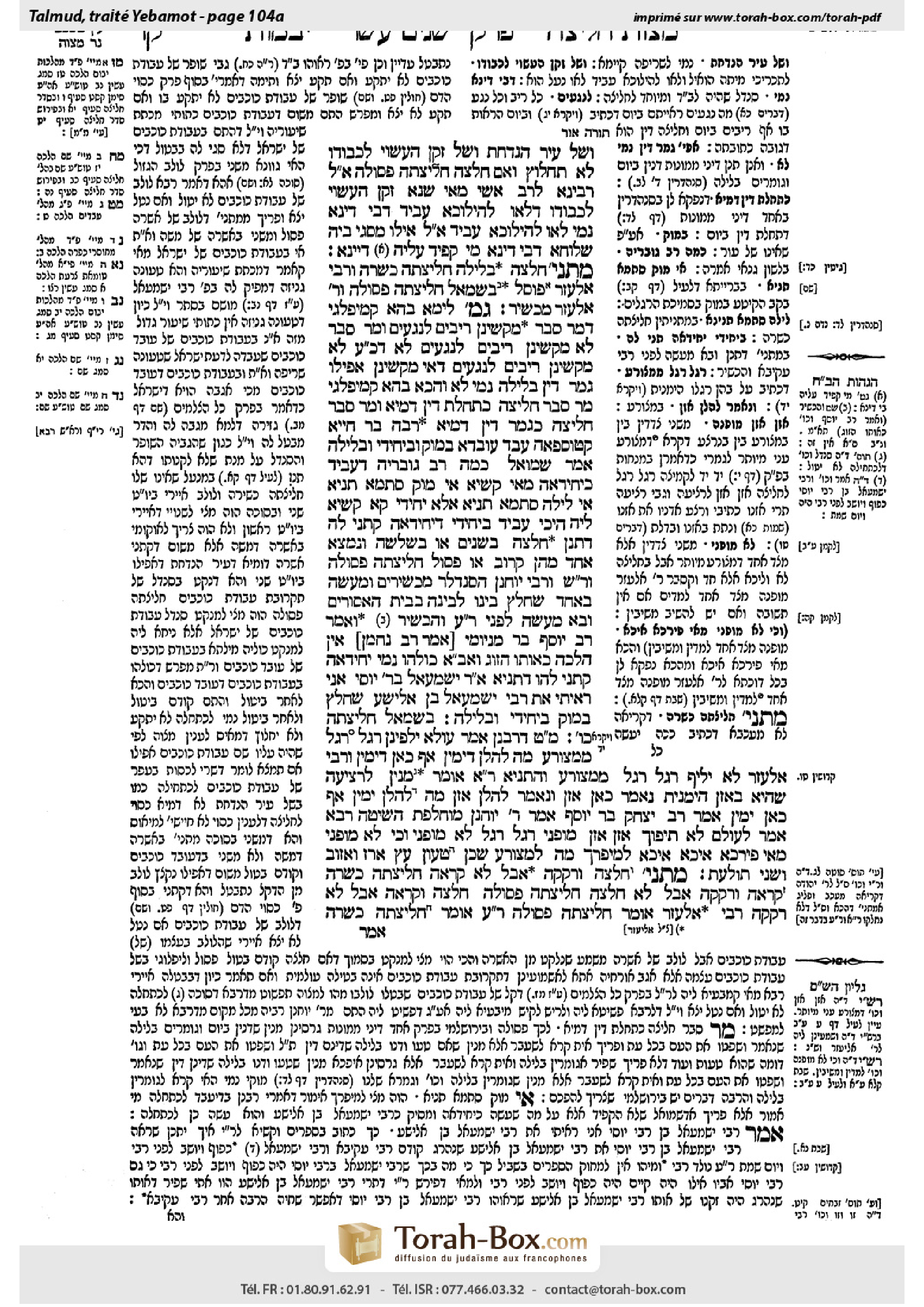
Yevamot 104a: Talmud study for Daf Yomi
Daf Yomi is the daily study of one Talmud folio. Explore 37 tractates with scans, Hebrew text, Sefaria English and AI-generated French translations where annotated.
Passage selection and English or AI-generated French translation are available where the scan has annotations. Daf Study is independent of Torah-Box and Sefaria.
Browse Yevamot · יבמות · All tractatesYevamot 104a text and translations
This page of Yevamot includes the Aramaic text, an English translation and an AI-generated French translation, alongside the scan above.
יבמות ק״ד א · Aramaic and Hebrew text
וְשֶׁל עִיר הַנִּדַּחַת, וְשֶׁל זָקֵן הֶעָשׂוּי לִכְבוֹדוֹ — לֹא תַּחְלוֹץ, וְאִם חָלְצָה — חֲלִיצָתָהּ פְּסוּלָה.
אֲמַר לֵיהּ רָבִינָא לְרַב אָשֵׁי: מַאי שְׁנָא זָקֵן הֶעָשׂוּי לִכְבוֹדוֹ — דְּלָאו לְהִילּוּכָא עֲבִיד, דְּבֵי דִּינָא נָמֵי — לָאו לְהִילּוּכָא עֲבִיד!
אֲמַר לֵיהּ: אִילּוּ מְסַגֵּי בֵּיהּ שְׁלוּחָא דְּבֵי דִּינָא, מִי קָפֵיד עֲלֵיהּ דַּיָּינָא?
מַתְנִי׳ חָלְצָה בַּלַּיְלָה — חֲלִיצָתָהּ כְּשֵׁרָה, וְרַבִּי אֶלְעָזָר פּוֹסֵל. בִּשְׂמֹאל — חֲלִיצָתָהּ פְּסוּלָה, וְרַבִּי אֶלְעָזָר מַכְשִׁיר.
גְּמָ׳ לֵימָא בְּהָא קָמִיפַּלְגִי: דְּמָר סָבַר מַקְּשִׁינַן רִיבִים לִנְגָעִים, וּמָר סָבַר לָא מַקְּשִׁינַן רִיבִים לִנְגָעִים?
לָא: דְּכוּלֵּי עָלְמָא לָא מַקְּשִׁינַן רִיבִים לִנְגָעִים, דְּאִי מַקְּשִׁינַן — אֲפִילּוּ גְּמַר דִּין בַּלַּיְלָה נָמֵי לָא, וְהָכָא בְּהָא קָמִיפַּלְגִי: מָר סָבַר: חֲלִיצָה כִּתְחִלַּת דִּין דָּמְיָא, וּמָר סָבַר: חֲלִיצָה כִּגְמַר דִּין דָּמְיָא.
רַבָּה בַּר חִיָּיא קְטוֹסְפָאָה עֲבַד עוֹבָדָא בְּמוּק, וּבִיחִידִי, וּבַלַּיְלָה. אָמַר שְׁמוּאֵל: כַּמָּה רַב גּוּבְרֵיהּ דְּעָבֵיד כִּיחִידָאָה.
מַאי קַשְׁיָא? אִי מוּק — סְתָמָא תַּנְיָא. אִי לַיְלָה — סְתָמָא תַּנְיָא.
אֶלָּא יְחִידִי קָא קַשְׁיָא לֵיהּ: הֵיכִי עָבֵיד בִּיחִידִי, דִּיחִידָאָה קָתָנֵי לַהּ. דִּתְנַן: חָלְצָה בִּשְׁנַיִם אוֹ בִּשְׁלֹשָׁה וְנִמְצָא אֶחָד מֵהֶן קָרוֹב אוֹ פָּסוּל — חֲלִיצָתָהּ פְּסוּלָה. וְרַבִּי שִׁמְעוֹן וְרַבִּי יוֹחָנָן הַסַּנְדְּלָר מַכְשִׁירִים. וּמַעֲשֶׂה בְּאֶחָד שֶׁחָלַץ בֵּינוֹ לְבֵינָהּ בְּבֵית הָאֲסוּרִים, וּבָא מַעֲשֶׂה לִפְנֵי רַבִּי עֲקִיבָא וְהִכְשִׁיר.
וְאָמַר רַב יוֹסֵף בַּר מִנְיוֹמֵי [אָמַר רַב נַחְמָן]: אֵין הֲלָכָה כְּאוֹתוֹ הַזּוּג. וְאִיבָּעֵית אֵימָא: כּוּלְּהוּ נָמֵי יְחִידָאָה קָתָנֵי לְהוּ. דְּתַנְיָא, אָמַר רַבִּי יִשְׁמָעֵאל בְּרַבִּי יוֹסֵי: אֲנִי רָאִיתִי אֶת רַבִּי יִשְׁמָעֵאל בֶּן אֱלִישָׁע שֶׁחָלַץ בְּמוּק, בִּיחִידִי, וּבַלַּיְלָה.
בִּשְׂמֹאל חֲלִיצָתָהּ כּוּ׳. מַאי טַעְמָא דְּרַבָּנַן? אָמַר עוּלָּא: יָלְפִינַן ״רֶגֶל״ ״רֶגֶל״ מִמְּצוֹרָע. מָה לְהַלָּן דְּיָמִין, אַף כָּאן דְּיָמִין.
וְרַבִּי אֶלְעָזָר לָא יָלֵיף ״רֶגֶל״ ״רֶגֶל״ מִמְּצוֹרָע? וְהָתַנְיָא, רַבִּי אֶלְעָזָר אוֹמֵר: מִנַּיִן לִרְצִיעָה שֶׁהִיא בְּאֹזֶן הַיְמָנִית? נֶאֱמַר כָּאן ״אֹזֶן״, וְנֶאֱמַר לְהַלָּן ״אֹזֶן״. מָה לְהַלָּן יָמִין, אַף כָּאן יָמִין!
אָמַר רַב יִצְחָק בַּר יוֹסֵף אָמַר רַבִּי יוֹחָנָן: מוּחְלֶפֶת הַשִּׁיטָה.
רָבָא אָמַר: לְעוֹלָם לָא תֵּיפוֹךְ, ״אֹזֶן״ ״אֹזֶן״ מוּפְנֵי, ״רֶגֶל״ ״רֶגֶל״ לָא מוּפְנֵי.
וְכִי לָא מוּפְנֵי, מַאי פִּירְכָא אִיכָּא? אִיכָּא לְמִיפְרַךְ: מָה לִמְצוֹרָע, שֶׁכֵּן טָעוּן עֵץ אֶרֶז וְאֵזוֹב וּשְׁנִי תוֹלָעַת.
מַתְנִי׳ חָלְצָה וְרָקְקָה, אֲבָל לֹא קָרְאָה — חֲלִיצָתָהּ כְּשֵׁרָה. קָרְאָה וְרָקְקָה, אֲבָל לֹא חָלְצָה — חֲלִיצָתָהּ פְּסוּלָה. חָלְצָה וְקָרְאָה, אֲבָל לֹא רָקְקָה — רַבִּי אֱלִיעֶזֶר אוֹמֵר: חֲלִיצָתָהּ פְּסוּלָה, רַבִּי עֲקִיבָא אוֹמֵר: חֲלִיצָתָהּ כְּשֵׁרָה.
Yevamot 104a · English translation
or a sandal belonging to an inhabitant of an idolatrous city, a city the majority of whose inhabitants committed idolatry, which stands to be destroyed with all of the city’s property; and likewise, the sandal of an Elder made in accordance with his dignity to be worn upon his death as part of his shroud, i.e., it is not meant for walking as a normal shoe, the yevama may not perform ḥalitza using any of these shoes. And if she did perform ḥalitza, her ḥalitza is invalid even after the fact, as these are not halakhically considered shoes.
Ravina said to Rav Ashi: What is different about the sandal of an Elder that is made in accordance with his dignity that one should say that even though it is the proper size for his foot, it is not valid because it was not made for walking, but merely for him to wear after his death. But the court’s sandal also was not made for walking, as the court kept a sandal that met all the other necessary qualifications for a sandal for ḥalitza and gave it to the yavam to be worn during the ḥalitza procedure. Since the yavam would return the ḥalitza sandal after the conclusion of the ḥalitza, therefore, the sandal was never used for walking and should be invalidated for ḥalitza just as the sandal made for the dignity of an Elder?
He said to him: If a messenger of the court had walked in the ḥalitza shoe used by the court, would the judge reprimand him? Although the court’s sandal was designed for the express purpose of ḥalitza, it may also be used for walking. A shoe designed for a dead person, on the other hand, is forbidden for any other use and is not made for walking at all, and it is consequently disqualified.
MISHNA: If a woman performed ḥalitza at night, her ḥalitza is valid, but Rabbi Elazar invalidates it. If she performed ḥalitza on the left foot, her ḥalitza is invalid, but Rabbi Elazar validates it.
GEMARA: Let us say that they disagree about this issue: One Sage, Rabbi Elazar, holds that we compare the halakhot governing monetary disputes, which category includes ḥalitza, as ḥalitza carries with it monetary ramifications and requires payment of the marriage contract to the yevama, with the halakhot of leprosy. Just as leprosy cases are judged only during the day (see Leviticus 13:14), likewise, monetary cases may take place only during the day. And one Sage, the first tanna, holds that we do not compare monetary disputes with leprosy.
The Gemara responds: No, everyone holds that we do not compare monetary disputes with leprosy, for if we would compare them fully, then even delivering the verdict of the court case could not be done at night, but it is permitted to complete monetary judgments and deliver the verdict at night, provided the proceedings began during the day. And here, with respect to performing ḥalitza at night they disagree about this issue: One Sage, Rabbi Elazar, holds that ḥalitza is considered like the commencement of judgment of monetary cases, and one Sage, the first tanna, holds that ḥalitza is considered like the verdict of a monetary judgment, and therefore it may also be conducted at night.
It is told: Rabba bar Ḥiyya Ketosfa’a, from Ctesiphon, conducted ḥalitza using a slipper that was not made of leather, and he did so in private, as he was the only judge, and by night. Shmuel said disparagingly: How great is the power of this master who follows an individual opinion, as in his practice he relied on individual opinions that are not accepted as halakha.
The Gemara asks: What is difficult for Shmuel about Rabba bar Ḥiyya’s actions? If it was the fact that he conducted ḥalitza using a slipper, an unattributed opinion is taught in a baraita stating that this is valid. As the opinion is unattributed, this indicates that it is not the view of one individual, but rather the opinion of the majority. If it was the fact that he performed ḥalitza at night, an unattributed opinion is taught in the mishna stating that it is valid as well.
Rather, it was difficult for him that Rabba bar Ḥiyya conducted ḥalitza in private, as the sole judge: How could he do so in private, as that is taught only in accordance with an individual opinion, as we learned in a mishna: If she performed ḥalitza before two or three judges and one of them is found to be a relative or disqualified, her ḥalitza is invalid. And Rabbi Shimon and Rabbi Yoḥanan the Cobbler validate the judge who is not a relative or disqualified. If there are two judges who are not relatives, then they hold that the ḥalitza is valid, as they validate a ḥalitza performed before two judges. And an incident occurred involving one who performed ḥalitza between him and her alone in prison, as there was no judge present at all, and the incident came before Rabbi Akiva and he validated it.
And Rav Yosef bar Minyumi said that Rav Naḥman said: The halakha does not follow that pair, i.e., Rabbi Shimon and Rabbi Yoḥanan the Cobbler. Evidently, Rabba bar Ḥiyya relied on the individual opinion of Rabbi Akiva, who permitted ḥalitza in private, and therefore Shmuel commented regarding Rabba bar Ḥiyya’s power to rule based on an individual’s opinion. And if you wish, say that not only does this detail follow an individual opinion, but rather all of these details are taught by an individual opinion. As it is taught in a baraita: Rabbi Yishmael, son of Rabbi Yosei, said: I saw that Rabbi Yishmael ben Elisha performed a ḥalitza using a slipper, in private, and at night. This statement implies that these details are all according to his individual opinion, contrary to the opinion of the rest of the Sages.
It was taught in the mishna that if ḥalitza was performed using his left foot, her ḥalitza is invalid, while Rabbi Elazar validates it. The Gemara asks: What is the reason of the Rabbis’ opinion? Ulla said: We derive a verbal analogy from the word “foot” stated here, and the word “foot” stated regarding the leper. Just as there, with respect to the leper, it is the right foot (Leviticus 14:14), so too here, with respect to ḥalitza, it is the right foot that must be used.
The Gemara notes: And this would seem to indicate that Rabbi Elazar does not derive “foot” with regard to ḥalitza from the word “foot” from the leper. But isn’t it taught in a baraita: Rabbi Elazar says: From where is it derived that piercing a Hebrew slave’s ear with an awl when the slave chooses to remain in servitude is done specifically on the right ear? “Ear” is stated here in the halakhot pertaining to a pierced slave, and “ear” is stated there in the halakhot of the leper. Just as there, with regard to leprosy, it is the right ear, as it is stated explicitly there, so too here, with regard to piercing the ear, it is the right ear. This statement of Rabbi Elazar implies that he does learn a verbal analogy about the word “right.”
Rav Yitzḥak bar Yosef said that Rabbi Yoḥanan said: The attribution of the opinions is reversed, meaning that it is Rabbi Elazar who invalidates ḥalitza on the left foot, as he learns an analogy from the halakha with regard to piercing the ear that the right must be used.
Rava said: Actually, do not reverse the opinions. The words “ear” and “ear” are free terms, i.e., they are superfluous in their context and therefore it is clear that the Torah included those terms for the express purpose of establishing the verbal analogy. A verbal analogy that is based on otherwise extraneous terms cannot be logically refuted. Therefore, the superfluous “ear” teaches that piercing is done on the right ear. However, the words “foot” and “foot” are not free, because the word “foot,” written with regard to the yavam, is necessary in its context and is not superfluous. Therefore, the verbal analogy of the word “foot” is incomplete.
The Gemara asks: And even if they are not both free to be used for exposition, what refutation is there? A verbal analogy that is free to be used for exposition in only one place is still valid, provided there is no reason to refute the comparison. The Gemara explains: It can be refuted, as the leper is unique in that there is a very specific process necessary for his purification: He requires that the blood of the offering be sprinkled upon him, and he requires cedarwood, hyssop, and scarlet thread. Therefore, it is possible to say that the Torah also specified the use of the right foot in the case of the leper. However, this would not necessarily be required with respect to ḥalitza, which lacks such specific halakhot. Consequently, ḥalitza performed using the left foot could be valid.
MISHNA: If she, i.e., the yevama, removed the shoe and spat in accordance with the halakha but did not recite the necessary text, her ḥalitza is valid. If she recited the text and spat but did not remove the shoe, her ḥalitza is disqualified. If she removed the shoe and recited the text but did not spit, Rabbi Elazar says: Her ḥalitza is disqualified, while Rabbi Akiva says: Her ḥalitza is valid.
Yevamot 104a · Traduction française (IA)
ou une sandale appartenant à un habitant d’une ville idolâtre, c’est-à-dire une ville dont la majorité des habitants a pratiqué l’idolâtrie et qui doit être détruite avec tous ses biens ; de même, la sandale d’un Ancien, confectionnée selon sa dignité pour être portée après sa mort dans le cadre de son linceul, c’est-à-dire qu’elle n’est pas destinée à servir de chaussure ordinaire, ne peut être utilisée par la yevama pour accomplir la ḥalitza. Si elle a néanmoins accompli la ḥalitza avec l’une de ces chaussures, sa ḥalitza est invalide même a posteriori, car ces objets ne sont pas considérés comme des chaussures du point de vue de la halakha.
Ravina dit à Rav Ashi : En quoi la sandale d’un Ancien, confectionnée selon sa dignité, diffère-t-elle, au point qu’on dise que, même si elle est à la bonne taille pour son pied, elle n’est pas valide parce qu’elle n’a pas été faite pour marcher, mais seulement pour qu’il la porte après sa mort ? La sandale du tribunal non plus n’a pas été faite pour marcher : le tribunal conservait une sandale répondant à toutes les autres conditions requises pour une sandale de ḥalitza et la donnait au yavam pour qu’il la porte pendant la procédure de ḥalitza. Puisque le yavam rendait la sandale après la ḥalitza, celle-ci n’a donc jamais servi à marcher et devrait être invalidée pour la ḥalitza, tout comme la sandale confectionnée pour la dignité d’un Ancien.
Il lui répondit : Si un messager du tribunal avait marché avec la chaussure de ḥalitza utilisée par le tribunal, le juge l’aurait-il réprimandé ? Bien que la sandale du tribunal ait été conçue expressément pour la ḥalitza, elle peut aussi servir à marcher. En revanche, une chaussure conçue pour un mort est interdite à tout autre usage et n’est pas du tout destinée à la marche ; elle est donc disqualifiée.
MICHNA : Si une femme a accompli la ḥalitza de nuit, sa ḥalitza est valide, mais Rabbi Elazar l’invalide. Si elle a accompli la ḥalitza avec le pied gauche, sa ḥalitza est invalide, mais Rabbi Elazar la valide.
GUEMARA : On pourrait dire qu’ils sont en désaccord sur le point suivant : Rabbi Elazar estime que les règles régissant les litiges pécuniaires, catégorie à laquelle appartient la ḥalitza puisqu’elle entraîne des conséquences financières et impose de verser à la yevama le montant de la ketouba, sont comparées aux règles relatives à la lèpre. De même que les affaires de lèpre ne sont jugées que le jour (voir Lévitique 13:14), les affaires pécuniaires ne peuvent elles aussi être jugées que le jour. Le premier tanna, quant à lui, estime que les litiges pécuniaires ne sont pas comparés à la lèpre.
La Guemara répond : Non, tous estiment que les litiges pécuniaires ne sont pas comparés à la lèpre. En effet, si on les comparait entièrement, même le prononcé du verdict dans une affaire judiciaire ne pourrait avoir lieu la nuit. Or, il est permis de conclure les jugements pécuniaires et d’en prononcer le verdict la nuit, à condition que la procédure ait commencé le jour. Ici, au sujet de la ḥalitza accomplie la nuit, ils sont en désaccord sur le point suivant : Rabbi Elazar estime que la ḥalitza est assimilée au début d’un procès pécuniaire, tandis que le premier tanna estime qu’elle est assimilée au verdict d’un jugement pécuniaire et peut donc, elle aussi, avoir lieu la nuit.
Il est rapporté que Rabba bar Ḥiyya Ketosfa’a, de Ctésiphon, accomplit la ḥalitza au moyen d’une pantoufle qui n’était pas en cuir, en privé, puisqu’il était le seul juge, et de nuit. Shmuel dit avec dédain : « Quelle grande autorité que ce maître, qui suit l’opinion d’un seul ! » En effet, dans sa pratique, il s’était appuyé sur des opinions individuelles qui ne sont pas retenues comme halakha.
La Guemara demande : Qu’est-ce qui posait problème à Shmuel dans les actes de Rabba bar Ḥiyya ? Si c’était le fait qu’il ait accompli la ḥalitza au moyen d’une pantoufle, une opinion anonyme est enseignée dans une baraïta, selon laquelle cela est valide. Puisque cette opinion n’est pas attribuée à un tanna particulier, cela indique qu’elle n’est pas celle d’un seul, mais celle de la majorité. Si c’était le fait qu’il ait accompli la ḥalitza de nuit, une opinion anonyme est également enseignée dans la Michna, selon laquelle cela est valide.
Ce qui lui posait problème, c’était donc le fait que Rabba bar Ḥiyya ait accompli la ḥalitza en privé, en tant que seul juge : comment pouvait-il le faire, puisque cette pratique n’est enseignée que selon l’opinion d’un seul ? Nous avons en effet appris dans une Michna : Si elle a accompli la ḥalitza devant deux ou trois juges et que l’un d’eux se révèle être un parent ou une personne inapte, sa ḥalitza est invalide. Rabbi Shimon et Rabbi Yoḥanan le Cordonnier valident la ḥalitza accomplie devant le juge qui n’est ni parent ni inapte. S’il y a deux juges qui ne sont pas parents, ils estiment alors que la ḥalitza est valide, puisqu’ils valident celle qui est accomplie devant deux juges. Un événement s’est produit : un homme et une femme accomplirent la ḥalitza seuls, en prison, car aucun juge n’était présent. L’affaire fut portée devant Rabbi Akiva, qui valida la ḥalitza.
Et Rav Yosef bar Minyumi a dit au nom de Rav Naḥman : La halakha ne suit pas cette paire, c’est-à-dire Rabbi Shimon et Rabbi Yoḥanan le Cordonnier. Il apparaît que Rabba bar Ḥiyya s’était appuyé sur l’opinion individuelle de Rabbi Akiva, qui autorisait la ḥalitza en privé ; c’est pourquoi Shmuel commenta la hardiesse de Rabba bar Ḥiyya, qui avait statué selon l’opinion d’un seul. Et si tu veux, dis plutôt que non seulement ce détail relève de l’opinion d’un seul, mais que tous ces détails sont enseignés selon l’opinion d’un seul. En effet, il est enseigné dans une baraïta : Rabbi Yishmael, fils de Rabbi Yosei, a dit : « J’ai vu Rabbi Yishmael ben Elisha accomplir la ḥalitza au moyen d’une pantoufle, en privé et de nuit. » Cette déclaration implique que tous ces détails relèvent de son opinion individuelle, contrairement à celle des autres Sages.
Il a été enseigné dans la Michna que si la ḥalitza a été accomplie avec son pied gauche, sa ḥalitza est invalide, tandis que Rabbi Elazar la valide. La Guemara demande : Quelle est la raison de l’opinion des Sages ? Ulla a dit : Nous établissons une analogie verbale entre le mot « pied », employé ici, et le mot « pied », employé au sujet du lépreux. De même que là, au sujet du lépreux, il s’agit du pied droit (Lévitique 14:14), de même ici, pour la ḥalitza, il faut utiliser le pied droit.
La Guemara relève : Il semblerait donc que Rabbi Elazar n’établisse pas, pour la ḥalitza, d’analogie entre le mot « pied » et le mot « pied » relatif au lépreux. Mais n’est-il pas enseigné dans une baraïta : Rabbi Elazar dit : « D’où apprend-on que le percement de l’oreille d’un esclave hébreu avec un poinçon, lorsqu’il choisit de rester en servitude, se fait précisément à l’oreille droite ? » Le mot « oreille » est employé ici, dans les règles concernant l’esclave dont l’oreille est percée, et le mot « oreille » est employé là, dans les règles concernant le lépreux. De même que là, pour la lèpre, il s’agit de l’oreille droite, comme cela est explicitement indiqué, de même ici, pour le percement de l’oreille, il s’agit de l’oreille droite. Cette déclaration de Rabbi Elazar implique qu’il établit bien une analogie verbale à partir du mot « droite ».
Rav Yitzḥak bar Yosef a dit au nom de Rabbi Yoḥanan : Les attributions des opinions sont inversées : c’est Rabbi Elazar qui invalide la ḥalitza accomplie avec le pied gauche, car il déduit de la règle relative au percement de l’oreille qu’il faut utiliser le côté droit.
Rava a dit : En réalité, n’inverse pas les opinions. Les mots « oreille » et « oreille » sont disponibles, c’est-à-dire qu’ils sont superflus dans leur contexte ; il est donc clair que la Torah les a inclus expressément afin d’établir l’analogie verbale. Une analogie verbale fondée sur des termes par ailleurs superflus ne peut être réfutée par un raisonnement logique. Ainsi, le mot « oreille » superflu enseigne que le percement se fait à l’oreille droite. En revanche, les mots « pied » et « pied » ne sont pas disponibles, car le mot « pied » employé au sujet du yavam est nécessaire dans son contexte et n’est pas superflu. L’analogie verbale fondée sur le mot « pied » est donc incomplète.
La Guemara demande : Même si les deux mots ne sont pas disponibles pour l’interprétation, quelle réfutation peut-on opposer ? Une analogie verbale dont un seul des termes est disponible pour l’interprétation reste valable, à condition qu’il n’y ait aucune raison de réfuter la comparaison. La Guemara explique : On peut la réfuter, car le lépreux se distingue par le processus très précis requis pour sa purification : il faut asperger sur lui le sang du sacrifice, ainsi que du bois de cèdre, de l’hysope et du fil écarlate. On peut donc dire que la Torah a également précisé l’usage du pied droit dans le cas du lépreux. Cela n’est toutefois pas nécessairement requis pour la ḥalitza, à laquelle ne s’appliquent pas de règles aussi précises. Par conséquent, la ḥalitza accomplie avec le pied gauche pourrait être valide.
MICHNA : Si elle, c’est-à-dire la yevama, a retiré la chaussure et craché conformément à la halakha, mais n’a pas récité le texte requis, sa ḥalitza est valide. Si elle a récité le texte et craché, mais n’a pas retiré la chaussure, sa ḥalitza est invalide. Si elle a retiré la chaussure et récité le texte, mais n’a pas craché, Rabbi Elazar dit : Sa ḥalitza est invalide, tandis que Rabbi Akiva dit : Sa ḥalitza est valide.
Traduction française générée par IA à partir de l’édition anglaise de Sefaria. Vérifie toujours un passage avec le texte source.
Text from Sefaria: William Davidson Edition - Vocalized Aramaic (CC BY NC); William Davidson Edition - English (CC BY NC).