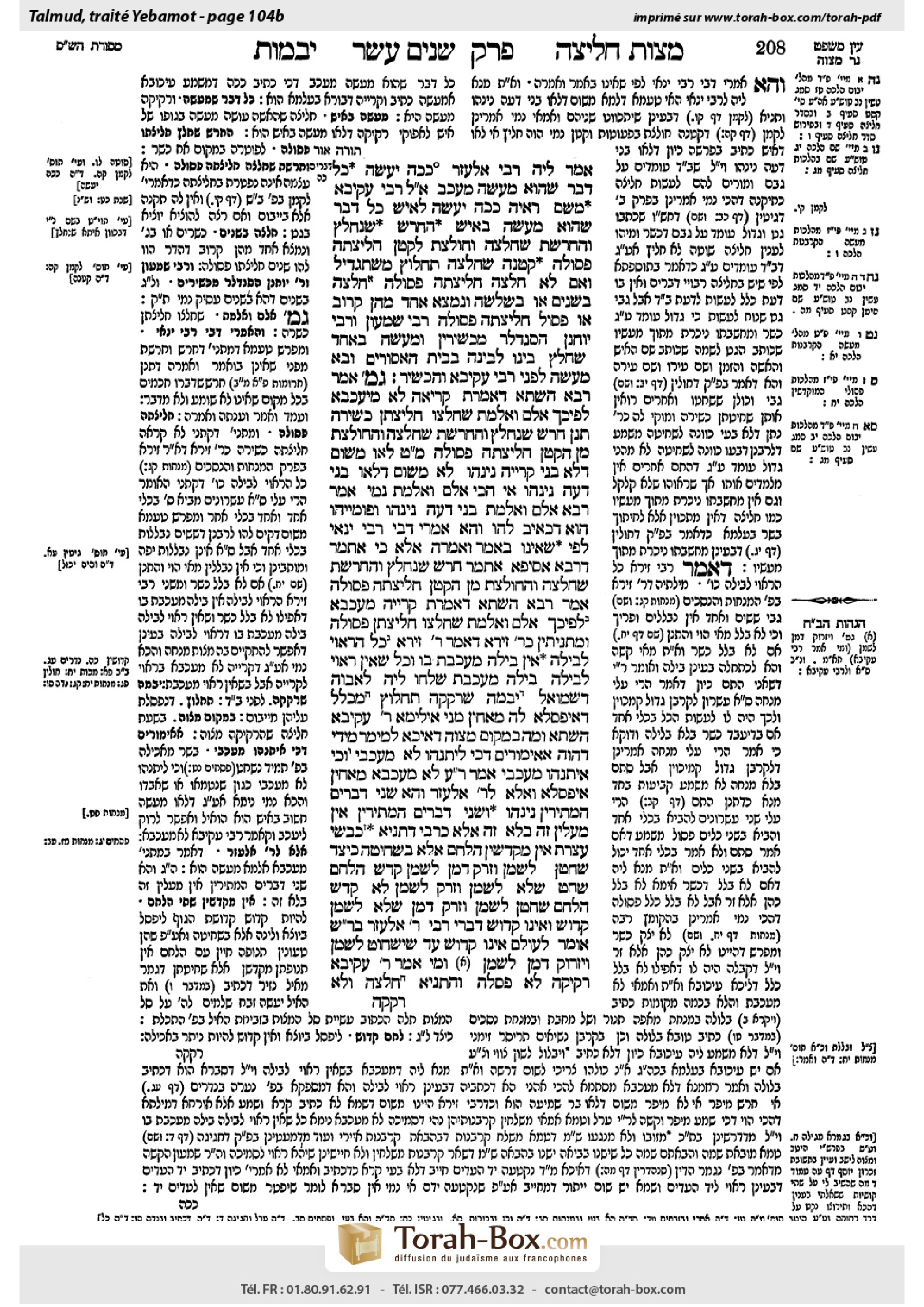
Yevamot 104b: Talmud study for Daf Yomi
Daf Yomi is the daily study of one Talmud folio. Explore 37 tractates with scans, Hebrew text, Sefaria English and AI-generated French translations where annotated.
Passage selection and English or AI-generated French translation are available where the scan has annotations. Daf Study is independent of Torah-Box and Sefaria.
Browse Yevamot · יבמות · All tractatesYevamot 104b text and translations
This page of Yevamot includes the Aramaic text, an English translation and an AI-generated French translation, alongside the scan above.
יבמות ק״ד ב · Aramaic and Hebrew text
אָמַר רַבִּי אֱלִיעֶזֶר: ״כָּכָה יֵעָשֶׂה״ — כׇּל דָּבָר שֶׁהוּא מַעֲשֶׂה מְעַכֵּב. אֲמַר לֵיהּ רַבִּי עֲקִיבָא: מִשָּׁם רְאָיָה? ״כָּכָה יֵעָשֶׂה לָאִישׁ״ — כׇּל דָּבָר שֶׁהוּא מַעֲשֶׂה בָּאִישׁ.
הַחֵרֵשׁ שֶׁנֶּחְלַץ, וְהַחֵרֶשֶׁת שֶׁחָלְצָה, וְחוֹלֶצֶת לְקָטָן — חֲלִיצָתָהּ פְּסוּלָה. קְטַנָּה שֶׁחָלְצָה — תַּחְלוֹץ מִשֶּׁתַּגְדִּיל, וְאִם לֹא חָלְצָה — חֲלִיצָתָהּ פְּסוּלָה. חָלְצָה בִּשְׁנַיִם אוֹ בִּשְׁלֹשָׁה, וְנִמְצָא אֶחָד מֵהֶן קָרוֹב אוֹ פָּסוּל — חֲלִיצָתָהּ פְּסוּלָה. רַבִּי שִׁמְעוֹן וְרַבִּי יוֹחָנָן הַסַּנְדְּלָר מַכְשִׁירִין. וּמַעֲשֶׂה בְּאֶחָד שֶׁחָלַץ בֵּינוֹ לְבֵינָהּ בְּבֵית הָאֲסוּרִים, וּבָא מַעֲשֶׂה לִפְנֵי רַבִּי עֲקִיבָא וְהִכְשִׁיר.
גְּמָ׳ אָמַר רָבָא: הַשְׁתָּא דְּאָמְרַתְּ קְרִיאָה לָא מְיעַכְּבָא, לְפִיכָךְ אִלֵּם וְאִלֶּמֶת שֶׁחָלְצוּ — חֲלִיצָתָן כְּשֵׁירָה.
תְּנַן: חֵרֵשׁ שֶׁנֶּחְלַץ, וְהַחֵרֶשֶׁת שֶׁחָלְצָה, וְהַחוֹלֶצֶת מִן הַקָּטָן — חֲלִיצָתָהּ פְּסוּלָה. מַאי טַעְמָא — לָאו מִשּׁוּם דְּלָא בְּנֵי קְרִיָּיה נִינְהוּ! לָא, מִשּׁוּם דְּלָאו בְּנֵי דֵעָה נִינְהוּ.
אִי הָכִי, אִלֵּם וְאִלֶּמֶת נָמֵי! אָמַר רָבָא: אִלֵּם וְאִלֶּמֶת בְּנֵי דֵעָה נִינְהוּ, וּפוּמַּיְיהוּ הוּא דְּכָאֵיב לְהוּ.
וְהָא אָמְרִי דְּבֵי רַבִּי יַנַּאי: לְפִי שֶׁאֵינוֹ בְּ״אָמַר״ ״וְאָמְרָה״! אֶלָּא, כִּי אִתְּמַר דְּרָבָא אַסֵּיפָא אִתְּמַר: חֵרֵשׁ שֶׁנֶּחְלַץ, וְהַחֵרֶשֶׁת שֶׁחָלְצָה, וְהַחוֹלֶצֶת מִן הַקָּטָן — חֲלִיצָתָהּ פְּסוּלָה.
אָמַר רָבָא: הַשְׁתָּא דְּאָמְרַתְּ קְרִיָּיה מְעַכְּבָא, לְפִיכָךְ אִלֵּם וְאִלֶּמֶת שֶׁחָלְצוּ — חֲלִיצָתָן פְּסוּלָה. וּמַתְנִיתִין כְּרַבִּי זֵירָא.
דְּאָמַר רַבִּי זֵירָא: כׇּל הָרָאוּי לְבִילָּה — אֵין בִּילָּה מְעַכֶּבֶת בּוֹ. וְכֹל שֶׁאֵין רָאוּי לְבִילָּה — בִּילָּה מְעַכֶּבֶת.
שְׁלַחוּ לֵיהּ לַאֲבוּהּ דִּשְׁמוּאֵל: יְבָמָה שֶׁרָקְקָה — תַּחְלוֹץ. מִכְּלָל דְּאִיפַּסְלָא לַהּ מֵאַחִין.
מַנִּי? אִילֵימָא רַבִּי עֲקִיבָא, הַשְׁתָּא וּמָה בִּמְקוֹם מִצְוָה, דְּאִיכָּא לְמֵימַר מִידֵּי דְּהָוֵה אַאֵימוּרִים, דְּכִי לֵיתַנְהוּ — לָא מְעַכְּבִי,
וְכִי אִיתַנְהוּ — מְעַכְּבִי,
אָמַר רַבִּי עֲקִיבָא לָא מְעַכְּבָא, מֵאַחִין אִיפַּסְלָא?
וְאֶלָּא לְרַבִּי אֶלְעָזָר —
וְהָא שְׁנֵי דְּבָרִים הַמַּתִּירִין נִינְהוּ, וּשְׁנֵי דְּבָרִים הַמַּתִּירִין — אֵין מַעֲלִין זֶה בְּלֹא זֶה.
אֶלָּא כְּרַבִּי. דְּתַנְיָא: כִּבְשֵׂי עֲצֶרֶת — אֵין מְקַדְּשִׁין הַלֶּחֶם אֶלָּא בִּשְׁחִיטָה.
כֵּיצַד? שְׁחָטָן לִשְׁמָן, וְזָרַק דָּמָן לִשְׁמָן — קָדַשׁ הַלֶּחֶם. שָׁחַט שֶׁלֹּא לִשְׁמָן, וְזָרַק לִשְׁמָן — לֹא קָדַשׁ הַלֶּחֶם. שְׁחָטָן לִשְׁמָן, וְזָרַק דָּמָן שֶׁלֹּא לִשְׁמָן — קָדוֹשׁ וְאֵינוֹ קָדוֹשׁ, דִּבְרֵי רַבִּי.
רַבִּי אֶלְעָזָר בְּרַבִּי שִׁמְעוֹן אוֹמֵר: לְעוֹלָם אֵינוֹ קָדוֹשׁ עַד שֶׁיִּשְׁחוֹט לִשְׁמָן וְיִזְרוֹק דָּמָן לִשְׁמָן.
וּמִי אָמַר רַבִּי עֲקִיבָא רְקִיקָה לָא פָּסְלָה? וְהָתַנְיָא: חָלְצָה וְלֹא
Yevamot 104b · English translation
Rabbi Elazar said to him: The verse states: “So shall it be done to the man who does not build his brother’s house” (Deuteronomy 25:9). “So” is an exclusionary term indicating that only precisely in this fashion is ḥalitza valid. Therefore, any term that constitutes an action for ḥalitza is indispensable. Rabbi Akiva said to him: You derive proof from there? But it states: “So shall it be done to the man” indicating that only a term constituting an action toward the man, namely any aspect of ḥalitza that concerns the man’s body, such as removal of his shoe, is indispensable. But spitting, which does not involve the man, although it takes place in his presence, is not indispensable.
The mishna lists additional halakhot with regard to ḥalitza. If a deaf-mute man underwent ḥalitza, or a deaf-mute woman performed ḥalitza, or if an adult woman performs ḥalitza with a male minor, her ḥalitza is invalid and the woman may not marry. If a female minor performed ḥalitza, she must perform ḥalitza a second time once she becomes an adult, and if she does not perform the second ḥalitza, her first ḥalitza is invalid. If she performed ḥalitza before two or three judges and one of them is found to be a relative or disqualified as a judge for some other reason, her ḥalitza is invalid. Rabbi Shimon and Rabbi Yoḥanan the Cobbler validate the ḥalitza in this case. And an incident occurred involving a certain person who performed ḥalitza between him and her alone in prison, i.e., not in the presence of others, and the case came before Rabbi Akiva and he validated it.
GEMARA: Rava said: Now that you have said that recitation of the text is not indispensable in order for the ḥalitza to be valid, therefore if a mute man or a mute woman performed ḥalitza, their ḥalitza is valid. Although the statements should be recited ab initio, since the recitation is not indispensable, mute individuals can perform ḥalitza.
The Gemara challenges: But we learned in the mishna above: If a deaf-mute man underwent ḥalitza, or a deaf-mute woman performed ḥalitza, or if a woman performs ḥalitza with a male minor, her ḥalitza is invalid. What is the reason that the ḥalitza is invalid? Is it not because they are not competent to recite the text, thereby indicating that the recitation is necessary even after the fact? The Gemara rejects this assertion: No, the reason for disqualifying a deaf-mute man and woman is because they are not considered to have intellectual capacity, and therefore their actions do not have halakhic significance.
The Gemara asks: If that is so, let us also say that a mute man and woman do not have intellectual capacity. Rava said: A mute man and woman do have intellectual capacity. Rather, it is their mouth that hurts them. Mute individuals have full intellectual capacity; they merely lack a means of expression. The deaf-mute, on the other hand, is not considered to have the mental capacity to speak.
The Gemara challenges again: But didn’t the scholars from the house of study of Rabbi Yannai say that a deaf-mute man and woman are disqualified from participation in ḥalitza because they cannot fulfill the requirements of “he says” (Deuteronomy 25:8) and “she shall say” (Deuteronomy 25:9), and not due to insufficient intellectual capacity? Rather, when that first statement of Rava was said, it was stated concerning the latter clause of the mishna: If a deaf-mute man underwent ḥalitza, or a deaf-mute woman performed ḥalitza, or if a woman performs ḥalitza on a male minor, her ḥalitza is invalid.
Rava said: You have now said that recitation is indispensable, as can be inferred from the mishna disqualifying the deaf-mute. Therefore, if a mute man or woman performed ḥalitza, their ḥalitza is invalid. And the mishna, which indicates in its first clause that recitation is not indispensable, but later states that ḥalitza performed by someone incapable of recitation is invalid, is in accordance with the opinion of Rabbi Zeira with regard to a meal-offering. A meal-offering is generally a mixture of flour and oil. If flour is added to the oil but they are not mixed, they are considered to be fitting to be mixed so long as there is not an excessive amount of flour.
This is that which Rabbi Zeira said: Whatever is fitting to be mixed, mixing is not indispensable to it, and it is valid even if it is not mixed. And whatever is not fit to be mixed, e.g., if the quantity of flour is so great that the ingredients cannot be properly mixed, mixing is indispensable for it and it is invalid if it has not been mixed. From here one may learn a general halakhic principle: There are some actions for which their actual performance is not indispensable, provided they are capable of being performed. An action becomes indispensable only if one is unfit or unable to perform it. With regard to recitation of the verses, although it is not indispensable, a mute person is disqualified from performing ḥalitza because he is not capable of reciting the verses.
They sent the following teaching from Eretz Yisrael to the father of Shmuel: Once a yevama has spat she must perform a complete ḥalitza and may not enter into levirate marriage. The Gemara comments: By inference, you may learn that even though the spitting did not permit her to marry outside the family, she is disqualified from entering into levirate marriage with any of the brothers, and must therefore complete the ḥalitza.
The Gemara asks: In accordance with whose opinion is this halakha taught? If we say it is in accordance with Rabbi Akiva, who stated in the mishna that spitting is not required after the fact, it is difficult, as the following a fortiori reasoning indicates: Now if even in a case where there is a mitzva of ḥalitza, and the yevama is still around and capable of fulfilling the Torah command of spitting, and one might say that spitting should be treated just as it is with regard to the fatty portions of offerings that are to be consumed on the altar, where the halakha is that when they are not present for offering, i.e., they were lost or became ritually impure, they are not considered indispensable to permit the consumption of the offering.
When the fats of the offering are no longer present for offering, it is permitted for the sacrificial meat to be eaten by the priests through the sprinkling of blood alone, even without offering the fatty portions on the altar. But when the fatty portions are present and extant, then they are considered indispensable, and the priests are not permitted to eat their portions of the offering until the fatty portions are burned on the altar.
Based on an analogy to the fatty portions of offerings, one would have said regarding the spitting of a yevama that even if it is not indispensable after the fact, so long as the yevama is around, one would expect that her spitting is indispensable. Yet even so, Rabbi Akiva said in the mishna that spitting is not indispensable to ḥalitza even in such a case, and the ḥalitza is validated by the removal of the shoe alone. Since Rabbi Akiva seems to accord little significance to the spitting, he cannot be the basis for this halakha, as if spitting is never indispensable, could spitting alone disqualify her from entering into levirate marriage with one of the brothers?
But rather, one might say that this teaching is in accordance with the opinion of Rabbi Elazar, who disagrees with Rabbi Akiva and states in the mishna that spitting is indispensable for validating ḥalitza and is necessary alongside the removal of the shoe. Since he accords significance to the spitting, one might have thought that the teaching prohibiting the yevama from levirate marriage is in accordance with his view.
But that is difficult as well, as according to Rabbi Elazar, removal of the shoe and spitting are both necessary, and therefore, they are considered two permitting factors that must be completed in order to fulfill an obligation. And there is a principle accepted by Rabbi Elazar with regard to offerings that should be applicable here: Whenever there are two permitting factors that are indispensable for an offering to be valid, one of those factors cannot elevate one of the subordinate components of the offering to consecrated status without the other. Similarly, since Rabbi Elazar holds that ḥalitza and spitting are both indispensable, if she performs only one of these actions, such as spitting, it is only one of two permitting factors and therefore should not disqualify her for levirate marriage with one of the other yevamin.
Rather, one must say that this teaching is in accordance with the opinion of Rabbi Yehuda HaNasi, who is of the opinion that even one of two permitting factors can effect a change in status without performance of the other factor, as it is taught in a baraita: The lambs sacrificed on the festival of Assembly, i.e., Shavuot, consecrate the loaves that accompany them only by means of their slaughter, as the slaughtering of the lambs consecrates the bread.
How so? If one slaughtered the lambs for their own sake, i.e., as lambs for Shavuot, and the priest sprinkled their blood for their own sake, the loaves are consecrated. However, if one slaughtered them not for their own sake, and the priest sprinkled their blood for their own sake, the loaves are not consecrated, as the factors indispensable in rendering the offering valid were not properly performed. If one slaughtered them for their own sake, and he sprinkled their blood not for their own sake, the fact that the lambs were properly slaughtered renders the loaves partially consecrated. Therefore, the loaves are consecrated to the extent that they cannot be redeemed, but they are not consecrated to the extent that they may be eaten. This is the statement of Rabbi Yehuda HaNasi.
Rabbi Elazar, son of Rabbi Shimon, says: Actually, the loaves are consecrated only when one slaughters the offerings for their own sake and sprinkles their blood for their own sake, i.e., only if both factors indispensable in rendering the offering valid were properly performed. If so, the teaching sent from Eretz Yisrael seems to be in accordance with Rabbi Yehuda HaNasi’s opinion that even if only one of the two permitting factors of slaughter and sprinkling was performed, the loaves will still be consecrated. Likewise, with respect to ḥalitza, where there is a need for two permitting factors, spitting and removal of the shoe, performing one factor such as spitting is sufficient to disqualify the yevama from subsequently entering into levirate marriage.
The Gemara questions the previous assumption with regard to Rabbi Akiva’s opinion on the matter: But did Rabbi Akiva say that spitting does not disqualify the yevama from a later levirate marriage to one of the other brothers? But isn’t it taught in a baraita: If she removed the shoe but did not
Yevamot 104b · Traduction française (IA)
Rabbi Elazar lui dit : Le verset dit : « Ainsi sera-t-il fait à l’homme qui ne bâtit pas la maison de son frère » (Deutéronome 25, 9). « Ainsi » est une expression restrictive, qui indique que la ḥalitsa n’est valide que si elle est accomplie exactement de cette manière. Par conséquent, tout acte constitutif de la ḥalitsa est indispensable. Rabbi Akiva lui dit : Est-ce de là que tu tires ta preuve ? Il est pourtant dit : « Ainsi sera-t-il fait à l’homme », ce qui indique que seul est indispensable un acte accompli à l’égard de l’homme, c’est-à-dire tout aspect de la ḥalitsa qui concerne le corps de l’homme, comme le retrait de sa chaussure. En revanche, le crachat, qui ne concerne pas l’homme, même s’il a lieu en sa présence, n’est pas indispensable.
La Michna énumère d’autres halakhot concernant la ḥalitsa. Si un homme sourd-muet subit la ḥalitsa, si une femme sourde-muette l’accomplit, ou si une femme adulte accomplit la ḥalitsa avec un homme mineur, la ḥalitsa est invalide et la femme ne peut pas se marier. Si une fille mineure accomplit la ḥalitsa, elle doit l’accomplir une seconde fois lorsqu’elle devient adulte ; si elle ne l’accomplit pas une seconde fois, sa première ḥalitsa est invalide. Si elle accomplit la ḥalitsa devant deux ou trois juges et que l’un d’eux se révèle être un parent ou être inapte à juger pour une autre raison, sa ḥalitsa est invalide. Rabbi Shimon et Rabbi Yoḥanan le Cordonnier valident la ḥalitsa dans ce cas. Un événement s’est produit : une certaine personne accomplit la ḥalitsa, lui et elle seuls, en prison, c’est-à-dire sans la présence d’autres personnes. L’affaire fut portée devant Rabbi Akiva, qui la valida.
GUEMARA : Rava dit : À présent que tu as dit que la récitation du texte n’est pas indispensable à la validité de la ḥalitsa, il s’ensuit que si un homme ou une femme muets accomplissent la ḥalitsa, celle-ci est valide. Bien que les paroles doivent être récitées a priori, puisque leur récitation n’est pas indispensable, les personnes muettes peuvent accomplir la ḥalitsa.
La Guemara objecte : Mais nous avons appris dans la Michna précédente : Si un homme sourd-muet subit la ḥalitsa, si une femme sourde-muette l’accomplit, ou si une femme accomplit la ḥalitsa avec un homme mineur, la ḥalitsa est invalide. Pourquoi est-elle invalide ? N’est-ce pas parce qu’ils ne sont pas capables de réciter le texte, ce qui indique que la récitation est nécessaire même a posteriori ? La Guemara rejette cette affirmation : Non, l’homme et la femme sourds-muets sont disqualifiés parce qu’on ne les considère pas comme ayant une capacité intellectuelle ; leurs actes n’ont donc pas de portée halakhique.
La Guemara demande : Si tel est le cas, disons également qu’un homme et une femme muets n’ont pas de capacité intellectuelle. Rava dit : Un homme et une femme muets ont une capacité intellectuelle. C’est plutôt leur bouche qui leur fait défaut. Les personnes muettes ont toute leur capacité intellectuelle ; elles n’ont simplement pas de moyen de s’exprimer. En revanche, le sourd-muet n’est pas considéré comme ayant la capacité mentale de parler.
La Guemara objecte de nouveau : Mais les sages de la maison d’étude de Rabbi Yannai n’ont-ils pas dit qu’un homme et une femme sourds-muets sont disqualifiés pour la ḥalitsa parce qu’ils ne peuvent satisfaire aux exigences « il dira » (Deutéronome 25, 8) et « elle dira » (Deutéronome 25, 9), et non en raison d’une capacité intellectuelle insuffisante ? Il faut plutôt dire que la première déclaration de Rava a été formulée à propos de la dernière partie de la Michna : Si un homme sourd-muet subit la ḥalitsa, si une femme sourde-muette l’accomplit, ou si une femme accomplit la ḥalitsa avec un homme mineur, sa ḥalitsa est invalide.
Rava dit : Tu as maintenant dit que la récitation est indispensable, comme on peut le déduire de la disqualification du sourd-muet dans la Michna. Il s’ensuit que si un homme ou une femme muets accomplissent la ḥalitsa, celle-ci est invalide. La Michna, qui indique dans sa première partie que la récitation n’est pas indispensable, mais affirme ensuite que la ḥalitsa accomplie par une personne incapable de réciter est invalide, suit l’opinion de Rabbi Zeira concernant une offrande de farine. Une offrande de farine est généralement un mélange de farine et d’huile. Si l’on ajoute de la farine à l’huile sans mélanger les ingrédients, ceux-ci sont considérés comme aptes à être mélangés, tant que la quantité de farine n’est pas excessive.
C’est ce qu’a dit Rabbi Zeira : Pour tout ce qui peut être mélangé, le mélange n’est pas indispensable et l’offrande est valide même si les ingrédients ne sont pas mélangés. En revanche, pour tout ce qui ne peut pas être mélangé — par exemple, si la quantité de farine est telle que les ingrédients ne peuvent pas être correctement mélangés —, le mélange est indispensable et l’offrande est invalide s’il n’a pas été effectué. On peut en tirer un principe halakhique général : certaines actions n’ont pas besoin d’être effectivement accomplies, à condition qu’elles puissent l’être. Une action ne devient indispensable que si l’on est inapte ou incapable de l’accomplir. Quant à la récitation des versets, bien qu’elle ne soit pas indispensable, une personne muette est disqualifiée pour accomplir la ḥalitsa, car elle est incapable de réciter les versets.
L’enseignement suivant fut envoyé d’Eretz Israël au père de Shmuel : Une fois qu’une yevama a craché, elle doit achever la ḥalitsa et ne peut pas contracter un mariage léviratique. La Guemara commente : On peut en déduire que, même si le crachat ne lui a pas permis d’épouser un homme extérieur à la famille, elle est disqualifiée pour contracter un mariage léviratique avec l’un quelconque des frères et doit donc achever la ḥalitsa.
La Guemara demande : Selon l’opinion de qui cette halakha est-elle enseignée ? Si l’on dit qu’elle suit l’opinion de Rabbi Akiva, qui a affirmé dans la Michna que le crachat n’est pas indispensable a posteriori, cela pose difficulté, comme le montre le raisonnement a fortiori suivant : à plus forte raison dans un cas où la mitsva de ḥalitsa s’applique, où la yevama est encore présente et capable d’accomplir le commandement de la Torah relatif au crachat, pourrait-on dire que le crachat doit être considéré comme les parties grasses des offrandes destinées à être consumées sur l’autel. La halakha veut que, lorsqu’elles ne sont pas disponibles pour être offertes, c’est-à-dire qu’elles ont été perdues ou sont devenues rituellement impures, elles ne sont pas considérées comme indispensables pour autoriser la consommation de l’offrande.
Lorsque les parties grasses de l’offrande ne sont plus disponibles pour être offertes, les prêtres peuvent consommer la viande sacrificielle sur la seule base de l’aspersion du sang, même sans offrir les parties grasses sur l’autel. En revanche, lorsqu’elles sont présentes et disponibles, elles sont considérées comme indispensables, et les prêtres ne sont pas autorisés à manger leur part de l’offrande tant que les parties grasses n’ont pas été brûlées sur l’autel.
Par analogie avec les parties grasses des offrandes, on aurait dit à propos du crachat d’une yevama que, même s’il n’est pas indispensable a posteriori, tant que la yevama est présente, son crachat devrait être indispensable. Pourtant, Rabbi Akiva a affirmé dans la Michna que le crachat n’est pas indispensable à la ḥalitsa même dans un tel cas, et que le seul retrait de la chaussure suffit à valider la ḥalitsa. Puisque Rabbi Akiva accorde peu d’importance au crachat, il ne peut être à l’origine de cette halakha : si le crachat n’est jamais indispensable, pourrait-il à lui seul disqualifier la yevama pour un mariage léviratique avec l’un des frères ?
On pourrait plutôt dire que cet enseignement suit l’opinion de Rabbi Elazar, qui s’oppose à Rabbi Akiva et affirme dans la Michna que le crachat est indispensable à la validité de la ḥalitsa et nécessaire en plus du retrait de la chaussure. Puisqu’il accorde de l’importance au crachat, on aurait pu penser que l’enseignement interdisant à la yevama le mariage léviratique suit son opinion.
Mais cela pose également difficulté : selon Rabbi Elazar, le retrait de la chaussure et le crachat sont tous deux nécessaires ; ils sont donc considérés comme deux facteurs autorisant l’accomplissement de l’obligation. Or Rabbi Elazar admet, concernant les offrandes, un principe qui devrait s’appliquer ici : lorsque deux facteurs autorisant une offrande sont indispensables à sa validité, l’un d’eux ne peut, sans l’autre, conférer le statut de consacré à l’un des éléments secondaires de l’offrande. De même, puisque Rabbi Elazar estime que le retrait de la chaussure et le crachat sont tous deux indispensables à la ḥalitsa, si elle n’accomplit qu’une seule de ces actions, par exemple le crachat, il ne s’agit que de l’un des deux facteurs autorisant la ḥalitsa ; cela ne devrait donc pas la disqualifier pour un mariage léviratique avec l’un des autres yevamim.
Il faut plutôt dire que cet enseignement suit l’opinion de Rabbi Yehuda HaNasi, selon laquelle même un seul de deux facteurs autorisant l’accomplissement peut modifier un statut sans que l’autre facteur soit accompli, comme l’enseigne une baraïta : les agneaux sacrifiés lors de la fête de l’Assemblée, c’est-à-dire Chavouot, consacrent les pains qui les accompagnent uniquement par leur abattage, car l’abattage des agneaux consacre les pains.
De quelle manière ? Si l’on a abattu les agneaux pour leur propre compte, c’est-à-dire comme offrandes de Chavouot, et que le prêtre a aspergé leur sang pour leur propre compte, les pains sont consacrés. En revanche, si l’on a abattu les agneaux sans le faire pour leur propre compte, mais que le prêtre a aspergé leur sang pour leur propre compte, les pains ne sont pas consacrés, car les facteurs indispensables à la validité de l’offrande n’ont pas été correctement appliqués. Si l’on a abattu les agneaux pour leur propre compte, mais aspergé leur sang sans le faire pour leur propre compte, le fait que les agneaux aient été abattus correctement confère aux pains un statut de consécration partiel. Les pains sont donc consacrés au point qu’ils ne peuvent être rachetés, mais pas au point qu’ils puissent être mangés. Telle est la déclaration de Rabbi Yehuda HaNasi.
Rabbi Elazar, fils de Rabbi Shimon, dit : En réalité, les pains ne sont consacrés que si l’on abat les offrandes pour leur propre compte et que l’on asperge leur sang pour leur propre compte, c’est-à-dire uniquement si les deux facteurs indispensables à la validité de l’offrande ont été correctement appliqués. Ainsi, l’enseignement envoyé d’Eretz Israël semble suivre l’opinion de Rabbi Yehuda HaNasi, selon laquelle les pains sont consacrés même si un seul des deux facteurs autorisant leur consécration — l’abattage et l’aspersion — a été appliqué. De même, pour la ḥalitsa, où deux facteurs sont nécessaires — le crachat et le retrait de la chaussure —, l’accomplissement d’un seul, tel que le crachat, suffit à disqualifier la yevama pour contracter ultérieurement un mariage léviratique.
La Guemara remet en question l’hypothèse précédente concernant l’opinion de Rabbi Akiva sur ce point : Mais Rabbi Akiva a-t-il dit que le crachat ne disqualifie pas la yevama pour un mariage léviratique ultérieur avec l’un des autres frères ? N’est-il pas enseigné dans une baraïta : Si elle a retiré la chaussure, mais n’a pas
Traduction française générée par IA à partir de l’édition anglaise de Sefaria. Vérifie toujours un passage avec le texte source.
Text from Sefaria: William Davidson Edition - Vocalized Aramaic (CC BY NC); William Davidson Edition - English (CC BY NC).