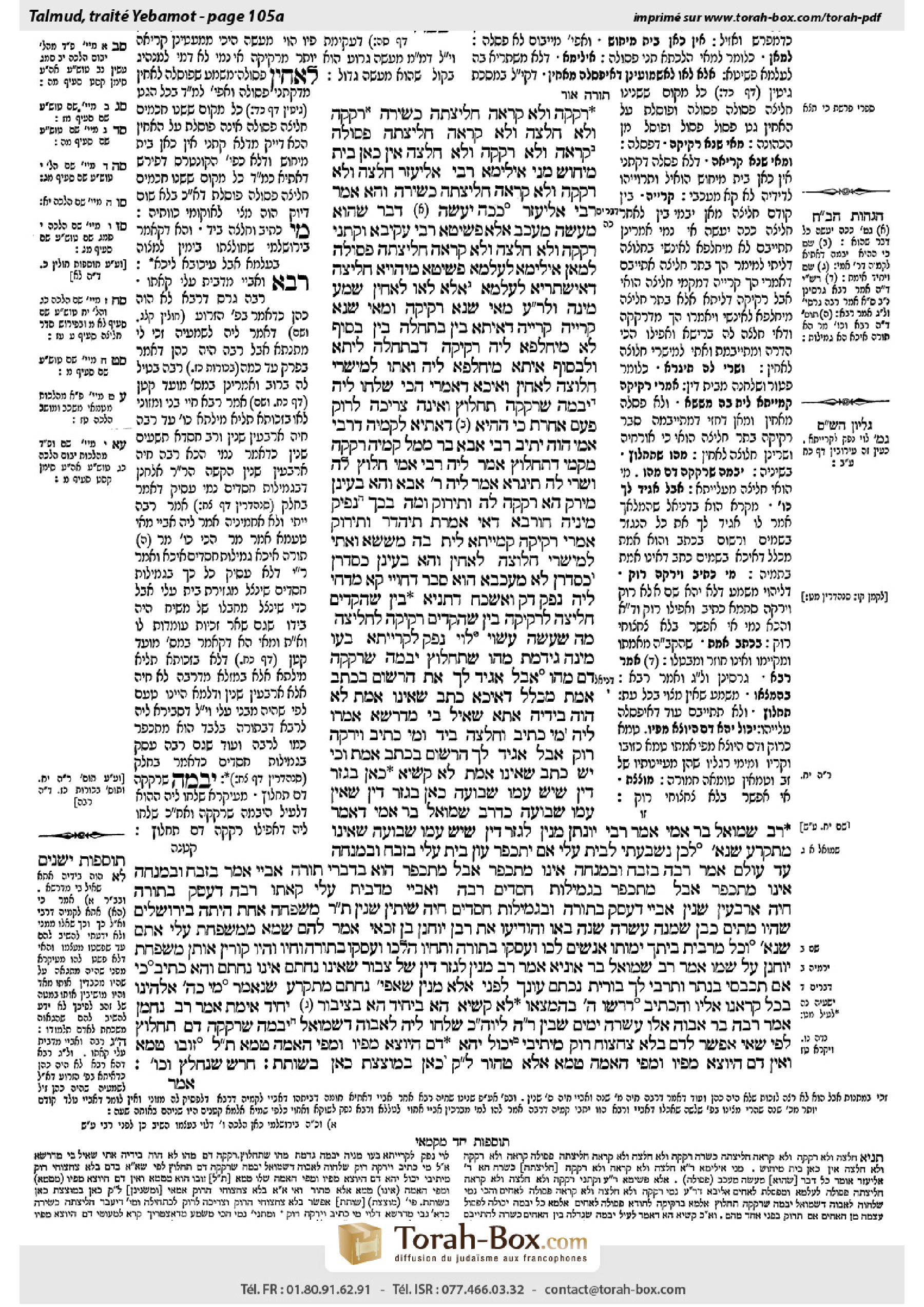
Yevamot 105a: Talmud study for Daf Yomi
Daf Yomi is the daily study of one Talmud folio. Explore 37 tractates with scans, Hebrew text, Sefaria English and AI-generated French translations where annotated.
Passage selection and English or AI-generated French translation are available where the scan has annotations. Daf Study is independent of Torah-Box and Sefaria.
Browse Yevamot · יבמות · All tractatesYevamot 105a text and translations
This page of Yevamot includes the Aramaic text, an English translation and an AI-generated French translation, alongside the scan above.
יבמות ק״ה א · Aramaic and Hebrew text
רָקְקָה וְלֹא קָרְאָה — חֲלִיצָתָהּ כְּשֵׁירָה, רָקְקָה וְלֹא חָלְצָה וְלֹא קָרְאָה — חֲלִיצָתָהּ פְּסוּלָה. קָרְאָה וְלֹא רָקְקָה וְלֹא חָלְצָה — אֵין כָּאן בֵּית מֵיחוֹשׁ.
מַנִּי? אִילֵימָא רַבִּי אֱלִיעֶזֶר: חָלְצָה וְלֹא רָקְקָה וְלֹא קָרְאָה חֲלִיצָתָהּ כְּשֵׁירָה? וְהָא אָמַר רַבִּי אֱלִיעֶזֶר: ״כָּכָה יֵעָשֶׂה״, דָּבָר שֶׁהוּא מַעֲשֵׂה מְעַכֵּב! אֶלָּא פְּשִׁיטָא רַבִּי עֲקִיבָא, וְקָתָנֵי: רָקְקָה וְלֹא חָלְצָה וְלֹא קָרְאָה — חֲלִיצָתָהּ פְּסוּלָה. לְמַאן?
אִילֵימָא לְעָלְמָא, פְּשִׁיטָא! מִי הָוְיָא חֲלִיצָה דְּאִישְׁתַּרְיָא לְעָלְמָא? אֶלָּא לָאו לָאַחִין, שְׁמַע מִינַּהּ.
וּלְרַבִּי עֲקִיבָא, מַאי שְׁנָא רְקִיקָה וּמַאי שְׁנָא קְרִיָּיה?
קְרִיָּיה, דְּאִיתַהּ בֵּין בַּתְּחִלָּה בֵּין בַּסּוֹף — לָא מִיחַלְּפָא לֵיהּ. רְקִיקָה, דְּבִתְחִלָּה לֵיתַהּ וְלִבְסוֹף אִיתַהּ — מִיחַלְּפָא לֵיהּ, וְאָתוּ לְמִישְׁרֵי חֲלוּצָה לָאַחִין.
וְאִיכָּא דְאָמְרִי, הָכִי שְׁלַחוּ לֵיהּ: יְבָמָהּ שֶׁרָקְקָה — תַּחְלוֹץ, וְאֵינָהּ צְרִיכָה לָרוֹק פַּעַם אַחֶרֶת. כִּי הַהִיא דַּאֲתַאי לְקַמֵּיהּ דְּרַבִּי אַמֵּי, הֲוָה יָתֵיב רַבִּי אַבָּא בַּר מֶמֶל קַמֵּיהּ. רְקַקָה מִקַּמֵּי דְּתַחְלוֹץ. אֲמַר לֵיהּ רַבִּי אַמֵּי: חֲלוֹץ לַהּ, וּשְׁרֵי לַהּ תִּיגְרָא.
אֲמַר לֵיהּ רַבִּי אַבָּא: וְהָא בָּעֵינַן מֵירַק! הָא רְקַקָה לַהּ. וְתֵירוֹק, וּמָה בְּכָךְ? נָפֵיק מִינֵּיהּ חוּרְבָּא, דְּאִי אָמְרַתְּ תִּיהְדַּר וְתֵירוֹק, אָמְרִי: רְקִיקָה קַמַּיְיתָא לֵית בַּהּ מְשָׁשָׁא, וְאָתֵי לְמִישְׁרֵי חֲלוּצָה לָאַחִין.
וְהָא בָּעֵינַן כְּסִדְרָן! כְּסִדְרָן לָא מְעַכְּבָא. הוּא סָבַר: דַּחוֹיֵי קָא מְדַחֵי לֵיהּ. נְפַק, דָּק וְאַשְׁכַּח, דְּתַנְיָא: בֵּין שֶׁהִקְדִּים חֲלִיצָה לִרְקִיקָה, בֵּין שֶׁהִקְדִּים רְקִיקָה לַחֲלִיצָה — מַה שֶּׁעָשָׂה עָשׂוּי.
לֵוִי נְפַק לְקִרְיָיתָא. בְּעוֹ מִינֵּהּ: גִּידֶּמֶת, מַהוּ שֶׁתַּחְלוֹץ? יְבָמָה שֶׁרָקְקָה דָּם, מַהוּ? ״אֲבָל אַגִּיד לְךָ אֶת הָרָשׁוּם בִּכְתָב אֱמֶת״ — מִכְּלָל דְּאִיכָּא כְּתָב שֶׁאֵינוֹ אֱמֶת?
לָא הֲוָה בִּידֵיהּ. אֲתָא שַׁאֵיל בֵּי מִדְרְשָׁא, אֲמַרוּ לֵיהּ: מִי כְּתִיב ״וְחָלְצָה בַּיָּד״? וּמִי כְּתִיב ״וְיָרְקָה רוֹק״?
״אֲבָל אַגִּיד לָךְ הָרָשׁוּם בִּכְתָב אֱמֶת״, וְכִי יֵשׁ כְּתָב שֶׁאֵינוֹ אֱמֶת?
לָא קַשְׁיָא: כָּאן בִּגְזַר דִּין שֶׁיֵּשׁ עִמּוֹ שְׁבוּעָה. כָּאן בִּגְזַר דִּין שֶׁאֵין עִמּוֹ שְׁבוּעָה.
כִּדְרַב שְׁמוּאֵל בַּר אַמֵּי. דְּאָמַר רַב שְׁמוּאֵל בַּר אַמֵּי אָמַר רַבִּי יוֹנָתָן: מִנַּיִן לִגְזַר דִּין שֶׁיֵּשׁ עִמּוֹ שְׁבוּעָה שֶׁאֵינוֹ מִתְקָרֵעַ, שֶׁנֶּאֱמַר: ״לָכֵן נִשְׁבַּעְתִּי לְבֵית עֵלִי אִם יִתְכַּפֵּר עֲוֹן בֵּית עֵלִי בְּזֶבַח וּבְמִנְחָה עַד עוֹלָם״.
אָמַר רַבָּה: בְּזֶבַח וּבְמִנְחָה אֵינוֹ מִתְכַּפֵּר, אֲבָל מִתְכַּפֵּר הוּא בְּדִבְרֵי תוֹרָה. אַבָּיֵי אָמַר: בְּזֶבַח וּבְמִנְחָה אֵינוֹ מִתְכַּפֵּר, אֲבָל מִתְכַּפֵּר בִּגְמִילוּת חֲסָדִים. רַבָּה וְאַבָּיֵי מִדְּבֵית עֵלִי קָאָתוּ, רַבָּה דַּעֲסַק בַּתּוֹרָה — חֲיָה אַרְבְּעִין שְׁנִין, אַבָּיֵי דַּעֲסַק בְּתוֹרָה וּבִגְמִילוּת חֲסָדִים — חֲיָה שִׁיתִּין שְׁנִין.
תָּנוּ רַבָּנַן: מִשְׁפָּחָה אַחַת הָיְתָה בִּירוּשָׁלַיִם שֶׁהָיוּ מֵתִים כְּבֶן שְׁמֹנֶה עֶשְׂרֵה שָׁנָה. בָּאוּ וְהוֹדִיעוּ אֶת רַבָּן יוֹחָנָן בֶּן זַכַּאי. אָמַר לָהֶם: שֶׁמָּא מִמִּשְׁפַּחַת עֵלִי אַתֶּם, שֶׁנֶּאֱמַר: ״וְכׇל מַרְבִּית בֵּיתְךָ יָמוּתוּ אֲנָשִׁים״ — לְכוּ וְעִסְקוּ בַּתּוֹרָה וְתִחְיוּ. הָלְכוּ וְעָסְקוּ בַּתּוֹרָה וְחָיוּ, וְהָיוּ קוֹרִין אוֹתָן ״מִשְׁפַּחַת יוֹחָנָן״ עַל שְׁמוֹ.
אָמַר רַב שְׁמוּאֵל בַּר אוּנְיָא אָמַר רַב: מִנַּיִן לִגְזַר דִּין שֶׁל צִבּוּר שֶׁאֵינוֹ נֶחְתָּם? אֵינוֹ נֶחְתָּם?! וְהָא כְּתִיב: ״כִּי אִם תְּכַבְּסִי בַּנֶּתֶר וְתַרְבִּי לָךְ בּוֹרִית נִכְתָּם עֲוֹנֵךְ לְפָנַי״!
אֶלָּא: מִנַּיִן שֶׁאֲפִילּוּ נֶחְתַּם מִתְקָרֵעַ — שֶׁנֶּאֱמַר: ״מִי כַּה׳ אֱלֹהֵינוּ בְּכׇל קׇרְאֵנוּ אֵלָיו״, וְהָכְתִיב: ״דִּרְשׁוּ ה׳ בְּהִמָּצְאוֹ״! לָא קַשְׁיָא: הָא בְּיָחִיד, הָא בְּצִיבּוּר.
יָחִיד אֵימַת? אָמַר רַב נַחְמָן אָמַר רַבָּה בַּר אֲבוּהּ: אֵלּוּ עֲשָׂרָה יָמִים שֶׁבֵּין רֹאשׁ הַשָּׁנָה לְיוֹם הַכִּפּוּרִים.
שְׁלַחוּ לֵיהּ לַאֲבוּהּ דִּשְׁמוּאֵל: יְבָמָה שֶׁרָקְקָה דָּם — תַּחְלוֹץ, לְפִי שֶׁאִי אֶפְשָׁר לַדָּם בְּלֹא צִחְצוּחַ רוֹק.
מֵיתִיבִי: יָכוֹל יְהֵא דָּם הַיּוֹצֵא מִפִּיו וּמִפִּי הָאַמָּה טָמֵא — תַּלְמוּד לוֹמַר: ״זוֹבוֹ טָמֵא״, וְאֵין דָּם הַיּוֹצֵא מִפִּיו וּמִפִּי הָאַמָּה טָמֵא, אֶלָּא טָהוֹר.
לָא קַשְׁיָא: כָּאן בְּמוֹצֶצֶת, כָּאן בְּשׁוֹתֵת.
חֵרֵשׁ שֶׁנֶּחְלַץ וְכוּ׳.
Yevamot 105a · English translation
spit and did not recite the verses, her ḥalitza is valid. If she spat but did not remove the shoe and did not recite the text, her ḥalitza is disqualified. If she recited the verses but did not spit or did not remove the shoe, there is no doubt that she has done nothing, and her action has no halakhic significance.
The Gemara clarifies: Who is the author of the baraita? If we say it is in accordance with the opinion of Rabbi Eliezer, could it be that he would hold that if she removed the shoe but did not spit or did not recite the verses, her ḥalitza is valid, as stated in the baraita? But didn’t Rabbi Eliezer say: The phrase “so shall it be done” (Deuteronomy 25:9) indicates that any element of the ḥalitza process that constitutes an action is indispensable; therefore spitting is necessary. Rather, it is obvious that the baraita is in accordance with the opinion of Rabbi Akiva, and he teaches at the end of the baraita that if she spat but did not remove the shoe or did not recite the text, her ḥalitza is disqualified. The Gemara clarifies: To whom is the yevama disqualified from marrying after such a ḥalitza?
If we say that Rabbi Akiva means to teach us that she is disqualified from marriage to everyone in the world, this is unnecessary, as it is clear that spitting alone will not permit her to marry any stranger. It is obvious that her ḥalitza is invalid, as did any ḥalitza take place in order for her to be permitted to a stranger? Rather, is it not clear that Rabbi Akiva is ruling that she is disqualified from marriage to the brothers? Learn from here that Rabbi Akiva also thinks that spitting alone disqualifies her from marriage to the brothers, which is not in accordance with the previous assumption with regard to his opinion.
The Gemara asks: But according to Rabbi Akiva’s understanding that only an action performed on the body of the yavam is indispensable for ḥalitza, what is different about spitting and what is different about recitation? Both are not indispensable, so why is it that if she spat but did not remove the shoe she is disqualified from marriage to the brothers, yet if she recited the text but did not remove the shoe her action has no halakhic significance?
The Gemara answers: Rabbi Akiva finds a reason to rabbinically prohibit the woman after spitting, yet holds that the reason is not valid after the recitation alone. The recitation of the verses, which takes place both at the beginning of the process, before the removal of the shoe, and at the end, will not cause him to be confused about a proper ḥalitza, as one who witnesses her recitation knows that she may have only recited the text but has not yet removed the shoe, and therefore it will cause no harm to invalidate her ḥalitza and permit her in levirate marriage to the yevamin. But with regard to spitting, which does not take place at the beginning but takes place at the end, after the removal of the shoe, one who witnesses her spitting might assume that she had already removed the shoe, and he might confuse this woman with a woman who removed the shoe, and if we would allow her to perform levirate marriage after the spitting, they will come to permit a yevama who performed ḥalitza to marry the brothers of the yavam after the ḥalitza. Therefore, Rabbi Akiva finds reason to rabbinically prohibit a woman after spitting, although he doesn’t do so if they merely recited the verses of ḥalitza.
And there are those who say that this is what they sent to Shmuel’s father: A yevama who spat before removing the shoe shall remove the shoe, and she is not required to spit another time. This is like the incident where a certain woman came before Rabbi Ami for ḥalitza, and Rabbi Abba bar Memel sat before him at the time. She spat before she removed the shoe. Rabbi Ami said to him: Rabbi Abba, tell her to remove the shoe of the yavam, so one may dismiss her case from the court, as she does not require another act of spitting.
Rabbi Abba said to him: But for ḥalitza we need her to spit. He answered: She already spat. Rabbi Abba said to him: That spitting was done before the removal, so let her spit again, and what would be the problem with that? He answered him: A disaster could be brought out from it, as, if you say she should spit again there will be others who say: The first spitting has no halakhic significance and she is still permitted to the brothers if no spitting was performed subsequently, and they will come to permit a bona fide ḥalutza, i.e., a yevama who has performed ḥalitza, to the brothers, because when they see her spitting the first time they will say that she certainly already removed the shoe beforehand.
He challenged again: But we require that ḥalitza be performed in the proper order, as recorded in the Torah. He answered him: Their proper order is not indispensable. Rabbi Abba bar Memel thought: He is merely pushing off my legitimate questions with far-fetched attempts to justify his statements that are not well founded. Afterward, he went out from the house of study and examined the matter and discovered that it was as Rabbi Ami said. As it is taught in a baraita: Whether the removal of the shoe preceded the spitting, as the proper order requires, or whether the spitting preceded the removal of the shoe, what he did is done, i.e., is effective, as the woman is therefore permitted to remarry.
Apropos adherence to instructions given in the Torah, the Gemara relates a story. Levi went out to the villages to teach people Torah. They asked him several questions: Firstly, what is the halakha for an armless woman, may she perform ḥalitza with her teeth? Secondly, what is the halakha if a yevama spat blood instead of saliva, is the ḥalitza valid? Furthermore, they asked with regard to the verse: “But I will declare to you that which is inscribed in the writing of truth” (Daniel 10:21), if by inference, there is writing in Heaven that is not truth.
He did not have an answer at hand to these questions, so he came and asked at the house of study. They said to him in response to the first question: Does it say in the Torah: And she shall remove the shoe by hand? Clearly, she may remove the shoe in any manner and there is no reason to disqualify an armless woman. With regard to the second question, they said: And does it say in the verse: And she shall spit saliva? It merely states: “And she shall spit,” indicating that even if she spits blood the ḥalitza is valid.
With regard to the verse cited in the third question: “But I will declare to you that which is inscribed in the writing of truth,” about which you ask: But is there writing in Heaven that is not truth?
This is not difficult. Here, i.e., a writing of truth, refers to a sentence of judgment accompanied by an oath; this is called “writing of truth” as it cannot ever be canceled. There, i.e., the inferred untruthful writing, refers to a sentence of judgment that is not accompanied by an oath, as it could be canceled if conditions change.
This is in accordance with the words of Rav Shmuel bar Ami, as Rav Shmuel bar Ami said that Rabbi Yonatan said: From where is it derived that a sentence of judgment accompanied by an oath cannot be torn up? It is as it is stated: “Therefore I have sworn unto the house of Eli, that the iniquity of Eli’s house shall not be atoned for with sacrifice nor offering forever” (I Samuel 3:14), which indicates that due to the accompanying oath, the sentence of judgment cannot ever be rescinded, even if offerings of atonement are brought.
Apropos this verse, the Gemara mentions what Rabba said with regard to it: With sacrifice and offering, one from the house of Eli will not be atoned for, but he may gain atonement through words of Torah study. Abaye said: Through sacrifice and offering he may not achieve atonement, but he may gain atonement through acts of kindness. The Gemara relates that Rabba and Abaye themselves descended from the house of Eli. Rabba, who immersed himself primarily in Torah study, lived forty years, while Abaye, who immersed himself both in Torah and acts of kindness, lived sixty years. They both lived longer lives than usual for descendants of the house of Eli, due to their actions.
The Gemara relates a similar story from a baraita: The Sages taught: There was a certain family in Jerusalem whose children were dying at around age eighteen. The members of the family came and told Rabban Yoḥanan ben Zakkai about these tragic deaths. He said to them: Perhaps you are from the house of Eli, as it is stated: “All the increase of your house shall die young men” (I Samuel 2:33), which teaches that as soon as they reach full maturity, old enough to be called “men,” they die. Therefore, you must go out and immerse yourselves in Torah, and you will live. They went and immersed themselves in Torah and lived longer lives, and people would call them: The family of Yoḥanan, after his name, as the advice he gave them enabled them to live.
With regard to a decree of judgment that cannot be torn up, Rav Shmuel bar Unya said that Rav said: From where is it derived that a sentence of judgment upon a community is never sealed? The Gemara expresses surprise: Is it truly not sealed? But isn’t it written: “For although you wash yourself with niter, and take much soap for yourself, yet your iniquity is marked before Me” (Jeremiah 2:22), indicating that there is no longer any atonement for iniquity of a community.
Rather, one must say as follows: From where is it derived that even when a community’s sentence is sealed, it may be torn up as a result of repentance, as it is stated: “For what great nation is there, that has God so close unto them, as the Lord our God is whenever we call upon Him?” (Deuteronomy 4:7). The Gemara objects: But isn’t it written in another verse: “Seek the Lord while He may be found, call upon Him when He is near” (Isaiah 55:6), implying that God is not always near and may not always answer whenever we call upon Him? The Gemara answers: This contradiction is not difficult. This verse is concerning an individual who must seek God where He is found, as He is not always equally accessible to answer those who call out to Him. That first verse is concerning a community, for whom He is accessible “whenever we call upon Him.”
The Gemara asks: For an individual, when is the time that God is close to him? Rav Naḥman said that Rabba bar Avuh said: These are the ten days that are between Rosh HaShana and Yom Kippur.
The Gemara returns to the questions the villagers asked Levi: The Sages in Eretz Yisrael sent this halakha to Shmuel’s father: A yevama who spat blood shall remove the shoe, because it is not possible that blood came out of her mouth without any trace of saliva, and she fulfills her obligation through this saliva.
The Gemara raises an objection from a baraita that states with regard to a zav: One might have thought that blood that issues from his mouth or from the opening of his genital organ should be ritually impure, like any of the secretions that issue from a zav e.g., saliva and urine; therefore, the verse states: “His discharge is impure” (Leviticus 15:2), to teach: Only his white, pus-like discharge and other secretions similar to it are ritually impure, but blood that issues from his mouth or from his genital organ is not impure, but it is pure. And from here one may learn that blood can issue from the mouth without saliva, for if it was as they said, that all spittle necessarily contains saliva, the blood in the spittle would be ritually impure due to the saliva.
The Gemara answers: This is not difficult. Here, where it said that blood cannot issue from the mouth without saliva, it is referring to a woman who sucks up the blood in her mouth before spitting it out, in which case there will certainly be some saliva in the mouth. There, it is referring to blood that was flowing by itself from an oral wound of the zav, in which case the spittle of blood might contain no saliva in it at all.
It was taught in the mishna: if a deaf-mute man underwent ḥalitza or a deaf-mute woman performed ḥalitza, or if an adult woman performs ḥalitza with a male minor, her ḥalitza is invalid.
Yevamot 105a · Traduction française (IA)
… elle cracha sans réciter les versets : sa ḥalitsa est valide. Si elle cracha sans retirer la chaussure ni réciter le texte, sa ḥalitsa est disqualifiée. Si elle récita les versets sans cracher ou sans retirer la chaussure, il ne fait aucun doute qu’elle n’a rien accompli et que son acte n’a aucune portée halakhique.
La Guemara précise : qui est l’auteur de cette baraïta ? Si l’on dit qu’elle suit l’opinion de Rabbi Eliezer, pourrait-il soutenir que, si elle a retiré la chaussure sans cracher ou sans réciter les versets, sa ḥalitsa est valide, comme l’énonce la baraïta ? Pourtant, Rabbi Eliezer a dit : l’expression « ainsi sera-t-il fait » (Deutéronome 25, 9) indique que tout élément du processus de ḥalitsa qui constitue un acte est indispensable ; cracher est donc nécessaire. Il est donc évident que la baraïta suit l’opinion de Rabbi Akiva, qui enseigne à la fin de la baraïta que si elle a craché sans retirer la chaussure ou sans réciter le texte, sa ḥalitsa est disqualifiée. La Guemara précise : à l’égard de qui la yevama est-elle disqualifiée pour se marier après une telle ḥalitsa ?
Si l’on dit que Rabbi Akiva veut nous enseigner qu’elle est disqualifiée pour se marier avec quiconque au monde, cela est inutile, car il est évident que le seul fait de cracher ne lui permet pas d’épouser un étranger. Il est évident que sa ḥalitsa est invalide : une ḥalitsa a-t-elle donc eu lieu pour lui permettre d’épouser un étranger ? N’est-il pas plutôt clair que Rabbi Akiva statue qu’elle est disqualifiée pour épouser les frères ? Il faut en déduire que Rabbi Akiva pense lui aussi que le seul fait de cracher la disqualifie pour épouser les frères, contrairement à l’hypothèse précédente concernant son opinion.
La Guemara demande : mais, selon l’interprétation de Rabbi Akiva, d’après laquelle seul un acte accompli sur le corps du yavam est indispensable à la ḥalitsa, quelle différence y a-t-il entre le fait de cracher et celui de réciter ? Ni l’un ni l’autre n’est indispensable. Pourquoi donc, si elle a craché sans retirer la chaussure, est-elle disqualifiée pour épouser les frères, alors que, si elle a récité le texte sans retirer la chaussure, son acte n’a aucune portée halakhique ?
La Guemara répond : Rabbi Akiva trouve une raison d’interdire à la femme, par décret rabbinique, de se marier après qu’elle a craché, mais considère que cette raison ne s’applique pas à la seule récitation. La récitation des versets a lieu à la fois au début du processus, avant le retrait de la chaussure, et à la fin ; elle ne risque donc pas de faire confondre cette situation avec celle d’une ḥalitsa valide, car celui qui la voit réciter sait qu’elle a peut-être seulement récité le texte et qu’elle n’a pas encore retiré la chaussure. Il n’y a donc aucun risque à invalider sa ḥalitsa et à lui permettre le mariage léviratique avec les yevamin. En revanche, le fait de cracher n’a pas lieu au début, mais à la fin, après le retrait de la chaussure. Celui qui la voit cracher pourrait supposer qu’elle a déjà retiré la chaussure et la confondre avec une femme qui l’a retirée. Si on lui permettait le mariage léviratique après qu’elle a craché, on en viendrait à autoriser une yevama qui a accompli la ḥalitsa à épouser les frères du yavam après la ḥalitsa. Rabbi Akiva trouve donc une raison d’interdire par décret rabbinique à une femme de se marier après qu’elle a craché, mais ne le fait pas si l’on a seulement récité les versets de la ḥalitsa.
D’autres rapportent que voici ce qu’ils firent parvenir au père de Shmuel : une yevama qui a craché avant de retirer la chaussure doit retirer la chaussure, sans avoir à cracher une seconde fois. Cela correspond à l’incident d’une femme qui se présenta devant Rabbi Ami pour la ḥalitsa, tandis que Rabbi Abba bar Memel siégeait devant lui. Elle cracha avant de retirer la chaussure. Rabbi Ami lui dit : « Rabbi Abba, dis-lui de retirer la chaussure du yavam, afin que nous puissions clore son affaire au tribunal, car elle n’a pas besoin de cracher de nouveau. »
Rabbi Abba lui dit : « Mais, pour la ḥalitsa, il faut qu’elle crache. » Il répondit : « Elle a déjà craché. » Rabbi Abba lui dit : « Elle l’a fait avant le retrait ; qu’elle crache donc de nouveau. Quel serait le problème ? » Il lui répondit : « Cela pourrait entraîner une catastrophe. En effet, si tu dis qu’elle doit cracher de nouveau, certains diront que le premier crachat n’a aucune portée halakhique et qu’elle est encore autorisée à épouser les frères si elle n’a pas craché par la suite. On en viendra alors à autoriser les frères à épouser une ḥaloutsa, c’est-à-dire une yevama qui a accompli la ḥalitsa, car, en la voyant cracher la première fois, ils diront qu’elle avait certainement déjà retiré la chaussure auparavant. »
Il objecta encore : « Mais la ḥalitsa doit être accomplie dans l’ordre prescrit par la Torah. » Il lui répondit : « Le respect de cet ordre n’est pas indispensable. » Rabbi Abba bar Memel pensa : « Il ne fait que repousser mes objections légitimes par des justifications tirées par les cheveux et sans fondement, afin de défendre ses propos. » Par la suite, il sortit de la maison d’étude, examina la question et découvrit que Rabbi Ami avait raison. En effet, il est enseigné dans une baraïta : que le retrait de la chaussure ait précédé le crachat, comme l’exige l’ordre prescrit, ou que le crachat ait précédé le retrait de la chaussure, l’acte accompli est valable, c’est-à-dire qu’il produit son effet et permet à la femme de se remarier.
À propos du respect des prescriptions de la Torah, la Guemara rapporte une histoire. Levi se rendit dans les villages pour enseigner la Torah. On lui posa plusieurs questions. Premièrement, quelle est la halakha pour une femme qui n’a pas de bras : peut-elle accomplir la ḥalitsa avec les dents ? Deuxièmement, quelle est la halakha si une yevama crache du sang au lieu de salive : la ḥalitsa est-elle valide ? On lui demanda aussi, au sujet du verset « Mais je te déclarerai ce qui est inscrit dans l’écrit de vérité » (Daniel 10, 21), si l’on peut en déduire qu’il existe dans le Ciel un écrit qui n’est pas vérité.
Il n’avait pas de réponse à ces questions ; il vint donc les poser à la maison d’étude. En réponse à la première question, on lui dit : « La Torah dit-elle : “Elle retirera la chaussure à la main” ? » Il est clair qu’elle peut retirer la chaussure de n’importe quelle manière et qu’il n’y a aucune raison de disqualifier une femme sans bras. À propos de la deuxième question, on lui dit : « Le verset dit-il : “Elle crachera de la salive” ? » Il dit simplement : « Elle crachera », ce qui indique que même si elle crache du sang, la ḥalitsa est valide.
À propos du verset cité dans la troisième question — « Mais je te déclarerai ce qui est inscrit dans l’écrit de vérité » — vous demandez : existe-t-il donc dans le Ciel un écrit qui ne soit pas vérité ?
Il n’y a pas de difficulté. Ici, l’« écrit de vérité » désigne un décret de jugement accompagné d’un serment ; on l’appelle « écrit de vérité », car il ne peut jamais être annulé. Là, l’écrit qui, selon la déduction, ne serait pas vérité désigne un décret de jugement qui n’est pas accompagné d’un serment, car il pourrait être annulé si les circonstances changeaient.
Cela correspond aux propos de Rav Shmuel bar Ami, car Rav Shmuel bar Ami a dit que Rabbi Yonatan a dit : d’où déduit-on qu’un décret de jugement accompagné d’un serment ne peut être révoqué ? Du verset : « C’est pourquoi j’ai juré à la maison d’Éli que la faute de la maison d’Éli ne sera jamais expiée par un sacrifice ni par une offrande » (I Samuel 3, 14). Cela indique qu’en raison du serment qui l’accompagne, le décret de jugement ne peut jamais être révoqué, même si l’on apporte des offrandes expiatoires.
À propos de ce verset, la Guemara mentionne ce que Rabba a dit à son sujet : un membre de la maison d’Éli ne sera pas expié par un sacrifice ni par une offrande, mais il peut obtenir l’expiation par les paroles de l’étude de la Torah. Abaye a dit : il ne peut obtenir l’expiation par un sacrifice ni par une offrande, mais il peut l’obtenir par des actes de bienfaisance. La Guemara rapporte que Rabba et Abaye descendaient eux-mêmes de la maison d’Éli. Rabba, qui se consacrait principalement à l’étude de la Torah, vécut quarante ans, tandis qu’Abaye, qui se consacrait à la fois à la Torah et aux actes de bienfaisance, vécut soixante ans. Grâce à leurs actes, ils vécurent tous deux plus longtemps que ce qui était habituel pour les descendants de la maison d’Éli.
La Guemara rapporte une histoire semblable tirée d’une baraïta. Les Sages ont enseigné : il y avait à Jérusalem une certaine famille dont les enfants mouraient vers l’âge de dix-huit ans. Les membres de la famille vinrent raconter à Rabban Yoḥanan ben Zakkaï ces morts tragiques. Il leur dit : « Peut-être descendez-vous de la maison d’Éli, car il est dit : “Tous les rejetons de ta maison mourront dans la force de l’âge” (I Samuel 2, 33), ce qui enseigne que, dès qu’ils atteignent leur pleine maturité, assez âgés pour être appelés “hommes”, ils meurent. Vous devez donc vous consacrer à l’étude de la Torah, et vous vivrez. » Ils se consacrèrent à l’étude de la Torah et vécurent plus longtemps ; on les appelait la famille de Yoḥanan, d’après son nom, car le conseil qu’il leur avait donné leur avait permis de vivre.
À propos d’un décret de jugement qui ne peut être révoqué, Rav Shmuel bar Unya a dit que Rav a dit : d’où déduit-on qu’un décret de jugement concernant une communauté n’est jamais scellé ? La Guemara s’étonne : n’est-il vraiment jamais scellé ? Pourtant, il est écrit : « Même si tu te lavais avec du nitre et prenais beaucoup de savon, ta faute resterait marquée devant Moi » (Jérémie 2, 22), ce qui indique qu’il n’y a plus aucune expiation possible pour la faute d’une communauté.
Il faut plutôt dire ceci : d’où déduit-on que, même lorsqu’un décret de jugement concernant une communauté est scellé, il peut être révoqué à la suite d’un repentir ? Du verset : « Quelle est la grande nation dont les dieux sont proches d’elle, comme l’Éternel notre Dieu l’est chaque fois que nous l’invoquons ? » (Deutéronome 4, 7). La Guemara objecte : pourtant, il est écrit dans un autre verset : « Cherchez l’Éternel lorsqu’il se laisse trouver, invoquez-le lorsqu’il est proche » (Isaïe 55, 6), ce qui implique que Dieu n’est pas toujours proche et qu’il ne répond pas toujours chaque fois que nous l’invoquons. La Guemara répond : cette contradiction n’est pas difficile. Ce verset concerne un particulier, qui doit chercher Dieu là où il se laisse trouver, car il n’est pas toujours également accessible pour répondre à ceux qui l’invoquent. Le premier verset concerne une communauté, auprès de laquelle il est accessible « chaque fois que nous l’invoquons ».
La Guemara demande : pour un particulier, quand Dieu est-il proche de lui ? Rav Naḥman a dit que Rabba bar Avuh a dit : ce sont les dix jours entre Roch Hachana et Yom Kippour.
La Guemara revient aux questions que les villageois avaient posées à Levi. Les Sages d’Eretz Israël firent parvenir cette halakha au père de Shmuel : une yevama qui a craché du sang doit retirer la chaussure, car il est impossible que du sang sorte de sa bouche sans qu’il y ait la moindre trace de salive ; elle s’acquitte donc de son obligation grâce à cette salive.
La Guemara soulève une objection à partir d’une baraïta qui enseigne au sujet d’un zav : on aurait pu penser que le sang qui sort de sa bouche ou de l’orifice de son organe génital est rituellement impur, comme toutes les sécrétions d’un zav, par exemple la salive et l’urine. Le verset dit donc : « Son écoulement est impur » (Lévitique 15, 2), pour enseigner que seuls son écoulement blanc, semblable à du pus, et les autres sécrétions qui lui sont semblables sont rituellement impurs, tandis que le sang qui sort de sa bouche ou de son organe génital n’est pas impur, mais pur. On peut en déduire que du sang peut sortir de la bouche sans salive ; car, s’il était vrai que toute expectoration contient nécessairement de la salive, le sang présent dans l’expectoration serait rituellement impur à cause de cette salive.
La Guemara répond : il n’y a pas de difficulté. Ici, lorsqu’il est dit que du sang ne peut sortir de la bouche sans salive, il s’agit d’une femme qui aspire le sang dans sa bouche avant de le cracher ; il y aura donc certainement de la salive dans sa bouche. Là, il s’agit du sang qui s’écoulait de lui-même d’une blessure dans la bouche du zav ; l’expectoration sanguinolente pouvait donc ne contenir aucune salive.
Il a été enseigné dans la Michna : si un homme sourd-muet a subi la ḥalitsa, ou si une femme sourde-muette a accompli la ḥalitsa, ou si une femme adulte accomplit la ḥalitsa avec un garçon mineur, sa ḥalitsa est invalide.
Traduction française générée par IA à partir de l’édition anglaise de Sefaria. Vérifie toujours un passage avec le texte source.
Text from Sefaria: William Davidson Edition - Vocalized Aramaic (CC BY NC); William Davidson Edition - English (CC BY NC).