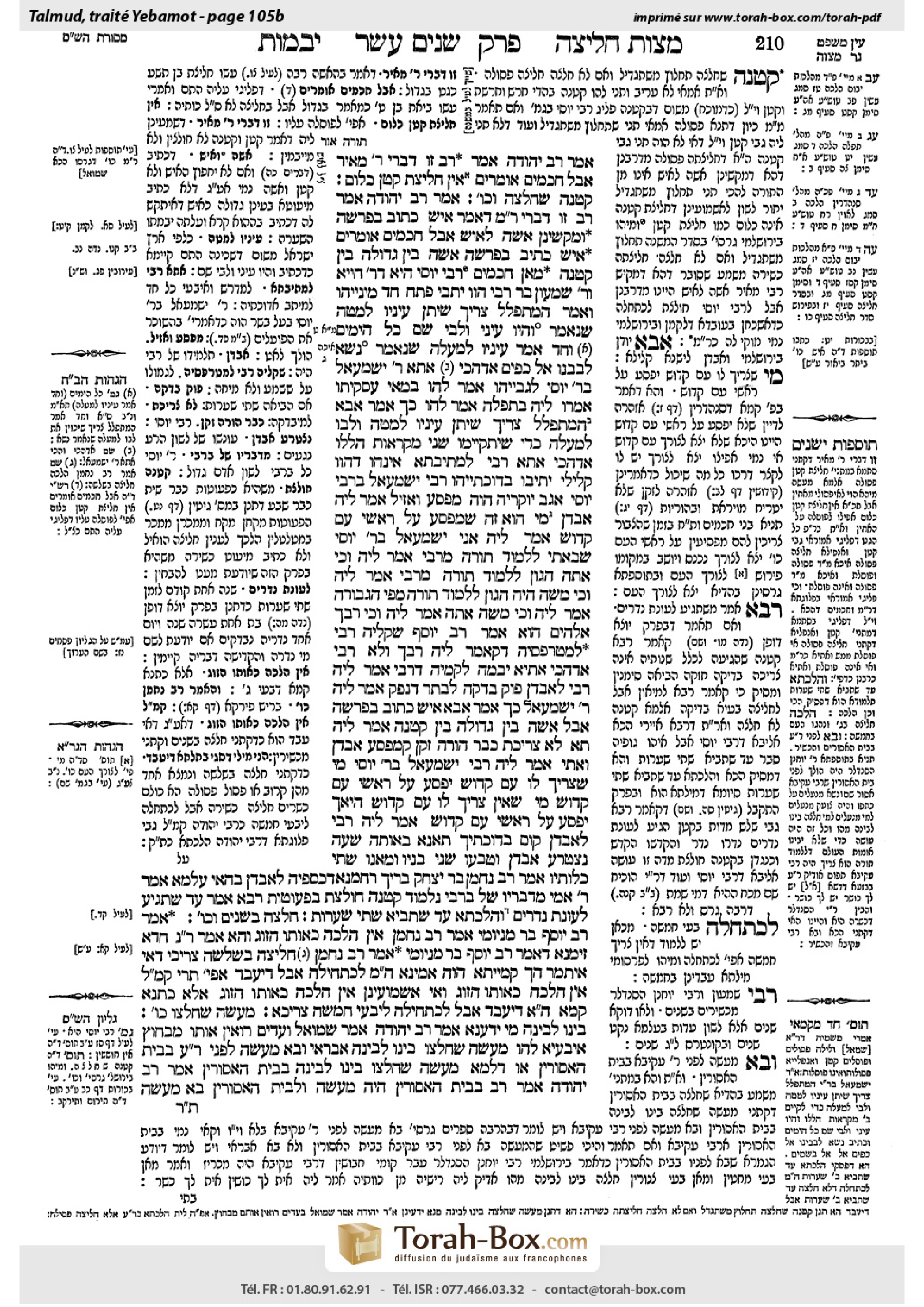
Yevamot 105b: Talmud study for Daf Yomi
Daf Yomi is the daily study of one Talmud folio. Explore 37 tractates with scans, Hebrew text, Sefaria English and AI-generated French translations where annotated.
Passage selection and English or AI-generated French translation are available where the scan has annotations. Daf Study is independent of Torah-Box and Sefaria.
Browse Yevamot · יבמות · All tractatesYevamot 105b text and translations
This page of Yevamot includes the Aramaic text, an English translation and an AI-generated French translation, alongside the scan above.
יבמות ק״ה ב · Aramaic and Hebrew text
אָמַר רַב יְהוּדָה אָמַר רַב: זוֹ דִּבְרֵי רַבִּי מֵאִיר, אֲבָל חֲכָמִים אוֹמְרִים: אֵין חֲלִיצַת קָטָן כְּלוּם.
קְטַנָּה שֶׁחָלְצָה וְכוּ׳. אָמַר רַב יְהוּדָה אָמַר רַב: זוֹ דִּבְרֵי רַבִּי מֵאִיר, דְּאָמַר: ״אִישׁ״ כָּתוּב בַּפָּרָשָׁה, וּמַקְּשִׁינַן אִשָּׁה לְאִישׁ.
אֲבָל חֲכָמִים אוֹמְרִים: ״אִישׁ״ כְּתִיב בַּפָּרָשָׁה. אִשָּׁה — בֵּין גְּדוֹלָה בֵּין קְטַנָּה.
מַאן חֲכָמִים? רַבִּי יוֹסֵי הִיא. דְּרַבִּי חִיָּיא וְרַבִּי שִׁמְעוֹן בַּר רַבִּי הֲווֹ יָתְבִי. פְּתַח חַד מִינַּיְיהוּ וַאֲמַר: הַמִּתְפַּלֵּל, צָרִיךְ שֶׁיִּתֵּן עֵינָיו לְמַטָּה, שֶׁנֶּאֱמַר: ״וְהָיוּ עֵינַי וְלִבִּי שָׁם כׇּל הַיָּמִים״.
וְחַד אָמַר: עֵינָיו לְמַעְלָה, שֶׁנֶּאֱמַר: ״נִשָּׂא לְבָבֵנוּ אֶל כַּפָּיִם״. אַדְּהָכִי אֲתָא רַבִּי יִשְׁמָעֵאל בְּרַבִּי יוֹסֵי לְגַבַּיְיהוּ. אֲמַר לְהוּ: בְּמַאי עָסְקִיתוּ? אֲמַרוּ לֵיהּ: בִּתְפִלָּה. אֲמַר לְהוּ: כָּךְ אָמַר אַבָּא: הַמִּתְפַּלֵּל צָרִיךְ שֶׁיִּתֵּן עֵינָיו לְמַטָּה וְלִבּוֹ לְמַעְלָה, כְּדֵי שֶׁיִּתְקַיְּימוּ שְׁנֵי מִקְרָאוֹת הַלָּלוּ.
אַדְּהָכִי, אֲתָא רַבִּי לִמְתִיבְתָּא. אִינְהוּ דַּהֲווֹ קַלִּילֵי, יְתִיבוּ בְּדוּכְתַּיְיהוּ. רַבִּי יִשְׁמָעֵאל בְּרַבִּי יוֹסֵי, אַגַּב יוּקְרֵיהּ הֲוָה מְפַסַּע וְאָזֵיל.
אֲמַר לֵיהּ אַבָּדָן: מִי הוּא זֶה שֶׁמְּפַסֵּעַ עַל רָאשֵׁי עַם קָדוֹשׁ! אֲמַר לֵיהּ: אֲנִי יִשְׁמָעֵאל בְּרַבִּי יוֹסֵי שֶׁבָּאתִי לִלְמוֹד תּוֹרָה מֵרַבִּי. אֲמַר לֵיהּ: וְכִי אַתָּה הָגוּן לִלְמוֹד תּוֹרָה מֵרַבִּי?
אֲמַר לֵיהּ: וְכִי מֹשֶׁה הָיָה הָגוּן לִלְמוֹד תּוֹרָה מִפִּי הַגְּבוּרָה? אֲמַר לֵיהּ: וְכִי מֹשֶׁה אַתָּה? אֲמַר לֵיהּ: וְכִי רַבְּךָ אֱלֹהִים הוּא? אָמַר רַב יוֹסֵף: שַׁקְלֵיהּ רַבִּי לְמַטְרַפְסֵיהּ — דְּקָאָמַר לֵיהּ: ״רַבְּךָ״ וְלָא ״רַבִּי״.
אַדְּהָכִי אַתְיָא יְבָמָה לְקַמֵּיהּ דְּרַבִּי. אֲמַר לֵיהּ רַבִּי לְאַבָּדָן: פּוֹק בִּדְקַהּ. לְבָתַר דִּנְפַק, אֲמַר לֵיהּ רַבִּי יִשְׁמָעֵאל, כָּךְ אָמַר אַבָּא: ״אִישׁ״ כָּתוּב בַּפָּרָשָׁה, אֲבָל אִשָּׁה — בֵּין גְּדוֹלָה בֵּין קְטַנָּה.
אֲמַר לֵיהּ: תָּא, לָא צְרִיכַתְּ, כְּבָר הוֹרָה זָקֵן. קָמְפַסַּע אַבָּדָן וְאָתֵי. אֲמַר לֵיהּ רַבִּי יִשְׁמָעֵאל בְּרַבִּי יוֹסֵי: מִי שֶׁצָּרִיךְ לוֹ עַם קָדוֹשׁ, יְפַסֵּעַ עַל רָאשֵׁי עַם קָדוֹשׁ. מִי שֶׁאֵין צָרִיךְ לוֹ עַם קָדוֹשׁ, הֵיאַךְ יְפַסֵּעַ עַל רָאשֵׁי עַם קָדוֹשׁ?
אֲמַר לֵיהּ רַבִּי לְאַבָּדָן: קוּם בְּדוּכְתִּיךְ! תָּאנָא: בְּאוֹתָהּ שָׁעָה נִצְטָרַע אַבָּדָן, וְטָבְעוּ שְׁנֵי בָנָיו, וּמֵאֲנוּ שְׁתֵּי כַלּוֹתָיו. אָמַר רַב נַחְמָן בַּר יִצְחָק: בְּרִיךְ רַחֲמָנָא דְּכַסְּפֵיהּ לְאַבָּדָן בְּהַאי עָלְמָא.
אָמַר רַבִּי אַמֵּי: מִדְּבָרָיו שֶׁל בְּרַבִּי נִלְמוֹד: קְטַנָּה חוֹלֶצֶת בִּפְעוּטוּת. רָבָא אָמַר: עַד שֶׁתַּגִּיעַ לְעוֹנַת נְדָרִים. וְהִלְכְתָא: עַד שֶׁתָּבִיא שְׁתֵּי שְׂעָרוֹת.
חָלְצָה בִּשְׁנַיִם וְכוּ׳. אָמַר רַב יוֹסֵף בַּר מִנְיוֹמֵי אָמַר רַב נַחְמָן: אֵין הֲלָכָה כְּאוֹתוֹ הַזּוּג. וְהָא אָמַר רַב נַחְמָן חֲדָא זִימְנָא. דְּאָמַר רַב יוֹסֵף בַּר מִנְיוֹמֵי אָמַר רַב נַחְמָן: חֲלִיצָה בִּשְׁלֹשָׁה!
צְרִיכִי, דְּאִי אִיתְּמַר הָךְ קַמַּיְיתָא, הֲוָה אָמֵינָא: הָנֵי מִילֵּי לְכַתְּחִילָּה, אֲבָל דִּיעֲבַד — אֲפִילּוּ תְּרֵי, קָא מַשְׁמַע לַן: אֵין הֲלָכָה כְּאוֹתוֹ הַזּוּג. וְאִי אַשְׁמוֹעִינַן אֵין הֲלָכָה כְּאוֹתוֹ הַזּוּג, אֶלָּא כְּתַנָּא קַמָּא, הֲוָה אָמֵינָא: דִּיעֲבַד, אֲבָל לְכַתְּחִילָּה לִיבְעֵי חֲמִשָּׁה, צְרִיכָא.
מַעֲשֶׂה שֶׁחָלְצוּ כּוּ׳. בֵּינוֹ לְבֵינָהּ מִי יָדַעְנָא? אָמַר רַב יְהוּדָה אָמַר שְׁמוּאֵל: וְעֵדִים רוֹאִין אוֹתוֹ מִבַּחוּץ.
אִיבַּעְיָא לְהוּ: מַעֲשֶׂה שֶׁחָלְצוּ בֵּינוֹ לְבֵינָהּ אַבָּרַאי, וּבָא מַעֲשֶׂה לִפְנֵי רַבִּי עֲקִיבָא בְּבֵית הָאֲסוּרִין, אוֹ דִלְמָא: מַעֲשֶׂה שֶׁחָלְצוּ בֵּינוֹ לְבֵינָהּ בְּבֵית הָאֲסוּרִין? אָמַר רַב יְהוּדָה אָמַר רַב: בְּבֵית הָאֲסוּרִין הָיָה מַעֲשֶׂה, וּלְבֵית הָאֲסוּרִין בָּא מַעֲשֶׂה.
Yevamot 105b · English translation
Rav Yehuda said that Rav said: This teaching of the mishna with regard to a minor is the statement of Rabbi Meir, who maintains that such a ḥalitza has significance in that it disqualifies a subsequent levirate marriage, but it is insufficient to permit the woman to marry a stranger. But the Rabbis say: The ḥalitza of a male minor isn’t significant of anything, as she is permitted to one of the brothers in levirate marriage as one who performed no ḥalitza at all.
§ It was taught in the mishna: If a female minor performed ḥalitza, she must perform ḥalitza a second time once she becomes an adult, and if she does not, her first ḥalitza is invalid. Rav Yehuda said that Rav said: This is the statement of Rabbi Meir, who said: “Man” is written in the Torah portion about ḥalitza: “And if the man does not wish” (Deuteronomy 25:7), implying an adult must perform ḥalitza, and we juxtapose and compare a woman with a man, indicating that the woman must also be an adult at the time of ḥalitza.
But the Rabbis say: “Man” is written in this Torah portion, which indicates that an adult male must perform ḥalitza, but with respect to the woman who removes the shoe, since the term woman is not used to describe her, but rather the more general term yevama is written, as the continuation of the above-mentioned verse says: “To take his yevama” (Deuteronomy 25:9), she may be either an adult or a female minor.
The Gemara asks: Who are these Rabbis who disagree with Rabbi Meir? The Gemara answers: It is Rabbi Yosei, as it seems from this incident: As, Rabbi Ḥiyya and Rabbi Shimon bar Rabbi Yehuda HaNasi were sitting outside the house of study, immersed in Torah learning. One of them began and said: One who prays must direct his gaze downward while praying, as it is stated by God with regard to the Holy Temple: “And My eyes and My heart shall be there perpetually” (I Kings 9:3), meaning: The Divine Presence rests in the Eretz Yisrael, and one must direct his gaze to the sacred land when praying.
And one of them said he must direct his eyes upward, because it is stated: “Let us lift our hearts with our hands toward God in Heaven” (Lamentations 3:41). In the meantime, Rabbi Yishmael, son of Rabbi Yosei, came beside them. He said to them: What are you dealing with? They said to him: With prayer, as we are debating the proper posture for prayer. He said to them: My father, Rabbi Yosei, said as follows: One who prays must direct his eyes downward and his heart upward, in order to fulfill both of these verses.
In the meantime, while they were talking, Rabbi Yehuda HaNasi came to the house of study and everyone quickly went to sit in their assigned places. Those who were light-footed hurried and sat in their places. Rabbi Yishmael, son of Rabbi Yosei, due to his being very heavy, was stepping and walking slowly, as everyone was already sitting in his place on the ground, requiring him to pass over their heads in order to get to his place.
Abdon, the shortened form of the name of Rabbi Yehuda HaNasi’s student and attendant, Abba Yudan, said to him: Who is that individual stepping over the heads of a sacred people, for it appeared to him as an act of disrespect to those sitting that Rabbi Yishmael stepped over their heads. He said to him: I am Yishmael, son of Rabbi Yosei, who came to learn Torah from Rabbi Yehuda HaNasi. Abdon said to him: But are you fit to learn Torah from Rabbi Yehuda HaNasi, for it seems that you are showing disrespect to others in order to accomplish it?
He said to him: Was Moses fit to learn Torah from the mouth of the Almighty? Rather, it is not necessary that the student be as dignified as his teacher. He said to him: And are you Moses? Rabbi Yishmael said to him: And is your teacher God? Rav Yosef said about this part of the story: Here Rabbi Yehuda HaNasi received his retribution [mittarpesei] for remaining silent during this discussion and not reprimanding his student for humiliating Rabbi Yishmael. And what is his retribution? When Rabbi Yishmael spoke to Abdon, he said your teacher, and not my teacher, implying that he did not accept Rabbi Yehuda HaNasi’s authority upon himself.
In the meantime, a yevama came before Rabbi, and she was a minor close to the age of maturity who had performed ḥalitza, but it was not clear whether she had already reached the age of maturity necessary to validate her ḥalitza. Rabbi Yehuda HaNasi said to Abdon: Go and check to see if she has already reached maturity. After Abdon left, Rabbi Yishmael said to Rabbi Yehuda HaNasi: My father, Rabbi Yosei, said as follows: “Man” is written in the Torah portion of ḥalitza, but the woman may be either an adult woman or a female minor.
Rabbi Yehuda HaNasi said to Abdon: Come back. You do not need to check, as the Elder, Rabbi Yosei, has already ruled that a minor can perform ḥalitza, and therefore no further examination is required. Abdon was stepping and coming over the heads of the others in order to return to his place. Rabbi Yishmael, son of Rabbi Yosei, said to him: One upon whom a holy people depends may step over the heads of a holy people. But one upon whom a holy people does not depend, as there is no longer a need for Abdon to examine the woman, how can he step over the heads of a holy people?
Rabbi Yehuda HaNasi said to Abdon: Stand in your place and do not go any further. It was taught: At that moment Abdon was afflicted with leprosy as a punishment for insulting Rabbi Yishmael, son of Rabbi Yosei, and two of his sons who were recently married drowned, and his two daughters-in-law, who were minors married to those sons, made declarations of refusal and annulled their marriages. Rav Naḥman bar Yitzḥak said: Blessed is the Merciful One, Who shames Abdon in this world, for this prevents him from being punished further in the World-to-Come, as all his iniquities have been forgiven through this suffering.
Rabbi Ami said: From the words of the great man, Rabbi Yosei, let us learn: A female minor performs ḥalitza even as a young child, at age six or seven. Rava said: She may not perform ḥalitza until she reaches the age of vows as an eleven-year-old, when she has enough intellectual capacity to understand the meaning of a vow. However, the Gemara concludes: And the halakha is: She may not perform ḥalitza until she has two pubic hairs.
It was taught in the mishna: If she performed ḥalitza before two or three people, and one of them is found to be disqualified to serve as a judge, Rabbi Shimon and Rabbi Yoḥanan the Cobbler validate it. Rav Yosef bar Minyumi said that Rav Naḥman said: The halakha does not follow this pair who validate such a case. The Gemara asks: But didn’t Rav Naḥman already say this same ruling one time before? As Rav Yosef bar Minyumi said that Rav Naḥman said: Ḥalitza must be conducted before three people, indicating that there must be no fewer than three valid judges.
The Gemara answers: Both are necessary, for if only the first one, stating that ḥalitza must be before three judges, were stated, I would say: This applies ab initio, but after the fact even two is acceptable. Therefore, he teaches us that the halakha does not follow this pair of Sages, and her ḥalitza before two people is invalid even after the fact. And vice versa: If he would have told us only that the halakha does not follow this pair, but rather the first tanna, I would say that it is valid if performed before three people only after the fact, but they must require five people ab initio, in accordance with Rabbi Yehuda’s opinion. Therefore it is necessary to say both of these statements.
§ A story is told in the mishna about an incident in which a couple once performed ḥalitza between themselves in private while alone in prison, and the case later came before Rabbi Akiva and he validated it. The Gemara asks: How can we know what happened between him and her? There was no testimony to confirm it, and how can we be certain that the ḥalitza was done properly to validate it? Rav Yehuda said that Shmuel said: And the ḥalitza was validated because there were witnesses who saw them from outside the prison, who testified that the ḥalitza was performed properly.
A dilemma was raised before the students in the house of study with regard to the incident recorded in the mishna in which a private ḥalitza performed in a prison was validated: Did the incident in which they performed ḥalitza between him and her privately actually take place outside in a different locale, and the reference to prison is that the case came before Rabbi Akiva when he was confined in prison? Or, perhaps the incident when they performed ḥalitza between him and her took place in prison, and then this case came before Rabbi Akiva? Rav Yehuda said that Rav said: The ḥalitza incident took place in prison, and also the case came to Rabbi Akiva when he was in prison.
Yevamot 105b · Traduction française (IA)
Rav Yehouda a dit au nom de Rav : Cet enseignement de la Michna concernant un mineur est l’avis de Rabbi Meïr, qui considère qu’une telle ḥalitsa a une portée en ce qu’elle invalide un mariage léviratique ultérieur, mais qu’elle ne suffit pas à permettre à la femme d’épouser un étranger. Les Sages, eux, disent : La ḥalitsa accomplie par un garçon mineur n’a aucune portée, car la femme peut épouser l’un des frères par mariage léviratique, comme si elle n’avait pas du tout accompli la ḥalitsa.
§ Il est enseigné dans la Michna : Si une fille mineure a accompli la ḥalitsa, elle doit l’accomplir une seconde fois lorsqu’elle devient majeure ; si elle ne le fait pas, sa première ḥalitsa est invalide. Rav Yehouda a dit au nom de Rav : C’est l’avis de Rabbi Meïr, qui a dit : Le terme « homme » figure dans le passage de la Torah relatif à la ḥalitsa : « Et si l’homme ne veut pas » (Deutéronome 25,7), ce qui implique qu’un adulte doit accomplir la ḥalitsa. Nous rapprochons la femme de l’homme et les comparons, ce qui indique que la femme aussi doit être adulte au moment de la ḥalitsa.
Mais les Sages disent : Le terme « homme » figure dans ce passage de la Torah, ce qui indique qu’un homme adulte doit accomplir la ḥalitsa. En revanche, pour la femme qui retire la chaussure, le terme « femme » n’est pas employé pour la désigner ; c’est plutôt le terme général yevama qui est écrit, comme le dit la suite du verset cité plus haut : « Pour prendre sa yevama » (Deutéronome 25,9). Elle peut donc être adulte ou mineure.
La Guemara demande : Qui sont ces Sages qui sont en désaccord avec Rabbi Meïr ? La Guemara répond : Il s’agit de Rabbi Yossé, comme le montre cet épisode. Rabbi Ḥiyya et Rabbi Shimon, fils de Rabbi Yehouda HaNassi, étaient assis à l’extérieur de la maison d’étude, plongés dans l’étude de la Torah. L’un d’eux prit la parole et dit : Celui qui prie doit diriger son regard vers le bas pendant la prière, comme il est dit à propos du Temple : « Mes yeux et Mon cœur y seront perpétuellement » (I Rois 9,3). Cela signifie que la Présence divine repose en Eretz Israël et que l’on doit diriger son regard vers la terre sainte pendant la prière.
L’autre dit qu’il faut diriger les yeux vers le haut, car il est dit : « Élevons nos cœurs avec nos mains vers Dieu au ciel » (Lamentations 3,41). Sur ces entrefaites, Rabbi Yishmaël, fils de Rabbi Yossé, passa près d’eux. Il leur demanda : « De quoi parlez-vous ? » Ils lui répondirent : « De la prière, car nous débattons de la posture à adopter pendant la prière. » Il leur dit : « Mon père, Rabbi Yossé, a dit ceci : Celui qui prie doit diriger ses yeux vers le bas et son cœur vers le haut », afin d’accomplir ces deux versets.
Pendant qu’ils parlaient, Rabbi Yehouda HaNassi arriva à la maison d’étude et tous se dépêchèrent de s’asseoir à leurs places assignées. Ceux qui avaient le pas léger se hâtèrent et s’assirent à leur place. Rabbi Yishmaël, fils de Rabbi Yossé, en raison de son grand embonpoint, avançait lentement. Tous étaient déjà assis à même le sol, à leur place, et il dut donc passer par-dessus leurs têtes pour rejoindre la sienne.
Abdon, forme abrégée du nom Abba Yudan, élève et assistant de Rabbi Yehouda HaNassi, lui dit : « Qui est cet individu qui marche par-dessus les têtes d’un peuple saint ? » Le fait que Rabbi Yishmaël passe par-dessus les têtes des personnes assises lui semblait irrespectueux. Il lui répondit : « Je suis Yishmaël, fils de Rabbi Yossé, et je suis venu étudier la Torah auprès de Rabbi Yehouda HaNassi. » Abdon lui dit : « Mais es-tu digne d’étudier la Torah auprès de Rabbi Yehouda HaNassi, alors qu’il semble que tu manques de respect aux autres pour y parvenir ? »
Il lui répondit : « Moïse était-il digne de recevoir la Torah de la bouche du Tout-Puissant ? Il n’est pas nécessaire que l’élève soit aussi digne que son maître. » Abdon lui dit : « Et toi, es-tu Moïse ? » Rabbi Yishmaël lui répondit : « Et ton maître, est-il Dieu ? » Rav Yossef dit à propos de cette partie du récit : Ici, Rabbi Yehouda HaNassi reçut son châtiment [mittarpesei] pour être resté silencieux pendant cette discussion et ne pas avoir réprimandé son élève qui avait humilié Rabbi Yishmaël. Quel fut son châtiment ? Lorsque Rabbi Yishmaël s’adressa à Abdon, il dit « ton maître », et non « mon maître », laissant entendre qu’il ne reconnaissait pas l’autorité de Rabbi Yehouda HaNassi sur lui.
Sur ces entrefaites, une yevama se présenta devant Rabbi. Elle était mineure, proche de l’âge de la majorité, et avait accompli la ḥalitsa, mais on ne savait pas clairement si elle avait déjà atteint l’âge de la majorité nécessaire pour que sa ḥalitsa soit valide. Rabbi Yehouda HaNassi dit à Abdon : « Va vérifier si elle a déjà atteint la majorité. » Après le départ d’Abdon, Rabbi Yishmaël dit à Rabbi Yehouda HaNassi : « Mon père, Rabbi Yossé, a dit ceci : Le terme “homme” figure dans le passage de la Torah relatif à la ḥalitsa, mais la femme peut être adulte ou mineure. »
Rabbi Yehouda HaNassi dit à Abdon : « Reviens. Il n’est pas nécessaire de vérifier, car l’Ancien, Rabbi Yossé, a déjà statué qu’une mineure peut accomplir la ḥalitsa ; aucun examen supplémentaire n’est donc requis. » Abdon avançait en passant par-dessus les têtes des autres pour retourner à sa place. Rabbi Yishmaël, fils de Rabbi Yossé, lui dit : « Celui dont dépend un peuple saint peut passer par-dessus les têtes d’un peuple saint. Mais celui dont ne dépend pas un peuple saint — puisqu’il n’est plus nécessaire qu’Abdon examine la femme — comment peut-il passer par-dessus les têtes d’un peuple saint ? »
Rabbi Yehouda HaNassi dit à Abdon : « Reste à ta place et n’avance pas davantage. » Il a été enseigné qu’à cet instant, Abdon fut frappé de lèpre en punition pour avoir insulté Rabbi Yishmaël, fils de Rabbi Yossé ; deux de ses fils, récemment mariés, se noyèrent, et ses deux belles-filles, qui étaient mineures et mariées à ces fils, firent une déclaration de refus et annulèrent leurs mariages. Rav Naḥman bar Yitzḥak dit : « Béni soit le Miséricordieux, qui humilie Abdon en ce monde, car cela lui évite un châtiment supplémentaire dans le Monde futur, puisque toutes ses fautes lui ont été pardonnées par cette souffrance. »
Rabbi Ami dit : « Des paroles de ce grand homme, Rabbi Yossé, apprenons qu’une fille mineure accomplit la ḥalitsa même dès l’âge de six ou sept ans. » Rava dit : « Elle ne peut accomplir la ḥalitsa avant d’avoir atteint l’âge des vœux, à onze ans, lorsqu’elle possède une capacité intellectuelle suffisante pour comprendre le sens d’un vœu. » Toutefois, la Guemara conclut : La halakha est qu’elle ne peut accomplir la ḥalitsa avant d’avoir deux poils pubiens.
Il est enseigné dans la Michna : Si elle a accompli la ḥalitsa devant deux ou trois personnes, et que l’une d’elles se révèle inapte à exercer comme juge, Rabbi Shimon et Rabbi Yoḥanan le Cordonnier la déclarent valide. Rav Yossef bar Minyumi a dit au nom de Rav Naḥman : La halakha ne suit pas l’avis de ces deux sages qui valident un tel cas. La Guemara demande : Mais Rav Naḥman n’a-t-il pas déjà énoncé cette même règle ? Car Rav Yossef bar Minyumi a dit au nom de Rav Naḥman : La ḥalitsa doit se dérouler devant trois personnes, ce qui indique qu’il faut au moins trois juges aptes.
La Guemara répond : Les deux énoncés sont nécessaires. Si seul le premier, selon lequel la ḥalitsa doit se dérouler devant trois juges, avait été énoncé, j’aurais dit que cela s’applique a priori, mais qu’après coup, deux personnes suffisent. Il nous enseigne donc que la halakha ne suit pas l’avis de ces deux sages et que sa ḥalitsa devant deux personnes est invalide même après coup. Inversement, si l’on nous avait seulement dit que la halakha ne suit pas l’avis de ces deux sages, mais celui du premier tanna, j’aurais dit que la ḥalitsa devant trois personnes n’est valide qu’après coup, mais qu’il en faut cinq a priori, conformément à l’avis de Rabbi Yehouda. Il est donc nécessaire d’énoncer les deux règles.
§ La Michna relate qu’un couple avait un jour accompli la ḥalitsa en privé, seuls dans une prison, et que l’affaire fut ensuite portée devant Rabbi Akiva, qui la valida. La Guemara demande : Comment peut-on savoir ce qui s’est passé entre lui et elle ? Il n’y avait aucun témoignage pour le confirmer ; comment peut-on être certain que la ḥalitsa a été accomplie correctement et qu’elle est donc valide ? Rav Yehouda a dit au nom de Shmuel : La ḥalitsa fut validée parce que des témoins les avaient vus depuis l’extérieur de la prison et avaient attesté qu’elle avait été accomplie correctement.
Une question fut posée aux élèves de la maison d’étude au sujet de l’épisode rapporté dans la Michna, où une ḥalitsa accomplie en privé dans une prison fut validée : L’épisode où ils accomplirent la ḥalitsa en privé, lui et elle, eut-il réellement lieu à l’extérieur, dans un autre endroit, et la mention de la prison signifie-t-elle que l’affaire fut portée devant Rabbi Akiva alors qu’il était détenu en prison ? Ou bien l’épisode où ils accomplirent la ḥalitsa eut-il lieu en prison, puis l’affaire fut-elle portée devant Rabbi Akiva ? Rav Yehouda a dit au nom de Rav : L’épisode de la ḥalitsa eut lieu en prison, et l’affaire fut également portée devant Rabbi Akiva alors qu’il était en prison.
Traduction française générée par IA à partir de l’édition anglaise de Sefaria. Vérifie toujours un passage avec le texte source.
Text from Sefaria: William Davidson Edition - Vocalized Aramaic (CC BY NC); William Davidson Edition - English (CC BY NC).