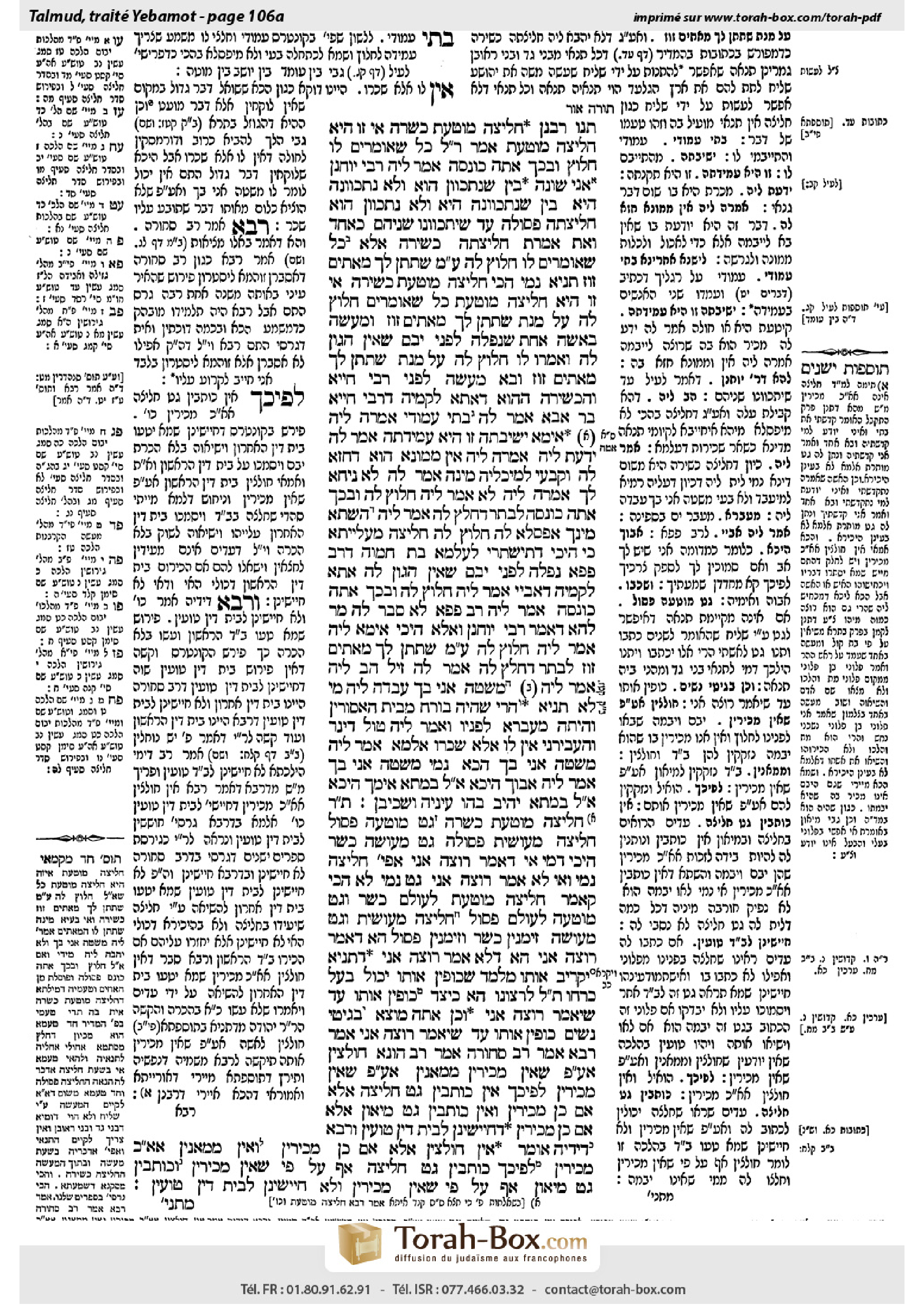
Yevamot 106a: Talmud study for Daf Yomi
Daf Yomi is the daily study of one Talmud folio. Explore 37 tractates with scans, Hebrew text, Sefaria English and AI-generated French translations where annotated.
Passage selection and English or AI-generated French translation are available where the scan has annotations. Daf Study is independent of Torah-Box and Sefaria.
Browse Yevamot · יבמות · All tractatesYevamot 106a text and translations
This page of Yevamot includes the Aramaic text, an English translation and an AI-generated French translation, alongside the scan above.
יבמות ק״ו א · Aramaic and Hebrew text
תָּנוּ רַבָּנַן: חֲלִיצָה מוּטְעֵת — כְּשֵׁרָה. אֵי זוֹ הִיא חֲלִיצָה מוּטְעֵת? אָמַר רֵישׁ לָקִישׁ: כֹּל שֶׁאוֹמְרִים לוֹ: חֲלוֹץ, וּבְכָךְ אַתָּה כּוֹנְסָהּ.
אֲמַר לֵיהּ רַבִּי יוֹחָנָן, אֲנִי שׁוֹנֶה: בֵּין שֶׁנִּתְכַּוֵּון הוּא וְלֹא נִתְכַּוְּונָה הִיא, בֵּין שֶׁנִּתְכַּוְּונָה הִיא וְלֹא נִתְכַּוֵּון הוּא — חֲלִיצָתָהּ פְּסוּלָה, עַד שֶׁיִּתְכַּוְּונוּ שְׁנֵיהֶם כְּאֶחָד. וְאַתְּ אָמְרַתְּ חֲלִיצָתָהּ כְּשֵׁירָה?!
אֶלָּא כֹּל שֶׁאוֹמְרִים לוֹ: ״חֲלוֹץ לָהּ עַל מְנָת שֶׁתִּתֵּן לְךָ מָאתַיִם זוּז״. תַּנְיָא נָמֵי הָכִי: חֲלִיצָה מוּטְעֵת — כְּשֵׁירָה. אֵי זוֹ הִיא חֲלִיצָה מוּטְעֵת — כֹּל שֶׁאוֹמְרִים: חֲלוֹץ לָהּ עַל מְנָת שֶׁתִּתֵּן לְךָ מָאתַיִם זוּז.
וּמַעֲשֶׂה בְּאִשָּׁה אַחַת שֶׁנָּפְלָה לִפְנֵי יָבָם שֶׁאֵין הָגוּן לָהּ, וְאָמְרוּ לוֹ: ״חֲלוֹץ לָהּ עַל מְנָת שֶׁתִּתֵּן לְךָ מָאתַיִם זוּז״, וּבָא מַעֲשֶׂה לִפְנֵי רַבִּי חִיָּיא וְהִכְשִׁירָהּ.
הַהוּא דַּאֲתָא לְקַמֵּיהּ דְּרַבִּי חִיָּיא בַּר אַבָּא. אֲמַר לַהּ: בִּתִּי, עֲמוֹדִי! אֲמַרָה לֵיהּ: אֵימָא יְשִׁיבָתָהּ זוֹ הִיא עֲמִידָתָהּ. אֲמַר לַהּ: יָדְעַתְּ לֵיהּ? אֲמַרָה לֵיהּ: אִין, מָמוֹנָא הוּא דַּחֲזָא לַהּ וְקָבְעֵי לְמֵיכְלֵיהּ מִינַּהּ.
אֲמַר לַהּ: לָא נִיחָא לָךְ? אֲמַרָה לֵיהּ: לָא. אֲמַר לֵיהּ: חֲלוֹץ לָהּ, וּבְכָךְ אַתָּה כּוֹנְסָהּ. לְבָתַר דַּחֲלַץ לַהּ, אֲמַר לֵיהּ: הַשְׁתָּא, מִינָּךְ אִפַּסְלָא לַהּ, חֲלוֹץ לַהּ חֲלִיצָה מְעַלַּיְיתָא, כִּי הֵיכִי דְּתִישְׁתְּרֵי לְעָלְמָא.
בַּת חֲמוּהּ, דְּרַב פָּפָּא נָפְלָה לִפְנֵי יָבָם שֶׁאֵין הָגוּן לָהּ. אֲתָא לְקַמֵּיהּ דְּאַבָּיֵי, אֲמַר לֵיהּ: חֲלוֹץ לָהּ, וּבְכָךְ אַתָּה כּוֹנְסָהּ. אֲמַר לֵיהּ רַב פָּפָּא: לָא סָבַר לַהּ מָר לְהָא דְּאָמַר רַבִּי יוֹחָנָן? וְאֶלָּא הֵיכִי אֵימָא לֵיהּ?
אֲמַר לֵיהּ: חֲלוֹץ לָהּ עַל מְנָת שֶׁתִּתֵּן לְךָ מָאתַיִם זוּז. לְבָתַר דַּחֲלַץ לַהּ, אֲמַר לַהּ: זִיל הַב לֵיהּ. אֲמַר לֵיהּ: מְשַׁטָּה אֲנִי בָּךְ עֲבַדָה לֵיהּ.
מִי לָא תַּנְיָא: הֲרֵי שֶׁהָיָה בּוֹרֵחַ מִבֵּית הָאֲסוּרִין, וְהָיְתָה מַעְבּוֹרֶת לְפָנָיו, וַאֲמַר לֵיהּ: טוֹל דִּינָר וְהַעֲבִירֵנִי — אֵין לוֹ אֶלָּא שְׂכָרוֹ.
אַלְמָא אָמַר לֵיהּ מְשַׁטֶּה אֲנִי בָּךְ — הָכָא נָמֵי, מְשַׁטָּה אֲנִי בָּךְ.
אֲמַר לֵיהּ: אֲבוּךְ הֵיכָא? אֲמַר לֵיהּ: בְּמָתָא. אִימָּךְ הֵיכָא? אֲמַר לֵיהּ: בְּמָתָא. יְהַב בְּהוּ עֵינֵיהּ (וּשְׁכִיבָן).
תָּנוּ רַבָּנַן: חֲלִיצָה מוּטְעֵת — כְּשֵׁרָה. גֵּט מוּטְעֶה — פָּסוּל. חֲלִיצָה מְעוּשֵּׂית — פְּסוּלָה. גֵּט מְעוּשֶּׂה — כָּשֵׁר. הֵיכִי דָּמֵי? אִי דְּאָמַר ״רוֹצֶה אֲנִי״ — אֲפִילּוּ חֲלִיצָה נָמֵי, וְאִי לָא אָמַר ״רוֹצֶה אֲנִי״ — גֵּט נָמֵי לָא.
הָכִי קָאָמַר: חֲלִיצָה מוּטְעֵת לְעוֹלָם כָּשֵׁר, וְגֵט מוּטְעֶה לְעוֹלָם פָּסוּל. חֲלִיצָה מְעוּשֵּׂית וְגֵט מְעוּשֶּׂה — זִימְנִין כָּשֵׁר וְזִימְנִין פָּסוּל. הָא דְּאָמַר ״רוֹצֶה אֲנִי״, הָא דְּלָא אָמַר ״רוֹצֶה אֲנִי״.
דְּתַנְיָא: ״יַקְרִיב אוֹתוֹ״ — מְלַמֵּד שֶׁכּוֹפִין אוֹתוֹ. יָכוֹל בְּעַל כׇּרְחוֹ — תַּלְמוּד לוֹמַר: ״לִרְצוֹנוֹ״. הָא כֵּיצַד? כּוֹפִין אוֹתוֹ עַד שֶׁיֹּאמַר ״רוֹצֶה אֲנִי״. וְכֵן אַתָּה מוֹצֵא בְּגִיטֵּי נָשִׁים, כּוֹפִין אוֹתוֹ עַד שֶׁיֹּאמַר ״רוֹצֶה אֲנִי״.
אָמַר רָבָא אָמַר רַב סְחוֹרָה אָמַר רַב הוּנָא: חוֹלְצִין אַף עַל פִּי שֶׁאֵין מַכִּירִין, מְמָאֲנִין אַף עַל פִּי שֶׁאֵין מַכִּירִין.
לְפִיכָךְ אֵין כּוֹתְבִין גֵּט חֲלִיצָה אֶלָּא אִם כֵּן מַכִּירִין, וְאֵין כּוֹתְבִין גֵּט מֵיאוּן אֶלָּא אִם כֵּן מַכִּירִין, דְּחָיְישִׁינַן לְבֵית דִּין טוֹעִין.
וְרָבָא דִּידֵיהּ אוֹמֵר: אֵין חוֹלְצִין אֶלָּא אִם כֵּן מַכִּירִין, וְאֵין מְמָאֲנִין אֶלָּא אִם כֵּן מַכִּירִין. לְפִיכָךְ כּוֹתְבִין גֵּט חֲלִיצָה אַף עַל פִּי שֶׁאֵין מַכִּירִין, וְכוֹתְבִין גֵּט מֵיאוּן אַף עַל פִּי שֶׁאֵין מַכִּירִין, וְלָא חָיְישִׁינַן לְבֵית דִּין טוֹעִין.
Yevamot 106a · English translation
§ The Sages taught: A mistaken ḥalitza is valid. The Gemara asks: What constitutes a mistaken ḥalitza? Reish Lakish said: Any case in which they say to a yavam who is not well versed in halakha: Let her remove your shoe, and in doing so you will take her in marriage, i.e., the yavam understands that by allowing ḥalitza he will actually be marrying her. Although he actually intended to marry her, having allowed her to remove his shoe validates the ḥalitza. Subsequently it is prohibited for the woman to marry him, and she is permitted to others.
Rabbi Yoḥanan said to him: I teach that whether in a case where he had intended to perform valid ḥalitza and she did not intend, or whether she had intended and he did not intend, the ḥalitza is invalid, unless they both intend together as one to perform a proper ḥalitza that would permit her to marry others. And yet you say that in that case when he doesn’t have any intention of permitting her to others, and actually intends to marry her through the act of ḥalitza, her ḥalitza is valid?
Rather, a mistaken ḥalitza that is valid refers to any case in which they say to him: Let her perform ḥalitza on you, with the intention of releasing her bond, on the condition that she will give you two hundred dinars afterward, and even if she does not give him the money the ḥalitza is valid, as the stipulated condition is not binding. This idea of Rabbi Yoḥanan is also taught in a baraita, which states: A mistaken ḥalitza is valid. What constitutes a mistaken ḥalitza? Any case in which they say: Let her perform ḥalitza on you on condition that she will give you two hundred dinars.
And an incident occurred involving a certain woman, who happened before her yavam for levirate marriage, yet he was not suitable for her, and they, the judges, said to him: Let her perform ḥalitza on the condition that she will give you two hundred dinars. Afterward, when she did not pay, the incident came before Rabbi Ḥiyya and he validated that ḥalitza.
One man came before Rabbi Ḥiyya bar Abba with his yevama in order to have the court convince her to perform a levirate marriage. Rabbi Ḥiyya said to her: My daughter, stand up, for we are beginning to discuss your case now, and the participants must stand. She said to him: Say that her sitting, referring to her desire to remain seated as an act of refusal of even contemplating the possibility of performing levirate marriage, is therefore tantamount to her standing, as levirate marriage is not an option for her. In other words, the option that will enable her to remain standing proud in the future is not to enter into levirate marriage with this man. Rabbi Ḥiyya said to her: Are you acquainted with this yavam and do you know him well enough to know why he wants to perform levirate marriage with you although you are not interested? She said to him: Yes, it is money that he saw in her, a euphemism for herself, and he wants to consume it by taking it from her, and therefore he wishes to enter levirate marriage.
Rabbi Ḥiyya said to her: Is he not amenable to you? She said to him: No, I am certain he is not good for me. Rabbi Ḥiyya accepted her wish, but knowing that the yavam was adamant in his desire to marry her, he said to the yavam: Let her remove your shoe, and in doing so you will take her in marriage, for he wanted to mislead him into allowing ḥalitza, which would disqualify a subsequent levirate marriage between them. After he allowed her to perform ḥalitza, Rabbi Ḥiyya said to the yavam: Now, she is disqualified for you forever, since you allowed her to perform ḥalitza. Although you thought it was an act of marriage, she is no longer permitted to marry you, so you have nothing to lose if you permit her to marry others. Therefore, allow her to perform valid proper ḥalitza, so she will be permitted to others. By performing a second ḥalitza, even Rabbi Yoḥanan, who disqualified this form of a mistaken ḥalitza, would have no problem permitting her to remarry based on the second ḥalitza.
It is told: The daughter of Rav Pappa’s father-in-law, i.e., his sister-in-law, happened before her yavam for levirate marriage, yet he was not suitable for her, although he wished to perform levirate marriage. The case came before Abaye. Abaye said to the yavam: Let her remove your shoe, and in doing so you will take her in marriage. Rav Pappa said to him: Does the Master, i.e., do you, not accept what Rabbi Yoḥanan said, that this type of ḥalitza does not work at all? Abaye said to him: But what shall I say to him?
He said to Abaye that he should say to him as Rabbi Yoḥanan himself suggested: Let her perform ḥalitza on the condition that she will give you two hundred dinars. Convince him to allow ḥalitza on the basis that he will profit financially from it. Abaye told the yavam to do so and he did. After he let her perform ḥalitza, Abaye said to Rav Pappa’s sister-in-law: Go give him the money, for you have agreed to give him two hundred dinars. Rav Pappa said to Abaye on her behalf that a case of: I was fooling you, was what she did to him. She never seriously intended to give him the money when accepting his stipulated condition, and even though the ḥalitza is valid one cannot force her to pay.
Isn’t it taught in a baraita: One who was running away from prison and came upon a ferry. He said to the ferry man: Take a dinar, i.e., he offered to pay an amount much larger than the standard fee, and take me across the river. Despite the escapee’s commitment, it is ruled in the baraita that the ferryman receives nothing other than his usual rate, as the escapee is legally exempt from paying the higher amount he had agreed to pay.
Apparently, one could have said in such a case: I was deceiving you and never really intended to live up to my side of the agreement, and therefore it is not an actual debt. Here too, she may say to him: I was fooling you, and she is therefore exempt from paying the two hundred dinars. Abaye heard this and agreed.
Abaye was amazed at Rav Pappa’s sharpness, as he was a young man at the time of this incident. Therefore, he said to Rav Pappa: Where is your father? He said to him: He is in the city. Where is your mother? He said: In the city. Abaye, who was orphaned in his youth, felt that a large part of Rav Pappa’s success came because his parents lived in close proximity to him and provided for all his needs, freeing him from any need to get involved in business affairs and enabling him to immerse himself in Torah without distractions. Abaye felt a twinge of jealousy and set his gaze upon them, Rav Pappa’s parents, in the pain that he did not have similarly supportive parents, and both Rav Pappa’s father and mother died.
§ The Sages taught: A mistaken ḥalitza is valid, while a mistaken bill of divorce is invalid. A coerced ḥalitza is invalid, while a coerced bill of divorce is valid. The Gemara clarifies: What are the circumstances of a coerced bill of divorce? If they force him until he says: I want to give the bill of divorce, then even this type of ḥalitza also should be valid, as although he was initially coerced, he acquiesced. And if he did not say by the end of the giving of the bill of divorce: I want to divorce her, then even this type of coerced bill of divorce should also not be acceptable.
The Gemara answers that this is what the Sage said: A mistaken ḥalitza is always valid, while a mistaken bill of divorce is always invalid. A coerced ḥalitza and a coerced bill of divorce are sometimes valid and sometimes invalid. How so? With regard to the one who says after being coerced: I want to give the bill of divorce, it is effective, although he says this as a result of being under compulsion. With regard to the one who does not say: I want to give the bill of divorce, the divorce is invalid.
As it is taught in a baraita: It is said with regard to some offerings: “He shall offer it” (Leviticus 1:3). This teaches that they may coerce him to bring the offering he owes. I might have thought this means that he brings the offering totally against his will. Therefore, the continuation of that verse states: “In accordance with his will” (Leviticus 1:3). How can these two contradictory expositions be reconciled? They coerce him by imposing fines or penalties until he says: I want to. And similarly, you find the same principle with respect to bills of divorce for women, as it is prohibited for anyone other than the husband to write the bill of divorce, but they coerce him until he says: I want to divorce her, and then write the bill of divorce on his behalf.
§ Rava said that Rav Seḥora said that Rav Huna said: Judges can allow a man and woman to conduct ḥalitza even if the judges do not recognize the participants. In other words, even if they do not have complete testimony before them that proves that these two people are a yavam and a yevama, if two people wish to perform ḥalitza, the judges are not required to check their identities. Likewise, with regard to women making declarations of refusal: If a young woman after reaching majority comes to make a declaration of refusal against her husband, she may do so, even if witnesses do not recognize her and they do not know for sure that she is the wife of the supposed husband.
Therefore, in cases where the woman is not identified, although the court may perform ḥalitza and refusals, it may not write a document of ḥalitza, i.e., a document attesting that ḥalitza took place, unless they, the judges, recognize her. And witnesses to the act may not write a document of a declaration of refusal, i.e., a document attesting that a refusal took place, unless they, the judges, recognize the woman, as we are concerned about the possibility of a mistaken court. Perhaps a court will not know that such a document is not complete proof that the action was conducted properly, and will consider it as proof that it was the yevama in this document who removed the shoe, or the wife in this document who made a declaration of refusal. Since the first court can conduct ḥalitza and refusals without accepting witnesses attesting to the identities of the involved parties, a second court cannot rely on these attesting documents alone, but must verify the identities before declaring the women eligible for marriage.
And Rava himself said the opposite of what he quoted in the name of others: A court may not conduct ḥalitza unless they, the judges, recognize the participants, and a court may not convene a declaration of refusal unless they, the judges, recognize the young woman. Therefore, witnesses may write a document of ḥalitza even if they do not recognize the woman themselves, as one who witnessed a court conduct ḥalitza can be sure that the court already checked the party’s identities thoroughly. And witnesses may write a document of refusal even if they do not recognize the young woman who has refused, relying on the fact that witnesses must have already attested to their identities. And we need not be concerned about the possibility of a mistaken court, as there is no reason to fear that the first court conducted the case without properly identifying the participants.
Yevamot 106a · Traduction française (IA)
§ Les Sages ont enseigné : Une ḥalitsa faite par erreur est valable. La Guemara demande : Qu’est-ce qu’une ḥalitsa faite par erreur ? Reish Lakish a dit : C’est tout cas où l’on dit à un yavam qui connaît mal la halakha : « Qu’elle te retire ta chaussure ; ainsi, tu la prendras pour épouse », c’est-à-dire que le yavam comprend qu’en lui permettant de retirer sa chaussure, il l’épousera en réalité. Bien qu’il ait effectivement eu l’intention de l’épouser, le fait de lui avoir permis de retirer sa chaussure rend la ḥalitsa valable. Par la suite, il lui est interdit d’épouser cet homme, et elle peut épouser d’autres hommes.
Rabbi Yoḥanan lui dit : J’enseigne que, qu’il s’agisse d’un cas où lui avait eu l’intention d’accomplir une ḥalitsa valable, mais pas elle, ou d’un cas où elle en avait eu l’intention, mais pas lui, la ḥalitsa est invalide, à moins qu’ils n’aient tous deux l’intention, ensemble et d’un commun accord, d’accomplir une ḥalitsa en bonne et due forme, qui lui permettra d’épouser d’autres hommes. Et pourtant, tu dis que, dans ce cas où il n’a nullement l’intention de lui permettre d’épouser d’autres hommes et où il entend en réalité l’épouser par l’acte de ḥalitsa, sa ḥalitsa est valable ?
Il s’agit plutôt, dans le cas d’une ḥalitsa faite par erreur qui est valable, de tout cas où l’on dit à l’homme : « Qu’elle procède à la ḥalitsa sur toi afin de rompre son lien, à condition qu’elle te donne ensuite deux cents dinars. » Même si elle ne lui donne pas l’argent, la ḥalitsa est valable, car la condition stipulée n’a pas force obligatoire. Cette idée de Rabbi Yoḥanan est également enseignée dans une baraïta, qui énonce : Une ḥalitsa faite par erreur est valable. Qu’est-ce qu’une ḥalitsa faite par erreur ? C’est tout cas où l’on dit : « Qu’elle procède à la ḥalitsa sur toi, à condition qu’elle te donne deux cents dinars. »
Un incident s’est produit au sujet d’une certaine femme qui se présenta devant son yavam pour le mariage léviratique, alors que celui-ci ne lui convenait pas. Les juges lui dirent : « Qu’elle procède à la ḥalitsa, à condition qu’elle te donne deux cents dinars. » Par la suite, comme elle ne paya pas, l’affaire fut portée devant Rabbi Ḥiyya, qui valida cette ḥalitsa.
Un homme se présenta devant Rabbi Ḥiyya bar Abba avec sa yevama, afin que le tribunal la convainque de contracter un mariage léviratique. Rabbi Ḥiyya lui dit : « Ma fille, lève-toi, car nous allons maintenant examiner ton affaire », puisque les personnes présentes devaient se tenir debout. Elle lui répondit : « Dis plutôt que le fait qu’elle soit assise — allusion à son refus d’envisager même la possibilité d’un mariage léviratique — équivaut à ce qu’elle soit debout, car le mariage léviratique n’est pas une option pour elle. » Autrement dit, le seul moyen pour elle de pouvoir rester fièrement debout à l’avenir est de ne pas contracter de mariage léviratique avec cet homme. Rabbi Ḥiyya lui demanda : « Connais-tu ce yavam et le connais-tu assez bien pour savoir pourquoi il veut contracter un mariage léviratique avec toi, alors que tu ne le souhaites pas ? » Elle lui répondit : « Oui, c’est de l’argent qu’il a vu en elle — expression pudique désignant sa personne — et qu’il veut consommer en le lui prenant ; c’est pourquoi il souhaite contracter un mariage léviratique. »
Rabbi Ḥiyya lui demanda : « Ne te convient-il pas ? » Elle répondit : « Non, je suis certaine qu’il ne me convient pas. » Rabbi Ḥiyya accepta son souhait. Mais, sachant que le yavam était déterminé à l’épouser, il lui dit : « Qu’elle te retire ta chaussure ; ainsi, tu la prendras pour épouse », car il voulait le tromper afin qu’il permette la ḥalitsa, ce qui exclurait entre eux tout mariage léviratique ultérieur. Après qu’il lui eut permis d’accomplir la ḥalitsa, Rabbi Ḥiyya lui dit : « À présent, elle t’est définitivement interdite, puisque tu lui as permis d’accomplir la ḥalitsa. Même si tu pensais qu’il s’agissait d’un acte de mariage, elle ne peut plus t’épouser ; tu n’as donc rien à perdre à lui permettre d’épouser d’autres hommes. Permets-lui donc d’accomplir une ḥalitsa valable et en bonne et due forme, afin qu’elle puisse épouser d’autres hommes. Une fois la seconde ḥalitsa accomplie, même Rabbi Yoḥanan, qui invalide cette forme de ḥalitsa faite par erreur, n’aurait aucune difficulté à lui permettre de se remarier sur la base de cette seconde ḥalitsa. »
Il est rapporté que la fille du beau-père de Rav Pappa, c’est-à-dire sa belle-sœur, se présenta devant son yavam pour le mariage léviratique, mais celui-ci ne lui convenait pas, bien qu’il souhaitât contracter ce mariage. L’affaire fut portée devant Abaye. Abaye dit au yavam : « Qu’elle te retire ta chaussure ; ainsi, tu la prendras pour épouse. » Rav Pappa lui dit : « Le Maître n’accepte-t-il pas l’enseignement de Rabbi Yoḥanan, selon lequel ce genre de ḥalitsa est totalement inopérant ? » Abaye lui répondit : « Mais que veux-tu que je lui dise ? »
Rav Pappa dit à Abaye de répondre au yavam comme Rabbi Yoḥanan lui-même l’avait suggéré : « Qu’elle procède à la ḥalitsa, à condition qu’elle te donne deux cents dinars. » Il devait le convaincre de permettre la ḥalitsa en lui faisant miroiter un gain financier. Abaye dit au yavam de procéder ainsi, et celui-ci le fit. Après qu’il lui eut permis d’accomplir la ḥalitsa, Abaye dit à la belle-sœur de Rav Pappa : « Va lui donner l’argent, car tu as accepté de lui donner deux cents dinars. » Rav Pappa intervint en sa faveur : elle lui avait simplement fait croire qu’elle acceptait. Elle n’avait jamais sérieusement eu l’intention de lui donner l’argent en acceptant la condition qu’il avait stipulée ; bien que la ḥalitsa soit valable, on ne peut pas la contraindre à payer.
N’est-il pas enseigné dans une baraïta : Un homme qui s’enfuyait de prison arriva à un bac. Il dit au passeur : « Prends un dinar — il lui proposait ainsi une somme bien supérieure au tarif habituel — et fais-moi traverser le fleuve. » Malgré l’engagement du fugitif, la baraïta statue que le passeur ne reçoit que son tarif habituel, car le fugitif n’est juridiquement pas tenu de payer la somme plus élevée qu’il avait accepté de verser.
Il apparaît donc que, dans un tel cas, on pourrait dire : « Je t’ai trompé et n’ai jamais vraiment eu l’intention de respecter ma part de l’accord », et que la somme ne constitue donc pas une véritable dette. De même ici, elle peut lui dire : « Je t’ai trompé », et elle est donc dispensée de payer les deux cents dinars. Abaye entendit cet argument et l’approuva.
Abaye fut stupéfait par la perspicacité de Rav Pappa, qui était encore jeune à l’époque de cet incident. Il lui demanda donc : « Où est ton père ? » Rav Pappa répondit : « En ville. » Abaye demanda : « Où est ta mère ? » Rav Pappa répondit : « En ville. » Abaye, devenu orphelin dans sa jeunesse, pensait qu’une grande part de la réussite de Rav Pappa tenait au fait que ses parents vivaient près de lui et pourvoyaient à tous ses besoins, le dispensant de toute activité commerciale et lui permettant de se consacrer à la Torah sans distraction. Abaye ressentit une pointe de jalousie et posa sur les parents de Rav Pappa un regard douloureux, car il n’avait pas eu de parents aussi dévoués ; le père et la mère de Rav Pappa moururent tous deux.
§ Les Sages ont enseigné : Une ḥalitsa faite par erreur est valable, tandis qu’un acte de divorce fait par erreur est invalide. Une ḥalitsa obtenue sous la contrainte est invalide, tandis qu’un acte de divorce obtenu sous la contrainte est valable. La Guemara précise : Dans quelles circonstances un acte de divorce obtenu sous la contrainte est-il valable ? Si on le contraint jusqu’à ce qu’il dise : « Je veux donner l’acte de divorce », alors ce type de ḥalitsa devrait lui aussi être valable, puisqu’il a fini par consentir, même s’il avait d’abord été contraint. Et s’il n’a pas dit, au terme de la remise de l’acte de divorce : « Je veux divorcer d’elle », alors même ce type d’acte de divorce obtenu sous la contrainte devrait être irrecevable.
La Guemara répond que voici ce que le Sage a enseigné : Une ḥalitsa faite par erreur est toujours valable, tandis qu’un acte de divorce fait par erreur est toujours invalide. Une ḥalitsa obtenue sous la contrainte et un acte de divorce obtenu sous la contrainte sont parfois valables et parfois invalides. Comment cela ? Celui qui, après avoir été contraint, dit : « Je veux donner l’acte de divorce », rend celui-ci valable, bien qu’il le dise sous la contrainte. Celui qui ne dit pas : « Je veux donner l’acte de divorce » rend le divorce invalide.
Comme il est enseigné dans une baraïta : À propos de certains sacrifices, il est dit : « Il le présentera » (Lévitique 1,3). Cela enseigne qu’on peut le contraindre à apporter le sacrifice qu’il doit. J’aurais pu penser que cela signifie qu’il apporte le sacrifice entièrement contre son gré. C’est pourquoi la suite du verset dit : « Selon sa volonté » (Lévitique 1,3). Comment concilier ces deux interprétations contradictoires ? On le contraint en lui imposant des amendes ou des pénalités, jusqu’à ce qu’il dise : « Je le veux. » Le même principe s’applique aux actes de divorce : puisqu’il est interdit à quiconque autre que le mari de rédiger l’acte de divorce, on le contraint jusqu’à ce qu’il dise : « Je veux divorcer d’elle », puis on rédige l’acte de divorce pour lui.
§ Rava a dit au nom de Rav Seḥora, qui l’a dit au nom de Rav Huna : Les juges peuvent faire procéder un homme et une femme à la ḥalitsa même s’ils ne reconnaissent pas les personnes concernées. Autrement dit, même s’ils ne disposent pas de témoignages complets établissant que ces deux personnes sont un yavam et une yevama, si deux personnes souhaitent accomplir la ḥalitsa, les juges ne sont pas tenus de vérifier leur identité. De même, en ce qui concerne les femmes qui font une déclaration de refus : si une jeune femme, après avoir atteint la majorité, vient faire une déclaration de refus à l’encontre de son mari, elle peut le faire même si les témoins ne la reconnaissent pas et ne savent pas avec certitude qu’elle est l’épouse de l’homme présenté comme son mari.
Par conséquent, lorsque l’identité de la femme n’est pas établie, bien que le tribunal puisse procéder à la ḥalitsa et aux déclarations de refus, il ne peut rédiger un acte de ḥalitsa, c’est-à-dire un document attestant que la ḥalitsa a eu lieu, que si les juges reconnaissent la femme. De même, les témoins de l’acte ne peuvent rédiger un document attestant qu’une déclaration de refus a eu lieu que si les juges reconnaissent la femme, car nous craignons qu’un tribunal ne se trompe. Peut-être un tribunal ne saura-t-il pas qu’un tel document ne constitue pas une preuve complète que l’acte a été accompli correctement et le considérera comme la preuve que c’est la yevama qui y est désignée qui a retiré la chaussure, ou que c’est l’épouse qui y est désignée qui a fait une déclaration de refus. Puisque le premier tribunal peut procéder à la ḥalitsa et aux déclarations de refus sans exiger de témoignages établissant l’identité des personnes concernées, un second tribunal ne peut se fier aux seuls documents attestant ces actes ; il doit vérifier les identités avant de déclarer les femmes aptes au mariage.
Et Rava lui-même a enseigné le contraire de ce qu’il avait rapporté au nom d’autres maîtres : Un tribunal ne peut procéder à la ḥalitsa que si les juges reconnaissent les personnes concernées, et il ne peut recevoir une déclaration de refus que si les juges reconnaissent la jeune femme. Par conséquent, les témoins peuvent rédiger un acte de ḥalitsa même s’ils ne reconnaissent pas eux-mêmes la femme, car celui qui a vu un tribunal procéder à une ḥalitsa peut être certain que celui-ci a déjà vérifié soigneusement l’identité des parties. Les témoins peuvent également rédiger un acte de refus même s’ils ne reconnaissent pas la jeune femme qui a fait la déclaration, en s’appuyant sur le fait que des témoins ont nécessairement déjà attesté de son identité. Il n’est pas nécessaire de craindre qu’un tribunal se soit trompé, car rien ne permet de penser que le premier tribunal ait examiné l’affaire sans identifier correctement les personnes concernées.
Traduction française générée par IA à partir de l’édition anglaise de Sefaria. Vérifie toujours un passage avec le texte source.
Text from Sefaria: William Davidson Edition - Vocalized Aramaic (CC BY NC); William Davidson Edition - English (CC BY NC).