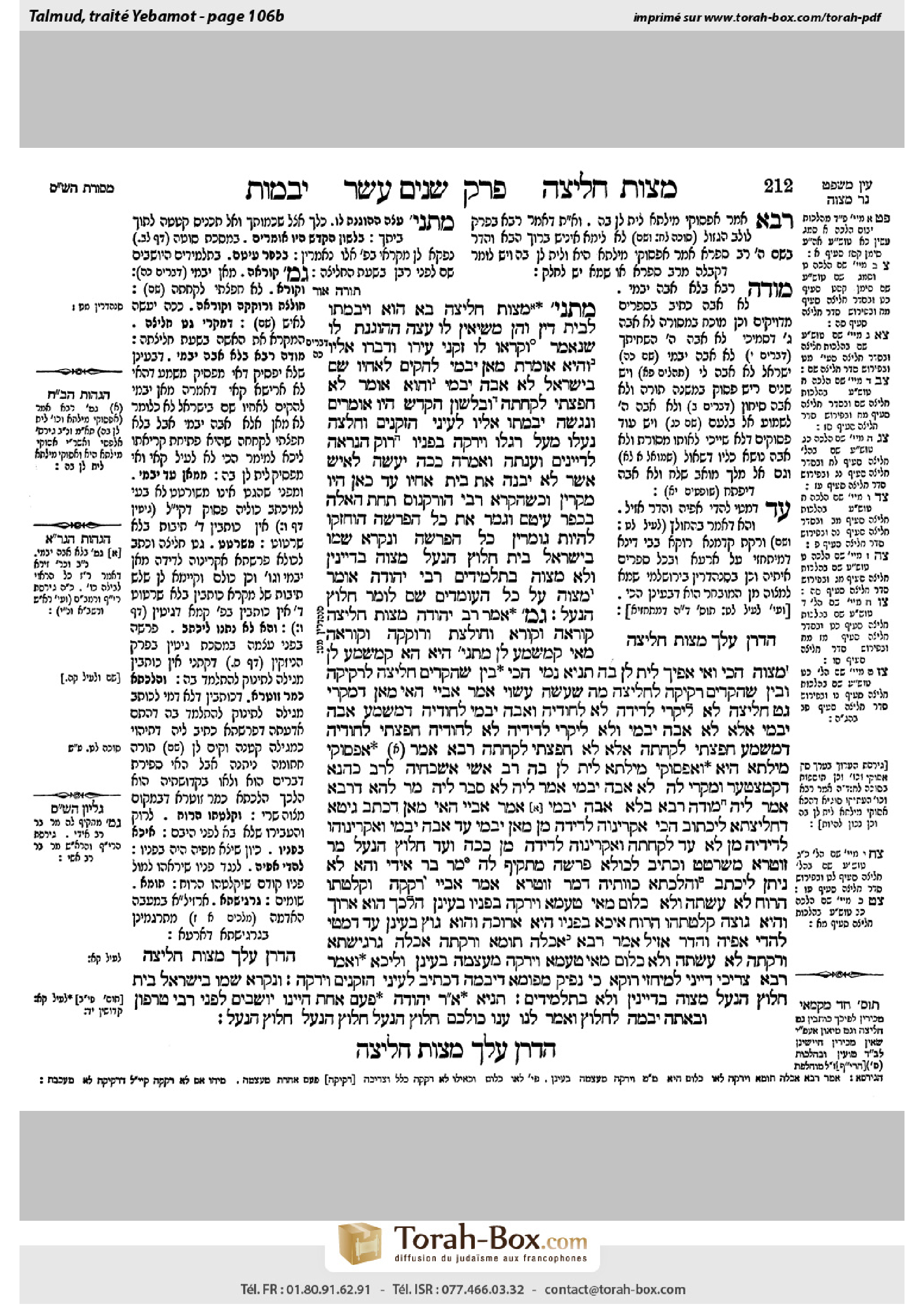
Yevamot 106b: Talmud study for Daf Yomi
Daf Yomi is the daily study of one Talmud folio. Explore 37 tractates with scans, Hebrew text, Sefaria English and AI-generated French translations where annotated.
Passage selection and English or AI-generated French translation are available where the scan has annotations. Daf Study is independent of Torah-Box and Sefaria.
Browse Yevamot · יבמות · All tractatesYevamot 106b text and translations
This page of Yevamot includes the Aramaic text, an English translation and an AI-generated French translation, alongside the scan above.
יבמות ק״ו ב · Aramaic and Hebrew text
מַתְנִי׳ מִצְוַת חֲלִיצָה: בָּא הוּא וִיבִמְתּוֹ לְבֵית דִּין, וְהֵן מַשִּׂיאִין לוֹ עֵצָה הַהוֹגֶנֶת לוֹ, שֶׁנֶּאֱמַר: ״וְקָרְאוּ לוֹ זִקְנֵי עִירוֹ וְדִבְּרוּ אֵלָיו״,
וְהִיא אוֹמֶרֶת: ״מֵאֵן יְבָמִי לְהָקִים לְאָחִיו שֵׁם בְּיִשְׂרָאֵל לֹא אָבָה יַבְּמִי״, וְהוּא אוֹמֵר: ״לֹא חָפַצְתִּי לְקַחְתָּהּ״. וּבִלְשׁוֹן הַקֹּדֶשׁ הָיוּ אוֹמְרִים. ״וְנִגְּשָׁה יְבִמְתּוֹ אֵלָיו לְעֵינֵי הַזְּקֵנִים וְחָלְצָה נַעֲלוֹ מֵעַל רַגְלוֹ וְיָרְקָה בְּפָנָיו״, רוֹק הַנִּרְאֶה לַדַּיָּינִים. ״וְעָנְתָה וְאָמְרָה כָּכָה יֵעָשֶׂה לָאִישׁ אֲשֶׁר לֹא יִבְנֶה אֶת בֵּית אָחִיו״. עַד כָּאן הָיוּ מַקְרִין.
וּכְשֶׁהִקְרָא רַבִּי הוּרְקָנוֹס תַּחַת הָאֵלָה בִּכְפַר עֵיטָם, וְגָמַר אֶת כׇּל הַפָּרָשָׁה, הוּחְזְקוּ לִהְיוֹת גּוֹמְרִין כׇּל הַפָּרָשָׁה. ״וְנִקְרָא שְׁמוֹ בְּיִשְׂרָאֵל בֵּית חֲלוּץ הַנָּעַל״. מִצְוָה בַּדַּיָּינִין, וְלֹא מִצְוָה בַּתַּלְמִידִים. רַבִּי יְהוּדָה אוֹמֵר: מִצְוָה עַל כׇּל הָעוֹמְדִים שָׁם לוֹמַר ״חֲלוּץ הַנָּעַל״.
גְּמָ׳ אָמַר רַב יְהוּדָה, מִצְוַת חֲלִיצָה: קוֹרְאָה וְקוֹרֵא, וְחוֹלֶצֶת וְרוֹקֶקֶת וְקוֹרְאָה. מַאי קָמַשְׁמַע לַן? מַתְנִיתִין הִיא! הָא קָמַשְׁמַע לַן מִצְוָה הָכִי, וְאִי אָפֵיךְ, לֵית לַן בַּהּ.
תַּנְיָא נָמֵי הָכִי: בֵּין שֶׁהִקְדִּים חֲלִיצָה לִרְקִיקָה, וּבֵין שֶׁהִקְדִּים רְקִיקָה לַחֲלִיצָה — מַה שֶּׁעָשָׂה עָשׂוּי.
אָמַר אַבָּיֵי: הַאי מַאן דְּמַקְרֵי גֵּט חֲלִיצָה, לָא לַיקְרֵי לְדִידַהּ ״לֹא״ לְחוֹדֵיהּ וְ״אָבָה יַבְּמִי״ לְחוֹדֵיהּ, דְּמַשְׁמַע: ״אָבָה יַבְּמִי״. אֶלָּא: ״לֹא אָבָה יַבְּמִי״.
וְלָא לַיקְרֵי לְדִידֵיהּ ״לֹא״ לְחוֹדֵיהּ ״חָפַצְתִּי״ לְחוֹדֵיהּ, דְּמַשְׁמַע ״חָפַצְתִּי לְקַחְתָּהּ״, אֶלָּא ״לֹא חָפַצְתִּי לְקַחְתָּהּ״. רָבָא אָמַר: אַפְסוֹקֵי מִילְּתָא הִיא, וְאַפְסוֹקֵי מִילְּתָא לֵית לַן בַּהּ.
רַב אָשֵׁי אַשְׁכְּחֵיהּ לְרַב כָּהֲנָא דְּקָמִצְטַעַר וּמַקְרֵי לַהּ ״לֹא אָבָה יַבְּמִי״, אֲמַר לֵיהּ: לָא סָבַר לֵיהּ מָר לְהָא דְּרָבָא?
אֲמַר לֵיהּ: מוֹדֵה רָבָא בְּ״לֹא אָבָה יַבְּמִי״. אָמַר אַבָּיֵי: הַאי מַאן דְּכָתֵב גִּיטָּא דַּחֲלִיצְתָּא — לִיכְתּוֹב הָכִי: אַקְרֵינוּהָ לְדִידַהּ מִן ״מֵאֵן יְבָמִי״ עַד ״אָבָה יַבְּמִי״, וְאַקְרֵינוֹהִי לְדִידֵיהּ מִן ״לֹא״ עַד ״לְקַחְתָּהּ״, וְאַקְרֵינוּהָ לְדִידַהּ מִן ״כָּכָה״ וְעַד ״חֲלוּץ הַנָּעַל״.
מָר זוּטְרָא מְשַׂרְטֵט וְכָתֵיב לְכוּלַּהּ פָּרָשָׁה. מַתְקֵיף לַהּ מָר בַּר אִידִי: וְהָא לֹא נִיתַּן לִיכָּתֵב! וְהִלְכְתָא כְּווֹתֵיהּ דְּמָר זוּטְרָא.
אָמַר אַבָּיֵי: רָקְקָה וּקְלָטַתּוּ הָרוּחַ — לֹא עָשְׂתָה וְלֹא כְּלוּם. מַאי טַעְמָא — ״וְיָרְקָה בְּפָנָיו״ בָּעֵינַן. הִלְכָּךְ, הוּא אָרוֹךְ וְהִיא גּוּצָה, קְלָטַתְהוּ הָרוּחַ — אִיכָּא ״בְּפָנָיו״. הִיא אֲרוּכָּה וְהוּא גּוּץ — בָּעֵינַן עַד דְּמָטֵי לַהֲדֵי אַפֵּיהּ וַהֲדַר אָזֵיל.
אָמַר רָבָא: אֲכַלָה תּוּמָא וְרָקַת, אֲכַלָה גַּרְגִּישְׁתָּא וְרָקַתה — לֹא עָשְׂתָה וְלֹא כְּלוּם. מַאי טַעְמָא — ״וְיָרְקָה״ מֵעַצְמָהּ בָּעֵינַן, וְלֵיכָּא. וְאָמַר רָבָא: צְרִיכִי דַּיָּינֵי לְמִיחְזֵי רוּקָּא כִּי נָפֵיק מִפּוּמַּהּ דִּיבָמָה. דִּכְתִיב: ״לְעֵינֵי הַזְּקֵנִים ... וְיָרְקָה״.
״וְנִקְרָא שְׁמוֹ בְּיִשְׂרָאֵל בֵּית חֲלוּץ הַנָּעַל״ — מִצְוָה בַּדַּיָּינִין וְלֹא בַּתַּלְמִידִים. תַּנְיָא, אָמַר רַבִּי יְהוּדָה: פַּעַם אַחַת הָיִינוּ יוֹשְׁבִים לִפְנֵי רַבִּי טַרְפוֹן, וּבָאתָה יְבָמָה לַחְלוֹץ, וְאָמַר לָנוּ, עָנוּ כּוּלְּכֶם: ״חֲלוּץ הַנָּעַל״, ״חֲלוּץ הַנָּעַל״, ״חֲלוּץ הַנָּעַל״.
הֲדַרַן עֲלָךְ מִצְוַת חֲלִיצָה
Yevamot 106b · English translation
MISHNA: The mitzva of ḥalitza is performed as follows: He and his yevama come to the court, and the scholars of the court give him advice appropriate for him, whether to enter levirate marriage or to perform ḥalitza, as it is stated: “And the Elders of his city shall call him and speak to him” (Deuteronomy 25:8).
If they decide to perform ḥalitza, she says: “My brother-in-law refused to establish a name for his brother in Israel, he did not wish to consummate the levirate marriage” (Deuteronomy 25:7), and afterward he says: “I do not wish to take her” (Deuteronomy 25:8). And they would say these statements in the sacred Hebrew language and not in any other language. Afterward, the shoe is removed and she spits before him, as is written: “His yevama shall approach him, before the Elders, and remove his shoe from on his foot and spit before him” (Deuteronomy 25:9), which indicates that this spittle must be visible to the judges. “And she shall respond and say: So shall it be done to the man who does not build his brother’s house” (Deuteronomy 25:9). Up until this point the judges would prompt the parties to recite the text that they are required to say.
And when Rabbi Hyrkanus once prompted the participants in ḥalitza under the ela tree in the village of Eitam, he prompted them to finish reciting the whole Torah passage, after which they established the custom of completing the whole Torah passage. Therefore, they continue and say the following verse: “And his name shall be called in Israel: The house of he who had his shoe removed” (Deuteronomy 25:10). This mitzva of saying: The house of he who had his shoe removed, applies to the judges, but not to the students, i.e., the students of the judges and other onlookers who are present. Rabbi Yehuda says: It is a mitzva upon all those present to say: He who had his shoe removed.
GEMARA: Rav Yehuda said: This is the correct order for the mitzva of ḥalitza: She recites the sentence beginning with “My brother-in-law refused” (Deuteronomy 25:7), and afterward he recites “I do not wish to take her” (Deuteronomy 25:8). Then she removes the shoe, and spits, and recites: “So shall it be done to the man who does not build his brother’s house” (Deuteronomy 25:9). The Gemara asks: What is Rav Yehuda teaching us? This is already explicit in the mishna. The Gemara answers: This teaches us that the mitzva is like this, i.e., this is the proper order, but if one switched the order, we have no problem with it, as even though he did not fulfill the mitzva properly, the ḥalitza is still valid, since the order is not indispensable.
The Gemara comments: This is also taught in a baraita: Whether the removal of the shoe preceded the spitting, or whether the spitting preceded the removal of the shoe, what he did is done, i.e., the ḥalitza is valid.
§ Abaye said concerning the details of these halakhot: The one who prompts the yavam and the yevama to read the text for the bill of ḥalitza should not prompt her by reciting “He did not” (Deuteronomy 25:7) by itself, and “wish to consummate the levirate marriage” (Deuteronomy 25:7) by itself, because such a way of reading sounds to one who hears only the second phrase like he is saying: My yavam does wish to consummate the marriage. Rather, he should prompt her all at once consecutively: “He did not wish to consummate the levirate marriage” (Deuteronomy 25:7), which will ensure that the intended meaning is clear.
And he should not read to the yavam: “I do not” by itself, followed by: “Wish to take her” by itself, as it sounds to one who heard only the second phrase like: I do wish to take her. Rather, he should read together at once: “I do not wish to take her.” Rava said: It is a mere interruption in the matter. And we have no problem with regard to an interruption in the matter as it is basically just a pause for taking a breath.
It is told: Rav Ashi found Rav Kahana painstakingly trying to prompt a certain yevama, so that she would recite: “He did not wish to consummate the levirate marriage” all at once, but the yevama did not understand and was distorting the meaning by not reciting the words together. Rav Ashi said to him: Does the Master not hold that which Rava said, that the proper pausing during the recitation is not indispensable?
He said to him: Although Rava disagreed with Abaye about interruptions in the recitation of: “I do not wish to take her,” Rava concedes concerning the recitation of: “He did not wish to consummate the levirate marriage,” as this recitation is essential and must be recited properly. Rav Kahana added that Abaye also said: One who writes a bill of ḥalitza must write as follows: We prompted her to recite from “My brother-in-law refused” until “he did not wish to consummate the levirate marriage” (Deuteronomy 25:7); and we prompted him to recite from “I do not” until “take her” (Deuteronomy 25:8). And we prompted her to recite from “So shall” (Deuteronomy 25:9) until “he who had his shoe removed” (Deuteronomy 25:10).
Mar Zutra would score lines of a parchment and write the whole ḥalitza passage on it as a bill of ḥalitza, so it would be displayed before the ḥalitza participants. Mar bar Idi strongly objected to this: But it is unable to be written like this on its own, as the Torah may be written only in a complete state, and it is prohibited to write parts of the Torah when there is no mitzva to write them separately. The Gemara comments: Even so, the halakha is in accordance with the opinion of Mar Zutra, because there is an aspect of a mitzva here, as it is being written as part of a bill of ḥalitza, not for its own purpose.
§ Abaye said: If the yevama spat, but the wind seized her saliva and it never landed in front of the face of the yavam, she did nothing, and her actions have no halakhic significance. What is the reason for this? We require that “she spit before him,” as is mentioned in the verse. Therefore, if he is tall and she is short and the wind seized it, the requirement of “before him” is satisfied, because the moment the saliva left her mouth it was in front of the face of the yavam. But if she is tall and he is short, we require that the saliva reach the space across from his face, and afterward it may go with the wind; i.e., if she was taller than him and the saliva was taken by the wind before it reached the height of his face, she did not fulfill her obligation.
Rava said: If she ate garlic and spat, or if she ate gargishta clay, i.e., a type of clay once chewed for medicinal purposes, and spat, she did nothing and her actions have no halakhic significance, for this is not called spitting. What is the reason for this? We require that “she shall spit” on her own, and this is not satisfied here, for in this case she spits only on account of another thing that causes a pooling of saliva in her mouth. And Rava said: The judges must see the spittle when it leaves the mouth of the yevama, and the mere fact that she spat on the ground is insufficient, as it is written: “Before the Elders…and spit,” indicating that the spitting must take place before the eyes of the judges.
§ It was taught in the mishna: With regard to the verse “And his name shall be called in Israel: The house of he who had his shoe removed,” there is a mitzva upon the judges to recite this but it is not a requirement for the students or onlookers. It is taught in a baraita that Rabbi Yehuda says: Once we were sitting before Rabbi Tarfon and a yevama came to perform ḥalitza. He said to us: You must all answer: “He who had his shoe removed,” “He who had his shoe removed,” “He who had his shoe removed,” stating that portion of the verse three times.
Yevamot 106b · Traduction française (IA)
MICHNA : La mitsva de la ḥalitsa s’accomplit ainsi : lui et sa yevama se présentent devant le tribunal, et les sages du tribunal le conseillent selon ce qui lui convient, qu’il contracte le mariage léviratique ou qu’il accomplisse la ḥalitsa, comme il est dit : « Les anciens de sa ville l’appelleront et lui parleront » (Deutéronome 25,8).
S’ils décident d’accomplir la ḥalitsa, elle dit : « Mon beau-frère a refusé d’établir un nom pour son frère en Israël ; il n’a pas voulu contracter le mariage léviratique » (Deutéronome 25,7), puis il dit : « Je ne veux pas la prendre » (Deutéronome 25,8). Ils prononçaient ces paroles dans la langue sacrée, l’hébreu, et non dans une autre langue. Ensuite, la chaussure est retirée et elle crache devant lui, comme il est écrit : « Sa yevama s’approchera de lui, devant les anciens, lui retirera sa chaussure du pied et crachera devant lui » (Deutéronome 25,9), ce qui indique que ce crachat doit être visible aux juges. « Elle répondra et dira : Ainsi sera fait à l’homme qui ne bâtit pas la maison de son frère » (Deutéronome 25,9). Jusqu’à ce point, les juges guidaient les parties pour qu’elles récitent le texte qu’elles sont tenues de dire.
Or, un jour, lorsque Rabbi Hyrkanus guida les participants à la ḥalitsa sous l’arbre ela, dans le village d’Eitam, il les guida pour qu’ils récitent jusqu’au bout tout le passage de la Torah. À la suite de cela, on institua l’usage de réciter le passage entier. Ils poursuivent donc en disant le verset suivant : « Et son nom sera appelé en Israël : La maison de celui qui a perdu sa chaussure » (Deutéronome 25,10). Cette mitsva de dire « La maison de celui qui a perdu sa chaussure » incombe aux juges, mais pas aux étudiants, c’est-à-dire aux élèves des juges et aux autres personnes présentes. Rabbi Yehuda dit : Tous ceux qui sont présents ont la mitsva de dire : « Celui qui a perdu sa chaussure. »
GUEMARA : Rav Yehuda dit : Voici l’ordre correct de la mitsva de ḥalitsa : elle récite la phrase qui commence par « Mon beau-frère a refusé » (Deutéronome 25,7), puis il récite « Je ne veux pas la prendre » (Deutéronome 25,8). Ensuite, elle retire la chaussure, crache et récite : « Ainsi sera fait à l’homme qui ne bâtit pas la maison de son frère » (Deutéronome 25,9). La Guemara demande : Que nous enseigne Rav Yehuda ? Cela est déjà explicite dans la Michna. La Guemara répond : Il nous enseigne que telle est la manière correcte d’accomplir la mitsva ; toutefois, si l’ordre est inversé, cela ne pose pas de problème : même si la mitsva n’a pas été accomplie comme il convient, la ḥalitsa reste valide, car cet ordre n’est pas indispensable.
La Guemara fait remarquer que cela est également enseigné dans une baraïta : que le retrait de la chaussure ait précédé le crachat ou que le crachat ait précédé le retrait de la chaussure, ce qui a été fait est fait, c’est-à-dire que la ḥalitsa est valide.
§ Abaye dit au sujet des détails de ces halakhot : Celui qui guide le yavam et la yevama dans la récitation du texte du document de ḥalitsa ne doit pas lui faire réciter séparément « il n’a pas » (Deutéronome 25,7), puis « voulu contracter le mariage léviratique » (Deutéronome 25,7), car celui qui n’entendrait que la seconde partie pourrait croire qu’elle dit : « Mon yavam veut contracter le mariage léviratique. » Il doit plutôt la guider pour qu’elle récite d’un seul trait : « Il n’a pas voulu contracter le mariage léviratique » (Deutéronome 25,7), afin que le sens voulu soit clair.
De même, il ne doit pas faire réciter au yavam « Je ne » séparément, puis « veux pas la prendre » séparément, car celui qui n’entendrait que la seconde partie pourrait croire qu’il dit : « Je veux la prendre. » Il doit plutôt lui faire réciter d’un seul trait : « Je ne veux pas la prendre. » Rava dit : Il ne s’agit que d’une interruption dans la phrase. Et une interruption dans la phrase ne pose pas de problème, car il s’agit essentiellement d’une pause pour reprendre son souffle.
Il est rapporté que Rav Ashi trouva Rav Kahana qui s’efforçait avec insistance de guider une certaine yevama afin qu’elle récite d’un seul trait : « Il n’a pas voulu contracter le mariage léviratique », mais elle ne comprenait pas et en déformait le sens en ne prononçant pas les mots ensemble. Rav Ashi lui dit : Le Maître ne considère-t-il pas que, comme l’a dit Rava, les pauses appropriées pendant la récitation ne sont pas indispensables ?
Il lui répondit : Bien que Rava ne soit pas d’accord avec Abaye au sujet des interruptions dans la récitation de « Je ne veux pas la prendre », Rava reconnaît que la récitation de « Il n’a pas voulu contracter le mariage léviratique » est essentielle et doit être faite correctement. Rav Kahana ajouta qu’Abaye avait également dit : Celui qui rédige un document de ḥalitsa doit écrire ainsi : Nous l’avons guidée pour qu’elle récite depuis « Mon beau-frère a refusé » jusqu’à « il n’a pas voulu contracter le mariage léviratique » (Deutéronome 25,7) ; et nous l’avons guidé pour qu’il récite depuis « Je ne » jusqu’à « la prendre » (Deutéronome 25,8). Et nous l’avons guidée pour qu’elle récite depuis « Ainsi sera » (Deutéronome 25,9) jusqu’à « celui qui a perdu sa chaussure » (Deutéronome 25,10).
Mar Zutra traçait des lignes sur un parchemin et y écrivait tout le passage de la ḥalitsa sous forme de document de ḥalitsa, afin qu’il soit placé devant les participants à la ḥalitsa. Mar bar Idi s’y opposa vivement : Mais on ne peut pas écrire ainsi ce passage isolément, car la Torah ne peut être écrite que dans son intégralité, et il est interdit d’en écrire des parties lorsqu’il n’y a pas de mitsva de les écrire séparément. La Guemara fait remarquer que, malgré cela, la halakha suit l’avis de Mar Zutra, car il y a ici un aspect de mitsva : le passage est écrit dans le cadre d’un document de ḥalitsa et non pour lui-même.
§ Abaye dit : Si la yevama a craché, mais que le vent a emporté sa salive et que celle-ci n’est jamais tombée devant le visage du yavam, elle n’a rien fait et son acte n’a aucune portée halakhique. Pour quelle raison ? Nous exigeons qu’« elle crache devant lui », comme le mentionne le verset. Par conséquent, s’il est grand et qu’elle est petite, et que le vent emporte la salive, l’exigence de « devant lui » est satisfaite, car, au moment où la salive a quitté sa bouche, elle se trouvait devant le visage du yavam. Mais si elle est grande et lui petit, nous exigeons que la salive atteigne l’espace situé à la hauteur de son visage, après quoi le vent peut l’emporter. Autrement dit, si elle était plus grande que lui et que le vent a emporté la salive avant qu’elle n’atteigne la hauteur de son visage, elle ne s’est pas acquittée de son obligation.
Rava dit : Si elle a mangé de l’ail puis craché, ou si elle a mangé de l’argile gargishta, c’est-à-dire une sorte d’argile que l’on mâchait autrefois à des fins médicinales, puis craché, elle n’a rien fait et son acte n’a aucune portée halakhique, car cela ne s’appelle pas cracher. Pour quelle raison ? Nous exigeons qu’« elle crache » de son propre chef, ce qui n’est pas le cas ici, car elle ne crache qu’à cause d’un autre élément qui provoque une accumulation de salive dans sa bouche. Rava dit également : Les juges doivent voir le crachat au moment où il quitte la bouche de la yevama ; le simple fait qu’elle ait craché par terre ne suffit pas, comme il est écrit : « Devant les anciens… et crachera », ce qui indique que le crachat doit avoir lieu sous les yeux des juges.
§ La Michna enseigne, au sujet du verset « Et son nom sera appelé en Israël : La maison de celui qui a perdu sa chaussure », qu’il incombe aux juges de le réciter, mais que les étudiants et les personnes présentes n’y sont pas tenus. Une baraïta enseigne que Rabbi Yehuda dit : Un jour, nous étions assis devant Rabbi Tarfon lorsqu’une yevama vint accomplir la ḥalitsa. Il nous dit : Vous devez tous répondre : « Celui qui a perdu sa chaussure », « Celui qui a perdu sa chaussure », « Celui qui a perdu sa chaussure », en répétant trois fois cette partie du verset.
Traduction française générée par IA à partir de l’édition anglaise de Sefaria. Vérifie toujours un passage avec le texte source.
Text from Sefaria: William Davidson Edition - Vocalized Aramaic (CC BY NC); William Davidson Edition - English (CC BY NC).