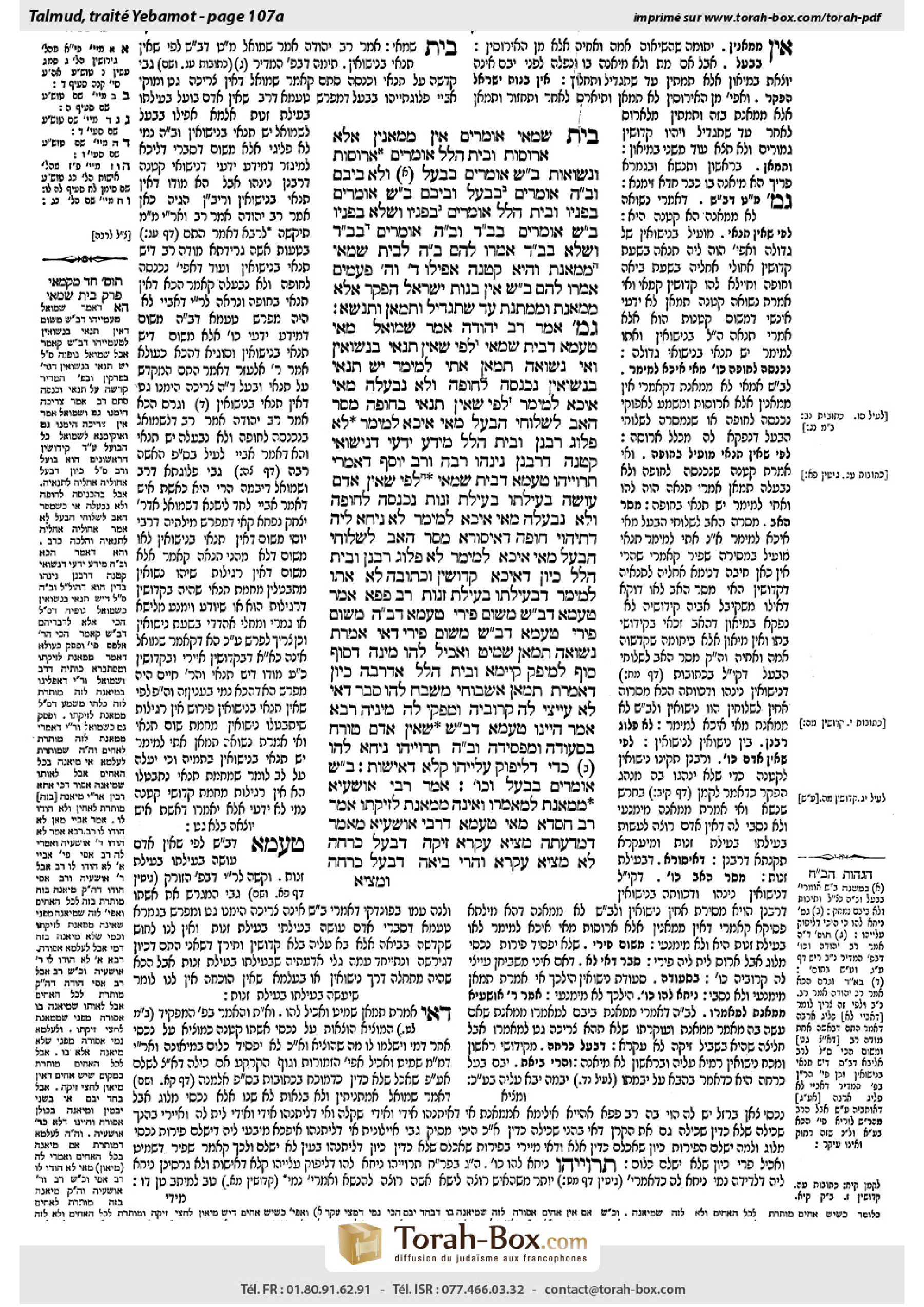
Yevamot 107a: Talmud study for Daf Yomi
Daf Yomi is the daily study of one Talmud folio. Explore 37 tractates with scans, Hebrew text, Sefaria English and AI-generated French translations where annotated.
Passage selection and English or AI-generated French translation are available where the scan has annotations. Daf Study is independent of Torah-Box and Sefaria.
Browse Yevamot · יבמות · All tractatesYevamot 107a text and translations
This page of Yevamot includes the Aramaic text, an English translation and an AI-generated French translation, alongside the scan above.
יבמות ק״ז א · Aramaic and Hebrew text
בֵּית שַׁמַּאי אוֹמְרִים: אֵין מְמָאֲנִין אֶלָּא אֲרוּסוֹת, וּבֵית הִלֵּל אוֹמְרִים: אֲרוּסוֹת וּנְשׂוּאוֹת.
בֵּית שַׁמַּאי אוֹמְרִים: בַּבַּעַל וְלֹא בַּיָּבָם, וּבֵית הִלֵּל אוֹמְרִים: בַּבַּעַל וּבַיָּבָם.
בֵּית שַׁמַּאי אוֹמְרִים: בְּפָנָיו, וּבֵית הִלֵּל אוֹמְרִים: בְּפָנָיו וְשֶׁלֹּא בְּפָנָיו. בֵּית שַׁמַּאי אוֹמְרִים: בְּבֵית דִּין. וּבֵית הִלֵּל אוֹמְרִים: בְּבֵית דִּין וְשֶׁלֹּא בְּבֵית דִּין.
אָמְרוּ לָהֶם בֵּית הִלֵּל לְבֵית שַׁמַּאי: מְמָאֶנֶת וְהִיא קְטַנָּה, אֲפִילּוּ אַרְבַּע וְחָמֵשׁ פְּעָמִים. אָמְרוּ לָהֶם בֵּית שַׁמַּאי: אֵין בְּנוֹת יִשְׂרָאֵל הֶפְקֵר, אֶלָּא מְמָאֶנֶת וּמַמְתֶּנֶת עַד שֶׁתַּגְדִּיל, וּתְמָאֵן, וְתִנָּשֵׂא.
גְּמָ׳ אָמַר רַב יְהוּדָה אָמַר שְׁמוּאֵל: מַאי טַעְמָא דְּבֵית שַׁמַּאי — לְפִי שֶׁאֵין תְּנַאי בְּנִשּׂוּאִין. וְאִי נְשׂוּאָה תְּמָאֵן, אָתֵי לְמֵימַר יֵשׁ תְּנַאי בְּנִשּׂוּאִין.
נִכְנְסָה לְחוּפָּה וְלֹא נִבְעֲלָה, מַאי אִיכָּא לְמֵימַר? לְפִי שֶׁאֵין תְּנַאי בְּחוּפָּה.
מָסַר הָאָב לִשְׁלוּחֵי הַבַּעַל, מַאי אִיכָּא לְמֵימַר? לָא פְּלוּג רַבָּנַן.
וּבֵית הִלֵּל: מִידָּע יָדְעִי דְּנִישּׂוּאֵי קְטַנָּה דְּרַבָּנַן נִינְהוּ. רַבָּה וְרַב יוֹסֵף דְּאָמְרִי תַּרְוַיְיהוּ: טַעְמָא דְּבֵית שַׁמַּאי, לְפִי שֶׁאֵין אָדָם עוֹשֶׂה בְּעִילָתוֹ בְּעִילַת זְנוּת.
נִכְנְסָה לַחוּפָּה וְלֹא נִבְעֲלָה, מַאי אִיכָּא לְמֵימַר? לָא נִיחָא לֵיהּ דְּתִיהְוֵי חוּפָּה דְאִיסּוּרָא. מָסַר הָאָב לִשְׁלוּחֵי הַבַּעַל מַאי אִיכָּא לְמֵימַר? לָא פְּלוּג רַבָּנַן. וּבֵית הִלֵּל, כֵּיוָן דְּאִיכָּא קִדּוּשִׁין וּכְתוּבָּה — לָא אָתוּ לְמֵימַר דִּבְעִילָתוֹ בְּעִילַת זְנוּת.
רַב פָּפָּא אָמַר: טַעְמָא דְּבֵית שַׁמַּאי מִשּׁוּם פֵּירֵי, טַעְמָא דְּבֵית הִלֵּל מִשּׁוּם פֵּירֵי. טַעְמָא דְּבֵית שַׁמַּאי מִשּׁוּם פֵּירֵי — דְּאִי אָמְרַתְּ נְשׂוּאָה תְּמָאֵן, שָׁמֵיט וְאָכֵיל לְהוּ מִינַּהּ, דְּסוֹף סוֹף לְמִיפַּק קָיְימָא. וּבֵית הִלֵּל: אַדְּרַבָּה, כֵּיוָן דְּאָמְרַתְּ תְּמָאֵן — אַשְׁבּוֹחֵי מַשְׁבַּח לְהוּ. סָבַר דְּאִי לָא, עָיְיצִי לַהּ קְרוֹבֵיהּ, וּמַפְּקִי לַהּ מִינֵּיהּ.
רָבָא אָמַר: הַיְינוּ טַעְמָא דְּבֵית שַׁמַּאי — שֶׁאֵין אָדָם טוֹרֵחַ בִּסְעוּדָה וּמַפְסִידָהּ. וּבֵית הִלֵּל: תַּרְוַיְיהוּ נִיחָא לְהוּ, כְּדֵי דְּלִיפּוֹק עֲלַיְיהוּ קָלָא דְאִישׁוּת.
בֵּית שַׁמַּאי אוֹמְרִים בַּבַּעַל וְכוּ׳. אָמַר רַבִּי אוֹשַׁעְיָא: מְמָאֶנֶת לְמַאֲמָרוֹ, וְאֵינָהּ מְמָאֶנֶת לְזִיקָּתוֹ. אָמַר רַב חִסְדָּא: מַאי טַעְמָא דְּרַבִּי אוֹשַׁעְיָא? מַאֲמָר, דְּמִדַּעְתַּהּ — מָצְיָא עָקְרָא. זִיקָּה, דִּבְעַל כֻּרְחַהּ — לָא מָצְיָא עָקְרָא.
וַהֲרֵי בִּיאָה, דִּבְעַל כֻּרְחַהּ,
Yevamot 107a · English translation
MISHNA: The Sages decreed that in the case of a minor girl whose father died, her mother or brothers may marry her off. However, such a marriage does not have the same legal status as the marriage of an adult. Therefore, if the minor regrets having married, she is allowed to make a declaration of refusal to her husband, thereby annulling the marital bond. The Sages disagreed with regard to the details of this halakha: Beit Shammai say: Only betrothed girls may refuse. A girl may refuse, upon reaching adulthood, to remain married to the man to whom her mother or brothers married her as a minor after the death of her father. But Beit Hillel say that both betrothed and fully married girls may refuse.
Beit Shammai say: Refusal may be directed only at her husband and not at her yavam. In such a situation, she must perform ḥalitza in order to dissolve the levirate bond. But Beit Hillel say: It may be directed at her husband or her yavam.
Beit Shammai say: The refusal must take place specifically in the presence of the husband. But Beit Hillel say: It may take place either in his presence or in his absence. Beit Shammai say: The refusal must take place specifically in court. But Beit Hillel say: It may take place either in court, or not in court.
Beit Hillel said to Beit Shammai: She may refuse as long as she is a minor, even four or five times if her relatives married her off again to another man after each refusal. Beit Shammai said to them: The daughters of Israel are not to be treated with disregard and should not be passed from one man to another. Rather, she refuses once. And then she must wait until she reaches majority, and refuse, and marry.
GEMARA: Rav Yehuda said that Shmuel said: What is the reason of Beit Shammai for ruling that a married minor girl may not perform refusal? It is because there are no conditions with regard to marriage. Although a betrothal can be conditional, the condition is nullified upon consummation of the marriage. Likewise, marriage cannot be conditional, as the sexual relationship is not subject to conditions. And if a married minor girl would refuse, others may mistakenly think this to be a condition with regard to the marriage of an adult woman, and they will come to say that there can be a condition with regard to marriage.
The Gemara asks: But what is there to say if she entered the marriage canopy but did not yet engage in sexual intercourse? The marriage goes into effect even though it has not yet been consummated. The Gemara replies: There are no conditions with regard to a wedding canopy, i.e., the wedding ceremony.
The Gemara asks further: But what is there to say if the father delivered his daughter to the agents of the husband to be married, so that she was considered married even before the marriage ceremony took place? The Gemara answers: The Sages did not distinguish between different circumstances, and no marriages are conditional. It follows that refusal cannot take place once a minor girl is married.
And with regard to Beit Hillel, what is their reasoning? It is known that marriage of a minor girl is by rabbinic law, and therefore no one would confuse this type of marriage with an adult marriage. Rabba and Rav Yosef both say: Beit Shammai’s reason is that a man would not readily render his sexual act licentious sexual intercourse. If he had intercourse with the minor girl and the marriage was later retroactively annulled by her refusal, then his sexual act was outside the context of marriage and is regarded as licentious.
The Gemara asks: What is there to say if she entered the marriage canopy but did not engage in sexual intercourse, as this reason would not apply to such a case? The Gemara answers: It would not be satisfactory for him, i.e., the husband, if his would be a forbidden marriage canopy, because if the marriage is later annulled by her refusal, he will have stood under the marriage canopy with a woman who was not permitted to him. The Gemara asks: What is there to say if the father delivered his daughter to the agents of the husband? The Gemara answers: The Sages did not distinguish between different circumstances. And how do Beit Hillel respond to Beit Shammai’s reasoning? Since there is both betrothal and a marriage contract in this case, no one will come to say that his sexual act was licentious intercourse. The primary reason Beit Shammai prohibit refusal after marriage is because it would render the sexual relationship of the marriage a licentious one. Beit Hillel do not regard sexual activity under such circumstances as licentious, so there is also no stigma attached to having stood under a wedding canopy with a girl who later refuses the marriage.
Rav Pappa said: The reasoning for Beit Shammai’s opinion is because of the profits from the property she brings into the marriage, and the reasoning for Beit Hillel’s opinion is also because of the profits from her property. He explains: The reasoning for Beit Shammai’s opinion is because of the profits from her property, for if you say that a married minor girl may perform refusal, then the husband of that minor might seize those profits from her and consume them, as ultimately she stands to leave him if she refuses him later. In the meantime, he will try to extract as much profit as he can. And Beit Hillel say: On the contrary: Since you say she may refuse, he will seek to improve her property. He will think: if I do not do so, her relatives will advise her to refuse him and they will take her from him.
Rava said: This is the reasoning of Beit Shammai: A man will not bother to make a marriage feast and then lose it. If the wife is entitled to refuse him even after the marriage, the man will not be willing to marry a minor and bear the expenses of the wedding, when it is uncertain that she will stay with him. And Beit Hillel reason as follows: The marriage is convenient for both of them even if it is nullified later, so as to generate publicity about them that they are married.
§ It is taught in the mishna: Beit Shammai say: Refusal may be directed only at her husband and not her yavam. If she wishes to refuse her yavam, she must perform ḥalitza in order to dissolve the levirate bond. But Beit Hillel say that refusal may be directed at her husband or her yavam. Rabbi Oshaya said: A minor yevama may direct a refusal against a levirate betrothal but she may not direct a refusal against his levirate bond. Before the yavam betroths her, she cannot nullify the levirate bond by refusal. Rav Ḥisda said: What is the reasoning of Rabbi Oshaya? In the case of levirate betrothal, which is consensual, she can nullify it. But with regard to the levirate bond, which applies to her even against her will, she cannot nullify it.
The Gemara asks: But the consummation of the levirate bond may be against her will
Yevamot 107a · Traduction française (IA)
MICHNA : Les Sages ont décrété que, lorsqu’une fillette mineure a perdu son père, sa mère ou ses frères peuvent la marier. Toutefois, un tel mariage n’a pas le même statut juridique que celui d’une femme majeure. Par conséquent, si la mineure regrette de s’être mariée, elle peut faire à son mari une déclaration de refus, annulant ainsi le lien matrimonial. Les Sages sont en désaccord sur les détails de cette halakha. Beit Shammaï disent : Seules les jeunes filles fiancées peuvent refuser. Une fille peut, lorsqu’elle atteint la majorité, refuser de rester mariée à l’homme auquel sa mère ou ses frères l’ont mariée alors qu’elle était mineure, après la mort de son père. Mais Beit Hillel disent que les jeunes filles, qu’elles soient fiancées ou déjà pleinement mariées, peuvent refuser.
Beit Shammaï disent : Le refus ne peut être adressé qu’à son mari, et non à son yavam. Dans une telle situation, elle doit accomplir la ḥalitsa afin de dissoudre le lien de lévirat. Mais Beit Hillel disent qu’elle peut adresser son refus à son mari ou à son yavam.
Beit Shammaï disent : Le refus doit avoir lieu précisément en présence du mari. Mais Beit Hillel disent qu’il peut avoir lieu en sa présence ou en son absence. Beit Shammaï disent : Le refus doit avoir lieu précisément devant un tribunal. Mais Beit Hillel disent qu’il peut avoir lieu devant un tribunal ou hors tribunal.
Beit Hillel dirent à Beit Shammaï : Elle peut refuser tant qu’elle est mineure, même quatre ou cinq fois, si ses proches la marient de nouveau à un autre homme après chaque refus. Beit Shammaï leur dirent : Il ne faut pas traiter les filles d’Israël avec désinvolture ni les faire passer d’un homme à un autre. Elle ne refuse qu’une seule fois. Ensuite, elle doit attendre d’atteindre la majorité, puis refuser et se marier.
GUEMARA : Rav Yehouda a dit au nom de Shmouel : Pourquoi Beit Shammaï statuent-ils qu’une jeune fille mineure déjà mariée ne peut pas faire de déclaration de refus ? Parce qu’il n’y a pas de conditions en matière de mariage. Bien qu’un mariage puisse être conditionnel au stade des fiançailles, la condition est annulée lorsque le mariage est consommé. De même, le mariage ne peut pas être conditionnel, car les relations sexuelles ne sont pas soumises à des conditions. Si une jeune fille mineure déjà mariée pouvait refuser, les gens pourraient croire à tort qu’une condition est possible dans le mariage d’une femme majeure, et en venir à dire qu’un mariage peut être assorti d’une condition.
La Guemara demande : Mais que dire si elle est entrée sous la houppa sans avoir encore eu de relations sexuelles ? Le mariage prend effet même s’il n’a pas encore été consommé. La Guemara répond : Il n’y a pas de conditions en matière de houppa, c’est-à-dire de cérémonie de mariage.
La Guemara demande encore : Mais que dire si le père a remis sa fille aux émissaires du marié en vue de son mariage, de sorte qu’elle était considérée comme mariée avant même que la cérémonie ait eu lieu ? La Guemara répond : Les Sages n’ont pas distingué entre les différentes circonstances, et aucun mariage ne peut être assorti d’une condition. Il s’ensuit qu’une fois qu’une jeune fille mineure est mariée, elle ne peut plus refuser.
Et quelle est la raison de Beit Hillel ? On sait que le mariage d’une jeune fille mineure relève du droit rabbinique ; personne ne confondra donc ce type de mariage avec celui d’une femme majeure. Rabba et Rav Yossef disent tous deux : La raison de Beit Shammaï est qu’un homme ne consent pas facilement à ce que ses relations sexuelles deviennent des relations licencieuses. S’il a eu des relations avec la jeune fille mineure, puis que le mariage est annulé rétroactivement par son refus, ses relations sexuelles ont eu lieu hors du cadre du mariage et sont considérées comme licencieuses.
La Guemara demande : Mais que dire si elle est entrée sous la houppa sans avoir eu de relations sexuelles, puisque cette raison ne s’appliquerait pas à un tel cas ? La Guemara répond : Cela ne conviendrait pas à l’homme, c’est-à-dire au mari, que sa houppa devienne interdite ; en effet, si le mariage est ensuite annulé par son refus, il aura été sous la houppa avec une femme qui ne lui était pas permise. La Guemara demande : Mais que dire si le père a remis sa fille aux émissaires du marié ? La Guemara répond : Les Sages n’ont pas distingué entre les différentes circonstances. Et comment Beit Hillel répondent-ils au raisonnement de Beit Shammaï ? Puisqu’il y a ici à la fois des fiançailles et un acte de mariage, personne ne pensera que ses relations sexuelles étaient licencieuses. La raison principale pour laquelle Beit Shammaï interdisent le refus après le mariage est qu’il ferait des relations sexuelles conjugales des relations licencieuses. Beit Hillel ne considèrent pas les relations sexuelles dans de telles circonstances comme licencieuses ; il n’y a donc pas non plus de stigmate à avoir été sous la houppa avec une jeune fille qui refuse ensuite le mariage.
Rav Pappa a dit : Selon Beit Shammaï, la raison tient aux revenus des biens qu’elle apporte dans le mariage ; selon Beit Hillel également, la raison tient aux revenus de ses biens. Il explique : La raison de Beit Shammaï tient aux revenus de ses biens, car si l’on dit qu’une jeune fille mineure déjà mariée peut refuser, le mari de cette mineure pourrait s’emparer de ces revenus et les dépenser, puisqu’en définitive elle pourrait le quitter si elle le refuse par la suite. Entre-temps, il cherchera à en tirer le plus de profit possible. Mais Beit Hillel disent : Au contraire, puisque l’on dit qu’elle peut refuser, il cherchera à améliorer ses biens. Il se dira : si je ne le fais pas, ses proches lui conseilleront de me refuser et ils l’éloigneront de moi.
Rava a dit : Voici la raison de Beit Shammaï : Un homme ne prendra pas la peine d’organiser un festin de mariage pour ensuite le perdre. Si l’épouse a le droit de le refuser même après le mariage, l’homme ne voudra pas épouser une mineure et supporter les frais des noces, alors qu’il n’est pas certain qu’elle restera avec lui. Et Beit Hillel raisonnent ainsi : Le mariage est avantageux pour eux deux, même s’il est annulé par la suite, car il fait savoir publiquement qu’ils sont mariés.
§ Il est enseigné dans la Michna : Beit Shammaï disent : Le refus ne peut être adressé qu’à son mari, et non à son yavam. Si elle souhaite refuser son yavam, elle doit accomplir la ḥalitsa afin de dissoudre le lien de lévirat. Mais Beit Hillel disent que le refus peut être adressé à son mari ou à son yavam. Rabbi Oshaya a dit : Une mineure yevama peut adresser son refus à des fiançailles léviratiques, mais elle ne peut pas adresser son refus au lien de lévirat avec son yavam. Avant que le yavam ne la fiance, elle ne peut pas annuler le lien de lévirat par un refus. Rav Ḥisda a dit : Quel est le raisonnement de Rabbi Oshaya ? Dans le cas des fiançailles léviratiques, qui reposent sur son consentement, elle peut les annuler. Mais pour ce qui est du lien de lévirat, qui s’impose à elle même contre sa volonté, elle ne peut pas l’annuler.
La Guemara demande : Mais la consommation du lien de lévirat peut avoir lieu contre sa volonté…
Traduction française générée par IA à partir de l’édition anglaise de Sefaria. Vérifie toujours un passage avec le texte source.
Text from Sefaria: William Davidson Edition - Vocalized Aramaic (CC BY NC); William Davidson Edition - English (CC BY NC).