Yevamot 107b: Talmud study for Daf Yomi
Daf Yomi is the daily study of one Talmud folio. Explore 37 tractates with scans, Hebrew text, Sefaria English and AI-generated French translations where annotated.
Passage selection and English or AI-generated French translation are available where the scan has annotations. Daf Study is independent of Torah-Box and Sefaria.
Browse Yevamot · יבמות · All tractatesYevamot 107b text and translations
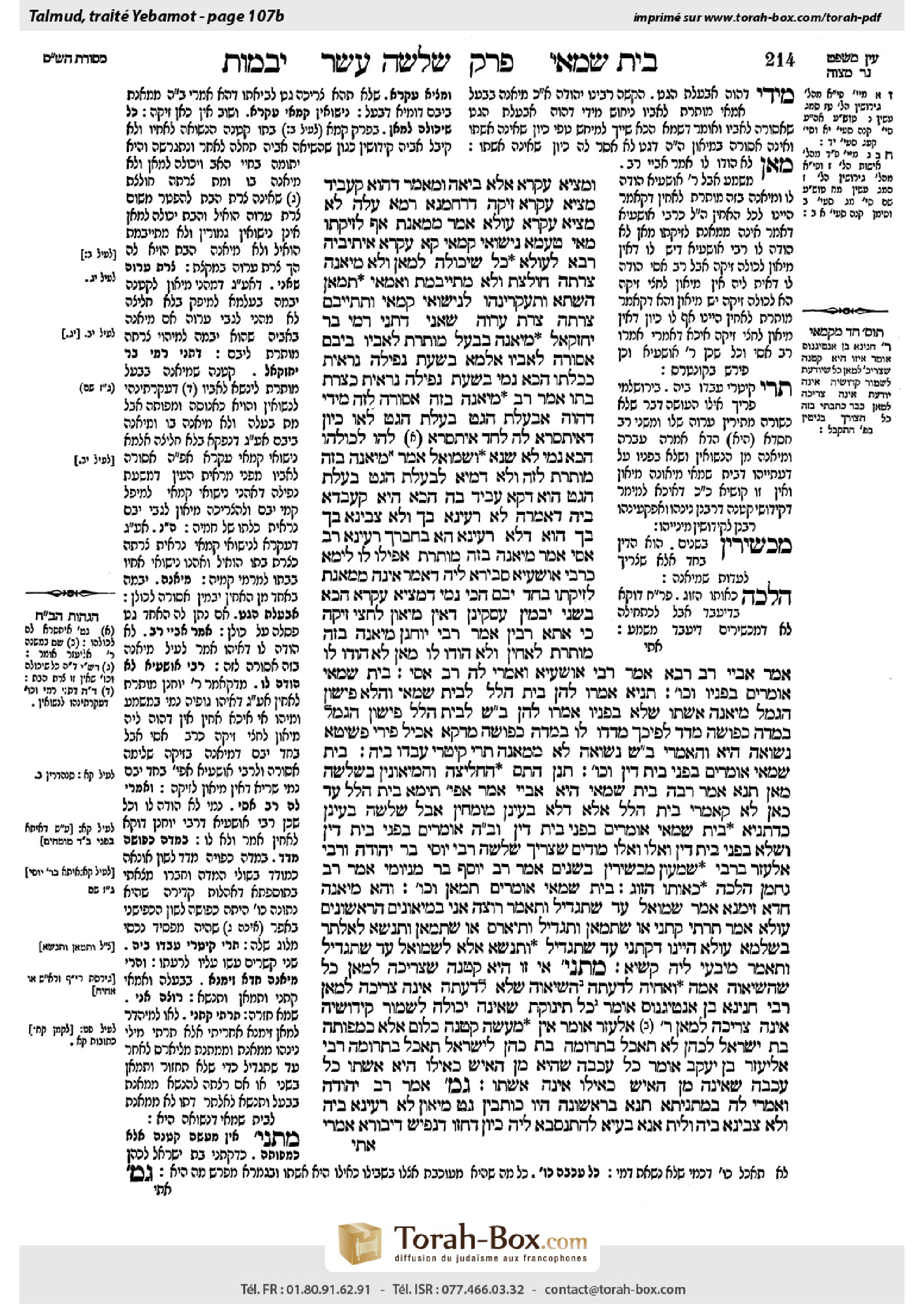
This page of Yevamot includes the Aramaic text, an English translation and an AI-generated French translation, alongside the scan above.
יבמות ק״ז ב · Aramaic and Hebrew text
וּמָצְיָא עָקְרָא! אֶלָּא: בִּיאָה וּמַאֲמָר, דְּהוּא קָעָבֵיד — מָצְיָא עָקְרָא. זִיקָּה, דְּרַחֲמָנָא רְמָא עֲלַהּ — לָא מָצְיָא עָקְרָא. עוּלָּא אָמַר: מְמָאֶנֶת אַף לְזִיקָּתוֹ. מַאי טַעְמָא — נִישּׂוּאֵי קַמָּאֵי קָא עָקְרָא.
אֵיתִיבֵיהּ רָבָא לְעוּלָּא: כֹּל שֶׁיְּכוֹלָה לְמָאֵן וְלֹא מֵיאֲנָה — צָרָתָהּ חוֹלֶצֶת וְלֹא מִתְיַיבֶּמֶת. וְאַמַּאי? תְּמָאֵן הַשְׁתָּא וְתִעְקְרִינְהוּ לְנִישּׂוּאֵי קַמָּאֵי, וְתִתְיַיבֵּם צָרָתָהּ! צָרַת עֶרְוָה שָׁאנֵי. דְּתָנֵי רָמֵי בַּר יְחֶזְקֵאל: מֵיאֲנָה בַּבַּעַל — מוּתֶּרֶת לְאָבִיו. בַּיָּבָם — אֲסוּרָה לְאָבִיו.
אַלְמָא בִּשְׁעַת נְפִילָה נִרְאֵית כְּכַלָּתוֹ, הָכָא נָמֵי בִּשְׁעַת נְפִילָה נִרְאֵית כְּצָרַת בִּתּוֹ.
אָמַר רַב: מֵיאֲנָה בָּזֶה — אֲסוּרָה לָזֶה, מִידֵּי דְּהָוֵה אַבַּעֲלַת הַגֵּט. בַּעֲלַת הַגֵּט, לָאו כֵּיוָן דְּאִיתַּסְרָא לַהּ לְחַד, אִיתַּסְרָא לְהוּ לְכוּלְּהוּ — הָכָא נָמֵי לָא שְׁנָא.
וּשְׁמוּאֵל אָמַר: מֵיאֲנָה בָּזֶה — מוּתֶּרֶת לָזֶה, וְלָא דָּמְיָא לְבַעֲלַת הַגֵּט. בַּעֲלַת הַגֵּט, הוּא דְּקָא עָבֵיד בַּהּ. הָכָא, הִיא קָעָבְדָא בֵּיהּ, דְּאָמְרָה: ״לָא רָעֵינָא בָּךְ, וְלָא צָבֵינָא בָּךְ״. בָּךְ הוּא דְּלָא רָעֵינָא, הָא בְּחַבְרָךְ רָעֵינָא.
רַב אַסִּי אָמַר: מֵיאֲנָה בָּזֶה — מוּתֶּרֶת אֲפִילּוּ לוֹ. לֵימָא כְּרַבִּי אוֹשַׁעְיָא סְבִירָא לֵיהּ, דְּאָמַר: אֵינָהּ מְמָאֶנֶת לְזִיקָּתוֹ. בְּחַד יָבָם הָכִי נָמֵי דְּמָצְיָא עָקְרָא. הָכָא, בִּשְׁנֵי יְבָמִין עֲסִיקִינַן, דְּאֵין מֵיאוּן לַחֲצִי זִיקָּה.
כִּי אֲתָא רָבִין, אָמַר רַבִּי יוֹחָנָן: מֵיאֲנָה בָּזֶה — מוּתֶּרֶת לָאַחִין, וְלֹא הוֹדוּ לוֹ. מַאן לֹא הוֹדוּ לוֹ? אָמַר אַבָּיֵי: רַב. רָבָא אָמַר: רַבִּי אוֹשַׁעְיָא. וְאָמְרִי לַהּ רַב אַסִּי.
בֵּית שַׁמַּאי אוֹמְרִים: בְּפָנָיו וְכוּ׳. תַּנְיָא, אָמְרוּ לָהֶן בֵּית הִלֵּל לְבֵית שַׁמַּאי: וַהֲלֹא פִּישׁוֹן הַגַּמָּל מֵיאֲנָה אִשְׁתּוֹ שֶׁלֹּא בְּפָנָיו! אָמְרוּ לָהֶן בֵּית שַׁמַּאי לְבֵית הִלֵּל: פִּישׁוֹן הַגַּמָּל בְּמִדָּה כְּפוּשָׁה מָדַד, לְפִיכָךְ מָדְדוּ לוֹ בְּמִדָּה כְּפוּשָׁה.
מִדְּקָא אָכֵיל פֵּירֵי, פְּשִׁיטָא נְשׂוּאָה הִיא. וְהָאָמְרִי בֵּית שַׁמַּאי נְשׂוּאָה לָא מְמָאֲנָה! תְּרֵי קִיטְרֵי עֲבַדוּ בֵּיהּ.
בֵּית שַׁמַּאי אוֹמְרִים: בִּפְנֵי בֵּית דִּין וְכוּ׳. תְּנַן הָתָם: הַחֲלִיצָה וְהַמֵּיאוּנִין בִּשְׁלֹשָׁה. מַאן תַּנָּא? אָמַר רַבָּה: בֵּית שַׁמַּאי הִיא. אַבָּיֵי אָמַר: אֲפִילּוּ תֵּימָא בֵּית הִלֵּל, עַד כָּאן לָא קָאָמְרִי בֵּית הִלֵּל אֶלָּא דְּלָא בָּעֵינַן מוּמְחִין, אֲבָל שְׁלֹשָׁה בָּעֵינַן.
כִּדְתַנְיָא, בֵּית שַׁמַּאי אוֹמְרִים: בִּפְנֵי בֵּית דִּין, וּבֵית הִלֵּל אוֹמְרִים: בִּפְנֵי בֵּית דִּין וְשֶׁלֹּא בִּפְנֵי בֵּית דִּין. וְאֵלּוּ וְאֵלּוּ מוֹדִים שֶׁצָּרִיךְ שְׁלֹשָׁה. רַבִּי יוֹסֵי בַּר יְהוּדָה וְרַבִּי אֶלְעָזָר בְּרַבִּי שִׁמְעוֹן מַכְשִׁירִין בִּשְׁנַיִם. אָמַר רַב יוֹסֵף בַּר מִנְיוֹמֵי אָמַר רַב נַחְמָן: הֲלָכָה כְּאוֹתוֹ הַזּוּג.
בֵּית שַׁמַּאי אוֹמְרִים: תְּמָאֵן וְכוּ׳. וְהָא מֵיאֲנָה חֲדָא זִימְנָא! אָמַר שְׁמוּאֵל: עַד שֶׁתַּגְדִּיל וְתֹאמַר: ״רוֹצָה אֲנִי בַּמֵּיאוּנִים הָרִאשׁוֹנִים״.
עוּלָּא אָמַר, תַּרְתֵּי קָתָנֵי: אוֹ שֶׁתְּמָאֵן וְתַגְדִּיל וְתֵיאָרֵס, אוֹ שֶׁתְּמָאֵן וְתִנָּשֵׂא לְאַלְתַּר.
בִּשְׁלָמָא עוּלָּא, הַיְינוּ דְּקָתָנֵי ״עַד שֶׁתַּגְדִּיל וְתִנָּשֵׂא״. אֶלָּא לִשְׁמוּאֵל ״עַד שֶׁתַּגְדִּיל וְתֹאמַר״ מִיבְּעֵי לֵיהּ! קַשְׁיָא.
מַתְנִי׳ אֵי זוֹ הִיא קְטַנָּה שֶׁצְּרִיכָה לְמָאֵן — כֹּל שֶׁהִשִּׂיאוּהָ אִמָּהּ וְאַחֶיהָ לְדַעְתָּהּ. הִשִּׂיאוּהָ שֶׁלֹּא לְדַעְתָּהּ — אֵינָהּ צְרִיכָה לְמָאֵן. רַבִּי חֲנִינָא בֶּן אַנְטִיגְנוֹס אוֹמֵר: כׇּל תִּינוֹקֶת שֶׁאֵינָהּ יְכוֹלָה לִשְׁמוֹר קִידּוּשֶׁיהָ — אֵינָהּ צְרִיכָה לְמָאֵן.
רַבִּי אֶלְעָזָר אוֹמֵר: אֵין מַעֲשֵׂה קְטַנָּה כְּלוּם, אֶלָּא כִּמְפוּתָּה. בַּת יִשְׂרָאֵל לְכֹהֵן — לֹא תֹּאכַל בִּתְרוּמָה, בַּת כֹּהֵן לְיִשְׂרָאֵל — תֹּאכַל בִּתְרוּמָה.
רַבִּי אֱלִיעֶזֶר בֶּן יַעֲקֹב אוֹמֵר: כׇּל עַכָּבָה שֶׁהִיא מִן הָאִישׁ — כְּאִילּוּ הִיא אִשְׁתּוֹ. כׇּל עַכָּבָה שֶׁאֵינָהּ מִן הָאִישׁ — כְּאִילּוּ אֵינָהּ אִשְׁתּוֹ.
גְּמָ׳ אָמַר רַב יְהוּדָה, וְאָמְרִי לַהּ בְּמַתְנִיתָא תָּנָא: בָּרִאשׁוֹנָה הָיוּ כּוֹתְבִין גֵּט מֵיאוּן: ״לָא רָעֵינָא בֵּיהּ וְלָא צָבֵינָא בֵּיהּ וְלֵית אֲנָא בָּעֲיָא לְהִתְנַסְבָא לֵיהּ״. כֵּיוָן דַּחֲזוֹ דִּנְפִישׁ דִּיבּוּרָא, אָמְרִי:
Yevamot 107b · English translation
and she can nullify it, as she can subsequently refuse the yavam with whom she entered into levirate marriage. Rather, the reasoning is: With regard to consummation of the levirate marriage and to levirate betrothal, both of which he performs, she can nullify them. But with regard to the levirate bond, which the Merciful One imposes upon her at the death of her first husband, she cannot nullify it. Whereas Ulla said: She may direct her refusal even to his levirate bond. What is the reason? By refusing, she nullifies the original marriage, rather than the levirate bond that resulted from the death of her husband.
Rava raised an objection to the statement made by Ulla. It is taught in a baraita: In any case of levirate marriage in which a minor girl is forbidden to the yavam and she could perform refusal but does not perform refusal, her rival wife performs ḥalitza and may not enter into levirate marriage. Rava continues: Why? Let her perform refusal now and nullify the first marriage retroactively, so that the so-called rival wife was never really a rival wife of a forbidden relative at all, and let her rival wife enter into levirate marriage. The Gemara answers: A rival wife of a forbidden relative is different, due to a rabbinic decree, as Rami bar Yeḥezkel taught in a baraita: A minor girl who refuses her husband is permitted to his father, because the marriage was annulled and she is no longer his daughter-in-law. But one who refuses a yavam is forbidden to his father.
Evidently, at the time when she happens before her yavam for levirate marriage she appears to be his father’s daughter-in-law. Since people would not understand that her refusal later on would annul her first marriage, the Sages decreed that the father-in-law may no longer marry her. Here, too, in a case, for example, of the rival wife of a girl who was married to her uncle, since at the time she happened before the girl’s father for levirate marriage she appears to be his daughter’s rival wife, the Sages decreed that even if the girl refuses her original marriage, the rival wife is forbidden to the girl’s father.
§ Rav said: A minor girl who refuses this yavam who married her in levirate marriage is forbidden to that yavam, his brother, just as it is in a case concerning a yevama who has received a bill of divorce from one of her yevamin. Is it not so that since the yevama who has received a bill of divorce is forbidden to one of them, i.e., the one who gave her the divorce, she is forbidden to all of them? Here too, it is no different.
And Shmuel said: If she refused this yavam, she is permitted to that one, and it is not comparable to a yevama who has received a bill of divorce. For in the case of the yevama who has received a bill of divorce, it is he who performed the act of giving the bill of divorce to her, and he thereby renders her forbidden to his brothers as well. Here, she is performing an act on him, as she says: I do not desire you and I do not want you, indicating: It is you whom I do not desire, but I may desire your fellow.
Rav Asi said: If she refuses this yavam she is permitted even to him if she changes her mind. The Gemara asks: Shall we say that he holds in accordance with the opinion of Rabbi Oshaya, who said: She cannot refuse his levirate bond, and since the bond still exists and is not dissolved by her refusal, she is consequently permitted to engage in sexual relations with him to consummate it. The Gemara rejects this: Rav Asi’s opinion is consistent with that of Ulla, that refusal of a levirate bond is effective. In the case of one yavam who had no additional brothers, she can indeed nullify the levirate bond. However, here, we are dealing with two yevamin, and there cannot be refusal of half a levirate bond. Since she refuses only one yavam, her status as a yevama remains intact, the levirate bond remains intact, and she is permitted to consummate the levirate bond even with the one she initially refused.
The Gemara relates: When Ravin came from Eretz Yisrael he said that Rabbi Yoḥanan said: A minor girl who refuses this yavam is permitted to the brothers, and they did not agree with him. The Gemara asks: Who did not agree with him? Abaye said: It was Rav, as Rav claims that she is forbidden to the brothers. Rava said: It was Rabbi Oshaya, who claims that refusal cannot nullify the levirate bond. And some say: It was Rav Asi who did not agree with him, since according to Rav Asi she is permitted to marry even the brother she refused.
§ It is taught in the mishna: Beit Shammai say: The refusal must take place specifically in the presence of the husband, but Beit Hillel say: Either in his presence or in his absence. It is taught in a baraita: Beit Hillel said to Beit Shammai: But didn’t the wife of Pishon the camel driver refuse him in his absence? Beit Shammai said to Beit Hillel: Pishon the camel driver measured using a defective standard, as he did not properly take care of the property she brought into the marriage, and therefore the Sages measured him with a defective standard [midda kefusha]. The marriage in that case was annulled by the Sages and the refusal was not treated as a standard refusal.
The Gemara asks: Since he was consuming the profits from her property, it is obvious that it is speaking of a case where she was married, as a man is not entitled to the profits of the property of his betrothed. But didn’t Beit Shammai say that a married minor girl cannot perform refusal? The Gemara answers in accordance with Beit Shammai’s opinion: They tied him in two knots, i.e., the Sages punished Pishon in two ways: They permitted the refusal against him to take place in his absence, and they permitted it even though she was already married to him.
§ It was taught: Beit Shammai say: The refusal must take place specifically before a court, but Beit Hillel say: It may take place either before a court, or not before a court. We learned in a mishna elsewhere (Sanhedrin 2a): Ḥalitza and refusals take place in the presence of three judges. The Gemara asks: Who is the tanna who taught this? Rabba said: It is Beit Shammai who say that refusal must take place specifically before a court. Abaye said: You can even say that it is Beit Hillel. Beit Hillel state only that we do not require expert judges for a refusal, but we do require three upright people, who constitute a court of laymen.
As it is taught in a baraita: Beit Shammai say: Before a court, and Beit Hillel say: Either before a court or not before a court, but both this school and that school concede that three people are required. Rabbi Yosei bar Yehuda and Rabbi Elazar, son of Rabbi Shimon, validate a refusal in the presence of two. Rav Yosef bar Manyumi said that Rav Naḥman said: The halakha is in accordance with that pair.
§ The mishna states that Beit Shammai say: She refuses once. And then she must wait until she reaches majority, and refuse, and marry. The Gemara asks: Didn’t she already refuse once? Why must she refuse again? Shmuel said: Beit Shammai’s statement means: The refusal does not take effect until she reaches majority and says: I wish to uphold my initial refusal, in case she changed her mind in the interim.
Ulla said: Two different possibilities are taught in Beit Shammai’s statement: Either she should refuse, and then once she has matured she should become betrothed; or she should refuse and marry immediately. She should not refuse and then only become betrothed again. According to Beit Shammai, as a minor, she may not refuse again.
The Gemara challenges this: Granted, the explanation of Ulla is consistent with that which is taught: Until she reaches majority and marries. That is: Until she reaches majority, or until she marries. But according to the explanation of Shmuel, the mishna should have said: Until she reaches majority and says that she wishes to uphold the refusal. The Gemara comments: This phrase is difficult according to his explanation.
MISHNA: Who is a minor girl who needs to perform refusal in order to annul her marriage? Any minor whose mother or brother married her off with her consent. If they married her off without her consent, she need not refuse her husband at all and may leave her husband without a declaration of refusal. Rabbi Ḥanina ben Antigonus says: Any girl who is so young that she cannot keep her betrothal, i.e., the money or document of betrothal, safe does not need to refuse, as the Sages instituted marriage only for a girl old enough to understand what she is doing.
Rabbi Elazar says: The act of a minor girl is nothing, so that if a minor girl’s mother or brothers marry her off, the marriage is essentially invalid. Rather, her status is as though she were a seduced unmarried woman. Therefore, a minor daughter of a non-priest married to a priest may not eat teruma, and the minor daughter of a priest married to an Israelite may eat teruma.
Rabbi Eliezer ben Ya’akov says otherwise: If there is any obstruction in the matter due to the man, it is as if she were his wife. If there is any obstruction in the matter that is not due to the man, it is as if she were not his wife. This statement will be explained in the Gemara.
GEMARA: Rav Yehuda said, and some say it was taught in a baraita: At first, they would write a bill of refusal in this manner: I do not desire him, I do not want him, and I do not wish to be married to him. Once they saw that the text was too long, the Sages said:
Yevamot 107b · Traduction française (IA)
et elle peut l’annuler, puisqu’elle peut ensuite refuser le yavam avec lequel elle est entrée en mariage léviratique. La raison est plutôt la suivante : elle peut annuler la consommation du mariage léviratique et les épousailles léviratiques, qui sont toutes deux accomplies par lui. Mais elle ne peut pas annuler le lien léviratique, que le Miséricordieux lui impose à la mort de son premier mari. Or, Oulla a dit : Elle peut diriger son refus même contre le lien léviratique. Pour quelle raison ? Par son refus, elle annule le mariage initial, et non le lien léviratique résultant de la mort de son mari.
Rava objecta à la déclaration d’Oulla. On enseigne dans une baraïta : Dans tout cas de mariage léviratique où une jeune fille mineure est interdite au yavam et pourrait exercer son refus, mais ne le fait pas, sa coépouse accomplit la ḥalitsa et ne peut pas entrer en mariage léviratique. Rava poursuit : Pourquoi ? Qu’elle exerce maintenant son refus et annule rétroactivement le premier mariage, de sorte que celle qui est appelée sa coépouse n’ait en réalité jamais été la coépouse d’une parente interdite, et que cette coépouse puisse entrer en mariage léviratique. La Guemara répond : Le cas d’une coépouse d’une parente interdite est différent, en raison d’un décret rabbinique, comme l’enseigna Rami bar Yeḥezkel dans une baraïta : Une jeune fille mineure qui refuse son mari est permise à son père, car le mariage a été annulé et elle n’est plus sa belle-fille. Mais celle qui refuse un yavam est interdite à son père.
Il en ressort que, lorsqu’elle se présente devant son yavam pour le mariage léviratique, elle semble être la belle-fille de son père. Comme les gens ne comprendraient pas que son refus ultérieur annule son premier mariage, les Sages décrétèrent que le beau-père ne pouvait plus l’épouser. De même, dans le cas, par exemple, de la coépouse d’une jeune fille mariée à son oncle, puisque, lorsqu’elle se présente devant le père de la jeune fille pour le mariage léviratique, elle semble être la coépouse de sa fille, les Sages décrétèrent que, même si la jeune fille refuse son mariage initial, sa coépouse est interdite au père de la jeune fille.
§ Rav dit : Une jeune fille mineure qui refuse ce yavam qui l’a épousée par mariage léviratique est interdite à ce yavam et à son frère, comme dans le cas d’une yevama qui a reçu un acte de divorce de l’un de ses yevamin. En effet, puisque la yevama qui a reçu un acte de divorce est interdite à l’un d’eux, c’est-à-dire à celui qui lui a donné le divorce, n’est-elle pas interdite à tous ? Ici aussi, il en va de même.
Et Shmuel dit : Si elle a refusé ce yavam, elle est permise à l’autre ; le cas n’est pas comparable à celui d’une yevama qui a reçu un acte de divorce. En effet, dans le cas de la yevama qui a reçu un acte de divorce, c’est lui qui a accompli l’acte en lui remettant le divorce, et il la rend ainsi interdite à ses frères également. Ici, c’est elle qui agit à son égard, car elle dit : « Je ne te désire pas et je ne veux pas de toi », ce qui signifie : « C’est toi que je ne désire pas, mais je peux désirer ton frère. »
Rav Assi dit : Si elle refuse ce yavam, elle lui est même permise à lui si elle change d’avis. La Guemara demande : Faut-il en conclure qu’il est du même avis que Rabbi Ochaya, qui dit qu’elle ne peut pas refuser le lien léviratique et que, puisque ce lien subsiste et n’est pas dissous par son refus, elle est donc autorisée à avoir des relations sexuelles avec lui pour le consommer ? La Guemara rejette cette interprétation : L’avis de Rav Assi est conforme à celui d’Oulla, selon lequel le refus du lien léviratique est effectif. Dans le cas d’un yavam qui n’a pas d’autres frères, elle peut effectivement annuler le lien léviratique. Mais ici, il s’agit de deux yevamin, et on ne peut pas refuser la moitié d’un lien léviratique. Puisqu’elle ne refuse qu’un seul yavam, son statut de yevama reste intact, le lien léviratique subsiste, et elle est autorisée à consommer ce lien léviratique même avec celui qu’elle avait initialement refusé.
La Guemara rapporte : Lorsque Ravin vint d’Eretz Israël, il dit que Rabbi Yoḥanan avait enseigné : Une jeune fille mineure qui refuse ce yavam est permise aux frères, mais ils ne furent pas d’accord avec lui. La Guemara demande : Qui n’était pas d’accord avec lui ? Abayé dit : C’était Rav, car Rav soutient qu’elle est interdite aux frères. Rava dit : C’était Rabbi Ochaya, qui soutient que le refus ne peut pas annuler le lien léviratique. Et certains disent que c’était Rav Assi qui n’était pas d’accord avec lui, puisque, selon Rav Assi, elle est permise à épouser même le frère qu’elle a refusé.
§ On enseigne dans la Michna : Beit Shammaï disent que le refus doit avoir lieu précisément en présence du mari, tandis que Beit Hillel disent qu’il peut avoir lieu en sa présence ou en son absence. On enseigne dans une baraïta : Beit Hillel dirent à Beit Shammaï : « Mais la femme de Pishon le chamelier ne l’a-t-elle pas refusé en son absence ? » Beit Shammaï répondirent à Beit Hillel : « Pishon le chamelier utilisait une mesure défectueuse, car il ne prenait pas correctement soin des biens qu’elle avait apportés dans le mariage ; les Sages lui appliquèrent donc une mesure défectueuse [midda kefusha]. » Dans ce cas, les Sages annulèrent le mariage et le refus ne fut pas considéré comme un refus ordinaire.
La Guemara demande : Puisqu’il percevait les revenus de ses biens, il est évident qu’il s’agit d’un cas où elle était mariée, car un homme n’a pas droit aux revenus des biens de sa fiancée. Mais Beit Shammaï n’ont-ils pas dit qu’une jeune fille mineure mariée ne peut pas exercer son refus ? La Guemara répond conformément à l’opinion de Beit Shammaï : Ils le sanctionnèrent doublement, c’est-à-dire que les Sages punirent Pishon de deux façons : ils permirent qu’elle le refuse en son absence et autorisèrent ce refus alors même qu’elle était déjà mariée avec lui.
§ Il fut enseigné : Beit Shammaï disent que le refus doit avoir lieu précisément devant un tribunal, tandis que Beit Hillel disent qu’il peut avoir lieu devant un tribunal ou non. Nous avons appris dans une Michna ailleurs (Sanhédrin 2a) : La ḥalitsa et les refus ont lieu en présence de trois juges. La Guemara demande : Qui est le tanna qui a enseigné cela ? Rabba dit : C’est Beit Shammaï, qui disent que le refus doit avoir lieu précisément devant un tribunal. Abayé dit : On peut même dire qu’il s’agit de Beit Hillel. Beit Hillel affirment seulement qu’il n’est pas nécessaire d’avoir des juges experts pour un refus, mais qu’il faut bien trois personnes intègres, qui constituent un tribunal de non-spécialistes.
Car on enseigne dans une baraïta : Beit Shammaï disent : « Devant un tribunal », et Beit Hillel disent : « Devant un tribunal ou non », mais les deux écoles reconnaissent qu’il faut trois personnes. Rabbi Yossei bar Yehouda et Rabbi Elazar, fils de Rabbi Shimon, valident un refus en présence de deux personnes. Rav Yossef bar Manyumi dit au nom de Rav Naḥman : La halakha suit ces deux avis.
§ La Michna dit que Beit Shammaï disent : « Elle refuse une fois. Puis elle doit attendre d’avoir atteint la majorité, refuser et se marier. » La Guemara demande : N’a-t-elle pas déjà refusé une fois ? Pourquoi doit-elle refuser de nouveau ? Shmuel dit : La déclaration de Beit Shammaï signifie que le refus ne prend effet que lorsqu’elle atteint la majorité et dit : « Je souhaite maintenir mon refus initial », au cas où elle aurait changé d’avis entre-temps.
Oulla dit : La déclaration de Beit Shammaï enseigne deux possibilités distinctes : soit elle refuse, puis, une fois devenue majeure, elle se fiance ; soit elle refuse et se marie immédiatement. Elle ne doit pas refuser, puis se fiancer à nouveau sans se marier. Selon Beit Shammaï, tant qu’elle est mineure, elle ne peut pas refuser de nouveau.
La Guemara objecte : Certes, l’explication d’Oulla est conforme à ce qui est enseigné : « Jusqu’à ce qu’elle atteigne la majorité et se marie », c’est-à-dire : jusqu’à ce qu’elle atteigne la majorité ou jusqu’à ce qu’elle se marie. Mais, selon l’explication de Shmuel, la Michna aurait dû dire : « Jusqu’à ce qu’elle atteigne la majorité et dise qu’elle souhaite maintenir son refus. » La Guemara remarque que cette formulation est difficile selon son explication.
MICHNA : Qui est la jeune fille mineure qui doit exercer son refus pour annuler son mariage ? Toute mineure que sa mère ou son frère a mariée avec son consentement. Si on l’a mariée sans son consentement, elle n’a pas besoin de refuser son mari et peut le quitter sans déclaration de refus. Rabbi Ḥanina ben Antigonus dit : Toute jeune fille si jeune qu’elle ne peut pas garder en sécurité son acte de fiançailles, c’est-à-dire l’argent ou le document de fiançailles, n’a pas besoin de refuser, car les Sages n’ont institué le mariage que pour une jeune fille assez âgée pour comprendre ce qu’elle fait.
Rabbi Elazar dit : L’acte d’une jeune fille mineure est sans effet ; ainsi, si sa mère ou ses frères la marient, ce mariage est en réalité invalide. Son statut est plutôt celui d’une femme célibataire séduite. Par conséquent, la fille mineure d’un non-prêtre mariée à un prêtre ne peut pas consommer la terouma, tandis que la fille mineure d’un prêtre mariée à un Israélite peut consommer la terouma.
Rabbi Eliezer ben Ya’akov dit au contraire : Si un obstacle à l’union est imputable à l’homme, c’est comme si elle était sa femme. Si un obstacle à l’union n’est pas imputable à l’homme, c’est comme si elle n’était pas sa femme. Cette déclaration sera expliquée dans la Guemara.
GUEMARA : Rav Yehouda dit, et certains disent que cela fut enseigné dans une baraïta : Au début, on rédigeait un acte de refus de la manière suivante : « Je ne le désire pas, je ne veux pas de lui et je ne souhaite pas être mariée avec lui. » Lorsqu’ils constatèrent que le texte était trop long, les Sages dirent :
Traduction française générée par IA à partir de l’édition anglaise de Sefaria. Vérifie toujours un passage avec le texte source.
Text from Sefaria: William Davidson Edition - Vocalized Aramaic (CC BY NC); William Davidson Edition - English (CC BY NC).