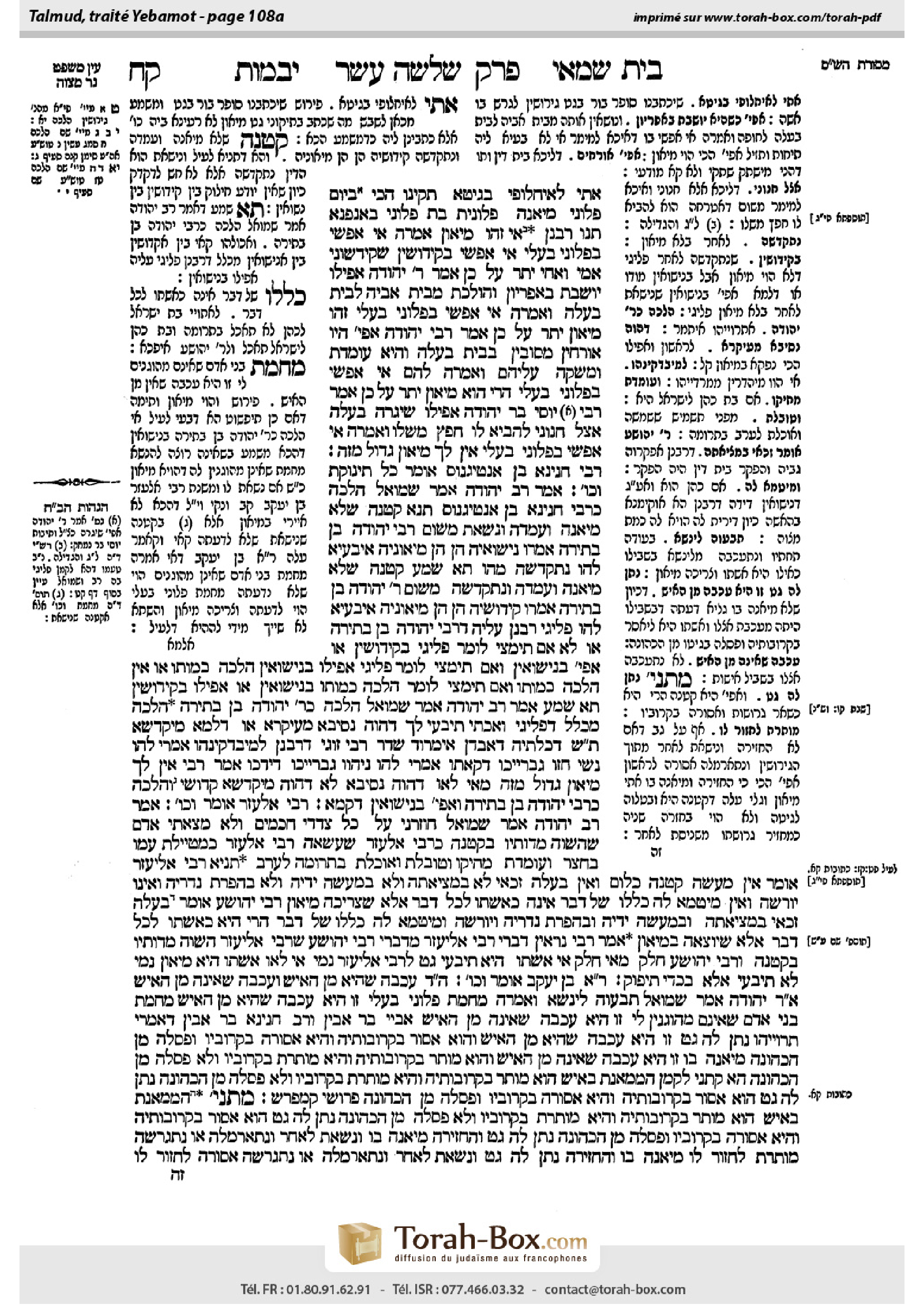
Yevamot 108a: Talmud study for Daf Yomi
Daf Yomi is the daily study of one Talmud folio. Explore 37 tractates with scans, Hebrew text, Sefaria English and AI-generated French translations where annotated.
Passage selection and English or AI-generated French translation are available where the scan has annotations. Daf Study is independent of Torah-Box and Sefaria.
Browse Yevamot · יבמות · All tractatesYevamot 108a text and translations
This page of Yevamot includes the Aramaic text, an English translation and an AI-generated French translation, alongside the scan above.
יבמות ק״ח א · Aramaic and Hebrew text
אָתֵי לְאִיחַלּוֹפֵי בְּגִיטָּא. תַּקִּינוּ הָכִי: ״בְּיוֹם פְּלוֹנִי מֵיאֲנָה פְּלוֹנִית בַּת פְּלוֹנִי בְּאַנְפַּנָא״.
תָּנוּ רַבָּנַן: אֵי זֶהוּ מֵיאוּן? אָמְרָה: ״אִי אֶפְשִׁי בִּפְלוֹנִי בַּעְלִי״, ״אִי אֶפְשִׁי בְּקִידּוּשִׁין שֶׁקִּידְּשׁוּנִי אִמִּי וְאַחַי״. יָתֵר עַל כֵּן אָמַר רַבִּי יְהוּדָה: אֲפִילּוּ יוֹשֶׁבֶת בְּאַפִּרְיוֹן וְהוֹלֶכֶת מִבֵּית אָבִיהָ לְבֵית בַּעְלָהּ, וְאָמְרָה: ״אִי אֶפְשִׁי בִּפְלוֹנִי בַּעְלִי״ — זֶהוּ מֵיאוּן.
יָתֵר עַל כֵּן אָמַר רַבִּי יְהוּדָה: אֲפִילּוּ הָיוּ אוֹרְחִין מְסוּבִּין בְּבֵית בַּעְלָהּ וְהִיא עוֹמֶדֶת וּמַשְׁקָה עֲלֵיהֶם, וְאָמְרָה לָהֶם: ״אִי אֶפְשִׁי בִּפְלוֹנִי בַּעְלִי״ — הֲרֵי הוּא מֵיאוּן. יָתֵר עַל כֵּן אָמַר רַבִּי יוֹסֵי בַּר יְהוּדָה: אֲפִילּוּ שִׁיגְּרָהּ בַּעְלָהּ אֵצֶל חֶנְוָנִי לְהָבִיא לוֹ חֵפֶץ מִשֶּׁלּוֹ, וְאָמְרָה: ״אִי אֶפְשִׁי בִּפְלוֹנִי בַּעְלִי״ — אֵין לְךָ מֵיאוּן גָּדוֹל מִזֶּה.
רַבִּי חֲנִינָא בֶּן אַנְטִיגְנוֹס אוֹמֵר: כׇּל תִּינוֹקֶת וְכוּ׳. אָמַר רַב יְהוּדָה אָמַר שְׁמוּאֵל: הֲלָכָה כְּרַבִּי חֲנִינָא בֶּן אַנְטִיגְנוֹס. תָּנָא: קְטַנָּה שֶׁלֹּא מֵיאֲנָה, וְעָמְדָה וְנִשֵּׂאת, מִשּׁוּם רַבִּי יְהוּדָה בֶּן בְּתִירָה אָמְרוּ: נִישּׂוּאֶיהָ הֵן הֵן מֵיאוּנֶיהָ.
אִיבַּעְיָא לְהוּ: נִתְקַדְּשָׁה, מַהוּ? תָּא שְׁמַע: קְטַנָּה שֶׁלֹּא מֵיאֲנָה וְעָמְדָה וְנִתְקַדְּשָׁה — מִשּׁוּם רַבִּי יְהוּדָה בֶּן בְּתִירָה אָמְרוּ: קִידּוּשֶׁיהָ הֵן הֵן מֵיאוּנֶיהָ.
אִיבַּעְיָא לְהוּ: פְּלִיגִי רַבָּנַן עֲלֵיהּ דְּרַבִּי יְהוּדָה בֶּן בְּתִירָה אוֹ לָא? אִם תִּימְצֵי לוֹמַר פְּלִיגִי: בְּקִידּוּשִׁין, אוֹ אֲפִילּוּ בְּנִישּׂוּאִין? וְאִם תִּימְצֵי לוֹמַר פְּלִיגִי אֲפִילּוּ בְּנִישּׂוּאִין: הֲלָכָה כְּמוֹתוֹ אוֹ אֵין הֲלָכָה כְּמוֹתוֹ? וְאִם תִּימְצֵי לוֹמַר הֲלָכָה כְּמוֹתוֹ: בְּנִישּׂוּאִין אוֹ אֲפִילּוּ בְּקִידּוּשִׁין?
תָּא שְׁמַע, אָמַר רַב יְהוּדָה אָמַר שְׁמוּאֵל: הֲלָכָה כְּרַבִּי יְהוּדָה בֶּן בְּתִירָה. הֲלָכָה — מִכְּלָל דִּפְלִיגִי.
וְאַכַּתִּי תִּיבְּעֵי לָךְ: דַּהֲוָה נְסִיבָא מֵעִיקָּרָא, אוֹ דִלְמָא מִיקַּדְּשָׁא? תָּא שְׁמַע: דְּכַלָּתֵיהּ דְּאַבָּדָן, אִימְּרוּד, שַׁדַּר רַבִּי זוּגֵי דְּרַבָּנַן לְמִיבְדְּקִינְהוּ. אָמְרִי לְהוּ נְשֵׁי: חֲזוּ גַּבְרַיְיכוּ דְּקָאָתוּ. אָמְרִי לְהוּ: נִיהְווֹ גַּבְרַיְיכוּ דִּידְכוּ.
אָמַר רַבִּי: אֵין לְךָ מֵיאוּן גָּדוֹל מִזֶּה. מַאי לָאו, דַּהֲוָה נְסִיבָא? לָא, דַּהֲוָה מִיקַּדְּשָׁא קִידּוּשֵׁי. וַהֲלָכָה כְּרַבִּי יְהוּדָה בֶּן בְּתִירָה, וַאֲפִילּוּ בְּנִישּׂוּאִין דְּקַמָּא.
רַבִּי אֶלְעָזָר אוֹמֵר וְכוּ׳. אָמַר רַב יְהוּדָה אָמַר שְׁמוּאֵל: חוֹזְרַנִי עַל כׇּל צִדְדֵי חֲכָמִים וְלֹא מָצָאתִי אָדָם שֶׁהִשְׁוָה מִדּוֹתָיו בִּקְטַנָּה כְּרַבִּי אֶלְעָזָר. שֶׁעֲשָׂאָהּ רַבִּי אֶלְעָזָר כִּמְטַיֶּילֶת עִמּוֹ בֶּחָצֵר, וְעוֹמֶדֶת מֵחֵיקוֹ וְטוֹבֶלֶת וְאוֹכֶלֶת בִּתְרוּמָה לָעֶרֶב.
תַּנְיָא, רַבִּי אֱלִיעֶזֶר אוֹמֵר: אֵין מַעֲשֵׂה קְטַנָּה כְּלוּם, וְאֵין בַּעְלָהּ זַכַּאי לֹא בִּמְצִיאָתָהּ, וְלֹא בְּמַעֲשֵׂה יָדֶיהָ, וְלֹא בַּהֲפָרַת נְדָרֶיהָ, וְאֵינוֹ יוֹרְשָׁהּ, וְאֵין מִיטַּמֵּא לָהּ. כְּלָלוֹ שֶׁל דָּבָר: אֵינָהּ כְּאִשְׁתּוֹ לְכׇל דָּבָר, אֶלָּא שֶׁצְּרִיכָה מֵיאוּן.
רַבִּי יְהוֹשֻׁעַ אוֹמֵר: בַּעְלָהּ זַכַּאי בִּמְצִיאָתָהּ, וּבְמַעֲשֵׂה יָדֶיהָ, וּבַהֲפָרַת נְדָרֶיהָ, וְיוֹרְשָׁהּ, וּמִיטַּמֵּא לָהּ. כְּלָלוֹ שֶׁל דָּבָר: הֲרֵי הִיא כְּאִשְׁתּוֹ לְכׇל דָּבָר, אֶלָּא שֶׁיּוֹצְאָה בְּמֵיאוּן.
אָמַר רַבִּי: נִרְאִין דִּבְרֵי רַבִּי אֱלִיעֶזֶר מִדִּבְרֵי רַבִּי יְהוֹשֻׁעַ. שֶׁרַבִּי אֱלִיעֶזֶר הִשְׁוָה מִדּוֹתָיו בִּקְטַנָּה, וְרַבִּי יְהוֹשֻׁעַ חָלַק. מַאי חָלַק? אִי אִשְׁתּוֹ הִיא — תִּיבְעֵי גֵּט.
לְרַבִּי אֱלִיעֶזֶר נָמֵי: אִי לָאו אִשְׁתּוֹ הִיא — מֵיאוּן נָמֵי לָא תִּיבְעֵי! אֶלָּא בִּכְדִי תִּיפּוֹק?!
רַבִּי אֱלִיעֶזֶר בֶּן יַעֲקֹב אוֹמֵר וְכוּ׳. הֵיכִי דָּמֵי עַכָּבָה שֶׁהִיא מִן הָאִישׁ וְעַכָּבָה שֶׁאֵינָהּ מִן הָאִישׁ? אָמַר רַב יְהוּדָה אָמַר שְׁמוּאֵל: תְּבָעוּהָ לִינָּשֵׂא, וְאָמְרָה: ״מֵחֲמַת פְּלוֹנִי בַּעְלִי״ — זוֹ הִיא עַכָּבָה שֶׁהִיא מִן הָאִישׁ. ״מֵחֲמַת בְּנֵי אָדָם שֶׁאֵינָם מְהוּגָּנִין לִי״ — זוֹ הִיא עַכָּבָה שֶׁאֵינָהּ מִן הָאִישׁ.
אַבָּיֵי בַּר אָבִין וְרַב חֲנִינָא בַּר אָבִין דְאָמְרִי תַּרְוַיְיהוּ: נָתַן לָהּ גֵּט — זוֹ הִיא עַכָּבָה שֶׁהִיא מִן הָאִישׁ, וְהוּא אָסוּר בִּקְרוֹבוֹתֶיהָ, וְהִיא אֲסוּרָה בִּקְרוֹבָיו, וּפְסָלָהּ מִן הַכְּהוּנָּה. מֵיאֲנָה בּוֹ — זוֹ הִיא עַכָּבָה שֶׁאֵינָהּ מִן הָאִישׁ, וְהוּא מוּתָּר בִּקְרוֹבוֹתֶיהָ, וְהִיא מוּתֶּרֶת בִּקְרוֹבָיו, וְלֹא פְּסָלָהּ מִן הַכְּהוּנָּה.
הָא קָתָנֵי לְקַמַּן: הַמְמָאֶנֶת בָּאִישׁ — הוּא מוּתָּר בִּקְרוֹבוֹתֶיהָ, וְהִיא מוּתֶּרֶת בִּקְרוֹבָיו, וְלֹא פְּסָלָהּ מִן הַכְּהוּנָּה. נָתַן לָהּ גֵּט — הוּא אָסוּר בִּקְרוֹבוֹתֶיהָ, וְהִיא אֲסוּרָה בִּקְרוֹבָיו, וּפְסָלָהּ מִן הַכְּהוּנָּה! פָּרוֹשֵׁי קָמְפָרֵשׁ.
מַתְנִי׳ הַמְמָאֶנֶת בָּאִישׁ — הוּא מוּתָּר בִּקְרוֹבוֹתֶיהָ, וְהִיא מוּתֶּרֶת בִּקְרוֹבָיו, וְלֹא פְּסָלָהּ מִן הַכְּהוּנָּה. נָתַן לָהּ גֵּט — הוּא אָסוּר בִּקְרוֹבוֹתֶיהָ, וְהִיא אֲסוּרָה בִּקְרוֹבָיו, וּפְסָלָהּ מִן הַכְּהוּנָּה.
נָתַן לָהּ גֵּט וְהֶחְזִירָהּ, מֵיאֲנָה בּוֹ וְנִשֵּׂאת לְאַחֵר, וְנִתְאַרְמְלָה אוֹ נִתְגָּרְשָׁה — מוּתֶּרֶת לַחְזוֹר לוֹ. מֵיאֲנָה בּוֹ וְהֶחְזִירָהּ, נָתַן לָהּ גֵּט וְנִשֵּׂאת לְאַחֵר, וְנִתְאַרְמְלָה אוֹ נִתְגָּרְשָׁה — אֲסוּרָה לַחְזוֹר לוֹ.
Yevamot 108a · English translation
This document may come to be confused with a bill of divorce and perhaps a man will err and give a bill of divorce using the text of refusal. Therefore, they decreed that one should write as follows: On such and such a day, so-and-so, the daughter of so-and-so, performed refusal in our presence, and no more.
§ The Sages taught: What constitutes a refusal? If she said: I do not want so-and-so as my husband, or: I do not want the betrothal in which my mother and brothers had me betrothed, that is a refusal. Rabbi Yehuda said more than that: Even if she is sitting in a bridal chair [apiryon] going from her father’s house to her husband’s house and said along the way: I do not want so-and-so as my husband, this constitutes a refusal.
Rabbi Yehuda said even more than that: Even if guests are reclining at her husband’s house and she is standing and serving them drinks as hostess, and she said to them: I do not want so-and-so as my husband, this constitutes a refusal, even though it is possible that she is merely complaining about the effort she is expending. Rabbi Yosei bar Yehuda said more than that: Even if her husband sent her to a shopkeeper to bring him an article of his and she said: I do not want so-and-so as my husband, there is no greater refusal than this.
§ It was taught in the mishna: Rabbi Ḥanina ben Antigonus says: Any girl who is so young that she cannot keep her betrothal safe does not need to refuse. Rav Yehuda said that Shmuel said: The halakha is in accordance with the opinion of Rabbi Ḥanina ben Antigonus. It was taught: In the case of a minor girl who did not refuse her husband, but who went and married someone else, it was said in the name of Rabbi Yehuda ben Beteira: Her new marriage constitutes her refusal, as she made her state of mind known, that she does not want him, and that is sufficient.
A dilemma was raised before the Sages: What is the halakha if she was betrothed to another man without performing refusal of the first husband? Is her acceptance of the betrothal sufficient to indicate that she refuses the first husband? The Gemara suggests: Come and hear an answer from a baraita: If a minor girl did not refuse her husband but went and became betrothed to another man, then, as the Sages said in the name of Rabbi Yehuda ben Beteira: Her betrothal constitutes her refusal.
A dilemma was raised before the Sages: Do the Rabbis disagree with Rabbi Yehuda ben Beteira or not? And further, if you say that they do disagree with him, do they disagree with him with regard to betrothal alone, or do they also disagree with him with regard to marriage? And if you say that they disagree even with regard to marriage, is the halakha in accordance with his opinion or is the halakha not in accordance with his opinion? And if you say that the halakha is in accordance with his opinion, is this only with regard to marriage, or is it even with regard to betrothal?
The Gemara cites a tradition: Come and hear: Rav Yehuda said that Shmuel said: The halakha is in accordance with the opinion of Rabbi Yehuda ben Beteira with regard to both marriage and betrothal. From the fact that he ruled the halakha, one may derive by inference that the Rabbis disagree.
But still, you should raise the dilemma: Does Rabbi Yehuda ben Beteira say that her betrothal to another counts as refusal even when she had initially been married or perhaps only if she was betrothed but not married beforehand? Come and hear: The daughters-in-law of Abdan rebelled against their husbands. Rabbi Yehuda HaNasi sent a pair of Sages to examine them and determine what could be done to rectify the matter. Some women said to the daughters-in-law: See, it is your husbands that are coming. They said back to them: Let them be your husbands.
Rabbi Yehuda HaNasi said: There is no greater refusal than this. What is the case? Is it not that they were already married? The Gemara rejects this: No, they were merely betrothed, but not married. This story cannot establish unequivocally what the halakha is in the case when the girl is married. The Gemara nevertheless concludes: The halakha is in accordance with the opinion of Rabbi Yehuda ben Beteira in all of these matters, even with regard to her marriage to the first husband: Even if she had actually been married to the first man, the marriage is invalidated by her betrothal to another.
§ It is taught in the mishna: Rabbi Elazar says: The act of a minor girl is nothing. Rather, her status is as though she were a seduced unmarried woman. Rav Yehuda said that Shmuel said: I reviewed all the opinions of the Sages concerning these matters, and I did not find any person who applied a consistent standard with regard to a minor like Rabbi Elazar did. For Rabbi Elazar portrayed her as a girl walking with her husband in a courtyard, who stands up from his bosom after he engaged in intercourse with her, and immerses herself to become ritually pure, and partakes of teruma by evening as if there were no marital bond between them and as if she, as the daughter of a priest, could continue to partake of teruma. The daughter of a priest is prohibited from eating teruma once she is married to a non-priest.
It is taught in a baraita: Rabbi Eliezer says: The act of a minor girl is nothing, and therefore her marriage is not valid. And her husband has no rights to items she finds, nor to her earnings; nor does he have the right to annul her vows; he does not inherit her assets if she dies; and if she dies he may not become ritually impure on her account if he is a priest, i.e., through his presence in the same room as her corpse. The principle is: She is not his wife in any sense, except that she must perform refusal in order to marry someone else.
Rabbi Yehoshua says: In the case of a minor whose mother or brother married her off, her husband has rights to items she finds, and to her earnings; and he has the right to annul her vows; and he inherits her assets if she dies; and if she dies he must become ritually impure on her account even if he is a priest. The principle is: She is his wife in every sense, except that she can leave him by means of refusal and does not require a bill of divorce.
Rabbi Yehuda HaNasi said: The statement of Rabbi Eliezer appears to be more correct than the statement of Rabbi Yehoshua, as Rabbi Eliezer applied a consistent standard with regard to a minor, while Rabbi Yehoshua applied an inconsistent standard. The Gemara asks: In what way is his standard inconsistent? The Gemara answers: If she is his wife, she should require a bill of divorce from him.
According to Rabbi Eliezer too, there appears to be an inconsistency, as, if she is not his wife, she should not be required to perform refusal either. The Gemara answers: But shall she leave with no ritual at all? Some sort of act is required to indicate that their relationship is permanently severed. Rabbi Eliezer has a consistent standard, according to which the marriage of a minor has no substance and to dissolve it she need only indicate that she does not want her husband. Rabbi Yehoshua is inconsistent in treating the relationship as a marriage even though it can be dissolved easily.
§ The mishna stated: Rabbi Eliezer ben Ya’akov says: If there is any obstruction in the matter due to the man, it is as if she were his wife. If there is any obstruction in the matter that is not due to the man, it is as if she were not his wife. The Gemara asks: What are the circumstances of an obstruction due to the man, and an obstruction that is not due to the man? Rav Yehuda said that Shmuel said: If someone proposed marriage to her and she said: I do not wish to marry on account of so-and-so, my husband, this is an obstruction that is due to the man. When she declined the proposal, she made it clear that she views herself as his wife. But if she says: I do not want to marry because the men suggested to me are not suitable for me, this is an obstruction that is not due to the man, and she is not considered to be his wife.
Abaye bar Avin and Rav Ḥanina bar Avin both say: If the minor’s husband gave her a bill of divorce, this is an obstruction that is due to the man, since in presenting the bill of divorce, the marriage is being treated as valid. Therefore, from then onward, he is prohibited from marrying her close relatives, and she is prohibited from marrying his close relatives; and, as a divorced woman, she is disqualified from marrying into the priesthood. However, if she refuses him, this is an obstruction that is not due to the man. Therefore, he is permitted to marry her close relatives, and she is permitted to marry his close relatives, and she is not disqualified from the priesthood, since her refusal annuls the marriage retroactively.
The Gemara challenges: But it is taught explicitly below, in the following mishna: If a minor girl refuses a man, he is permitted to marry her close relatives and she is permitted to marry his close relatives, and he has not disqualified her from marrying into the priesthood. If he gave her a bill of divorce, he is prohibited from marrying her close relatives, and she is prohibited from marrying his close relatives, and he has disqualified her from marrying into the priesthood. Since the difference between refusal and a bill of divorce is already addressed in the following mishna, why is the same ruling repeated here? The Gemara answers: The following mishna is explaining the latter part of this mishna.
MISHNA: If a minor girl refuses a man, he is permitted to marry her close relatives, such as her mother or her sister, and she is permitted to marry his close relatives, such as his father or brother, and he has not disqualified her from marrying into the priesthood, as she is not considered divorced. However, if he gave her a bill of divorce, then even though the marriage was valid according to rabbinic law and not Torah law, he is prohibited from marrying her close relatives, and she is prohibited from marrying his close relatives, and he has disqualified her from marrying into the priesthood.
If he gave her a bill of divorce but afterward remarried her, and she subsequently refused him and married another man, and then she was widowed or divorced from her second husband, she is permitted to return to him. Since she left him the last time by means of refusal, the refusal cancels the bill of divorce that he gave her previously, and her status is that of a minor girl who refused her husband, who is not forbidden to her first husband after a second marriage. However, if the order was different, and if she refused him and he subsequently remarried her, and this time he gave her a bill of divorce and she married another man, and she was widowed or divorced, she is forbidden to return to him, like any divorced woman who married another man.
Yevamot 108a · Traduction française (IA)
Ce document risque d’être confondu avec un acte de divorce, et un homme pourrait se tromper et donner un acte de divorce en utilisant la formule du refus. On décréta donc qu’il fallait écrire ainsi : « Tel jour, Untelle, fille d’Untel, a exprimé son refus en notre présence », et rien de plus.
§ Les Sages ont enseigné : Qu’est-ce qui constitue un refus ? Si elle dit : « Je ne veux pas d’Untel pour mari », ou : « Je ne veux pas de ce mariage auquel ma mère et mes frères m’ont fiancée », cela constitue un refus. Rabbi Yehouda va plus loin : même si elle est assise dans un palanquin nuptial [apiryon], en route de la maison de son père vers celle de son mari, et qu’elle dit en chemin : « Je ne veux pas d’Untel pour mari », cela constitue un refus.
Rabbi Yehouda va encore plus loin : même si des invités sont allongés chez son mari et qu’elle se tient debout pour les servir à boire en maîtresse de maison, et qu’elle leur dit : « Je ne veux pas d’Untel pour mari », cela constitue un refus, même s’il est possible qu’elle se plaigne simplement de la peine que lui donne ce travail. Rabbi Yosse bar Yehouda va plus loin encore : même si son mari l’envoie chez un commerçant chercher un objet qui lui appartient et qu’elle dit : « Je ne veux pas d’Untel pour mari », il n’y a pas de refus plus manifeste que celui-là.
§ La Michna enseigne : Rabbi Ḥanina ben Antigonos dit : Toute jeune fille si petite qu’elle ne peut veiller sur ses fiançailles n’a pas besoin d’exprimer son refus. Rav Yehouda a dit au nom de Chmouel : La halakha suit l’opinion de Rabbi Ḥanina ben Antigonos. Il a été enseigné : Dans le cas d’une mineure qui n’a pas exprimé son refus à son mari, mais qui est allée épouser un autre homme, on a rapporté au nom de Rabbi Yehouda ben Beteira que son nouveau mariage constitue son refus, puisqu’elle a fait connaître son intention : elle ne veut pas de lui, et cela suffit.
Une question fut posée aux Sages : Quelle est la halakha si elle s’est fiancée à un autre homme sans avoir exprimé son refus à son premier mari ? Son acceptation des fiançailles suffit-elle à indiquer qu’elle refuse son premier mari ? La Guemara propose : Viens et entends la réponse d’une baraïta : si une mineure n’a pas exprimé son refus à son mari, mais est allée se fiancer à un autre homme, alors, comme les Sages l’ont rapporté au nom de Rabbi Yehouda ben Beteira, ses fiançailles constituent son refus.
Une question fut posée aux Sages : Les Rabbins sont-ils en désaccord avec Rabbi Yehouda ben Beteira ou non ? En outre, si tu dis qu’ils sont en désaccord avec lui, le sont-ils uniquement au sujet des fiançailles, ou également au sujet du mariage ? Et si tu dis qu’ils sont en désaccord avec lui même au sujet du mariage, la halakha suit-elle son opinion ou non ? Et si tu dis que la halakha suit son opinion, est-ce uniquement au sujet du mariage, ou même au sujet des fiançailles ?
La Guemara cite une tradition : Viens et entends : Rav Yehouda a dit au nom de Chmouel : La halakha suit l’opinion de Rabbi Yehouda ben Beteira, aussi bien pour le mariage que pour les fiançailles. Du fait qu’il a tranché la halakha, on peut déduire que les Rabbins sont en désaccord avec lui.
Mais il faut encore poser la question : Rabbi Yehouda ben Beteira considère-t-il que ses fiançailles avec un autre homme valent refus même si elle avait auparavant été mariée, ou seulement si elle avait été fiancée, mais pas mariée ? Viens et entends : les belles-filles d’Avdan se rebellèrent contre leurs maris. Rabbi Yehouda HaNassi envoya deux Sages les examiner et déterminer comment remédier à la situation. Certaines femmes dirent aux belles-filles : « Regardez, ce sont vos maris qui arrivent. » Elles leur répondirent : « Qu’ils soient vos maris, à vous ! »
Rabbi Yehouda HaNassi dit : « Il n’y a pas de refus plus manifeste que celui-là. » De quoi s’agit-il ? N’étaient-elles pas déjà mariées ? La Guemara rejette cette interprétation : Non, elles étaient seulement fiancées, mais pas mariées. Cette histoire ne permet donc pas d’établir sans équivoque quelle est la halakha dans le cas où la jeune fille est mariée. La Guemara conclut néanmoins : La halakha suit l’opinion de Rabbi Yehouda ben Beteira dans tous ces cas, même lorsqu’elle a été mariée à son premier mari : même si elle a effectivement été mariée au premier homme, son mariage est annulé par ses fiançailles avec un autre.
§ La Michna enseigne : Rabbi Elazar dit : L’acte d’une mineure n’a aucune valeur. Elle a plutôt le statut d’une jeune fille célibataire séduite. Rav Yehouda a dit au nom de Chmouel : J’ai passé en revue toutes les opinions des Sages sur ces questions, et je n’ai trouvé personne qui ait appliqué à une mineure un critère aussi cohérent que Rabbi Elazar. En effet, Rabbi Elazar la dépeint comme une jeune fille qui marche avec son mari dans une cour, puis se relève de ses bras après qu’il a eu des rapports avec elle, s’immerge afin de retrouver la pureté rituelle et consomme de la terouma le soir, comme si aucun lien conjugal ne les unissait et comme si, fille de prêtre, elle pouvait continuer à consommer de la terouma. Or, une fille de prêtre n’a plus le droit de manger de la terouma dès qu’elle est mariée à un non-prêtre.
Il est enseigné dans une baraïta : Rabbi Eliezer dit : L’acte d’une mineure n’a aucune valeur, et son mariage n’est donc pas valide. Son mari n’a aucun droit sur ce qu’elle trouve ni sur ses revenus ; il n’a pas le droit d’annuler ses vœux ; il n’hérite pas de ses biens si elle meurt ; et, si elle meurt, il ne peut pas se rendre rituellement impur à cause d’elle s’il est prêtre, c’est-à-dire en se trouvant dans la même pièce que son cadavre. Le principe est le suivant : elle n’est en aucun sens son épouse, sauf qu’elle doit exprimer son refus pour pouvoir épouser quelqu’un d’autre.
Rabbi Yehoshoua dit : Dans le cas d’une mineure que sa mère ou son frère a mariée, son mari a des droits sur ce qu’elle trouve et sur ses revenus ; il a le droit d’annuler ses vœux ; il hérite de ses biens si elle meurt ; et, si elle meurt, il doit se rendre rituellement impur à cause d’elle, même s’il est prêtre. Le principe est le suivant : elle est son épouse à tous égards, sauf qu’elle peut le quitter en exprimant son refus et qu’elle n’a pas besoin d’un acte de divorce.
Rabbi Yehouda HaNassi dit : La déclaration de Rabbi Eliezer paraît plus juste que celle de Rabbi Yehoshoua, car Rabbi Eliezer a appliqué un critère cohérent à la mineure, tandis que Rabbi Yehoshoua a appliqué un critère incohérent. La Guemara demande : En quoi son critère est-il incohérent ? La Guemara répond : Si elle est son épouse, elle devrait avoir besoin d’un acte de divorce de sa part.
Selon Rabbi Eliezer aussi, il semble y avoir une incohérence : si elle n’est pas son épouse, elle ne devrait pas non plus être tenue d’exprimer son refus. La Guemara répond : Mais devrait-elle partir sans aucun rite ? Un acte quelconque est nécessaire pour indiquer que leur relation est définitivement rompue. Rabbi Eliezer applique un critère cohérent : le mariage d’une mineure n’a pas de substance et, pour y mettre fin, il lui suffit d’indiquer qu’elle ne veut pas de son mari. Rabbi Yehoshoua est incohérent en considérant leur relation comme un mariage alors qu’elle peut être dissoute si facilement.
§ La Michna a énoncé : Rabbi Eliezer ben Yaakov dit : Si un obstacle dans cette affaire est imputable à l’homme, c’est comme si elle était son épouse. Si l’obstacle n’est pas imputable à l’homme, c’est comme si elle n’était pas son épouse. La Guemara demande : Dans quelles circonstances l’obstacle est-il imputable à l’homme, et dans quelles circonstances ne l’est-il pas ? Rav Yehouda a dit au nom de Chmouel : Si quelqu’un lui propose le mariage et qu’elle répond : « Je ne veux pas me marier à cause d’Untel, mon mari », l’obstacle est imputable à l’homme. En refusant la proposition, elle a clairement montré qu’elle se considère comme son épouse. Mais si elle dit : « Je ne veux pas me marier parce que les hommes qu’on m’a proposés ne me conviennent pas », l’obstacle n’est pas imputable à l’homme et elle n’est pas considérée comme son épouse.
Abaye bar Avin et Rav Ḥanina bar Avin disent tous deux : Si le mari de la mineure lui a donné un acte de divorce, l’obstacle est imputable à l’homme, puisque, en lui présentant l’acte de divorce, le mariage est traité comme valide. Dès lors, il lui est interdit d’épouser ses proches parentes et elle ne peut épouser ses proches parents ; de plus, en tant que femme divorcée, elle est disqualifiée pour épouser un membre de la prêtrise. En revanche, si elle exprime son refus, l’obstacle n’est pas imputable à l’homme. Il peut donc épouser ses proches parentes, elle peut épouser ses proches parents, et elle n’est pas disqualifiée pour épouser un membre de la prêtrise, puisque son refus annule rétroactivement le mariage.
La Guemara objecte : Pourtant, il est explicitement enseigné plus loin, dans la Michna suivante : si une mineure exprime son refus à un homme, il peut épouser ses proches parentes et elle peut épouser ses proches parents, et il ne l’a pas disqualifiée pour épouser un membre de la prêtrise. S’il lui a donné un acte de divorce, il ne peut pas épouser ses proches parentes et elle ne peut pas épouser ses proches parents, et il l’a disqualifiée pour épouser un membre de la prêtrise. Puisque la Michna suivante traite déjà de la différence entre un refus et un acte de divorce, pourquoi la même règle est-elle répétée ici ? La Guemara répond : La Michna suivante explique la dernière partie de cette Michna.
MICHNA : Si une mineure exprime son refus à un homme, il peut épouser ses proches parentes, telles que sa mère ou sa sœur, et elle peut épouser ses proches parents, tels que son père ou son frère ; il ne l’a pas disqualifiée pour épouser un membre de la prêtrise, car elle n’est pas considérée comme divorcée. En revanche, s’il lui a donné un acte de divorce, bien que le mariage soit valide selon la loi rabbinique et non selon la Torah, il ne peut pas épouser ses proches parentes, elle ne peut pas épouser ses proches parents, et il l’a disqualifiée pour épouser un membre de la prêtrise.
S’il lui a donné un acte de divorce, mais l’a ensuite reprise pour épouse, puis qu’elle a exprimé son refus et épousé un autre homme, et qu’elle est ensuite devenue veuve ou a été divorcée de son second mari, elle a le droit de retourner auprès de lui. Puisqu’elle l’a quitté la dernière fois en exprimant son refus, celui-ci annule l’acte de divorce qu’il lui avait donné auparavant ; son statut est celui d’une mineure qui a exprimé son refus à son mari et qui n’est pas interdite à son premier mari après un second mariage. En revanche, si l’ordre des événements est différent, si elle a exprimé son refus, qu’il l’a ensuite reprise pour épouse et que, cette fois, il lui a donné un acte de divorce, après quoi elle a épousé un autre homme et est devenue veuve ou a été divorcée, il lui est interdit de retourner auprès de lui, comme à toute femme divorcée qui a épousé un autre homme.
Traduction française générée par IA à partir de l’édition anglaise de Sefaria. Vérifie toujours un passage avec le texte source.
Text from Sefaria: William Davidson Edition - Vocalized Aramaic (CC BY NC); William Davidson Edition - English (CC BY NC).