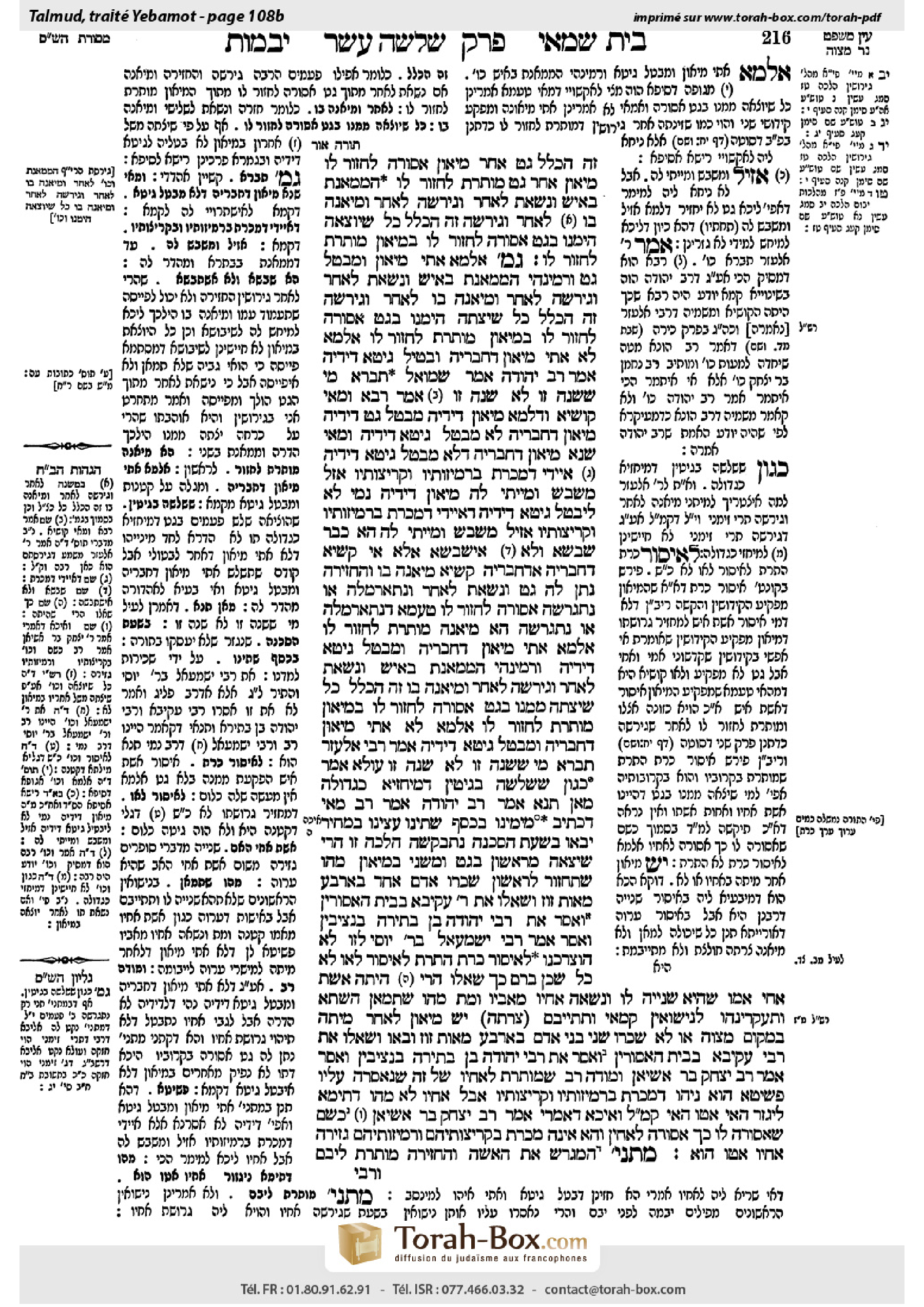
Yevamot 108b: Talmud study for Daf Yomi
Daf Yomi is the daily study of one Talmud folio. Explore 37 tractates with scans, Hebrew text, Sefaria English and AI-generated French translations where annotated.
Passage selection and English or AI-generated French translation are available where the scan has annotations. Daf Study is independent of Torah-Box and Sefaria.
Browse Yevamot · יבמות · All tractatesYevamot 108b text and translations
This page of Yevamot includes the Aramaic text, an English translation and an AI-generated French translation, alongside the scan above.
יבמות ק״ח ב · Aramaic and Hebrew text
זֶה הַכְּלָל: גֵּט אַחַר מֵיאוּן — אֲסוּרָה לַחְזוֹר לוֹ, מֵיאוּן אַחַר גֵּט — מוּתֶּרֶת לַחְזוֹר לוֹ.
הַמְמָאֶנֶת בָּאִישׁ וְנִשֵּׂאת לְאַחֵר וְגֵירְשָׁהּ, לְאַחֵר וּמֵיאֲנָה בּוֹ, לְאַחֵר וְגֵירְשָׁהּ, זֶה הַכְּלָל: כֹּל שֶׁיּוֹצְאָה הֵימֶנּוּ בְּגֵט — אֲסוּרָה לַחְזוֹר לוֹ, בְּמֵיאוּן — מוּתֶּרֶת לַחְזוֹר לוֹ.
גְּמָ׳ אַלְמָא אָתֵי מֵיאוּן וּמְבַטֵּל גֵּט.
וּרְמִינְהִי: הַמְמָאֶנֶת בָּאִישׁ וְנִשֵּׂאת לְאַחֵר וְגֵירְשָׁהּ, לְאַחֵר וּמֵיאֲנָה בּוֹ, לְאַחֵר וְגֵירְשָׁהּ, זֶה הַכְּלָל: כֹּל שֶׁיָּצְתָה הֵימֶנּוּ בְּגֵט — אֲסוּרָה לַחְזוֹר לוֹ, בְּמֵיאוּן — מוּתֶּרֶת לַחְזוֹר לוֹ. אַלְמָא לָא אָתֵי מֵיאוּן דְּחַבְרֵיהּ וּ[מְ]בַטֵּיל גִּיטָּא דִּידֵיהּ.
אָמַר רַב יְהוּדָה אָמַר שְׁמוּאֵל: תַּבְרַהּ, מִי שֶׁשָּׁנָה זוֹ לֹא שָׁנָה זוֹ.
אָמַר רָבָא: וּמַאי קוּשְׁיָא? וְדִלְמָא: מֵיאוּן דִּידֵיהּ מְבַטֵּל גֵּט דִּידֵיהּ, מֵיאוּן דְּחַבְרֵיהּ לָא מְבַטֵּל גִּיטָּא דִידֵיהּ. וּמַאי שְׁנָא מֵיאוּן דְּחַבְרֵיהּ דְּלָא מְבַטֵּל גִּיטָּא דִידֵיהּ — אַיְּידֵי דְּמַכֶּרֶת בִּרְמִיזוֹתָיו וּקְרִיצוֹתָיו אָזֵל מְשַׁבֵּשׁ וּמַיְיתֵי לַהּ, מֵיאוּן דִידֵיהּ נָמֵי לָא לִיבַטֵּל גִּיטָּא דִידֵיהּ — דְּאַיְּידֵי דְּמַכֶּרֶת בִּרְמִיזוֹתָיו וּקְרִיצוֹתָיו אָזֵיל מְשַׁבֵּשׁ וּמַיְיתֵי לַהּ!
הָא כְּבָר שַׁבְּשַׁהּ וְלָא אִישְׁתַּבַּשָׁא.
אֶלָּא אִי קַשְׁיָא, דְּחַבְרֵיהּ אַדְּחַבְרֵיהּ קַשְׁיָא: מֵיאֲנָה בּוֹ וְהֶחְזִירָהּ, נָתַן לָהּ גֵּט וְנִשֵּׂאת לְאַחֵר, וְנִתְאַרְמְלָה אוֹ נִתְגָּרְשָׁה — אֲסוּרָה לַחְזוֹר לוֹ. טַעְמָא דְּנִתְאַרְמְלָה אוֹ נִתְגָּרְשָׁה. הָא מֵיאֲנָה — מוּתֶּרֶת לַחְזוֹר לוֹ, אַלְמָא אָתֵי מֵיאוּן דְּחַבְרֵיהּ וּמְבַטֵּל גִּיטָּא דִידֵיהּ.
וּרְמִינְהִי: הַמְמָאֶנֶת בָּאִישׁ וְנִשֵּׂאת לְאַחֵר וְגֵירְשָׁהּ, לְאַחֵר וּמֵיאֲנָה בּוֹ, זֶה הַכְּלָל: כֹּל שֶׁיָּצְתָה מִמֶּנּוּ בְּגֵט — אֲסוּרָה לַחְזוֹר לוֹ, בְּמֵיאוּן — מוּתֶּרֶת לַחְזוֹר לוֹ. אַלְמָא לָא אָתֵי מֵיאוּן דְּחַבְרֵיהּ וּמְבַטֵּל גִּיטָּא דִידֵיהּ!
אָמַר רַבִּי אֶלְעָזָר: תִּבְרַהּ, מִי שֶׁשָּׁנָה זוֹ לֹא שָׁנָה זוֹ. עוּלָּא אָמַר: כְּגוֹן שֶׁשִּׁלְּשָׁה בְּגִיטִּין, דְּמִיחַזְּיָא כִּגְדוֹלָה.
מַאן תַּנָּא? אָמַר רַב יְהוּדָה אָמַר רַב, מַאי דִּכְתִיב: ״מֵימֵינוּ בְּכֶסֶף שָׁתִינוּ עֵצֵינוּ בִּמְחִיר יָבֹאוּ״? בִּשְׁעַת הַסַּכָּנָה נִתְבַּקְּשָׁה הֲלָכָה זוֹ: הֲרֵי שֶׁיָּצְאָה מֵרִאשׁוֹן בְּגֵט וּמִשֵּׁנִי בְּמֵיאוּן, מַהוּ שֶׁתַּחֲזוֹר לָרִאשׁוֹן?
שָׂכְרוּ אָדָם אֶחָד בְּאַרְבַּע מֵאוֹת זוּז, וְשָׁאֲלוּ אֶת רַבִּי עֲקִיבָא בְּבֵית הָאֲסוּרִין, וְאָסַר. אֶת רַבִּי יְהוּדָה בֶּן בְּתִירָה בִּנְצִיבִין, וְאָסַר.
אָמַר רַבִּי יִשְׁמָעֵאל בְּרַבִּי יוֹסֵי: לְזוֹ לֹא הוּצְרַכְנוּ. לְאִיסּוּר כָּרֵת הִתַּרְתָּ, לְאִיסּוּר לָאו — לֹא כׇּל שֶׁכֵּן.
בְּרַם כָּךְ שָׁאֲלוּ: הֲרֵי הָיְתָה אֵשֶׁת אֲחִי אִמּוֹ, שֶׁהִיא שְׁנִיָּיה לוֹ, וּנְשָׂאָהּ אָחִיו מֵאָבִיו וּמֵת, מַהוּ שֶׁתְּמָאֵן הַשְׁתָּא וְתִעְקְרִינְהוּ לְנִישּׂוּאִין קַמָּאֵי, וְתִתְיַיבֵּם (צָרָתַהּ). יֵשׁ מֵיאוּן לְאַחַר מִיתָה בִּמְקוֹם מִצְוָה, אוֹ לָא?
שָׂכְרוּ שְׁנֵי בְּנֵי אָדָם בְּאַרְבַּע מֵאוֹת זוּז, וּבָאוּ וְשָׁאֲלוּ אֶת רַבִּי עֲקִיבָא בְּבֵית הָאֲסוּרִין, וְאָסַר. אֶת רַבִּי יְהוּדָה בֶּן בְּתִירָה בִּנְצִיבִין, וְאָסַר.
אָמַר רַב יִצְחָק בַּר אַשְׁיָאן: וּמוֹדֶה רַב, שֶׁמּוּתֶּרֶת לְאָחִיו שֶׁל זֶה שֶׁנֶּאֶסְרָה עָלָיו.
פְּשִׁיטָא, הוּא נִיהוּ דְּמַכֶּרֶת בִּרְמִיזוֹתָיו וּקְרִיצוֹתָיו, אֲבָל אָחִיו לָא! מַהוּ דְּתֵימָא: לִיגְזַר הַאי אַטּוּ הַאי, קָא מַשְׁמַע לַן.
וְאִיכָּא דְּאָמְרִי, אָמַר רַב יִצְחָק בַּר אַשְׁיָאן: כְּשֵׁם שֶׁאֲסוּרָה לוֹ, כָּךְ אֲסוּרָה לָאַחִין. וְהָא אֵינָהּ מַכֶּרֶת בִּקְרִיצוֹתֵיהֶם וּרְמִיזוֹתֵיהֶם? גְּזֵירָה אָחִיו אַטּוּ הוּא.
מַתְנִי׳ הַמְגָרֵשׁ אֶת הָאִשָּׁה וְהֶחְזִירָהּ — מוּתֶּרֶת לַיָּבָם.
Yevamot 108b · English translation
This is the principle concerning a minor girl who refused her husband and then married several times: If the bill of divorce followed the refusal and she remarried, she is forbidden to return to him. If the refusal followed the bill of divorce, she is permitted to return to him. Since the refusal followed the bill of divorce it is clear that she was a minor and neither the marriage nor the divorce were valid by Torah law. However, when the ultimate separation is by means of a bill of divorce, there is no indication that she was a minor at the time and there is potential for confusion with an adult divorcée.
If a minor girl refuses one man and marries another, and he divorces her, and then she marries another man and refuses him, and then she marries another man and he divorces her, this is the principle for this case: With regard to anyone she leaves by means of a bill of divorce, it is prohibited for her to return to him. With regard to anyone she leaves by means of refusal, she is permitted to return to him.
GEMARA: It was taught in the mishna that if the man gave his minor wife a bill of divorce but subsequently remarried her and she refused him, and then she married someone else, she is permitted to remarry the first husband when her marriage to the second is concluded. Apparently, refusal comes and nullifies a bill of divorce.
The Gemara raises a contradiction from the end of the mishna: If a minor girl refuses one man and marries another, and he divorces her, and then she marries another man and refuses him, and then she marries another man and he divorces her, this is the principle: With regard to anyone she leaves by means of a bill of divorce, she is prohibited from returning to him. With regard to anyone she leaves by means of refusal, she is permitted to return to him. Apparently, a refusal of another man does not come and nullify one’s own bill of divorce. If the refusal completely nullified the marriage to the second husband, there would be no obstacle to her remarrying her first husband, as an ex-wife who did not marry another man is permitted to remarry her first husband. However, the divorce, combined with the second marriage, does generate a prohibition, and she is prohibited from remarrying in this case.
Rav Yehuda said that Shmuel said: This mishna is disjointed, and he who taught this halakha, that she may remarry her first husband if she refused him after he divorced her, did not teach that halakha, that her refusal of another man does not render her permitted to her divorced husband.
Rava said: What is the difficulty here? Perhaps her refusal of him nullifies his bill of divorce, while her refusal of the other man does not nullify the original husband’s bill of divorce. The Gemara asks: In what way is her refusal of the other man different, that it does not nullify his bill of divorce? Isn’t it that because she is familiar with the intimations and gestures [keritzotav] of her first husband, he will lead her astray and bring her back to him, by causing her to refuse her new husband and then return to him? Consequently, it was decreed that she may not return to her first husband by refusing the second. But for this same reason the refusal against the first husband himself also should not nullify his own bill of divorce, as, since she is familiar with his intimations and gestures, he will lead her astray and bring her back to him after she has married another man.
The Gemara answers: But he already tried to lead her astray and she was not led astray. In other words, he already remarried her after the divorce and she still refused him, which proves that he does not have sufficient influence to lead her astray.
But if there is a difficulty, it is the contradiction between one halakha involving another man and a different halakha involving another man that is difficult, as the mishna states: If she refused him and he subsequently remarried her, and this time he gave her a bill of divorce and she married another man, and she was widowed or divorced, she is prohibited from returning to her original husband. The reason is specifically that she was widowed or divorced by the other man. But if she had refused the second husband, she would be permitted to return to the first husband. Apparently, a refusal of the other man would have come and nullified his bill of divorce, permitting her to remarry the first husband, despite her erstwhile marriage to the other man.
This raises a contradiction, as it is taught later: If a minor girl refuses one man and marries another and he divorces her, and then she marries another and refuses him, this is the principle: With regard to anyone she leaves by means of a bill of divorce, she is prohibited from returning to him. With regard to anyone she leaves by means of refusal, she is permitted to return to him. Apparently, refusal of the other man cannot come and nullify his own bill of divorce.
Rabbi Elazar said: This mishna is disjointed, and he who taught this halakha did not teach that halakha. Ulla said: The last clause, in which it says her refusal does not nullify the bill of divorce, is referring to a case where she was divorced three times. Since she was divorced three times, she appears to be an adult, and therefore the Sages did not allow her refusal to cancel the effect of the divorce.
§ The Gemara asks: According to Rabbi Elazar, who holds that the mishna is disjointed, who is the tanna that taught that a minor may always remarry a husband she refused but not one who divorced her? Rav Yehuda said that Rav said: This can be determined based on the following incident. What is the meaning of that which is written: “We have drunk our water for money; our wood comes to us for a price” (Lamentations 5:4), implying that Torah, which is analogous to water, can be purchased with money. The Gemara explains: During the time of danger, i.e., religious persecution by the Romans, this halakhic ruling was requested: If she, a minor, left her first husband by means of a bill of divorce and her second by refusal, what is the halakha with regard to her returning to the first?
Those involved hired one person for four hundred dinars for the dangerous mission and asked Rabbi Akiva, who was incarcerated in prison by the Romans for teaching Torah, and he ruled that it is forbidden. They asked Rabbi Yehuda ben Beteira in Netzivin, in Babylonia, and he also deemed it forbidden.
Rabbi Yishmael, son of Rabbi Yosei, said: This question was not what they asked, as it was unnecessary: If you rendered permitted a prohibition for whose violation one is liable to receive excision from the World-to-Come [karet], i.e., if the prohibition against sexual intercourse with a married woman is dissolved by the refusal, as the marriage is nullified retroactively, then is it not clear all the more so that after a refusal, the regular prohibition against remarrying one’s ex-wife after she was married to another should be permitted? The opinion in the mishna that refusal does not cancel the effect of divorce is in accordance with that of Rabbi Akiva and Rabbi Yehuda ben Beteira, while the opinion that she is permitted to return to her first husband after refusing the second one is in accordance with the opinion of Rabbi Yishmael, son of Rabbi Yosei.
Rabbi Yishmael, son of Rabbi Yosei, continued: Rather, this is what they asked: If the minor was the wife of someone’s mother’s brother, a secondary forbidden relative, i.e., a relative forbidden to him by rabbinic law, and afterward his paternal brother married her and died, so that she became eligible to him for levirate marriage, what is the halakha with regard to the following: May she refuse now and uproot the first marriage to the mother’s brother, so that she will no longer be a forbidden relative, and likewise her rival wife will not be the rival wife of a forbidden relative, so that her rival wife may enter into levirate marriage? In other words, in a case where there is a mitzva of levirate marriage, is refusal after the husband’s death valid or not?
Those involved hired two people for four hundred dinars, and they came and asked Rabbi Akiva in prison and he deemed it prohibited. They asked Rabbi Yehuda ben Beteira in Netzivin and he deemed it prohibited.
Rav Yitzḥak bar Ashyan said: Rav concedes that she is permitted to the brother of the man to whom she is forbidden. Rav Yitzḥak is referring to a case of a minor who refused her husband, remarried the same man, and was subsequently divorced, and then married another man and refused him. Although she may not remarry the first husband, she may marry his brother, despite the fact that one may not ordinarily marry one’s brother’s divorcée.
The Gemara asks: It is obvious. It is he, her former husband, whose hints and gestures she recognizes, but not those of his brother, so that there is no concern that the brother will persuade her to refuse her husband. The Gemara explains: Rav Yitzḥak bar Ashyan saw fit to point this out, lest you say: Issue a decree rendering it prohibited for her to marry this brother due to the risk that such a marriage would lead people to think she is permitted to marry that brother, her original husband. Therefore, he teaches us that no such decree was instituted.
And there are those who say a different version of the discussion: Rav Yitzḥak bar Ashyan said: Just as she is forbidden to him, to the man who divorced her, so is she forbidden to his brothers. The Gemara asks: But she is not familiar with their intimations and gestures. Why is it prohibited for her to marry them? The Gemara answers: It is a rabbinic decree concerning the ex-husband’s brothers due to him, the ex-husband. If she were to be permitted to her ex-husband’s brothers, people might mistakenly think that she is even permitted to remarry the ex-husband himself.
MISHNA: With regard to one who divorces a woman and remarries her and then dies childless, his wife is permitted to enter into levirate marriage with her yavam,
Yevamot 108b · Traduction française (IA)
Voici le principe concernant une mineure qui a refusé son mari, puis s’est mariée plusieurs fois : si le guet a suivi le refus et qu’elle s’est remariée, il lui est interdit de retourner auprès de lui. Si le refus a suivi le guet, elle peut retourner auprès de lui. Puisque le refus a suivi le guet, il est clair qu’elle était mineure et que ni le mariage ni le divorce n’étaient valides selon la Torah. Cependant, lorsque la séparation finale a lieu au moyen d’un guet, rien n’indique qu’elle était mineure à ce moment-là, et il existe un risque de confusion avec une divorcée adulte.
Si une mineure refuse un homme et en épouse un autre, qui la répudie, puis qu’elle épouse encore un autre homme et le refuse, et qu’elle épouse enfin un autre homme, qui la répudie, voici le principe applicable à ce cas : tout homme qu’elle quitte au moyen d’un guet, il lui est interdit de retourner auprès de lui. Tout homme qu’elle quitte par un refus, elle peut retourner auprès de lui.
GUEMARA : La Michna enseigne que si un homme a donné un guet à sa jeune épouse, l’a ensuite épousée de nouveau et qu’elle l’a refusé, puis qu’elle a épousé un autre homme, elle peut épouser de nouveau son premier mari lorsque son mariage avec le second prend fin. Il semble donc que le refus survienne et annule un guet.
La Guemara soulève une contradiction à partir de la fin de la Michna : si une mineure refuse un homme et en épouse un autre, qui la répudie, puis qu’elle épouse encore un autre homme et le refuse, et qu’elle épouse enfin un autre homme, qui la répudie, voici le principe : tout homme qu’elle quitte au moyen d’un guet, il lui est interdit de retourner auprès de lui. Tout homme qu’elle quitte par un refus, elle peut retourner auprès de lui. Il semble donc que le refus d’un autre homme ne survienne pas pour annuler le guet de son propre mari. Si le refus annulait complètement le mariage avec le second mari, rien ne l’empêcherait d’épouser de nouveau son premier mari, car une femme divorcée qui n’a pas épousé un autre homme peut se remarier avec son premier mari. Cependant, le divorce, conjugué au second mariage, entraîne bien une interdiction, et il lui est interdit de se remarier dans ce cas.
Rav Yehuda a dit au nom de Shmuel : Cette Michna est décousue, et celui qui a enseigné cette halakha — selon laquelle elle peut épouser de nouveau son premier mari si elle l’a refusé après qu’il l’a répudiée — n’a pas enseigné cette autre halakha — selon laquelle son refus d’un autre homme ne la rend pas permise à son mari divorcé.
Rava dit : Quelle est la difficulté ici ? Peut-être que son refus de lui annule son guet, tandis que son refus de l’autre homme n’annule pas le guet du premier mari. La Guemara demande : En quoi son refus de l’autre homme est-il différent, pour qu’il n’annule pas son guet ? N’est-ce pas parce qu’elle connaît les allusions et les gestes [keritzotav] de son premier mari, qui la détournera et la fera revenir auprès de lui en l’amenant à refuser son nouveau mari, puis à retourner auprès de lui ? Par conséquent, il a été décrété qu’elle ne peut pas retourner auprès de son premier mari en refusant le second. Mais, pour cette même raison, le refus à l’égard du premier mari lui-même ne devrait pas non plus annuler son propre guet, car, puisqu’elle connaît ses allusions et ses gestes, il la détournera et la fera revenir auprès de lui après qu’elle aura épousé un autre homme.
La Guemara répond : Mais il a déjà essayé de la détourner, et elle ne s’est pas laissée détourner. Autrement dit, il l’a déjà épousée de nouveau après le divorce, et elle l’a malgré tout refusé, ce qui prouve qu’il n’a pas assez d’influence pour la détourner.
Mais s’il y a une difficulté, c’est la contradiction entre deux halakhot concernant un autre homme qui pose problème, car la Michna enseigne : si elle l’a refusé et qu’il l’a ensuite épousée de nouveau, puis lui a donné cette fois un guet et qu’elle a épousé un autre homme, et qu’elle est devenue veuve ou a été répudiée, il lui est interdit de retourner auprès de son premier mari. La raison est précisément qu’elle est devenue veuve ou a été répudiée par l’autre homme. Mais si elle avait refusé le second mari, elle aurait pu retourner auprès du premier. Il semble donc que le refus de l’autre homme aurait annulé son guet, ce qui lui aurait permis d’épouser de nouveau le premier mari, malgré son mariage antérieur avec l’autre homme.
Cela soulève une contradiction, car il est enseigné plus loin : si une mineure refuse un homme et en épouse un autre, qui la répudie, puis qu’elle épouse un autre homme et le refuse, voici le principe : tout homme qu’elle quitte au moyen d’un guet, il lui est interdit de retourner auprès de lui. Tout homme qu’elle quitte par un refus, elle peut retourner auprès de lui. Il semble donc que le refus de l’autre homme ne puisse pas survenir pour annuler son propre guet.
Rabbi Elazar a dit : Cette Michna est décousue, et celui qui a enseigné cette halakha n’a pas enseigné l’autre. Ulla a dit : La dernière clause, selon laquelle son refus n’annule pas le guet, se rapporte à un cas où elle a été répudiée trois fois. Comme elle a été répudiée trois fois, elle semble être adulte ; les Sages n’ont donc pas permis à son refus d’annuler l’effet du divorce.
§ La Guemara demande : Selon Rabbi Elazar, qui considère que la Michna est décousue, qui est le tanna ayant enseigné qu’une mineure peut toujours épouser de nouveau un mari qu’elle a refusé, mais pas un mari qui l’a répudiée ? Rav Yehuda a dit au nom de Rav : On peut le déterminer à partir de l’incident suivant. Que signifie ce qui est écrit : « Nous avons bu notre eau contre de l’argent ; notre bois nous vient à prix d’argent » (Lamentations 5,4), ce qui implique que la Torah, assimilée à l’eau, peut être achetée avec de l’argent ? La Guemara explique : À l’époque des persécutions, c’est-à-dire de la persécution religieuse par les Romains, on posa cette question de halakha : si elle, une mineure, a quitté son premier mari au moyen d’un guet et le second par un refus, quelle est la halakha quant à la possibilité pour elle de retourner auprès du premier ?
Les personnes concernées engagèrent quelqu’un pour quatre cents dinars afin qu’il accomplisse cette mission périlleuse. Elles interrogèrent Rabbi Akiva, emprisonné par les Romains pour avoir enseigné la Torah, et il déclara que cela était interdit. Elles interrogèrent Rabbi Yehuda ben Beteira à Netzivin, en Babylonie, et lui aussi jugea cela interdit.
Rabbi Yishmael, fils de Rabbi Yosei, dit : Ce n’est pas cela qu’ils ont demandé, car la question était inutile : si vous avez autorisé une interdiction dont la transgression expose à l’excision du monde à venir [karet] — c’est-à-dire si l’interdiction d’avoir des relations sexuelles avec une femme mariée est levée par le refus, puisque le mariage est annulé rétroactivement —, n’est-il pas évident, à plus forte raison, qu’après un refus, l’interdiction ordinaire de se remarier avec son ex-femme après qu’elle a épousé un autre homme devrait être levée ? L’opinion de la Michna selon laquelle le refus n’annule pas l’effet du divorce est celle de Rabbi Akiva et de Rabbi Yehuda ben Beteira, tandis que l’opinion selon laquelle elle peut retourner auprès de son premier mari après avoir refusé le second est celle de Rabbi Yishmael, fils de Rabbi Yosei.
Rabbi Yishmael, fils de Rabbi Yosei, poursuivit : Voici plutôt ce qu’ils ont demandé : si la mineure était l’épouse de l’oncle maternel de quelqu’un, une parente interdite à titre secondaire, c’est-à-dire une parente avec laquelle les relations sont interdites par décret rabbinique, et qu’ensuite son frère paternel l’a épousée puis est mort, de sorte qu’elle est devenue susceptible d’un mariage léviral avec lui, quelle est la halakha dans le cas suivant : peut-elle refuser maintenant et déraciner le premier mariage avec l’oncle maternel, afin qu’elle ne soit plus une parente interdite et que sa rivale ne soit pas non plus la rivale d’une parente interdite, de sorte que cette rivale puisse entrer dans un mariage léviral ? Autrement dit, lorsqu’il y a une mitsva de mariage léviral, un refus après la mort du mari est-il valide ou non ?
Les personnes concernées engagèrent deux personnes pour quatre cents dinars, et celles-ci allèrent interroger Rabbi Akiva en prison ; il jugea cela interdit. Elles interrogèrent Rabbi Yehuda ben Beteira à Netzivin, et il jugea également cela interdit.
Rav Yitzḥak bar Ashyan a dit : Rav reconnaît qu’elle peut épouser le frère de l’homme auquel elle est interdite. Rav Yitzḥak parle du cas d’une mineure qui a refusé son mari, a épousé de nouveau le même homme, puis a été répudiée, avant d’épouser un autre homme et de le refuser. Bien qu’elle ne puisse pas épouser de nouveau le premier mari, elle peut épouser son frère, même si, normalement, il est interdit d’épouser la femme répudiée de son frère.
La Guemara demande : C’est évident. C’est son ancien mari dont elle reconnaît les allusions et les gestes, mais pas ceux de son frère ; il n’y a donc pas à craindre que le frère la persuade de refuser son mari. La Guemara explique : Rav Yitzḥak bar Ashyan a jugé utile de le préciser, de peur que tu ne dises : décrétons qu’il lui est interdit d’épouser ce frère, par crainte qu’un tel mariage n’amène les gens à croire qu’elle a le droit d’épouser son ancien mari. Il nous enseigne donc qu’aucun décret de ce genre n’a été institué.
Et certains rapportent une version différente de la discussion : Rav Yitzḥak bar Ashyan a dit : De même qu’elle lui est interdite, à l’homme qui l’a répudiée, elle est interdite à ses frères. La Guemara demande : Mais elle ne connaît pas leurs allusions et leurs gestes. Pourquoi lui est-il interdit de les épouser ? La Guemara répond : C’est un décret rabbinique concernant les frères de l’ex-mari, à cause de lui, l’ex-mari. Si elle était autorisée à épouser les frères de son ex-mari, les gens pourraient croire à tort qu’elle est même autorisée à épouser de nouveau l’ex-mari lui-même.
MICHNA : Celui qui répudie une femme, l’épouse de nouveau, puis meurt sans enfant : sa femme peut entrer en mariage léviral avec son yavam,
Traduction française générée par IA à partir de l’édition anglaise de Sefaria. Vérifie toujours un passage avec le texte source.
Text from Sefaria: William Davidson Edition - Vocalized Aramaic (CC BY NC); William Davidson Edition - English (CC BY NC).