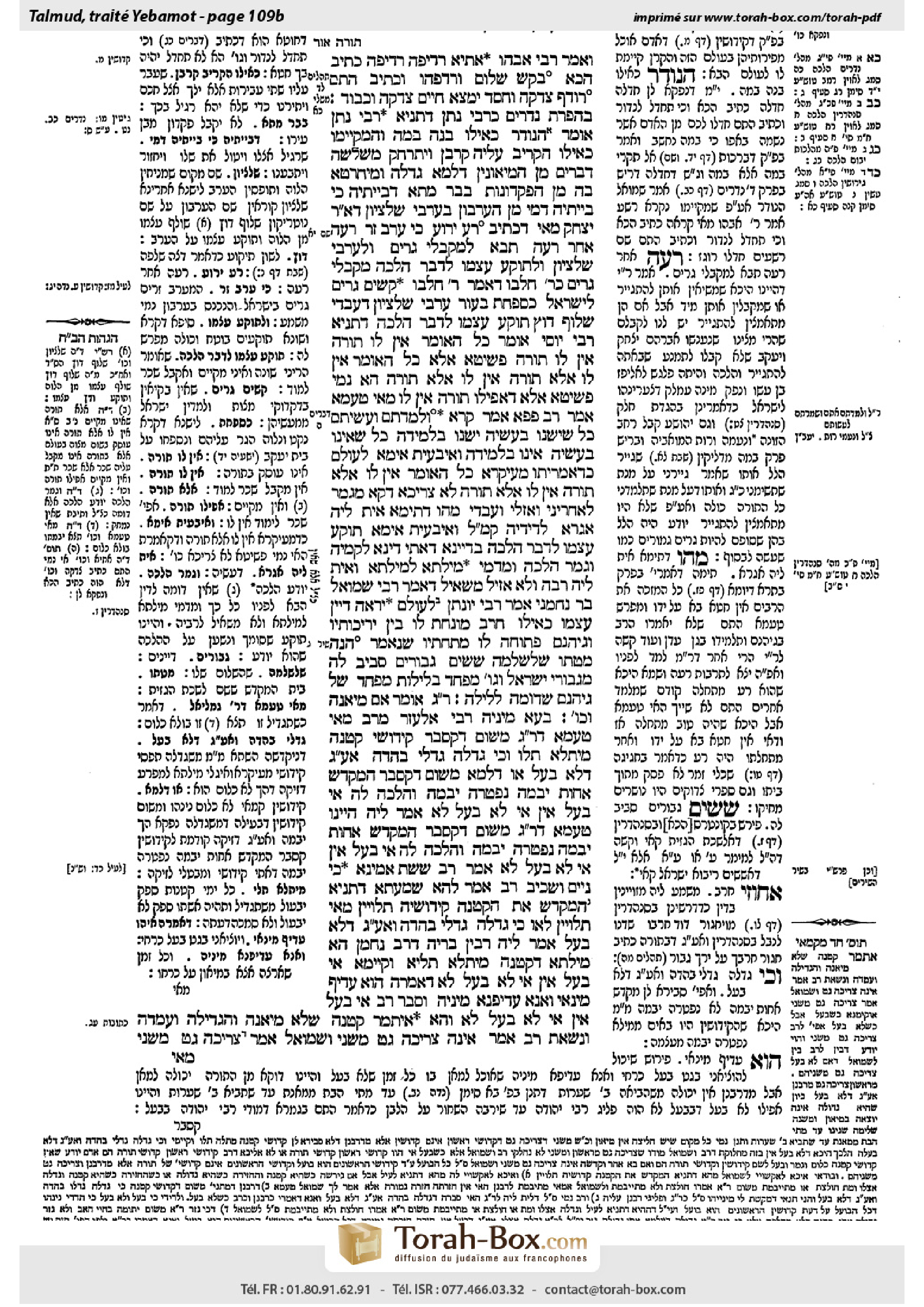
Yevamot 109b: Talmud study for Daf Yomi
Daf Yomi is the daily study of one Talmud folio. Explore 37 tractates with scans, Hebrew text, Sefaria English and AI-generated French translations where annotated.
Passage selection and English or AI-generated French translation are available where the scan has annotations. Daf Study is independent of Torah-Box and Sefaria.
Browse Yevamot · יבמות · All tractatesYevamot 109b text and translations
This page of Yevamot includes the Aramaic text, an English translation and an AI-generated French translation, alongside the scan above.
יבמות ק״ט ב · Aramaic and Hebrew text
וְאָמַר רַבִּי אֲבָהוּ: אָתְיָא ״רְדִיפָה״ ״רְדִיפָה״. כְּתִיב הָכָא: ״בַּקֵּשׁ שָׁלוֹם וְרׇדְפֵהוּ״, וּכְתִיב הָתָם: ״רוֹדֵף צְדָקָה וָחָסֶד יִמְצָא חַיִּים צְדָקָה וְכָבוֹד״. בַּהֲפָרַת נְדָרִים, כְּרַבִּי נָתָן. דְּתַנְיָא, רַבִּי נָתָן אוֹמֵר: הַנּוֹדֵר — כְּאִילּוּ בָּנָה בָּמָה. וְהַמְקַיְּימוֹ — כְּאִילּוּ הִקְרִיב עָלֶיהָ קׇרְבָּן.
וְיִתְרַחֵק מִשְּׁלֹשָׁה דְּבָרִים: מִן הַמֵּיאוּנִין — דִּלְמָא גָּדְלָה וּמִיחָרְטָא בָּהּ. מִן הַפִּקְדוֹנוֹת — בְּבַר מָתָא, דְּבַיְיתֵיהּ כִּי בַיְיתֵיהּ דָּמֵי. מִן הָעֵרָבוֹן — בַּעֲרָבֵי שַׁלְצִיּוֹן.
דְּאָמַר רַבִּי יִצְחָק: מַאי דִּכְתִיב: ״רַע יֵרוֹעַ כִּי עָרַב זָר״ — רָעָה אַחַר רָעָה תָּבֹא לִמְקַבְּלֵי גֵרִים, וְלַעֲרָבֵי שַׁלְצִיּוֹן, וּלְתוֹקֵעַ עַצְמוֹ לִדְבַר הֲלָכָה. מְקַבְּלֵי גֵרִים — כְּרַבִּי חֶלְבּוֹ. דְּאָמַר רַבִּי חֶלְבּוֹ: קָשִׁים גֵּרִים לְיִשְׂרָאֵל כְּסַפַּחַת בָּעוֹר.
עֲרָבֵי שַׁלְצִיּוֹן — דְּעָבְדִי שְׁלוֹף דּוֹץ. תּוֹקֵעַ עַצְמוֹ לִדְבַר הֲלָכָה — דְּתַנְיָא, רַבִּי יוֹסֵי אוֹמֵר: כׇּל הָאוֹמֵר אֵין לוֹ תּוֹרָה — אֵין לוֹ תּוֹרָה. פְּשִׁיטָא! אֶלָּא: כׇּל הָאוֹמֵר אֵין לוֹ אֶלָּא תּוֹרָה — אֵין לוֹ אֶלָּא תּוֹרָה.
הָא נָמֵי פְּשִׁיטָא! אֶלָּא דַּאֲפִילּוּ תּוֹרָה אֵין לוֹ. מַאי טַעְמָא? אָמַר רַב פָּפָּא, אָמַר קְרָא: ״וְלִמַּדְתֶּם וַעֲשִׂיתֶם״ — כֹּל שֶׁיֶּשְׁנוֹ בַּעֲשִׂיָּה יֶשְׁנוֹ בִּלְמִידָה, כֹּל שֶׁאֵינוֹ בַּעֲשִׂיָּה אֵינוֹ בִּלְמִידָה.
וְאִיבָּעֵית אֵימָא, לְעוֹלָם כִּדְאָמְרִיתוּ מֵעִיקָּרָא: כׇּל הָאוֹמֵר אֵין לוֹ אֶלָּא תּוֹרָה — אֵין לוֹ אֶלָּא תּוֹרָה, לָא צְרִיכָא דְּקָא מַגְמַר לְאַחֲרִינֵי וְאָזְלִי וְעָבְדִי. מַהוּ דְּתֵימָא: אִית לֵיהּ אַגְרָא לְדִידֵיהּ, קָא מַשְׁמַע לַן.
וְאִיבָּעֵית אֵימָא, תּוֹקֵעַ עַצְמוֹ לִדְבַר הֲלָכָה: בְּדַיָּינָא דְּאָתֵי דִּינָא לְקַמֵּיהּ, וְגָמַר הֲלָכָה וּמְדַמֵּי מִילְּתָא לְמִילְּתָא, וְאִית לֵיהּ רַבָּה וְלָא אָזֵיל מְשַׁאֵיל.
דְּאָמַר רַבִּי שְׁמוּאֵל בַּר נַחְמָנִי אָמַר רַבִּי יוֹנָתָן: לְעוֹלָם יִרְאֶה דַּיָּין עַצְמוֹ כְּאִילּוּ חֶרֶב מוּנַּחַת לוֹ בֵּין יְרֵיכוֹתָיו, וְגֵיהִנָּם פְּתוּחָה לוֹ מִתַּחְתָּיו, שֶׁנֶּאֱמַר: ״הִנֵּה מִטָּתוֹ שֶׁלִּשְׁלֹמֹה שִׁשִּׁים גִּבּוֹרִים סָבִיב לָהּ מִגִּבּוֹרֵי יִשְׂרָאֵל וְגוֹ׳ מִפַּחַד בַּלֵּילוֹת״, מִפַּחַד שֶׁל גֵּיהִנָּם שֶׁדּוֹמֶה לְלַיְלָה.
רַבָּן גַּמְלִיאֵל אוֹמֵר: אִם מֵיאֲנָה וְכוּ׳. בְּעָא מִינֵּיהּ רַבִּי אֶלְעָזָר מֵרַב: מַאי טַעְמָא דְּרַבָּן גַּמְלִיאֵל — מִשּׁוּם דְּקָסָבַר קִידּוּשֵׁי קְטַנָּה מִיתְלָא תְּלוּ, וְכִי גָּדְלָה גָּדְלִי בַּהֲדַהּ, אַף עַל גַּב דְּלָא בְּעַל,
אוֹ דִלְמָא מִשּׁוּם דְּקָסָבַר: הַמְקַדֵּשׁ אֲחוֹת יְבָמָה — נִפְטְרָה יְבָמָה וְהָלְכָה לָהּ, אִי בְּעַל — אִין, אִי לָא בְּעַל — לָא?
אֲמַר לֵיהּ: הַיְינוּ טַעְמָא דְּרַבָּן גַּמְלִיאֵל, מִשּׁוּם דְּקָסָבַר: הַמְקַדֵּשׁ אֲחוֹת יְבָמָה — נִפְטְרָה יְבָמָה וְהָלְכָה לָהּ, אִי בְּעַל — אִין, אִי לָא בְּעַל — לָא.
אָמַר רַב שֵׁשֶׁת: אָמֵינָא, כִּי נָיֵים וְשָׁכֵיב רַב, אֲמַר לְהָא שְׁמַעְתָּא. דְּתַנְיָא: הַמְקַדֵּשׁ אֶת הַקְּטַנָּה — קִידּוּשֶׁיהָ תְּלוּיִין. מַאי ״תְּלוּיִין״? לָאו כִּי גָּדְלָה גָּדְלִי בַּהֲדַהּ, וְאַף עַל גַּב דְּלָא בָּעַל?
אֲמַר לֵיהּ רָבִין בְּרֵיהּ דְּרַב נַחְמָן: הָא מִילְּתָא דִקְטַנָּה, מִיתְלָא תַּלְיָא וְקָיְימָא, אִי בְּעַל — אִין, אִי לָא בְּעַל — לָא. דְּאָמְרָה: הוּא עָדִיף מִינַּאי, וַאֲנָא עֲדִיפְנָא מִינֵּיהּ.
וְסָבַר רַב: אִי בְּעַל — אִין, אִי לָא בְּעַל — לָא? וְהָא אִיתְּמַר: קְטַנָּה שֶׁלֹּא מֵיאֲנָה, וְהִגְדִּילָה, וְעָמְדָה וְנִשֵּׂאת, רַב אָמַר: אֵינָהּ צְרִיכָה גֵּט מִשֵּׁנִי, וּשְׁמוּאֵל אָמַר: צְרִיכָה גֵּט מִשֵּׁנִי.
Yevamot 109b · English translation
And Rabbi Abbahu said: It is derived by verbal analogy from the terms pursuit and pursuit. It is written here: “Seek peace and pursue it” (Psalms 34:15) and it is written there: “He who pursues righteousness and mercy finds life, prosperity, and honor” (Proverbs 21:21), indicating that pursuing peace is a mitzva, just as pursuing righteousness and mercy is. As for the nullification of vows, this is in accordance with the opinion of Rabbi Natan, as it is taught in a baraita: Rabbi Natan says: With regard to one who vows, it is as if he built a personal altar when it is prohibited to build an altar outside the Temple. And one who fulfills that vow, it is as if he sacrificed an offering on this personal altar, thereby doubling his sin. Therefore, it is preferable that he ask a halakhic authority to dissolve the vow.
And one should distance himself from three things: From refusals, as perhaps she will grow up and regret her decision, and it will turn out that she refused a husband who was suitable for her. From deposits entrusted to him by an inhabitant of the same city, as he will treat the bailee’s home as his home. The owner might enter the bailee’s house and take the deposit without the latter’s knowledge, and subsequently falsely sue him for its return. From serving as a guarantor: This is referring to Sheltziyyon guarantees, in which the lender is entitled to demand payment from the guarantor even before the borrower defaults on the loan.
As Rabbi Yitzḥak said: What is the meaning of that which is written: “He who serves as a guarantor for a stranger shall suffer evil; but he who hates those who shake hands is secure” (Proverbs 11:15)? This means: Evil after evil will befall those who accept converts, and Sheltziyyon guarantors, and one who confounds himself in matters of halakha. The Gemara clarifies. Evil will befall those who accept converts: This is in accordance with the opinion of Rabbi Ḥelbo. As Rabbi Ḥelbo says: Converts are difficult for the Jewish people like a leprous sore on the skin.
Evil shall befall Sheltziyyon guarantors because they practice: Pull out, thrust in. That is, they pull out the borrower and thrust the guarantor in his place as the one responsible for the loan. Evil befalls one who confounds himself in matters of halakha, as it is taught in a baraita: Rabbi Yosei says: Anyone who says he has no Torah, has no Torah. The Gemara asks: Is this not obvious? Rather, anyone who says he has nothing other than Torah, has nothing other than Torah.
The Gemara asks: But isn’t this also obvious? One does not receive more reward than he deserves. Rather, it means that he does not even have Torah. What is the reason? Rav Pappa said: The verse states: That you may learn them and perform them, which is an abridged version of the verse “Hear, O Israel, the statutes and the ordinances that I speak in your ears this day, that you may learn them, and take care to perform them” (Deuteronomy 5:1). The verse teaches that anyone who is engaged in performing mitzvot is engaged in Torah study, while anyone not engaged in performing mitzvot is not engaged in Torah study; the Torah study of one who wishes only to immerse himself in his studies without fulfilling the mitzvot is not considered to be fulfilling even the mitzva of Torah study.
And if you wish, say: Actually, it is as you initially said: Anyone who says he has nothing other than Torah has nothing other than Torah. Rather, this statement is necessary with regard to one who teaches others and they go and perform the mitzvot. Lest you say that there is reward for him in it, Rabbi Yosei teaches us that since that person engaged in Torah study without the intention of observing the mitzvot himself, he does not receive a reward for the mitzvot that he taught others and which they performed.
And if you wish, say that one who confounds himself in matters of halakha is referring to a judge who had a case come before him, and he learned the tradition about a ruling in a similar case, and he likens one matter to the other in order to reach a conclusion; and he has a teacher nearby but he does not go and ask him. This is inappropriate, as judges must be very careful not to err in judgment.
As Rabbi Shmuel bar Naḥmani said that Rabbi Yonatan said: A judge should always view himself as if a sword were placed between his thighs, so that if he leans right or left he will be injured, and as if Gehenna was open beneath him, as it is stated: “Behold, it is the bed of Solomon; sixty mighty men are around it, of the mighty men of Israel. They all handle the sword, and are expert in war; every man has his sword upon his thigh, because of dread in the night” (Song of Songs 3:7–8), i.e., because of the dread of Gehenna, which is similar to the night. Rabbi Shmuel bar Naḥmani understands the mighty men of Israel in this verse to refer to the judges who sit in judgment around the bed of Solomon, i.e., in the Temple.
§ It was taught in the mishna that Rabban Gamliel says: If the minor refuses of her own accord, her refusal is valid. And if not, she should wait until she reaches majority, whereupon her marriage is valid by Torah law, and the widowed adult sister shall be exempt from levirate marriage due to her status as the sister of a wife. Rabbi Elazar raised a dilemma to Rav: What is Rabban Gamliel’s reasoning? Is it because he holds that the betrothal of a minor girl is in suspension and when she reaches majority, the betrothal reaches majority, i.e., is fully realized, with her? Accordingly, the betrothal would then be realized even if he did not engage in intercourse with her after she reached majority.
Or perhaps, is it because he holds that when a yavam betroths the sister of his yevama, causing the yevama to be forbidden to him, the yevama is exempt and is released even though her levirate bond came first? If he engaged in sexual intercourse with his betrothed after she reached majority, then yes, the yevama is exempt as a forbidden relative, because only then does Rabban Gamliel consider the betrothal to be fully realized, but if he did not engage in intercourse with his betrothed, then the yevama is not exempt from levirate marriage.
Rav said to him: This is Rabban Gamliel’s reasoning: Because he holds that in the case of one who betroths the sister of his yevama, the yevama is exempt and is released, then if he engaged in sexual intercourse with the sister after she reached majority then yes, the yevama is exempt from levirate marriage, but if he did not engage in intercourse with the sister after she reached majority, the yevama is not exempt.
Rav Sheshet said: I say that Rav said this halakha when he was dozing and lying down, as it is difficult. As it is taught in a baraita: In the case of one who betroths a minor girl, her betrothal is in suspension. What does it mean that it is in suspension? Is it not that when she reaches majority, the betrothal reaches majority with her and is fully realized even if he did not have intercourse with her after she reached majority?
Ravin, son of Rav Naḥman, said to Rav Sheshet: This matter, that the betrothal of a minor girl remains in suspension, should be understood differently. It means that her betrothal is provisional as long as she is still a minor: If he has sexual intercourse with her after she reaches majority, yes, her betrothal is realized; if he does not engage in intercourse with her after she reaches majority, her betrothal is not realized. For she says to herself: He has an advantage over me in that he can divorce me, and I have an advantage over him, as I can refuse him. Since the marriage of a minor depends upon her ongoing consent, as she can refuse him at any time, it remains provisional until it is consummated when she is an adult.
The Gemara asks: But does Rav truly think that only if he has intercourse with her after she becomes an adult, then yes, her betrothal is realized, but if he did not engage in intercourse with her, then no, it is not realized? Wasn’t it stated that with regard to a minor who had not refused her husband and reached majority, and then went and married another, Rav said: She does not require a bill of divorce from the second man, as she is fully married to the first and consequently her second marriage is invalid? And Shmuel said: She does require a bill of divorce from the second man, as it is uncertain whether her second marriage is valid.
Yevamot 109b · Traduction française (IA)
Et Rabbi Abbahou a dit : Cela se déduit par analogie verbale des termes « poursuivre » et « poursuivre ». Il est écrit ici : « Recherche la paix et poursuis-la » (Psaumes 34, 15), et il est écrit là : « Celui qui poursuit la justice et la bonté trouve la vie, la prospérité et l’honneur » (Proverbes 21, 21). Cela indique que poursuivre la paix est une mitsva, tout comme poursuivre la justice et la bonté. Quant à l’annulation des vœux, elle est conforme à l’opinion de Rabbi Nathan, comme l’enseigne une baraïta : Rabbi Nathan dit : Celui qui prononce un vœu, c’est comme s’il avait construit un autel privé alors qu’il est interdit de construire un autel en dehors du Temple. Et celui qui accomplit ce vœu, c’est comme s’il avait offert un sacrifice sur cet autel privé, doublant ainsi sa faute. Il vaut donc mieux qu’il demande à une autorité halakhique de dissoudre le vœu.
Et l’on doit se tenir à l’écart de trois choses : des refus, car il se peut que la jeune fille grandisse et regrette sa décision ; il s’avérera alors qu’elle a refusé un mari qui lui convenait. Des dépôts confiés par un habitant de la même ville, car il en viendra à considérer la maison du dépositaire comme la sienne. Le propriétaire pourrait entrer chez le dépositaire et reprendre le dépôt à son insu, puis le poursuivre mensongèrement en justice pour en obtenir la restitution. Enfin, du fait de se porter garant : il s’agit des garanties de Sheltziyyon, dans lesquelles le prêteur a le droit d’exiger le paiement du garant même avant que l’emprunteur ne manque à son obligation de remboursement.
Car Rabbi Yitzḥak a dit : Quel est le sens de ce qui est écrit : « Celui qui se porte garant d’un étranger subira un malheur, mais celui qui déteste ceux qui se serrent la main est en sécurité » (Proverbes 11, 15) ? Cela signifie que des malheurs successifs s’abattront sur ceux qui accueillent des convertis, sur les garants de Sheltziyyon et sur celui qui s’embrouille dans les questions de halakha. La Guemara précise : des malheurs s’abattront sur ceux qui accueillent des convertis. Cela est conforme à l’opinion de Rabbi Ḥelbo, car Rabbi Ḥelbo dit : Les convertis sont une difficulté pour le peuple juif, comme une plaie lépreuse sur la peau.
Des malheurs s’abattront sur les garants de Sheltziyyon parce qu’ils pratiquent la méthode suivante : faire sortir l’un et faire entrer l’autre. Autrement dit, ils font sortir l’emprunteur et font entrer le garant à sa place comme responsable du prêt. Des malheurs s’abattent sur celui qui s’embrouille dans les questions de halakha, comme l’enseigne une baraïta : Rabbi Yosei dit : Quiconque dit qu’il n’a pas de Torah n’a pas de Torah. La Guemara demande : N’est-ce pas évident ? En réalité, quiconque dit qu’il n’a rien d’autre que la Torah n’a rien d’autre que la Torah.
La Guemara demande : Mais cela aussi n’est-il pas évident ? On ne reçoit pas une récompense supérieure à celle qu’on mérite. En réalité, cela signifie qu’il n’a même pas de Torah. Pour quelle raison ? Rav Pappa dit : Le verset dit : « Afin que vous les appreniez et les mettiez en pratique », formulation abrégée du verset : « Écoute, Israël, les lois et les ordonnances que je prononce aujourd’hui à vos oreilles, afin que vous les appreniez et que vous veilliez à les mettre en pratique » (Deutéronome 5, 1). Le verset enseigne que quiconque s’emploie à accomplir les mitsvot s’emploie à étudier la Torah, tandis que quiconque ne s’emploie pas à accomplir les mitsvot ne s’emploie pas à étudier la Torah ; l’étude de la Torah de celui qui souhaite seulement se plonger dans ses études sans accomplir les mitsvot n’est même pas considérée comme l’accomplissement de la mitsva d’étudier la Torah.
Et si tu veux, dis plutôt : En réalité, c’est bien ce que tu as dit au début : quiconque dit qu’il n’a rien d’autre que la Torah n’a rien d’autre que la Torah. Cette affirmation est toutefois nécessaire à propos de celui qui enseigne aux autres, lesquels vont ensuite accomplir les mitsvot. De peur que tu ne dises qu’il en reçoit une récompense, Rabbi Yosei nous enseigne que, puisque cet homme s’est consacré à l’étude de la Torah sans avoir lui-même l’intention d’observer les mitsvot, il ne reçoit pas de récompense pour les mitsvot qu’il a enseignées aux autres et qu’ils ont accomplies.
Et si tu veux, dis que celui qui s’embrouille dans les questions de halakha désigne un juge qui a été saisi d’une affaire, a appris la tradition concernant une décision rendue dans un cas similaire et assimile les deux affaires afin de parvenir à une conclusion, alors qu’il a un maître à proximité et ne va pas le consulter. C’est inapproprié, car les juges doivent veiller avec le plus grand soin à ne pas se tromper dans leurs jugements.
Car Rabbi Shmuel bar Naḥmani a dit au nom de Rabbi Yonatan : Un juge doit toujours se considérer comme si une épée était placée entre ses cuisses, de sorte que s’il penche à droite ou à gauche, il soit blessé, et comme si la Géhenne était ouverte sous lui, ainsi qu’il est dit : « Voici le lit de Salomon ; soixante guerriers l’entourent, parmi les guerriers d’Israël. Ils manient tous l’épée et sont experts à la guerre ; chacun porte son épée sur sa cuisse, à cause des terreurs de la nuit » (Cantique des Cantiques 3, 7-8), c’est-à-dire à cause de la terreur de la Géhenne, qui ressemble à la nuit. Rabbi Shmuel bar Naḥmani comprend que les guerriers d’Israël mentionnés dans ce verset désignent les juges qui siègent en jugement autour du lit de Salomon, c’est-à-dire dans le Temple.
§ Il a été enseigné dans la Michna que Rabban Gamliel dit : Si la mineure refuse de son propre gré, son refus est valable. Sinon, elle doit attendre d’atteindre la majorité ; son mariage devient alors valable selon la Torah, et la sœur adulte devenue veuve est dispensée du lévirat, puisqu’elle a le statut de sœur d’une épouse. Rabbi Elazar posa à Rav la question suivante : quel est le raisonnement de Rabban Gamliel ? Est-ce parce qu’il considère que les kidouchin d’une jeune fille mineure restent en suspens et que, lorsqu’elle atteint la majorité, les kidouchin atteignent la majorité avec elle, c’est-à-dire se réalisent pleinement ? Selon cette explication, les kidouchin se réaliseraient alors même s’il n’avait pas eu de rapports avec elle après qu’elle a atteint la majorité.
Ou bien est-ce parce qu’il considère que, lorsqu’un yavam épouse la sœur de sa yevama, rendant ainsi la yevama interdite à son égard, celle-ci est dispensée et libérée, même si son lien léviratique est antérieur ? S’il a eu des rapports avec sa fiancée après qu’elle a atteint la majorité, alors oui, la yevama est dispensée en tant que proche parente interdite, car ce n’est qu’alors que Rabban Gamliel considère les kidouchin comme pleinement réalisés ; mais s’il n’a pas eu de rapports avec sa fiancée, la yevama n’est pas dispensée du lévirat.
Rav lui dit : Voici le raisonnement de Rabban Gamliel : il considère que, dans le cas où un homme épouse la sœur de sa yevama, la yevama est dispensée et libérée. Par conséquent, s’il a eu des rapports avec la sœur après qu’elle a atteint la majorité, alors oui, la yevama est dispensée du lévirat ; mais s’il n’a pas eu de rapports avec la sœur après qu’elle a atteint la majorité, la yevama n’est pas dispensée.
Rav Sheshet dit : Je pense que Rav a énoncé cette halakha alors qu’il somnolait, allongé, car elle est difficile. En effet, une baraïta enseigne : Dans le cas d’un homme qui épouse une jeune fille mineure, ses kidouchin restent en suspens. Que signifie « restent en suspens » ? Cela ne signifie-t-il pas que, lorsqu’elle atteint la majorité, les kidouchin atteignent la majorité avec elle et se réalisent pleinement, même s’il n’a pas eu de rapports avec elle après qu’elle a atteint la majorité ?
Ravin, fils de Rav Naḥman, dit à Rav Sheshet : Il faut comprendre autrement cette notion selon laquelle les kidouchin d’une jeune fille mineure restent en suspens. Cela signifie que ses kidouchin sont provisoires tant qu’elle est encore mineure : s’il a des rapports avec elle après qu’elle a atteint la majorité, alors oui, ses kidouchin se réalisent ; s’il n’a pas de rapports avec elle après qu’elle a atteint la majorité, ses kidouchin ne se réalisent pas. Car elle se dit : Il a un avantage sur moi, puisqu’il peut me répudier, et j’ai un avantage sur lui, puisque je peux le refuser. Comme le mariage d’une mineure dépend de son consentement continu, puisqu’elle peut le refuser à tout moment, il reste provisoire jusqu’à sa consommation lorsqu’elle est adulte.
La Guemara demande : Mais Rav pense-t-il vraiment que si un homme a des rapports avec elle après qu’elle est devenue adulte, alors oui, ses kidouchin se réalisent, mais que s’il n’a pas eu de rapports avec elle, ils ne se réalisent pas ? N’a-t-il pas été rapporté qu’au sujet d’une mineure qui n’avait pas refusé son mari et qui a atteint la majorité, puis est allée épouser un autre homme, Rav a dit : Elle n’a pas besoin d’un acte de divorce du second homme, car elle est pleinement mariée au premier et son second mariage est donc invalide. Et Shmuel a dit : Elle a besoin d’un acte de divorce du second homme, car on ne sait pas avec certitude si son second mariage est valable.
Traduction française générée par IA à partir de l’édition anglaise de Sefaria. Vérifie toujours un passage avec le texte source.
Text from Sefaria: William Davidson Edition - Vocalized Aramaic (CC BY NC); William Davidson Edition - English (CC BY NC).