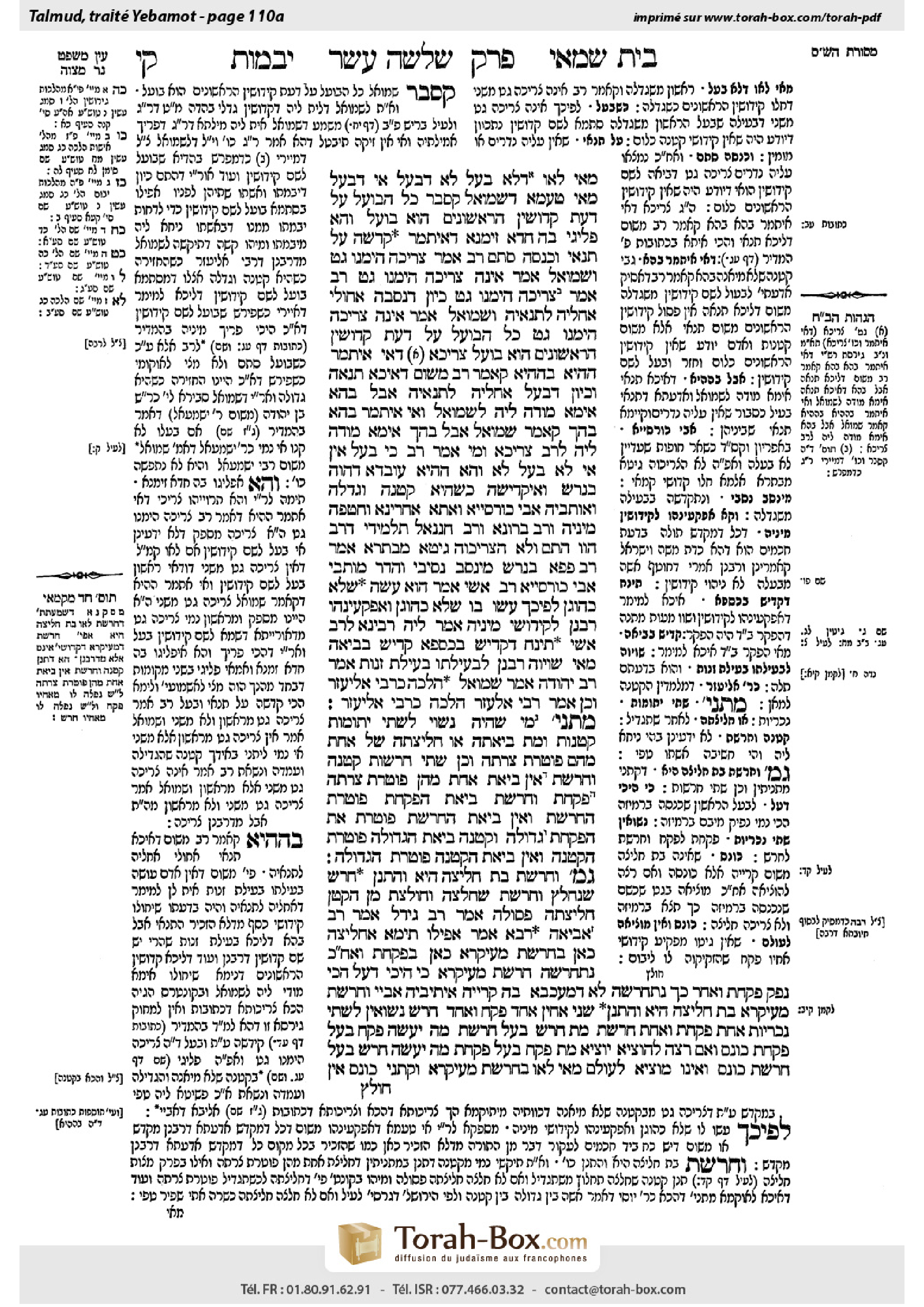
Yevamot 110a: Talmud study for Daf Yomi
Daf Yomi is the daily study of one Talmud folio. Explore 37 tractates with scans, Hebrew text, Sefaria English and AI-generated French translations where annotated.
Passage selection and English or AI-generated French translation are available where the scan has annotations. Daf Study is independent of Torah-Box and Sefaria.
Browse Yevamot · יבמות · All tractatesYevamot 110a text and translations
This page of Yevamot includes the Aramaic text, an English translation and an AI-generated French translation, alongside the scan above.
יבמות ק״י א · Aramaic and Hebrew text
מַאי לָאו, דְּלָא בְּעַל? לָא, דִּבְעַל. אִי דִּבְעַל, מַאי טַעְמָא דִּשְׁמוּאֵל? קָסָבַר: כׇּל הַבּוֹעֵל — עַל דַּעַת קִדּוּשִׁין הָרִאשׁוֹנִים הוּא בּוֹעֵל.
וְהָא פְּלִיגִי בַּהּ חֲדָא זִימְנָא, דְּאִיתְּמַר: קִדְּשָׁהּ עַל תְּנַאי, וּכְנָסָהּ סְתָם — רַב אָמַר: צְרִיכָה הֵימֶנּוּ גֵּט, וּשְׁמוּאֵל אָמַר: אֵינָהּ צְרִיכָה הֵימֶנּוּ גֵּט.
רַב אָמַר צְרִיכָה הֵימֶנּוּ גֵּט — כֵּיוָן דְּנַסְבַהּ אַחוֹלֵי אַחֲלֵיהּ לִתְנָאֵיהּ. וּשְׁמוּאֵל אָמַר: אֵינָהּ צְרִיכָה הֵימֶנּוּ גֵּט, כׇּל הַבּוֹעֵל, עַל דַּעַת קִדּוּשִׁין הָרִאשׁוֹנִים הוּא בּוֹעֵל!
צְרִיכָא, דְּאִי אִיתְּמַר הָהִיא, בְּהָהִיא קָאָמַר רַב, מִשּׁוּם דְּאִיכָּא תְּנָאָה, וְכֵיוָן דִּבְעַל, אַחֲלֵיהּ לִתְנָאֵיהּ. אֲבָל בְּהָא, אֵימָא מוֹדֶה לֵיהּ, לִשְׁמוּאֵל. וְאִי אִיתְּמַר בְּהָא: בְּהָךְ קָאָמַר שְׁמוּאֵל, אֲבָל בְּהָךְ, אֵימָא מוֹדֶה לֵיהּ לְרַב, צְרִיכָא.
וּמִי אָמַר רַב כִּי בְּעַל — אִין, אִי לָא בְּעַל — לָא? הָא הָהִיא עוֹבָדָא דַּהֲוָה בְּנַרֶשׁ, וְאִיקַּדִּישָׁה כְּשֶׁהִיא קְטַנָּה, וְגָדְלָה, וְאוֹתְבַיהּ אַבֵּי כוּרְסְיָיא, וַאֲתָא אַחֲרִינָא וְחַטְפַהּ מִינֵּיהּ. וְרַב בְּרוֹנָא וְרַב חֲנַנְאֵל תַּלְמִידֵי דְרַב הֲווֹ הָתָם, וְלָא אַצְרְיכוּהָ גִּיטָּא מִבָּתְרָא!
אָמַר רַב פָּפָּא: בְּנַרֶשׁ מִינְסַב נָסְיבִי, וַהֲדַר מוֹתְבִי אַבֵּי כוּרְסְיָיא. רַב אָשֵׁי אָמַר: הוּא עָשָׂה שֶׁלֹּא כַּהוֹגֶן, לְפִיכָךְ עָשׂוּ בּוֹ שֶׁלֹּא כַּהוֹגֶן, וְאַפְקְעִינְהוּ רַבָּנַן לְקִידּוּשֵׁי מִינֵּיהּ.
אֲמַר לֵיהּ רָבִינָא לְרַב אָשֵׁי: תִּינַח דְּקַדֵּישׁ בְּכַסְפָּא, קַדֵּישׁ בְּבִיאָה מַאי? שַׁוְּיוּהָ רַבָּנַן לִבְעִילָתוֹ בְּעִילַת זְנוּת. אָמַר רַב יְהוּדָה אָמַר שְׁמוּאֵל: הֲלָכָה כְּרַבִּי אֱלִיעֶזֶר. וְכֵן אָמַר רַבִּי אֶלְעָזָר: הֲלָכָה כְּרַבִּי אֱלִיעֶזֶר.
מַתְנִי׳ מִי שֶׁהָיָה נָשׂוּי לִשְׁתֵּי יְתוֹמוֹת קְטַנּוֹת, וּמֵת — בִּיאָתָהּ אוֹ חֲלִיצָתָהּ שֶׁל אַחַת מֵהֶם פּוֹטֶרֶת צָרָתָהּ. וְכֵן שְׁתֵּי חֵרְשׁוֹת. קְטַנָּה וְחֵרֶשֶׁת — אֵין בִּיאַת אַחַת מֵהֶן פּוֹטֶרֶת צָרָתָהּ.
פִּקַּחַת וְחֵרֶשֶׁת — בִּיאַת הַפִּקַּחַת פּוֹטֶרֶת הַחֵרֶשֶׁת, וְאֵין בִּיאַת הַחֵרֶשֶׁת פּוֹטֶרֶת אֶת הַפִּקַּחַת. גְּדוֹלָה וּקְטַנָּה — בִּיאַת הַגְּדוֹלָה פּוֹטֶרֶת הַקְּטַנָּה, וְאֵין בִּיאַת הַקְּטַנָּה פּוֹטֶרֶת הַגְּדוֹלָה.
גְּמָ׳ וְחֵרֶשֶׁת בַּת חֲלִיצָה הִיא? וְהָתְנַן: חֵרֵשׁ שֶׁנֶּחְלַץ, וְחֵרֶשֶׁת שֶׁחָלְצָה, וְחוֹלֶצֶת מִן הַקָּטָן — חֲלִיצָתָהּ פְּסוּלָה!
אָמַר רַב גִּידֵּל אָמַר רַב: אַבִּיאָה. רָבָא אָמַר: אֲפִילּוּ תֵּימָא אַחֲלִיצָה — כָּאן בְּחֵרֶשֶׁת מֵעִיקָּרָא, כָּאן בְּפִקַּחַת וְאַחַר כָּךְ נִתְחָרְשָׁה.
חֵרֶשֶׁת מֵעִיקָּרָא, כִּי הֵיכִי דְּעָל — הָכִי נָפֵק, פִּקַּחַת וְאַחַר כָּךְ נִתְחָרְשָׁה — לָא, דִּמְעַכְּבָא בַּהּ קְרִיָּיה.
אֵיתִיבֵיהּ אַבָּיֵי: וְחֵרֶשֶׁת מֵעִיקָּרָא בַּת חֲלִיצָה הִיא? וְהָתְנַן: שְׁנֵי אַחִין, אֶחָד פִּקֵּחַ וְאֶחָד חֵרֵשׁ, נְשׂוּאִין לִשְׁתֵּי נׇכְרִיּוֹת, אַחַת פִּקַּחַת וְאַחַת חֵרֶשֶׁת, מֵת חֵרֵשׁ בַּעַל חֵרֶשֶׁת, מָה יַעֲשֶׂה פִּקֵּחַ בַּעַל פִּקַּחַת? כּוֹנֵס. וְאִם רָצָה לְהוֹצִיא — יוֹצִיא.
מֵת פִּקֵּחַ בַּעַל פִּקַּחַת, מָה יַעֲשֶׂה חֵרֵשׁ בַּעַל חֵרֶשֶׁת? כּוֹנֵס, וְאֵינוֹ מוֹצִיא לְעוֹלָם. מַאי לָאו, בְּחֵרֶשֶׁת מֵעִיקָּרָא, וְקָתָנֵי: כּוֹנֵס אִין,
Yevamot 110a · English translation
What, is it not a case where he did not have intercourse with her after she reached majority? If so, Rav thinks that even when he did not have intercourse with her, her marriage is fully realized once she reaches majority. The Gemara rejects this: No, this is referring to a case where he did have intercourse with her. The Gemara asks: If it is referring to a case where he had intercourse with her, what is Shmuel’s reasoning? If the first one engaged in intercourse with her after she reached majority, then the marriage was fully realized. Under such circumstances, the second betrothal would not take effect. The Gemara answers: Shmuel holds that when anyone has sexual intercourse with a woman he married as a minor, his intention is that the intercourse is within the framework established by the initial betrothal and is not a new act of acquisition.
The Gemara asks: But if this is the basis of the dispute, they already disagreed about this once, as it was stated with regard to the following case: A man betrothed a woman on some condition, and married her without mentioning the condition, and the condition was not fulfilled. Rav says: She requires a bill of divorce from him, and Shmuel says: She does not require a bill of divorce from him.
The Gemara explains: Rav says she requires a bill of divorce from him, for since he married her, he apparently retracted his condition, and is therefore married to her even though the condition was not met. And Shmuel says: She does not require a bill of divorce from him, because anyone who has sexual intercourse with his wife, his intention is that the intercourse is within the framework established by the initial betrothal and the condition he set at the time of betrothal still stands. Since it was not fulfilled, the marriage is annulled. If so, Rav and Shmuel already disagreed about this same issue.
The Gemara answers: It is necessary to state the dispute in both contexts, for if only that halakha about conditional betrothal was stated, one might think: In this case Rav says she needs a divorce since there is a condition with regard to the betrothal, but when he had intercourse with her, he retracted the condition. But in this case of betrothal to a minor, say that Rav would concede to Shmuel that the intercourse was not performed with the intention of it constituting a full betrothal. And if only this case of betrothal to a minor was stated, one might think: Shmuel said that the marriage is effective in this case of betrothal to a minor, but in that case of a conditional betrothal, say that he would concede to Rav. Therefore, it was necessary to state the dispute explicitly in both instances.
The Gemara asks: And did Rav actually say that when he engaged in sexual intercourse with her, yes, the original marriage is valid, and if he did not have intercourse with her, no, it is not valid? Wasn’t there an incident in the city of Neresh where a woman was betrothed when she was a minor, and she reached majority, and the husband seated her in a bridal chair under the marriage canopy and had not yet had intercourse with her, and another man came and seized her from him and married her? And Rav Bruna and Rav Ḥananel, the students of Rav, were there and they did not require her to receive a bill of divorce from the latter husband. Presumably, they regarded her as fully married to the first husband, so the marriage to the second marriage never took effect, despite the fact that the first marriage had not yet been consummated.
Rav Pappa said: There is a difference, because in Neresh their practice is to first marry a woman and have intercourse with her, and afterward they seat her in the bridal chair. In this incident, the husband had already had intercourse with her once she was an adult, and that is why Rav’s students did not require a bill of divorce from the second man. Rav Ashi says: There was a different reason, even if the practice was not as Rav Pappa describes. This bride snatcher acted improperly. Consequently, they treated him improperly by annulling the legal validity of his actions, and the Sages abrogated his betrothal.
Ravina said to Rav Ashi: This works out well if the second man betrothed her with money, as then the Sages could declare that money to be ownerless property and void the betrothal. If he betrothed her by means of intercourse, what is the halakha? How can the Sages dissolve the betrothal when the sexual act took place? The Gemara answers: The Sages rendered his sexual act a licentious sexual act, which does not create a bond of betrothal. With regard to the dispute in the mishna, Rav Yehuda said that Shmuel said: The halakha is in accordance with the opinion of Rabbi Eliezer, and the minor is instructed to make a declaration of refusal. Likewise, Rabbi Elazar said: The halakha is in accordance with the opinion of Rabbi Eliezer.
MISHNA: If a man was married to two orphaned minors and died, consummation of levirate marriage or ḥalitza with one of them exempts her rival wife from either levirate marriage or ḥalitza, rendering her free to remarry. Likewise, if two deaf-mutes were married to one man who died, consummation of levirate marriage or ḥalitza with one of them exempts her rival wife. In both of these cases, both women are married by rabbinic law and consequently become yevamot by rabbinic law. Since their statuses are equal, one can exempt the other. If one wife is a minor and the other is a deaf-mute, consummation of levirate marriage or ḥalitza with one of them does not exempt her rival wife. Although both women are married by rabbinic law, their statuses are not the same and one cannot exempt the other.
If one of them was halakhically competent and one was a deaf-mute, consummation of levirate marriage with the halakhically competent wife exempts the deaf-mute, as the halakhically competent women’s marriage and levirate marriage are by Torah law. But consummation of levirate marriage with the deaf-mute does not exempt the halakhically competent wife. Likewise, if one was an adult woman and one a minor girl, consummation of levirate marriage with the adult exempts the minor but consummation of levirate marriage with the minor does not exempt the adult.
GEMARA: The mishna states that ḥalitza by one deaf-mute exempts the other. The Gemara asks: Can a deaf-mute perform ḥalitza? Didn’t we learn in a mishna (104b): If a male deaf-mute performs ḥalitza, and if a female deaf-mute performs ḥalitza, and if a woman performs ḥalitza on a minor boy, her ḥalitza is disqualified?
Rav Giddel said that Rav said: The mishna is not referring to a deaf-mute’s ḥalitza, but rather to consummation of levirate marriage with one of the deaf-mutes. Rava said: You can even say it is referring to ḥalitza. Here, the mishna is referring to a woman who was a deaf-mute from the outset, when he married her, and there the mishna that disqualifies the ḥalitza is referring to someone who was halakhically competent when she was married and afterward became a deaf-mute.
The difference is that a deaf-mute from the outset, just as she entered into marriage with her first husband so she leaves the levirate bond by means of ḥalitza. Both her marriage and her status as a yevama are by rabbinic law. However, one who was halakhically competent, so that she was married by Torah law, and later became a deaf-mute, no, she cannot be released by ḥalitza, since recitation is indispensable for her ḥalitza, and she cannot recite the text that a yevama must recite.
Abaye raised an objection to this: And is one who is a deaf-mute from the outset a candidate for ḥalitza? Didn’t we learn in a mishna (Yevamot 112b): Two brothers, one who is halakhically competent and one who is a deaf-mute, are married to two unrelated women, one who is halakhically competent and one deaf-mute. If the male deaf-mute, who is the husband of the female deaf-mute, dies, what should the halakhically competent man, who is the husband of the halakhically competent woman, do? He may consummate the levirate marriage, but there is no option of performing ḥalitza. And if he wants to divorce her later, he may divorce her.
If the halakhically competent man, husband of the halakhically competent woman, dies, what should the male deaf-mute, who is the husband of the female deaf-mute, do? He may consummate the levirate marriage, but he may never divorce her, as a deaf-mute is not halakhically competent to divorce a woman to whom he is married by Torah law. What, is it not referring to a deaf-mute from the outset? And it is taught: Yes, he may consummate the levirate marriage,
Yevamot 110a · Traduction française (IA)
N’est-ce pas le cas où il n’a pas eu de rapports avec elle après qu’elle a atteint la majorité ? Si tel est le cas, Rav estime que même s’il n’a pas eu de rapports avec elle, son mariage est pleinement établi dès qu’elle atteint la majorité. La Guemara rejette cette interprétation : non, il s’agit d’un cas où il a eu des rapports avec elle. La Guemara demande : s’il s’agit d’un cas où il a eu des rapports avec elle, quel est le raisonnement de Shmuel ? Si le premier a eu des rapports avec elle après qu’elle a atteint la majorité, alors le mariage était pleinement établi. Dans ces circonstances, le second mariage ne prendrait pas effet. La Guemara répond : Shmuel estime que lorsqu’un homme a des rapports avec une femme qu’il a épousée alors qu’elle était mineure, il entend que ces rapports s’inscrivent dans le cadre établi par les premiers kiddouchin et ne constituent pas un nouvel acte d’acquisition.
La Guemara demande : Mais si telle est la base de leur désaccord, ils ont déjà divergé une fois sur cette question, comme cela a été enseigné à propos du cas suivant : un homme a fiancé une femme sous condition, puis l’a épousée sans mentionner la condition, laquelle n’a pas été remplie. Rav dit : elle doit recevoir de lui un acte de divorce ; Shmuel dit : elle n’a pas besoin de recevoir de lui un acte de divorce.
La Guemara explique : Rav dit qu’elle doit recevoir de lui un acte de divorce, car, puisqu’il l’a épousée, il a apparemment renoncé à sa condition et est donc marié avec elle, même si la condition n’a pas été remplie. Shmuel dit : elle n’a pas besoin de recevoir de lui un acte de divorce, car lorsqu’un homme a des rapports avec son épouse, il entend que ces rapports s’inscrivent dans le cadre établi par les premiers kiddouchin et que la condition posée au moment des kiddouchin reste en vigueur. Puisqu’elle n’a pas été remplie, le mariage est annulé. Si tel est le cas, Rav et Shmuel ont déjà divergé sur cette même question.
La Guemara répond : Il est nécessaire d’énoncer le désaccord dans les deux contextes. En effet, si seule avait été énoncée cette halakha concernant des kiddouchin conditionnels, on aurait pu penser : dans ce cas, Rav dit qu’elle a besoin d’un acte de divorce parce qu’une condition a été posée lors des kiddouchin, mais, lorsqu’il a eu des rapports avec elle, il a renoncé à cette condition. En revanche, dans le cas présent, celui de kiddouchin avec une mineure, on aurait pu penser que Rav concéderait à Shmuel que les rapports n’ont pas été accomplis avec l’intention de constituer un mariage pleinement établi. Et si seul avait été énoncé ce cas de kiddouchin avec une mineure, on aurait pu penser : Shmuel a dit que le mariage prend effet dans ce cas, mais, dans celui des kiddouchin conditionnels, il concéderait à Rav. Il était donc nécessaire d’énoncer explicitement le désaccord dans les deux cas.
La Guemara demande : Rav a-t-il vraiment dit que si l’homme a eu des rapports avec elle, alors le mariage initial est valide, mais que s’il n’en a pas eu, il ne l’est pas ? N’y a-t-il pas eu un incident dans la ville de Neresh, où une femme avait été fiancée alors qu’elle était mineure, puis avait atteint la majorité, et où son mari l’avait installée sur un siège nuptial sous la houppa sans avoir encore eu de rapports avec elle ? Un autre homme était alors venu la lui ravir et l’avait épousée. Rav Bruna et Rav Ḥananel, les élèves de Rav, se trouvaient là et ne lui ont pas imposé de recevoir un acte de divorce de son second mari. On en déduit qu’ils la considéraient comme pleinement mariée à son premier mari ; le mariage avec le second n’avait donc jamais pris effet, bien que le premier mariage n’ait pas encore été consommé.
Rav Pappa dit : Il y a une différence, car à Neresh, l’usage est d’épouser d’abord une femme et d’avoir des rapports avec elle, puis de l’installer sur le siège nuptial. Dans cet incident, le mari avait déjà eu des rapports avec elle après qu’elle était devenue majeure ; c’est pourquoi les élèves de Rav ne lui ont pas imposé de recevoir un acte de divorce de la part du second homme. Rav Ashi dit : Il y avait une autre raison, même si l’usage n’était pas celui que décrit Rav Pappa. Cet homme qui avait enlevé la fiancée avait agi de façon inconvenante. Par conséquent, on l’a traité de façon inconvenante en annulant la validité juridique de ses actes, et les Sages ont annulé ses kiddouchin.
Ravina dit à Rav Ashi : Cela s’explique bien si le second homme l’a fiancée avec de l’argent, car les Sages pouvaient alors déclarer cet argent sans propriétaire et annuler les kiddouchin. Mais s’il l’a fiancée par des rapports, quelle est la halakha ? Comment les Sages peuvent-ils dissoudre les kiddouchin alors que l’acte sexuel a eu lieu ? La Guemara répond : les Sages ont considéré son acte sexuel comme un rapport de débauche, qui ne crée pas de lien de kiddouchin. Concernant le désaccord de la Michna, Rav Yehuda a dit au nom de Shmuel : la halakha est conforme à l’opinion de Rabbi Eliezer, et l’on ordonne à la mineure de faire une déclaration de refus. De même, Rabbi Elazar a dit : la halakha est conforme à l’opinion de Rabbi Eliezer.
MICHNA : Si un homme était marié à deux mineures orphelines et qu’il meurt, la consommation du mariage léviratique avec l’une d’elles ou la ḥalitsa accomplie par l’une d’elles dispense sa coépouse du mariage léviratique comme de la ḥalitsa, et la laisse libre de se remarier. De même, si deux sourdes-muettes étaient mariées au même homme et qu’il meurt, la consommation du mariage léviratique avec l’une d’elles ou la ḥalitsa accomplie par l’une d’elles dispense sa coépouse. Dans ces deux cas, les deux femmes sont mariées selon le droit rabbinique et deviennent donc des yevamot selon le droit rabbinique. Leurs statuts étant égaux, l’une peut dispenser l’autre. Si l’une des épouses est mineure et l’autre sourde-muette, la consommation du mariage léviratique avec l’une d’elles ou la ḥalitsa accomplie par l’une d’elles ne dispense pas sa coépouse. Bien que les deux femmes soient mariées selon le droit rabbinique, leurs statuts ne sont pas les mêmes et l’une ne peut donc pas dispenser l’autre.
Si l’une d’elles était juridiquement capable et l’autre sourde-muette, la consommation du mariage léviratique avec l’épouse juridiquement capable dispense la sourde-muette, car le mariage de la femme juridiquement capable et son mariage léviratique relèvent de la Torah. Mais la consommation du mariage léviratique avec la sourde-muette ne dispense pas l’épouse juridiquement capable. De même, si l’une était adulte et l’autre mineure, la consommation du mariage léviratique avec l’adulte dispense la mineure, mais celle avec la mineure ne dispense pas l’adulte.
GUEMARA : La Michna enseigne que la ḥalitsa accomplie par l’une des sourdes-muettes dispense l’autre. La Guemara demande : Une sourde-muette peut-elle accomplir la ḥalitsa ? N’avons-nous pas appris dans une Michna (104b) : « Si un sourd-muet accomplit la ḥalitsa, si une sourde-muette accomplit la ḥalitsa ou si une femme accomplit la ḥalitsa avec un garçon mineur, sa ḥalitsa est invalide » ?
Rav Giddel a dit au nom de Rav : La Michna ne parle pas de la ḥalitsa d’une sourde-muette, mais de la consommation du mariage léviratique avec l’une des sourdes-muettes. Rava a dit : On peut même dire qu’elle parle de la ḥalitsa. Ici, la Michna parle d’une femme qui était sourde-muette dès le départ, au moment où il l’a épousée ; là, la Michna qui invalide la ḥalitsa parle d’une femme qui était juridiquement capable lorsqu’elle s’est mariée et qui est devenue sourde-muette par la suite.
La différence est que, de même qu’une sourde-muette dès le départ est entrée dans le mariage avec son premier mari, elle quitte le lien léviratique au moyen de la ḥalitsa. Son mariage comme son statut de yevama relèvent du droit rabbinique. En revanche, celle qui était juridiquement capable, de sorte qu’elle était mariée selon la Torah, puis est devenue sourde-muette, ne peut pas être libérée par la ḥalitsa, car la récitation est indispensable à sa ḥalitsa et elle ne peut pas réciter le texte qu’une yevama doit réciter.
Abaye souleva une objection : Une femme sourde-muette dès le départ peut-elle être candidate à la ḥalitsa ? N’avons-nous pas appris dans une Michna (Yevamot 112b) : « Deux frères, l’un juridiquement capable et l’autre sourd-muet, sont mariés à deux femmes sans lien de parenté entre elles, l’une juridiquement capable et l’autre sourde-muette. Si le frère sourd-muet, mari de la femme sourde-muette, meurt, que doit faire l’homme juridiquement capable, mari de la femme juridiquement capable ? Il peut consommer le mariage léviratique, mais il ne peut pas accomplir la ḥalitsa. Et s’il veut la divorcer par la suite, il peut le faire. »
Si l’homme juridiquement capable, mari de la femme juridiquement capable, meurt, que doit faire le frère sourd-muet, mari de la femme sourde-muette ? Il peut consommer le mariage léviratique, mais il ne peut jamais la divorcer, car un sourd-muet n’est pas juridiquement capable de divorcer d’une femme à laquelle il est marié selon la Torah. N’est-ce pas là le cas d’une sourde-muette dès le départ ? Et il est enseigné : « Oui, il peut consommer le mariage léviratique… »
Traduction française générée par IA à partir de l’édition anglaise de Sefaria. Vérifie toujours un passage avec le texte source.
Text from Sefaria: William Davidson Edition - Vocalized Aramaic (CC BY NC); William Davidson Edition - English (CC BY NC).