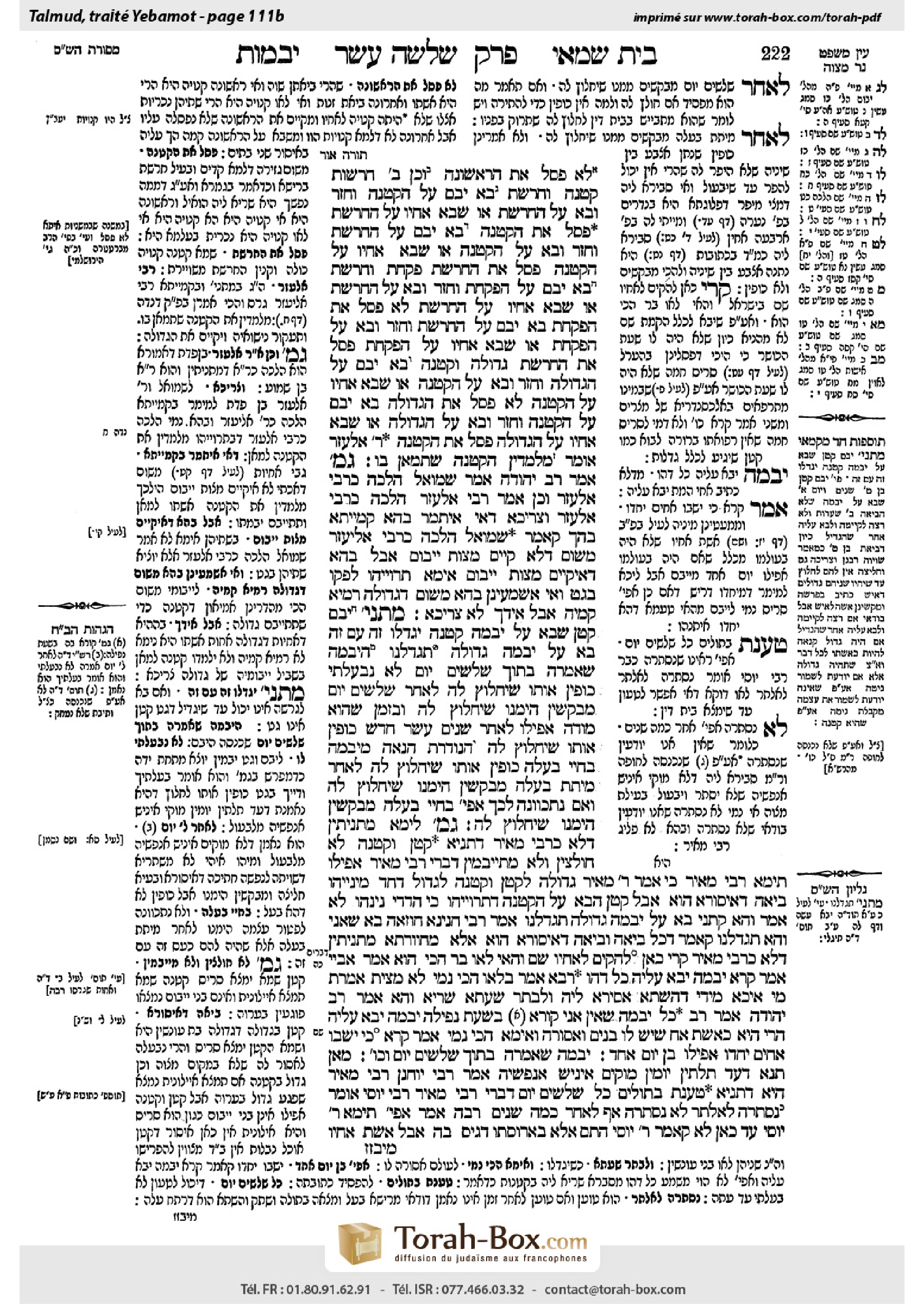
Yevamot 111b: Talmud study for Daf Yomi
Daf Yomi is the daily study of one Talmud folio. Explore 37 tractates with scans, Hebrew text, Sefaria English and AI-generated French translations where annotated.
Passage selection and English or AI-generated French translation are available where the scan has annotations. Daf Study is independent of Torah-Box and Sefaria.
Browse Yevamot · יבמות · All tractatesYevamot 111b text and translations
This page of Yevamot includes the Aramaic text, an English translation and an AI-generated French translation, alongside the scan above.
יבמות קי״א ב · Aramaic and Hebrew text
לֹא פָּסַל אֶת הָרִאשׁוֹנָה, וְכֵן שְׁתֵּי חֵרְשׁוֹת.
קְטַנָּה וְחֵרֶשֶׁת. בָּא יָבָם עַל הַקְּטַנָּה, וְחָזַר וּבָא עַל הַחֵרֶשֶׁת, אוֹ שֶׁבָּא אָחִיו עַל הַחֵרֶשֶׁת — פָּסַל אֶת הַקְּטַנָּה.
בָּא יָבָם עַל הַחֵרֶשֶׁת, וְחָזַר וּבָא עַל הַקְּטַנָּה, אוֹ שֶׁבָּא אָחִיו עַל הַקְּטַנָּה — פָּסַל אֶת הַחֵרֶשֶׁת.
פִּקַּחַת וְחֵרֶשֶׁת. בָּא יָבָם עַל הַפִּקַּחַת, וְחָזַר וּבָא עַל הַחֵרֶשֶׁת, אוֹ שֶׁבָּא אָחִיו עַל הַחֵרֶשֶׁת — לֹא פָּסַל אֶת הַפִּקַּחַת.
בָּא יָבָם עַל הַחֵרֶשֶׁת וְחָזַר וּבָא עַל הַפִּקַּחַת, אוֹ שֶׁבָּא אָחִיו עַל הַפִּקַּחַת — פָּסַל אֶת הַחֵרֶשֶׁת.
גְּדוֹלָה וּקְטַנָּה. בָּא יָבָם עַל הַגְּדוֹלָה, וְחָזַר וּבָא עַל הַקְּטַנָּה, אוֹ שֶׁבָּא אָחִיו עַל הַקְּטַנָּה — לֹא פָּסַל אֶת הַגְּדוֹלָה. בָּא יָבָם עַל הַקְּטַנָּה, וְחָזַר וּבָא עַל הַגְּדוֹלָה, אוֹ שֶׁבָּא אָחִיו עַל הַגְּדוֹלָה — פָּסַל אֶת הַקְּטַנָּה. רַבִּי אֶלְעָזָר אוֹמֵר: מְלַמְּדִין הַקְּטַנָּה שֶׁתְּמָאֵן בּוֹ.
גְּמָ׳ אָמַר רַב יְהוּדָה אָמַר שְׁמוּאֵל: הֲלָכָה כְּרַבִּי אֶלְעָזָר. וְכֵן אָמַר רַבִּי אֶלְעָזָר: הֲלָכָה כְּרַבִּי אֶלְעָזָר.
וּצְרִיכָא, דְּאִי אִיתְּמַר בְּהָא קַמַּיְיתָא, בְּהָךְ קָאָמַר שְׁמוּאֵל הֲלָכָה כְּרַבִּי אֱלִיעֶזֶר — מִשּׁוּם דְּלָא קַיֵּים מִצְוַת יִיבּוּם, אֲבָל בְּהָא, דְּאִיקַּיַּים מִצְוַת יִיבּוּם — אֵימָא תַּרְוַיְיהוּ לִפְּקוּ בְּגֵט,
וְאִי אַשְׁמְעִינַן בְּהָא, מִשּׁוּם דִּגְדוֹלָה רַמְיָא קַמֵּיהּ. אֲבָל אִידַּךְ — לָא. צְרִיכָא.
מַתְנִי׳ יָבָם קָטָן, שֶׁבָּא עַל יְבָמָה קְטַנָּה — יִגְדְּלוּ זֶה עִם זֶה. בָּא עַל יְבָמָה גְּדוֹלָה — תְּגַדְּלֶנּוּ.
הַיְּבָמָה שֶׁאָמְרָה בְּתוֹךְ שְׁלֹשִׁים יוֹם ״לֹא נִבְעַלְתִּי״ — כּוֹפִין אוֹתוֹ שֶׁיַּחְלוֹץ לָהּ. לְאַחַר שְׁלֹשִׁים יוֹם — מְבַקְּשִׁין הֵימֶנּוּ שֶׁיַּחְלוֹץ לָהּ. וּבִזְמַן שֶׁהוּא מוֹדֶה — אֲפִילּוּ לְאַחַר שְׁנֵים עָשָׂר חֹדֶשׁ כּוֹפִין אוֹתוֹ שֶׁיַּחְלוֹץ לָהּ.
הַנּוֹדֶרֶת הֲנָאָה מִיְּבָמָהּ, בְּחַיֵּי בַּעְלָהּ — כּוֹפִין אוֹתוֹ שֶׁיַּחְלוֹץ לָהּ. לְאַחַר מִיתַת בַּעְלָהּ — מְבַקְּשִׁין הֵימֶנּוּ שֶׁיַּחְלוֹץ לָהּ. וְאִם נִתְכַּוְּונָה לְכָךְ — אֲפִילּוּ בְּחַיֵּי בַעְלָהּ מְבַקְּשִׁין הֵימֶנּוּ שֶׁיַּחְלוֹץ לָהּ.
גְּמָ׳ לֵימָא מַתְנִיתִין דְּלָא כְּרַבִּי מֵאִיר. דְּתַנְיָא: קָטָן וּקְטַנָּה לֹא חוֹלְצִין וְלֹא מִתְיַיבְּמִין, דִּבְרֵי רַבִּי מֵאִיר.
אֲפִילּוּ תֵּימָא רַבִּי מֵאִיר, כִּי אָמַר רַבִּי מֵאִיר, גְּדוֹלָה לְקָטָן וּקְטַנָּה לְגָדוֹל, דְּחַד מִינַּיְיהוּ בִּיאָה דְאִיסּוּרָא הוּא. אֲבָל קָטָן הַבָּא עַל הַקְּטַנָּה, דְּתַרְוַיְיהוּ כִּי הֲדָדֵי נִינְהוּ, לָא אָמַר.
וְהָא קָתָנֵי: בָּא עַל יְבָמָה גְּדוֹלָה — תְּגַדְּלֶנּוּ! אָמַר רַבִּי חֲנִינָא חוֹזָאָה: בָּא שָׁאנֵי. וְהָא תְּגַדְּלֶנּוּ קָאָמַר, דְּכׇל בִּיאָה וּבִיאָה דְאִיסּוּרָא הוּא! אֶלָּא מְחַוַּורְתָּא מַתְנִיתִין דְּלָא כְּרַבִּי מֵאִיר.
קְרִי כָּאן ״לְהָקִים לְאָחִיו שֵׁם״, וְהַאי לָאו בַּר הָכִי הוּא! אָמַר אַבָּיֵי, אָמַר קְרָא: ״יְבָמָהּ יָבֹא עָלֶיהָ״ — כָּל דְּהוּ.
רָבָא אָמַר: בְּלָאו הָכִי נָמֵי לָא מָצֵית אָמְרַתְּ, מִי אִיכָּא מִידֵּי דְּהַשְׁתָּא אֲסִירָא לֵיהּ וּלְבָתַר שַׁעְתָּא שַׁרְיָא? וְהָא אָמַר רַב יְהוּדָה אָמַר רַב: כׇּל יְבָמָה שֶׁאֵין אֲנִי קוֹרֵא בִּשְׁעַת נְפִילָה ״יְבָמָהּ יָבֹא עָלֶיהָ״ — הֲרֵי הִיא כְּאֵשֶׁת אָח שֶׁיֵּשׁ לוֹ בָּנִים, וַאֲסוּרָה.
וְאֵימָא הָכִי נָמֵי! אָמַר קְרָא: ״כִּי יֵשְׁבוּ אַחִים יַחְדָּו״, אֲפִילּוּ בֶּן יוֹם אֶחָד.
יְבָמָה שֶׁאָמְרָה בְּתוֹךְ שְׁלֹשִׁים יוֹם וְכוּ׳. מַאן תַּנָּא דְּעַד תְּלָתִין יוֹמִין מוֹקֵים אִינִישׁ אַנַּפְשֵׁיהּ?
אָמַר רַבִּי יוֹחָנָן: רַבִּי מֵאִיר הִיא. דְּתַנְיָא: טַעֲנַת בְּתוּלִים — כׇּל שְׁלֹשִׁים יוֹם, דִּבְרֵי רַבִּי מֵאִיר.
רַבִּי יוֹסֵי אוֹמֵר: נִסְתְּרָה — לְאַלְתַּר, לֹא נִסְתְּרָה — אַף לְאַחַר כַּמָּה שָׁנִים.
רַבָּה אָמַר: אֲפִילּוּ תֵּימָא רַבִּי יוֹסֵי. עַד כָּאן לָא קָאָמַר רַבִּי יוֹסֵי הָתָם אֶלָּא בַּאֲרוּסָתוֹ דְּגִיס בַּהּ. אֲבָל אֵשֶׁת אָחִיו —
Yevamot 111b · English translation
the yavam or his brother did not disqualify the first girl from staying married to him, as her levirate marriage was consummated. Likewise, if the two wives were two female deaf-mutes, the first wife may remain married to the yavam. Intercourse with the second wife, though prohibited, has no effect: If the marriage was of uncertain status, then either the levirate marriage was concluded when he engaged in intercourse with the first, or neither wife was really married to the first husband, and they are therefore not rival wives. If the initial marriage was partial, then since both wives have the same standing, the levirate marriage with the first wife fully realizes whatever degree of levirate marriage is available.
If one wife was a minor and the other a deaf-mute, and the yavam engaged in intercourse with the minor and then engaged in intercourse with the deaf-mute, or if his brother engaged in intercourse with the deaf-mute, then the yavam or his brother disqualified the minor from staying married due to the Sages’ decree, lest it be confused with a situation where the intercourse with the deaf-mute was first.
If the yavam engaged in intercourse with the deaf-mute and then engaged in intercourse with the minor, or if his brother engaged in intercourse with the minor, then the yavam or his brother disqualified the deaf-mute from staying married. The marriage to the deaf-mute creates a partial acquisition that does not exempt the second wife from levirate marriage, as she, as a minor, has a different standing. Accordingly, intercourse with the second wife also creates a partial acquisition and thereby both women are prohibited to the yavam, as it is prohibited to consummate levirate marriage with more than one wife.
If one widow was halakhically competent and one widow was a deaf-mute, and the yavam engaged in intercourse with the halakhically competent woman and then engaged in intercourse with the deaf-mute, or if his brother then engaged in intercourse with the deaf-mute, the yavam or his brother did not disqualify the halakhically competent woman from staying married. Since the yavam consummated the levirate marriage with her first, the levirate bond was entirely dissolved and the intercourse with the deaf-mute, though forbidden, had no effect.
If the yavam engaged in intercourse with the deaf-mute and then engaged in intercourse with the halakhically competent woman, or if his brother engaged in intercourse with the halakhically competent woman, the yavam or his brother disqualified the deaf-mute from staying married. Consummation of the levirate marriage with the deaf-mute creates only a partial acquisition that does not fully dissolve the levirate bond.
If the deceased brother had two wives, an adult and a minor, and the yavam engaged in sexual intercourse with the adult, then engaged in intercourse with the minor, or if his brother engaged in intercourse with the minor, the yavam or his brother did not disqualify the adult from staying married, as the consummation of the levirate marriage with the adult completely dissolves the levirate bond. If the yavam engaged in intercourse with the minor, and then engaged in intercourse with the adult, or if his brother engaged in intercourse with the adult, the yavam or his brother disqualified the minor from staying married. Rabbi Elazar says: The court instructs the minor to refuse him thereby annulling her marriage retroactively, and then the minor is permitted to marry any man.
GEMARA: Rav Yehuda said that Shmuel said: The halakha is in accordance with the opinion of Rabbi Elazar, and likewise the amora Rabbi Elazar ben Pedat said: The halakha is in accordance with the opinion of Rabbi Elazar ben Shammua, the tanna in the mishna.
The Gemara says: It is necessary to rule that the minor is instructed to refuse, thus annulling her original marriage, both in this case and in the earlier case (Yevamot 109a) of an adult woman who becomes the yevama of her husband’s brother who is married to her minor sister. For if this halakhic ruling was stated only in that earlier case, I would have said: It was in that case that Shmuel stated the halakha is in accordance with the opinion of Rabbi Eliezer, due to the fact that the yavam did not fulfill the mitzva of levirate marriage with the adult. In order for him to be permitted to do so, the Sages rule that the minor should be instructed to refuse him. But for this case, where the mitzva of levirate marriage is fulfilled, say that they must both be released with a bill of divorce.
And conversely, if the tanna teaches us the ruling only in this case, one would think: It is because the adult happened before him for levirate marriage, and since both the adult and the minor are equally candidates for levirate marriage, it makes sense to encourage the minor to refuse; however, in the other mishna, where the minor is already married to the yavam, making the adult yevama his wife’s sister who is forbidden to him, she should not be encouraged to refuse. Therefore, it was necessary to state, also in this case, that she is nevertheless encouraged to refuse.
MISHNA: If a minor yavam engaged in sexual intercourse with a minor yevama, they should grow up together, living as a married couple. He may not divorce her, as he is a minor. If he engaged in sexual intercourse with an adult yevama, she should raise him, i.e., they must stay married, as there is no way for him to divorce her until he reaches majority.
When a yevama said within thirty days of her marriage: I have not engaged in sexual intercourse with him, the court forces him to perform ḥalitza with her. If she said this after thirty days but he claimed that he had engaged in sexual intercourse, the court asks him to perform ḥalitza with her, as there are grounds to believe him. And when he admits that he did not engage in intercourse with her, even after twelve months, the court forces him to perform ḥalitza with her.
If a woman vows during her husband’s lifetime to derive no benefit from her yavam, the court forces him to perform ḥalitza with her as it is forbidden for her to engage in sexual intercourse with him to consummate the levirate marriage. If she vowed after the death of her husband to derive no benefit from her yavam, the court asks him to perform ḥalitza with her. And if she intended to do so, i.e., she had an ulterior motive of avoiding levirate marriage when she vowed, even if she made the vow during her husband’s lifetime, the court merely asks him to perform ḥalitza with her.
GEMARA: The mishna teaches that a minor yavam and minor yevama can consummate a levirate marriage and are permitted to live together. The Gemara suggests: Let us say that the mishna is not in accordance with the opinion of Rabbi Meir as it is taught in a baraita: A minor boy and a minor girl may not perform ḥalitza and may not enter into levirate marriage. This is the statement of Rabbi Meir. Rabbi Meir prohibits this lest the boy turn out to be a eunuch or the girl turn out to be sexually underdeveloped. In such cases, the mitzva of levirate marriage would not apply, and the prohibition against marrying one’s brother’s wife would be in effect.
The Gemara responds: You can even say that the mishna is in accordance with the opinion of Rabbi Meir. When Rabbi Meir said that minors may not enter into levirate marriage, he was referring to an adult yevama with a minor yavam or a minor yevama with an adult yavam. This is because for one of them it would be a forbidden sexual act, due to the uncertainty of the minor’s status. Since the minor may turn out to be permanently sexually underdeveloped, the adult is forbidden from having intercourse with him or her. But in the case of a minor yavam who has sexual intercourse with a minor yevama, where they are both similar to one another, as neither of them is obligated to perform mitzvot, Rabbi Meir did not state that it is forbidden for them to perform levirate marriage.
The Gemara asks: But it is taught in the mishna: If he, i.e., the minor yavam, engaged in sexual intercourse with an adult yevama, she should raise him, which contradicts the explication of Rabbi Meir’s opinion above. Rabbi Ḥanina Ḥoza’a said: It is different once he engaged in intercourse with her. Although at the outset Rabbi Meir prohibits consummation of the levirate marriage, once it has already taken place, it is preferable that she raise him. The Gemara asks: But it says that she should raise him, indicating that they are meant to live as a married couple, even though each and every sexual act is forbidden according to Rabbi Meir. Rather, it is clear that the mishna is not in accordance with the opinion of Rabbi Meir.
The Gemara asks: How can the minor enter into levirate marriage? The verse here reads: “And if the man does not wish to take his yevama, his yevama shall ascend to the gate to the Elders and say: My brother-in-law refused to establish a name for his brother in Israel; he did not wish to consummate the levirate marriage” (Deuteronomy 25:7), and this minor is incapable of doing so, as he cannot sire children. Abaye said that the verse states: “Her brother-in-law will have intercourse with her and take her to him to be his wife and consummate the levirate marriage” (Deuteronomy 25:5), to include anyone, even someone who cannot sire children.
Rava said: Even without this interpretation you still could not say that it is prohibited for a minor to enter into levirate marriage. Is there a case of levirate marriage where she is forbidden to him now, and after some time she becomes permitted? Didn’t Rav Yehuda say that Rav said: Any yevama to whom I cannot apply the verse “Her brother-in-law will have intercourse with her” (Deuteronomy 25:5) at the time she happens before him for levirate marriage, is considered as if she were the wife of a brother who has children, who is exempt from levirate marriage, and she is consequently forbidden to him forever? It must be the case that minors can perform levirate marriage. If it was forbidden, then they would be exempt from levirate marriage even after reaching the age of majority.
The Gemara asks: And say, indeed, a minor should be exempt from levirate marriage, and consequently forbidden from ever marrying his brother’s wife. The Gemara answers: The verse states: “If brothers dwell together” (Deuteronomy 25:5), indicating that this rule applies to all brothers who are alive simultaneously, even if the brother was only one day old.
§ The mishna states: When a yevama said within thirty days of her marriage: I have not engaged in sexual intercourse with him, the court forces him to perform ḥalitza with her. The Gemara asks: Who is the tanna who taught that for up to thirty days a person can be presumed to restrain himself and resist engaging in sexual intercourse with a woman who lives with him?
Rabbi Yoḥanan said: It is the opinion of Rabbi Meir, as it is taught in a baraita: A man may come to court to make a claim concerning virginity, i.e., that the woman he married was not a virgin, for thirty days after the marriage ceremony. Assuming that he makes the claim immediately following their first sexual act, his claim is credible if he makes it within the first thirty days; this is the statement of Rabbi Meir.
Rabbi Yosei says: If she was secluded with him after the wedding in a place suitable for sexual intercourse, a claim concerning virginity is only credible immediately. But if she was not secluded with him, they presumably did not engage in intercourse, and such a claim is credible even several years later.
Rabba said: You can even say that the mishna is in accordance with the opinion of Rabbi Yosei. Rabbi Yosei states his opinion there only with regard to a virginity claim about one’s betrothed, to whom he is accustomed, and therefore less inhibited, but with regard to his brother’s wife, i.e., a widow,
Yevamot 111b · Traduction française (IA)
le yavam ou son frère n'a pas disqualifié la première femme pour qu'elle reste mariée à lui, car son mariage de levirat a été consommé. De même, si les deux épouses étaient deux sourdes-muettes, la première épouse peut rester mariée au yavam. Le rapport sexuel avec la seconde épouse, bien qu'il soit interdit, n'a aucun effet : si le statut du mariage était incertain, alors soit le mariage de levirat a été conclu lorsqu'il a eu des rapports avec la première, soit aucune des deux épouses n'était réellement mariée au premier défunt, et elles ne sont donc pas des épouses rivales. Si le mariage initial était partiel, alors, comme les deux épouses ont le même statut, le mariage de levirat avec la première épouse réalise pleinement le degré de mariage de levirat disponible.
Si une épouse était une mineure et l'autre une sourde-muette, et que le yavam a eu des rapports avec la mineure puis avec la sourde-muette, ou si son frère a eu des rapports avec la sourde-muette, alors le yavam ou son frère a disqualifié la mineure pour qu'elle reste mariée, en vertu du décret des Sages, de peur que cela ne soit confondu avec une situation où les rapports avec la sourde-muette ont eu lieu en premier.
Si le yavam a eu des rapports avec la sourde-muette puis avec la mineure, ou si son frère a eu des rapports avec la mineure, alors le yavam ou son frère a disqualifié la sourde-muette pour qu'elle reste mariée. Le mariage avec la sourde-muette crée une acquisition partielle qui n'exonère pas la seconde épouse du mariage de levirat, car elle, en tant que mineure, a un statut différent. En conséquence, les rapports avec la seconde épouse créent également une acquisition partielle, et par conséquent les deux femmes sont interdites au yavam, car il est interdit de consommer le mariage de levirat avec plus d'une épouse.
Si une veuve était halakhiquement compétente et l'autre une sourde-muette, et que le yavam a eu des rapports avec la femme halakhiquement compétente puis avec la sourde-muette, ou si son frère a ensuite eu des rapports avec la sourde-muette, le yavam ou son frère n'a pas disqualifié la femme halakhiquement compétente pour qu'elle reste mariée. Puisque le yavam a consommé le mariage de levirat avec elle en premier, le lien de levirat a été entièrement dissous et les rapports avec la sourde-muette, bien qu'interdits, n'ont eu aucun effet.
Si le yavam a eu des rapports avec la sourde-muette puis avec la femme halakhiquement compétente, ou si son frère a eu des rapports avec la femme halakhiquement compétente, le yavam ou son frère a disqualifié la sourde-muette pour qu'elle reste mariée. La consommation du mariage de levirat avec la sourde-muette ne crée qu'une acquisition partielle qui ne dissout pas entièrement le lien de levirat.
Si le frère défunt avait deux épouses, une adulte et une mineure, et que le yavam a eu des rapports sexuels avec l'adulte, puis avec la mineure, ou si son frère a eu des rapports avec la mineure, le yavam ou son frère n'a pas disqualifié l'adulte pour qu'elle reste mariée, car la consommation du mariage de levirat avec l'adulte dissout complètement le lien de levirat. Si le yavam a eu des rapports avec la mineure, puis avec l'adulte, ou si son frère a eu des rapports avec l'adulte, le yavam ou son frère a disqualifié la mineure pour qu'elle reste mariée. Rabbi Elazar dit : Le tribunal instruit la mineure de le refuser, annulant ainsi rétroactivement son mariage, et ensuite la mineure est autorisée à épouser n'importe quel homme.
GUEMARA : Rav Yehuda a dit que Shmuel a dit : La halakha est conforme à l'opinion de Rabbi Elazar, et de même l'amora Rabbi Elazar ben Pedat a dit : La halakha est conforme à l'opinion de Rabbi Elazar ben Shammua, le tanna de la Michna.
La Guemara dit : Il est nécessaire de statuer que la mineure est instruite de refuser, annulant ainsi son mariage initial, tant dans ce cas que dans le cas antérieur (Yevamot 109a) d'une femme adulte qui devient yevama du frère de son mari, lequel est marié à sa sœur mineure. Car si cette décision halakhique n'avait été énoncée que dans ce cas antérieur, j'aurais dit : C'est dans ce cas que Shmuel a statué que la halakha est conforme à l'opinion de Rabbi Eliezer, en raison du fait que le yavam n'a pas accompli la mitsva de levirat avec l'adulte. Pour qu'il soit autorisé à le faire, les Sages statuent que la mineure doit être instruite de le refuser. Mais pour ce cas, où la mitsva de levirat est accomplie, on dirait qu'elles doivent toutes deux être libérées par un acte de divorce.
Et inversement, si le tanna nous enseigne la décision seulement dans ce cas, on pourrait penser : C'est parce que l'adulte s'est présentée à lui pour le levirat, et comme l'adulte et la mineure sont également candidates au levirat, il est logique d'encourager la mineure à refuser ; cependant, dans la Michna précédente, où la mineure est déjà mariée au yavam, faisant de la yevama adulte la sœur de son épouse qui lui est interdite, elle ne devrait pas être encouragée à refuser. Par conséquent, il était nécessaire de préciser, également dans ce cas, qu'elle est néanmoins encouragée à refuser.
Michna : Si un yavam mineur a eu des rapports sexuels avec une yevama mineure, ils doivent grandir ensemble, vivant comme un couple marié. Il ne peut pas la divorcer, car il est mineur. S'il a eu des rapports sexuels avec une yevama adulte, elle doit l'élever, c'est-à-dire qu'ils doivent rester mariés, car il n'y a aucun moyen pour lui de la divorcer jusqu'à ce qu'il atteigne la majorité.
Lorsqu'une yevama a déclaré dans les trente jours suivant son mariage : « Je n'ai pas eu de rapports sexuels avec lui », le tribunal l'oblige à effectuer la ḥalitza avec elle. Si elle a déclaré cela après trente jours mais qu'il a affirmé avoir eu des rapports sexuels, le tribunal lui demande d'effectuer la ḥalitza avec elle, car il y a des motifs de le croire. Et lorsqu'il admet n'avoir pas eu de rapports avec elle, même après douze mois, le tribunal l'oblige à effectuer la ḥalitza avec elle.
Si une femme fait un vœu, du vivant de son mari, de ne tirer aucun profit de son yavam, le tribunal l'oblige à effectuer la ḥalitza avec elle, car il lui est interdit d'avoir des rapports sexuels avec lui pour consommer le mariage lévirat. Si elle a fait ce vœu après la mort de son mari, le tribunal lui demande d'effectuer la ḥalitza avec elle. Et si elle avait l'intention de le faire, c'est-à-dire si elle avait un motif caché d'éviter le mariage lévirat lorsqu'elle a fait le vœu, même si elle l'a fait du vivant de son mari, le tribunal se contente de lui demander d'effectuer la ḥalitza avec elle.
GUEMARA : La Michna enseigne qu'un yavam mineur et une yevama mineure peuvent consommer un mariage lévirat et sont autorisés à vivre ensemble. La Guemara suggère : Disons que la Michna ne suit pas l'opinion de Rabbi Meïr, car il est enseigné dans une baraïta : Un garçon mineur et une fille mineure ne peuvent pas effectuer la ḥalitza et ne peuvent pas entrer dans un mariage lévirat. C'est l'opinion de Rabbi Meïr. Rabbi Meïr l'interdit de peur que le garçon ne s'avère être un eunuque ou que la fille ne s'avère être sexuellement sous-développée. Dans de tels cas, la mitsva du mariage lévirat ne s'appliquerait pas, et l'interdiction d'épouser la femme de son frère serait en vigueur.
La Guemara répond : On peut même dire que la Michna est conforme à l'opinion de Rabbi Meïr. Lorsque Rabbi Meïr a dit que les mineurs ne peuvent pas entrer dans un mariage lévirat, il faisait référence à une yevama adulte avec un yavam mineur ou à une yevama mineure avec un yavam adulte. C'est parce que pour l'un d'eux, ce serait un acte sexuel interdit, en raison de l'incertitude du statut du mineur. Étant donné que le mineur peut s'avérer être sexuellement sous-développé de manière permanente, l'adulte est interdit d'avoir des rapports avec lui ou elle. Mais dans le cas d'un yavam mineur qui a des rapports sexuels avec une yevama mineure, où ils sont tous deux semblables l'un à l'autre, car aucun d'eux n'est obligé d'accomplir les mitsvot, Rabbi Meïr n'a pas déclaré qu'il leur est interdit d'effectuer un mariage lévirat.
La Guemara demande : Mais la Michna enseigne : « S'il, c'est-à-dire le yavam mineur, a eu des rapports sexuels avec une yevama adulte, elle doit l'élever », ce qui contredit l'explication de l'opinion de Rabbi Meïr donnée plus haut. Rabbi Ḥanina Ḥoza'a a dit : La situation est différente une fois qu'il a eu des rapports avec elle. Bien qu'au départ Rabbi Meïr interdise la consommation du mariage lévirat, une fois que cela s'est déjà produit, il est préférable qu'elle l'éleve. La Guemara demande : Mais il est dit qu'elle doit l'élever, ce qui indique qu'ils sont censés vivre comme un couple marié, bien que chaque acte sexuel soit interdit selon Rabbi Meïr. Au contraire, il est clair que la Michna ne suit pas l'opinion de Rabbi Meïr.
La Guemara demande : Comment le mineur peut-il entrer dans un mariage lévirat ? Le verset ici dit : « Et si l'homme ne veut pas prendre sa yevama, sa yevama montera à la porte vers les Anciens et dira : Mon beau-frère a refusé d'établir un nom pour son frère en Israël ; il n'a pas voulu consommer le mariage lévirat » (Deutéronome 25:7), et ce mineur n'est pas capable de le faire, car il ne peut pas engendrer d'enfants. Abaye a dit que le verset dit : « Son beau-frère aura des rapports avec elle et la prendra pour lui comme femme et consommera le mariage lévirat » (Deutéronome 25:5), pour inclure quiconque, même quelqu'un qui ne peut pas engendrer d'enfants.
Rava a dit : Même sans cette interprétation, on ne pourrait pas dire qu'il est interdit à un mineur d'entrer dans un mariage lévirat. Y a-t-il un cas de mariage lévirat où elle lui est interdite maintenant, et après un certain temps elle devient permise ? N'est-ce pas Rav Yehouda qui a dit que Rav a dit : Toute yevama à laquelle je ne peux pas appliquer le verset « Son beau-frère aura des rapports avec elle » (Deutéronome 25:5) au moment où elle se présente devant lui pour le mariage lévirat, est considérée comme si elle était la femme d'un frère qui a des enfants, qui est exempt du mariage lévirat, et elle lui est donc interdite pour toujours ? Il doit être le cas que les mineurs peuvent effectuer un mariage lévirat. S'il était interdit, alors ils seraient exempts du mariage lévirat même après avoir atteint l'âge de la majorité.
La Guemara demande : Et dire, en effet, qu'un mineur devrait être exempt du mariage lévirat, et par conséquent interdit d'épouser la femme de son frère pour toujours. La Guemara répond : Le verset dit : « Si des frères demeurent ensemble » (Deutéronome 25:5), indiquant que cette règle s'applique à tous les frères qui sont vivants simultanément, même si le frère n'avait qu'un jour.
§ La Michna énonce : Lorsqu'une yevama a dit dans les trente jours suivant son mariage : Je n'ai pas eu de rapports sexuels avec lui, le tribunal l'oblige à effectuer la ḥalitza avec elle. La Guemara demande : Qui est le tanna qui a enseigné que pendant jusqu'à trente jours, on peut présumer qu'une personne peut se retenir et résister à avoir des rapports sexuels avec une femme qui vit avec elle ?
Rabbi Yoḥanan a dit : C'est l'opinion de Rabbi Meïr, comme l'enseigne une baraïta : Un homme peut se présenter devant le tribunal pour faire une réclamation concernant la virginité, c'est-à-dire que la femme qu'il a épousée n'était pas vierge, pendant trente jours après la cérémonie de mariage. En supposant qu'il fasse la réclamation immédiatement après leur premier rapport sexuel, sa réclamation est crédible s'il la formule dans les trente premiers jours ; c'est l'opinion de Rabbi Meïr.
Rabbi Yosse dit : Si elle a été isolée avec lui après le mariage dans un lieu approprié pour les rapports sexuels, une réclamation concernant la virginité n'est crédible qu'immédiatement. Mais si elle n'a pas été isolée avec lui, ils n'ont probablement pas eu de rapports, et une telle réclamation est crédible même plusieurs années plus tard.
Rabba a dit : On peut même dire que la Michna est conforme à l'opinion de Rabbi Yosse. Rabbi Yosse énonce son opinion là uniquement en ce qui concerne une réclamation de virginité sur sa fiancée, à qui il est habitué, et donc moins inhibé, mais en ce qui concerne la femme de son frère, c'est-à-dire une veuve,
Traduction française générée par IA à partir de l’édition anglaise de Sefaria. Vérifie toujours un passage avec le texte source.
Text from Sefaria: William Davidson Edition - Vocalized Aramaic (CC BY NC); William Davidson Edition - English (CC BY NC).