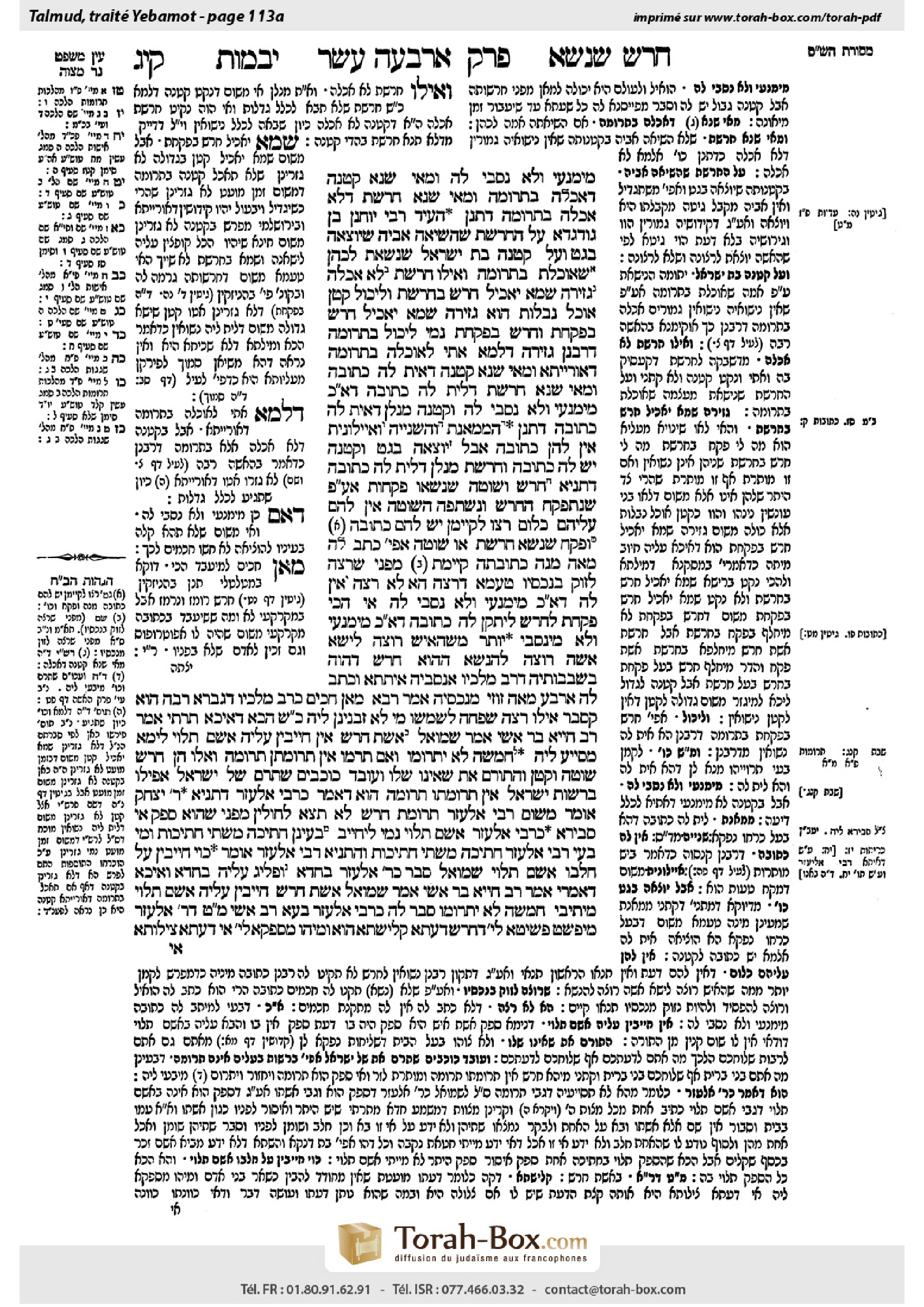
Yevamot 113a: Talmud study for Daf Yomi
Daf Yomi is the daily study of one Talmud folio. Explore 37 tractates with scans, Hebrew text, Sefaria English and AI-generated French translations where annotated.
Passage selection and English or AI-generated French translation are available where the scan has annotations. Daf Study is independent of Torah-Box and Sefaria.
Browse Yevamot · יבמות · All tractatesYevamot 113a text and translations
This page of Yevamot includes the Aramaic text, an English translation and an AI-generated French translation, alongside the scan above.
יבמות קי״ג א · Aramaic and Hebrew text
מִימַּנְעִי וְלָא נָסְבִי לַהּ.
וּמַאי שְׁנָא קְטַנָּה דְּאָכְלָה בִּתְרוּמָה, וּמַאי שְׁנָא חֵרֶשֶׁת דְּלָא אָכְלָה בִּתְרוּמָה? דִּתְנַן: הֵעִיד רַבִּי יוֹחָנָן בֶּן גּוּדְגְּדָא עַל הַחֵרֶשֶׁת שֶׁהִשִּׂיאָהּ אָבִיהָ שֶׁיּוֹצְאָה בְּגֵט, וְעַל קְטַנָּה בַּת יִשְׂרָאֵל שֶׁנִּשֵּׂאת לְכֹהֵן שֶׁאוֹכֶלֶת בִּתְרוּמָה, וְאִילּוּ חֵרֶשֶׁת לָא אָכְלָה!
גְּזֵירָה שֶׁמָּא יַאֲכִיל חֵרֵשׁ בְּחֵרֶשֶׁת. וְלֵיכוֹל, קָטָן אוֹכֵל נְבֵלוֹת הוּא!
גְּזֵירָה שֶׁמָּא יַאֲכִיל חֵרֵשׁ בְּפִקַּחַת. וְחֵרֵשׁ בְּפִקַּחַת נָמֵי לֵיכוֹל בִּתְרוּמָה דְּרַבָּנַן! גְּזֵירָה דִּלְמָא אָתֵי לְאוֹכֹלַהּ בִּתְרוּמָה דְּאוֹרָיְיתָא.
וּמַאי שְׁנָא קְטַנָּה דְּאִית לַהּ כְּתוּבָּה, וּמַאי שְׁנָא חֵרֶשֶׁת דְּלֵית לַהּ כְּתוּבָּה? דְּאִם כֵּן — מִימַּנְעִי וְלָא נָסְבִי לַהּ.
וּקְטַנָּה מְנָלַן דְּאִית לַהּ כְּתוּבָּה? דִּתְנַן: הַמְמָאֶנֶת, וְהַשְּׁנִיָּיה, וְאַיְילוֹנִית — אֵין לָהֶן כְּתוּבָּה. אֲבָל יוֹצְאָה בְּגֵט וּקְטַנָּה — יֵשׁ לָהּ כְּתוּבָּה.
וְחֵרֶשֶׁת מְנָלַן דְּלֵית לַהּ כְּתוּבָּה? דְּתַנְיָא: חֵרֵשׁ וְשׁוֹטֶה שֶׁנָּשְׂאוּ פִּקְּחוֹת, אַף עַל פִּי שֶׁנִּתְפַּקֵּחַ הַחֵרֵשׁ, וְנִשְׁתַּפָּה הַשּׁוֹטֶה — אֵין לָהֶם עֲלֵיהֶם כְּלוּם. רָצוּ לְקַיְּימָן — יֵשׁ לָהֶם כְּתוּבָּה.
וּפִקֵּחַ שֶׁנָּשָׂא חֵרֶשֶׁת אוֹ שׁוֹטָה, אֲפִילּוּ כָּתַב לָהּ מֵאָה מָנֶה — כְּתוּבָּתָהּ קַיֶּימֶת, מִפְּנֵי שֶׁרָצָה לִזּוֹק בִּנְכָסָיו. טַעְמָא דְּרָצָה, הָא לֹא רָצָה — אֵין לָהּ, דְּאִם כֵּן מִימַּנְעִי וְלָא נָסְבִי לַהּ.
אִי הָכִי, פִּקַּחַת לְחֵרֵשׁ לִיתַקֵּן לַהּ כְּתוּבָּה, דְּאִם כֵּן מִימַּנְעִי וְלָא מִינַּסְבִי! יוֹתֵר מִשֶּׁהָאִישׁ רוֹצֶה לִישָּׂא, אִשָּׁה רוֹצָה לְהִנָּשֵׂא.
הָהוּא חֵרֵשׁ דַּהֲוָה בְּשִׁבָבוּתֵיהּ דְּרַב מַלְכִּיּוֹ, אַנְסְבֵיהּ אִיתְּתָא וּכְתַב לַהּ אַרְבַּע מְאָה זוּזֵי מִנִּכְסֵיהּ. אָמַר רָבָא: מַאן חַכִּים כְּרַב מַלְכִּיּוֹ, דְּגַבְרָא רַבָּה הוּא. קָסָבַר: אִילּוּ רָצָה שִׁפְחָה לְשַׁמְּשׁוֹ מִי לָא זָבְנִינַן לֵיהּ? כׇּל שֶׁכֵּן הָכָא, דְּאִיכָּא תַּרְתֵּי.
אָמַר רַב חִיָּיא בַּר אָשֵׁי אָמַר שְׁמוּאֵל: אֵשֶׁת חֵרֵשׁ — אֵין חַיָּיבִין עָלֶיהָ אָשָׁם תָּלוּי.
לֵימָא מְסַיַּיע לֵיהּ: חֲמִשָּׁה לֹא יִתְרוֹמוּ, וְאִם תָּרְמוּ — אֵין תְּרוּמָתָן תְּרוּמָה. וְאֵלּוּ הֵן: חֵרֵשׁ, שׁוֹטֶה, וְקָטָן, וְהַתּוֹרֵם אֶת שֶׁאֵינוֹ שֶׁלּוֹ, וְגוֹי שֶׁתָּרַם שֶׁל יִשְׂרָאֵל אֲפִילּוּ בִּרְשׁוּת יִשְׂרָאֵל — אֵין תְּרוּמָתוֹ תְּרוּמָה.
הוּא דְּאָמַר כְּרַבִּי אֶלְעָזָר. דְּתַנְיָא: רַבִּי יִצְחָק אוֹמֵר מִשּׁוּם רַבִּי אֶלְעָזָר: תְּרוּמַת חֵרֵשׁ לֹא תֵּצֵא לְחוּלִּין, מִפְּנֵי שֶׁהוּא סָפֵק. אִי סְבִירָא כְּרַבִּי אֶלְעָזָר, אָשָׁם תָּלוּי נָמֵי לִיחַיַּיב!
בָּעֵינַן חֲתִיכָה מִשְׁתֵּי חֲתִיכוֹת.
וּמִי בָּעֵי רַבִּי אֶלְעָזָר חֲתִיכָה מִשְׁתֵּי חֲתִיכוֹת? וְהָתַנְיָא, רַבִּי אֶלְעָזָר אוֹמֵר: כּוֹי — חַיָּיבִין עַל חֶלְבּוֹ אָשָׁם תָּלוּי.
שְׁמוּאֵל סָבַר כְּרַבִּי אֶלְעָזָר בַּחֲדָא, וּפְלִיג עֲלֵיהּ בַּחֲדָא.
וְאִיכָּא דְּאָמְרִי, אָמַר רַב חִיָּיא בַּר אָשֵׁי אָמַר שְׁמוּאֵל: אֵשֶׁת חֵרֵשׁ חַיָּיבִין עָלֶיהָ אָשָׁם תָּלוּי. מֵיתִיבִי: חֲמִשָּׁה לֹא יִתְרוֹמוּ! סָבַר לַהּ כְּרַבִּי אֶלְעָזָר.
בְּעָא רַב אָשֵׁי: מַאי טַעְמָא דְּרַבִּי אֶלְעָזָר? מִיפְשָׁט פְּשִׁיטָא לֵיהּ דְּחֵרֵשׁ דַּעְתָּא קְלִישְׁתָּא הוּא, וּמִיהוּ מְסַפְּקָא לֵיהּ אִי דַּעְתָּא צִילּוּתָא
Yevamot 113a · English translation
others would refrain from marrying her at all, as she can issue a declaration of refusal indefinitely, whereas in the case of a minor there is a time limit with regard to her option of a refusal.
§ The Gemara further asks: What is the difference between a minor girl, that she may partake of teruma when she is married to a priest, and a deaf-mute woman, that she may not partake of teruma when she is married to a priest, despite the fact that both of their marriages apply by rabbinic law? As we learned in a mishna (Gittin 55b): Rabbi Yoḥanan ben Gudgada testified with regard to a female deaf-mute whose father married her off, that she can be divorced with a bill of divorce. And he testified with regard to a minor girl, daughter of an non-priest who was married to a priest, that she may partake of teruma, whereas a deaf-mute woman, it may be inferred, may not partake of teruma.
The Gemara answers: The reason that a deaf-mute woman may not partake of teruma, even if she is married to a halakhically competent priest, is due to a rabbinic decree lest a deaf-mute priest likewise feed teruma to his deaf-mute wife. The Gemara asks: And which prohibition would that violate? Let him feed her, as he is equivalent to a minor who eats meat from unslaughtered animals. This is referring to the halakha that there is no obligation to prevent minors from committing transgressions. Since a deaf-mute, who is not legally competent, has the status of a minor, the same reasoning should apply in this case. Consequently, the court should be under no obligation to prevent this deaf-mute woman from eating teruma unlawfully.
Rather, it is a rabbinic decree lest a deaf-mute priest feed teruma to a halakhically competent wife. Since by Torah law her marriage to a deaf-mute man is not valid, she may not eat teruma. The Gemara asks: As well, in the case of a deaf-mute priest who wishes to feed a halakhically competent wife, let her partake of teruma that applies by rabbinic law. There are types of produce from which there is no obligation to separate teruma by Torah law, and one separates teruma from them due to rabbinic decree. Just as the marriage of this woman is by rabbinic law, she should be permitted to eat teruma that applies by rabbinic law. The Gemara answers: It is a rabbinic decree, as perhaps he will come to feed her teruma that applies by Torah law.
The Gemara further asks: And what is the difference between a minor girl, that she has a marriage contract, and a deaf-mute woman, that she does not have a marriage contract? The Gemara answers: The reason is that if so, if the husband of a deaf-mute would be obligated to give her a marriage contract, men would refrain from marrying her at all.
The Gemara asks: And a minor girl, from where do we derive that she has a marriage contract? As we learned in a mishna (Bava Metzia 67a): With regard to a minor who refuses her husband and leaves him, and likewise a woman who is a secondary forbidden relative prohibited by rabbinic law, and a sexually underdeveloped woman who is incapable of bearing children, these women have no marriage contract. The Gemara infers: However, any other woman who can be divorced by means of a bill of divorce, and this includes a minor girl, is entitled to a marriage contract.
The Gemara asks: And a deaf-mute woman, from where do we derive that she has no marriage contract? As it is taught in a baraita: A deaf-mute and an imbecile who married halakhically competent women, even if the deaf-mute subsequently regained his senses, and the imbecile regained his competence, their wives have no claim of anything against them, even if their wives received marriage contracts from them. However, if the men wish to maintain these women as their wives after they became fully competent, they have a marriage contract from that point onward.
And in the case of a halakhically competent man who married a deaf-mute or an imbecile, and he decided to write a marriage contract for her, even if he wrote for her one hundred dinars her marriage contract is valid, because he wanted to harm his own property. In other words, as he acted willingly, despite the lack of obligation to do so, this is comparable to one who chooses to harm himself and give away property in any other manner; it is his prerogative. The Gemara infers: The reason for this halakha is that he wanted to write her a marriage contract, from which it may be inferred that if he does not want to write one, she will not have a marriage contract. The logic is as stated above, that if so, men would refrain from marrying her.
The Gemara asks: If so, in a case of a halakhically competent woman who was married to a deaf-mute, let the Sages enact a marriage contract for her, for if so, i.e., if women would not receive marriage contracts in this situation, they would refrain from marrying deaf-mute men entirely. The Gemara answers: More than the man wants to get married, a woman wants to be married. Consequently, women will not be too discriminating with regard to marriage with a deaf-mute, even if they are not entitled to a marriage contract.
The Gemara relates: There was a certain deaf-mute man who was in the neighborhood of Rav Malkiyyu. Rav Malkiyyu married him to a woman, and he wrote four-hundred dinars for her from the property of the deaf-mute as her marriage contract. Rava said: Who is as wise as Rav Malkiyyu, as he is a great man who found a way to achieve a desirable result by giving her a marriage contract, despite the fact that the deaf-mute was not obligated to do so. Rav Malkiyyu reasoned as follows: If that deaf-mute man wanted a maidservant to attend to him, would we not acquire one for him? All the more so here, as there are two advantages, for she will attend to his needs both as a maidservant and as a wife.
§ Rav Ḥiyya bar Ashi said that Shmuel said: If a man had unwitting relations with the wife of a deaf-mute, i.e., not knowing that she was married, he is not obligated to bring a guilt-offering for uncertainty on her account. He is not liable to bring an offering that is brought in cases where one is unsure whether he committed a sin that requires a sin-offering. A man who unwittingly has relations with a married woman must bring a sin-offering, whereas if the woman was doubtfully married, he brings a guilt-offering for uncertainty. However, the marriage of a deaf-mute is not even categorized as a doubtful marriage.
The Gemara comments: Let us say that the mishna (Terumot 1:1) supports Shmuel’s opinion: There are five categories of people who may not separate teruma ab initio, and if they separated teruma, their teruma is not considered teruma. They are: A deaf-mute, an imbecile, and a minor, and one who separates teruma from produce that is not his, and a gentile who separated teruma from the produce of a Jew even with the Jew’s permission. In this last case, his teruma is not considered teruma, because a gentile cannot be appointed as an agent to separate teruma, and all the more so he cannot separate teruma on his own. This shows that the actions of a deaf-mute have no effect, and are not even considered of doubtful validity.
The Gemara responds: This is no proof, as with regard to teruma, Shmuel said his statement in accordance with the opinion of Rabbi Elazar. As it is taught in a baraita that Rabbi Yitzḥak said in the name of Rabbi Elazar: The teruma of a deaf-mute is not released into a non-sacred status, because it is uncertain. Rabbi Elazar does not maintain that the actions of a deaf-mute have no consequence whatsoever. The Gemara asks: If Shmuel maintains, in accordance with the opinion of Rabbi Elazar, that a deaf-mute is competent, let him also obligate a man who has relations with the wife of a deaf-mute to bring a guilt-offering for uncertainty.
The Gemara answers: We require one piece from two pieces. Shmuel maintains that one is not liable to bring a guilt-offering for uncertainty in every case where there is doubt whether or not there was a transgression, and where one would be liable to bring a sin-offering if it were certain that there was a transgression. Rather, a guilt-offering for uncertainty is brought if, for example, one had two pieces of meat before him, one of which was definitely forbidden while the other was permitted, but he does not know with certainty which one he ate. However, when the doubt involves a single item or action, which may or may not have been prohibited, in that situation one does not bring a guilt-offering for uncertainty. In the case discussed here, the doubt concerning the wife of a deaf-mute does not involve a choice between an action that is prohibited and one that is permitted. Rather, it depends on the status of the woman’s marriage.
The Gemara asks: And does Rabbi Elazar need a case involving one piece from two pieces to render one liable to bring a guilt-offering for uncertainty? But isn’t it taught in a baraita that Rabbi Elazar says: With regard to a koy, a kosher animal with characteristics of both a domesticated animal and a non-domesticated animal, one is obligated to bring a guilt-offering for uncertainty for eating its forbidden fat. Certain fats, which are permitted in the case of a wild animal, are prohibited if they are from a domesticated animal, and one who partakes of them is liable to bring a sin-offering. Since a koy is of uncertain status, one must bring a guilt-offering for uncertainty for eating its fat. This shows that Rabbi Elazar maintains that one brings a guilt-offering for uncertainty even for a doubt involving one item or action.
The Gemara answers: Shmuel holds in accordance with the opinion of Rabbi Elazar in one matter, the status of a deaf-mute, and disagrees with him in one other matter, the halakha of a guilt-offering for uncertainty.
And there are those who say a different version of the above discussion. Rav Ḥiyya bar Ashi said that Shmuel said: If a man had unwitting relations with the wife of a deaf-mute, he is obligated to bring a guilt-offering for uncertainty on her account, due to the doubt. The Gemara raises an objection: Five categories of people may not separate teruma, etc., which indicates that the actions of a deaf-mute have no legal effect. The Gemara answers that Shmuel maintains his opinion in accordance with the opinion of Rabbi Elazar, that the teruma of a deaf-mute is considered teruma that is of doubtful legal status.
Rav Ashi raised a dilemma: What is the reason for the opinion of Rabbi Elazar? One possibility is that it is obvious to him that the mind of a deaf-mute is weak. However, he is uncertain as to whether his mind is clear. In other words, although a deaf-mute is weaker intellectually than an average person, and he does not understand everything, nevertheless he is aware of what he is doing with regard to certain undertakings.
Yevamot 113a · Traduction française (IA)
Les autres s’abstiendraient alors de l’épouser, puisqu’elle peut déclarer son refus indéfiniment, tandis que, dans le cas d’une mineure, son droit de refus est limité dans le temps.
§ La Guemara demande encore : Quelle différence y a-t-il entre une mineure, qui peut consommer de la terouma lorsqu’elle est mariée à un prêtre, et une sourde-muette, qui ne le peut pas lorsqu’elle est mariée à un prêtre, alors que, dans les deux cas, le mariage n’est valide qu’en vertu de la loi rabbinique ? En effet, nous avons appris dans une Michna (Guittin 55b) que Rabbi Yoḥanan ben Gudgada a témoigné au sujet d’une sourde-muette que son père avait mariée : elle peut être répudiée au moyen d’un acte de divorce. Il a également témoigné au sujet d’une mineure, fille d’un non-prêtre, mariée à un prêtre : elle peut consommer de la terouma. On en déduit qu’une sourde-muette, elle, ne peut pas en consommer.
La Guemara répond : Si une sourde-muette ne peut pas consommer de terouma, même lorsqu’elle est mariée à un prêtre juridiquement compétent, c’est en raison d’un décret rabbinique, de crainte qu’un prêtre sourd-muet ne donne lui aussi de la terouma à son épouse sourde-muette. La Guemara demande : Quelle interdiction cela enfreindrait-il ? Qu’il lui en donne, puisqu’elle est comparable à une mineure qui mange de la viande d’animaux non abattus rituellement. Cela renvoie à la halakha selon laquelle on n’est pas tenu d’empêcher les mineurs de commettre des transgressions. Puisqu’un sourd-muet, qui n’a pas la capacité juridique, a le statut d’un mineur, le même raisonnement devrait s’appliquer ici. Le tribunal ne devrait donc pas être tenu d’empêcher cette sourde-muette de consommer illicitement de la terouma.
Il s’agit plutôt d’un décret rabbinique, de crainte qu’un prêtre sourd-muet ne donne de la terouma à une épouse juridiquement compétente. Comme, selon la Torah, son mariage avec un sourd-muet n’est pas valide, elle ne peut pas consommer de terouma. La Guemara demande : De même, dans le cas d’un prêtre sourd-muet qui souhaite donner de la terouma à une épouse juridiquement compétente, pourquoi ne pas la laisser consommer de la terouma d’origine rabbinique ? Il existe des produits pour lesquels l’obligation de prélever la terouma ne découle pas de la Torah, mais d’un décret rabbinique. De même que le mariage de cette femme relève de la loi rabbinique, elle devrait être autorisée à consommer la terouma d’origine rabbinique. La Guemara répond : C’est l’objet d’un décret rabbinique, de crainte qu’il ne finisse par lui donner de la terouma prescrite par la Torah.
La Guemara demande encore : Quelle différence y a-t-il entre une mineure, qui a droit à une ketouba, et une sourde-muette, qui n’y a pas droit ? La Guemara répond : En effet, si le mari d’une sourde-muette était tenu de lui donner une ketouba, les hommes s’abstiendraient complètement de l’épouser.
La Guemara demande : D’où déduit-on qu’une mineure a droit à une ketouba ? Nous avons appris dans une Michna (Bava Metsia 67a) : Une mineure qui refuse son mari et le quitte, ainsi qu’une femme qui est une parente secondaire interdite par la loi rabbinique et une femme dont le développement sexuel est insuffisant au point qu’elle ne peut pas avoir d’enfants, n’ont pas droit à une ketouba. On en déduit toutefois que toute autre femme qui peut être répudiée au moyen d’un acte de divorce — ce qui inclut une mineure — a droit à une ketouba.
La Guemara demande : D’où déduit-on qu’une sourde-muette n’a pas droit à une ketouba ? Comme il est enseigné dans une baraïta : Un sourd-muet et un déficient intellectuel qui ont épousé des femmes juridiquement compétentes n’ont aucune obligation envers elles, même si le sourd-muet recouvre ensuite ses facultés et que le déficient intellectuel retrouve sa capacité, et même si leurs épouses ont reçu d’eux une ketouba. Toutefois, si les hommes souhaitent garder ces femmes pour épouses après être devenus pleinement compétents, elles ont droit à une ketouba à partir de ce moment.
Et lorsqu’un homme juridiquement compétent a épousé une sourde-muette ou une déficiente intellectuelle et décide de lui rédiger une ketouba, même s’il lui en inscrit une de cent dinars, la ketouba est valide, car il a voulu porter atteinte à ses propres biens. Autrement dit, puisqu’il a agi de son plein gré, sans y être obligé, cela équivaut à choisir de se nuire et de céder des biens de toute autre manière : c’est son droit. La Guemara en déduit que cette halakha s’applique parce qu’il a voulu lui rédiger une ketouba ; on peut donc en inférer que, s’il ne veut pas lui en rédiger une, elle n’y a pas droit. Le raisonnement est celui qui a été énoncé plus haut : sinon, les hommes s’abstiendraient de l’épouser.
La Guemara demande : Dans ce cas, pour une femme juridiquement compétente mariée à un sourd-muet, pourquoi les Sages ne lui institueraient-ils pas une ketouba ? En effet, si les femmes n’en recevaient pas dans cette situation, elles s’abstiendraient complètement d’épouser des sourds-muets. La Guemara répond : Le désir d’une femme de se marier est plus grand que celui d’un homme. Par conséquent, les femmes ne se montreront pas trop exigeantes quant au fait d’épouser un sourd-muet, même si elles n’ont pas droit à une ketouba.
La Guemara rapporte : Il y avait dans le voisinage de Rav Malkiyyu un certain sourd-muet. Rav Malkiyyu le maria et inscrivit pour son épouse une ketouba de quatre cents dinars, prélevés sur les biens du sourd-muet. Rava dit : Qui est aussi sage que Rav Malkiyyu ? C’est un grand homme, qui a trouvé le moyen d’obtenir un résultat souhaitable en lui donnant une ketouba, alors que le sourd-muet n’y était pas tenu. Rav Malkiyyu a raisonné ainsi : Si cet homme sourd-muet avait voulu une servante pour s’occuper de lui, ne lui en aurions-nous pas acquis une ? À plus forte raison ici, puisqu’il y a deux avantages : elle prendra soin de lui à la fois comme servante et comme épouse.
§ Rav Ḥiyya bar Ashi a dit au nom de Shmuel : Si un homme a eu involontairement des relations avec l’épouse d’un sourd-muet, c’est-à-dire sans savoir qu’elle était mariée, il n’est pas tenu, de ce fait, d’apporter un sacrifice de culpabilité pour incertitude. Il n’est pas tenu d’apporter un sacrifice offert lorsqu’on ignore si l’on a commis une faute qui exige un sacrifice expiatoire. Un homme qui a involontairement des relations avec une femme mariée doit apporter un sacrifice expiatoire, tandis que, si le mariage de la femme est incertain, il apporte un sacrifice de culpabilité pour incertitude. Toutefois, le mariage d’une sourde-muette n’est même pas considéré comme un mariage douteux.
La Guemara fait remarquer : La Michna (Teroumot 1:1) semble appuyer l’opinion de Shmuel. Il existe cinq catégories de personnes qui ne peuvent pas prélever la terouma a priori et dont le prélèvement, s’il est effectué, n’est pas considéré comme de la terouma. Ce sont : un sourd-muet, un déficient intellectuel et un mineur ; celui qui prélève la terouma sur des produits qui ne lui appartiennent pas ; et un non-Juif qui prélève la terouma sur les produits d’un Juif, même avec l’autorisation de ce dernier. Dans ce dernier cas, son prélèvement n’est pas considéré comme de la terouma, car un non-Juif ne peut pas être désigné comme mandataire pour prélever la terouma ; à plus forte raison ne peut-il pas la prélever de sa propre initiative. Cela montre que les actes d’un sourd-muet n’ont aucun effet et ne sont même pas considérés comme ayant une validité incertaine.
La Guemara répond : Cela ne constitue pas une preuve, car, concernant la terouma, Shmuel a formulé son opinion conformément à celle de Rabbi Elazar. En effet, il est enseigné dans une baraïta que Rabbi Yitzḥak a dit au nom de Rabbi Elazar : La terouma d’un sourd-muet ne perd pas son statut de terouma et ne devient pas profane, car son statut est incertain. Rabbi Elazar ne soutient donc pas que les actes d’un sourd-muet soient totalement dépourvus de conséquence. La Guemara demande : Si Shmuel soutient, conformément à l’opinion de Rabbi Elazar, qu’un sourd-muet a une capacité juridique, pourquoi n’oblige-t-il pas également un homme qui a des relations avec l’épouse d’un sourd-muet à apporter un sacrifice de culpabilité pour incertitude ?
La Guemara répond : Il faut qu’il y ait un morceau parmi deux morceaux. Selon Shmuel, on n’est pas tenu d’apporter un sacrifice de culpabilité pour incertitude dans tous les cas où l’on doute qu’une transgression ait été commise, alors que l’on serait tenu d’apporter un sacrifice expiatoire si l’existence de cette transgression était certaine. On apporte plutôt un sacrifice de culpabilité pour incertitude si, par exemple, deux morceaux de viande se trouvaient devant soi, dont l’un était certainement interdit et l’autre permis, mais que l’on ignore lequel on a mangé. En revanche, lorsque le doute porte sur un seul élément ou un seul acte, qui peut ou non avoir été interdit, on n’apporte pas de sacrifice de culpabilité pour incertitude. Dans le cas examiné ici, le doute concernant l’épouse d’un sourd-muet ne consiste pas à choisir entre un acte interdit et un acte permis ; il dépend plutôt du statut du mariage de la femme.
La Guemara demande : Rabbi Elazar a-t-il besoin d’un cas où il y a un morceau parmi deux morceaux pour rendre quelqu’un passible d’un sacrifice de culpabilité pour incertitude ? N’est-il pas enseigné dans une baraïta que Rabbi Elazar dit : À propos du koy, animal casher présentant des caractéristiques à la fois d’un animal domestique et d’un animal sauvage, celui qui mange sa graisse interdite est tenu d’apporter un sacrifice de culpabilité pour incertitude. Certaines graisses, permises lorsqu’elles proviennent d’un animal sauvage, sont interdites lorsqu’elles proviennent d’un animal domestique ; celui qui en mange est passible d’un sacrifice expiatoire. Puisque le statut du koy est incertain, celui qui mange sa graisse doit apporter un sacrifice de culpabilité pour incertitude. Cela montre que, selon Rabbi Elazar, on apporte un sacrifice de culpabilité pour incertitude même lorsque le doute porte sur un seul élément ou un seul acte.
La Guemara répond : Shmuel suit l’opinion de Rabbi Elazar sur un point, le statut d’un sourd-muet, mais est en désaccord avec lui sur un autre, la halakha relative au sacrifice de culpabilité pour incertitude.
Certains transmettent une autre version de la discussion qui précède. Rav Ḥiyya bar Ashi a dit au nom de Shmuel : Si un homme a eu involontairement des relations avec l’épouse d’un sourd-muet, il est tenu d’apporter un sacrifice de culpabilité pour incertitude en raison du doute. La Guemara objecte : Cinq catégories de personnes ne peuvent pas prélever la terouma, etc. Cela indique que les actes d’un sourd-muet n’ont aucun effet juridique. La Guemara répond que Shmuel soutient son opinion conformément à celle de Rabbi Elazar : la terouma d’un sourd-muet est considérée comme une terouma dont le statut juridique est incertain.
Rav Ashi souleva une question : Quelle est la raison de l’opinion de Rabbi Elazar ? Est-il certain que l’esprit d’un sourd-muet est faible, tout en doutant qu’il soit lucide ? Autrement dit, bien qu’un sourd-muet soit intellectuellement moins capable qu’une personne ordinaire et ne comprenne pas tout, il sait néanmoins ce qu’il fait dans certaines affaires.
Traduction française générée par IA à partir de l’édition anglaise de Sefaria. Vérifie toujours un passage avec le texte source.
Text from Sefaria: William Davidson Edition - Vocalized Aramaic (CC BY NC); William Davidson Edition - English (CC BY NC).