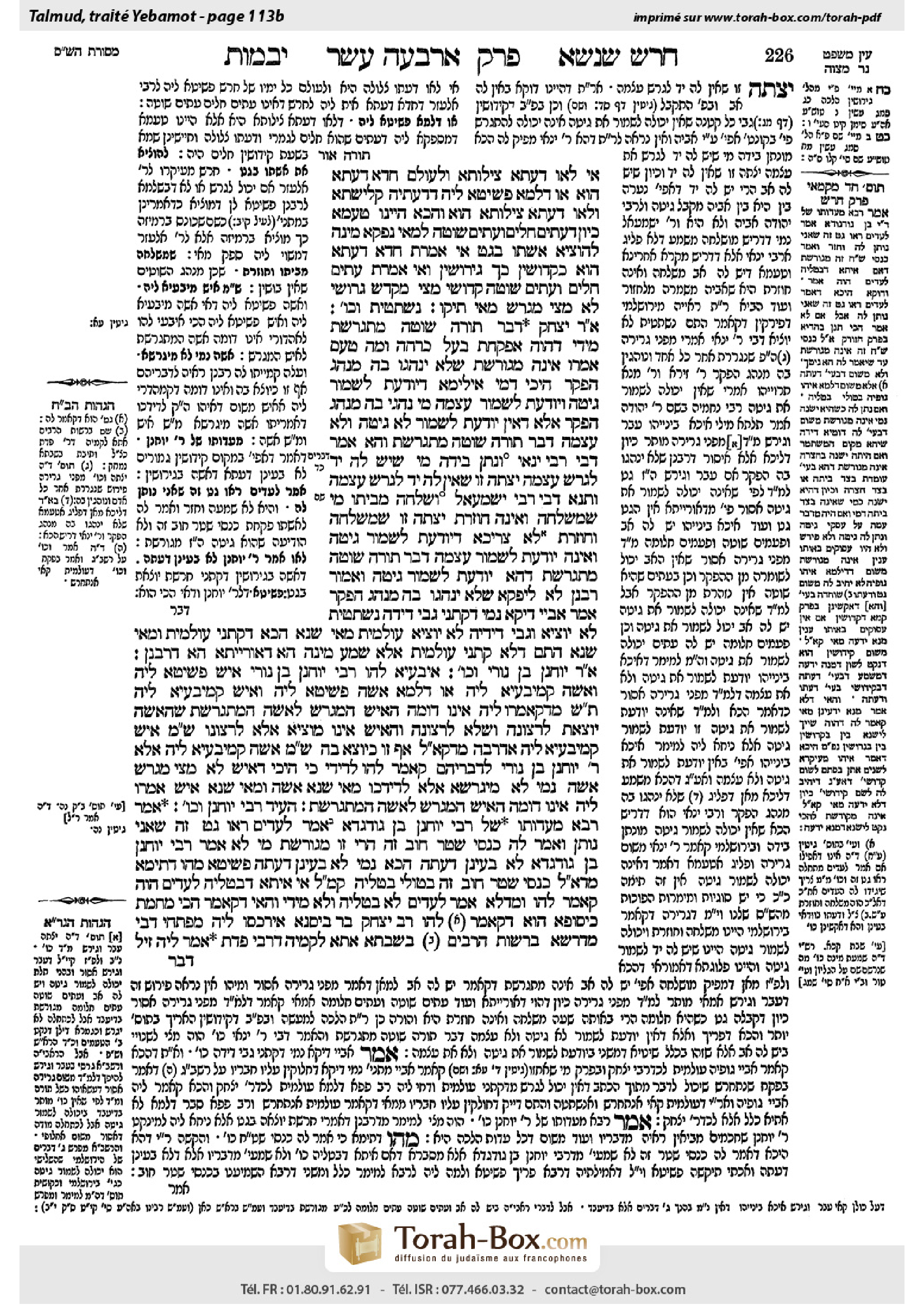
Yevamot 113b: Talmud study for Daf Yomi
Daf Yomi is the daily study of one Talmud folio. Explore 37 tractates with scans, Hebrew text, Sefaria English and AI-generated French translations where annotated.
Passage selection and English or AI-generated French translation are available where the scan has annotations. Daf Study is independent of Torah-Box and Sefaria.
Browse Yevamot · יבמות · All tractatesYevamot 113b text and translations
This page of Yevamot includes the Aramaic text, an English translation and an AI-generated French translation, alongside the scan above.
יבמות קי״ג ב · Aramaic and Hebrew text
אִי לָאו דַּעְתָּא צִילּוּתָא, וּלְעוֹלָם חֲדָא דַּעְתָּא הוּא. אוֹ דִלְמָא פְּשִׁיטָא לֵיהּ דְּדַעְתֵּיהּ קְלִישְׁתָּא וְלָאו דַּעְתָּא צִילּוּתָא הוּא, וְהָכָא הַיְינוּ טַעְמָא: כֵּיוָן דְּעִתִּים חָלִים וְעִתִּים שׁוֹטֶה.
לְמַאי נָפְקָא מִינַּהּ — לְהוֹצִיא אִשְׁתּוֹ בְּגֵט. אִי אָמְרַתְּ חֲדָא דַּעְתָּא הוּא — כְּקִדּוּשִׁין כָּךְ גֵּירוּשִׁין.
וְאִי אָמְרַתְּ עִתִּים חָלִים וְעִתִּים שׁוֹטֶה — קַדּוֹשֵׁי מָצֵי מְקַדֵּשׁ, גָּרוֹשֵׁי לָא מָצֵי מְגָרֵשׁ. מַאי? תֵּיקוּ.
נִשְׁתַּטֵּית וְכוּ׳. אָמַר רַבִּי יִצְחָק: דְּבַר תּוֹרָה שׁוֹטָה מִתְגָּרֶשֶׁת, מִידֵּי דְּהָוֵה אַפִּקַּחַת בְּעַל כׇּרְחָהּ. וּמָה טַעַם אָמְרוּ אֵינָהּ מְגוֹרֶשֶׁת? שֶׁלֹּא יִנְהֲגוּ בָּהּ מִנְהַג הֶפְקֵר.
הֵיכִי דָּמֵי? אִילֵּימָא דְּיוֹדַעַת לִשְׁמוֹר גִּיטָּהּ וְיוֹדַעַת לִשְׁמוֹר עַצְמָהּ — מִי נָהֲגִי בָּהּ מִנְהַג הֶפְקֵר? אֶלָּא, דְּאֵין יוֹדַעַת לִשְׁמוֹר לֹא גִּיטָּהּ וְלֹא עַצְמָהּ.
דְּבַר תּוֹרָה שׁוֹטָה מִתְגָּרֶשֶׁת? וְהָא אָמַר דְּבֵי רַבִּי יַנַּאי: ״וְנָתַן בְּיָדָהּ״, מִי שֶׁיֵּשׁ לָהּ יָד לְגָרֵשׁ עַצְמָהּ, יָצְתָה זוֹ, שֶׁאֵין לָהּ יָד לְגָרֵשׁ עַצְמָהּ.
וְתָנָא דְּבֵי רַבִּי יִשְׁמָעֵאל: ״וְשִׁלְּחָהּ מִבֵּיתוֹ״, מִי שֶׁמְּשַׁלְּחָהּ וְאֵינָהּ חוֹזֶרֶת, יָצְתָה זוֹ, שֶׁמְּשַׁלְּחָהּ וְחוֹזֶרֶת.
לָא צְרִיכָא, דְּיוֹדַעַת לִשְׁמוֹר גִּיטָּהּ וְאֵינָהּ יוֹדַעַת לִשְׁמוֹר עַצְמָהּ. דְּבַר תּוֹרָה שׁוֹטָה מִתְגָּרֶשֶׁת, דְּהָא יוֹדַעַת לִשְׁמוֹר גִּיטָּהּ. וַאֲמוּר רַבָּנַן לָא לַיפְּקַהּ, שֶׁלֹּא יִנְהֲגוּ בָּהּ מִנְהַג הֶפְקֵר.
אָמַר אַבָּיֵי: דַּיְקָא נָמֵי, דְּקָתָנֵי גַּבֵּי דִידַהּ ״נִשְׁתַּטֵּית לֹא יוֹצִיא״, וְגַבֵּי דִידֵיהּ ״לֹא יוֹצִיא עוֹלָמִית״. מַאי שְׁנָא הָכָא דְּקָתָנֵי ״עוֹלָמִית״ וּמַאי שְׁנָא הָתָם דְּלָא קָתָנֵי ״עוֹלָמִית״? אֶלָּא שְׁמַע מִינַּהּ, הָא — דְּאוֹרָיְיתָא, הָא — דְּרַבָּנַן.
אָמַר רַבִּי יוֹחָנָן בֶּן נוּרִי וְכוּ׳. אִיבַּעְיָא לְהוּ? רַבִּי יוֹחָנָן בֶּן נוּרִי, אִישׁ פְּשִׁיטָא לֵיהּ, וְאִשָּׁה קָמִיבַּעְיָא לֵיהּ. אוֹ דִלְמָא: אִשָּׁה פְּשִׁיטָא לֵיהּ, וְאִישׁ קָמִיבַּעְיָא לֵיהּ.
תָּא שְׁמַע, מִדְּקָאָמְרוּ לֵיהּ: אֵינוֹ דּוֹמֶה הָאִישׁ הַמְגָרֵשׁ לָאִשָּׁה הַמִּתְגָּרֶשֶׁת, שֶׁהָאִשָּׁה יוֹצֵאת לִרְצוֹנָהּ וְשֶׁלֹּא לִרְצוֹנָהּ, וְהָאִישׁ אֵינוֹ מוֹצִיא אֶלָּא לִרְצוֹנוֹ — שְׁמַע מִינַּהּ אִישׁ קָמִיבַּעְיָא לֵיהּ. אַדְּרַבָּה, מִדְּקָאָמְרוּ לֵיהּ: אַף זוֹ כַּיּוֹצֵא בָּהּ — שְׁמַע מִינַּהּ אִשָּׁה קָמִיבַּעְיָא לֵיהּ.
אֶלָּא, רַבִּי יוֹחָנָן בֶּן נוּרִי לְדִבְרֵיהֶם קָאָמַר לְהוּ: לְדִידִי, כִּי הֵיכִי דְּאִישׁ לָא מָצֵי מְגָרֵשׁ — אִשָּׁה נָמֵי לָא מִיגָּרְשָׁא, אֶלָּא לְדִידְכוּ, מַאי שְׁנָא אִשָּׁה וּמַאי שְׁנָא אִישׁ! אֲמַרוּ לֵיהּ: אֵינוֹ דּוֹמֶה הָאִישׁ הַמְגָרֵשׁ לָאִשָּׁה הַמִּתְגָּרֶשֶׁת.
הֵעִיד רַבִּי יוֹחָנָן וְכוּ׳. אָמַר רָבָא: מֵעֵדוּתוֹ שֶׁל רַבִּי יוֹחָנָן בֶּן גּוּדְגְּדָא, אָמַר לְעֵדִים: ״רְאוּ גֵּט זֶה שֶׁאֲנִי נוֹתֵן״, וְאָמַר לָהּ: ״כִּנְסִי שְׁטַר חוֹב זֶה״ — הֲרֵי זוֹ מְגוֹרֶשֶׁת.
מִי לָא אָמַר רַבִּי יוֹחָנָן בֶּן גּוּדְגְּדָא לָא בָּעֵינַן דַּעְתַּהּ, הָכָא נָמֵי לָא בָּעֵינַן דַּעְתַּהּ. פְּשִׁיטָא?
מַהוּ דְּתֵימָא: מִדַּאֲמַר לַהּ ״כִּנְסִי שְׁטַר חוֹב זֶה״ — בַּטּוֹלֵי בַּטְּלֵיהּ, קָא מַשְׁמַע לַן. אִי אִיתָא דְּבַטְּלֵיהּ — לְעֵדִים הֲוָה קָאָמַר לְהוּ, וּמִדְּלָא אֲמַר לְעֵדִים — לָא בַּטְּלֵיהּ וְלָא מִידֵּי. וְהַאי דְּקָאָמַר הָכִי — מֵחֲמַת כִּיסּוּפָא הוּא דְּקָאָמַר לְהוּ.
רַב יִצְחָק בַּר בִּיסְנָא אִירְכַסוּ לֵיהּ מַפְתְּחֵי דְּבֵי מִדְרְשָׁא בִּרְשׁוּת הָרַבִּים בְּשַׁבְּתָא, אֲתָא לְקַמֵּיהּ דְּרַבִּי פְּדָת. אֲמַר לֵיהּ: זִיל
Yevamot 113b · English translation
Or perhaps his mind is not clear, i.e., he cannot achieve full and clear understanding, and yet he is always of one mind. In other words, a deaf-mute functions at the same level of intellectual capacity every day. Rav Ashi explains the other possibility: Or perhaps it is obvious to Rabbi Elazar that the mind of a deaf-mute is weak and his mind is unclear, but in this case here, this is Rabbi Elazar’s reasoning: Since he is at times competent and at times imbecilic, without clarity of mind, i.e., he does not function at the same level of understanding every day, therefore the teruma of a deaf-mute is considered teruma that is of doubtful legal status.
The Gemara asks: What is the practical difference how one defines the intellectual capacity of a deaf-mute? The Gemara answers: It makes a difference with respect to divorcing his wife with a bill of divorce. If you say that a deaf-mute has one consistent mind, his divorce is equivalent in status to his betrothal. Since he had a weak mind at the time of his betrothal, he has the same level of competence at his divorce and therefore he may divorce his wife.
But if you say that he is at times competent and at times imbecilic, he may betroth a woman, as the Sages are stringent and assume that he was healthy and of clear mind at the time; however he cannot divorce her, due to a concern that he was competent when he betrothed her but he is incompetent now. If so, what is Rabbi Elazar’s reasoning? No solution is found, and therefore the Gemara states that the dilemma shall stand unresolved.
§ The mishna taught that one whose wife became imbecilic may not divorce her. Rabbi Yitzḥak said: By Torah law, an imbecilic woman may be divorced, just as it is in the analogous case of a halakhically competent woman who was divorced against her will. Since there is no need for a woman to agree to receive a bill of divorce, an imbecile’s lack of sound mind does not prevent her from being divorced. And if so, what is the reason that the Sages said that an imbecilic woman may not be divorced? The reason is so that people should not treat her in the manner of ownerless property. Since she is not of sound mind and has no husband to protect her, there is a concern that people might treat her in a disrespectful fashion.
The Gemara inquires: What are the precise circumstances of this case? If we say that this woman knows how to guard her bill of divorce, i.e., she understands the concept of a bill of divorce, and she also knows how to take care of herself, would people treat her in the manner of ownerless property? She is capable of protecting herself. Rather, the mishna is evidently referring to a woman who does not know how to guard her bill of divorce, nor does she know how to take care of herself.
The Gemara asks: Is it correct that by Torah law an imbecilic woman may be divorced? But didn’t a Sage of the school of Rabbi Yannai say, with regard to the verse: “He shall write her a bill of divorce and give it into her hand” (Deuteronomy 24:3), that this refers only to a woman who has a hand, i.e., she has enough intellectual capacity to accept a bill of divorce for herself. This serves to exclude this imbecilic woman, who does not have a hand to accept her divorce for herself.
And the school of Rabbi Yishmael taught this slightly differently. The verse continues: “And send her out of his house” (Deuteronomy 24:3); this indicates that one may divorce only the type of woman whom he will send away and she will not return. It serves to exclude this imbecilic woman, as he will send her away and she will return, as she does not understand the concept of divorce.
The Gemara explains: No, Rabbi Yitzḥak’s halakha is necessary in the case of a woman who knows how to guard her bill of divorce but does not know how to take care of herself. By Torah law this imbecilic woman may be divorced, as she knows how to safeguard her bill of divorce, and yet the Sages said that her husband should not divorce her, so that people should not treat her in the manner of ownerless property, because she does not know how to take care of herself.
Abaye said: The language of the mishna is also precise in this case, as it teaches with regard to this woman that if she became an imbecile he may not divorce her; and yet, with regard to the husband, the mishna states that if he became an imbecile he may never divorce her. What is different here, that the mishna teaches using the word: Never, and what is different there, that it does not teach: Never? Rather, one can learn from here that this halakha, that an imbecilic man may not give a divorce, applies by Torah law, and this one, that a man may not divorce an imbecilic woman, applies by rabbinic law, and therefore the mishna does not add the phrase: Never.
§ The mishna taught that Rabbi Yoḥanan ben Nuri said: What is the reason that the husband of a woman who became a deaf-mute may divorce her, whereas a man who becomes a deaf-mute may not divorce his wife? A dilemma was raised before the scholars with regard to the opinion of Rabbi Yoḥanan ben Nuri: Is it obvious to him that a deaf-mute man may not divorce his wife, and he raised his dilemma with regard to a woman, i.e., why she may be divorced if she is a deaf-mute? Or perhaps, it is obvious to him why one may divorce a deaf-mute woman, and he raised his dilemma with regard to a deaf-mute man, i.e., why he may not divorce his wife.
The Gemara cites a proof: Come and hear from what the Rabbis said in response to Rabbi Yoḥanan ben Nuri: The man who divorces his wife is not similar to the woman who is divorced, as the woman is divorced whether she is willing or unwilling, and the man divorces his wife only willingly. Learn from here that Rabbi Yoḥanan ben Nuri raised his dilemma with regard to a deaf-mute man, not a woman, as the reply of the Rabbis is referring to the man, not the woman. The Gemara rejects this proof: On the contrary, from the fact that the Rabbis said to him: This woman, too, has a similar status, one can learn from here that he raised his dilemma with regard to a deaf-mute woman.
Rather, Rabbi Yoḥanan ben Nuri spoke to the Rabbis in accordance with their statement, i.e., he formulated his statement so as best to argue with their opinion, as follows: According to my opinion, just as a deaf-mute man cannot divorce his wife, so too a deaf-mute woman cannot be divorced. However, according to your opinion, what is the difference between the case of a deaf-mute woman and the case of a deaf-mute man? They said to him: The man who divorces his wife is not similar to the woman who is divorced.
The mishna taught: Rabbi Yoḥanan ben Gudgada testified that in the case of a deaf-mute minor whose father married her off, which is a marriage that is valid by Torah law, she may nevertheless be divorced once she matures. Rava said: From the testimony of Rabbi Yoḥanan ben Gudgada one may learn that if a husband said to witnesses: See this bill of divorce that I am giving my wife, and yet he said to her: Take this promissory note, she is divorced, despite the fact when he gave his wife the bill of divorce she did not know what it was.
This halakha is derived from Rabbi Yoḥanan ben Gudgada’s statement in the following manner: Didn’t Rabbi Yoḥanan ben Gudgada say that we do not require her consent, as there is no need for the woman to understand that she is receiving a bill of divorce? Here, too, we do not require her consent, and even if she believes that she is receiving a bill of debt, she is divorced. The Gemara asks: Isn’t it obvious that there is no need for the woman’s consent? What is the novel element in Rava’s statement?
The Gemara answers that Rava’s statement is necessary, lest you say: From the fact that the husband said to her: Take this promissory note, he has thereby nullified the bill of divorce. Rava therefore teaches us that this is not the case, for if it is so, that he nullified the bill of divorce, he would have said so to the witnesses. And from the fact that he did not say this to the witnesses, he evidently did not nullify the bill of divorce at all. And the reason that the husband said this, i.e., that she should take this bill of debt, it was due to shame that he said this to her, as he meant to divorce her all along, but he did not want her to know at the time what he was doing.
The Gemara relates a story: Rav Yitzḥak bar Bisna lost the keys to the study hall, and therefore they could not come into the study hall from the public domain on Shabbat. It was impossible to open the synagogue, as they could not bring the key because it is prohibited to carry in the public domain. He came before Rabbi Pedat to ask what to do. Rabbi Pedat said to him: Go
Yevamot 113b · Traduction française (IA)
Ou peut-être son esprit n’est-il pas clair, c’est-à-dire qu’il ne peut parvenir à une compréhension pleine et nette, et pourtant son état d’esprit reste toujours le même. Autrement dit, un sourd-muet fonctionne chaque jour au même niveau de capacité intellectuelle. Rav Achi explique l’autre possibilité : ou peut-être est-il évident pour Rabbi Elazar que l’esprit d’un sourd-muet est faible et manque de clarté, mais voici le raisonnement de Rabbi Elazar dans ce cas : puisqu’il est parfois compétent et parfois déficient, sans clarté d’esprit, c’est-à-dire qu’il ne fonctionne pas chaque jour au même niveau de compréhension, la terouma d’un sourd-muet est donc considérée comme ayant un statut juridique incertain.
La Guemara demande : quelle différence pratique y a-t-il selon la manière dont on définit la capacité intellectuelle d’un sourd-muet ? La Guemara répond : cela fait une différence quant à la possibilité de répudier sa femme au moyen d’un acte de divorce. Si l’on dit qu’un sourd-muet conserve un état d’esprit constant, son divorce a le même statut que ses fiançailles. Puisqu’il avait l’esprit faible au moment de ses fiançailles, il a le même degré de capacité au moment de son divorce et peut donc répudier sa femme.
Mais si l’on dit qu’il est parfois compétent et parfois déficient, il peut fiancer une femme, car les Sages se montrent rigoureux et supposent qu’il était sain d’esprit et lucide à ce moment-là ; cependant, il ne peut pas la répudier, par crainte qu’il ait été compétent lorsqu’il l’a fiancée, mais qu’il ne le soit plus à présent. Si tel est le cas, quel est le raisonnement de Rabbi Elazar ? Aucune solution n’est trouvée ; la Guemara conclut donc que la question reste sans réponse.
§ La Michna a enseigné que celui dont la femme est devenue déficiente ne peut pas la répudier. Rabbi Yitzḥak a dit : selon la Torah, une femme déficiente peut être répudiée, comme dans le cas analogue d’une femme juridiquement capable qui a été répudiée contre son gré. Puisqu’une femme n’a pas besoin de consentir à recevoir un acte de divorce, l’absence de discernement d’une femme déficiente n’empêche pas qu’elle soit répudiée. Si tel est le cas, pourquoi les Sages ont-ils dit qu’une femme déficiente ne peut pas être répudiée ? C’est pour que les gens ne la traitent pas comme un bien sans propriétaire. Puisqu’elle manque de discernement et n’a pas de mari pour la protéger, on craint que les gens ne la traitent avec irrespect.
La Guemara s’interroge : quelles sont exactement les circonstances de ce cas ? Si l’on dit que cette femme sait garder son acte de divorce, c’est-à-dire qu’elle comprend la notion d’acte de divorce, et qu’elle sait également prendre soin d’elle-même, les gens la traiteraient-ils comme un bien sans propriétaire ? Elle est capable de se protéger. La Michna parle donc manifestement d’une femme qui ne sait ni garder son acte de divorce ni prendre soin d’elle-même.
La Guemara demande : est-il exact que, selon la Torah, une femme déficiente peut être répudiée ? Pourtant, un Sage de l’école de Rabbi Yannai n’a-t-il pas dit, au sujet du verset : « Il écrira pour elle un acte de divorce et le lui remettra » (Deutéronome 24, 3), que cela ne concerne qu’une femme qui a une main, c’est-à-dire qui possède une capacité intellectuelle suffisante pour recevoir elle-même un acte de divorce ? Cela vient exclure cette femme déficiente, qui n’a pas de main pour recevoir elle-même son acte de divorce.
Et l’école de Rabbi Yishmael a enseigné la chose de manière légèrement différente. Le verset poursuit : « Il la fera sortir de sa maison » (Deutéronome 24, 3) ; cela indique qu’on ne peut répudier qu’une femme que l’on renvoie et qui ne revient pas. Cela vient exclure cette femme déficiente, car il la renverra et elle reviendra, puisqu’elle ne comprend pas la notion de divorce.
La Guemara explique : non, la halakha de Rabbi Yitzḥak est nécessaire dans le cas d’une femme qui sait garder son acte de divorce, mais ne sait pas prendre soin d’elle-même. Selon la Torah, cette femme déficiente peut être répudiée, car elle sait garder son acte de divorce ; pourtant, les Sages ont dit que son mari ne devait pas la répudier, afin que les gens ne la traitent pas comme un bien sans propriétaire, puisqu’elle ne sait pas prendre soin d’elle-même.
Abaye a dit : la formulation de la Michna est également précise dans ce cas, puisqu’elle enseigne au sujet de cette femme que, si elle est devenue déficiente, son mari ne peut pas la répudier ; tandis qu’au sujet du mari, la Michna dit que s’il est devenu déficient, il ne pourra jamais répudier sa femme. Pourquoi, ici, la Michna emploie-t-elle le terme « jamais », alors que là, elle ne l’emploie pas ? On peut plutôt en déduire que cette halakha, selon laquelle un homme déficient ne peut pas donner le divorce, s’applique selon la Torah, tandis que celle-ci, selon laquelle un homme ne peut pas répudier une femme déficiente, relève du droit rabbinique ; c’est pourquoi la Michna n’ajoute pas l’expression « jamais ».
§ La Michna a enseigné que Rabbi Yoḥanan ben Nuri a dit : pourquoi le mari d’une femme devenue sourde-muette peut-il la répudier, alors qu’un homme devenu sourd-muet ne peut pas répudier sa femme ? Les Sages ont soulevé une question au sujet de l’opinion de Rabbi Yoḥanan ben Nuri : lui est-il évident qu’un homme sourd-muet ne peut pas répudier sa femme, et a-t-il soulevé sa question au sujet d’une femme, c’est-à-dire pour demander pourquoi elle peut être répudiée si elle est sourde-muette ? Ou peut-être lui est-il évident qu’on peut répudier une femme sourde-muette, et a-t-il soulevé sa question au sujet d’un homme sourd-muet, c’est-à-dire pour demander pourquoi il ne peut pas répudier sa femme ?
La Guemara apporte une preuve : examinons ce que les Rabbins ont répondu à Rabbi Yoḥanan ben Nuri : l’homme qui répudie sa femme n’est pas comparable à la femme qui est répudiée, car la femme est répudiée qu’elle le veuille ou non, tandis que l’homme ne répudie sa femme que de son plein gré. On en déduit que Rabbi Yoḥanan ben Nuri a soulevé sa question au sujet d’un homme sourd-muet, et non d’une femme, car la réponse des Rabbins concerne l’homme, non la femme. La Guemara rejette cette preuve : au contraire, du fait que les Rabbins lui ont dit : « Cette femme aussi a un statut comparable », on peut déduire qu’il a soulevé sa question au sujet d’une femme sourde-muette.
En réalité, Rabbi Yoḥanan ben Nuri s’est adressé aux Rabbins en se conformant à leur formulation, c’est-à-dire qu’il a formulé son propos de manière à mieux contester leur opinion, comme suit : selon mon opinion, de même qu’un homme sourd-muet ne peut pas répudier sa femme, de même une femme sourde-muette ne peut pas être répudiée. Mais selon votre opinion, quelle différence y a-t-il entre le cas d’une femme sourde-muette et celui d’un homme sourd-muet ? Ils lui répondirent : l’homme qui répudie sa femme n’est pas comparable à la femme qui est répudiée.
La Michna a enseigné : Rabbi Yoḥanan ben Gudgada a témoigné que, dans le cas d’une mineure sourde-muette que son père a mariée — mariage valide selon la Torah —, elle peut néanmoins être répudiée une fois qu’elle a atteint la majorité. Rava a dit : du témoignage de Rabbi Yoḥanan ben Gudgada, on peut apprendre que si un mari dit aux témoins : « Voyez cet acte de divorce que je remets à ma femme », mais lui dit à elle : « Prends ce billet à ordre », elle est répudiée, bien qu’au moment où son mari lui a remis l’acte de divorce, elle n’ait pas su de quoi il s’agissait.
On déduit cette halakha de la déclaration de Rabbi Yoḥanan ben Gudgada de la manière suivante : Rabbi Yoḥanan ben Gudgada n’a-t-il pas dit que nous n’exigeons pas son consentement, car la femme n’a pas besoin de comprendre qu’elle reçoit un acte de divorce ? Ici aussi, nous n’exigeons pas son consentement et, même si elle croit recevoir un billet à ordre, elle est répudiée. La Guemara demande : n’est-il pas évident que le consentement de la femme n’est pas nécessaire ? Quel est donc l’élément novateur de la déclaration de Rava ?
La Guemara répond que la déclaration de Rava est nécessaire, de peur que tu ne dises : puisque le mari lui a dit : « Prends ce billet à ordre », il a de ce fait annulé l’acte de divorce. Rava nous enseigne que ce n’est pas le cas, car s’il avait annulé l’acte de divorce, il l’aurait dit aux témoins. Puisqu’il ne le leur a pas dit, il est manifeste qu’il n’a nullement annulé l’acte de divorce. Le mari lui a dit de prendre ce billet à ordre par honte : il avait l’intention de la répudier depuis le début, mais ne voulait pas qu’elle sache sur le moment ce qu’il faisait.
La Guemara rapporte une histoire : Rav Yitzḥak bar Bisna perdit les clés de la maison d’étude ; ils ne purent donc pas y entrer depuis le domaine public pendant Chabbat. Il était impossible d’ouvrir la synagogue, car ils ne pouvaient pas apporter la clé, puisqu’il est interdit de transporter un objet dans le domaine public. Il se présenta devant Rabbi Pedat pour lui demander quoi faire. Rabbi Pedat lui dit : « Va »
Traduction française générée par IA à partir de l’édition anglaise de Sefaria. Vérifie toujours un passage avec le texte source.
Text from Sefaria: William Davidson Edition - Vocalized Aramaic (CC BY NC); William Davidson Edition - English (CC BY NC).