Yevamot 114a: Talmud study for Daf Yomi
Daf Yomi is the daily study of one Talmud folio. Explore 37 tractates with scans, Hebrew text, Sefaria English and AI-generated French translations where annotated.
Passage selection and English or AI-generated French translation are available where the scan has annotations. Daf Study is independent of Torah-Box and Sefaria.
Browse Yevamot · יבמות · All tractatesYevamot 114a text and translations
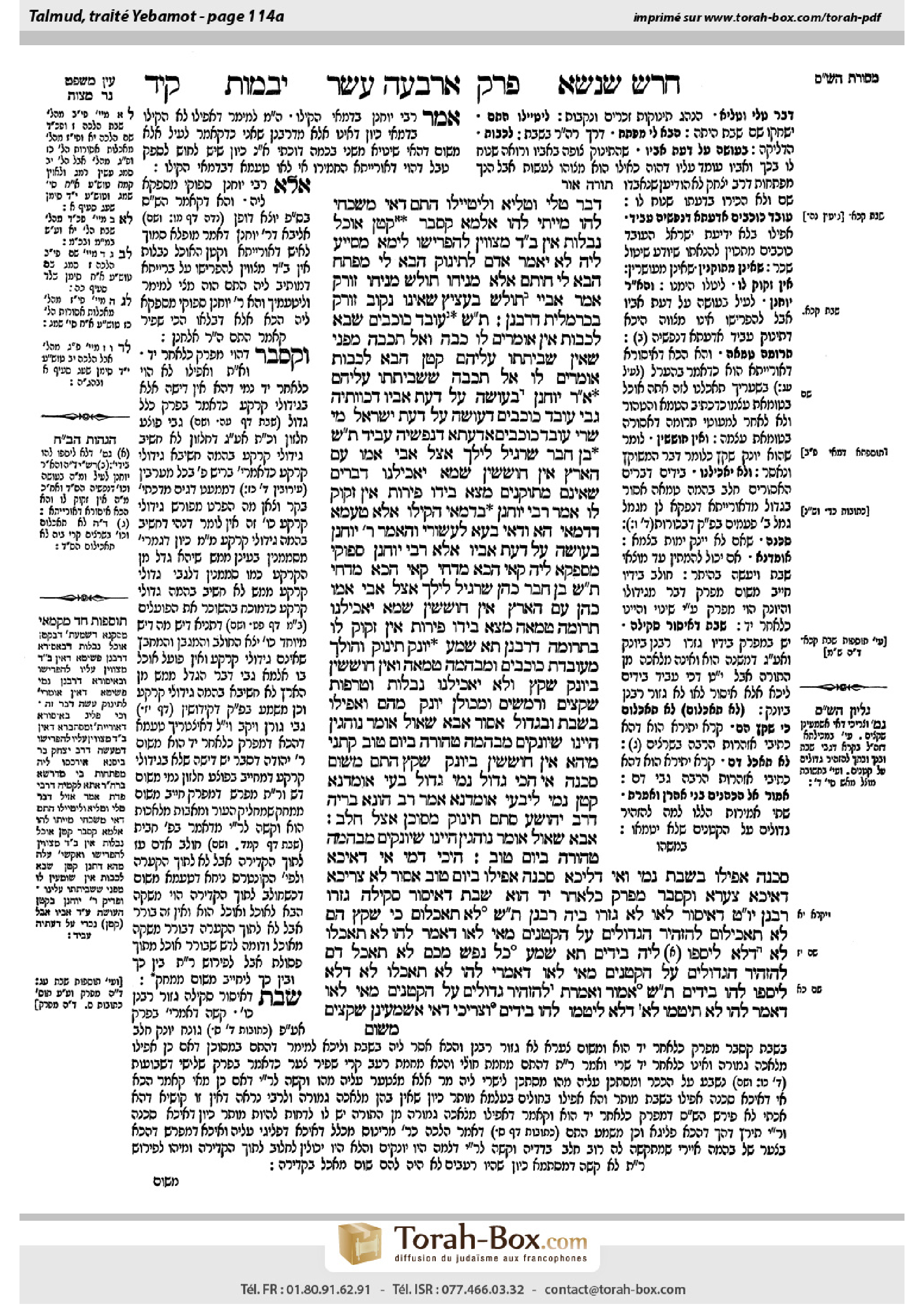
This page of Yevamot includes the Aramaic text, an English translation and an AI-generated French translation, alongside the scan above.
יבמות קי״ד א · Aramaic and Hebrew text
דְּבַר טְלֵי וְטַלְיָא וְלִיטַיְּילוּ הָתָם, דְּאִי מַשְׁכְּחִי לְהוּ, מַיְיתֵי לְהוּ. אַלְמָא קָסָבַר: קָטָן אוֹכֵל נְבֵלוֹת — אֵין בֵּית דִּין מְצֻוִּוין לְהַפְרִישׁוֹ. לֵימָא מְסַיַּיע לֵיהּ: לֹא יֹאמַר אָדָם לְתִינוֹק ״הָבֵא לִי מַפְתֵּחַ״, ״הָבֵא לִי חוֹתָם״, אֶלָּא מַנִּיחוֹ תּוֹלֵשׁ, מַנִּיחוֹ זוֹרֵק.
אָמַר אַבָּיֵי: ״תּוֹלֵשׁ״ — בְּעָצִיץ שֶׁאֵינוֹ נָקוּב, ״זוֹרֵק״ — בְּכַרְמְלִית דְּרַבָּנַן.
תָּא שְׁמַע: גּוֹי שֶׁבָּא לְכַבּוֹת — אֵין אוֹמְרִים לוֹ ״כַּבֵּה״ וְ״אַל תְּכַבֶּה״, מִפְּנֵי שֶׁאֵין שְׁבִיתָתוֹ עֲלֵיהֶם. קָטָן הַבָּא לְכַבּוֹת — אוֹמְרִים לוֹ ״אַל תְּכַבֶּה״, שֶׁשְּׁבִיתָתוֹ עֲלֵיהֶם.
אָמַר רַבִּי יוֹחָנָן: בְּעוֹשֶׂה עַל דַּעַת אָבִיו, דִּכְווֹתֵיהּ גַּבֵּי גּוֹי דְּעוֹשֶׂה עַל דַּעַת יִשְׂרָאֵל, מִי שְׁרֵי? גּוֹי אַדַּעְתָּא דְּנַפְשֵׁיהּ עָבֵיד.
תָּא שְׁמַע: בֶּן חָבֵר שֶׁרָגִיל לֵילֵךְ אֵצֶל אֲבִי אִמּוֹ עַם הָאָרֶץ — אֵין חוֹשְׁשִׁין שֶׁמָּא יַאֲכִילֶנּוּ דְּבָרִים שֶׁאֵינָם מְתוּקָּנִים. מָצָא בְּיָדוֹ פֵּירוֹת — אֵין זָקוּק לוֹ! אָמַר רַבִּי יוֹחָנָן: בִּדְמַאי הֵקֵילּוּ.
אֶלָּא טַעְמָא דִּדְמַאי, הָא וַדַּאי בְּעָא לְעַשּׂוֹרֵי? וְהָאָמַר רַבִּי יוֹחָנָן: בְּעוֹשֶׂה עַל דַּעַת אָבִיו! אֶלָּא רַבִּי יוֹחָנָן סַפּוֹקֵי מְסַפְּקָא לֵיהּ, קָאֵי הָכָא מְדַחֵי, קָאֵי הָכָא מְדַחֵי.
תָּא שְׁמַע: בֶּן חָבֵר כֹּהֵן שֶׁרָגִיל לֵילֵךְ אֵצֶל אֲבִי אִמּוֹ כֹּהֵן עַם הָאָרֶץ — אֵין חוֹשְׁשִׁין שֶׁמָּא יַאֲכִילֶנּוּ תְּרוּמָה טְמֵאָה, מָצָא בְּיָדוֹ פֵּירוֹת — אֵין זָקוּק לוֹ! בִּתְרוּמָה דְּרַבָּנַן.
תָּא שְׁמַע: יוֹנֵק תִּינוֹק וְהוֹלֵךְ מִגּוֹיָה וּמִבְּהֵמָה טְמֵאָה, וְאֵין חוֹשְׁשִׁין בְּיוֹנֵק שֶׁקֶץ. וְלֹא יַאֲכִילֶנּוּ נְבֵלוֹת וּטְרֵפוֹת שְׁקָצִים וּרְמָשִׂים. וּמִכּוּלָּן יוֹנֵק מֵהֶם וַאֲפִילּוּ בַּשַּׁבָּת. וּבְגָדוֹל אָסוּר. אַבָּא שָׁאוּל אוֹמֵר: נוֹהֲגִין הָיִינוּ שֶׁיּוֹנְקִים מִבְּהֵמָה טְהוֹרָה בְּיוֹם טוֹב.
קָתָנֵי מִיהָא אֵין חוֹשְׁשִׁין בְּיוֹנֵק שֶׁקֶץ! הָתָם מִשּׁוּם סַכָּנָה. אִי הָכִי — גָּדוֹל נָמֵי!
גָּדוֹל בָּעֵי אוּמְדָּנָא. קָטָן נָמֵי לִיבְעֵי אוּמְדָּנָא! אָמַר רַב הוּנָא בְּרֵיהּ דְּרַב יְהוֹשֻׁעַ: סְתָם תִּינוֹק מְסוּכָּן אֵצֶל חָלָב.
אַבָּא שָׁאוּל אוֹמֵר: נוֹהֲגִין הָיִינוּ שֶׁיּוֹנְקִים מִבְּהֵמָה טְהוֹרָה בְּיוֹם טוֹב. הֵיכִי דָּמֵי? אִי דְּאִיכָּא סַכָּנָה — אֲפִילּוּ בְּשַׁבָּת נָמֵי, וְאִי דְּלֵיכָּא סַכָּנָה — אֲפִילּוּ בְּיוֹם טוֹב אָסוּר! לָא צְרִיכָא דְּאִיכָּא צַעֲרָא.
וְקָסָבַר מְפָרֵק כִּלְאַחַר יָד הוּא. שַׁבָּת דְּאִיסּוּר סְקִילָה — גְּזַרוּ רַבָּנַן, יוֹם טוֹב דְּאִיסּוּר לָאו — לָא גְּזַרוּ בֵּיהּ רַבָּנַן.
תָּא שְׁמַע: ״לֹא תֹאכְלוּם כִּי שֶׁקֶץ הֵם״, לֹא תַּאֲכִילוּם — לְהַזְהִיר הַגְּדוֹלִים עַל הַקְּטַנִּים. מַאי לָאו, דְּאָמַר לְהוּ לֹא תֵּאכְלוּ! לָא, דְּלָא לִיסְפּוֹ לֵיהּ בְּיָדַיִם.
תָּא שְׁמַע: ״כׇּל נֶפֶשׁ מִכֶּם לֹא תֹאכַל דָּם״, לְהַזְהִיר הַגְּדוֹלִים עַל הַקְּטַנִּים. מַאי לָאו, דְּאָמְרִי לְהוּ לֹא תֵּאכְלוּ! לָא, דְּלָא לִיסְפּוֹ לְהוּ בְּיָדַיִם.
תָּא שְׁמַע: ״אֱמוֹר ... וְאָמַרְתָּ״, לְהַזְהִיר גְּדוֹלִים עַל הַקְּטַנִּים. מַאי לָאו, דְּאָמַר לְהוּ לָא תִּיטַּמּוֹ! לָא, דְּלָא לִיטַמּוֹ לְהוּ בְּיָדַיִם.
וּצְרִיכִי: דְּאִי אַשְׁמְעִינַן שְׁקָצִים —
Yevamot 114a · English translation
and lead boys and girls and let them walk there where the keys were lost, and if they find the keys they will bring them to you of their own accord, without you saying anything to them. The Gemara comments: Apparently, Rabbi Pedat maintains that with regard to a minor who eats meat from unslaughtered animals or violates other prohibitions, the court is not commanded to prevent him from doing so. The Gemara comments: Let us say that the following source supports his opinion: A person may not tell a child on Shabbat: Bring me a key, or: Bring me my seal from the public domain. However, he may allow the child to detach plants and allow him to throw in the public domain. This shows that one need not be strict with a child who transgresses a prohibition, but one may not tell a child to transgress a prohibition.
The Gemara rejects this suggestion: Abaye said that this is no proof, as it is possible that detaching plants is referring to an unperforated flowerpot, as the prohibition against detaching plants from a vessel of this kind applies by rabbinic law. Similar, when it states: Throw, this can be referring to throwing in a karmelit rather than the public domain. A karmelit is an intermediate domain between public and private domains, which has the status of a public domain by rabbinic law. However, perhaps one is obligated to stop the child if he is transgressing a Torah prohibition.
The Gemara further suggests: Come and hear the following statement (Shabbat 121a): If a gentile comes to extinguish a Jew’s fire on Shabbat, one may not say to him: Extinguish, or: Do not extinguish, because responsibility for his rest is not incumbent upon the Jew. However, if a Jewish child comes to extinguish a fire on Shabbat, they do say to him: Do not extinguish, despite the fact that he is not yet obligated in mitzva observance, because responsibility for his rest is incumbent upon the Jew. This shows that one must prevent a minor from violating a Torah prohibition.
Rabbi Yoḥanan said: This is referring to a minor who is acting with his father’s consent. Even if the father did not tell him explicitly what to do, the child is aware of his father’s wishes, and acts on his behalf. The Gemara asks: The same reasoning can be applied with regard to a gentile, that he acts with the Jew’s consent, and yet in this case is it permitted for him to perform labor on behalf of a Jew? The Gemara answers: A gentile acts in accordance with his own wishes. As an adult he is responsible for his own decisions and is not considered to be following the instructions of others.
Come and hear: The son of a ḥaver, one who is devoted to the meticulous observance of mitzvot, especially the halakhot of ritual purity, teruma, and tithes, is accustomed to going to his mother’s father, who is an ignoramus and therefore is not known to be as careful to separate teruma and tithes. In this case, the son need not be concerned lest his grandfather feed him food items that are not tithed. If the father found fruit in the child’s hand, and he does not know where the fruit is from, he is not bound to separate tithes from the fruit. This indicates that one need not prevent a minor from eating forbidden food. Rabbi Yoḥanan said: The Sages were lenient with regard to doubtfully tithed produce [demai]. Since the prohibition against eating this produce applies only due to doubt, and most ignoramuses do separate tithes, the Sages were lenient in uncertain cases of this kind.
The Gemara infers: Rather, the reason that the Sages were lenient is that it is demai, from which it may be inferred that if it was definitely untithed, the father would be required to tithe the fruit. But didn’t Rabbi Yoḥanan himself say that one need stop a minor only when he is acting with his father’s consent? Rather, Rabbi Yoḥanan is uncertain with regard to this halakha, and therefore in this case he refutes it, and in that case he refutes it. In other words, he reached no definite conclusion about this matter, and therefore he treats each case on its own merits.
Come and hear: With regard to the son of a ḥaver priest who is accustomed to going to his mother’s father, a priest who is also an ignoramus, one need not be concerned lest his grandfather feed him ritually impure teruma. If the father found fruit in the child’s hand, he is not bound to take it from him. This shows that even when the concern involves ritually impure teruma, which is a Torah prohibition, one is not required to ensure that a minor does not sin. The Gemara rejects this: This is no proof, as this is referring to teruma that is separated by rabbinic law, not a doubt concerning a Torah prohibition.
Come and hear: A child may regularly suckle from a gentile woman; and a child may suckle from a non-kosher animal. And in both cases one need not be concerned that he might be considered one who suckles from a detestable creature. But one may not feed a child unslaughtered animal carcasses, or animals with wounds that will cause the animals to die within twelve months [tereifot], or repugnant creatures, or creeping animals. A child may suckle from all these, including the non-kosher creatures, even on Shabbat, but in the case of an adult, it is prohibited for him to suckle on Shabbat even from a kosher animal. Abba Shaul says: We were accustomed to suckle from a kosher animal on a Festival, rather than milk it by hand, in the usual way.
In any event, this tanna teaches that one need not be concerned that he might be considered one who suckles from a detestable creature, which indicates that a child may be left to eat forbidden food. The Gemara rejects this: There, permission is granted due to a danger, because a child must eat. The Gemara asks: If so, it should also be permitted for an adult, as saving a human life supersedes these prohibitions.
The Gemara answers: An adult requires consultation, i.e., doctors or other experts must examine him and establish that he is dangerously ill. The Gemara retorts: A minor should also require consultation as to whether he is in danger. Rav Huna, son of Rav Yehoshua, said: There is no need for a special consultation, as in an unspecified case a child is in danger with regard to milk. It can be assumed that a child needs milk, and if he does not get it, he will be in danger.
The Gemara analyzes the last opinion in the above baraita. Abba Shaul says: We were accustomed to suckle from a kosher animal on a Festival. The Gemara inquires: What are the circumstances? If there is imminent danger to a person, even on Shabbat it should also be permitted. And if there is no danger, even on a Festival it should be prohibited. The Gemara answers: No, it is necessary in a case where there is suffering, i.e., they suffer from thirst but no danger is involved.
The Gemara explains: And Abba Shaul holds that sucking directly from an animal is considered the prohibited labor of extracting performed in an unusual manner. It is prohibited to remove food from a source that is not fit for consumption. However, in this case he does not do so in the usual way of milking, but by sucking, and therefore it is prohibited by rabbinic law. Consequently, on Shabbat, when it is a prohibition punishable by stoning, the Sages issued a decree in this case, even if the milking is done in an unusual manner. Conversely, with regard to a Festival, when labor is a negative prohibition that is not punishable by stoning, the Sages did not issue a decree in a situation that involves suffering. In any case, this source offers no proof with respect to how to treat a child who transgresses.
Come and hear: The verse states, with regard to creeping animals and other non-kosher animals: “You shall not eat them [tokhlum] for they are a detestable thing” (Leviticus 11:42). The Sages interpret this verse as though it said ta’akhilum, do not feed them to others. The verse comes to warn adults concerning minors, i.e., not only is it prohibited for adults to eat these items themselves, they may also not feed them to minors. What, is it not the case that this means adults must say to children: Do not eat, and prevent them from transgressing? The Gemara rejects this explanation: No, it means that an adult may not feed the minor non-kosher food directly by direct action, but this does not prove that one must stop a child from eating non-kosher food of his own accord.
Come and hear, as the verse states: “No soul of you shall eat blood” (Leviticus 17:12). This serves to warn adults concerning minors. What, is it not the case that this means adults must say to children: Do not eat blood? The Gemara responds: No, here, too, it means that an adult may not feed minors by direct action.
Come and hear, as the verse states: “Speak to the priests, the sons of Aaron, and say to them: None shall become impure for the dead among his people” (Leviticus 21:1). This reiteration of “speak” and “and say” comes to warn adults concerning minors. What, is it not the case that this means adults must say to children: Do not become impure? The Gemara rejects this: No, it is possible to interpret that an adult should not render children impure by direct action.
The Gemara adds: And all these three cases are necessary, despite the fact that they apparently teach the same halakha, i.e., that adults may not feed minors forbidden food. As, had the tanna taught us only the case of repugnant creatures,
Yevamot 114a · Traduction française (IA)
et qu’ils conduisent des garçons et des filles et les laissent marcher là où les clés ont été perdues ; s’ils les trouvent, ils vous les apporteront d’eux-mêmes, sans que vous leur disiez quoi que ce soit. La Guemara commente : Apparemment, Rabbi Pedat estime que, lorsqu’un mineur mange de la viande provenant d’animaux non abattus rituellement ou enfreint d’autres interdits, le tribunal n’est pas tenu de l’en empêcher. La Guemara commente : Disons que la source suivante appuie son opinion : on ne peut pas dire à un enfant, pendant Chabbat : « Apporte-moi une clé » ou « Apporte-moi mon sceau depuis le domaine public ». Cependant, on peut le laisser arracher des plantes et les jeter dans le domaine public. Cela montre qu’il n’est pas nécessaire d’être strict envers un enfant qui transgresse un interdit, mais qu’on ne peut pas lui demander de transgresser un interdit.
La Guemara rejette cette suggestion : Abayé dit que cela ne prouve rien, car l’arrachage des plantes peut concerner un pot de fleurs non percé, puisque l’interdiction d’arracher des plantes d’un récipient de ce type relève de la loi rabbinique. De même, lorsque le texte dit : « Jette », cela peut désigner le fait de jeter dans un karmelit plutôt que dans le domaine public. Un karmelit est un domaine intermédiaire entre le domaine public et le domaine privé, auquel la loi rabbinique confère le statut de domaine public. Cependant, il se peut qu’on soit tenu d’arrêter l’enfant s’il transgresse un interdit de la Torah.
La Guemara propose encore : Viens et entends l’énoncé suivant (Chabbat 121a) : si un non-Juif vient éteindre le feu d’un Juif pendant Chabbat, on ne peut lui dire ni « Éteins » ni « N’éteins pas », car le Juif n’est pas tenu de veiller au repos du non-Juif. En revanche, si un enfant juif vient éteindre un feu pendant Chabbat, on lui dit bien : « N’éteins pas », bien qu’il ne soit pas encore tenu d’observer les mitsvot, car le Juif est tenu de veiller à son repos. Cela montre qu’il faut empêcher un mineur de transgresser un interdit de la Torah.
Rabbi Yoḥanan dit : cela concerne un mineur qui agit avec l’assentiment de son père. Même si son père ne lui a pas explicitement dit quoi faire, l’enfant connaît les souhaits de son père et agit pour son compte. La Guemara demande : Le même raisonnement pourrait s’appliquer à un non-Juif : il agit avec l’assentiment du Juif ; pourtant, dans ce cas, lui est-il permis d’effectuer un travail pour un Juif ? La Guemara répond : Un non-Juif agit selon sa propre volonté. En tant qu’adulte, il est responsable de ses propres décisions et n’est pas considéré comme agissant sur les instructions d’autrui.
Viens et entends : le fils d’un ḥaver, c’est-à-dire d’un homme particulièrement scrupuleux dans l’observance des mitsvot, notamment des halakhot de pureté rituelle, de terouma et des dîmes, a l’habitude de se rendre chez son grand-père maternel, qui est un ignorant et n’est donc pas réputé veiller aussi soigneusement à prélever la terouma et les dîmes. Dans ce cas, le fils n’a pas à craindre que son grand-père lui donne des aliments dont les dîmes n’ont pas été prélevées. Si le père trouve un fruit dans la main de l’enfant et ignore d’où il vient, il n’est pas tenu d’en prélever les dîmes. Cela indique qu’il n’est pas nécessaire d’empêcher un mineur de manger un aliment interdit. Rabbi Yoḥanan dit : les Sages se sont montrés indulgents à l’égard des produits dont le prélèvement des dîmes est douteux [demai]. Puisque l’interdiction de consommer ces produits ne repose que sur un doute et que la plupart des ignorants prélèvent effectivement les dîmes, les Sages se sont montrés indulgents dans ce genre de cas incertains.
La Guemara déduit : la raison de l’indulgence des Sages est donc qu’il s’agit de demai, ce qui permet d’inférer que, si les produits n’avaient certainement pas été soumis à la dîme, le père serait tenu d’en prélever les dîmes. Mais Rabbi Yoḥanan lui-même n’a-t-il pas dit qu’il ne faut arrêter un mineur que lorsqu’il agit avec l’assentiment de son père ? Rabbi Yoḥanan est donc incertain au sujet de cette halakha ; dans un cas, il réfute l’argument, et dans l’autre, il le réfute également. Autrement dit, il n’a pas tranché cette question et examine donc chaque cas selon ses propres mérites.
Viens et entends : au sujet du fils d’un ḥaver prêtre, qui a l’habitude de se rendre chez son grand-père maternel, lui aussi prêtre mais ignorant, il n’y a pas à craindre que son grand-père lui donne de la terouma rituellement impure. Si le père trouve un fruit dans la main de l’enfant, il n’est pas tenu de le lui retirer. Cela montre que même lorsque la crainte porte sur de la terouma rituellement impure, ce qui constitue une transgression de la Torah, on n’est pas tenu de veiller à ce qu’un mineur ne pèche pas. La Guemara rejette cette preuve : elle ne prouve rien, car il s’agit ici de terouma prélevée en vertu de la loi rabbinique, et non d’un doute portant sur une interdiction de la Torah.
Viens et entends : un enfant peut régulièrement téter auprès d’une femme non juive, et il peut téter auprès d’un animal non cachère. Dans les deux cas, il n’y a pas à craindre qu’il soit considéré comme tétant auprès d’une créature répugnante. Toutefois, on ne peut pas donner à un enfant des carcasses d’animaux non abattus rituellement, des animaux atteints de lésions qui les feront mourir dans les douze mois [tereifot], des créatures répugnantes ni des animaux rampants. Un enfant peut téter auprès de toutes ces sources, y compris des créatures non cachères, même pendant Chabbat ; mais, pour un adulte, il est interdit de téter pendant Chabbat, même auprès d’un animal cachère. Abba Shaul dit : nous avions l’habitude, pendant une fête, de téter auprès d’un animal cachère plutôt que de le traire à la main, comme on le fait habituellement.
Quoi qu’il en soit, ce tanna enseigne qu’il n’y a pas à craindre que l’enfant soit considéré comme tétant auprès d’une créature répugnante, ce qui indique qu’on peut laisser un enfant manger un aliment interdit. La Guemara rejette cette interprétation : dans ce cas, la permission est accordée en raison d’un danger, car un enfant doit manger. La Guemara demande : si tel est le cas, cela devrait aussi être permis pour un adulte, puisque le sauvetage d’une vie humaine l’emporte sur ces interdits.
La Guemara répond : pour un adulte, une consultation est nécessaire, c’est-à-dire que des médecins ou d’autres experts doivent l’examiner et établir qu’il est gravement malade. La Guemara réplique : une consultation ne devrait-elle pas également être nécessaire pour un mineur, afin de déterminer s’il est en danger ? Rav Houna, fils de Rav Yehoshoua, dit : il n’est pas nécessaire de procéder à une consultation particulière, car, dans un cas ordinaire, un enfant est en danger en ce qui concerne le lait. On peut présumer qu’un enfant a besoin de lait et que, s’il n’en reçoit pas, il sera en danger.
La Guemara examine la dernière opinion de la baraïta citée plus haut. Abba Shaul dit : nous avions l’habitude de téter auprès d’un animal cachère pendant une fête. La Guemara demande : dans quelles circonstances ? S’il existe un danger imminent pour une personne, cela devrait aussi être permis pendant Chabbat. Et s’il n’y a pas de danger, cela devrait être interdit même pendant une fête. La Guemara répond : non, cela est nécessaire dans un cas où il y a souffrance, c’est-à-dire que les personnes souffrent de la soif, sans toutefois être en danger.
La Guemara explique : Abba Shaul estime que téter directement auprès d’un animal est considéré comme un travail d’extraction interdit, effectué d’une manière inhabituelle. Il est interdit de retirer de la nourriture d’une source qui n’est pas destinée à la consommation. Toutefois, dans ce cas, on ne le fait pas de la manière habituelle, qui consiste à traire, mais en tétant ; l’interdiction relève donc de la loi rabbinique. Par conséquent, pendant Chabbat, où cette transgression est passible de lapidation, les Sages ont édicté un décret dans ce cas, même si l’extraction est effectuée d’une manière inhabituelle. À l’inverse, pendant une fête, où le travail constitue un interdit négatif non passible de lapidation, les Sages n’ont pas édicté de décret dans une situation de souffrance. Quoi qu’il en soit, cette source n’apporte aucune preuve quant à la conduite à adopter envers un enfant qui transgresse.
Viens et entends : au sujet des animaux rampants et des autres animaux non cachères, le verset dit : « Vous ne les mangerez pas [tokhlum], car ils sont une chose répugnante » (Lévitique 11:42). Les Sages interprètent ce verset comme s’il disait ta’akhilum, « ne les donnez pas à manger à autrui ». Le verset vient avertir les adultes au sujet des mineurs : il est interdit non seulement aux adultes de manger eux-mêmes ces aliments, mais aussi de les donner à manger aux mineurs. Cela signifie-t-il que les adultes doivent dire aux enfants : « N’en mangez pas », et les empêcher de transgresser ? La Guemara rejette cette explication : non, cela signifie qu’un adulte ne peut pas donner directement à un mineur de la nourriture non cachère, mais cela ne prouve pas qu’il faille empêcher un enfant de manger de sa propre initiative des aliments non cachères.
Viens et entends, car le verset dit : « Aucune personne parmi vous ne mangera de sang » (Lévitique 17:12). Cela sert à avertir les adultes au sujet des mineurs. Cela signifie-t-il que les adultes doivent dire aux enfants : « Ne mangez pas de sang » ? La Guemara répond : non, ici aussi, cela signifie qu’un adulte ne peut pas faire manger des mineurs en agissant directement.
Viens et entends, car le verset dit : « Parle aux prêtres, fils d’Aaron, et dis-leur : Aucun d’eux ne se rendra impur pour un mort parmi son peuple » (Lévitique 21:1). Cette répétition de « parle » et de « dis-leur » vient avertir les adultes au sujet des mineurs. Cela signifie-t-il que les adultes doivent dire aux enfants : « Ne vous rendez pas impurs » ? La Guemara rejette cette interprétation : non, on peut comprendre qu’un adulte ne doit pas rendre des enfants impurs par une action directe.
La Guemara ajoute : ces trois cas sont tous nécessaires, bien qu’ils semblent enseigner la même halakha, à savoir qu’il est interdit aux adultes de donner aux mineurs des aliments interdits. En effet, si le tanna ne nous avait enseigné que le cas des créatures répugnantes,
Traduction française générée par IA à partir de l’édition anglaise de Sefaria. Vérifie toujours un passage avec le texte source.
Text from Sefaria: William Davidson Edition - Vocalized Aramaic (CC BY NC); William Davidson Edition - English (CC BY NC).