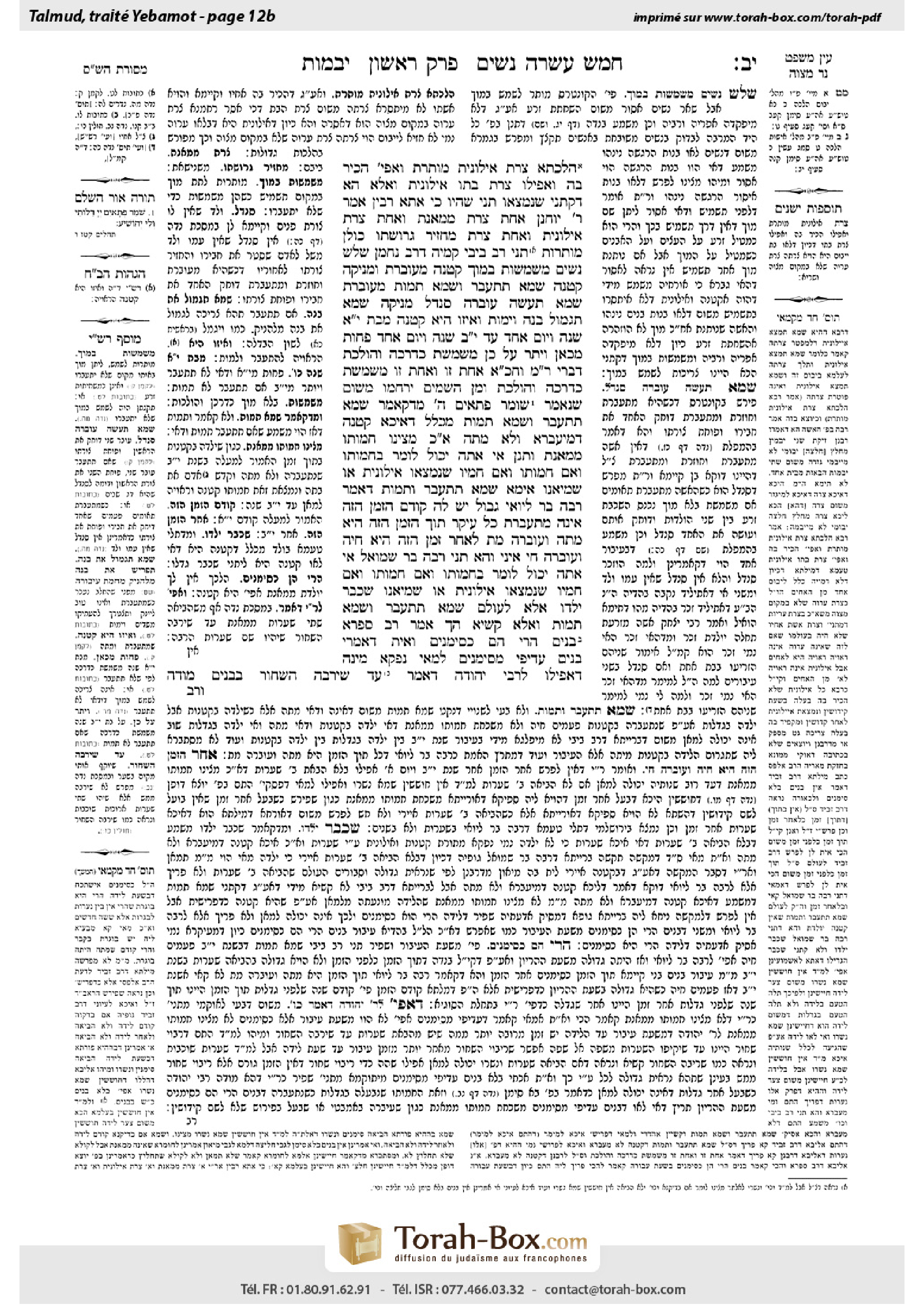
Yevamot 12b: Talmud study for Daf Yomi
Daf Yomi is the daily study of one Talmud folio. Explore 37 tractates with scans, Hebrew text, Sefaria English and AI-generated French translations where annotated.
Passage selection and English or AI-generated French translation are available where the scan has annotations. Daf Study is independent of Torah-Box and Sefaria.
Browse Yevamot · יבמות · All tractatesYevamot 12b text and translations
This page of Yevamot includes the Aramaic text, an English translation and an AI-generated French translation, alongside the scan above.
יבמות י״ב ב · Aramaic and Hebrew text
הִלְכְתָא: צָרַת אַיְלוֹנִית מוּתֶּרֶת, וַאֲפִילּוּ הִכִּיר בָּהּ. וַאֲפִילּוּ צָרַת בִּתּוֹ אַיְלוֹנִית.
וְאֶלָּא הָא דְּקָתָנֵי ״שֶׁנִּמְצְאוּ״ — תְּנִי ״שֶׁהָיוּ״. כִּי אֲתָא רָבִין, אָמַר רַבִּי יוֹחָנָן: אַחַת צָרַת מְמָאֶנֶת, וְאַחַת צָרַת אַיְלוֹנִית, וְאַחַת צָרַת מַחֲזִיר גְּרוּשָׁתוֹ — כּוּלָּן מוּתָּרוֹת.
תָּנֵי רַב בִּיבִי קַמֵּיהּ דְּרַב נַחְמָן, שָׁלֹשׁ נָשִׁים מְשַׁמְּשׁוֹת בְּמוֹךְ: קְטַנָּה, מְעוּבֶּרֶת, וּמְנִיקָה. קְטַנָּה — שֶׁמָּא תִּתְעַבֵּר וְשֶׁמָּא תָּמוּת. מְעוּבֶּרֶת — שֶׁמָּא תַּעֲשֶׂה עוּבָּרָהּ סַנְדָּל. מְנִיקָה — שֶׁמָּא תִּגְמוֹל בְּנָהּ וְיָמוּת.
וְאֵיזוֹ הִיא קְטַנָּה — מִבַּת אַחַת עֶשְׂרֵה שָׁנָה וְיוֹם אֶחָד עַד שְׁתֵּים עֶשְׂרֵה שָׁנָה וְיוֹם אֶחָד. פָּחוֹת מִכֵּאן וְיָתֵר עַל כֵּן — מְשַׁמֶּשֶׁת כְּדַרְכָּהּ וְהוֹלֶכֶת, דִּבְרֵי רַבִּי מֵאִיר. וַחֲכָמִים אוֹמְרִים: אַחַת זוֹ וְאַחַת זוֹ מְשַׁמֶּשֶׁת כְּדַרְכָּהּ וְהוֹלֶכֶת, וּמִן הַשָּׁמַיִם יְרַחֲמוּ, מִשּׁוּם שֶׁנֶּאֱמַר: ״שׁוֹמֵר פְּתָאִים ה׳״.
מִדְּקָאָמַר שֶׁמָּא תִּתְעַבֵּר וְשֶׁמָּא תָּמוּת, מִכְּלָל דְּאִיכָּא קְטַנָּה דְּמִיעַבְּרָא וְלָא מֵתָה. אִם כֵּן, מָצִינוּ חֲמוֹתוֹ מְמָאֶנֶת.
וּתְנַן: אִי אַתָּה יָכוֹל לוֹמַר בַּחֲמוֹתוֹ וְאֵם חֲמוֹתוֹ וְאֵם חָמִיו שֶׁנִּמְצְאוּ אַיְלוֹנִית אוֹ שֶׁמֵּיאֲנוּ! אֵימָא: שֶׁמָּא תִּתְעַבֵּר וְתָמוּת.
דְּאָמַר רַבָּה בַּר לֵיוַאי: גְּבוּל יֵשׁ לָהּ, קוֹדֶם הַזְּמַן הַזֶּה — אֵינָהּ מִתְעַבֶּרֶת כׇּל עִיקָּר, תּוֹךְ הַזְּמַן הַזֶּה — הִיא מֵתָה וְעוּבָּרָהּ מֵת, לְאַחַר זְמַן הַזֶּה — הִיא חַיָּה וְעוּבָּרָהּ חַי.
אִינִי? וְהָא תָּנֵי רַבָּה בַּר שְׁמוּאֵל: אִי אַתָּה יָכוֹל לוֹמַר בַּחֲמוֹתוֹ וְאֵם חֲמוֹתוֹ וְאֵם חָמִיו שֶׁנִּמְצְאוּ אַיְלוֹנִית אוֹ שֶׁמֵּיאֲנוּ — שֶׁכְּבָר יָלְדוּ. אֶלָּא לְעוֹלָם: שֶׁמָּא תִּתְעַבֵּר וְשֶׁמָּא תָּמוּת. וְאֶלָּא קַשְׁיָא הָךְ!
אָמַר רַב סָפְרָא: בָּנִים הֲרֵי הֵם כְּסִימָנִים. וְאִית דְּאָמְרִי: בָּנִים עֲדִיפִי מִסִּימָנִים. לְמַאי נָפְקָא מִינַּהּ? דַּאֲפִילּוּ לְרַבִּי יְהוּדָה דְּאָמַר עַד שֶׁיִּרְבֶּה הַשָּׁחוֹר, בְּבָנִים מוֹדֶה.
Yevamot 12b · English translation
And the halakha is that the rival wife of an aylonit is permitted, and this is the case even if her first husband knew of her status and her marriage was fully valid. The mitzva of levirate marriage does not apply to an aylonit, but her rival wife is not forbidden. And even in the case of the rival wife of his aylonit daughter who was recognized as such, the other wife is not considered the rival wife of a forbidden relative.
The Gemara asks: However, with regard to that which the mishna teaches: Were found to be, from which it was inferred that there is a difference between an aylonit whose condition was known by the husband beforehand and one who was recognized by him only later, how is this to be explained? The Gemara answers that one should emend this and teach simply: That were, and not: Were found to be. When Ravin came from Eretz Yisrael he said that Rabbi Yoḥanan said: There is one halakha with regard to the rival wife of a girl who refused her husband, and the rival wife of an aylonit, and also the rival wife of one who remarries his divorcée: They are all permitted.
§ Incidental to the case of refusal, the Gemara cites a related halakha. Rav Beivai taught a baraita before Rav Naḥman: Three women may engage in relations with a contraceptive resorbent, a soft fabric placed at the entrance to their wombs to prevent conception, despite the fact that this practice is generally prohibited. They are as follows: A minor, a woman who is already pregnant, and a nursing woman. The baraita specifies the reason for each exception: A minor may do so lest she become pregnant and perhaps die; a pregnant woman, lest she be impregnated a second time and her previous fetus becomes deformed into the shape of a sandal fish by being squashed by the pressure of the second fetus. As for a nursing woman, she does so lest she become pregnant and her milk dry up, in which case she will wean her son too early, thereby endangering him, and he will die.
And the baraita continues: Who is considered a minor? It is a girl from the age of eleven years and one day until the age of twelve years and one day. If she was younger than this or older than this, she may go ahead and engage in relations in her usual manner. This is the statement of Rabbi Meir. Since it is assumed that a minor who is less than eleven years old cannot become pregnant, she is considered to be in no danger. And the Rabbis say: Both this one and that one, i.e., in all these cases, she may go ahead and engage in relations in her usual manner, and Heaven will have mercy upon her and prevent any mishap, since it is stated: “The Lord preserves the simple” (Psalms 116:2).
The Gemara analyzes the baraita: From the fact that the baraita states: Lest she become pregnant and perhaps die, this indicates by inference that there is a minor who can become pregnant and will not die, although the conditions for this scenario of a minor giving birth and surviving are unclear. If so, that a minor might be impregnated and give birth, we find the case of one’s mother-in-law who refused her husband. Since it is possible for a woman to give birth to a daughter while still a minor, if a man betroths this daughter while still an infant, the mother might be a mother-in-law who performed refusal.
And yet we learned in the mishna: You cannot say, i.e., the possibility does not exist, in the case of his mother-in-law, his mother-in-law’s mother, and his father-in-law’s mother, that they were found to be an aylonit or performed refusal, as refusal may be performed only by a minor, who cannot give birth. If so, there is apparently a contradiction between the mishna and the baraita. The Gemara answers: Do not say: Lest she become pregnant and perhaps die, which indicates that it is possible for her not to die from the impregnation. Rather, say: Lest she become pregnant and die. In other words, although it is uncertain whether she will be impregnated, if she does become pregnant she will certainly die, which means that there is no case in which a minor could give birth and live.
As Rabba bar Livai said: There is a limit with regard to her pregnancy, i.e., that of a young girl. Before this time, the age of eleven, she cannot be impregnated at all. During this time, from age eleven to twelve, she dies and her fetus dies. After this time, from twelve onward, she lives and her fetus lives.
The Gemara raises a difficulty: Is that so? But didn’t Rabba bar Shmuel teach: You cannot say in the case of his mother-in-law, and his mother-in-law’s mother, and his father-in-law’s mother that they were found to be an aylonit or performed refusal, as they already gave birth. This indicates that a minor can give birth, as otherwise he should have stated: As they are already mature. Rather, actually, the original version of the baraita is correct: Lest she become pregnant and perhaps die. But this is difficult with regard to the mishna, which indicates that this scenario is impossible.
Rav Safra said: Children are equivalent to signs of puberty. In other words, a girl who gives birth does not retain the legal status of a minor, as the very fact that she bore children is equivalent to a physical sign of maturity, usually in the form of pubic hairs. And some say: Children are preferable to signs of puberty. The Gemara asks: What is the practical difference that arises from the question of whether bearing children is equivalent or preferable to signs of maturity? The Gemara answers: The difference is that even according to the opinion of Rabbi Yehuda, who said that a minor may perform refusal even after she develops two pubic hairs, until the black hairs of her genitals are more plentiful than the hairless skin, in the case of children he concedes that she is considered mature and may not perform refusal.
Yevamot 12b · Traduction française (IA)
Et la halakha est que la coépouse d’une aylonit est permise, même si son premier mari connaissait son statut et que leur mariage était pleinement valide. La mitsva du mariage léviratique ne s’applique pas à une aylonit, mais sa coépouse n’est pas interdite. Même dans le cas de la coépouse de sa fille aylonit, dont le statut était connu, l’autre épouse n’est pas considérée comme la coépouse d’une parente interdite.
La Guemara demande : Cependant, comment expliquer ce que la Michna enseigne : « Ont été reconnues », formulation dont on déduit qu’il existe une différence entre une aylonit dont le mari connaissait le statut à l’avance et une aylonit qu’il n’a reconnue comme telle que plus tard ? La Guemara répond qu’il faut corriger le texte et enseigner simplement : « Qui étaient », et non : « Ont été reconnues ». Lorsque Ravin vint d’Eretz Israël, il rapporta que Rabbi Yoḥanan avait enseigné qu’il existe une même halakha concernant la coépouse d’une fille qui a refusé son mari, la coépouse d’une aylonit et la coépouse d’une femme qui se remarie avec son ancien mari après avoir divorcé de lui : elles sont toutes permises.
§ À propos du cas du refus, la Guemara cite une halakha connexe. Rav Beivai enseigna une baraïta devant Rav Naḥman : trois femmes peuvent avoir des rapports avec un tampon contraceptif, tissu doux placé à l’entrée de leur matrice pour empêcher la conception, bien que cette pratique soit généralement interdite. Il s’agit d’une mineure, d’une femme déjà enceinte et d’une femme qui allaite. La baraïta précise la raison de chaque exception : une mineure peut le faire de peur de tomber enceinte et peut-être de mourir ; une femme enceinte, de peur d’être fécondée une seconde fois et que le fœtus qu’elle porte ne soit déformé, écrasé par la pression du second fœtus, au point de prendre la forme d’un poisson-sandale. Quant à une femme qui allaite, elle le fait de peur de tomber enceinte et que son lait ne tarisse ; elle sevrerait alors son fils trop tôt, le mettant ainsi en danger, et il mourrait.
Et la baraïta poursuit : Qui est considérée comme une mineure ? Une fille âgée de onze ans et un jour à douze ans et un jour. Si elle est plus jeune ou plus âgée, elle peut avoir des rapports de la manière habituelle. Telle est l’opinion de Rabbi Meir. On présume qu’une mineure de moins de onze ans ne peut pas tomber enceinte ; elle n’est donc considérée comme exposée à aucun danger. Les Sages disent : Dans les deux cas, c’est-à-dire dans toutes ces situations, elle peut avoir des rapports de la manière habituelle, et le Ciel aura pitié d’elle et la préservera de tout malheur, comme il est dit : « L’Éternel protège les simples » (Psaumes 116, 2).
La Guemara analyse la baraïta : Le fait que la baraïta dise : « De peur qu’elle ne tombe enceinte et ne meure peut-être » implique qu’il existe une mineure qui peut tomber enceinte sans mourir, bien que les circonstances dans lesquelles une mineure accoucherait et survivrait ne soient pas claires. Si une mineure peut donc être fécondée et accoucher, on trouve le cas d’une belle-mère qui a refusé son mari. En effet, une femme peut donner naissance à une fille alors qu’elle est encore mineure ; si un homme fiance cette fille alors qu’elle est encore nourrisson, sa mère peut être une belle-mère ayant accompli un refus.
Et pourtant, nous avons appris dans la Michna : on ne peut pas dire, dans le cas de sa belle-mère, de la mère de sa belle-mère et de la mère de son beau-père, qu’elles aient été reconnues comme aylonit ou aient accompli un refus ; car seul une mineure peut accomplir un refus, et une mineure ne peut pas accoucher. Il semble donc y avoir une contradiction entre la Michna et la baraïta. La Guemara répond : Ne dis pas : « De peur qu’elle ne tombe enceinte et ne meure peut-être », ce qui implique qu’il est possible qu’elle ne meure pas des suites de la fécondation. Dis plutôt : « De peur qu’elle ne tombe enceinte et ne meure. » Autrement dit, bien qu’il soit incertain qu’elle soit fécondée, si elle tombe enceinte, elle mourra certainement ; il n’existe donc aucun cas où une mineure puisse accoucher et vivre.
Car Rabba bar Livai a dit : Il y a une limite concernant la grossesse d’une jeune fille. Avant cet âge, c’est-à-dire avant onze ans, elle ne peut pas être fécondée. Pendant cette période, de onze à douze ans, elle meurt et son fœtus meurt. Après cette période, à partir de douze ans, elle survit et son fœtus survit.
La Guemara soulève une difficulté : Est-ce bien le cas ? Rabba bar Shmuel n’a-t-il pas enseigné : on ne peut pas dire, dans le cas de sa belle-mère, de la mère de sa belle-mère et de la mère de son beau-père, qu’elles aient été reconnues comme aylonit ou aient accompli un refus, puisqu’elles ont déjà accouché ? Cela indique qu’une mineure peut accoucher, car sinon il aurait dû dire : « puisqu’elles sont déjà pubères ». En réalité, la version initiale de la baraïta est correcte : « De peur qu’elle ne tombe enceinte et ne meure peut-être. » Mais cela pose une difficulté concernant la Michna, qui implique que cette situation est impossible.
Rav Safra a dit : Les enfants équivalent aux signes de puberté. Autrement dit, une fille qui accouche ne conserve pas le statut juridique de mineure, car le fait même d’avoir donné naissance à des enfants équivaut à un signe physique de maturité, généralement l’apparition de poils pubiens. Certains disent : Les enfants valent davantage que les signes de puberté. La Guemara demande : Quelle différence pratique découle de la question de savoir si le fait d’avoir des enfants équivaut aux signes de maturité ou leur est supérieur ? La Guemara répond : La différence concerne l’opinion de Rabbi Yehuda. Celui-ci a dit qu’une mineure peut accomplir un refus même après l’apparition de deux poils pubiens, jusqu’à ce que les poils noirs de son sexe soient plus nombreux que les zones dépourvues de poils ; mais dans le cas d’une fille qui a des enfants, il reconnaît qu’elle est considérée comme pubère et ne peut pas accomplir de refus.
Traduction française générée par IA à partir de l’édition anglaise de Sefaria. Vérifie toujours un passage avec le texte source.
Text from Sefaria: William Davidson Edition - Vocalized Aramaic (CC BY NC); William Davidson Edition - English (CC BY NC).