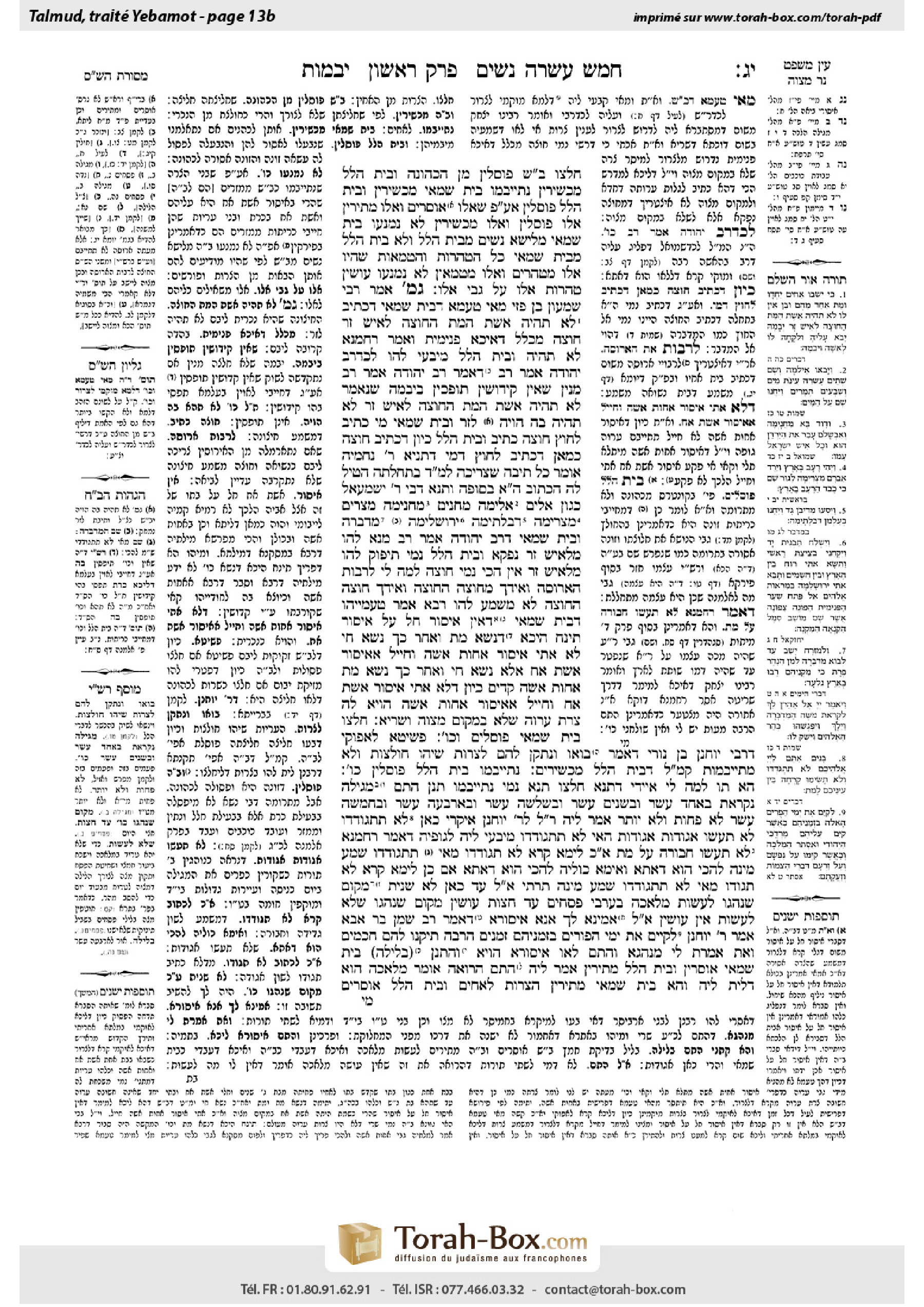
Yevamot 13b: Talmud study for Daf Yomi
Daf Yomi is the daily study of one Talmud folio. Explore 37 tractates with scans, Hebrew text, Sefaria English and AI-generated French translations where annotated.
Passage selection and English or AI-generated French translation are available where the scan has annotations. Daf Study is independent of Torah-Box and Sefaria.
Browse Yevamot · יבמות · All tractatesYevamot 13b text and translations
This page of Yevamot includes the Aramaic text, an English translation and an AI-generated French translation, alongside the scan above.
יבמות י״ג ב · Aramaic and Hebrew text
חָלְצוּ — בֵּית שַׁמַּאי פּוֹסְלִין מִן הַכְּהוּנָּה, וּבֵית הִלֵּל מַכְשִׁירִין. נִתְיַיבְּמוּ — בֵּית שַׁמַּאי מַכְשִׁירִין, וּבֵית הִלֵּל פּוֹסְלִין.
אַף עַל פִּי שֶׁאֵלּוּ אוֹסְרִים וְאֵלּוּ מַתִּירִין, אֵלּוּ פּוֹסְלִין וְאֵלּוּ מַכְשִׁירִין — לֹא נִמְנְעוּ בֵּית שַׁמַּאי מִלִּישָּׂא נָשִׁים מִבֵּית הִלֵּל, וְלָא בֵּית הִלֵּל מִבֵּית שַׁמַּאי. כָּל הַטְּהָרוֹת וְהַטְּמָאוֹת שֶׁהָיוּ אֵלּוּ מְטַהֲרִים וְאֵלּוּ מְטַמְּאִין — לֹא נִמְנְעוּ עוֹשִׂין טְהָרוֹת אֵלּוּ עַל גַּבֵּי אֵלּוּ.
גְּמָ׳ אָמַר רַבִּי שִׁמְעוֹן בֶּן פַּזִּי: מַאי טַעְמָא דְּבֵית שַׁמַּאי, דִּכְתִיב: ״לֹא תִהְיֶה אֵשֶׁת הַמֵּת הַחוּצָה לְאִישׁ זָר״. ״חוּצָה״ — מִכְּלָל דְּאִיכָּא פְּנִימִית, וְאָמַר רַחֲמָנָא: ״לֹא תִהְיֶה״.
וּבֵית הִלֵּל — מִיבְּעֵי לְהוּ לְכִדְרַב יְהוּדָה אָמַר רַב. דְּאָמַר רַב יְהוּדָה אָמַר רַב: מִנַּיִן שֶׁאֵין קִידּוּשִׁין תּוֹפְסִין בִּיבָמָה — שֶׁנֶּאֱמַר: ״לֹא תִהְיֶה אֵשֶׁת הַמֵּת הַחוּצָה לְאִישׁ זָר״. לֹא תִּהְיֶה בָּהּ הֲוָיָה לְזָר.
וּבֵית שַׁמַּאי — מִי כְּתִיב ״לַחוּץ״? ״חוּצָה״ כְּתִיב. וּבֵית הִלֵּל — כֵּיוָן דִּכְתִיב ״חוּצָה״, כְּמַאן דִּכְתִיב ״לַחוּץ״ דָּמֵי.
דְּתַנְיָא, רַבִּי נְחֶמְיָה אוֹמֵר: כׇּל תֵּיבָה שֶׁצְּרִיכָה לָמֶד בִּתְחִלָּתָהּ — הֵטִיל לָהּ הַכָּתוּב הֵא בְּסוֹפָהּ. וְתָנָא דְּבֵי רַבִּי יִשְׁמָעֵאל: כְּגוֹן ״אֵלִים״ — ״אֵלִימָה״, ״מַחֲנַיִם״ — ״מַחֲנָיְמָה״, ״מִצְרַיִם״ — ״מִצְרַיְמָה״, ״דִּבְלָתָיְמָה״, ״יְרוּשָׁלַיְמָה״, ״מִדְבָּרָה״.
וּבֵית שַׁמַּאי, דְּרַב יְהוּדָה אָמַר רַב מְנָא לְהוּ? מִ״לְּאִישׁ זָר״ נָפְקָא.
וּבֵית הִלֵּל נָמֵי, תִּיפּוֹק לְהוּ מִ״לְּאִישׁ זָר״? אִין הָכִי נָמֵי. ״חוּצָה״ לְמָה לִי — לְרַבּוֹת הָאֲרוּסָה.
וְאִידַּךְ: מֵ״חוּצָה״ — ״הַחוּצָה״. וְאִידַּךְ: ״חוּצָה״ ״הַחוּצָה״ — לָא מַשְׁמַע לְהוּ.
רָבָא אָמַר: טַעְמַיְיהוּ דְּבֵית שַׁמַּאי דְּאֵין אִיסּוּר חָל עַל אִיסּוּר.
תִּינַח הֵיכָא דְּנָשָׂא מֵת, וְאַחַר כָּךְ נָשָׂא חַי — לָא אָתֵי אִיסּוּר אֲחוֹת אִשָּׁה וְחָיֵיל אַאִיסּוּר אֵשֶׁת אָח. אֶלָּא נָשָׂא חַי וְאַחַר כָּךְ נָשָׂא מֵת, אֲחוֹת אִשָּׁה קָדֵים!
כֵּיוָן דְּלָא אָתֵי אִיסּוּר אֵשֶׁת אָח וְחָיֵיל אַאִיסּוּר אֲחוֹת אִשָּׁה, הָוְיָא לַהּ צָרַת עֶרְוָה שֶׁלֹּא בִּמְקוֹם מִצְוָה, וְשָׁרְיָא.
חָלְצוּ בֵּית שַׁמַּאי פּוֹסְלִים וְכוּ׳. פְּשִׁיטָא!
לְאַפּוֹקֵי דְּרַבִּי יוֹחָנָן בֶּן נוּרִי, דְּאָמַר: בּוֹאוּ וּנְתַקֵּן לָהֶם לַצָּרוֹת שֶׁיְּהוּ חוֹלְצוֹת וְלֹא מִתְיַיבְּמוֹת. קָא מַשְׁמַע לַן דְּבֵית הִלֵּל מַכְשִׁירִים.
נִתְיַיבְּמוּ, בֵּית הִלֵּל פּוֹסְלִין כּוּ׳. הָא תּוּ לְמָה לִי! אַיְּידֵי דִּתְנָא חָלְצוּ, תְּנָא נָמֵי נִתְיַיבְּמוּ.
תְּנַן הָתָם: מְגִילָּה נִקְרֵאת בְּאַחַד עָשָׂר, וּבִשְׁנֵים עָשָׂר, וּבִשְׁלֹשָׁה עָשָׂר, וּבְאַרְבָּעָה עָשָׂר, וּבַחֲמִשָּׁה עָשָׂר, לֹא פָּחוֹת וְלֹא יוֹתֵר.
אֲמַר לֵיהּ רֵישׁ לָקִישׁ לְרַבִּי יוֹחָנָן: אִיקְּרִי כָּאן ״לֹא תִתְגּוֹדְדוּ״, לֹא תֵּעָשׂוּ אֲגוּדּוֹת אֲגוּדּוֹת? הַאי ״לֹא תִתְגּוֹדְדוּ״ מִיבְּעֵי לֵיהּ לְגוּפֵיהּ, דְּאָמַר רַחֲמָנָא: לֹא תַּעֲשׂוּ חַבּוּרָה עַל מֵת!
אִם כֵּן, לֵימָא קְרָא ״לֹא תְגוֹדְדוּ״. מַאי ״תִתְגּוֹדְדוּ״ — שְׁמַע מִינַּהּ לְהָכִי הוּא דַּאֲתָא. וְאֵימָא כּוּלֵּיהּ לְהָכִי הוּא דַּאֲתָא! אִם כֵּן, לֵימָא קְרָא ״לֹא תָגוֹדּוּ״. מַאי ״לֹא תִתְגּוֹדְדוּ״ — שְׁמַע מִינַּהּ תַּרְתֵּי.
אֲמַר לֵיהּ: עַד כָּאן לֹא שָׁנִיתָ מָקוֹם שֶׁנָּהֲגוּ לַעֲשׂוֹת מְלָאכָה בְּעַרְבֵי פְּסָחִים עַד חֲצוֹת — עוֹשִׂין, מָקוֹם שֶׁנָּהֲגוּ שֶׁלֹּא לַעֲשׂוֹת — אֵין עוֹשִׂין!
אֲמַר לֵיהּ: אָמֵינָא לָךְ אֲנָא אִיסּוּרָא, דְּאָמַר רַב שֶׁמֶן בַּר אַבָּא אָמַר רַבִּי יוֹחָנָן: ״לְקַיֵּים אֵת יְמֵי הַפּוּרִים בִּזְמַנֵּיהֶם״ — זְמַנִּים הַרְבֵּה תִּיקְּנוּ לָהֶם חֲכָמִים, וְאַתְּ אָמְרַתְּ לִי מִנְהָגָא?!
וְהָתָם לָאו אִיסּוּרָא הוּיא? וְהָתְנַן: (בַּלַּיְלָה) בֵּית שַׁמַּאי אוֹסְרִין, וּבֵית הִלֵּל מַתִּירִין.
אֲמַר לֵיהּ: הָתָם, הָרוֹאֶה אוֹמֵר: מְלָאכָה הוּא דְּלֵית לֵיהּ. וְהָא בֵּית שַׁמַּאי מַתִּירִין הַצָּרוֹת לָאַחִים, וּבֵית הִלֵּל אוֹסְרִים?
Yevamot 13b · English translation
If any of the rival wives of the brother performed ḥalitza, Beit Shammai disqualify her from marrying into the priesthood, as in their opinion these rival wives were fit for levirate marriage, which means that the ḥalitza was fully valid. Consequently, they are disqualified from marrying a priest, like all other women who perform ḥalitza. And Beit Hillel deem them fit, as they maintain that no legal act of ḥalitza was performed here at all. If they entered into levirate marriage, Beit Shammai deem them fit for the priesthood, as in their opinion, this is a fully legal levirate marriage. And Beit Hillel disqualify them, because they engaged in licentious sexual relations as the rival wives of a forbidden relative.
§ The mishna comments: Although Beit Hillel prohibit the rival wives to the brothers and Beit Shammai permit them, and although these disqualify these women and those deem them fit, Beit Shammai did not refrain from marrying women from Beit Hillel, nor did Beit Hillel refrain from marrying women from Beit Shammai. Furthermore, with regard to all of the disputes concerning the halakhot of ritual purity and impurity, where these rule that an article is ritually pure and those rule it ritually impure, they did not refrain from handling ritually pure objects each with the other, as Beit Shammai and Beit Hillel frequently used each other’s vessels.
GEMARA: Rabbi Shimon ben Pazi said: What is the reason for the opinion of Beit Shammai? As it is written: “The wife of the dead man shall not be married outside of the family to one not of his kin” (Deuteronomy 25:5). The term “outside” indicates by inference that there is a woman who is considered inside, i.e., a close relative of the yavam, who is inside his family. And the Merciful One states: “Shall not be married” and also “to one not of his kin.” In other words, even when one of the wives is a forbidden relative, the rival wife who is outside the family of the yavam is obligated in levirate marriage.
And how do Beit Hillel respond to this argument of Beit Shammai? They require these passages for that which Rav Yehuda said that Rav said, as Rav Yehuda said that Rav said: From where is it derived that betrothal is not effective in the case of a yevama who did not perform ḥalitza, if the betrothal is performed by an unrelated man and not a yavam? This betrothal is not valid at all, as it is stated: The wife of the dead man shall not be married outside of the family to one not of his kin” (Deuteronomy 25:5). This verse indicates that there shall not be in her case the becoming married to one not of his kin.
And how do Beit Shammai respond to this claim? They ask: Is it written: To the outside [laḥutz], which might indicate betrothal to an unrelated man? It is actually written “outside [ḥutza],” which is an adjective describing this woman as one who is from the outside. And Beit Hillel, what is their response? They maintain that since it is written “outside,” it is considered as though it is written: To the outside.
As it is taught in a baraita: Rabbi Neḥemya says that with regard to any word that requires the letter lamed at its beginning, meaning: To, the verse at times placed a letter heh at its end, but the meaning is the same. And the school of Rabbi Yishmael taught: For example, the term: To “Elim” (Exodus 16:1) can be rendered as “Elima” (Exodus 15:27) instead of le’Elim; “Maḥanaim” (I Kings 2:8) becomes “Maḥanaima” (II Samuel 17:24); “Mitzraim” (e.g., Genesis 13:1) into “Mitzraima” (Genesis 12:10); Divlatayim is “Divlataima” (Numbers 33:46); to Yerushalaim is “Yerushalaima” (Ezekiel 8:3); and “midbara” (Joshua 18:12) means: To the wilderness [midbar]. All these words that contain the letter heh at the end mean the same as if there were a lamed at the beginning.
The Gemara asks: And Beit Shammai, from where do they derive that halakha that Rav Yehuda said that Rav said? The Gemara answers: They derive it from the phrase: “To one not of his kin” (Deuteronomy 25:5). This phrase indicates that marriage is invalid with an unrelated man. However, they learn another matter from the term “outside.”
The Gemara asks: But if so, let Beit Hillel, too, derive this halakha from: “To one not of his kin.” The Gemara answers: Yes, it is indeed so. They, too, infer it from this source. Then why do I need the term “outside”? This word was necessary to include a betrothed woman. With regard to a woman who was betrothed but not yet married to the deceased brother, although she is still technically outside his house, she is nevertheless obligated in levirate marriage.
And the other one, Beit Shammai, infers this halakhic ruling from a single superfluous letter, as instead of “outside” being written as ḥutza it is written as haḥutza. And as for the other one, Beit Hillel, they do not derive a halakha from the linguistic difference between ḥutza and haḥutza, as they maintain that this is not a significant enough difference.
§ Rava said: The rationale of Beit Shammai for their opinion that rival wives are permitted in levirate marriage is not due to a specific verse. Rather, Beit Shammai apply the well-known halakhic principle that a prohibition does not take effect where another prohibition already exists. Since the first wife was already a prohibited relation to her brother-in-law during his brother’s lifetime, the second prohibition of a wife’s sister does not apply to her. Accordingly, her presence is entirely disregarded, as though there is no forbidden relative here to exempt the rival wife.
The Gemara raises a difficulty: This works out well where the deceased brother had first married one sister and afterward the surviving brother had married another sister, as in this case it is possible to say that the prohibition of a wife’s sister does not come and apply in addition to the prohibition of a brother’s wife. However, if the surviving brother had married one sister and afterward the deceased brother had married another sister, in this case the prohibition of a wife’s sister precedes that of a brother’s wife. How can it be said in this situation that this prohibition of a forbidden relative does not take effect where another prohibition already exists, if actually it came first?
The Gemara answers: Since the prohibition of a brother’s wife does not come and apply in addition to the prohibition of a wife’s sister, the status of a brother’s wife does not pertain to her and she is not obligated in levirate marriage with him at all. This means that the other wife is a rival wife of a forbidden relative where no mitzva applies, and she is therefore permitted.
§ The mishna taught: If any of the rival wives of the brother performed ḥalitza, Beit Shammai disqualify her from marrying into the priesthood, as they hold that the ḥalitza was fully valid. The Gemara asks: If the rival wives are obligated in the mitzva of levirate marriage and they performed ḥalitza, it is obvious that the status of a woman who had undergone ḥalitza applies to them.
The Gemara answers: This statement comes to exclude the opinion of Rabbi Yoḥanan ben Nuri, who said: Come and let us institute for rival wives of women with whom relations are forbidden that they should perform ḥalitza and not enter into levirate marriage. If this ordinance were accepted, these rival wives would be disqualified by rabbinic law, even according to the opinion of Beit Hillel. The mishna therefore teaches us that Beit Hillel deem the rival wives fully fit to marry into the priesthood, as no ḥalitza was instituted for rival wives and any ḥalitza performed with them is entirely meaningless.
§ The mishna further taught: If they entered into levirate marriage, Beit Shammai deem them fit for the priesthood and Beit Hillel disqualify them. The Gemara asks: Why do I need this as well, as this halakha follows logically from the previous statement concerning ḥalitza? The Gemara answers that since the mishna taught: Performed ḥalitza, it also taught the case of: Entered into levirate marriage, despite the fact that this was not necessary, as even without this ruling the matter would have been understood.
§ Apropos the mishna’s comments concerning the details of the relationship between Beit Shammai and Beit Hillel, the Gemara discusses the issue of disputes in general. We learned in a mishna there, in tractate Megilla (2a): The Megilla, the Scroll of Esther, is read on the eleventh of Adar, on the twelfth, on the thirteenth, on the fourteenth, or on the fifteenth, in cities surrounded by a wall, no earlier and no later than this. The obligation to read the Megilla on the fourteenth or fifteenth of Adar is stated in the Megilla itself, while the additional days were instituted by the Sages to allow residents of villages, who would come to the cities on Mondays and Thursdays and supply water and rations to the residents of the cities, to hear the reading of the Megilla at that opportunity.
Reish Lakish said to Rabbi Yoḥanan: I should read here the verse: “You shall not cut yourselves [titgodedu]” (Deuteronomy 14:1), which is interpreted as meaning: Do not become numerous factions [agudot]. In other words, the Jewish people should be united, rather than divided into disparate groups that act in different ways. Before analyzing this issue, the Gemara asks: This verse: “You shall not cut yourselves,” is required for the matter itself, as the Merciful One is saying: Do not cut yourselves over the dead. How is the halakha concerning factions derived from this apparently straightforward verse?
The Gemara answers: If so, that the verse comes to teach only about the practices of mourning, let the verse state only: You shall not cut. What is the meaning of: “You shall not cut yourselves”? Learn from this that it comes for this purpose as well, to teach the prohibition against splitting into factions. The Gemara asks: But in that case, one can say that the entire verse comes for this purpose and does not refer to cutting for the dead at all. The Gemara answers: If so, let the verse state: Lo tagodu, rather than lo titgodedu, both of which mean: You shall not cut. What is the meaning of: “Lo titgodedu”? Conclude two conclusions from it: Both the simple prohibition against making cuts for the dead and the matter of dividing into factions.
After this incidental discussion, the Gemara returns to the basic question raised by Reish Lakish: Why doesn’t the reading of the Scroll of Esther in different places at different times violate the prohibition against breaking into factions? Rabbi Yoḥanan said to him: Have you not taught until now: In a place where the people were accustomed to perform labor on Passover eve until midday, one may do so on that day; in a place where the people were accustomed not to perform labor, one may not do so? This shows that different places can have different customs without violating the prohibition against dividing into factions.
Reish Lakish said to Rabbi Yoḥanan: I speak to you of a prohibition, as residents of villages are prohibited from reading the Megilla with a blessing on the fifteenth of Adar, as Rav Shemen bar Abba said that Rabbi Yoḥanan said: The verse “to confirm these days of Purim in their appointed times” (Esther 9:31) teaches that the Sages instituted many times for their reading, and it is prohibited to deviate from these dates. And you speak to me about a custom that does not involve a prohibition. How can a prohibition be established in a manner that involves the formation of factions among the people?
Rabbi Yoḥanan replied: And in that case there, on Passover eve, is there no prohibition involved? But didn’t we learn in a mishna: On the night before the fourteenth of Nisan, Beit Shammai prohibit the performance of work and Beit Hillel permit it. Evidently, there is indeed a prohibition involved, and yet some perform work while others do not, which splits the people into factions.
Reish Lakish said to him: In that case there, the different factions are not noticeable, as one who sees another idle says: It is because he has no labor to perform. Therefore, refraining from work does not have the appearance of breaking off into factions. Rabbi Yoḥanan raises a difficulty: But Beit Shammai permit rival wives to the brothers, and Beit Hillel prohibit this practice. This is an example of a clear prohibition, and yet two different traditions were followed.
Yevamot 13b · Traduction française (IA)
Si l’une des coépouses du frère accomplit la ḥalitsa, Beit Shammaï la déclarent inapte à épouser un prêtre, car, selon eux, ces coépouses étaient aptes au mariage léviratique, ce qui signifie que la ḥalitsa était pleinement valide. Par conséquent, elles sont inaptes à épouser un prêtre, comme toutes les autres femmes qui accomplissent la ḥalitsa. Beit Hillel les déclarent aptes, car ils estiment qu’aucun acte juridique de ḥalitsa n’a été accompli ici. Si elles contractent un mariage léviratique, Beit Shammaï les déclarent aptes à épouser un prêtre, car, selon eux, il s’agit d’un mariage léviratique pleinement conforme à la loi. Beit Hillel les déclarent inaptes, parce qu’elles ont eu des relations sexuelles illicites en tant que coépouses d’une parente interdite.
§ La Michna commente : Bien que Beit Hillel interdisent aux frères d’épouser les coépouses et que Beit Shammaï le leur permettent, et que les uns déclarent ces femmes inaptes tandis que les autres les déclarent aptes, Beit Shammaï ne se sont pas abstenus d’épouser des femmes de Beit Hillel, et Beit Hillel ne se sont pas abstenus d’épouser des femmes de Beit Shammaï. En outre, dans tous les différends portant sur les halakhot de pureté et d’impureté rituelles, lorsque les uns statuaient qu’un objet était rituellement pur et les autres qu’il était rituellement impur, ils ne s’abstenaient pas de manipuler les objets rituellement purs les uns des autres, car Beit Shammaï et Beit Hillel utilisaient fréquemment les ustensiles les uns des autres.
GUEMARA : Rabbi Shimon ben Pazi dit : Quelle est la raison de l’opinion de Beit Shammaï ? Car il est écrit : « La femme du défunt ne se mariera pas au-dehors, à un homme qui n’est pas de sa parenté » (Deutéronome 25,5). Le terme « au-dehors » implique qu’il existe une femme considérée comme étant « à l’intérieur », c’est-à-dire une proche parente du yavam, qui se trouve dans sa famille. Et le Miséricordieux dit : « ne se mariera pas » et aussi « à un homme qui n’est pas de sa parenté ». Autrement dit, même si l’une des femmes est une parente interdite, la coépouse qui est en dehors de la famille du yavam est soumise au mariage léviratique.
Et comment Beit Hillel répondent-ils à cet argument de Beit Shammaï ? Ils ont besoin de ces passages pour ce que Rav Yehouda a dit au nom de Rav, car Rav Yehouda a dit au nom de Rav : D’où déduit-on que les kidouchin n’ont pas d’effet dans le cas d’une yevama qui n’a pas accompli la ḥalitsa, si les kidouchin sont effectués par un homme sans lien de parenté avec elle, et non par un yavam ? Ces kidouchin sont totalement invalides, comme il est dit : « La femme du défunt ne se mariera pas au-dehors, à un homme qui n’est pas de sa parenté » (Deutéronome 25,5). Ce verset indique qu’elle ne peut pas se marier à un homme qui n’est pas de sa parenté.
Et comment Beit Shammaï répondent-ils à cette affirmation ? Ils demandent : Est-il écrit « vers l’extérieur » [laḥutz], ce qui pourrait indiquer des kidouchin avec un homme sans lien de parenté ? Il est en réalité écrit « au-dehors » [ḥutza], adjectif qui décrit cette femme comme venant de l’extérieur. Et quelle est la réponse de Beit Hillel ? Ils estiment que, puisque le texte dit « au-dehors », c’est comme s’il était écrit « vers l’extérieur ».
Comme il est enseigné dans une baraïta : Rabbi Neḥemya dit qu’à propos de tout mot qui requiert la lettre lamed à son début, avec le sens de « vers » ou « à », le verset place parfois une lettre hé à sa fin, sans que le sens en soit modifié. Et l’école de Rabbi Yishmaël a enseigné : Par exemple, l’expression « vers Élim » (Exode 16,1) peut être rendue par « Élima » (Exode 15,27), au lieu de le’Élim ; « Maḥanaïm » (I Rois 2,8) devient « Maḥanaïma » (II Samuel 17,24) ; « Mitsraïm » (par exemple, Genèse 13,1) devient « Mitsraïma » (Genèse 12,10) ; Divlataïm devient « Divlataïma » (Nombres 33,46) ; « vers Jérusalem » se dit « Yerushalaïma » (Ézéchiel 8,3) ; et « midbara » (Josué 18,12) signifie « vers le désert » [midbar]. Tous ces mots qui ont une lettre hé à la fin ont le même sens que s’ils avaient une lettre lamed au début.
La Guemara demande : Et Beit Shammaï, d’où déduisent-ils la halakha que Rav Yehouda a dite au nom de Rav ? La Guemara répond : Ils la déduisent de l’expression « à un homme qui n’est pas de sa parenté » (Deutéronome 25,5). Cette expression indique qu’un mariage avec un homme sans lien de parenté est invalide. Cependant, ils déduisent une autre règle du terme « au-dehors ».
La Guemara demande : Mais dans ce cas, que Beit Hillel déduisent eux aussi cette halakha de l’expression « à un homme qui n’est pas de sa parenté ». La Guemara répond : Oui, c’est bien ainsi. Eux aussi la déduisent de cette source. Alors, pourquoi le terme « au-dehors » est-il nécessaire ? Ce mot était nécessaire pour inclure une femme fiancée. Une femme qui était fiancée au frère défunt, mais ne l’avait pas encore épousé, bien qu’elle soit encore techniquement hors de sa maison, est néanmoins soumise au mariage léviratique.
Et l’autre, Beit Shammaï, déduit cette règle halakhique d’une seule lettre superflue : au lieu d’écrire « au-dehors » sous la forme ḥutza, le texte écrit haḥutza. Quant à Beit Hillel, ils ne déduisent pas de halakha de la différence linguistique entre ḥutza et haḥutza, car ils estiment que cette différence n’est pas suffisamment significative.
§ Rava dit : La raison de l’opinion de Beit Shammaï, selon laquelle les coépouses sont permises dans le mariage léviratique, ne repose pas sur un verset particulier. Beit Shammaï appliquent plutôt le principe halakhique bien connu selon lequel une interdiction ne prend pas effet lorsqu’une autre interdiction existe déjà. Puisque la première épouse était déjà une parente interdite à son beau-frère du vivant de son frère, la seconde interdiction — celle d’épouser la sœur de son épouse — ne s’applique pas à elle. Par conséquent, sa présence est entièrement écartée, comme s’il n’y avait ici aucune parente interdite pour dispenser la coépouse du mariage léviratique.
La Guemara soulève une difficulté : cela convient lorsque le frère défunt a d’abord épousé une sœur, puis que le frère survivant a épousé une autre sœur, car dans ce cas, on peut dire que l’interdiction d’épouser la sœur de son épouse ne vient pas s’ajouter à celle d’épouser la femme de son frère. Cependant, si le frère survivant a épousé une sœur, puis que le frère défunt en a épousé une autre, l’interdiction d’épouser la sœur de son épouse précède alors celle d’épouser la femme de son frère. Comment peut-on dire dans cette situation que l’interdiction liée à cette parente interdite ne prend pas effet lorsqu’une autre interdiction existe déjà, alors qu’en réalité, elle est apparue la première ?
La Guemara répond : Puisque l’interdiction d’épouser la femme de son frère ne vient pas s’ajouter à l’interdiction d’épouser la sœur de son épouse, le statut de femme du frère ne s’applique pas à elle, et elle n’est pas du tout soumise au mariage léviratique avec lui. Cela signifie que l’autre épouse est la coépouse d’une parente interdite à laquelle aucune mitsva ne s’applique ; elle est donc permise.
§ La Michna a enseigné : Si l’une des coépouses du frère accomplit la ḥalitsa, Beit Shammaï la déclarent inapte à épouser un prêtre, car ils considèrent que la ḥalitsa était pleinement valide. La Guemara demande : Si les coépouses sont soumises à la mitsva du mariage léviratique et qu’elles accomplissent la ḥalitsa, il est évident que le statut de femme ayant subi la ḥalitsa s’applique à elles.
La Guemara répond : Cette déclaration vise à exclure l’opinion de Rabbi Yoḥanan ben Nuri, qui a dit : Venez, instituons pour les coépouses de femmes avec lesquelles les relations sont interdites l’obligation d’accomplir la ḥalitsa, sans contracter de mariage léviratique. Si cette ordonnance était acceptée, ces coépouses seraient déclarées inaptes en vertu du droit rabbinique, même selon l’opinion de Beit Hillel. La Michna nous enseigne donc que Beit Hillel déclarent les coépouses pleinement aptes à épouser un prêtre, puisqu’aucune ḥalitsa n’a été instituée pour les coépouses et que toute ḥalitsa accomplie avec elles est entièrement dépourvue de valeur.
§ La Michna a également enseigné : Si elles contractent un mariage léviratique, Beit Shammaï les déclarent aptes à épouser un prêtre, tandis que Beit Hillel les déclarent inaptes. La Guemara demande : Pourquoi fallait-il enseigner cela aussi, puisque cette halakha découle logiquement de la déclaration précédente au sujet de la ḥalitsa ? La Guemara répond que, puisque la Michna a enseigné le cas où elles « ont accompli la ḥalitsa », elle a également enseigné le cas où elles « ont contracté un mariage léviratique », bien que cela ne fût pas nécessaire, car même sans cette règle, le point aurait été compris.
§ À propos des remarques de la Michna sur les détails des relations entre Beit Shammaï et Beit Hillel, la Guemara aborde la question des désaccords en général. Nous avons appris dans une Michna de là-bas, dans le traité Meguila (2a) : La Meguila, le rouleau d’Esther, se lit le onze, le douze, le treize, le quatorze ou le quinze adar, dans les villes entourées d’une muraille, ni plus tôt ni plus tard. L’obligation de lire la Meguila les quatorze ou quinze adar est énoncée dans la Meguila elle-même, tandis que les jours supplémentaires ont été institués par les Sages afin de permettre aux habitants des villages, qui se rendaient dans les villes les lundis et les jeudis pour apporter de l’eau et des provisions aux habitants des villes, d’entendre la lecture de la Meguila à cette occasion.
Reish Lakish dit à Rabbi Yoḥanan : Puis-je citer ici le verset : « Vous ne vous ferez pas d’incisions [titgodedu] » (Deutéronome 14,1), qui est interprété ainsi : « Ne formez pas de factions [agudot]. » Autrement dit, le peuple juif doit être uni, au lieu d’être divisé en groupes distincts qui agissent différemment. Avant d’analyser cette question, la Guemara demande : Ce verset, « Vous ne vous ferez pas d’incisions », est nécessaire pour son sens même, car le Miséricordieux dit : Ne vous faites pas d’incisions pour les morts. Comment déduit-on de ce verset, qui semble avoir un sens direct, la halakha relative aux factions ?
La Guemara répond : Dans ce cas, si le verset ne vient enseigner que les pratiques de deuil, qu’il dise seulement : « Vous ne ferez pas d’incision. » Que signifie alors : « Vous ne vous ferez pas d’incisions » ? Déduis-en qu’il vient aussi à cette fin, pour enseigner l’interdiction de se diviser en factions. La Guemara demande : Mais dans ce cas, on pourrait dire que le verset tout entier vise cet enseignement et ne parle pas du tout des incisions pour les morts. La Guemara répond : Dans ce cas, que le verset dise lo tagodu, au lieu de lo titgodedu ; les deux expressions signifient : « Vous ne ferez pas d’incisions. » Que signifie donc lo titgodedu ? Déduis-en deux enseignements : l’interdiction littérale de se faire des incisions pour les morts et l’interdiction de se diviser en factions.
Après cette digression, la Guemara revient à la question fondamentale soulevée par Reish Lakish : Pourquoi la lecture du rouleau d’Esther à des dates différentes selon les lieux ne transgresse-t-elle pas l’interdiction de se diviser en factions ? Rabbi Yoḥanan lui dit : N’as-tu pas étudié jusqu’à présent que, dans un endroit où les gens ont coutume de travailler la veille de Pessaḥ jusqu’à midi, on peut le faire ce jour-là, tandis que, dans un endroit où les gens ont coutume de ne pas travailler, on ne peut pas le faire ? Cela montre que des lieux différents peuvent avoir des coutumes différentes sans transgresser l’interdiction de se diviser en factions.
Reish Lakish dit à Rabbi Yoḥanan : Je te parle d’une interdiction, car il est interdit aux habitants des villages de lire la Meguila avec une bénédiction le quinze adar, comme Rav Shemen bar Abba a dit au nom de Rabbi Yoḥanan : Le verset « afin de confirmer ces jours de Pourim aux dates qui leur sont fixées » (Esther 9,31) enseigne que les Sages ont institué plusieurs dates pour sa lecture et qu’il est interdit de s’écarter de ces dates. Et toi, tu me parles d’une coutume qui ne comporte pas d’interdiction. Comment une interdiction peut-elle être établie d’une manière qui entraîne la formation de factions au sein du peuple ?
Rabbi Yoḥanan répondit : Et dans ce cas-là, la veille de Pessaḥ, n’y a-t-il aucune interdiction en jeu ? Mais n’avons-nous pas appris dans une Michna : La nuit précédant le quatorze nissan, Beit Shammaï interdisent de travailler et Beit Hillel le permettent. Il y a manifestement bien une interdiction en jeu ; pourtant, certains travaillent et d’autres non, ce qui divise le peuple en factions.
Reish Lakish lui dit : Dans ce cas-là, les différentes factions ne sont pas discernables, car celui qui voit quelqu’un inactif se dit qu’il n’a pas de travail à effectuer. Par conséquent, s’abstenir de travailler ne donne pas l’impression de se diviser en factions. Rabbi Yoḥanan soulève une difficulté : Mais Beit Shammaï permettent aux frères d’épouser les coépouses, tandis que Beit Hillel interdisent cette pratique. C’est là un exemple d’interdiction manifeste, et pourtant deux traditions différentes étaient suivies.
Traduction française générée par IA à partir de l’édition anglaise de Sefaria. Vérifie toujours un passage avec le texte source.
Text from Sefaria: William Davidson Edition - Vocalized Aramaic (CC BY NC); William Davidson Edition - English (CC BY NC).