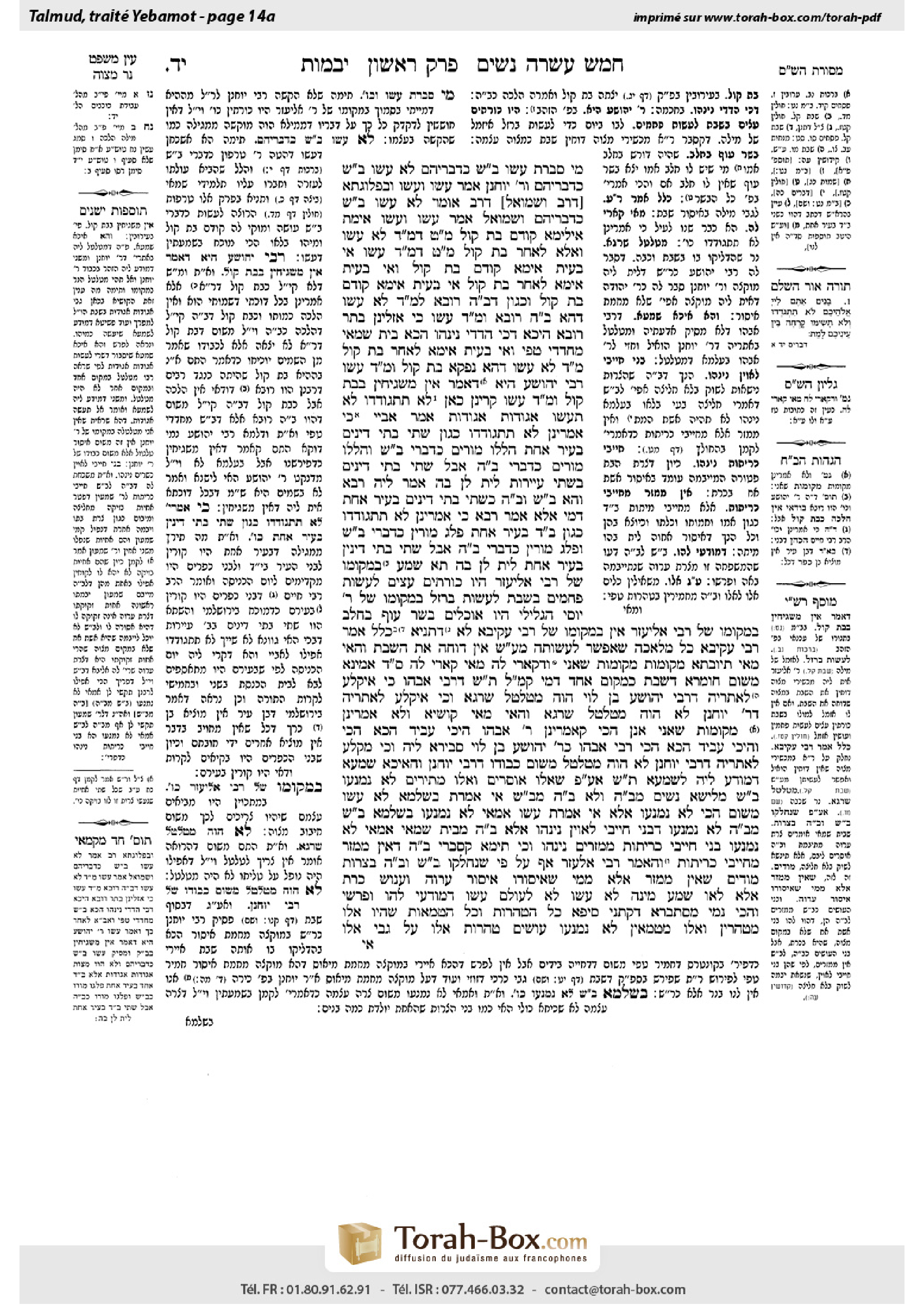
Yevamot 14a: Talmud study for Daf Yomi
Daf Yomi is the daily study of one Talmud folio. Explore 37 tractates with scans, Hebrew text, Sefaria English and AI-generated French translations where annotated.
Passage selection and English or AI-generated French translation are available where the scan has annotations. Daf Study is independent of Torah-Box and Sefaria.
Browse Yevamot · יבמות · All tractatesYevamot 14a text and translations
This page of Yevamot includes the Aramaic text, an English translation and an AI-generated French translation, alongside the scan above.
יבמות י״ד א · Aramaic and Hebrew text
מִי סָבְרַתְּ עָשׂוּ בֵּית שַׁמַּאי כְּדִבְרֵיהֶם? לֹא עָשׂוּ בֵּית שַׁמַּאי כְּדִבְרֵיהֶם. וְרַבִּי יוֹחָנָן אָמַר: עָשׂוּ וְעָשׂוּ. וּבִפְלוּגְתָּא [דְּרַב וּשְׁמוּאֵל]. דְּרַב אוֹמֵר: לֹא עָשׂוּ בֵּית שַׁמַּאי כְּדִבְרֵיהֶם, וּשְׁמוּאֵל אֹמֵר: עָשׂוּ וְעָשׂוּ.
אֵימַת? אִילֵּימָא קוֹדֶם בַּת קוֹל — מַאי טַעְמָא דְּמַאן דְּאָמַר לֹא עָשׂוּ? וְאֶלָּא לְאַחַר בַּת קוֹל — מַאי טַעְמָא דְּמַאן דְּאָמַר עָשׂוּ?
אִי בָּעֵית אֵימָא קוֹדֶם בַּת קוֹל, וְאִי בָּעֵית אֵימָא לְאַחַר בַּת קוֹל. אִי בָּעֵית אֵימָא קוֹדֶם בַּת קוֹל, וּכְגוֹן דְּבֵית הִלֵּל רוּבָּא, לְמַאן דְּאָמַר לֹא עָשׂוּ — דְּהָא בֵּית הִלֵּל רוּבָּא.
וּמַאן דְּאָמַר עָשׂוּ, כִּי אָזְלִינַן בָּתַר רוּבָּא — הֵיכָא דְּכִי הֲדָדֵי נִינְהוּ. הָכָא, בֵּית שַׁמַּאי מְחַדְּדִי טְפֵי.
וְאִי בָּעֵית אֵימָא לְאַחַר בַּת קוֹל, מַאן דְּאָמַר לֹא עָשׂוּ — דְּהָא נְפַקָא בַּת קוֹל, וּמַאן דַּאֲמַר עָשׂוּ — רַבִּי יְהוֹשֻׁעַ הִיא, דְּאָמַר: אֵין מַשְׁגִּיחִין בְּבַת קוֹל.
וּמַאן דַּאֲמַר עָשׂוּ, קָרֵינַן כָּאן ״לֹא תִתְגּוֹדְדוּ״ — לֹא תֵּעָשׂוּ אֲגוּדּוֹת אֲגוּדּוֹת! אֲמַר אַבָּיֵי: כִּי אָמְרִינַן ״לֹא תִתְגּוֹדְדוּ״ — כְּגוֹן שְׁתֵּי בָּתֵּי דִינִים בְּעִיר אַחַת, הַלָּלוּ מוֹרִים כְּדִבְרֵי בֵּית שַׁמַּאי, וְהַלָּלוּ מוֹרִים כְּדִבְרֵי בֵּית הִלֵּל. אֲבָל שְׁתֵּי בָּתֵּי דִינִים בִּשְׁתֵּי עֲיָירוֹת — לֵית לַן בַּהּ.
אֲמַר לֵיהּ רָבָא: וְהָא בֵּית שַׁמַּאי וּבֵית הִלֵּל כִּשְׁתֵּי בָּתֵּי דִינִים בְּעִיר אַחַת דָּמֵי! אֶלָּא אָמַר רָבָא: כִּי אָמְרִינַן ״לֹא תִתְגּוֹדְדוּ״ — כְּגוֹן בֵּית דִּין בְּעִיר אַחַת, פְּלַג מוֹרִין כְּדִבְרֵי בֵּית שַׁמַּאי, וּפְלַג מוֹרִין כְּדִבְרֵי בֵּית הִלֵּל. אֲבָל שְׁתֵּי בָּתֵּי דִינִין בְּעִיר אַחַת — לֵית לַן בַּהּ.
תָּא שְׁמַע: בִּמְקוֹמוֹ שֶׁל רַבִּי אֱלִיעֶזֶר הָיוּ כּוֹרְתִים עֵצִים לַעֲשׂוֹת פֶּחָמִים בְּשַׁבָּת לַעֲשׂוֹת בַּרְזֶל. בִּמְקוֹמוֹ שֶׁל רַבִּי יוֹסֵי הַגְּלִילִי הָיוּ אוֹכְלִים בְּשַׂר עוֹף בְּחָלָב.
בִּמְקוֹמוֹ שֶׁל רַבִּי אֱלִיעֶזֶר — אִין, בִּמְקוֹמוֹ שֶׁל רַבִּי עֲקִיבָא — לָא. דְּתַנְיָא, כְּלָל אָמַר רַבִּי עֲקִיבָא: כׇּל מְלָאכָה שֶׁאֶפְשָׁר לַעֲשׂוֹתָהּ מֵעֶרֶב שַׁבָּת — אֵין דּוֹחָה אֶת הַשַּׁבָּת.
וְהַאי מַאי תְּיוּבְתָּא? מְקוֹמוֹת מְקוֹמוֹת שָׁאנֵי! וּדְקָאָרֵי לַהּ — מַאי קָאָרֵי לַהּ?!
סָלְקָא דַּעְתָּךְ אָמֵינָא מִשּׁוּם חוּמְרָא דְשַׁבָּת — כְּמָקוֹם אֶחָד דָּמֵי, קָא מַשְׁמַע לַן.
תָּא שְׁמַע, דְּרַבִּי אֲבָהוּ כִּי אִיקְּלַע לְאַתְרֵיהּ דְּרַבִּי יְהוֹשֻׁעַ בֶּן לֵוִי הֲוָה מְטַלְטֵל שְׁרָגָא. וְכִי אִיקְּלַע לְאַתְרֵיהּ דְּרַבִּי יוֹחָנָן, לָא הֲוָה מְטַלְטֵל שְׁרָגָא.
וְהַאי מַאי קוּשְׁיָא? וְלָא אָמְרִינַן מְקוֹמוֹת שָׁאנֵי? אֲנַן הָכִי קָאָמְרִינַן: רַבִּי אֲבָהוּ, הֵיכִי עָבֵיד הָכָא הָכִי, וְהֵיכִי עָבֵיד הָכָא הָכִי?
רַבִּי אֲבָהוּ כְּרַבִּי יְהוֹשֻׁעַ בֶּן לֵוִי סְבִירָא לֵיהּ, וְכִי מִקְּלַע לְאַתְרֵיהּ דְּרַבִּי יוֹחָנָן לָא הֲוָה מְטַלְטֵל מִשּׁוּם כְּבוֹדוֹ דְרַבִּי יוֹחָנָן. וְהָאִיכָּא שַׁמָּעָא! דְּמוֹדַע לֵיהּ לְשַׁמָּעָא.
תָּא שְׁמַע: אַף עַל פִּי שֶׁאֵלּוּ אוֹסְרִים וְאֵלּוּ מַתִּירִים — לֹא נִמְנְעוּ בֵּית שַׁמַּאי מִלִּישָּׂא נָשִׁים מִבֵּית הִלֵּל, וְלֹא בֵּית הִלֵּל מִבֵּית שַׁמַּאי. אִי אָמְרַתְּ בִּשְׁלָמָא לֹא עָשׂוּ, מִשּׁוּם הָכִי לֹא נִמְנְעוּ. אֶלָּא אִי אָמְרַתְּ עָשׂוּ, אַמַּאי לֹא נִמְנְעוּ?
בִּשְׁלָמָא בֵּית שַׁמַּאי מִבֵּית הִלֵּל לֹא נִמְנְעוּ, דִּבְנֵי חַיָּיבֵי לָאוִין נִינְהוּ.
אֶלָּא בֵּית הִלֵּל מִבֵּית שַׁמַּאי אַמַּאי לֹא נִמְנְעוּ? בְּנֵי חַיָּיבֵי כָּרֵיתוֹת — מַמְזֵרִים נִינְהוּ?
וְכִי תֵּימָא קָסָבְרִי בֵּית הִלֵּל דְּאֵין מַמְזֵר מֵחַיָּיבֵי כָּרֵיתוֹת — וְהָאָמַר רַבִּי אֶלְעָזָר: אַף עַל פִּי שֶׁנֶּחְלְקוּ בֵּית שַׁמַּאי וּבֵית הִלֵּל בְּצָרוֹת, מוֹדִים שֶׁאֵין מַמְזֵר אֶלָּא מִמִּי שֶׁאִיסּוּרוֹ אִיסּוּר עֶרְוָה וְעָנוּשׁ כָּרֵת! אֶלָּא לָאו שְׁמַע מִינַּהּ, לֹא עָשׂוּ!
לָא, לְעוֹלָם עָשׂוּ, דְּמוֹדְעִי לְהוּ וּפָרְשִׁי.
וְהָכִי נָמֵי מִסְתַּבְּרָא, דְּקָתָנֵי סֵיפָא: כָּל הַטְּהָרוֹת וְכׇל הַטְּמָאוֹת שֶׁהָיוּ אֵלּוּ מְטַהֲרִין וְאֵלּוּ מְטַמְּאִין — לֹא נִמְנְעוּ עוֹשִׂים טְהָרוֹת אֵלּוּ עַל גַּבֵּי אֵלּוּ.
Yevamot 14a · English translation
Reish Lakish said to him: Do you hold that Beit Shammai actually acted in accordance with their own statement? Beit Shammai did not in fact act in accordance with their own statement, as the dispute was merely theoretical. And Rabbi Yoḥanan said: Beit Shammai certainly did act in accordance with their opinion. The Gemara comments: And this is also reflected in the dispute between Rav and Shmuel, as Rav says: Beit Shammai did not act in accordance with their own statement, and Shmuel said: They certainly did act in that manner.
The Gemara inquires: When does this question apply? If we say that it is referring to the period prior to the Divine Voice that declared that the halakha is in accordance with the opinion of Beit Hillel, then what is the rationale of the one who said that Beit Shammai did not act in accordance with their opinion? But rather, if one would say it is referring to after the Divine Voice, what is the reason for the one who said that they did act in accordance with their opinion? After all, the Divine Voice established that the halakha is in accordance with the opinion of Beit Hillel.
The Gemara answers: Neither of these options poses a difficulty. If you wish, say that it is referring to the period prior to the Divine Voice, and if you wish, say instead that it is after the Divine Voice. The Gemara elaborates: If you wish, say it is prior to the Divine Voice, and it is referring to the period when Beit Hillel formed the majority of the Sages. Therefore, according to the one who said that Beit Shammai did not act in accordance with their opinion, the reason is that Beit Hillel was the majority, and the halakha is in accordance with the majority.
And the one who said that they did act in accordance with their opinion maintains that when do we follow the majority? It is in a case where the disputing parties are equal in wisdom to one another. Here, however, Beit Shammai are sharper than Beit Hillel, and therefore they acted in accordance with their own opinion despite the fact that they were in the minority.
And if you wish, say instead that it was after the Divine Voice. The one who said that Beit Shammai did not act in accordance with their opinion would say that this was due to the pronouncement of the Divine Voice. And the one who said that they did do so, this is in accordance with the opinion of Rabbi Yehoshua, who said, with regard to the Divine Voice that emerged and proclaimed that the halakha is in accordance with the opinion of Rabbi Eliezer in the case of the oven of akhnai (Bava Metzia 59b), that one disregards a Heavenly Voice. Just as he disregarded the Divine Voice in his dispute with Rabbi Eliezer, so too, one disregards the Divine Voice that proclaimed that the halakha is in accordance with the opinion of Beit Hillel.
And yet the question remains: According to the one who said that Beit Shammai acted in accordance with their opinion, we should read here: “You shall not cut yourselves” (Deuteronomy 14:1), which is interpreted to mean: Do not become numerous factions. Abaye said: When we say that the prohibition: “You shall not cut yourselves” applies, we are referring to a case where two courts are located in one city, and these rule in accordance with the statement of Beit Shammai and those rule in accordance with the statement of Beit Hillel. However, with regard to two courts located in two different cities, we have no problem with it.
Rava said to him: But the dispute between Beit Shammai and Beit Hillel is considered like a case of two courts in one city, as these two schools of thought were found everywhere, not in any specific place. Rather, Rava said: When we say that the prohibition: “You shall not cut yourselves” applies, we are referring to a case where there is a court in one city, a section of which rules in accordance with the statement of Beit Shammai and another section rules in accordance with the statement of Beit Hillel. However, with regard to two courts located in one city, we have no problem with it.
§ The Gemara cites other relevant sources. Come and hear: In the locale of Rabbi Eliezer, where his ruling was followed, they would cut down trees on Shabbat to prepare charcoal from them to fashion iron tools with which to circumcise a child on Shabbat. In Rabbi Eliezer’s opinion, not only does the mitzva of circumcision override Shabbat, but also any action required for the preparation of the tools necessary for the circumcision likewise overrides Shabbat. The baraita adds: In the locale of Rabbi Yosei HaGelili they would eat poultry meat in milk, as Rabbi Yosei HaGelili held that the prohibition of meat in milk does not include poultry.
The Gemara infers: In the locale of Rabbi Eliezer, yes, they would act in this manner, whereas in the locale of Rabbi Akiva, for instance, no, they would not do so, as it is taught in a baraita that a principle was stated by Rabbi Akiva: Any prohibited labor that can be performed on Shabbat eve does not override Shabbat even if it involves a mitzva. A mitzva whose proper time is on Shabbat overrides Shabbat only if its performance was impossible earlier, e.g., the act of circumcision itself, which cannot be performed earlier.
The Gemara asks: And what is this refutation? As stated above, it is different when dealing with numerous places, and the baraita explicitly states that this practice was followed in Rabbi Eliezer’s locale. Consequently, there is no violation of the prohibition against splitting into factions. The Gemara asks: He who asked it, why did he ask it, i.e., what is the basis for the question in the first place? It is obvious that the baraita is referring to a specific place.
The Gemara answers: It might enter your mind to say that due to the severity of Shabbat, it, i.e., the world, is considered like a single locale. In other words, one might have thought that the permission to tolerate diverse customs in different places applies only to other prohibitions, whereas the prohibition of Shabbat is so severe that it is unacceptable to allow different customs, as this might lead people to disrespect Shabbat. Therefore, the baraita teaches us that even in the case of Shabbat there can be different customs in various locales.
§ The Gemara cites another relevant case involving Shabbat: Come and hear that Rabbi Abbahu, when he happened to come to the place of Rabbi Yehoshua ben Levi, would move an oil lamp [sheraga] after the flame that had been lit for that Shabbat had burned out, as Rabbi Yehoshua accepted the ruling that it is permitted to carry items of this sort that had been set aside. But when he happened to come to the place of Rabbi Yoḥanan, who prohibited carrying items of this kind that had been set aside on Shabbat, he would not move an oil lamp. This indicates that divergent customs are followed in different places.
Again, the Gemara asks: And what is this difficulty? Didn’t we say that it is different when dealing with numerous places? The Gemara explains that this is what we are saying: With regard to Rabbi Abbahu himself, how could he act in this manner here and how could he act in that manner there?
The Gemara answers: Rabbi Abbahu holds in accordance with the opinion of Rabbi Yehoshua ben Levi that it is permitted to carry this item. And when he happened to come to the place of Rabbi Yoḥanan he would not carry it, in deference to Rabbi Yoḥanan, so as not to act contrary to his ruling in the place where he was the authority. The Gemara asks: But there was a servant accompanying Rabbi Abbahu who would see him carrying these types of articles that had been set aside. Wasn’t Rabbi Abbahu concerned that the servant might carry them in Rabbi Yoḥanan’s locale? The Gemara explains that he would inform the servant and explain to him the reason for his change in behavior.
§ The Gemara continues to discuss the question of whether Beit Shammai followed their own rulings. Come and hear that which is taught in the mishna: Although Beit Hillel prohibit and Beit Shammai permit, and these disqualify the women and those deem them fit, Beit Shammai did not refrain from marrying women from Beit Hillel, nor did Beit Hillel refrain from marrying women from Beit Shammai. Granted, if you say that Beit Shammai did not act in accordance with their opinion, it is due to that reason that they did not have to refrain from marrying women from Beit Hillel. However, if you say that they did act in accordance with their opinion, why didn’t they refrain from marrying one another?
The Gemara elaborates: Granted, Beit Shammai did not refrain from marrying into Beit Hillel, as even if Beit Shammai maintain in a certain case that a rival wife required levirate marriage or ḥalitza, if she went ahead and married another man their children are born to a union whose partners are liable by a regular prohibition: “The wife of the dead man shall not be married outside” (Deuteronomy 25:5). Since this transgression does not entail karet, the children of this relationship are not mamzerim.
However, why did Beit Hillel not refrain from marrying into Beit Shammai? In the opinion of Beit Hillel the children of these rival wives who entered into levirate marriage are born of a union whose partners are liable to receive karet, as the prohibition of a brother’s wife was never nullified in this case, which means that the children are mamzerim. If so, how could Beit Hillel allow these marriages?
And if you would say that Beit Hillel maintain that the child of a union whose partners are liable to receive karet is not a mamzer, as a mamzer is only one whose parents violated a prohibition that entails the death penalty, didn’t Rabbi Elazar say: Although Beit Shammai and Beit Hillel disagreed with regard to rival wives, they concede that a mamzer is only from a union whose prohibition is a prohibition of forbidden relations punishable by karet? Consequently, the children of rival wives are mamzerim according to Beit Hillel. Rather, isn’t it correct to conclude from here that Beit Shammai did not act in accordance with their own opinion?
The Gemara rejects this conclusion: No; actually, Beit Shammai did act in accordance with their opinion. As for the problem with these marriages, the answer is that they would inform Beit Hillel and Beit Hillel would withdraw from the match. When those who acted in accordance with the opinion of Beit Hillel would come to marry women from those who followed the rulings of Beit Shammai, they would be notified that certain children were born of rival wives and that those people were considered mamzerim in the opinion of Beit Hillel, who therefore declared them forbidden in marriage.
The Gemara comments: And so too, it is reasonable that this is the case, as the mishna teaches in the latter clause: With regard to all of the disputes concerning the halakhot of ritual purity and impurity, where those, Beit Hillel, rule an article ritually pure and these, Beit Shammai, rule it ritually impure, they did not refrain from handling ritually pure objects each with the other.
Yevamot 14a · Traduction française (IA)
Reish Lakish lui dit : Penses-tu que Beit Shammaï aient effectivement agi conformément à leur propre position ? Beit Shammaï n’ont pas agi conformément à leur propre position, car leur controverse était purement théorique. Rabbi Yoḥanan dit, quant à lui : Beit Shammaï ont bel et bien agi conformément à leur opinion. La Guemara fait remarquer que cela ressort également de la controverse entre Rav et Shmuel : Rav dit que Beit Shammaï n’ont pas agi conformément à leur propre position, tandis que Shmuel dit qu’ils ont bel et bien agi ainsi.
La Guemara demande : À quelle période cette question s’applique-t-elle ? Si l’on dit qu’elle concerne la période antérieure à la Voix céleste qui a déclaré que la halakha suit l’opinion de Beit Hillel, quelle est alors la raison de celui qui affirme que Beit Shammaï n’ont pas agi conformément à leur opinion ? Mais si l’on dit qu’elle concerne la période postérieure à la Voix céleste, quelle est la raison de celui qui affirme qu’ils ont agi conformément à leur opinion ? Après tout, la Voix céleste a établi que la halakha suit l’opinion de Beit Hillel.
La Guemara répond : Aucune de ces deux possibilités ne pose de difficulté. Si tu veux, dis que cela concerne la période antérieure à la Voix céleste ; si tu veux, dis plutôt que cela concerne la période postérieure. La Guemara développe : Si tu veux, dis que cela se situe avant la Voix céleste, à l’époque où Beit Hillel constituait la majorité des Sages. Ainsi, selon celui qui affirme que Beit Shammaï n’ont pas agi conformément à leur opinion, la raison est que Beit Hillel était majoritaire et que la halakha suit la majorité.
Celui qui affirme qu’ils ont agi conformément à leur opinion soutient, quant à lui, que nous ne suivons la majorité que lorsque les parties en désaccord sont égales en sagesse. Ici, en revanche, Beit Shammaï sont plus perspicaces que Beit Hillel ; ils ont donc agi conformément à leur propre opinion, bien qu’ils fussent minoritaires.
Et si tu veux, dis plutôt que cela se situait après la Voix céleste. Selon celui qui affirme que Beit Shammaï n’ont pas agi conformément à leur opinion, c’est en raison de la proclamation de la Voix céleste. Quant à celui qui affirme qu’ils l’ont fait, il suit l’opinion de Rabbi Yehoshua qui, au sujet de la Voix céleste apparue pour proclamer que la halakha suivait l’opinion de Rabbi Eliezer dans le cas du four d’akhnai (Bava Metzia 59b), a dit qu’il faut faire abstraction d’une Voix céleste. De même qu’il a fait abstraction de la Voix céleste dans sa controverse avec Rabbi Eliezer, on fait également abstraction de la Voix céleste qui a proclamé que la halakha suit l’opinion de Beit Hillel.
Mais la question demeure : selon celui qui affirme que Beit Shammaï ont agi conformément à leur opinion, il faudrait lire ici : « Vous ne vous tailladerez pas » (Deutéronome 14:1), ce qui est interprété ainsi : ne formez pas de factions. Abaye dit : Lorsque nous disons que l’interdiction « Vous ne vous tailladerez pas » s’applique, nous parlons du cas où deux tribunaux se trouvent dans une même ville, les uns statuant conformément à la position de Beit Shammaï et les autres conformément à celle de Beit Hillel. En revanche, lorsqu’il s’agit de deux tribunaux situés dans deux villes différentes, cela ne nous pose aucun problème.
Rava lui dit : Mais la controverse entre Beit Shammaï et Beit Hillel est comparable au cas de deux tribunaux dans une même ville, puisque ces deux écoles de pensée se trouvaient partout, et non dans un lieu particulier. Rava dit plutôt : Lorsque nous disons que l’interdiction « Vous ne vous tailladerez pas » s’applique, nous parlons du cas où un tribunal se trouve dans une ville, avec une partie qui statue conformément à la position de Beit Shammaï et une autre conformément à celle de Beit Hillel. En revanche, le cas de deux tribunaux situés dans une même ville ne nous pose aucun problème.
§ La Guemara cite d’autres sources pertinentes. Viens et entends : Dans la localité de Rabbi Eliezer, où l’on suivait sa décision, on abattait des arbres le Chabbat pour en faire du charbon, afin de fabriquer des outils en fer servant à circoncire un enfant le Chabbat. Selon Rabbi Eliezer, non seulement la mitsva de la circoncision l’emporte sur le Chabbat, mais toute action nécessaire à la préparation des outils requis pour la circoncision l’emporte également sur le Chabbat. La baraïta ajoute : Dans la localité de Rabbi Yosei HaGelili, on mangeait de la volaille avec du lait, car Rabbi Yosei HaGelili tenait que l’interdiction de mélanger viande et lait ne s’étend pas à la volaille.
La Guemara en déduit : Dans la localité de Rabbi Eliezer, oui, on agissait ainsi ; mais dans celle de Rabbi Akiva, par exemple, non, on ne le faisait pas. En effet, il est enseigné dans une baraïta que Rabbi Akiva a énoncé le principe suivant : tout travail interdit qui peut être effectué la veille du Chabbat ne l’emporte pas sur le Chabbat, même s’il sert à accomplir une mitsva. Une mitsva dont le moment approprié tombe le Chabbat ne l’emporte sur le Chabbat que s’il était impossible de l’accomplir plus tôt, comme l’acte même de la circoncision, qui ne peut être effectué auparavant.
La Guemara demande : En quoi cela constitue-t-il une réfutation ? Comme on l’a dit plus haut, le cas de plusieurs lieux est différent, et la baraïta précise explicitement que cette pratique était suivie dans la localité de Rabbi Eliezer. Par conséquent, l’interdiction de former des factions n’est pas enfreinte. La Guemara demande : Pourquoi celui qui a soulevé cette objection l’a-t-il soulevée ? Autrement dit, sur quoi reposait sa question ? Il est évident que la baraïta parle d’un lieu particulier.
La Guemara répond : On aurait pu penser que, du fait de la gravité du Chabbat, le monde, c’est-à-dire le monde entier, est considéré comme un seul lieu. Autrement dit, on aurait pu croire que la tolérance de coutumes différentes selon les lieux ne vaut que pour les autres interdictions, tandis que l’interdiction du Chabbat est si grave qu’il est inadmissible d’autoriser des coutumes différentes, car cela pourrait conduire les gens à manquer de respect au Chabbat. La baraïta nous enseigne donc que même pour le Chabbat, des coutumes différentes peuvent exister selon les lieux.
§ La Guemara cite un autre cas pertinent concernant le Chabbat. Viens et entends : Lorsque Rabbi Abbahou se trouvait par hasard dans la localité de Rabbi Yehoshua ben Levi, il déplaçait une lampe à huile [sheraga] après que la flamme allumée pour ce Chabbat se fut éteinte, car Rabbi Yehoshua acceptait la décision permettant de transporter de tels objets qui avaient été mis à l’écart. Mais lorsqu’il se trouvait par hasard dans la localité de Rabbi Yoḥanan, qui interdisait le transport de ce genre d’objets mis à l’écart pendant le Chabbat, il ne déplaçait pas la lampe à huile. Cela montre que des coutumes divergentes sont suivies dans des lieux différents.
La Guemara demande de nouveau : En quoi cela pose-t-il une difficulté ? N’avons-nous pas dit que le cas de plusieurs lieux est différent ? La Guemara explique que voici ce que nous voulons dire : Comment Rabbi Abbahou lui-même pouvait-il agir ainsi ici et autrement là-bas ?
La Guemara répond : Rabbi Abbahou suit l’opinion de Rabbi Yehoshua ben Levi, selon laquelle il est permis de transporter cet objet. Lorsqu’il se trouvait par hasard dans la localité de Rabbi Yoḥanan, il ne le transportait pas par égard pour Rabbi Yoḥanan, afin de ne pas agir à l’encontre de sa décision dans le lieu où il faisait autorité. La Guemara demande : Mais un serviteur accompagnait Rabbi Abbahou et le voyait transporter ce genre d’objets mis à l’écart. Rabbi Abbahou ne craignait-il pas que le serviteur les transporte dans la localité de Rabbi Yoḥanan ? La Guemara explique qu’il informait le serviteur et lui expliquait la raison de son changement de comportement.
§ La Guemara poursuit l’examen de la question de savoir si Beit Shammaï suivaient leurs propres décisions. Viens et entends ce qui est enseigné dans la Michna : Bien que Beit Hillel interdisent et que Beit Shammaï autorisent, et que les uns déclarent ces femmes inaptes tandis que les autres les déclarent aptes, Beit Shammaï ne s’abstenaient pas d’épouser des femmes de Beit Hillel, pas plus que Beit Hillel ne s’abstenaient d’épouser des femmes de Beit Shammaï. Il est compréhensible que, si l’on dit que Beit Shammaï n’agissaient pas conformément à leur opinion, ils n’aient pas eu à s’abstenir d’épouser des femmes de Beit Hillel. Mais si l’on dit qu’ils agissaient conformément à leur opinion, pourquoi ne s’abstenaient-ils pas de s’épouser entre eux ?
La Guemara développe : Il est compréhensible que Beit Shammaï ne s’abstiennent pas de s’allier par mariage à Beit Hillel. En effet, même si Beit Shammaï soutiennent dans un cas donné qu’une épouse rivale doit contracter le lévirat ou subir la ḥalitsa, si elle va de l’avant et épouse un autre homme, les enfants issus de cette union naissent d’une relation dont les partenaires sont passibles de la peine prévue pour une interdiction ordinaire : « La femme du défunt ne se mariera pas à l’extérieur » (Deutéronome 25:5). Comme cette transgression n’entraîne pas le karet, les enfants de cette union ne sont pas des mamzerim.
Mais pourquoi Beit Hillel ne s’abstenaient-ils pas de s’allier par mariage à Beit Shammaï ? Selon Beit Hillel, les enfants de ces épouses rivales qui ont contracté le lévirat sont issus d’une union dont les partenaires sont passibles du karet, car dans ce cas l’interdiction d’épouser la femme de son frère n’a jamais été levée, ce qui signifie que les enfants sont des mamzerim. Dès lors, comment Beit Hillel pouvaient-ils autoriser ces mariages ?
Et si tu dis que Beit Hillel considèrent que l’enfant d’une union dont les partenaires sont passibles du karet n’est pas un mamzer, car seul est mamzer celui dont les parents ont transgressé une interdiction entraînant la peine de mort, Rabbi Elazar n’a-t-il pas dit : Bien que Beit Shammaï et Beit Hillel soient en désaccord au sujet des épouses rivales, ils reconnaissent qu’un mamzer ne peut être issu que d’une union interdite par une interdiction de relations prohibées punissable du karet ? Par conséquent, selon Beit Hillel, les enfants des épouses rivales sont des mamzerim. Ne faut-il donc pas conclure de là que Beit Shammaï n’ont pas agi conformément à leur propre opinion ?
La Guemara rejette cette conclusion : Non ; en réalité, Beit Shammaï ont agi conformément à leur opinion. Quant à la difficulté concernant ces mariages, la réponse est qu’ils en informaient Beit Hillel, qui se retirait alors de l’union envisagée. Lorsque ceux qui suivaient l’opinion de Beit Hillel venaient à vouloir épouser des femmes de ceux qui suivaient les décisions de Beit Shammaï, on les avertissait que certaines personnes étaient nées d’épouses rivales et qu’elles étaient considérées comme des mamzerim selon Beit Hillel, qui les déclarait donc interdites au mariage.
La Guemara fait remarquer qu’il est également raisonnable qu’il en soit ainsi, car la dernière partie de la Michna enseigne : Pour tous les désaccords concernant les lois de pureté et d’impureté rituelles, lorsque Beit Hillel déclarent un objet rituellement pur et que Beit Shammaï le déclarent rituellement impur, ils ne s’abstenaient pas de manipuler les objets rituellement purs les uns avec les autres.
Traduction française générée par IA à partir de l’édition anglaise de Sefaria. Vérifie toujours un passage avec le texte source.
Text from Sefaria: William Davidson Edition - Vocalized Aramaic (CC BY NC); William Davidson Edition - English (CC BY NC).