Yevamot 14b: Talmud study for Daf Yomi
Daf Yomi is the daily study of one Talmud folio. Explore 37 tractates with scans, Hebrew text, Sefaria English and AI-generated French translations where annotated.
Passage selection and English or AI-generated French translation are available where the scan has annotations. Daf Study is independent of Torah-Box and Sefaria.
Browse Yevamot · יבמות · All tractatesYevamot 14b text and translations
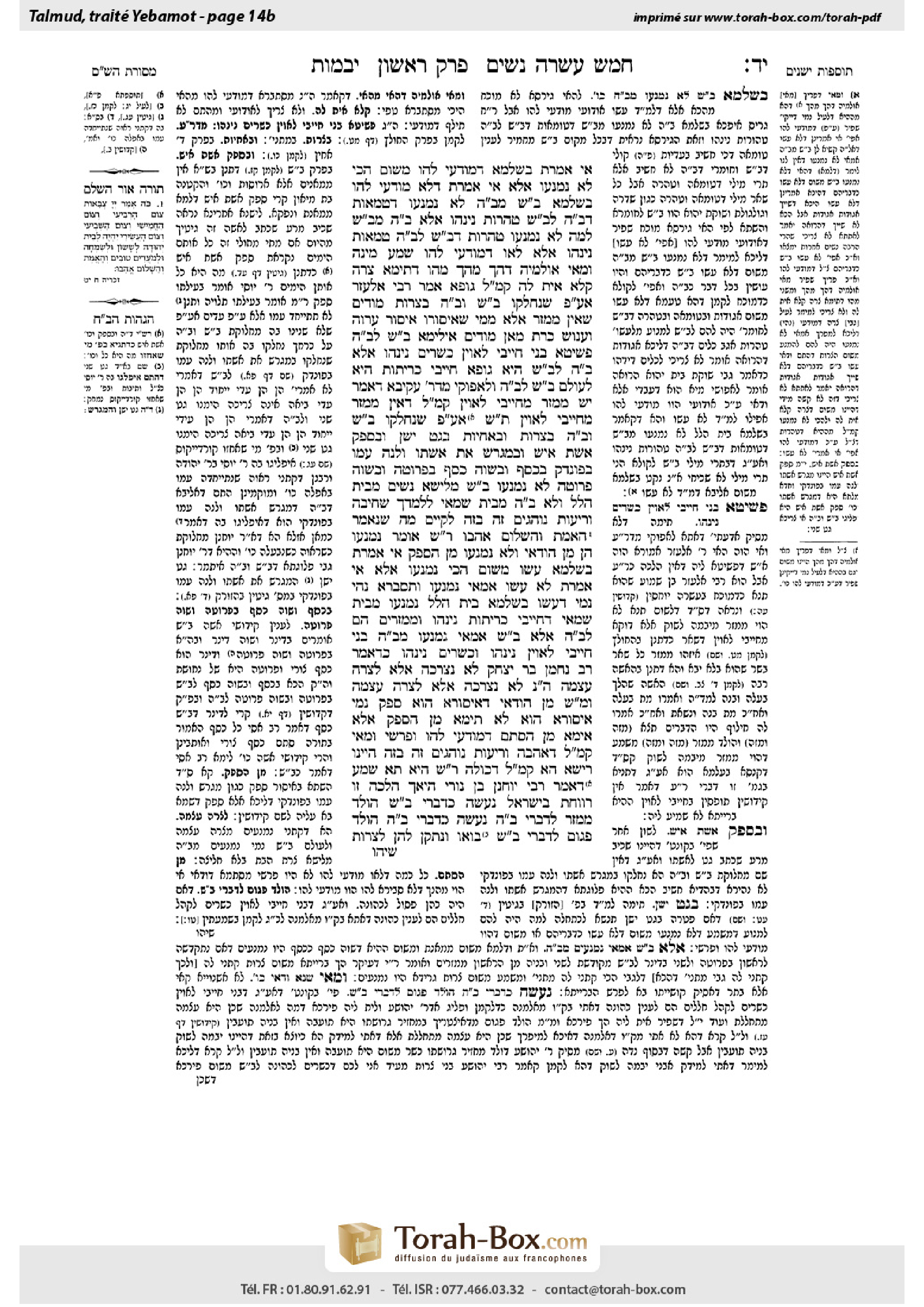
This page of Yevamot includes the Aramaic text, an English translation and an AI-generated French translation, alongside the scan above.
יבמות י״ד ב · Aramaic and Hebrew text
אִי אָמְרַתְּ בִּשְׁלָמָא דְּמוֹדְעִי לְהוּ — מִשּׁוּם הָכִי לֹא נִמְנְעוּ, אֶלָּא אִי אָמְרַתְּ דְּלָא מוֹדְעִי לְהוּ, בִּשְׁלָמָא בֵּית שַׁמַּאי מִבֵּית הִלֵּל לֹא נִמְנְעוּ — דִּטְמָאוֹת דְּבֵית הִלֵּל, לְבֵית שַׁמַּאי טְהָרוֹת נִינְהוּ.
אֶלָּא בֵּית הִלֵּל מִבֵּית שַׁמַּאי לָמָּה לֹא נִמְנְעוּ? טְהָרוֹת דְּבֵית שַׁמַּאי, לְבֵית הִלֵּל טְמָאוֹת נִינְהוּ! אֶלָּא לָאו דְּמוֹדְעִי לְהוּ, שְׁמַע מִינַּהּ.
וּמַאי אוּלְמֵיהּ דְּהָךְ מֵהָךְ? מַהוּ דְּתֵימָא צָרָה קָלָא אִית לַהּ, קָא מַשְׁמַע לַן.
גּוּפָא, אָמַר רַבִּי אֶלְעָזָר: אַף עַל פִּי שֶׁנֶּחְלְקוּ בֵּית שַׁמַּאי וּבֵית הִלֵּל בְּצָרוֹת, מוֹדִים שֶׁאֵין מַמְזֵר אֶלָּא מִמִּי שֶׁאִיסּוּרוֹ אִיסּוּר עֶרְוָה וְעָנוּשׁ כָּרֵת. מַאן מוֹדִים? אִילֵּימָא בֵּית שַׁמַּאי לְבֵית הִלֵּל — פְּשִׁיטָא! בְּנֵי חַיָּיבֵי לָאוִין, כְּשֵׁרִים נִינְהוּ!
אֶלָּא בֵּית הִלֵּל לְבֵית שַׁמַּאי — הִיא גּוּפַהּ חַיָּיבֵי כָּרֵיתוֹת הִיא!
לְעוֹלָם בֵּית שַׁמַּאי לְבֵית הִלֵּל, וּלְאַפּוֹקֵי מִדְּרַבִּי עֲקִיבָא, דְּאָמַר: יֵשׁ מַמְזֵר מֵחַיָּיבֵי לָאוִין, קָא מַשְׁמַע לַן דְּאֵין מַמְזֵר מֵחַיָּיבֵי לָאוִין.
תָּא שְׁמַע: אַף עַל פִּי שֶׁנֶּחְלְקוּ בֵּית שַׁמַּאי וּבֵית הִלֵּל בְּצָרוֹת וּבַאֲחָיוֹת,
בְּגֵט יָשָׁן, וּבִסְפֵק אֵשֶׁת אִישׁ, וּבִמְגָרֵשׁ אֶת אִשְׁתּוֹ וְלָנָה עִמּוֹ בְּפוּנְדָּק,
בְּכֶסֶף וּבְשָׁוֶה כֶּסֶף, בִּפְרוּטָה וּבְשָׁוֶה פְּרוּטָה —
לֹא נִמְנְעוּ בֵּית שַׁמַּאי מִלִּישָּׂא נָשִׁים מִבֵּית הִלֵּל, וְלֹא בֵּית הִלֵּל מִבֵּית שַׁמַּאי. לְלַמֶּדְךָ שֶׁחִיבָּה וְרֵיעוּת נוֹהֲגִים זֶה בָּזֶה, לְקַיֵּים מַה שֶּׁנֶּאֱמַר: ״הָאֱמֶת וְהַשָּׁלוֹם אֱהָבוּ״. רַבִּי שִׁמְעוֹן אוֹמֵר: נִמְנְעוּ הֵן מִן הַוַּדַּאי, וְלֹא נִמְנְעוּ מִן הַסָּפֵק.
אִי אָמְרַתְּ בִּשְׁלָמָא עָשׂוּ — מִשּׁוּם הָכִי נִמְנְעוּ. אֶלָּא אִי אָמְרַתְּ לֹא עָשׂוּ, אַמַּאי נִמְנְעוּ? וְתִסְבְּרָא? נְהִי נָמֵי דְּעָשׂוּ, בִּשְׁלָמָא בֵּית הִלֵּל — נִמְנְעוּ מִבֵּית שַׁמַּאי, דְּחַיָּיבֵי כָּרֵיתוֹת נִינְהוּ, וּמַמְזֵרִים הֵם לְבֵית הִלֵּל.
אֶלָּא בֵּית שַׁמַּאי — אַמַּאי נִמְנְעוּ מִבֵּית הִלֵּל? בְּנֵי חַיָּיבֵי לָאוִין נִינְהוּ, וּכְשֵׁרִים נִינְהוּ! כִּדְאָמַר רַב נַחְמָן בַּר יִצְחָק: לֹא נִצְרְכָה אֶלָּא לַצָּרָה עַצְמָהּ, הָכָא נָמֵי: לָא נִצְרְכָה אֶלָּא לַצָּרָה עַצְמָהּ.
וּמַאי שְׁנָא מִן הַוַּדַּאי — דְּאִיסּוּרָא הוּא, סָפֵק נָמֵי אִיסּוּרָא הוּא!
לָא תֵּימָא: מִן הַסָּפֵק, אֶלָּא אֵימָא: מִן הַסְּתָם, דְּמוֹדְעִי לְהוּ וּפָרְשִׁי.
וּמַאי קָא מַשְׁמַע לַן, דְּאַהֲבָה וְרֵיעוּת נוֹהֲגִים זֶה בָּזֶה? הַיְינוּ רֵישָׁא! הָא קָא מַשְׁמַע לַן דְּכוּלַּהּ רַבִּי שִׁמְעוֹן הִיא.
תָּא שְׁמַע דְּאָמַר רַבִּי יוֹחָנָן בֶּן נוּרִי: הֵיאַךְ הֲלָכָה זוֹ רוֹוַחַת בְּיִשְׂרָאֵל? נַעֲשֶׂה כְּדִבְרֵי בֵּית שַׁמַּאי — הַוָּלָד מַמְזֵר לְדִבְרֵי בֵּית הִלֵּל, נַעֲשֶׂה כְּדִבְרֵי בֵּית הִלֵּל — הַוָּלָד פָּגוּם לְדִבְרֵי בֵּית שַׁמַּאי. בּוֹאוּ וּנְתַקֵּן לָהֶן לַצָּרוֹת,
Yevamot 14b · English translation
Granted, if you say that they notified them, it is due to that reason that they did not need to refrain from using their objects. However, if you say that they did not notify them, granted, it is logical that Beit Shammai did not refrain from handling items belonging to Beit Hillel, as ritually impure objects for Beit Hillel are ritually pure for Beit Shammai, and therefore no special care is necessary.
However, why didn’t Beit Hillel refrain from touching articles that belonged to Beit Shammai? After all, ritually pure objects for Beit Shammai are ritually impure for Beit Hillel. Rather, is it not the case that Beit Shammai notified Beit Hillel that these items were ritually pure only in their own opinion, and Beit Hillel separated themselves from them? The Gemara summarizes the discussion: Conclude from here that this is the correct interpretation.
The Gemara asks: In what way is this case stronger than that case? In other words, why is the statement with regard to ritual purity and impurity more conclusive than the one that deals with marriage? Since the practice of notification was not explicitly stated in the case of ritual purity but was merely inferred logically, the same reasoning applies equally to the case of marriage. The Gemara answers: Lest you say that since it is so unusual, a marriage to a rival wife generates publicity and is so widely known that no special notification is required, therefore, the Gemara teaches us that even in this case notification is required.
§ Since the statement of Rabbi Elazar was mentioned, the Gemara turns to discuss the matter itself. Rabbi Elazar said: Although Beit Shammai and Beit Hillel disagreed with regard to rival wives, they concede that a mamzer is only from a union whose prohibition is a prohibition of forbidden relations punishable by karet. The Gemara asks: Who concedes to whom? If we say that Beit Shammai concede to Beit Hillel, this is obvious, since if they acted in accordance with their own opinion that rival wives who married others without ḥalitza are liable only for violating a regular prohibition, their children are therefore fit and are not mamzerim at all.
Rather, one could say that Beit Hillel concede to Beit Shammai. But in that case she herself, the rival wife of a forbidden relative who married one of the yevamin, is liable to receive karet in the opinion of Beit Hillel, and the child is a mamzer, whereas Rabbi Elazar’s statement indicates that they concede with regard to a different case.
The Gemara explains: Actually, Beit Shammai concede to Beit Hillel, and this is not a novelty with regard to their basic dispute. Instead, the statement comes to exclude the opinion of Rabbi Akiva, who said: The offspring from forbidden relations for which one is liable for violating a prohibition is a mamzer. Rabbi Elazar teaches us that Beit Shammai and Beit Hillel agree that the offspring from forbidden relations for which one is liable for violating a prohibition is not a mamzer; rather, one is a mamzer only if he is born of a union punishable by karet.
§ The Gemara returns to the initial question of whether or not Beit Shammai acted in accordance with their own opinion. The Gemara suggests: Come and hear: Although Beit Shammai and Beit Hillel disagreed with regard to several cases, nevertheless, they did not refrain from marrying women from each other’s communities. The cases with regard to which they disagreed include rival wives, and sisters, i.e., if two sisters had been married to two brothers and simultaneously became obligated in levirate marriage, Beit Hillel prohibit both in levirate marriage, and if they violated the prohibition and married regardless, they require a divorce. By contrast, Beit Shammai permit them to remain married.
Furthermore, Beit Shammai and Beit Hillel disagreed with regard to an outdated bill of divorce that had been written but not delivered. Beit Shammai maintain that if the husband and wife continued to live together after the writing of the bill of divorce, the same bill of divorce can still be used later, whereas Beit Hillel dispute this. And they likewise disagreed with regard to an uncertain married woman, i.e., whether a minor who was actually married, and not merely betrothed, may perform refusal. And they also disagreed with regard to one who divorces his wife and later she lodged together with him at an inn, as to whether or not this is sufficient grounds for assuming that they remarried.
Additionally, they disagreed with regard to the issue of betrothal by money and with the equivalent value of money, and by a peruta or with the equivalent value of a peruta. According to Beit Shammai, the minimal amount of money effective for betrothal is a dinar or the equivalent of a dinar, whereas Beit Hillel maintain that even the less valuable peruta or its equivalent is sufficient.
Despite the fact that these halakhot entail important ramifications depending on whether or not these women were married or fit for marriage, or whether their offspring are fit for marriage, Beit Shammai did not refrain from marrying women from Beit Hillel, nor did Beit Hillel refrain from marrying women from Beit Shammai. This serves to teach you that they practiced affection and camaraderie between them, to fulfill that which is stated: “Love truth and peace” (Zechariah 8:19). Rabbi Shimon says: They did refrain in the certain cases, but they did not refrain in the uncertain cases. In other words, Beit Hillel were not worried that any ordinary woman from Beit Shammai might be one of those of uncertain status.
The Gemara infers from the opinion of Rabbi Shimon: Granted, if you say that Beit Shammai did act in accordance with their opinion, it is due to that reason that they refrained in the certain cases. However, if you say that they did not act in accordance with their opinion, why did they refrain from marriage? The Gemara replies: And how can you understand it that way, that Beit Shammai acted in accordance with their opinion? Even if they acted in accordance with their opinion, granted that Beit Hillel refrained from marrying into Beit Shammai, as those rival wives who entered into levirate marriage are liable to receive karet and their children are mamzerim according to the opinion of Beit Hillel.
However, why did Beit Shammai refrain from marrying the offspring of rival wives of Beit Hillel? The parents are liable for violating a regular prohibition, and therefore their children are fit. The Gemara answers as Rav Naḥman bar Yitzḥak said with regard to a different matter: This halakha was necessary not for the children of the rival wife, but only for the rival wife herself. Here too, it was necessary only for the rival wife herself. The halakha was not taught with regard to the children of the rival wives; rather, it is referring only to the rival wives.
The Gemara asks further: And in what way are uncertain cases different from the certain cases, such as forbidden rival wives? If you say that certain cases are undoubtedly prohibited in the opinion of Beit Hillel, the cases involving uncertain circumstances, e.g., one who divorced his wife and then stayed with her in the same inn, are also prohibited. Even if Beit Hillel render these cases prohibited only due to some uncertainty, the ruling is the same.
The Gemara answers: Do not say: In the uncertain cases, i.e., that the halakha involved doubtful circumstances. Rather, say: From the unspecified case. In other words, barring clear knowledge of an uncertain betrothal within a specific family, they would take women from that family in marriage. The reason is that Beit Shammai would notify Beit Hillel of the prohibition according to their opinion, and they would refrain from the marriage. If there was no notification, this was a clear sign that no doubt was involved in this case at all.
The Gemara asks: But if so, what does this come to teach us? Is it that they had relations of affection and camaraderie between them, i.e., that each trusted that the other side would never cause them to err with regard to something they held to be prohibited? This is the same as the first clause of the baraita. What is Rabbi Shimon adding by his statement? The Gemara answers: This comes to teach us that the entire baraita is the opinion of Rabbi Shimon. This is not a dispute between two Sages. Rather, Rabbi Shimon’s opinion elucidates the earlier statement.
§ The Gemara offers an alternative resolution: Come and hear, as Rabbi Yoḥanan ben Nuri said: How should one act with regard to this halakha of rival wives? In what form should it become widespread among the Jewish people? If we act in accordance with the statement of Beit Shammai and permit a rival wife in levirate marriage, the offspring will be a mamzer according to the statement of Beit Hillel. If we act in accordance with the statement of Beit Hillel and grant full exemption to the rival wives, the offspring will be of flawed lineage according to the opinion of Beit Shammai, as he is the child of a woman prohibited in marriage by a regular prohibition. Although he is not a mamzer, his lineage is nevertheless defective. Instead, let us enact a general decree for rival wives
Yevamot 14b · Traduction française (IA)
Admettons que, si l’on dit qu’ils les en informaient, c’est pour cette raison qu’ils n’avaient pas besoin de s’abstenir d’utiliser leurs objets. Cependant, si l’on dit qu’ils ne les en informaient pas, il est logique que Beit Shammaï ne se soient pas abstenus de manipuler les objets appartenant à Beit Hillel, puisque les objets rituellement impurs pour Beit Hillel sont rituellement purs pour Beit Shammaï ; aucune précaution particulière n’était donc nécessaire.
Cependant, pourquoi Beit Hillel ne se seraient-ils pas abstenus de toucher les objets appartenant à Beit Shammaï ? Après tout, les objets rituellement purs pour Beit Shammaï sont rituellement impurs pour Beit Hillel. N’est-il donc pas plutôt établi que Beit Shammaï avaient informé Beit Hillel que ces objets n’étaient rituellement purs qu’à leurs yeux, et que Beit Hillel s’en étaient tenus à l’écart ? La Guemara résume la discussion : Conclus-en que telle est la bonne interprétation.
La Guemara demande : En quoi ce cas est-il plus concluant que l’autre ? Autrement dit, pourquoi l’énoncé relatif à la pureté et à l’impureté rituelles est-il plus concluant que celui qui concerne le mariage ? Puisque le fait d’informer n’est pas explicitement mentionné dans le cas de la pureté rituelle, mais seulement déduit par raisonnement, le même raisonnement s’applique tout autant au cas du mariage. La Guemara répond : De crainte que tu ne dises qu’un mariage avec une rivale étant si inhabituel, il fait grand bruit et est si largement connu qu’aucune information particulière n’est nécessaire, la Guemara nous enseigne que même dans ce cas, il faut informer.
§ Puisque la déclaration de Rabbi Elazar a été mentionnée, la Guemara examine la question elle-même. Rabbi Elazar a dit : Bien que Beit Shammaï et Beit Hillel soient en désaccord au sujet des rivales, ils reconnaissent qu’un mamzer ne naît que d’une union interdite par une prohibition de relations interdites passible de karet. La Guemara demande : Qui reconnaît cela à qui ? Si l’on dit que Beit Shammaï le reconnaissent à Beit Hillel, cela va de soi : s’ils agissaient conformément à leur propre opinion, selon laquelle les rivales qui ont épousé d’autres hommes sans ḥalitsa ne sont passibles que de la violation d’une prohibition ordinaire, leurs enfants sont aptes au mariage et ne sont donc pas des mamzerim.
On pourrait plutôt dire que Beit Hillel le reconnaissent à Beit Shammaï. Mais dans ce cas, elle-même, la rivale d’une parente interdite qui a épousé l’un des yevamin, est passible de karet selon l’opinion de Beit Hillel, et l’enfant est un mamzer, alors que la déclaration de Rabbi Elazar indique qu’ils reconnaissent cela au sujet d’un autre cas.
La Guemara explique : En réalité, Beit Shammaï le reconnaissent à Beit Hillel, et cela n’apporte rien de nouveau concernant leur désaccord fondamental. Cette déclaration vise plutôt à exclure l’opinion de Rabbi Akiva, qui a dit : L’enfant issu de relations interdites dont la transgression n’entraîne que la violation d’une prohibition est un mamzer. Rabbi Elazar nous enseigne que Beit Shammaï et Beit Hillel s’accordent à dire que l’enfant issu de relations interdites dont la transgression n’entraîne que la violation d’une prohibition n’est pas un mamzer ; on n’est mamzer que si l’on naît d’une union passible de karet.
§ La Guemara revient à la question initiale : Beit Shammaï ont-ils, oui ou non, agi conformément à leur propre opinion ? La Guemara propose : Viens et entends : Bien que Beit Shammaï et Beit Hillel aient été en désaccord sur plusieurs cas, ils ne se sont pourtant pas abstenus d’épouser des femmes de l’autre communauté. Parmi les cas sur lesquels ils étaient en désaccord figuraient les rivales et les sœurs : si deux sœurs avaient été mariées à deux frères et étaient simultanément devenues soumises au mariage léviratique, Beit Hillel interdisent le mariage léviratique avec l’une et l’autre et, si elles transgressent cette interdiction et se marient malgré tout, elles doivent divorcer. À l’inverse, Beit Shammaï leur permettent de rester mariées.
En outre, Beit Shammaï et Beit Hillel étaient en désaccord au sujet d’un acte de divorce périmé, qui avait été rédigé mais non remis. Beit Shammaï soutiennent que si le mari et la femme ont continué à vivre ensemble après la rédaction de l’acte de divorce, celui-ci peut encore être utilisé par la suite, tandis que Beit Hillel contestent cette position. Ils étaient également en désaccord au sujet d’une femme dont le statut matrimonial est incertain, c’est-à-dire sur la question de savoir si une mineure réellement mariée, et non simplement fiancée, peut exercer le refus. Ils étaient aussi en désaccord au sujet d’un homme qui divorce de sa femme puis partage une chambre avec elle dans une auberge : cela suffit-il ou non pour présumer qu’ils se sont remariés ?
Ils étaient également en désaccord sur le fait de contracter des fiançailles avec de l’argent ou son équivalent, et sur le montant requis : un dinar ou son équivalent, ou une perouta ou son équivalent. Selon Beit Shammaï, la somme minimale qui permet de contracter des fiançailles est un dinar ou l’équivalent d’un dinar, tandis que Beit Hillel soutiennent que même la perouta, de moindre valeur, ou son équivalent, suffit.
Bien que ces halakhot entraînent d’importantes conséquences quant à savoir si ces femmes étaient mariées ou aptes au mariage, et si leurs enfants sont aptes au mariage, Beit Shammaï ne se sont pas abstenus d’épouser des femmes de Beit Hillel, et Beit Hillel ne se sont pas abstenus d’épouser des femmes de Beit Shammaï. Cela t’enseigne qu’ils entretenaient entre eux des relations d’affection et de camaraderie, afin d’accomplir ce qui est dit : « Aimez la vérité et la paix » (Zacharie 8:19). Rabbi Shimon dit : Ils s’en abstenaient dans les cas certains, mais pas dans les cas incertains. Autrement dit, Beit Hillel ne craignaient pas que n’importe quelle femme ordinaire de Beit Shammaï ait un statut incertain.
La Guemara déduit de l’opinion de Rabbi Shimon : Admettons que, si l’on dit que Beit Shammaï agissaient conformément à leur opinion, c’est pour cette raison qu’ils s’abstenaient dans les cas certains. Cependant, si l’on dit qu’ils n’agissaient pas conformément à leur opinion, pourquoi s’abstenaient-ils de se marier ? La Guemara répond : Comment peux-tu comprendre les choses ainsi, en disant que Beit Shammaï agissaient conformément à leur opinion ? Même s’ils agissaient conformément à leur opinion, il est certes compréhensible que Beit Hillel se soient abstenus d’épouser des femmes de Beit Shammaï, puisque, selon leur opinion, les rivales qui ont contracté un mariage léviratique sont passibles de karet et leurs enfants sont des mamzerim.
Cependant, pourquoi Beit Shammaï se seraient-ils abstenus d’épouser les enfants des rivales de Beit Hillel ? Les parents ne sont passibles que de la violation d’une prohibition ordinaire, et leurs enfants sont donc aptes au mariage. La Guemara répond, comme Rav Naḥman bar Yitzḥak l’a dit au sujet d’une autre question : Cette halakha était nécessaire, non pas à propos des enfants de la rivale, mais uniquement à propos de la rivale elle-même. Ici aussi, elle était nécessaire uniquement à propos de la rivale elle-même. La halakha n’a pas été enseignée au sujet des enfants des rivales ; elle concerne uniquement les rivales.
La Guemara demande encore : En quoi les cas incertains diffèrent-ils des cas certains, comme celui des rivales interdites ? Si tu dis que, selon l’opinion de Beit Hillel, les cas certains sont indubitablement interdits, les cas impliquant des circonstances incertaines, par exemple celui d’un homme qui a divorcé de sa femme puis a séjourné avec elle dans la même auberge, sont eux aussi interdits. Même si Beit Hillel déclarent ces cas interdits en raison d’un doute seulement, la décision reste la même.
La Guemara répond : Ne dis pas : « Dans les cas incertains », c’est-à-dire que la halakha concernait des circonstances douteuses. Dis plutôt : « Dans le cas non précisé ». Autrement dit, en l’absence d’information claire indiquant qu’il y avait eu des fiançailles douteuses au sein d’une famille précise, ils épousaient des femmes de cette famille. La raison en est que Beit Shammaï informaient Beit Hillel de l’interdiction selon leur opinion, et ceux-ci s’abstenaient alors de se marier. En l’absence d’une telle information, cela indiquait clairement qu’il n’y avait aucun doute dans ce cas.
La Guemara demande : Mais alors, que vient-on nous enseigner ? Qu’ils entretenaient entre eux des relations d’affection et de camaraderie, c’est-à-dire que chaque groupe faisait confiance à l’autre, sachant qu’il ne l’induira jamais en erreur au sujet de ce qu’il considérait comme interdit ? C’est la même chose que la première partie de la baraïta. Qu’ajoute Rabbi Shimon par sa déclaration ? La Guemara répond : Cela vient nous enseigner que toute la baraïta exprime l’opinion de Rabbi Shimon. Il ne s’agit pas d’un désaccord entre deux Sages ; l’opinion de Rabbi Shimon explicite plutôt l’énoncé précédent.
§ La Guemara propose une autre résolution : Viens et entends ce que Rabbi Yoḥanan ben Nuri a dit : Comment faut-il agir au sujet de cette halakha concernant les rivales ? Sous quelle forme faut-il la faire connaître au peuple juif ? Si nous suivons la déclaration de Beit Shammaï et autorisons le mariage léviratique avec une rivale, l’enfant sera un mamzer selon la déclaration de Beit Hillel. Si nous suivons la déclaration de Beit Hillel et accordons une exemption complète aux rivales, l’enfant aura une ascendance défectueuse selon l’opinion de Beit Shammaï, puisqu’il est l’enfant d’une femme dont le mariage est interdit par une prohibition ordinaire. Bien qu’il ne soit pas un mamzer, son ascendance est néanmoins défectueuse. Décrétons plutôt une interdiction générale concernant les rivales
Traduction française générée par IA à partir de l’édition anglaise de Sefaria. Vérifie toujours un passage avec le texte source.
Text from Sefaria: William Davidson Edition - Vocalized Aramaic (CC BY NC); William Davidson Edition - English (CC BY NC).