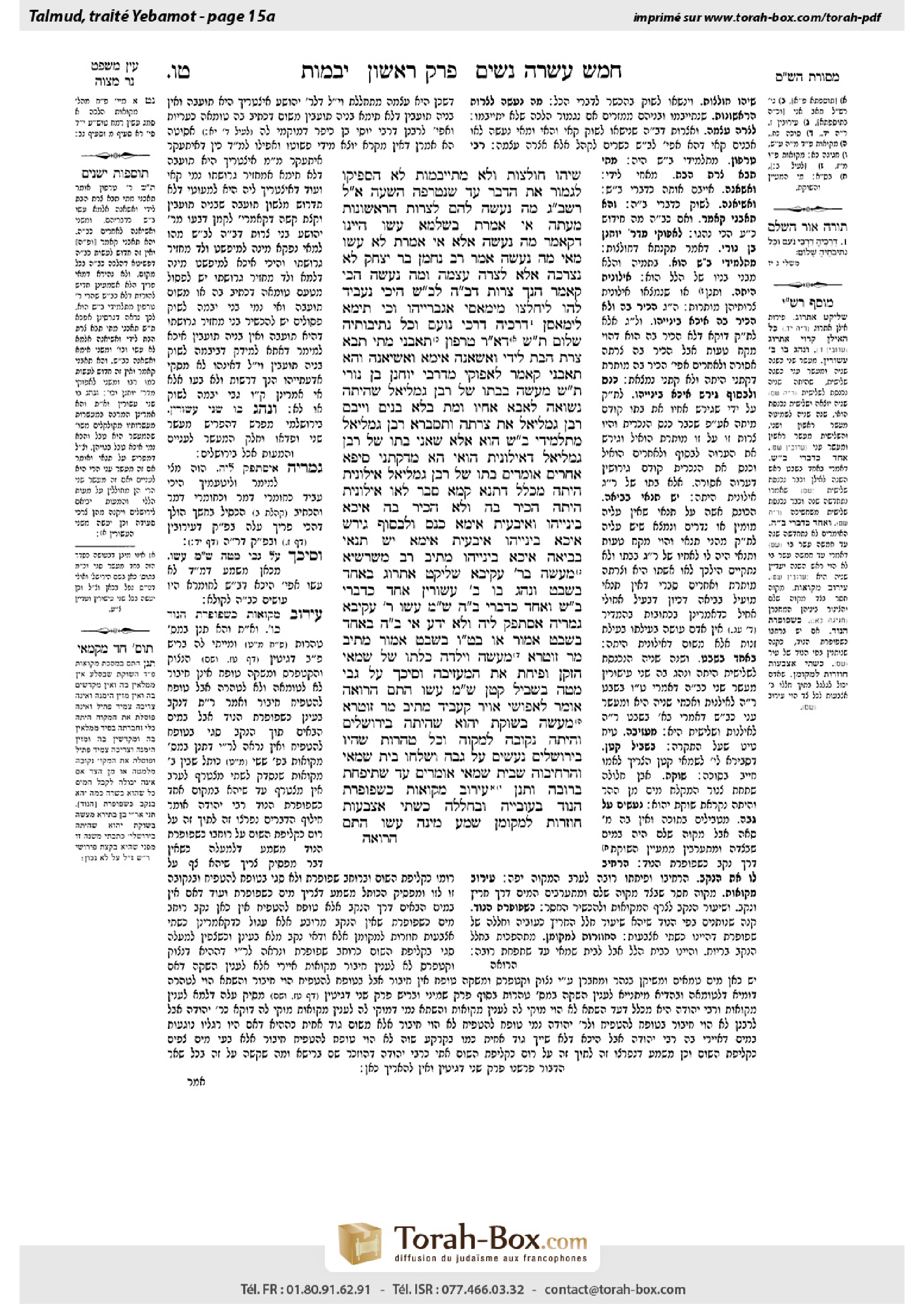
Yevamot 15a: Talmud study for Daf Yomi
Daf Yomi is the daily study of one Talmud folio. Explore 37 tractates with scans, Hebrew text, Sefaria English and AI-generated French translations where annotated.
Passage selection and English or AI-generated French translation are available where the scan has annotations. Daf Study is independent of Torah-Box and Sefaria.
Browse Yevamot · יבמות · All tractatesYevamot 15a text and translations
This page of Yevamot includes the Aramaic text, an English translation and an AI-generated French translation, alongside the scan above.
יבמות י״ה א · Aramaic and Hebrew text
שֶׁיְּהוּ חוֹלְצוֹת וְלֹא מִתְיַיבְּמוֹת. לֹא הִסְפִּיקוּ לִגְמוֹר אֶת הַדָּבָר עַד שֶׁנִּטְרְפָה הַשָּׁעָה.
אֲמַר לֵיהּ רַבָּן שִׁמְעוֹן בֶּן גַּמְלִיאֵל: מָה נַעֲשֶׂה לָהֶם לַצָּרוֹת הָרִאשׁוֹנוֹת מֵעַתָּה?
אִי אָמְרַתְּ בִּשְׁלָמָא עָשׂוּ — הַיְינוּ דְּקָאָמַר מָה נַעֲשֶׂה. אֶלָּא אִי אָמְרַתְּ לֹא עָשׂוּ, מַאי מָה נַעֲשֶׂה?
אָמַר רַב נַחְמָן בַּר יִצְחָק: לֹא נִצְרְכָה אֶלָּא לְצָרָה עַצְמָהּ, ״וּמָה נַעֲשֶׂה״ הָכִי קָאָמַר: הָנָךְ צָרוֹת דְּבֵית הִלֵּל, לְבֵית שַׁמַּאי הֵיכִי נַעֲבֵיד לְהוּ?
לִיחְלְצוּ — מִימַּאֲסִי אַגַּבְרַיְיהוּ. וְכִי תֵּימָא לִימַּאֲסָן — ״דְּרָכֶיהָ דַרְכֵי נוֹעַם וְכׇל נְתִיבוֹתֶיהָ שָׁלוֹם״.
תָּא שְׁמַע, דְּאָמַר רַבִּי טַרְפוֹן: תְּאֵבַנִי, מָתַי תָּבֹא צָרַת הַבַּת לְיָדִי וְאֶשָּׂאֶנָּה! אֵימָא וְאַשִּׂיאֶנָּה.
וְהָא תְּאֵבַנִי קָאָמַר! לְאַפּוֹקֵי מִדְּרַבִּי יוֹחָנָן בֶּן נוּרִי.
תָּא שְׁמַע: מַעֲשֶׂה בְּבִתּוֹ שֶׁל רַבָּן גַּמְלִיאֵל שֶׁהָיְתָה נְשׂוּאָה לְאַבָּא אָחִיו, וּמֵת בְּלֹא בָּנִים, וְיִיבֵּם רַבָּן גַּמְלִיאֵל אֶת צָרָתָהּ. וְתִסְבְּרָא, רַבָּן גַּמְלִיאֵל מִתַּלְמִידֵי בֵּית שַׁמַּאי הוּא?
אֶלָּא שָׁאנֵי בִּתּוֹ שֶׁל רַבָּן גַּמְלִיאֵל, דְּאַיְלוֹנִית הֲוַאי. הָא מִדְּקָתָנֵי סֵיפָא: אֲחֵרִים אוֹמְרִים בִּתּוֹ שֶׁל רַבָּן גַּמְלִיאֵל אַיְלוֹנִית הָיְתָה, מִכְּלָל דְּתַנָּא קַמָּא סָבַר לָאו אַיְלוֹנִית הָיְתָה!
הִכִּיר בָּהּ וְלֹא הִכִּיר בָּהּ, אִיכָּא בֵּינַיְיהוּ.
וְאִיבָּעֵית אֵימָא: כָּנַס וּלְבַסּוֹף גֵּירַשׁ אִיכָּא בֵּינַיְיהוּ.
אִיבָּעֵית אֵימָא: יֵשׁ תְּנַאי בְּבִיאָה אִיכָּא בֵּינַיְיהוּ.
מֵתִיב רַב מְשַׁרְשְׁיָא: מַעֲשֶׂה בְּרַבִּי עֲקִיבָא שֶׁלִּיקֵּט אֶתְרוֹג בְּאֶחָד בִּשְׁבָט, וְנָהַג בּוֹ שְׁנֵי עִשּׂוּרִין.
אֶחָד כְּדִבְרֵי בֵּית שַׁמַּאי, וְאֶחָד כְּדִבְרֵי בֵּית הִלֵּל. שְׁמַע מִינַּהּ עָשׂוּ!
רַבִּי עֲקִיבָא גְּמָרֵיהּ אִסְתַּפַּק לֵיהּ, וְלָא יְדַע אִי בֵּית הִלֵּל בְּאֶחָד בִּשְׁבָט אֲמוּר, אוֹ בַּחֲמִשָּׁה עָשָׂר בִּשְׁבָט אֲמוּר.
מֵתִיב מָר זוּטְרָא: מַעֲשֶׂה וְיָלְדָה כַּלָּתוֹ שֶׁל שַׁמַּאי הַזָּקֵן, וּפִיחֵת אֶת הַמַּעֲזִיבָה, וְסִיכֵּךְ עַל גַּבֵּי מִטָּה בִּשְׁבִיל קָטָן. שְׁמַע מִינַּהּ עָשׂוּ! הָתָם, הָרוֹאֶה אוֹמֵר לְאַפּוֹשֵׁי אֲוִיר קָעָבֵיד.
מֵתִיב מָר זוּטְרָא: מַעֲשֵׂה בְּשׁוֹקֶת יֵהוּא שֶׁהָיְתָה בִּירוּשָׁלַיִם, וְהָיְתָה נְקוּבָה לַמִּקְוֶה, וְכׇל טְהָרוֹת שֶׁהָיוּ בִּירוּשָׁלַיִם נַעֲשִׂים עַל גַּבָּהּ. וְשָׁלְחוּ בֵּית שַׁמַּאי וְהִרְחִיבוּהָ, שֶׁבֵּית שַׁמַּאי אוֹמְרִים: עַד שֶׁתִּיפָּחֵת בְּרוּבָּהּ,
וּתְנַן: עֵירוּב מִקְוָאוֹת, כִּשְׁפוֹפֶרֶת הַנּוֹד בְּעוֹבְיָיהּ וּבַחֲלָלָהּ, כִּשְׁתֵּי אֶצְבָּעוֹת חוֹזְרוֹת לִמְקוֹמָן. שְׁמַע מִינַּהּ עָשׂוּ! הָתָם
Yevamot 15a · English translation
that they should perform ḥalitza and not enter into levirate marriage. If they act in this manner, they will be permitted to marry others and the problem will be solved according to all opinions. They were unable to finalize the matter according to the proposition raised by Rabbi Yoḥanan ben Nuri before times of trouble arrived. Due to the outbreak of war they were unable to gather together to vote and establish an accepted halakhic ruling.
Sometime later, when they returned to discuss the issue, Rabban Shimon ben Gamliel said to the other Sages: What shall we do with those earlier rival wives from now onward? Since in the meantime some rival wives had entered into levirate marriage, if we issue a collective ruling that rival wives may not do so, their children will be declared mamzerim. Therefore, it is better not to establish this halakha at all.
The Gemara analyzes this episode in relation to the matter at hand. Granted, if you say that Beit Shammai did act in accordance with their own opinion, this is the meaning of what Rabban Shimon ben Gamliel said: What shall we do? Since these rival wives had already entered into levirate marriage, it was impossible to change the status of their children retroactively. However, if you say that they did not act in accordance with their opinion, what is the meaning of: What shall we do? If Beit Shammai did not act upon their ruling, they never actually permitted a yavam to take a rival wife in levirate marriage.
Rav Naḥman bar Yitzḥak said: This amendment was necessary, not for the benefit of the children of rival wives, as Beit Shammai never in fact acted on their ruling; rather, it was necessary only for the rival wife herself. If these rival wives married others, in the opinion of Beit Shammai their marriages were flawed, as they did not perform ḥalitza. And as for the question: What shall we do, this is what Rabban Shimon ben Gamliel is saying: With regard to those rival wives who were entirely exempt according to Beit Hillel, what should we do with them according to Beit Shammai, as these rival wives had already married others without performing ḥalitza?
The Gemara elaborates: If you say let them perform ḥalitza, they will be repulsive to their husbands, as it will seem to the husband that the woman he has been living with for some time suddenly requires a permit for marriage. And if you would say, let them be repulsive to their husbands, as that is not our concern, this is not the case, as the Torah says: “Her ways are ways of pleasantness, and all her paths are peace” (Proverbs 3:17).
§ The Gemara suggests further: Come and hear another source, as Rabbi Tarfon said: I yearn for the following scenario: When shall my daughter’s rival wife come before me and I will marry her? In other words, in this hypothetical case I would act in accordance with the opinion of Beit Shammai and take her in levirate marriage. This statement indicates that those who held by the traditions of Beit Shammai did indeed act upon their opinion. The Gemara amends this statement. Say: And I will marry her off, i.e., I shall act in accordance with the opinion of Beit Hillel and marry her off to others.
The Gemara asks: But he said: I yearn, and if he meant that he would follow the ruling of Beit Hillel, which is the common practice, what is the novelty of Rabbi Tarfon’s statement? The Gemara responds: Rabbi Tarfon comes to exclude the statement of Rabbi Yoḥanan ben Nuri, who maintains that all rival wives perform ḥalitza. Rabbi Tarfon yearned for an opportunity to demonstrate that the halakha is not in accordance with the opinion of Rabbi Yoḥanan ben Nuri.
The Gemara suggests: Come and hear an incident involving Rabban Gamliel’s daughter, who was married to Abba, his brother, and Abba died childless, and Rabban Gamliel entered into levirate marriage with her rival wife. This is apparently conclusive proof that the rival wife of a daughter may enter into levirate marriage. The Gemara asks: And how can you understand it that way? Was Rabban Gamliel among the disciples of Beit Shammai? In fact, Rabban Gamliel, who was a descendant of Hillel himself, certainly followed the opinion of Beit Hillel.
Rather, the case of Rabban Gamliel’s daughter is different, as she was a sexually underdeveloped woman [aylonit], and therefore the prohibition against marrying her rival wife does not apply, as explicitly stated in the mishna. The Gemara asks: But from the fact that it is taught in the latter clause of the same baraita: Others say that Rabban Gamliel’s daughter was an aylonit, it can be derived by inference that the first tanna holds that she was not an aylonit.
The Gemara answers: The dispute between the tanna’im was not about whether or not she was an aylonit, as she certainly was. Rather, the practical difference between them is whether he knew that she was an aylonit at the time of marriage and decided to marry her regardless. Some maintain in general that if the husband was aware of her condition prior to marriage, her rival wife is forbidden, but if he did not know about her status, the rival wife is permitted.
And if you wish, say that the practical difference between them concerns a different case, that of one who married and ultimately divorced. This is referring to an issue discussed above of whether a woman is considered the rival wife of a forbidden relation simply by virtue of her marriage to the specific man or whether she must be married to him at the time when the mitzva of levirate obligation takes effect, i.e., at the time of the brother’s death.
And if you wish, say that the practical difference between them concerns a case where there is a condition in sexual relations. In other words, the first tanna holds that Rabban Gamliel’s daughter was married only conditionally, and since the condition was never fulfilled the marriage was nullified. Consequently, Rabban Gamliel could marry the other wife regardless of his daughter’s status as an aylonit, as she was never married to his brother at all. However, according to the other tanna, even if the marriage was dependent upon a condition that was not fulfilled, because the man engaged in sexual relations with her the act of intercourse itself serves to nullify the condition. Accordingly, he maintains that the only reason Rabban Gamliel could enter into levirate marriage with his daughter’s rival wife was not because of the condition, but due to the fact that his daughter was an aylonit. Whichever explanation is accepted, this case provides no proof with regard to the issue of whether or not Beit Shammai acted in accordance with their ruling.
§ Rav Mesharshiyya raised an objection against those who claim that Beit Shammai did not act in accordance with their opinion. It is taught in a mishna: There was an incident involving Rabbi Akiva, who collected an etrog on the first of the month of Shevat and performed with it two tenths. In other words, he separated two tithes from the fruit, as though it belonged to two different tithing years. He removed both the second tithe and the poor man’s tithe at the same time, two tithes that should not be separated in the same year.
The mishna explains: One tithe he removed in accordance with the statement of Beit Shammai, who hold that the new year for trees occurs on the first of Shevat, which means that the etrog required tithing according to the regulations of the upcoming year. And one tithe was in accordance with the statement of Beit Hillel, who hold the new year for trees is on the fifteenth of Shevat, and therefore the etrog required tithing in accordance with the previous year. The Gemara infers: Conclude from here that Beit Shammai did act in accordance with their opinion, as Rabbi Akiva took care to act in accordance with the ruling of Beit Shammai.
The Gemara answers: Rabbi Akiva was uncertain as to his tradition, and he did not know if Beit Hillel said that the New Year for trees occurs on the first of Shevat or if they said it is on the fifteenth of Shevat. He did not act in accordance with the opinion of Beit Shammai at all; rather, he sought to act in accordance with the ruling of Beit Hillel but was uncertain about their opinion on this matter.
§ Mar Zutra raised an objection to this issue from a different source: There was an incident in which the daughter-in-law of Shammai the Elder gave birth to a son. In Shammai’s opinion this newborn baby is immediately obligated in the mitzva to sit in a sukka, and he therefore removed the mortar [ma’aziva] covering the ceiling and he placed sukka covering over the bed for the minor. Conclude from here that Beit Shammai did act in accordance with their opinions. The Gemara answers: There is no proof from there, as anyone watching would say that he did it merely to increase the air. Since people would not necessarily think that he removed the mortar as a ruling of halakha, this behavior is not considered the formation of a faction.
Mar Zutra raised a further objection: There was an incident involving the Yehu water trough in Jerusalem, which had a hole that connected it to a ritual bath, and all the ritual purifications in Jerusalem were performed in it, i.e., people immersed their utensils in this trough. And Beit Shammai sent messengers and they widened the opening in the water trough, as in the opinion of Beit Shammai the hole was not large enough for the trough to be considered connected to the adjacent ritual bath as Beit Shammai say: The two areas are not connected unless the majority of it is opened. In other words, they require the major portion of the barrier between the ritual bath and the nearby trough to be open.
And we learned in a mishna: Beit Hillel hold that a joining of ritual baths is effective if the hole has the width of the tube used to pour water in and out of a wineskin, and in its open space there is enough room for about two fingers that can return to their place. In other words, if it is possible to insert into the hole two fingers that can move around on all sides, the cavity is sufficiently large to be considered a connection. According to Beit Shammai, however, the hole must open up the majority of the barrier between the two areas. If so, conclude from this that Beit Shammai did act in accordance with their opinions. The Gemara rejects this contention: There,
Yevamot 15a · Traduction française (IA)
qu’elles accomplissent la ḥalitsa et ne contractent pas de mariage léviratique. Si elles agissent ainsi, elles pourront épouser d’autres hommes et le problème sera résolu selon toutes les opinions. Ils ne purent trancher la question selon la proposition avancée par Rabbi Yoḥanan ben Nuri avant que ne surviennent des temps de troubles. En raison du déclenchement de la guerre, ils ne purent se réunir pour voter et établir une décision halakhique faisant autorité.
Quelque temps plus tard, lorsqu’ils reprirent la discussion, Rabban Shimon ben Gamliel dit aux autres Sages : « Que devons-nous faire désormais de ces coépouses d’autrefois ? » Entre-temps, certaines d’entre elles avaient contracté un mariage léviratique. Si nous rendons une décision générale interdisant aux coépouses de le faire, leurs enfants seront déclarés mamzerim. Il vaut donc mieux ne pas établir cette halakha du tout.
La Guemara examine cet épisode à la lumière de la question en discussion. Il est compréhensible, si l’on dit que Beit Shammaï a agi conformément à sa propre opinion, que Rabban Shimon ben Gamliel ait demandé : « Que devons-nous faire ? » En effet, puisque ces coépouses avaient déjà contracté un mariage léviratique, il était impossible de modifier rétroactivement le statut de leurs enfants. Cependant, si l’on dit qu’ils n’ont pas agi conformément à leur opinion, que signifie la question : « Que devons-nous faire ? » Si Beit Shammaï n’a pas appliqué sa décision, ils n’ont jamais réellement autorisé un yavam à épouser une coépouse en mariage léviratique.
Rav Naḥman bar Yitzḥak dit : Cet amendement était nécessaire, non pas pour protéger les enfants des coépouses, puisque Beit Shammaï n’avait en réalité jamais appliqué sa décision, mais uniquement pour la coépouse elle-même. Si ces coépouses avaient épousé d’autres hommes, leurs unions étaient, selon l’opinion de Beit Shammaï, irrégulières, puisqu’elles n’avaient pas accompli la ḥalitsa. Quant à la question « Que devons-nous faire ? », voici ce que Rabban Shimon ben Gamliel voulait dire : que devons-nous faire, selon Beit Shammaï, de ces coépouses qui étaient entièrement dispensées selon Beit Hillel, mais qui avaient déjà épousé d’autres hommes sans accomplir la ḥalitsa ?
La Guemara développe : si l’on dit qu’elles doivent accomplir la ḥalitsa, elles deviendront répugnantes aux yeux de leurs maris, qui auront l’impression que la femme avec laquelle ils vivent depuis quelque temps a soudain besoin d’une autorisation pour se marier. Et si l’on dit qu’elles doivent devenir répugnantes aux yeux de leurs maris, au motif que cela ne nous concerne pas, ce n’est pas le cas, car la Torah dit : « Ses voies sont des voies agréables, et tous ses sentiers sont paisibles » (Proverbes 3,17).
§ La Guemara propose une autre preuve : « Viens et entends », car Rabbi Tarfon disait : « Je languis de voir le jour où la coépouse de ma fille se présentera devant moi, afin que je l’épouse. » Autrement dit, dans ce cas hypothétique, j’agirais conformément à l’opinion de Beit Shammaï et l’épouserais en mariage léviratique. Cette déclaration indique que ceux qui suivaient les traditions de Beit Shammaï agissaient effectivement conformément à leur opinion. La Guemara rectifie cette déclaration : lis plutôt « et je la donnerai en mariage », c’est-à-dire que j’agirai conformément à l’opinion de Beit Hillel et la donnerai en mariage à d’autres hommes.
La Guemara demande : Mais il a dit : « Je languis de voir cela » ; s’il voulait dire qu’il suivrait la décision de Beit Hillel, qui est la pratique courante, quelle nouveauté y a-t-il dans la déclaration de Rabbi Tarfon ? La Guemara répond : Rabbi Tarfon entend exclure la position de Rabbi Yoḥanan ben Nuri, qui soutient que toutes les coépouses doivent accomplir la ḥalitsa. Rabbi Tarfon languissait de trouver l’occasion de démontrer que la halakha ne suit pas l’opinion de Rabbi Yoḥanan ben Nuri.
La Guemara propose : « Viens et entends » le récit concernant la fille de Rabban Gamliel, qui était mariée à Abba, son frère. Abba mourut sans enfant, et Rabban Gamliel épousa en mariage léviratique la coépouse de sa fille. Voilà apparemment une preuve concluante que la coépouse d’une fille peut contracter un mariage léviratique. La Guemara demande : comment peut-on comprendre les choses ainsi ? Rabban Gamliel était-il un disciple de Beit Shammaï ? En réalité, Rabban Gamliel, qui descendait de Hillel lui-même, suivait certainement l’opinion de Beit Hillel.
La situation de la fille de Rabban Gamliel était plutôt différente : c’était une femme sexuellement sous-développée [aylonit] ; l’interdiction d’épouser sa coépouse ne s’applique donc pas, comme l’enseigne explicitement la Michna. La Guemara demande : mais puisque la clause finale de cette même baraïta enseigne : « D’autres disent que la fille de Rabban Gamliel était une aylonit », on peut en déduire que le premier tanna considère qu’elle n’était pas une aylonit.
La Guemara répond : le désaccord entre les tannaïm ne portait pas sur le fait qu’elle ait été ou non une aylonit, car elle l’était certainement. La différence pratique entre eux concerne plutôt la question de savoir si son mari savait qu’elle était une aylonit au moment du mariage et avait décidé de l’épouser malgré tout. Certains soutiennent en général que si le mari connaissait sa condition avant le mariage, sa coépouse est interdite, mais que s’il ignorait son statut, celle-ci est autorisée.
Et si tu le souhaites, dis que la différence pratique entre eux concerne un autre cas : celui d’une femme qu’un homme a épousée puis répudiée. Il s’agit d’une question examinée plus haut : une femme est-elle considérée comme la coépouse d’une parente interdite du seul fait qu’elle a été mariée à cet homme en particulier, ou doit-elle encore être mariée à lui au moment où prend effet l’obligation de mariage léviratique, c’est-à-dire au décès du frère ?
Et si tu le souhaites, dis que la différence pratique entre eux concerne un cas où les relations sexuelles sont soumises à une condition. Autrement dit, le premier tanna considère que la fille de Rabban Gamliel n’était mariée que sous condition et que, puisque celle-ci ne s’est jamais réalisée, le mariage a été annulé. Par conséquent, Rabban Gamliel pouvait épouser l’autre femme, quel que soit le statut de sa fille en tant qu’aylonit, puisqu’elle n’avait jamais été mariée à son frère. Cependant, selon l’autre tanna, même si le mariage dépendait d’une condition qui ne s’est pas réalisée, le fait que l’homme ait eu des relations sexuelles avec elle annule cette condition. Il estime donc que si Rabban Gamliel a pu contracter un mariage léviratique avec la coépouse de sa fille, ce n’est pas en raison de la condition, mais parce que sa fille était une aylonit. Quelle que soit l’explication retenue, ce cas ne prouve rien quant à la question de savoir si Beit Shammaï a agi conformément à sa décision.
§ Rav Mesharshiyya soulève une objection contre ceux qui affirment que Beit Shammaï n’a pas agi conformément à son opinion. Une Michna enseigne : il y eut un incident concernant Rabbi Akiva, qui cueillit un etrog le premier jour du mois de Chevat et en préleva deux dîmes. Autrement dit, il préleva deux dîmes sur le fruit, comme s’il appartenait à deux années de dîme différentes. Il préleva à la fois la seconde dîme et la dîme du pauvre, deux dîmes qui ne doivent pas être prélevées la même année.
La Michna explique : il préleva une dîme conformément à l’avis de Beit Shammaï, selon lequel le nouvel an des arbres tombe le premier Chevat ; l’etrog devait donc être soumis aux règles de prélèvement de l’année à venir. Et il préleva une dîme conformément à l’avis de Beit Hillel, selon lequel le nouvel an des arbres tombe le quinze Chevat ; l’etrog devait donc être soumis aux règles de prélèvement de l’année précédente. La Guemara en déduit : conclus-en que Beit Shammaï a bien agi conformément à son opinion, puisque Rabbi Akiva a pris soin d’agir selon la décision de Beit Shammaï.
La Guemara répond : Rabbi Akiva avait un doute quant à la tradition qu’il avait reçue et ne savait pas si Beit Hillel avait fixé le nouvel an des arbres au premier Chevat ou au quinze Chevat. Il n’a absolument pas agi conformément à l’opinion de Beit Shammaï ; il cherchait plutôt à suivre la décision de Beit Hillel, mais avait un doute sur leur opinion en la matière.
§ Mar Zutra soulève une objection sur cette question à partir d’une autre source : il y eut un incident où la belle-fille de Shammaï l’Ancien donna naissance à un garçon. Selon l’opinion de Shammaï, ce nouveau-né était immédiatement soumis à la mitsva de s’asseoir dans une soukka. Shammaï retira donc le mortier [ma’aziva] qui recouvrait le plafond et plaça une couverture de soukka au-dessus du lit du nourrisson. Conclus-en que Beit Shammaï a agi conformément à ses opinions. La Guemara répond : cela ne prouve rien, car quiconque observait la scène pouvait penser que Shammaï avait fait cela simplement pour augmenter l’aération. Puisqu’on ne pouvait pas nécessairement penser qu’il avait retiré le mortier en application d’une décision halakhique, ce comportement n’est pas considéré comme la formation d’une faction.
Mar Zutra soulève une autre objection : il y eut un incident concernant le bassin d’eau de Yehu, à Jérusalem. Celui-ci comportait une ouverture le reliant à un mikvé, et toutes les purifications rituelles de Jérusalem s’y accomplissaient, c’est-à-dire que les gens y immergeaient leurs ustensiles. Beit Shammaï envoya des messagers, qui élargirent l’ouverture du bassin, car, selon Beit Shammaï, celle-ci n’était pas assez grande pour que le bassin soit considéré comme relié au mikvé voisin. En effet, Beit Shammaï dit : « Les deux espaces ne sont reliés que si la majeure partie est ouverte. » Autrement dit, ils exigent que la majeure partie de la séparation entre le mikvé et le bassin voisin soit ouverte.
Et nous avons appris dans une Michna : selon Beit Hillel, la jonction entre des mikvés est valable si l’ouverture a la largeur du tube servant à verser l’eau dans une outre et à l’en faire sortir, et si son espace libre permet le passage d’environ deux doigts pouvant revenir à leur place. Autrement dit, si l’on peut introduire dans l’ouverture deux doigts qui peuvent bouger de tous côtés, la cavité est suffisamment grande pour être considérée comme une jonction. Selon Beit Shammaï, en revanche, l’ouverture doit laisser libre la majeure partie de la séparation entre les deux espaces. Si tel est le cas, conclus-en que Beit Shammaï a agi conformément à ses opinions. La Guemara rejette cette objection : là,
Traduction française générée par IA à partir de l’édition anglaise de Sefaria. Vérifie toujours un passage avec le texte source.
Text from Sefaria: William Davidson Edition - Vocalized Aramaic (CC BY NC); William Davidson Edition - English (CC BY NC).