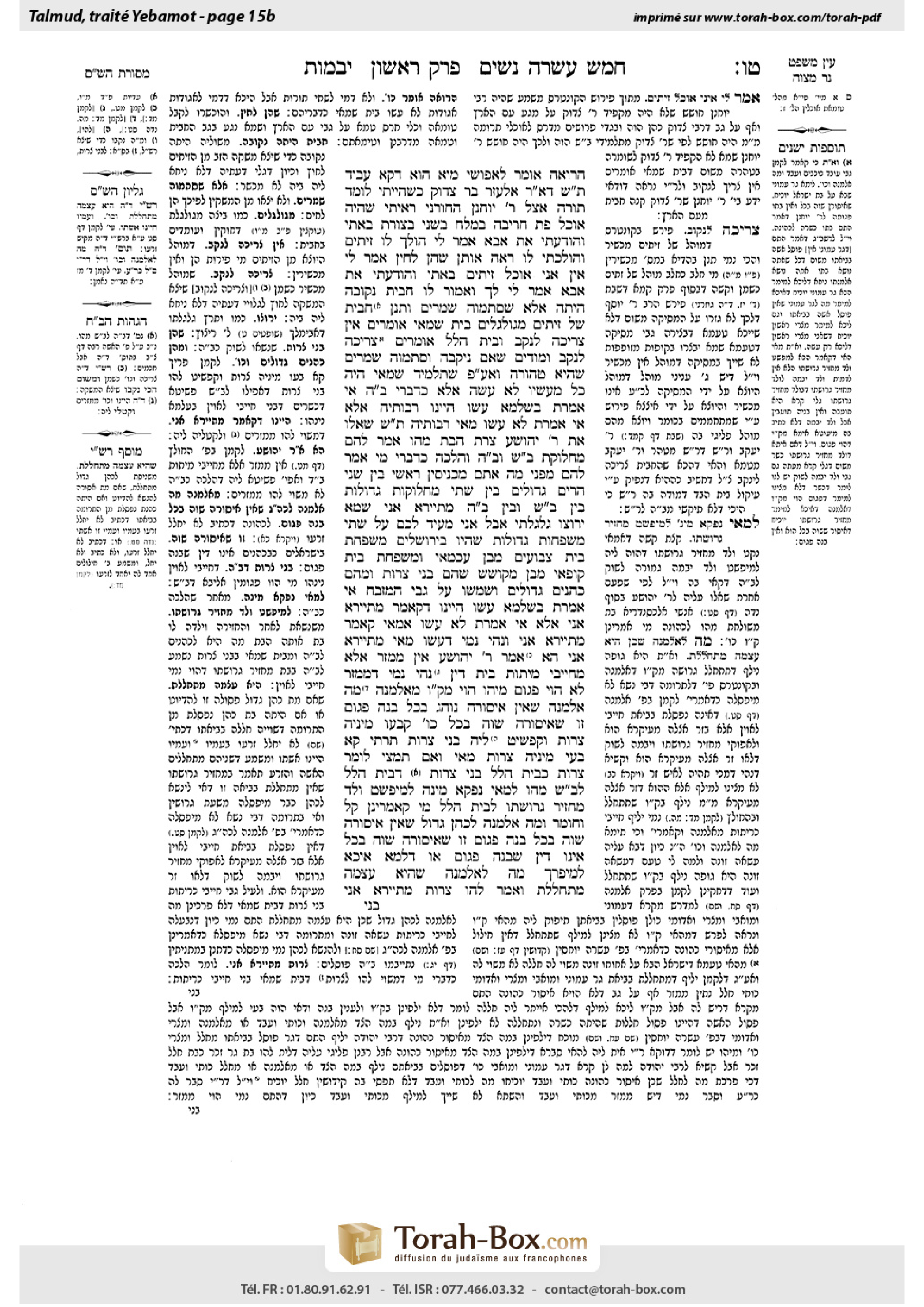
Yevamot 15b: Talmud study for Daf Yomi
Daf Yomi is the daily study of one Talmud folio. Explore 37 tractates with scans, Hebrew text, Sefaria English and AI-generated French translations where annotated.
Passage selection and English or AI-generated French translation are available where the scan has annotations. Daf Study is independent of Torah-Box and Sefaria.
Browse Yevamot · יבמות · All tractatesYevamot 15b text and translations
This page of Yevamot includes the Aramaic text, an English translation and an AI-generated French translation, alongside the scan above.
יבמות י״ה ב · Aramaic and Hebrew text
הָרוֹאֶה אוֹמֵר: לְאַפּוֹשֵׁי מַיָּא הוּא דְּקָא עָבֵיד.
תָּא שְׁמַע, דְּאָמַר רַבִּי אֶלְעָזָר בַּר צָדוֹק: כְּשֶׁהָיִיתִי לוֹמֵד תּוֹרָה אֵצֶל רַבִּי יוֹחָנָן הַחוֹרָנִי, רָאִיתִי שֶׁהָיָה אוֹכֵל פַּת חֲרֵיבָה בְּמֶלַח בִּשְׁנֵי בַצּוֹרֶת. בָּאתִי וְהוֹדַעְתִּי אֶת אַבָּא, אָמַר לִי: הוֹלֵךְ לוֹ זֵיתִים, וְהוֹלַכְתִּי לוֹ. רָאָה אוֹתָן שֶׁהֵן לַחִין, אָמַר לִי: אֵין אֲנִי אוֹכֵל זֵיתִים.
בָּאתִי וְהוֹדַעְתִּי אֶת אַבָּא. אָמַר לִי: לֵךְ וֶאֱמוֹר לוֹ, חָבִית נְקוּבָה הָיְתָה אֶלָּא שֶׁסְּתָמוּהָ שְׁמָרִים. וּתְנַן: חָבִית שֶׁל זֵיתִים מְגוּלְגָּלִים, בֵּית שַׁמַּאי אוֹמְרִים: אֵין צְרִיכָה לִנָּקֵב.
וּבֵית הִלֵּל אוֹמְרִים: צְרִיכָה לִנָּקֵב. וּמוֹדִים שֶׁאִם נִיקְּבָה וּסְתָמוּהָ שְׁמָרִים — שֶׁהִיא טְהוֹרָה.
וְאַף עַל פִּי שֶׁתַּלְמִיד שַׁמַּאי הָיָה, כׇּל מַעֲשָׂיו לֹא עָשָׂה אֶלָּא כְּדִבְרֵי בֵּית הִלֵּל. אִי אָמְרַתְּ בִּשְׁלָמָא עָשׂוּ — הַיְינוּ רְבוּתֵיהּ. אֶלָּא אִי אָמְרַתְּ לֹא עָשׂוּ — מַאי רְבוּתֵיהּ?!
תָּא שְׁמַע: שָׁאֲלוּ אֶת רַבִּי יְהוֹשֻׁעַ, צָרַת הַבַּת מַהוּ? אָמַר לָהֶם: מַחְלוֹקֶת בֵּית שַׁמַּאי וּבֵית הִלֵּל. וַהֲלָכָה כְּדִבְרֵי מִי? אָמַר לָהֶם: מִפְּנֵי מָה אַתֶּם מַכְנִיסִין רֹאשִׁי בֵּין שְׁנֵי הָרִים גְּדוֹלִים, בֵּין שְׁתֵּי מַחְלוֹקוֹת גְּדוֹלוֹת, בֵּין בֵּית שַׁמַּאי וּבֵין בֵּית הִלֵּל. מִתְיָירֵא אֲנִי שֶׁמָּא יָרוֹצּוּ גֻּלְגׇּלְתִּי.
אֲבָל אֲנִי מֵעִיד לָכֶם עַל שְׁתֵּי מִשְׁפָּחוֹת גְּדוֹלוֹת שֶׁהָיוּ בִּירוּשָׁלַיִם, מִשְׁפַּחַת בֵּית צְבוֹעִים מִבֶּן עַכְמַאי, וּמִשְׁפַּחַת בֵּית קוֹפַאי מִבֶּן מְקוֹשֵׁשׁ, שֶׁהֵם בְּנֵי צָרוֹת, וּמֵהֶם כֹּהֲנִים גְּדוֹלִים, וְשִׁמְּשׁוּ עַל גַּבֵּי הַמִּזְבֵּחַ.
אִי אָמְרַתְּ בִּשְׁלָמָא עָשׂוּ — הַיְינוּ דְּקָאָמַר מִתְיָירֵא אֲנִי. אֶלָּא אִי אָמְרַתְּ לֹא עָשׂוּ, אַמַּאי קָאָמַר מִתְיָירֵא אֲנִי? וּנְהִי נָמֵי דְּעָשׂוּ, מַאי מִתְיָירֵא אֲנִי?
הָא אָמַר רַבִּי יְהוֹשֻׁעַ: אֵין מַמְזֵר אֶלָּא מֵחַיָּיבֵי מִיתוֹת בֵּית דִּין! נְהִי נָמֵי דְּמַמְזֵר לָא הָוֵי, פָּגוּם מִיהָא הָוֵי.
מִקַּל וָחוֹמֶר מֵאַלְמָנָה: מָה אַלְמָנָה, שֶׁאֵין אִיסּוּרָהּ נוֹהֵג בַּכֹּל — בְּנָהּ פָּגוּם, זוֹ, שֶׁאִיסּוּרָהּ שָׁוֶה בַּכֹּל כּוּ׳.
קָבְעוּ מִינֵּיהּ צָרוֹת, וְקָפָשֵׁיט לֵיהּ בְּנֵי צָרוֹת! תַּרְתֵּי קָא בָּעֵי מִינֵּיהּ: צָרוֹת מַאי? וְאִם תִּמְצֵי לוֹמַר צָרוֹת כְּבֵית הִלֵּל, בְּנֵי צָרוֹת דְּבֵית הִלֵּל — לְבֵית שַׁמַּאי מַהוּ?
לְמַאי נָפְקָא מִינַּהּ? לְמִיפְשַׁט וְלַד מַחֲזִיר גְּרוּשָׁתוֹ לְבֵית הִלֵּל.
מִי קָאָמְרִינַן קַל וָחוֹמֶר: וּמָה אַלְמָנָה לְכֹהֵן גָּדוֹל שֶׁאֵין אִיסּוּרָהּ שָׁוֶה בַּכֹּל — בְּנָהּ פָּגוּם. זוֹ, שֶׁאִיסּוּרָהּ שָׁוֶה בַּכֹּל — אֵינוֹ דִּין שֶׁבְּנָהּ פָּגוּם?
אוֹ דִלְמָא אִיכָּא לְמִיפְרַךְ: מָה לְאַלְמָנָה שֶׁהִיא עַצְמָהּ מִתְחַלֶּלֶת. וַאֲמַר לְהוּ: צָרוֹת מִתְיָירֵא אֲנִי,
Yevamot 15b · English translation
anyone watching would say that he did it to increase the water flow, and he did not intend to change the halakha. Rather, they would think that he widened the water trough only because there was not enough water flow.
§ The Gemara cites another relevant source. Come and hear, as Rabbi Elazar bar Tzadok said: When I studied Torah with Rabbi Yoḥanan the Ḥorani, who was a disciple of Beit Shammai, I saw that he would eat dry bread in salt in years of drought. I went and informed my father of his meager meal, and he said to me: Take olives for him, and I took for him some olives. Rabbi Yoḥanan saw that they were moist with the liquid that oozes from olives, which renders them susceptible to ritual impurity. Concerned that they had already become ritually impure, he said to me: I do not eat olives. He spoke politely and stated that he did not eat olives because he did not wish to embarrass his benefactor by disclosing that he feared they had become ritually impure.
Rabbi Elazar bar Tzadok continued his account. I went and informed my father. He said to me: Go and say to him that the barrel containing the olives was perforated, but it was clogged by sediments in the oil and therefore some moisture remained inside. However, due to the presence of the hole, the olives were not rendered susceptible to ritual impurity. And we learned this in a mishna: With regard to a barrel of preserved olives, Beit Shammai say it does not need to be perforated, as the juice issuing from the olives does not render them susceptible to ritual impurity.
And Beit Hillel say that it does need to be perforated, as they maintain that the juice of olives is considered oil and it therefore renders the olives susceptible to ritual impurity. And Beit Hillel concede that if the barrel was perforated and subsequently clogged by sediments it is ritually pure, despite the moisture on the olives. Since liquids render food susceptible to ritual impurity only if they were placed on them intentionally, the hole in the barrel clearly shows that one did not intend for the juice to be there. By boring a hole in the barrel he has rendered it obvious that he did not desire the presence of the olive juices, and therefore it does not matter that the hole became blocked.
The baraita adds: And although Rabbi Yoḥanan the Ḥorani was a disciple of Shammai, he always acted only in accordance with the statements of Beit Hillel. The Gemara infers: Granted, if you say that Beit Shammai acted in accordance with their opinions, this is Rabbi Yoḥanan the Ḥorani’s greatness, i.e., he is praised for acting in accordance with the opinion of Beit Hillel. However, if you say that Beit Shammai did not act in accordance with their own rulings, what is the greatness and uniqueness of Rabbi Yoḥanan the Ḥorani? From here it can be inferred that Beit Shammai generally did act in accordance with their opinions.
§ The Gemara adds: Come and hear a different proof. They asked Rabbi Yehoshua: What is the halakha with regard to the rival wife of a daughter? He said to them: It is a matter of dispute between Beit Shammai and Beit Hillel. They continued to ask him: And in accordance with whose statement is the halakha? He said to them: Why are you inserting my head between two great mountains, i.e., between two great disputing opinions, between Beit Shammai and Beit Hillel? I fear lest these two mountains break my skull.
However, I shall testify to you about two great families that were in Jerusalem, the Beit Tzevo’im family who came from the town of Ben Akhmai, and the Beit Kofai family from the town of Ben Mekoshesh: They were the descendants of rival wives who married others, in accordance with the opinion of Beit Hillel, and from them came High Priests who served on the altar. Accordingly, I can testify that this was the accepted halakhic practice throughout the generations.
The Gemara infers from this statement: Granted, if you say that Beit Shammai acted in accordance with their opinions, this is why Rabbi Yehoshua said: I fear, since a conclusive halakhic ruling would mean that certain children are mamzerim, and the descendants of that family might take vengeance upon him. However, if you say that they did not act in accordance with their opinions, why did he say: I fear? The Gemara retorts: And even if Beit Shammai did act in accordance with their rulings, what is the reason that he said: I fear?
Didn’t Rabbi Yehoshua say that in his opinion a mamzer is only someone born from a union of those liable to receive the court-imposed capital punishments, not from those liable to receive karet. If so, in the opinion of Rabbi Yehoshua, the children of rival wives who entered into levirate marriage would not be mamzerim at all, and therefore he had no reason to fear reprisals. The Gemara answers: Even if this is the case, nevertheless, he had something to fear, as, although the child of a rival wife would not be a mamzer, he would nevertheless be of flawed lineage and disqualified from the priesthood.
The Gemara adds that this can be derived by an a fortiori inference from the case of a widow: Just as in the case of a widow, whose prohibition does not apply to all, as she is forbidden in marriage only to a High Priest and not to any other man, and yet the lineage of her son is flawed, as he is disqualified from the priesthood, the son of this rival wife should certainly be disqualified from the priesthood, as her prohibition applies equally to all, even regular Israelites.
§ Incidentally, the Gemara notes a problem with the above discussion: They asked Rabbi Yehoshua about rival wives, and he answered them about the children of rival wives. He did not refer to the rival wives themselves. The Gemara explains: They asked him questions on two matters: First, what is the halakha with regard to rival wives? And if you say that the halakha in the case of rival wives is in accordance with the opinion of Beit Hillel and they are exempt, what is the halakha according to Beit Shammai in the case of the children of rival wives who, following Beit Hillel, married others without ḥalitza?
The Gemara asks: What difference does this question make? Since Rabbi Yehoshua maintains that the halakha is in accordance with the ruling of Beit Hillel, why even discuss Beit Shammai’s opinion on this matter? The Gemara explains: His answer enables one to resolve a different issue, the case of a child of one who remarries his divorcée according to the opinion of Beit Hillel. Is the child of a divorcée who remarried her previous husband after she had been married to another man fit or disqualified from the priesthood?
The Gemara elaborates: Do we say the following an a fortiori inference: And just as with regard to a widow married to a High Priest, whose prohibition does not apply to all, as she is prohibited in marriage only to a High Priest, and yet the lineage of her son is flawed as he is disqualified from the priesthood, so too, in the case of this rival wife, whose prohibition applies equally to all men, is it not right that her son should be of flawed lineage?
Or perhaps this comparison can be refuted: What about the fact that a widow is different, as she herself is disqualified from marrying a priest, i.e., if a High Priest has intercourse with her she is disqualified from marrying any member of the entire priesthood, including common priests, whereas a remarried divorcée herself is not disqualified from marrying into the priesthood? And Rabbi Yehoshua said to them: I fear that if I issue a decisive ruling concerning rival wives this might lead to a conflict,
Yevamot 15b · Traduction française (IA)
Quiconque observerait la scène penserait qu’il l’a fait pour augmenter le débit de l’eau et qu’il n’avait pas l’intention de modifier la halakha. Il penserait plutôt qu’il a élargi l’auge uniquement parce que le débit d’eau était insuffisant.
§ La Guemara cite une autre source pertinente. Viens et entends : Rabbi Elazar bar Tzadok a dit : « Lorsque j’étudiais la Torah auprès de Rabbi Yoḥanan le Ḥorani, qui était un disciple de Beit Shammaï, je l’ai vu manger du pain sec avec du sel pendant les années de sécheresse. Je suis allé informer mon père de son maigre repas, et il m’a dit : “Prends des olives pour lui.” Je lui ai apporté des olives. Rabbi Yoḥanan vit qu’elles étaient humides du liquide qui suinte des olives, ce qui les rend susceptibles à l’impureté rituelle. Craignant qu’elles ne soient déjà devenues rituellement impures, il me dit : “Je ne mange pas d’olives.” Il s’exprima avec délicatesse et déclara qu’il ne mangeait pas d’olives parce qu’il ne voulait pas embarrasser son bienfaiteur en révélant qu’il craignait qu’elles ne soient devenues rituellement impures.
Rabbi Elazar bar Tzadok poursuivit son récit : « Je suis allé informer mon père. Il m’a dit : “Va lui dire que le tonneau contenant les olives était percé, mais que des dépôts dans l’huile avaient obstrué le trou, si bien qu’un peu d’humidité était restée à l’intérieur. Toutefois, en raison de la présence du trou, les olives n’avaient pas été rendues susceptibles à l’impureté rituelle.” » Et nous avons appris dans une Michna : au sujet d’un tonneau d’olives conservées, Beit Shammaï disent qu’il n’est pas nécessaire de le percer, car le jus qui s’écoule des olives ne les rend pas susceptibles à l’impureté rituelle.
Beit Hillel disent qu’il faut le percer, car ils considèrent que le jus des olives est de l’huile et qu’il rend donc les olives susceptibles à l’impureté rituelle. Beit Hillel reconnaissent que si le tonneau a été percé puis que le trou a été obstrué par des dépôts, il est rituellement pur, malgré l’humidité présente sur les olives. En effet, les liquides ne rendent les aliments susceptibles à l’impureté rituelle que s’ils y ont été déposés intentionnellement ; le trou dans le tonneau montre clairement que l’on ne voulait pas que le jus s’y trouve. En perçant le tonneau, on rend évident que l’on ne souhaitait pas la présence du jus des olives ; peu importe, par conséquent, que le trou se soit bouché.
La baraïta ajoute : bien que Rabbi Yoḥanan le Ḥorani fût un disciple de Shammaï, il agissait toujours uniquement conformément aux propos de Beit Hillel. La Guemara en déduit : certes, si l’on dit que Beit Shammaï agissaient conformément à leurs opinions, voilà en quoi Rabbi Yoḥanan le Ḥorani était remarquable : il est loué pour avoir agi conformément à l’opinion de Beit Hillel. Mais si l’on dit que Beit Shammaï n’agissaient pas conformément à leurs propres décisions, en quoi Rabbi Yoḥanan le Ḥorani était-il remarquable et unique ? On peut en déduire que Beit Shammaï agissaient généralement conformément à leurs opinions.
§ La Guemara ajoute : viens et entends une autre preuve. On demanda à Rabbi Yehoshua : « Quelle est la halakha concernant la coépouse d’une fille ? » Il leur répondit : « C’est un sujet de controverse entre Beit Shammaï et Beit Hillel. » Ils poursuivirent : « Et selon l’opinion de qui la halakha est-elle tranchée ? » Il leur dit : « Pourquoi placez-vous ma tête entre deux grandes montagnes, c’est-à-dire entre deux grandes opinions opposées, celles de Beit Shammaï et de Beit Hillel ? Je crains que ces deux montagnes ne me fracassent le crâne. »
« Toutefois, je peux témoigner à votre intention au sujet de deux grandes familles qui vivaient à Jérusalem : la famille Beit Tzevo’im, originaire de la ville de Ben Akhmai, et la famille Beit Kofai, originaire de la ville de Ben Mekoshesh. Elles descendaient de coépouses qui avaient épousé d’autres hommes, conformément à l’opinion de Beit Hillel, et des grands prêtres issus de ces familles ont servi sur l’autel. Je peux donc témoigner que telle était la pratique halakhique admise au fil des générations. »
La Guemara déduit de cette déclaration : certes, si l’on dit que Beit Shammaï agissaient conformément à leurs opinions, voilà pourquoi Rabbi Yehoshua a dit : « Je crains » : une décision halakhique définitive signifierait que certains enfants sont des mamzerim, et les descendants de cette famille pourraient se venger de lui. Mais si l’on dit qu’ils n’agissaient pas conformément à leurs opinions, pourquoi a-t-il dit : « Je crains » ? La Guemara rétorque : même si Beit Shammaï agissaient conformément à leurs décisions, pourquoi a-t-il dit : « Je crains » ?
Rabbi Yehoshua n’a-t-il pas dit que, selon lui, un mamzer est uniquement celui qui est né d’une union passible de la peine capitale prononcée par le tribunal, et non d’une union passible de karet ? Dans ce cas, selon Rabbi Yehoshua, les enfants des coépouses entrées en lévirat ne seraient nullement des mamzerim, et il n’avait donc aucune raison de craindre des représailles. La Guemara répond : même si tel est le cas, il avait néanmoins quelque chose à craindre : bien que l’enfant d’une coépouse ne soit pas un mamzer, sa lignée serait tout de même entachée et il serait inapte à la prêtrise.
La Guemara ajoute que l’on peut le déduire par raisonnement a fortiori du cas d’une veuve : de même que, dans le cas d’une veuve, dont l’interdiction ne concerne pas tout le monde puisqu’elle ne peut épouser qu’un grand prêtre et non un autre homme, la lignée de son fils est néanmoins entachée, car il est inapte à la prêtrise, le fils de cette coépouse devrait à plus forte raison être inapte à la prêtrise, puisque l’interdiction qui la concerne s’applique également à tous, même aux Israélites ordinaires.
§ Incidemment, la Guemara relève un problème dans la discussion précédente : on interrogea Rabbi Yehoshua au sujet des coépouses, et il leur répondit au sujet des enfants des coépouses. Il ne parla pas des coépouses elles-mêmes. La Guemara explique : on l’interrogea sur deux points. Premièrement : « Quelle est la halakha concernant les coépouses ? » Et si l’on dit que, dans leur cas, la halakha suit l’opinion de Beit Hillel et qu’elles sont dispensées, quelle est la halakha, selon Beit Shammaï, concernant les enfants des coépouses qui, suivant Beit Hillel, ont épousé d’autres hommes sans ḥalitsa ?
La Guemara demande : quelle différence cette question fait-elle ? Puisque Rabbi Yehoshua considère que la halakha suit la décision de Beit Hillel, pourquoi discuter même de l’opinion de Beit Shammaï sur ce sujet ? La Guemara explique : sa réponse permet de trancher une autre question, celle de l’enfant d’une femme qui se remarie avec son ancien mari, conformément à l’opinion de Beit Hillel. L’enfant d’une divorcée qui a épousé de nouveau son ancien mari après avoir été mariée à un autre homme est-il apte ou inapte à la prêtrise ?
La Guemara développe : formulons-nous le raisonnement a fortiori suivant : de même que, dans le cas d’une veuve mariée à un grand prêtre, dont l’interdiction ne concerne pas tout le monde puisqu’elle ne peut épouser qu’un grand prêtre, la lignée de son fils est néanmoins entachée, car il est inapte à la prêtrise, de même, dans le cas de cette coépouse, dont l’interdiction s’applique également à tous les hommes, ne convient-il pas que son fils ait une lignée entachée ?
Ou peut-être cette comparaison peut-elle être réfutée : la veuve est différente en ce qu’elle-même est inapte à épouser un prêtre ; autrement dit, si un grand prêtre a des relations avec elle, elle devient inapte à épouser tout membre de la prêtrise, y compris un prêtre ordinaire, tandis qu’une divorcée remariée n’est pas elle-même inapte à épouser un membre de la prêtrise. Et Rabbi Yehoshua leur dit : « Je crains que si je rends une décision définitive au sujet des coépouses, cela ne mène à un conflit. »
Traduction française générée par IA à partir de l’édition anglaise de Sefaria. Vérifie toujours un passage avec le texte source.
Text from Sefaria: William Davidson Edition - Vocalized Aramaic (CC BY NC); William Davidson Edition - English (CC BY NC).