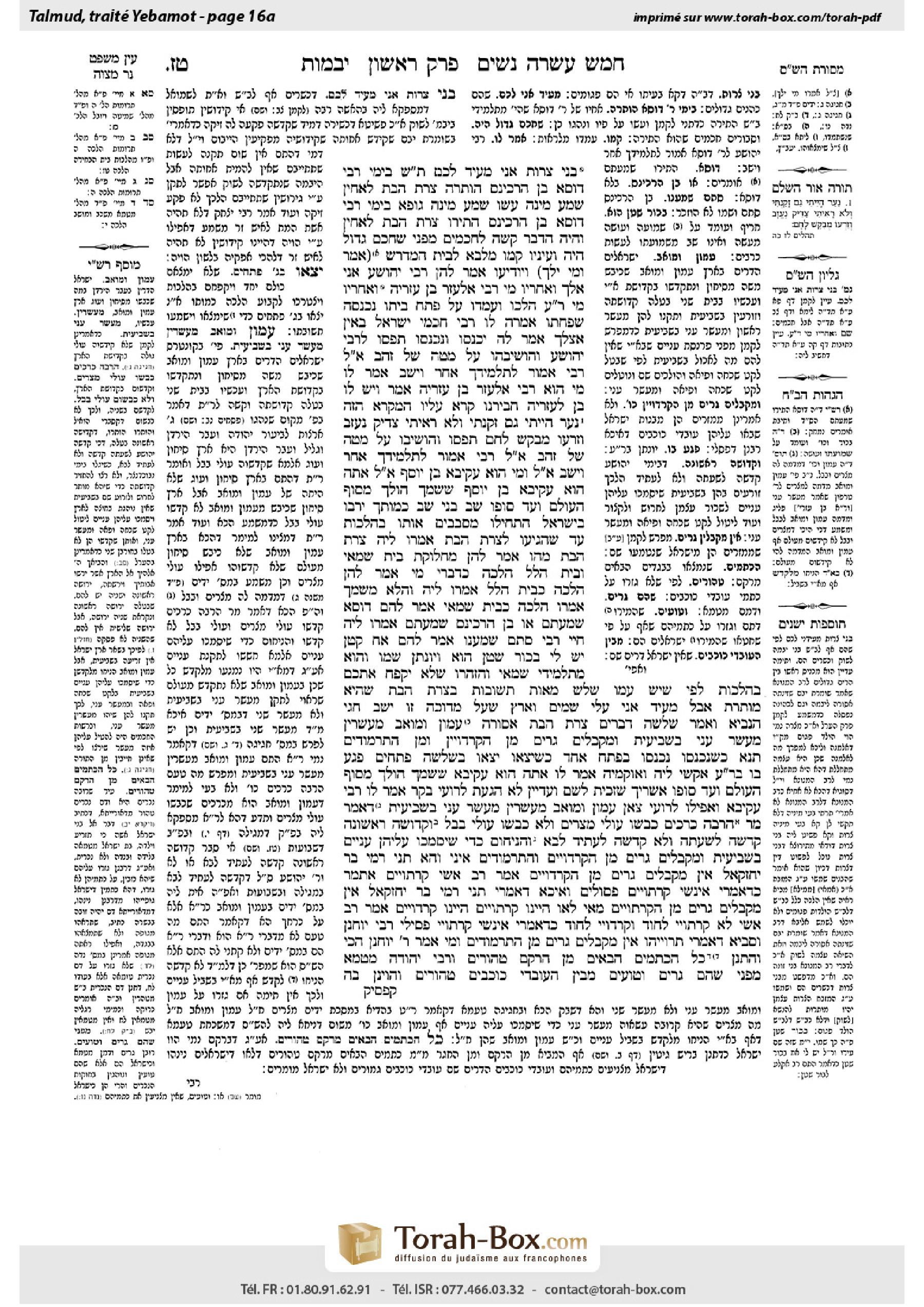
Yevamot 16a: Talmud study for Daf Yomi
Daf Yomi is the daily study of one Talmud folio. Explore 37 tractates with scans, Hebrew text, Sefaria English and AI-generated French translations where annotated.
Passage selection and English or AI-generated French translation are available where the scan has annotations. Daf Study is independent of Torah-Box and Sefaria.
Browse Yevamot · יבמות · All tractatesYevamot 16a text and translations
This page of Yevamot includes the Aramaic text, an English translation and an AI-generated French translation, alongside the scan above.
יבמות י״ו א · Aramaic and Hebrew text
בְּנֵי צָרוֹת אֲנִי מֵעִיד לָכֶם.
תָּא שְׁמַע: בִּימֵי רַבִּי דּוֹסָא בֶּן הַרְכִּינָס הוּתְּרָה צָרַת הַבַּת לָאַחִין. שְׁמַע מִינַּהּ עָשׂוּ: שְׁמַע מִינַּהּ.
גּוּפָא. בִּימֵי רַבִּי דּוֹסָא בֶּן הַרְכִּינָס הִתִּירוּ צָרַת הַבַּת לָאַחִין, וְהָיָה הַדָּבָר קָשֶׁה לַחֲכָמִים, מִפְּנֵי שֶׁחָכָם גָּדוֹל הָיָה, וְעֵינָיו קָמוּ מִלָּבֹא לְבֵית הַמִּדְרָשׁ.
אָמְרוּ: וּמִי יֵלֵךְ וְיוֹדִיעוֹ? אָמַר לָהֶן רַבִּי יְהוֹשֻׁעַ: אֲנִי אֵלֵךְ. וְאַחֲרָיו מִי — רַבִּי אֶלְעָזָר בֶּן עֲזַרְיָה. וְאַחֲרָיו מִי — רַבִּי עֲקִיבָא. הָלְכוּ וְעָמְדוּ עַל פֶּתַח בֵּיתוֹ. נִכְנְסָה שִׁפְחָתוֹ, אָמְרָה לוֹ: רַבִּי, חַכְמֵי יִשְׂרָאֵל בָּאִין אֶצְלְךָ, אָמַר לָהּ: יִכָּנְסוּ, וְנִכְנְסוּ.
תְּפָסוֹ לְרַבִּי יְהוֹשֻׁעַ, וְהוֹשִׁיבָהוּ עַל מִטָּה שֶׁל זָהָב. אָמַר לוֹ: רַבִּי, אֱמוֹר לְתַלְמִידְךָ אַחֵר וְיֵשֵׁב. אָמַר לוֹ: מִי הוּא? רַבִּי אֶלְעָזָר בֶּן עֲזַרְיָה. אָמַר: וְיֵשׁ לוֹ בֵּן לַעֲזַרְיָה חֲבֵירֵנוּ?
קָרָא עָלָיו הַמִּקְרָא הַזֶּה: ״נַעַר הָיִיתִי גַּם זָקַנְתִּי וְלֹא רָאִיתִי צַדִּיק נֶעֱזָב וְזַרְעוֹ מְבַקֶּשׁ לָחֶם״. תְּפָסוֹ וְהוֹשִׁיבוֹ עַל מִטָּה שֶׁל זָהָב. אָמַר לוֹ: רַבִּי, אֱמוֹר לְתַלְמִידְךָ אַחֵר וְיֵשֵׁב. אָמַר לוֹ: וּמִי הוּא? עֲקִיבָא בֶּן יוֹסֵף. אָמַר לוֹ: אַתָּה הוּא עֲקִיבָא בֶּן יוֹסֵף שֶׁשִּׁמְךָ הוֹלֵךְ מִסּוֹף הָעוֹלָם וְעַד סוֹפוֹ?! שֵׁב בְּנִי, שֵׁב, כְּמוֹתְךָ יִרְבּוּ בְּיִשְׂרָאֵל.
הִתְחִילוּ מְסַבְּבִים אוֹתוֹ בַּהֲלָכוֹת, עַד שֶׁהִגִּיעוּ לְצָרַת הַבַּת. אֲמַרוּ לוֹ: צָרַת הַבַּת מַהוּ? אָמַר לָהֶן: מַחְלוֹקֶת בֵּית שַׁמַּאי וּבֵית הִלֵּל. הֲלָכָה כְּדִבְרֵי מִי? אָמַר לָהֶן: הֲלָכָה כְּבֵית הִלֵּל. אָמְרוּ לוֹ: וַהֲלֹא מִשִּׁמְךָ אָמְרוּ הֲלָכָה כְּבֵית שַׁמַּאי!
אָמַר לָהֶם: דּוֹסָא שְׁמַעְתֶּם, אוֹ בֶּן הַרְכִּינָס שְׁמַעְתֶּם? אֲמַרוּ לוֹ: חַיֵּי רַבִּי, סְתָם שָׁמַעְנוּ. אָמַר לָהֶם: אָח קָטָן יֵשׁ לִי, בְּכוֹר שָׂטָן הוּא, וְיוֹנָתָן שְׁמוֹ, וְהוּא מִתַּלְמִידֵי שַׁמַּאי.
וְהִזָּהֲרוּ שֶׁלֹּא יְקַפֵּחַ אֶתְכֶם בַּהֲלָכוֹת, לְפִי שֶׁיֵּשׁ עִמּוֹ שְׁלֹשׁ מֵאוֹת תְּשׁוּבוֹת בְּצָרַת הַבַּת שֶׁהִיא מוּתֶּרֶת. אֲבָל מֵעִיד אֲנִי עָלַי שָׁמַיִם וָאָרֶץ, שֶׁעַל מְדוֹכָה זוֹ יָשַׁב חַגַּי הַנָּבִיא, וְאָמַר שְׁלֹשָׁה דְּבָרִים: צָרַת הַבַּת אֲסוּרָה,
עַמּוֹן וּמוֹאָב מְעַשְּׂרִין מַעְשַׂר עָנִי בַּשְּׁבִיעִית, וּמְקַבְּלִים גֵּרִים מִן הַקַּרְדּוֹיִין וּמִן הַתַּרְמוֹדִים.
תַּנָּא: כְּשֶׁנִּכְנְסוּ — נִכְנְסוּ בְּפֶתַח אֶחָד, כְּשֶׁיָּצְאוּ — יָצְאוּ בִּשְׁלֹשָׁה פְּתָחִים. פָּגַע בּוֹ בְּרַבִּי עֲקִיבָא, אַקְשִׁי לֵיהּ וְאוֹקְמֵיהּ.
אָמַר לוֹ: אַתָּה הוּא עֲקִיבָא שֶׁשִּׁמְךָ הוֹלֵךְ מִסּוֹף הָעוֹלָם וְעַד סוֹפוֹ? אַשְׁרֶיךָ שֶׁזָּכִיתָ לְשֵׁם, וַעֲדַיִין לֹא הִגַּעְתָּ לְרוֹעֵי בָקָר. אָמַר לוֹ רַבִּי עֲקִיבָא: וַאֲפִילּוּ לְרוֹעֵי צֹאן.
עַמּוֹן וּמוֹאָב מְעַשְּׂרִין מַעְשַׂר עָנִי בַּשְּׁבִיעִית. דְּאָמַר מָר: הַרְבֵּה כְּרַכִּים כָּבְשׁוּ עוֹלֵי מִצְרַיִם וְלֹא כָּבְשׁוּ עוֹלֵי בָבֶל, וּקְדוּשָּׁה רִאשׁוֹנָה — קִדְּשָׁה לִשְׁעָתָהּ, וְלֹא קִדְּשָׁה לֶעָתִיד לָבֹא.
וְהִנִּיחוּם, כְּדֵי שֶׁיִּסְמְכוּ עֲלֵיהֶן עֲנִיִּים בַּשְּׁבִיעִית.
וּמְקַבְּלִים גֵּרִים מִן הַקַּרְדּוֹיִים וְהַתַּרְמוֹדִים. אִינִי?! וְהָא תָּנֵי רָמֵי בַּר יְחֶזְקֵאל: אֵין מְקַבְּלִים גֵּרִים מִן הַקַּרְדּוֹיִים! אָמַר רַב אָשֵׁי: קַרְתּוֹיִים אִתְּמַר. כִּדְאָמְרִי אִינָשֵׁי: קַרְתּוֹיִים פְּסוּלִים.
וְאִיכָּא דְּאָמְרִי, תָּנֵי רָמֵי בַּר יְחֶזְקֵאל: אֵין מְקַבְּלִים גֵּרִים מִן הַקַּרְתּוֹיִים. מַאי לָאו: הַיְינוּ קַרְתּוֹיִים הַיְינוּ קַרְדּוֹיִים! אָמַר רַב אָשֵׁי: לָא, קַרְתּוֹיֵי לְחוֹד וְקַרְדּוֹיֵי לְחוֹד, כִּדְאָמְרִי אִינָשֵׁי: קַרְתּוֹיֵי פְּסִילִי.
רַבִּי יוֹחָנָן וְסָבַיָּא דְּאָמְרִי תַּרְוַיְיהוּ: אֵין מְקַבְּלִים גֵּרִים מִן הַתַּרְמוֹדִים. וּמִי אָמַר רַבִּי יוֹחָנָן הָכִי? וְהָתְנַן: כׇּל הַכְּתָמִים הַבָּאִים מִן הָרְקָם — טְהוֹרִים.
וְרַבִּי יְהוּדָה מְטַמֵּא, מִפְּנֵי שֶׁהֵם גֵּרִים וְטוֹעִים. מִבֵּין הַגּוֹיִם — טְהוֹרִים. וְהָוֵינַן בַּהּ:
Yevamot 16a · English translation
whereas with regard to the children of rival wives, I testify to you that they are not disqualified, since, as stated, their descendants served as High Priests.
§ The Gemara states: Come and hear another source that indicates Beit Shammai did act upon their opinions: In the time of Rabbi Dosa ben Harkinas, the rival wife of a daughter was permitted to the brothers. Conclude from this that Beit Shammai did act in accordance with their opinions. The Gemara summarizes these proofs: Indeed, conclude from these sources that Beit Shammai did put their rulings into practice.
§ Since the last source is only part of a larger incident, the Gemara cites the matter itself. In the time of Rabbi Dosa ben Harkinas the Sages permitted the rival wife of a daughter to the brothers. In other words, it became known that Rabbi Dosa ben Harkinas deemed permitted a daughter’s rival wife. And this matter was difficult in the eyes of the Rabbis because he was a great Sage and his decision in favor of Beit Shammai carried great weight. They could not approach him immediately, as he was very old and his eyes had dimmed so much that he was incapable of coming to the study hall.
They said: And who will go and notify him that this matter requires clarification? Rabbi Yehoshua said to them: I will go. They asked: And who shall go after him? They selected Rabbi Elazar ben Azarya, who was one of the great Sages of the generation, notwithstanding his youth. They further inquired: And who after him? Rabbi Akiva. They went and stood at the entrance of Rabbi Dosa ben Harkinas’s house. His maidservant entered and said to him: Rabbi, the Sages of Israel have come to you. He said to her: Let them enter, and they entered.
Rabbi Dosa ben Harkinas grabbed Rabbi Yehoshua, with whom he was already acquainted, and sat him on a bed of gold, as Rabbi Dosa was extremely wealthy. Rabbi Yehoshua said to him: Rabbi, call your other disciple so that he may sit. He asked him to call the other Sage as well, as it is a mark of respect when speaking to a great scholar to call every other Sage his disciple. He said to him: Who is it? Rabbi Yehoshua replied: Rabbi Elazar ben Azarya. Rabbi Dosa said: And does our colleague Azarya have a son? Due to his old age and prolonged absence from the study hall he had not heard of him.
Rabbi Dosa ben Harkinas recited this verse about Rabbi Elazar ben Azarya: “I have been young, and now am old; yet I have not seen the righteous forsaken, nor his seed begging bread” (Psalms 37:25). He interpreted this verse to mean that the son of a Torah scholar also becomes a Torah scholar. He grabbed him and sat him on a bed of gold. Rabbi Yehoshua said to him: Rabbi, call your other disciple so that he may sit. He said to him: Who is that? He said to him: Akiva ben Yosef. Rabbi Dosa said to him: You are Akiva ben Yosef, whose name has spread from one end of the world to the other? Even Rabbi Dosa had heard of Rabbi Akiva’s reputation as a great man. Sit, my son, sit. May the likes of you multiply in Israel.
Out of courtesy, they did not wish to broach the subject immediately. Rather, they began to encircle him with deliberations on different halakhot, until they came to the case of the rival wife of a daughter. They said to him: What is the halakha with regard to the rival wife of a daughter? He said that it is a matter of dispute between Beit Shammai and Beit Hillel. They asked him: According to whose statement is the halakha? He said to them: The halakha is in accordance with the opinion of Beit Hillel. They said to him: But didn’t they say in your name that the halakha is in accordance with the opinion of Beit Shammai?
He said to them: Did you hear that Dosa ben Harkinas issued this ruling, or did you hear that it was stated by ben Harkinas? They said to him: On your life, Rabbi, we heard simply ben Harkinas. He said to them: If so, it is no wonder, as I have a younger brother who is the firstborn of the Satan, i.e., he is extremely sharp and as brazen as a demon. And his name is Yonatan, and he is among the disciples of Shammai. It is he who issued this ruling.
Rabbi Dosa ben Harkinas added: And beware that he not batter you with halakhot in this matter, as he has with him three hundred proofs with regard to the rival wife of a daughter that she is permitted. However, you need not worry about the issue itself, as I call as witnesses before me the heavens and the earth that on this very mortar, which was preserved in my house due to its historical importance, Haggai the prophet sat, and I have a tradition that he said three matters of halakha: First, that the rival wife of a daughter is forbidden.
Second, that the halakhic rulings for the territories of Ammon and Moab in Transjordan, although similar to those of Eretz Yisrael, are not exactly the same, as their residents tithe the poor man’s tithe in the Sabbatical Year. The total abandonment of fields in the seventh year does not apply in Ammon and Moab, as they are not part of Eretz Yisrael. Instead, in those areas one must bring the poor man’s tithe to the paupers of Eretz Yisrael, as there are no tithes in Eretz Yisrael in the Sabbatical Year. Lastly, Haggai testified: And one accepts converts from the Karduyin and the Tarmodim, without concern that there might be Jews mingled among them, which could render them mamzerim and prohibited from entering the community.
The Sage taught: When they entered, they all entered through one entrance. When they left, they left through three entrances, in an effort to try to find Rabbi Dosa’s brother. Rabbi Akiva encountered him. Yonatan ben Harkinas raised against him all of his objections to the opinion of Beit Hillel, and he withstood him, i.e., Rabbi Akiva was able to respond to all of them.
Yonatan ben Harkinas grew angry and said to him: You are Akiva ben Yosef, whose name has spread from one end of the world to the other? Be happy that you have merited a great name, and yet you have not yet reached the level of cattle herders. Cattle herders were generally simple individuals who were not familiar even with ordinary matters, and certainly not with halakha. Rabbi Akiva said to him with characteristic modesty: And I have not even reached the level of shepherds, who are considered even worse than cattle herders, as they are unfit for giving testimony.
§ Since the halakhot of the prophet Haggai were mentioned, the Gemara discusses them here. Haggai said that Ammon and Moab tithe the poor man’s tithe in the Sabbatical Year, as the Master said: Many cities were conquered by those who returned from Egypt, and were not conquered by those who returned from Babylonia after the destruction of the First Temple. And the initial consecration of Eretz Yisrael, by those who returned from Egypt, sanctified it for its time and did not sanctify it forever, as the future sanctification of Eretz Yisrael depended on the renewed conquest of the land by the Jewish people.
And those who returned from Babylonia left those places aside and did not consider them part of Eretz Yisrael even after Jewish settlement was renewed there. They would plow and harvest in these places in the Sabbatical Year and tithe the poor man’s tithe so that the poor of Eretz Yisrael who did not have sufficient income from the previous years could rely upon them. Consequently, in the Sabbatical Year the poor received help from this tithe.
§ Haggai also declared: And one accepts converts from the Karduyim and the Tarmodim. The Gemara asks: Is that so? But didn’t Rami bar Yeḥezkel teach in a baraita: One does not accept converts from the Karduyim? Rav Ashi said: Kartuyim, not Karduyim, was stated by Rami bar Yeḥezkel. As people say in common discourse: The Kartuyim are unfit.
And there are those who say a slightly different version of this discussion. Rami bar Yeḥezkel taught: One does not accept converts from the Kartuyim. What, is it not the case that Kartuyim is the same as Karduyim? If so there is a contradiction between the baraita of Rami bar Yeḥezkel and the statement of Rabbi Dosa ben Harkinas. Rav Ashi said: No; the Kartuyim are one discrete category and the Karduyim are another discrete category, as people say: Kartuyim are unfit.
Rabbi Yoḥanan and the Elders both say: One does not accept converts from the Tarmodim. The Gemara asks: And did Rabbi Yoḥanan actually say this, that one does not accept converts from the Tarmodim due to a concern that Jews may have intermingled with them? But didn’t we learn in a mishna: All clothing with stains of blood that might be from a menstruating woman and that come from the city on the border of Eretz Yisrael called Rekem are ritually pure, as it can be assumed that they belong to gentiles, and the blood of a menstruating gentile woman is not ritually impure.
And Rabbi Yehuda deems it ritually impure because those residents of that place are converts and are in error. In other words, some of the inhabitants of Rekem assimilated and no longer observe the halakhot of the Torah, and therefore one must be wary lest the stains are in fact from a Jewish menstruating woman. Stains that came from among the gentiles, however, are ritually pure. And we discussed the following problem:
Yevamot 16a · Traduction française (IA)
tandis que, concernant les enfants des épouses rivales, je vous atteste qu’ils ne sont pas disqualifiés, puisque, comme on l’a dit, leurs descendants ont exercé la fonction de grands prêtres.
§ La Guemara dit : « Venez et entendez » une autre source indiquant que Beit Shammaï mettait ses opinions en pratique : à l’époque de Rabbi Dosa ben Harkinas, l’épouse rivale d’une fille fut permise aux frères. Déduisez-en que Beit Shammaï agissait conformément à ses opinions. La Guemara résume ces preuves : en effet, déduisez de ces sources que Beit Shammaï mettait ses décisions en pratique.
§ Puisque la dernière source ne constitue qu’une partie d’un récit plus vaste, la Guemara rapporte le récit lui-même. À l’époque de Rabbi Dosa ben Harkinas, les Sages permirent aux frères l’épouse rivale d’une fille. Autrement dit, on apprit que Rabbi Dosa ben Harkinas avait déclaré permise l’épouse rivale d’une fille. Cette affaire préoccupait les Rabbins, car c’était un grand Sage et sa décision en faveur de Beit Shammaï avait beaucoup de poids. Ils ne pouvaient pas l’aborder immédiatement, car il était très âgé et sa vue avait tellement baissé qu’il ne pouvait plus se rendre à la maison d’étude.
Ils dirent : « Et qui ira lui signaler que cette affaire doit être clarifiée ? » Rabbi Yehoshua leur dit : « J’irai. » Ils demandèrent : « Et qui ira après lui ? » Ils choisirent Rabbi Elazar ben Azarya, l’un des grands Sages de la génération, malgré sa jeunesse. Ils demandèrent encore : « Et qui ira après lui ? » Rabbi Akiva. Ils allèrent se tenir à l’entrée de la maison de Rabbi Dosa ben Harkinas. Sa servante entra et lui dit : « Rabbi, les Sages d’Israël sont venus vous voir. » Il lui dit : « Qu’ils entrent. » Ils entrèrent.
Rabbi Dosa ben Harkinas saisit Rabbi Yehoshua, qu’il connaissait déjà, et le fit asseoir sur un lit d’or, car il était extrêmement riche. Rabbi Yehoshua lui dit : « Rabbi, faites appeler votre autre disciple afin qu’il puisse s’asseoir. » Il lui demandait aussi de faire appeler l’autre Sage, car, lorsqu’on s’adresse à un grand érudit, c’est une marque de respect que de désigner tout autre Sage comme son disciple. Il lui demanda : « Qui est-ce ? » Rabbi Yehoshua répondit : « Rabbi Elazar ben Azarya. » Rabbi Dosa dit : « Notre collègue Azarya a donc un fils ? » En raison de son grand âge et de sa longue absence de la maison d’étude, il n’avait pas entendu parler de lui.
Rabbi Dosa ben Harkinas cita à propos de Rabbi Elazar ben Azarya ce verset : « J’ai été jeune et me voici vieux ; pourtant, je n’ai pas vu le juste abandonné, ni sa descendance mendier du pain » (Psaumes 37:25). Il interpréta ce verset comme signifiant que le fils d’un érudit de la Torah devient lui aussi un érudit de la Torah. Il le saisit et le fit asseoir sur un lit d’or. Rabbi Yehoshua lui dit : « Rabbi, faites appeler votre autre disciple afin qu’il puisse s’asseoir. » Il lui demanda : « Qui est-ce ? » Il lui répondit : « Akiva ben Yosef. » Rabbi Dosa lui dit : « C’est donc toi, Akiva ben Yosef, dont le nom s’est répandu d’un bout à l’autre du monde ? » Même Rabbi Dosa avait entendu parler de la réputation de Rabbi Akiva, grand personnage. « Assieds-toi, mon fils, assieds-toi. Puisse Israël en compter beaucoup comme toi. »
Par courtoisie, ils ne voulurent pas aborder immédiatement le sujet. Ils commencèrent plutôt par discuter avec lui de différentes halakhot, jusqu’à en venir au cas de l’épouse rivale d’une fille. Ils lui demandèrent : « Quelle est la halakha concernant l’épouse rivale d’une fille ? » Il répondit qu’il s’agissait d’un différend entre Beit Shammaï et Beit Hillel. Ils lui demandèrent : « Selon quel avis la halakha est-elle fixée ? » Il leur répondit : « La halakha suit l’avis de Beit Hillel. » Ils lui dirent : « Mais n’a-t-on pas dit en votre nom que la halakha suit l’avis de Beit Shammaï ? »
Il leur dit : « Avez-vous entendu que Dosa ben Harkinas avait rendu cette décision, ou avez-vous entendu qu’elle avait été attribuée à ben Harkinas ? » Ils lui répondirent : « Sur votre vie, Rabbi, nous avons simplement entendu ben Harkinas. » Il leur dit : « Dans ce cas, ce n’est pas étonnant, car j’ai un jeune frère, le premier-né de Satan, c’est-à-dire qu’il est extrêmement perspicace et aussi effronté qu’un démon. Il s’appelle Yonatan et fait partie des disciples de Shammaï. C’est lui qui a rendu cette décision. »
Rabbi Dosa ben Harkinas ajouta : « Prenez garde qu’il ne vous accable de halakhot à ce sujet, car il a avec lui trois cents preuves que l’épouse rivale d’une fille est permise. Toutefois, vous n’avez pas à vous inquiéter de la question elle-même, car je prends à témoin devant moi le ciel et la terre que le prophète Haggai s’est assis sur ce mortier même, conservé dans ma maison en raison de son importance historique. J’ai reçu la tradition selon laquelle il a énoncé trois règles de halakha : premièrement, que l’épouse rivale d’une fille est interdite.
Deuxièmement, les règles de halakha applicables aux territoires d’Ammon et de Moab en Transjordanie, bien que semblables à celles d’Eretz Yisrael, ne sont pas exactement les mêmes, car leurs habitants prélèvent la dîme du pauvre pendant l’année sabbatique. La mise en friche complète des champs durant la septième année ne s’applique pas à Ammon et à Moab, qui ne font pas partie d’Eretz Yisrael. Dans ces régions, on doit plutôt apporter la dîme du pauvre aux pauvres d’Eretz Yisrael, puisqu’il n’y a pas de dîmes en Eretz Yisrael pendant l’année sabbatique. Enfin, Haggai témoigna que l’on accepte des convertis parmi les Karduyin et les Tarmodim, sans craindre que des Juifs se soient mêlés à eux, ce qui pourrait en faire des mamzerim et les empêcher d’entrer dans l’assemblée.
Le Sage enseigna : lorsqu’ils entrèrent, ils passèrent tous par une seule porte. En repartant, ils sortirent par trois portes, dans l’espoir de trouver le frère de Rabbi Dosa. Rabbi Akiva le rencontra. Yonatan ben Harkinas lui opposa toutes ses objections à l’avis de Beit Hillel, et Rabbi Akiva lui résista, c’est-à-dire qu’il fut en mesure de répondre à chacune d’elles.
Yonatan ben Harkinas se mit en colère et lui dit : « C’est donc toi, Akiva ben Yosef, dont le nom s’est répandu d’un bout à l’autre du monde ? Réjouis-toi d’avoir acquis une grande renommée, et pourtant tu n’as pas encore atteint le niveau des bouviers. » Les bouviers étaient généralement des gens simples, qui ne connaissaient même pas les choses courantes, et encore moins la halakha. Rabbi Akiva lui répondit avec sa modestie habituelle : « Et moi, je n’ai même pas atteint le niveau des bergers », considérés comme encore moins capables que les bouviers, car ils sont inaptes à témoigner.
§ Puisque les halakhot du prophète Haggai ont été mentionnées, la Guemara les examine ici. Haggai dit qu’Ammon et Moab prélèvent la dîme du pauvre pendant l’année sabbatique, car le Maître a enseigné : de nombreuses villes furent conquises par ceux qui revinrent d’Égypte, mais ne furent pas conquises par ceux qui revinrent de Babylonie après la destruction du Premier Temple. La consécration initiale d’Eretz Yisrael par ceux qui revinrent d’Égypte la sanctifia pour son temps, mais pas pour l’éternité, car sa sanctification future dépendait d’une nouvelle conquête du pays par le peuple juif.
Ceux qui revinrent de Babylonie laissèrent ces lieux de côté et ne les considérèrent pas comme faisant partie d’Eretz Yisrael, même après la reprise de l’implantation juive dans ces régions. On y labourait et on y moissonnait pendant l’année sabbatique, et on y prélevait la dîme du pauvre afin que les pauvres d’Eretz Yisrael, qui ne disposaient pas de revenus suffisants des années précédentes, puissent compter sur ces ressources. Ainsi, pendant l’année sabbatique, les pauvres bénéficiaient de cette dîme.
§ Haggai déclara également que l’on accepte des convertis parmi les Karduyin et les Tarmodim. La Guemara demande : « Est-ce bien le cas ? Rami bar Yeḥezkel n’a-t-il pas enseigné dans une baraïta : “On n’accepte pas de convertis parmi les Karduyin” ? » Rav Ashi répondit : « Rami bar Yeḥezkel a dit Kartuyim, et non Karduyim. » Comme on le dit couramment : « Les Kartuyim sont inaptes. »
Certains rapportent une version légèrement différente de cette discussion. Rami bar Yeḥezkel enseigna : « On n’accepte pas de convertis parmi les Kartuyim. » Cela ne signifie-t-il pas que les Kartuyim sont les mêmes que les Karduyim ? Si tel est le cas, il y a une contradiction entre la baraïta de Rami bar Yeḥezkel et la déclaration de Rabbi Dosa ben Harkinas. Rav Ashi répondit : « Non ; les Kartuyim constituent une catégorie distincte des Karduyim », comme on le dit : « Les Kartuyim sont inaptes. »
Rabbi Yoḥanan et les Anciens disent tous deux : « On n’accepte pas de convertis parmi les Tarmodim. » La Guemara demande : « Rabbi Yoḥanan a-t-il vraiment dit qu’on n’accepte pas de convertis parmi les Tarmodim, par crainte que des Juifs se soient mêlés à eux ? N’avons-nous pas appris dans une Michna : “Tous les vêtements portant des taches de sang pouvant provenir d’une femme menstruée et venant de la ville de Rekem, située à la frontière d’Eretz Yisrael, sont purs rituellement, car on peut supposer qu’ils appartiennent à des non-Juifs, et le sang d’une femme non juive menstruée n’est pas rituellement impur” ? »
Rabbi Yehuda les considère comme rituellement impurs, car les habitants de cet endroit sont des convertis qui se trompent. Autrement dit, certains habitants de Rekem se sont assimilés et n’observent plus les halakhot de la Torah ; il faut donc craindre que les taches proviennent en réalité d’une femme juive menstruée. En revanche, les taches provenant des non-Juifs sont rituellement pures. Et nous avons examiné le problème suivant :
Traduction française générée par IA à partir de l’édition anglaise de Sefaria. Vérifie toujours un passage avec le texte source.
Text from Sefaria: William Davidson Edition - Vocalized Aramaic (CC BY NC); William Davidson Edition - English (CC BY NC).