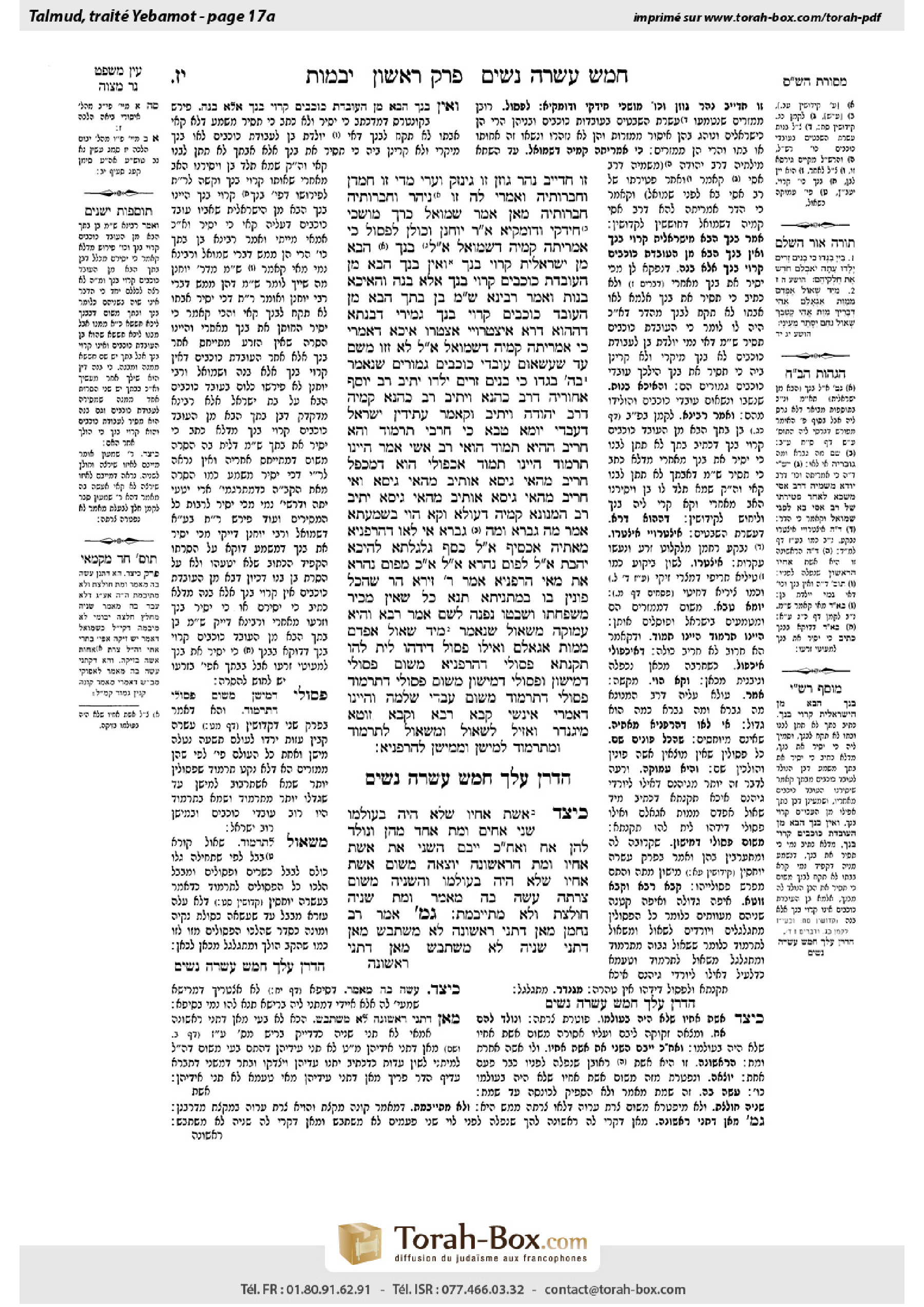
Yevamot 17a: Talmud study for Daf Yomi
Daf Yomi is the daily study of one Talmud folio. Explore 37 tractates with scans, Hebrew text, Sefaria English and AI-generated French translations where annotated.
Passage selection and English or AI-generated French translation are available where the scan has annotations. Daf Study is independent of Torah-Box and Sefaria.
Browse Yevamot · יבמות · All tractatesYevamot 17a text and translations
This page of Yevamot includes the Aramaic text, an English translation and an AI-generated French translation, alongside the scan above.
יבמות י״ז א · Aramaic and Hebrew text
זוֹ חַדְיָיב, ״נְהַר גּוֹזָן״ — זוֹ גִּינְזַק, ״וְעָרֵי מָדַי״ — זוֹ חַמְדָּן וְחַבְרוֹתֶיהָ, וְאָמְרִי לַהּ: זוֹ נִיהַר וְחַבְרוֹתֶיהָ. חַבְרוֹתֶיהָ מַאן? אָמַר שְׁמוּאֵל: כְּרַךְ, מוּשְׁכֵּי, חִידְקֵי וְדוּמְקֵי. אָמַר רַבִּי יוֹחָנָן: וְכוּלָּן לִפְסוּל.
כִּי אַמְרִיתַהּ קַמֵּיהּ דִּשְׁמוּאֵל, אֲמַר לִי: בִּנְךָ הַבָּא מִן יִשְׂרְאֵלִית קָרוּי בִּנְךָ, וְאֵין בִּנְךָ הַבָּא מִן הַגּוֹיָה קָרוּי בִּנְךָ, אֶלָּא בְּנָהּ.
וְהָאִיכָּא בָּנוֹת, וְאָמַר רָבִינָא: שְׁמַע מִינַּהּ, בֶּן בִּתְּךָ הַבָּא מִן הַגּוֹי קָרוּי בִּנְךָ! גְּמִירִי דִּבְנָתָא דְּהָהוּא דָּרָא אִיצְטְרוֹיֵי אִצְטְרוֹ.
אִיכָּא דְּאָמְרִי: כִּי אַמְרִיתַהּ קַמֵּיהּ דִּשְׁמוּאֵל, אָמַר לִי: לֹא זָזוּ מִשָּׁם, עַד שֶׁעֲשָׂאוּם גּוֹיִם גְּמוּרִים, שֶׁנֶּאֱמַר: ״בַּה׳ בָּגָדוּ כִּי בָנִים זָרִים יָלָדוּ״.
יָתֵיב רַב יוֹסֵף אֲחוֹרֵיהּ דְּרַב כָּהֲנָא, וְיָתֵיב רַב כָּהֲנָא קַמֵּיהּ דְּרַב יְהוּדָה וְיָתֵיב וְקָאָמַר: עֲתִידִין יִשְׂרָאֵל דְּעָבְדִי יוֹמָא טָבָא כִּי חָרְבָה תַּרְמוֹד. וְהָא חֲרִיב! הַהִיא תָּמוֹד הֲוַאי. רַב אָשֵׁי אָמַר: הַיְינוּ תַּרְמוֹד הַיְינוּ תָּמוֹד, אִכְּפוֹלֵי הוּא דְּמִכַּפְלָ[א]: חֲרִיב מֵהַאי גִּיסָא — אִיתִּיב מֵהַאי גִּיסָא, (וְאִי) חֲרִיב מֵהַאי גִּיסָא — אִיתִּיב מֵהַאי גִּיסָא.
יָתֵיב רַב הַמְנוּנָא קַמֵּיהּ דְּעוּלָּא וְקָא הָוֵי בִּשְׁמַעְתָּא, אָמַר: מָה גַּבְרָא וּמָה גַּבְרָא! אִי לָאו דְּהַרְפַּנְיָא מָאתֵיהּ! אִכְּסִיף, אֲמַר לֵיהּ: כְּסַף גֻּלְגֻּלְתָּא, לְהֵיכָא יָהֲבַתְּ? אֲמַר לֵיהּ לְפוּם נַהֲרָא. אֲמַר לֵיהּ: אִם כֵּן, מִפּוּם נַהֲרָא אַתְּ.
מַאי הַרְפַּנְיָא? אָמַר רַבִּי זֵירָא: הַר שֶׁהַכֹּל פּוֹנִין בּוֹ. בְּמַתְנִיתָא תָּנָא: כׇּל שֶׁאֵין מַכִּיר מִשְׁפַּחְתּוֹ וְשִׁבְטוֹ נִפְנֶה לְשָׁם. אָמַר רָבָא: וְהִיא עֲמוּקָּה מִשְּׁאוֹל, שֶׁנֶּאֱמַר: ״מִיַּד שְׁאוֹל אֶפְדֵּם מִמָּוֶת אֶגְאָלֵם״, וְאִילּוּ פְּסוּל דִּידְהוּ לֵית לְהוּ תַּקַּנְתָּא.
פְּסוּלֵי דְהַרְפַּנְיָא מִשּׁוּם פְּסוּלֵי דְּמֵישׁוֹן, וּפְסוּלֵי דְּמֵישׁוֹן מִשּׁוּם פְּסוּלֵי דְתַרְמוֹד, פְּסוּלֵי דְתַרְמוֹד מִשּׁוּם עַבְדֵי שְׁלֹמֹה.
וְהַיְינוּ דְּאָמְרִי אִינָשֵׁי: קַבָּא רַבָּא וְקַבָּא זוּטָא, מִיגַּנְדַּר וְאָזֵיל לִשְׁאוֹל, וּמִשְּׁאוֹל לְתַרְמוֹד, וּמִתַּרְמוֹד לְמֵישָׁן, וּמִמֵּישָׁן לְהַרְפַּנְיָא.
הֲדַרַן עֲלָךְ חֲמֵשׁ עֶשְׂרֵה נָשִׁים
כֵּיצַד אֵשֶׁת אָחִיו שֶׁלֹּא הָיָה בְּעוֹלָמוֹ? שְׁנֵי אַחִים, וּמֵת אֶחָד מֵהֶן, וְנוֹלַד לָהֶן אָח, וְאַחַר כָּךְ יִיבֵּם הַשֵּׁנִי אֶת אֵשֶׁת אָחִיו, וּמֵת. הָרִאשׁוֹנָה יוֹצְאָה מִשּׁוּם אֵשֶׁת אָחִיו שֶׁלֹּא הָיָה בְּעוֹלָמוֹ, וְהַשְּׁנִיָּה מִשּׁוּם צָרָתָהּ.
עָשָׂה בָּהּ מַאֲמָר וּמֵת, שְׁנִיָּה — חוֹלֶצֶת וְלֹא מִתְיַיבֶּמֶת.
גְּמָ׳ אָמַר רַב נַחְמָן: מַאן דְּתָנֵי רִאשׁוֹנָה לָא מִשְׁתַּבַּשׁ, מַאן דְּתָנֵי שְׁנִיָּה לָא מִשְׁתַּבַּשׁ. מַאן דְּתָנֵי
Yevamot 17a · English translation
this is Ḥadyab. The river of Gozan; this is Ginzak. And the cities of the Medes; this is Ḥamadan and its surroundings. And some say: This is Nihar and its surroundings. The Gemara asks: Which are its surroundings? Shmuel said: Kerakh, Mushkhei, Ḥidkei, and Domakya are the surroundings of Ḥamadan. Rabbi Yoḥanan said: And all of them are for disqualification. In other words, if someone from one of these places wishes to convert, there is concern that he might be a descendant of a Jew and therefore a mamzer. Consequently, they all are disqualified.
Rav Yehuda continued his recounting: When I said this halakha, that there is a concern about the betrothal of gentiles nowadays, before Shmuel, he said to me: One need not worry about this, as your son from a Jewish woman is called your son, i.e., he inherits his lineage from you, and your son from a gentile woman is not called your son, but rather her son. Consequently, all children born to Jews from gentile women are not considered Jews, as their lineage is determined by their gentile mothers.
The Gemara asks: Aren’t there Jewish girls who were captured by gentiles, whose children are considered to be Jews? And Ravina said: Learn from this that the son of your daughter from a gentile is called your son. If so, the descendants of Jewish women captured by gentiles would indeed be Jews. The Gemara answers: This is no concern, as it is learned as a tradition that the girls from the ten tribes of that generation became barren and did not give birth to any offspring, whereas some of the exiled men of the ten tribes married gentile women. Consequently, all of the children born there were gentiles.
There are those who say that Rav Yehuda actually related the following: When I said this halakha before Shmuel, he said to me: They did not move from there, the place where they deliberated on this matter, until they rendered all of them, including those who intermingled with the ten tribes in different locations, full-fledged gentiles. Consequently, there is no concern that their betrothals might be of any effect, as it is stated: “They have dealt treacherously against the Lord, for they have begotten strange children” (Hosea 5:7).
§ The Gemara relates: Rav Yosef sat behind Rav Kahana, and Rav Kahana sat before Rav Yehuda, and he sat and he said this tradition: In the future, the Jews will establish a Festival day when Tarmod is destroyed. The Gemara asks: But it has already been destroyed. The Gemara answers: That place that was destroyed was Tamud, not Tarmod. Rav Ashi said: Tarmod is the same as Tamud. However, the city is doubled. In other words, when it is destroyed from this side it is settled on that side, and when it is destroyed from that side it is settled on this side. Consequently, it has not yet been entirely destroyed.
The Gemara relates: Rav Hamnuna sat before Ulla and was engaged in the study of halakha. Ulla said about him: What a man; what a man. In other words: What a great man this Rav Hamnuna is. If only Harpanya were not his city, as the inhabitants of that place are all of flawed lineage, which indicates that the lineage of Rav Hamnuna is likewise impaired. Rav Hamnuna was ashamed. Ulla said to him: Where do you give the money for payment of the poll tax? He said to him: I pay it to the city of Pum Nahara, as my city is subject to taxation by that city. He said to him: If so, you are from Pum Nahara, not Harpanya, and your lineage is evidently not flawed.
§ The Gemara asks: What is the meaning of the name Harpanya? Rabbi Zeira said: It means the mountain to which all turn [har shehakol ponin bo]. In other words, it is the destination for all those who could not find wives anywhere else, as most of its population is of flawed lineage. It is taught in a baraita: All those who do not know their family or tribe turn there. Rava said: This type of flaw is appalling and is deeper than the netherworld, as is stated: “Shall I ransom them from the power of the netherworld? Shall I redeem them from death?” (Hosea 13:14). This verse indicates that it is possible to be ransomed and released from the netherworld, whereas their disqualification cannot be rectified.
The Gemara comments: Those who are disqualified from Harpanya are unfit due to the disqualification of the inhabitants of nearby Meishon, who were unfit and intermarried with the residents of Harpanya. Those disqualified from Meishon are unfit due to those disqualified from Tarmod, and those disqualified from Tarmod are disqualified due to the servants of Solomon.
The Gemara comments: And this explains the folk saying that people say in this regard: A large ephah and a small ephah, which are both inaccurate utensils that may not be used for measuring, roll onward to the netherworld, and from the netherworld to Tarmod, and from Tarmod to Meishon, and from Meishon to Harpanya. The same idea expressed by the Sages with regard to the disqualification of lineage was also incorporated into a well-known adage among commoners.
MISHNA: Each of the women enumerated in the first chapter causes exemption from levirate marriage and ḥalitza for her rival wives. This is due to the close family relationship she has with her brother-in-law, making her forbidden to him. The single exception is the case explained in this mishna. What is the case of the wife of a brother with whom he did not coexist? For example: If there were two brothers, and one of them died childless, and subsequently a brother of theirs was born, after which the second brother, the elder, took his deceased brother’s wife in levirate marriage, and then died as well. Consequently, two women require levirate marriage: The widow of the first brother who had been taken in levirate marriage by the second brother, and the widow of the second brother, the first widow’s rival wife. The first widow, who had been the wife of the first brother to die, goes out without any obligation to be taken in levirate marriage by the youngest brother who was born later, since she is the wife of a brother with whom he did not coexist. The first deceased brother never lived at the same time as the newly born brother. The second widow, who had been married to the second brother, is exempt due to her rival wife.
The mishna discusses an additional situation: If the second brother had performed only levirate betrothal with her, meaning that he had not yet consummated the marriage, and then died, both the wife betrothed by a levirate betrothal to the second brother and the wife of the second brother fall before the youngest brother born after the death of the first brother. In that case, the first wife certainly goes out and is exempt from both ḥalitza and levirate marriage, since she is to him the wife of a brother with whom he did not coexist. The second, however, was never effectively the rival wife of the first brother’s wife, as the first brother’s wife had only been betrothed by levirate betrothal and was not fully married to the second brother. Therefore, she performs ḥalitza and may not enter into levirate marriage.
GEMARA: Rav Naḥman said: He who taught the version of the mishna which reads: The first widow goes out, is not mistaken in his version, and he who taught a variant version of the mishna which reads: The second widow goes out, is not mistaken either, since it is possible to understand the mishna both ways. Both versions of the text can refer to the same woman, i.e., the wife of the first brother, by different titles. The Gemara explains that he who taught:
Yevamot 17a · Traduction française (IA)
Il s’agit de Ḥadyab. Le fleuve de Gozan, c’est Ginzak. Les villes des Mèdes, ce sont Ḥamadan et ses environs. Certains disent : il s’agit de Nihar et de ses environs. La Guemara demande : Quels sont ses environs ? Shmuel a dit : Kerakh, Mushkhei, Ḥidkei et Domakya sont les environs de Ḥamadan. Rabbi Yoḥanan a dit : Et tous sont disqualifiés. Autrement dit, si quelqu’un de l’un de ces endroits souhaite se convertir, on craint qu’il ne soit le descendant d’un Juif et, par conséquent, un mamzer. Ainsi, ils sont tous disqualifiés.
Rav Yehuda poursuivit son récit : Lorsque j’ai exposé cette halakha devant Shmuel, à savoir qu’il faut se préoccuper des fiançailles contractées par des non-Juifs de nos jours, il m’a dit : Il n’y a pas lieu de s’en inquiéter, car ton fils né d’une femme juive est appelé ton fils, c’est-à-dire qu’il tient sa filiation de toi, tandis que ton fils né d’une femme non juive n’est pas appelé ton fils, mais celui de sa mère. Par conséquent, les enfants nés de Juifs et de femmes non juives ne sont pas considérés comme juifs, puisque leur filiation est déterminée par leur mère non juive.
La Guemara demande : Mais n’y a-t-il pas des filles juives qui ont été capturées par des non-Juifs et dont les enfants sont considérés comme juifs ? Ravina a dit : Apprends de là que le fils de ta fille né d’un non-Juif est appelé ton fils. Dans ce cas, les descendants des femmes juives capturées par des non-Juifs seraient effectivement juifs. La Guemara répond : Il n’y a pas lieu de s’en inquiéter, car la tradition enseigne que les filles des dix tribus de cette génération devinrent stériles et ne donnèrent naissance à aucun enfant, tandis que certains hommes exilés des dix tribus épousèrent des femmes non juives. Par conséquent, tous les enfants qui y naquirent étaient non juifs.
Selon une autre version, Rav Yehuda rapporta en réalité ce qui suit : Lorsque j’ai exposé cette halakha devant Shmuel, il m’a dit : Ils ne quittèrent pas les lieux où ils avaient délibéré sur cette question avant de déclarer tous ces gens, y compris ceux qui s’étaient mêlés aux dix tribus en différents endroits, entièrement non juifs. Par conséquent, il n’y a pas lieu de craindre que leurs fiançailles aient le moindre effet, comme il est dit : « Ils ont agi avec perfidie envers l’Éternel, car ils ont engendré des enfants étrangers » (Osée 5, 7).
§ La Guemara rapporte : Rav Yosef était assis derrière Rav Kahana, et Rav Kahana était assis devant Rav Yehuda, qui était assis et transmettait cet enseignement : À l’avenir, les Juifs institueront un jour de fête lorsque Tarmod sera détruite. La Guemara demande : Mais elle a déjà été détruite. La Guemara répond : Le lieu qui a été détruit était Tamud, et non Tarmod. Rav Ashi a dit : Tarmod et Tamud sont une seule et même ville. Toutefois, la ville est double : lorsqu’elle est détruite d’un côté, elle est habitée de l’autre ; et lorsqu’elle est détruite de l’autre côté, elle est habitée de ce côté-ci. Par conséquent, elle n’a pas encore été entièrement détruite.
La Guemara rapporte : Rav Hamnuna était assis devant Ulla et étudiait la halakha. Ulla dit à son sujet : Quel homme ! Quel homme ! Autrement dit : Quel grand homme que ce Rav Hamnuna ! Si seulement Harpanya n’était pas sa ville, car les habitants de cet endroit ont tous une filiation entachée, ce qui indique que celle de Rav Hamnuna est elle aussi altérée. Rav Hamnuna eut honte. Ulla lui dit : À quelle ville verses-tu l’argent destiné au paiement de la capitation ? Il lui répondit : Je le verse à la ville de Pum Nahara, car ma ville dépend de cette ville pour le paiement de l’impôt. Ulla lui dit : Dans ce cas, tu es de Pum Nahara, et non de Harpanya ; ta filiation n’est donc manifestement pas entachée.
§ La Guemara demande : Que signifie le nom Harpanya ? Rabbi Zeira a dit : « La montagne vers laquelle tous se tournent » [har shehakol ponin bo]. Autrement dit, c’est la destination de tous ceux qui n’ont pu trouver d’épouse nulle part ailleurs, car la plupart de ses habitants ont une filiation entachée. Il est enseigné dans une baraïta : Tous ceux qui ne connaissent ni leur famille ni leur tribu s’y rendent. Rava a dit : Cette tare est effroyable et plus profonde que le monde inférieur, comme il est dit : « Les rachèterai-je du pouvoir du monde inférieur ? Les délivrerai-je de la mort ? » (Osée 13, 14). Ce verset indique qu’il est possible d’être racheté et libéré du monde inférieur, tandis que leur disqualification ne peut être corrigée.
La Guemara fait remarquer : Ceux qui sont disqualifiés à Harpanya le sont en raison des habitants de Meishon, localité voisine, qui étaient eux-mêmes inaptes et se sont mêlés aux habitants de Harpanya. Ceux qui sont disqualifiés à Meishon le sont en raison de ceux qui sont disqualifiés à Tarmod, et ceux qui sont disqualifiés à Tarmod le sont en raison des serviteurs de Salomon.
La Guemara fait remarquer que cela explique le dicton populaire : « Une grande épha et une petite épha », qui sont toutes deux des ustensiles de mesure imprécis qu’il est interdit d’utiliser, roulent jusqu’au monde inférieur, puis du monde inférieur à Tarmod, de Tarmod à Meishon et de Meishon à Harpanya. L’idée exprimée par les Sages au sujet de la disqualification de la filiation a également été reprise dans un dicton bien connu du peuple.
MICHNA : Chacune des femmes énumérées au premier chapitre entraîne, pour ses coépouses, l’exemption du mariage léviratique et de la ḥalitsa. Cela tient au lien de parenté étroit qui l’unit à son beau-frère et la rend interdite à celui-ci. La seule exception est le cas expliqué dans cette Michna. Quel est le cas de l’épouse d’un frère avec lequel il n’a pas coexisté ? Par exemple, il y avait deux frères ; l’un d’eux mourut sans enfant, puis un autre frère naquit après sa mort. Ensuite, le deuxième frère, l’aîné, épousa en mariage léviratique la femme de son frère décédé, puis mourut à son tour. Deux femmes se trouvent alors soumises au lévirat : la veuve du premier frère, que le deuxième frère avait épousée en mariage léviratique, et la veuve du deuxième frère, qui était la coépouse de la première. La première veuve, qui avait été l’épouse du premier frère décédé, est libérée sans obligation d’être épousée en mariage léviratique par le frère cadet né plus tard, puisqu’elle est l’épouse d’un frère avec lequel il n’a pas coexisté. Le premier frère décédé n’a jamais vécu à la même époque que le frère né après lui. La deuxième veuve, qui avait été mariée au deuxième frère, est exemptée en raison de sa coépouse.
La Michna examine une situation supplémentaire : si le deuxième frère s’était seulement fiancé à elle par le lévirat, c’est-à-dire s’il n’avait pas encore consommé le mariage, puis était mort, la femme à laquelle il s’était fiancé par le lévirat et l’épouse du deuxième frère se trouveraient toutes deux soumises au lévirat devant le frère cadet, né après la mort du premier frère. Dans ce cas, la première femme est assurément libérée et exemptée à la fois de la ḥalitsa et du mariage léviratique, puisqu’elle est pour lui l’épouse d’un frère avec lequel il n’a pas coexisté. La deuxième, en revanche, n’a jamais été véritablement la coépouse de la femme du premier frère, car celle-ci n’était liée au deuxième frère que par des fiançailles léviratiques et n’était pas pleinement mariée à lui. Elle doit donc accomplir la ḥalitsa et ne peut pas contracter de mariage léviratique.
GUEMARA : Rav Naḥman a dit : Celui qui enseigne la version de la Michna selon laquelle la première veuve est libérée ne se trompe pas dans sa version ; celui qui enseigne une variante de la Michna selon laquelle la deuxième veuve est libérée ne se trompe pas non plus, car il est possible de comprendre la Michna dans les deux sens. Les deux versions du texte peuvent désigner la même femme, c’est-à-dire l’épouse du premier frère, sous des appellations différentes. La Guemara explique que celui qui enseignait :
Traduction française générée par IA à partir de l’édition anglaise de Sefaria. Vérifie toujours un passage avec le texte source.
Text from Sefaria: William Davidson Edition - Vocalized Aramaic (CC BY NC); William Davidson Edition - English (CC BY NC).