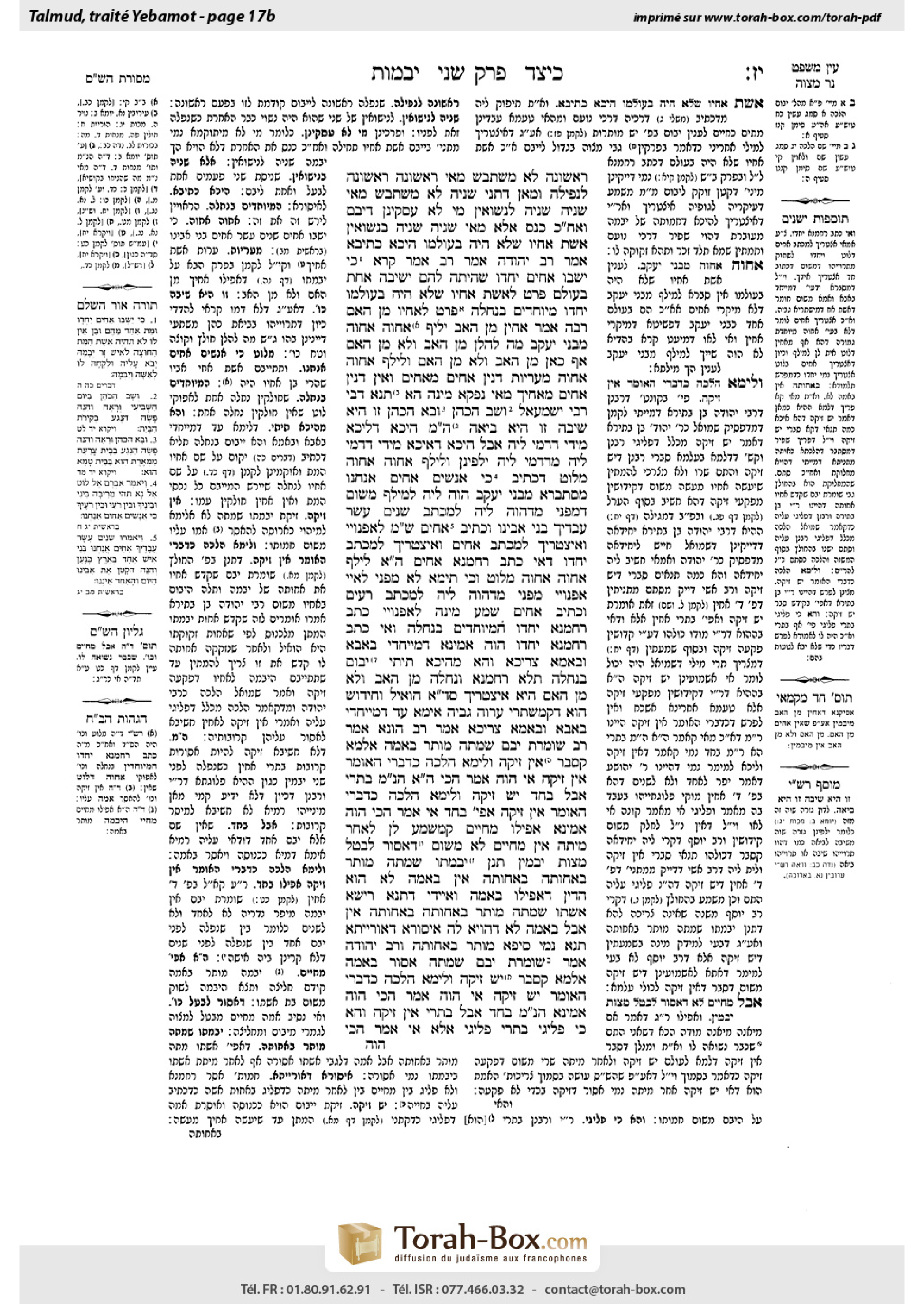
Yevamot 17b: Talmud study for Daf Yomi
Daf Yomi is the daily study of one Talmud folio. Explore 37 tractates with scans, Hebrew text, Sefaria English and AI-generated French translations where annotated.
Passage selection and English or AI-generated French translation are available where the scan has annotations. Daf Study is independent of Torah-Box and Sefaria.
Browse Yevamot · יבמות · All tractatesYevamot 17b text and translations
This page of Yevamot includes the Aramaic text, an English translation and an AI-generated French translation, alongside the scan above.
יבמות י״ז ב · Aramaic and Hebrew text
רִאשׁוֹנָה לָא מִשְׁתַּבַּשׁ: מַאי רִאשׁוֹנָה — רִאשׁוֹנָה לִנְפִילָה, וּמַאן דְּתָנֵי שְׁנִיָּה לָא מִשְׁתַּבַּשׁ: מַאי שְׁנִיָּה — שְׁנִיָּה לְנִשּׂוּאִין. מִי לָא עָסְקִינַן דְּיִבֵּם וְאַחַר כָּךְ כָּנַס? אֶלָּא מַאי שְׁנִיָּה — שְׁנִיָּה בְּנִשּׂוּאִין.
אֵשֶׁת אָחִיו שֶׁלֹּא הָיָה בְּעוֹלָמוֹ הֵיכָא כְּתִיבָא? אָמַר רַב יְהוּדָה אָמַר רַב, אָמַר קְרָא: ״כִּי יֵשְׁבוּ אַחִים יַחְדָּו״, שֶׁהָיְתָה לָהֶם יְשִׁיבָה אַחַת בָּעוֹלָם, פְּרָט לְאֵשֶׁת אָחִיו שֶׁלֹּא הָיָה בְּעוֹלָמוֹ. ״יַחְדָּו״ — מְיוּחָדִים בַּנַּחֲלָה, פְּרָט לְאָחִיו מִן הָאֵם.
רַבָּה אָמַר: אַחִין מִן הָאָב יָלֵיף ״אַחְוָה״ ״אַחְוָה״ מִבְּנֵי יַעֲקֹב: מַה לְהַלָּן — מִן הָאָב וְלֹא מִן הָאֵם, אַף כָּאן — מִן הָאָב וְלֹא מִן הָאֵם.
וְלֵילַף ״אַחְוָה״ ״אַחְוָה״ מֵעֲרָיוֹת! דָּנִין ״אַחִים״ מֵ״אַחִים״, וְאֵין דָּנִין ״אַחִים״ מֵ״אָחִיךָ״.
מַאי נָפְקָא מִינַּהּ, הָא תָּנָא דְּבֵי רַבִּי יִשְׁמָעֵאל: ״וְשָׁב הַכֹּהֵן״, ״וּבָא הַכֹּהֵן״, זוֹ הִיא שִׁיבָה זוֹ הִיא בִּיאָה! הָנֵי מִילֵּי הֵיכָא דְּלֵיכָּא מִידֵּי דְּדָמֵי לֵיהּ, אֲבָל הֵיכָא דְּאִיכָּא מִידֵּי דְּדָמֵי לֵיהּ — מִדְּדָמֵי לֵיהּ יָלְפִינַן.
וְלֵילַף ״אַחְוָה״ ״אַחְוָה״ מִלּוֹט, דִּכְתִיב: ״כִּי אֲנָשִׁים אַחִים אֲנָחְנוּ״! מִסְתַּבְּרָא מִבְּנֵי יַעֲקֹב הֲוָה לֵיהּ לְמֵילַף, מִשּׁוּם דְּמַפְנֵי: מִדַּהֲוָה לֵיהּ לְמִכְתַּב ״שְׁנֵים עָשָׂר עֲבָדֶיךָ בְּנֵי אָבִינוּ״, וּכְתִיב ״אַחִים״ — שְׁמַע מִינַּהּ לְאַפְנוֹיֵי.
וְאִיצְטְרִיךְ לְמִכְתַּב ״אַחִים״, וְאִיצְטְרִיךְ לְמִכְתַּב ״יַחְדָּו״. דְּאִי כְּתַב רַחֲמָנָא ״אַחִים״, הֲוָה אָמֵינָא: לֵילַף ״אַחְוָה״ ״אַחְוָה״ מִלּוֹט, וְכִי תֵּימָא לָא מַפְנֵי — לָאיֵי, אַפְנוֹיֵי מַפְנֵי, מִדַּהֲוָה לֵיהּ לְמִכְתַּב ״רֵעִים״, וּכְתִיב ״אַחִים״, שְׁמַע מִינַּהּ לְאַפְנוֹיֵי — כְּתַב רַחֲמָנָא: ״יַחְדָּו״, הַמְיוּחָדִים בַּנַּחֲלָה.
וְאִי כְּתַב רַחֲמָנָא ״יַחְדָּו״ — הֲוָה אָמֵינָא דִּמְיַיחֲדִי בְּאַבָּא וּבְאִמָּא, צְרִיכָא.
וְהָא מֵהֵיכָא תֵּיתֵי? יִבּוּם בַּנַּחֲלָה תְּלָא רַחְמָנָא, וְנַחֲלָה מִן הָאָב וְלֹא מִן הָאֵם הִיא! אִיצְטְרִיךְ, סָלְקָא דַּעְתָּךְ אָמֵינָא: הוֹאִיל וְחִידּוּשׁ הוּא דְּקָמִשְׁתְּרֵי עֶרְוָה גַּבֵּיהּ, אֵימָא עַד דִּמְיַיחֲדִי בְּאַבָּא וּבְאִמָּא, צְרִיכָא.
אָמַר רַב הוּנָא אָמַר רַב: שׁוֹמֶרֶת יָבָם שֶׁמֵּתָה — מוּתָּר בְּאִמָּהּ, אַלְמָא קָסָבַר אֵין זִיקָה. וְלֵימָא: הֲלָכָה כְּדִבְרֵי הָאוֹמֵר אֵין זִיקָה!
אִי הֲוָה אָמַר הָכִי, הֲוָה אָמֵינָא: הָנֵי מִילֵּי בִּתְרֵי, אֲבָל בְּחַד — יֵשׁ זִיקָה.
וְלֵימָא: הֲלָכָה כְּדִבְרֵי הָאוֹמֵר אֵין זִיקָה אֲפִילּוּ בְּחַד! אִי אָמַר הָכִי, הֲוָה אָמֵינָא: אֲפִילּוּ מֵחַיִּים — קָמַשְׁמַע לַן לְאַחַר מִיתָה אִין, מֵחַיִּים לָא — מִשּׁוּם דְּאָסוּר לְבַטֵּל מִצְוַת יְבָמִין.
תְּנַן: יְבִמְתּוֹ שֶׁמֵּתָה — מוּתָּר בַּאֲחוֹתָהּ. בַּאֲחוֹתָהּ אִין, בְּאִמָּהּ לָא.
הוּא הַדִּין דַּאֲפִילּוּ בְּאִמָּהּ, וְאַיְּידֵי דִּתְנָא רֵישָׁא: אִשְׁתּוֹ שֶׁמֵּתָה — מוּתָּר בַּאֲחוֹתָהּ, בַּאֲחוֹתָהּ אִין, אֲבָל בְּאִמָּהּ לָא, דְּהָוְיָא לַהּ אִיסּוּרָא דְּאוֹרָיְיתָא — תְּנָא נָמֵי סֵיפָא מוּתָּר בַּאֲחוֹתָהּ.
וְרַב יְהוּדָה אָמַר: שׁוֹמֶרֶת יָבָם שֶׁמֵּתָה — אָסוּר בְּאִמָּהּ. אַלְמָא קָסָבַר יֵשׁ זִיקָה. וְלֵימָא: הֲלָכָה כְּדִבְרֵי הָאוֹמֵר יֵשׁ זִיקָה!
אִי הֲוָה אָמַר הָכִי, הֲוָה אָמֵינָא: הָנֵי מִילֵּי בְּחַד, אֲבָל בִּתְרֵי — אֵין זִיקָה. וְהָא כִּי פְּלִיגִי — בִּתְרֵי פְּלִיגִי? אֶלָּא: אִי אָמַר הָכִי,
Yevamot 17b · English translation
The first, is not mistaken, as what is the meaning of first? It means the first to fall before her yavam for levirate marriage. And he who taught referring to her as the second is not mistaken either, as what is the meaning of second? It means the second to enter marriage. Since the second deceased brother was already married to one woman, this yevama whom he took in levirate marriage was his second wife. The Gemara wonders: Is this the necessary order of events? Are we not also dealing with a scenario in which the second brother took the wife of the first brother in levirate marriage and then later took another wife? Would such a situation not merit the same ruling? Rather, what is the meaning of calling the wife of the first brother the second? It means she who had been married for a second time. She had already been married twice, whereas the wife of the second brother had been married only once.
§ The Gemara turns from a review of the language used in the mishna to a discussion of the halakhot of a wife of a brother with whom one did not coexist. Where is it written that the mitzva of levirate marriage does not apply in the case of the wife of a brother with whom he did not coexist? Rav Yehuda said that Rav said: The verse states “If brothers dwell together and one of them dies” (Deuteronomy 25:5), meaning that they had a common dwelling together in the world. This excludes the wife of a brother with whom he did not coexist. Furthermore, it is derived: “Together” means that they were united together in an inheritance; i.e., they are united in that they inherit together. In other words, since property is inherited by sons from their father, it can be inferred that the verse is speaking specifically of brothers from the same father. This excludes his maternal half brother, with whom he is not united by inheritance, since only brothers who share the same father inherit from each other.
Rabba said: One learns the ruling that levirate marriage applies only to brothers from the same father by the verbal analogy between the term brotherhood used in the context of levirate marriage and the term brotherhood from the children of Jacob. Just as there, with regard to the children of Jacob, they are all brothers from the father and not from the mother, since they were from four different mothers, so too, here, in the case of levirate marriage, it is referring specifically to brothers from the father and not from the mother.
The Gemara raises an objection: Why should we learn from the children of Jacob? Let it derive the meaning of the term brotherhood by verbal analogy to the term brotherhood from the verses discussing those with whom relations are forbidden. In the halakhot of forbidden relations, both paternal and maternal half brothers are considered brothers, and are thereby subject to such prohibitions as those against relations with a brother’s wife. The Gemara answers: The first analogy is preferable, as we infer “brothers” from “brothers.” The word “brothers” is stated both with regard to the children of Jacob and with regard to the halakhot of levirate marriage, whereas with regard to forbidden relations it says “your brother,” and one cannot make an inference to “brothers” from “your brother.”
The Gemara objects: What difference does it make if there is a minor difference between the words being compared? As the school of Rabbi Yishmael taught a verbal analogy with regard to leprosy of houses between the verse “and the priest shall return [veshav]” (Leviticus 14:39) and the verse “and the priest shall come [uva]” (Leviticus 14:44), from which it is derived that this is the halakha with regard to returning, i.e., it is after seven days, and this is the same halakha with regard to coming, that it is after seven days. Consequently, a less pronounced difference of one letter between the Hebrew words for “brothers” and “your brother” should certainly not prevent the teaching of a verbal analogy. The Gemara responds: This applies when nothing else was more similar, but where there is something similar we infer from that which is more similar. In such situations, it is preferable to learn from the word that bears greater similarity.
The Gemara objects on another count: Let the halakha derive the meaning of the term brotherhood from the term brotherhood from Lot, as it is written that Abraham said to Lot: “For we are brothers” (Genesis 13:8). From here one could conclude that the word brothers means relatives and not necessarily brothers. The Gemara rejects this: It is more reasonable to derive from the children of Jacob, due to the fact that the word “brothers” is free in its context and is therefore available to be used in a verbal analogy: Since it could have written: We your servants are twelve children of our father, but instead it writes: “Twelve brothers, the children of one man” (Genesis 42:13), learn from here that this comes to render the word “brothers” free so that it may be allocated to another matter, i.e., the definition of brothers.
The Gemara comments: And although Rav Yehuda and Rabba learned the same ruling from two different passages, according to both it was necessary to write “brothers” and it was necessary to write “together” in the verses discussing levirate marriage, as, if the Merciful One had written only “brothers,” I would say that one should infer the meaning of the term “brothers” from the term “brothers” from Lot. And if you would say it is not free there in the same way that the word “brothers” is free in the passage concerning the children of Jacob, this is not so; in fact, it is free. With regard to Lot it could have written: Friends, as they were not actual brothers but relatives, and yet “brothers” is written. One might learn from here that this is free to be allocated elsewhere and teach that such relatives are called brothers even for levirate marriage. Therefore, the Torah wrote “together” to teach that this applies specifically to those brothers who are united in an inheritance.
And if the Merciful One had written “together” alone and not added “brothers,” I would say that they must have both the same father and mother together, and that otherwise the mitzva of levirate marriage would not apply. Therefore, “brothers” is written to compare this to the children of Jacob, who were brothers from the same father but not the same mother. It is for this reason, then, that it is necessary to write both.
The Gemara asks about the last supposition: But from where would it be derived that perhaps levirate marriage would apply only if they are full brothers, sharing both a father and mother? Why should one assume that maternal brotherhood is also of import here? Doesn’t the Merciful One make levirate marriage dependent upon inheritance? The Torah states that the yavam who performs the levirate marriage will establish the name of his deceased brother, meaning that he inherits from him, and inheritance comes from the father and not from the mother. Nevertheless, this was necessary, as it could enter your mind to say that since this halakha of levirate marriage is a novelty in that a woman who was a forbidden relation to him as a brother’s wife is now rendered permitted, say that this permissibility will be limited only to cases of brothers with the same father and same mother together. It is due to this possibility that the verbal analogy to the brothers who were the children of Jacob is necessary.
§ Rav Huna said that Rav said: In the case of a widow whose husband had died childless and who is waiting for her yavam to perform levirate marriage or set her free with ḥalitza, who then died before her yavam could take her in levirate marriage, the yavam is permitted to marry her mother. The levirate obligation does not create a familial relation between them. Apparently, Rav Huna says that Rav holds that the levirate bond [zikka] is not substantial. In other words, the bond formed between the yevama and her yavam requiring levirate marriage does not create a halakhic connection between the two. The Gemara asks: Then let him say explicitly: The halakha is in accordance with the statement of he who says that the levirate bond is not substantial, as this issue is in fact a matter of dispute between tanna’im. Why did he not simply conclude that the halakha is in accordance with the opinion of the tanna who held that the levirate bond is not substantial?
The Gemara answers: If he had said that, I would say: This statement that the levirate bond is not substantial applies only in reference to two brothers, each of whom has the possibility to take her in levirate marriage. In such cases the levirate bond between either one of the brothers and the yevama is not absolute, as it is always possible for the other brother to marry her instead. But in cases of one brother, then since the obligation to the yevama is exclusively his, I would say that the levirate bond is substantial.
The Gemara asks: Then let him say: The halakha is in accordance with the statement of the one who says that the levirate bond is not substantial, even in the case of one brother. The Gemara answers: If he had said that, I would say: Even if his yevama were alive and required levirate marriage with him, he would be allowed to take her mother in marriage. Therefore, this comes to teach us that after death, yes, he is permitted to marry her mother; but while she is alive, he is not. Why not? This is because it is prohibited to nullify the mitzva of levirate marriage. Were he to marry her mother, he would no longer be able to take the daughter in levirate marriage because his wife’s daughter is forbidden to him. As a result of his marriage, he would cancel the mitzva of levirate marriage so that it could no longer apply to him.
The Gemara raises an objection to the statement of Rav Huna: We learned in a mishna (49a): If his yevama dies, he is permitted to marry her sister. A precise reading of this phrase leads to the implication that with regard to her sister, yes, it is permitted, as even if it had been his wife who had died he would be permitted to marry her sister. But with regard to her mother, no, it is not permitted.
The Gemara rejects this: No evidence can be derived from here, as it is possible to say that the same is true even for her mother, that she too is permitted. But since it taught in the first clause of this mishna: If his wife dies he is permitted to take her sister, and there the language is precise and implies: Her sister, yes, but her mother, no, as she is forbidden by Torah law because it is prohibited for a man to marry both a woman and her daughter even after one of them dies, therefore he used the same language when he taught the latter clause of the same mishna that he is permitted to take her sister. However, in the latter clause it is not an exact reading, and in actuality one is allowed to marry any of her relatives. This completes the Gemara’s explanation of Rav Huna’s opinion.
And Rav Yehuda said: In the case of a widow who dies while waiting for her brother-in-law to perform ḥalitza or levirate marriage, he is prohibited from marrying her mother. The Gemara comments: Apparently Rav Yehuda holds that the levirate bond is substantial; this would mean that the attachment between the yevama and the yavam is like that of marriage and that the yavam is therefore prohibited from marrying her relatives. But it must be asked: Why does Rav Yehuda say it in such a way? Let him say: The halakha is in accordance with the statement of the one who says that the levirate bond is substantial.
The Gemara responds: If he would have said that, I would say that with regard to the levirate bond, this applies in the case of one brother, but if there were two brothers then the levirate bond is not substantial. The Gemara objects: But when the tanna’im disagree, they disagree in a case of two brothers, so how could one think that Rav Yehuda is speaking only in the case of a single brother? Rather, one must say: If he were to say that the conclusive halakhic ruling is that the bond is substantial,
Yevamot 17b · Traduction française (IA)
Le premier ne s’est pas trompé : que signifie « premier » ? Cela désigne celui qui s’est présenté le premier devant elle en vue du mariage léviratique. Celui qui l’a désignée comme la seconde ne s’est pas trompé non plus : que signifie « seconde » ? Cela désigne celle qui s’est mariée en second. Puisque le second frère défunt était déjà marié à une femme, cette yevama qu’il a prise en mariage léviratique était sa seconde épouse. La Guemara s’interroge : Les événements doivent-ils nécessairement s’être déroulés dans cet ordre ? Ne traite-t-on pas aussi d’un cas où le second frère a pris en mariage léviratique la femme du premier frère, puis a épousé une autre femme par la suite ? Une telle situation ne devrait-elle pas donner lieu à la même décision ? Il faut plutôt comprendre que l’expression « la seconde », à propos de la femme du premier frère, signifie qu’elle avait été mariée une seconde fois. Elle avait déjà été mariée deux fois, tandis que la femme du second frère ne l’avait été qu’une fois.
§ La Guemara passe de l’examen du langage employé dans la Michna à une discussion des halakhot concernant l’épouse d’un frère avec lequel on n’a pas coexisté. Où est-il écrit que la mitsva du mariage léviratique ne s’applique pas dans le cas de l’épouse d’un frère avec lequel il n’a pas coexisté ? Rav Yehouda a dit au nom de Rav : Le verset dit : « Si des frères demeurent ensemble et que l’un d’eux meure » (Deutéronome 25, 5), ce qui signifie qu’ils ont partagé une habitation dans le monde. Cela exclut l’épouse d’un frère avec lequel il n’a pas coexisté. En outre, on déduit du mot « ensemble » qu’ils étaient unis par l’héritage, c’est-à-dire qu’ils héritaient ensemble. Autrement dit, puisque les fils héritent de leur père, on peut en déduire que le verset parle précisément de frères issus du même père. Cela exclut son demi-frère utérin, avec lequel il n’est pas uni par l’héritage, puisque seuls les frères ayant le même père héritent l’un de l’autre.
Rabba a dit : On apprend que le mariage léviratique ne s’applique qu’entre frères issus du même père au moyen d’une analogie verbale entre le terme « frère » employé dans le contexte du mariage léviratique et celui qui est employé au sujet des fils de Jacob. De même que là, à propos des fils de Jacob, ils sont tous frères du côté paternel et non du côté maternel, puisqu’ils avaient quatre mères différentes, de même ici, dans le cas du mariage léviratique, il s’agit précisément de frères du côté paternel et non du côté maternel.
La Guemara soulève une objection : Pourquoi apprendre des fils de Jacob ? Que l’on déduise le sens du terme « frère » par analogie verbale avec le terme employé dans les versets portant sur les relations interdites. Dans les halakhot relatives aux relations interdites, les demi-frères tant paternels que maternels sont considérés comme des frères et sont donc soumis à des interdictions telles que celle d’avoir des relations avec la femme de son frère. La Guemara répond : La première analogie est préférable, car nous déduisons « frères » de « frères ». Le mot « frères » figure aussi bien à propos des fils de Jacob qu’à propos des halakhot du mariage léviratique, tandis que, dans le passage sur les relations interdites, on trouve « ton frère » ; on ne peut pas déduire « frères » de « ton frère ».
La Guemara objecte : Quelle importance y a-t-il à ce qu’il y ait une légère différence entre les mots comparés ? Car l’école de Rabbi Yichmaël a enseigné une analogie verbale à propos de la lèpre des maisons entre le verset « et le prêtre reviendra [veshav] » (Lévitique 14, 39) et le verset « et le prêtre viendra [uva] » (Lévitique 14, 44). On en déduit que la même halakha s’applique au retour, c’est-à-dire après sept jours, et à la venue, c’est-à-dire après sept jours. Par conséquent, une différence encore moins importante, d’une seule lettre, entre les mots hébreux signifiant « frères » et « ton frère » ne devrait certainement pas empêcher l’enseignement d’une analogie verbale. La Guemara répond : Cela s’applique lorsqu’il n’y a pas d’autre terme plus semblable ; mais, lorsqu’il en existe un, nous déduisons à partir du terme le plus semblable. Dans de telles situations, il est préférable de faire l’inférence à partir du mot qui présente la plus grande similitude.
La Guemara objecte sur un autre point : Que l’on déduise le sens du terme « frère » de celui qui est employé à propos de Lot, car il est écrit qu’Abraham dit à Lot : « Car nous sommes frères » (Genèse 13, 8). On pourrait en conclure que le mot « frères » désigne des parents, et pas nécessairement des frères. La Guemara rejette cette possibilité : Il est plus raisonnable de déduire des fils de Jacob, car le mot « frères » est superflu dans son contexte et peut donc servir à une analogie verbale. Le texte aurait pu dire : « Nous, tes serviteurs, sommes douze enfants de notre père », mais il dit plutôt : « Douze frères, fils d’un seul homme » (Genèse 42, 13). Il faut en déduire que le mot « frères » est rendu superflu afin de pouvoir être employé dans un autre domaine, à savoir pour définir qui sont les frères.
La Guemara fait remarquer : Bien que Rav Yehouda et Rabba aient appris la même halakha de deux passages différents, tous deux considèrent qu’il était nécessaire d’écrire « frères » et « ensemble » dans les versets sur le mariage léviratique. En effet, si le Miséricordieux avait écrit uniquement « frères », j’aurais dit qu’il faut déduire le sens du terme « frères » de celui qui est employé à propos de Lot. Et si tu dis que ce terme n’y est pas superflu de la même manière que le mot « frères » l’est dans le passage concernant les fils de Jacob, ce n’est pas le cas : en fait, il est superflu. À propos de Lot, le texte aurait pu dire « amis », puisqu’ils n’étaient pas frères au sens propre, mais parents, et pourtant il est écrit « frères ». On pourrait en déduire que ce terme est superflu et peut être employé ailleurs, enseignant que de tels parents sont appelés des frères même pour le mariage léviratique. C’est pourquoi la Torah a écrit « ensemble », pour enseigner que cela s’applique précisément aux frères qui sont unis par l’héritage.
Et si le Miséricordieux avait écrit seulement « ensemble », sans ajouter « frères », j’aurais dit qu’ils doivent avoir en commun à la fois le père et la mère, et que, dans le cas contraire, la mitsva du mariage léviratique ne s’applique pas. C’est pourquoi il est écrit « frères », afin de comparer ce cas à celui des fils de Jacob, qui étaient frères du même père, mais pas de la même mère. C’est donc pour cette raison qu’il était nécessaire d’écrire les deux termes.
La Guemara interroge au sujet de cette dernière hypothèse : D’où déduirait-on que le mariage léviratique ne s’appliquerait peut-être que s’ils étaient frères germains, ayant le même père et la même mère ? Pourquoi supposer que la fraternité maternelle compte également ici ? Le Miséricordieux ne fait-il pas dépendre le mariage léviratique de l’héritage ? La Torah dit que le yavam qui accomplit le mariage léviratique établira le nom de son frère défunt, ce qui signifie qu’il hérite de lui ; or l’héritage vient du père et non de la mère. Néanmoins, cela était nécessaire, car on pourrait être tenté de dire que, puisque cette halakha du mariage léviratique constitue une nouveauté — une femme qui lui était interdite en tant qu’épouse de son frère lui étant désormais permise —, cette permission doit être limitée aux seuls cas où les frères ont à la fois le même père et la même mère. C’est en raison de cette possibilité que l’analogie verbale avec les frères, fils de Jacob, est nécessaire.
§ Rav Houna a dit au nom de Rav : Dans le cas d’une veuve dont le mari est mort sans enfant et qui attend que son yavam accomplisse le mariage léviratique ou la libère par la ḥalitza, si elle meurt avant que son yavam ait pu la prendre en mariage léviratique, le yavam est autorisé à épouser sa mère. L’obligation léviratique ne crée pas de lien familial entre eux. Il semble donc que, selon Rav Houna, Rav considère que le lien léviratique [zikka] n’a pas de portée substantielle. Autrement dit, le lien établi entre la yevama et son yavam, qui exige le mariage léviratique, ne crée pas de lien halakhique entre eux. La Guemara demande : Qu’il dise alors explicitement : « La halakha suit l’avis de celui qui affirme que le lien léviratique n’a pas de portée substantielle », puisque cette question fait en réalité l’objet d’un désaccord entre les tannaïm. Pourquoi n’a-t-il pas simplement conclu que la halakha suit l’opinion du tanna qui estime que le lien léviratique n’a pas de portée substantielle ?
La Guemara répond : S’il avait dit cela, j’aurais dit que cette affirmation — selon laquelle le lien léviratique n’a pas de portée substantielle — ne s’applique qu’au cas de deux frères, chacun ayant la possibilité de la prendre en mariage léviratique. Dans ces cas, le lien léviratique entre chacun des frères et la yevama n’est pas absolu, puisque l’autre frère peut toujours l’épouser à sa place. Mais s’il n’y a qu’un seul frère, puisque l’obligation envers la yevama lui incombe exclusivement, j’aurais dit que le lien léviratique a une portée substantielle.
La Guemara demande : Qu’il dise alors que la halakha suit l’avis de celui qui affirme que le lien léviratique n’a pas de portée substantielle, même dans le cas d’un seul frère. La Guemara répond : S’il avait dit cela, j’aurais dit que, même si sa yevama était vivante et devait contracter avec lui un mariage léviratique, il aurait le droit d’épouser sa mère. C’est pourquoi cela vient nous enseigner qu’après la mort, oui, il est autorisé à épouser sa mère, mais que, tant qu’elle est vivante, il ne l’est pas. Pourquoi ? Parce qu’il est interdit d’annuler la mitsva du mariage léviratique. S’il épousait sa mère, il ne pourrait plus prendre la fille en mariage léviratique, puisque la fille de son épouse lui est interdite. En épousant ainsi sa mère, il annulerait la mitsva du mariage léviratique, de sorte qu’elle ne pourrait plus s’appliquer à lui.
La Guemara soulève une objection à l’affirmation de Rav Houna : Nous avons appris dans une Michna (49a) : « Si sa yevama meurt, il est autorisé à épouser sa sœur. » Une lecture attentive de cette formulation implique que, pour ce qui est de sa sœur, oui, c’est permis, puisque même si c’était son épouse qui était morte, il serait autorisé à épouser sa sœur. Mais pour ce qui est de sa mère, non, ce n’est pas permis.
La Guemara rejette cette objection : On ne peut rien déduire de ce passage, car il est possible de dire que sa mère aussi lui est permise. Mais puisque la première partie de cette Michna enseignait : « Si son épouse meurt, il est autorisé à épouser sa sœur », formulation précise qui implique : sa sœur, oui, mais sa mère, non, car la Torah interdit à un homme d’épouser une femme et sa fille, même après la mort de l’une d’elles, il a employé la même formulation dans la dernière partie de la même Michna, en enseignant qu’il est autorisé à épouser sa sœur. Cependant, dans cette dernière partie, la formulation ne doit pas être lue avec précision ; en réalité, on peut épouser n’importe laquelle de ses parentes. L’explication par la Guemara de l’opinion de Rav Houna est ainsi achevée.
Et Rav Yehouda a dit : Dans le cas d’une veuve qui meurt alors qu’elle attend que son beau-frère accomplisse la ḥalitza ou le mariage léviratique, il lui est interdit d’épouser sa mère. La Guemara fait remarquer : Il semble donc que Rav Yehouda considère que le lien léviratique a une portée substantielle ; cela signifierait que le lien entre la yevama et le yavam est semblable à celui qui existe dans le mariage, et que le yavam est donc empêché d’épouser les parentes de la yevama. Mais il faut se demander : Pourquoi Rav Yehouda le formule-t-il ainsi ? Qu’il dise : « La halakha suit l’avis de celui qui affirme que le lien léviratique a une portée substantielle. »
La Guemara répond : S’il avait dit cela, j’aurais dit que, s’agissant du lien léviratique, cela s’applique au cas d’un seul frère, mais que, s’il y avait deux frères, le lien léviratique n’a pas de portée substantielle. La Guemara objecte : Mais lorsque les tannaïm sont en désaccord, ils le sont dans le cas de deux frères ; comment pourrait-on donc penser que Rav Yehouda ne parle que du cas d’un seul frère ? Il faut plutôt dire : S’il avait dit que la décision halakhique définitive est que le lien a une portée substantielle,
Traduction française générée par IA à partir de l’édition anglaise de Sefaria. Vérifie toujours un passage avec le texte source.
Text from Sefaria: William Davidson Edition - Vocalized Aramaic (CC BY NC); William Davidson Edition - English (CC BY NC).