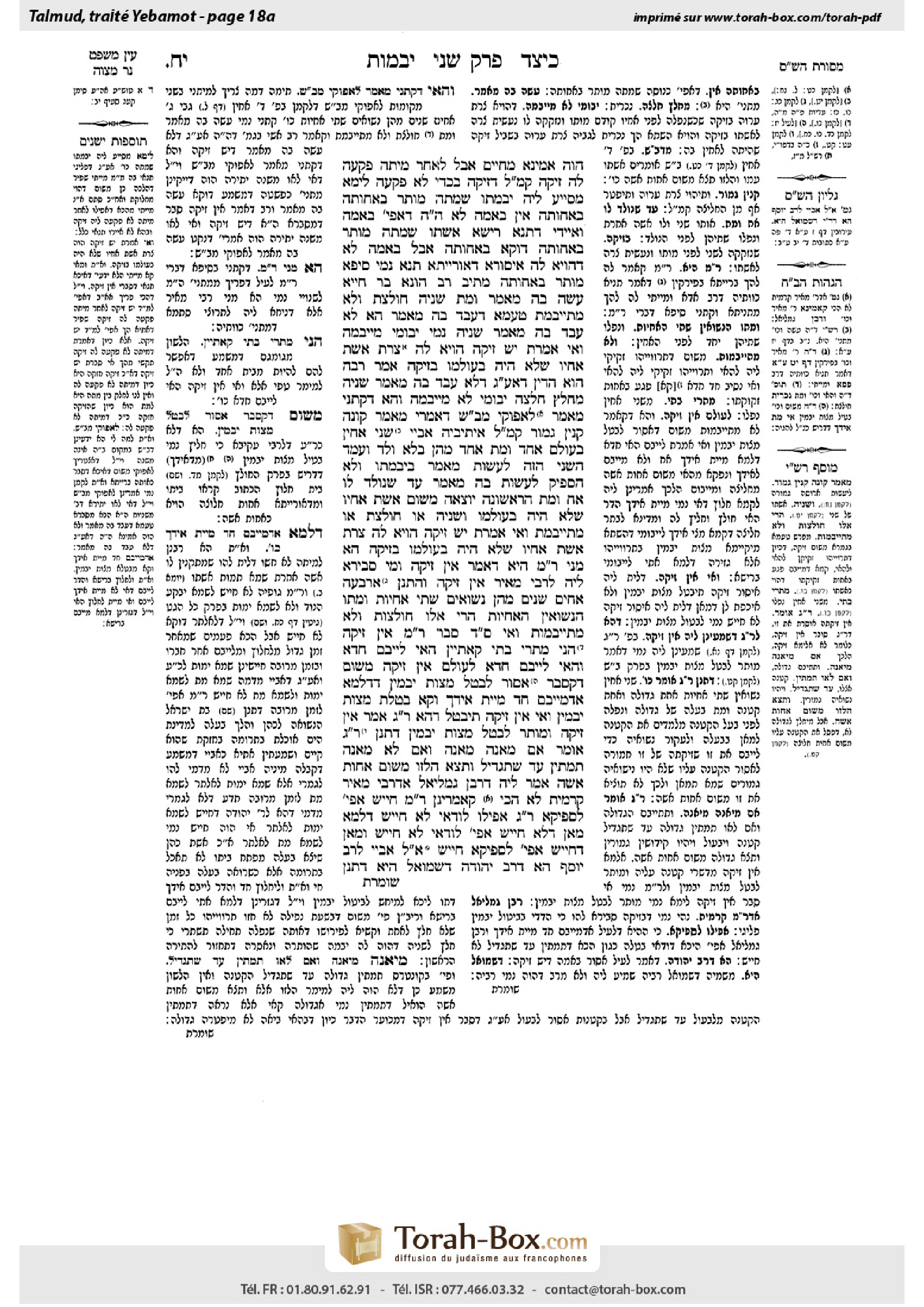
Yevamot 18a: Talmud study for Daf Yomi
Daf Yomi is the daily study of one Talmud folio. Explore 37 tractates with scans, Hebrew text, Sefaria English and AI-generated French translations where annotated.
Passage selection and English or AI-generated French translation are available where the scan has annotations. Daf Study is independent of Torah-Box and Sefaria.
Browse Yevamot · יבמות · All tractatesYevamot 18a text and translations
This page of Yevamot includes the Aramaic text, an English translation and an AI-generated French translation, alongside the scan above.
יבמות י״ח א · Aramaic and Hebrew text
הֲוָה אָמֵינָא מֵחַיִּים, אֲבָל לְאַחַר מִיתָה — פָּקְעָה לַהּ זִיקָה, קָא מַשְׁמַע לַן דְּזִיקָה בִּכְדִי לָא פָּקְעָה. לֵימָא מְסַיַּיע לֵיהּ: יְבִמְתּוֹ שֶׁמֵּתָה — מוּתָּר בַּאֲחוֹתָהּ. בַּאֲחוֹתָהּ אִין, בְּאִמָּהּ לָא!
הוּא הַדִּין דַּאֲפִילּוּ בְּאִמָּהּ, וְאַיְּידֵי דִּתְנָא רֵישָׁא: אִשְׁתּוֹ שֶׁמֵּתָה — מוּתָּר בַּאֲחוֹתָהּ, דַּוְקָא בַּאֲחוֹתָהּ, אֲבָל בְּאִמָּהּ לָא, דְּהָוְיָא לַהּ אִיסּוּרָא דְּאוֹרָיְיתָא — תְּנָא נָמֵי סֵיפָא מוּתָּר בַּאֲחוֹתָהּ.
מֵתִיב רַב הוּנָא בַּר חִיָּיא: עָשָׂה בָּהּ מַאֲמָר וּמֵת — שְׁנִיָּה חוֹלֶצֶת וְלֹא מִתְיַיבֶּמֶת. טַעְמָא דַּעֲבַד בַּהּ מַאֲמָר, הָא לָא עֲבַד בַּהּ מַאֲמָר — שְׁנִיָּה נָמֵי יַבּוֹמֵי מְיַיבְּמָה, וְאִי אָמְרַתְּ יֵשׁ זִיקָה, הָוְיָא לַהּ צָרַת אֵשֶׁת אָחִיו שֶׁלֹּא הָיָה בְּעוֹלָמוֹ בְּזִיקָה!
אָמַר רַבָּה: הוּא הַדִּין דְּאַף עַל גַּב דְּלָא עֲבַד בַּהּ מַאֲמָר — שְׁנִיָּה מִחְלָץ חָלְצָה, יַבּוֹמֵי לָא מִיַּיבְּמָה.
וְהָא דְּקָתָנֵי מַאֲמָר, לְאַפּוֹקֵי מִבֵּית שַׁמַּאי, דְּאָמְרִי: מַאֲמָר קוֹנֶה קִנְיָן גָּמוּר — קָא מַשְׁמַע לַן.
אֵיתִיבֵיהּ אַבָּיֵי: שְׁנֵי אַחִין בְּעוֹלָם אֶחָד, וָמֵת אֶחָד מֵהֶן בְּלֹא וָלָד, וְעָמַד הַשֵּׁנִי הַזֶּה לַעֲשׂוֹת מַאֲמָר בִּיבִמְתּוֹ, וְלֹא הִסְפִּיק לַעֲשׂוֹת בָּהּ מַאֲמָר עַד שֶׁנּוֹלַד לוֹ אָח, וּמֵת. הָרִאשׁוֹנָה — יוֹצְאָה מִשּׁוּם אֵשֶׁת אָחִיו שֶׁלֹּא הָיָה בְּעוֹלָמוֹ, וּשְׁנִיָּה — אוֹ חוֹלֶצֶת אוֹ מִתְיַיבֶּמֶת. וְאִי אָמְרַתְּ יֵשׁ זִיקָה, הָוְיָא לַהּ צָרַת אֵשֶׁת אָחִיו שֶׁלֹּא הָיָה בְּעוֹלָמוֹ בְּזִיקָה!
הָא מַנִּי — רַבִּי מֵאִיר הִיא, דְּאָמַר: אֵין זִיקָה. וּמִי סְבִירָא לֵיהּ לְרַבִּי מֵאִיר אֵין זִיקָה? וְהָתְנַן: אַרְבָּעָה אַחִים, שְׁנַיִם מֵהֶן נְשׂוּאִים שְׁתֵּי אֲחָיוֹת, וּמֵתוּ הַנְּשׂוּאִין הָאֲחָיוֹת — הֲרֵי אֵלּוּ חוֹלְצוֹת וְלֹא מִתְיַיבְּמוֹת.
וְאִי סָלְקָא דַעְתָּךְ סָבַר רַבִּי מֵאִיר אֵין זִיקָה, הָנֵי מִתְּרֵי בָּתֵּי קָאָתְיָין, הַאי לְיַיבֵּם חֲדָא וְהַאי לְיַיבֵּם חֲדָא!
לְעוֹלָם אֵין זִיקָה. מִשּׁוּם דְּקָסָבַר אָסוּר לְבַטֵּל מִצְוַת יְבָמִין — דְּדִלְמָא אַדִּמְיַיבֵּם חַד, מָיֵית אִידַּךְ, וְקָא בָּטְלָת מִצְוַת יְבָמִין.
וְאִי אֵין זִיקָה — תִּיבְטַל! דְּהָא רַבָּן גַּמְלִיאֵל אָמַר: אֵין זִיקָה, וּמוּתָּר לְבַטֵּל מִצְוַת יְבָמִין.
דִּתְנַן, רַבָּן גַּמְלִיאֵל אוֹמֵר: אִם מֵאֲנָה — מֵאֲנָה, וְאִם לֹא מֵאֲנָה — תַּמְתִּין עַד שֶׁתַּגְדִּיל, וְתֵצֵא הַלֵּזוּ, מִשּׁוּם אֲחוֹת אִשָּׁה.
אֲמַר לֵיהּ: דְּרַבָּן גַּמְלִיאֵל אַדְּרַבִּי מֵאִיר קָרָמֵית?! לָא, הָכִי קָאָמְרִינַן: רַבִּי מֵאִיר חָיֵישׁ אֲפִילּוּ לִסְפֵיקָא, רַבָּן גַּמְלִיאֵל אֲפִילּוּ לְוַדַּאי לָא חָיֵישׁ! דִּלְמָא מַאן דְּלָא חָיֵישׁ — אֲפִילּוּ לְוַדַּאי לָא חָיֵישׁ, וּמַאן דְּחָיֵישׁ — אֲפִילּוּ לִסְפֵיקָא חָיֵישׁ.
אֲמַר לֵיהּ אַבָּיֵי לְרַב יוֹסֵף: הָא דְּרַב יְהוּדָה — דִּשְׁמוּאֵל הִיא. דִּתְנַן:
Yevamot 18a · English translation
I would say that the levirate bond applies as long as the yevama requiring levirate marriage is alive but that after her death the bond was terminated. In other words, after the yevama died any relationship between the two dissolved. This comes to teach us that the bond is not terminated without cause but instead requires an actual act, such as ḥalitza or levirate marriage. Until one of these acts is performed, the bond remains in place. Let us say that it supports Rav Yehuda’s opinion from that which was taught: If his yevama dies, he is permitted to marry her sister. From here the Gemara deduces: Her sister, yes; her mother, no, in accordance with the opinion of Rav Yehuda.
The Gemara rejects this: The same is true, that even her mother is permitted. And this language was used only since he taught in the first clause of the baraita: If his wife dies he is permitted to take her sister; specifically her sister but not her mother, as she is forbidden by Torah law. Therefore, he also taught in the latter clause that he is permitted to marry her sister.
Rav Huna bar Ḥiyya raised an objection to this from the mishna: If he performed levirate betrothal with her and then died, the second woman performs ḥalitza and may not enter into levirate marriage. This implies that the reason is specifically that he performed levirate betrothal with her. Had the brother not performed levirate betrothal with her, the second woman would also be permitted to enter into levirate marriage. And if you say that the levirate bond is substantial, then she would be considered a rival wife of the wife of a brother with whom the third brother did not coexist by that bond. Since the wife of a brother with whom he did not coexist is prohibited from entering into levirate marriage, her rival wife would likewise be forbidden from doing so.
Rabba said: This should not be read precisely, as the same is true even if the second brother did not perform levirate betrothal; the second woman must perform ḥalitza but may not enter into levirate marriage, as the levirate bond renders her a rival wife of the wife of a brother with whom the third brother did not coexist.
And the reason that it teaches the case of levirate betrothal specifically was in order to exclude the opinion of Beit Shammai, who said: The legal status of levirate betrothal with a yevama eligible for levirate marriage is that of a full-fledged acquisition, and it is legally binding to the same degree as an actual betrothal. Therefore, even ḥalitza would be unnecessary, similar to the case of a rival wife of a forbidden relation. This is what it comes to teach us: Even if he performed levirate betrothal she is not truly considered the rival wife of a forbidden relation; the prohibition concerning her is by rabbinic law, and she is therefore required to perform ḥalitza.
Abaye raised an objection to this from that which was taught: In the case of two brothers who coexisted, and one died childless and the second arose to perform levirate betrothal with his yevama but did not manage to perform levirate betrothal before a third brother was born, and then the second brother, who also had a wife, died, whereby both women would fall before the newly born brother for levirate marriage, then the first goes out and is not obligated in levirate marriage because she is the wife of his brother with whom he did not coexist, and the second woman, who was the wife of the second brother, either performs ḥalitza or enters into levirate marriage. But if you say that the levirate bond is substantial, then the wife of the second brother would be rendered a rival wife of the wife of a brother with whom he did not coexist by that bond.
The Gemara rejects that: In accordance with whose opinion is this? It is the opinion of Rabbi Meir, who said: The levirate bond is not substantial. The Gemara asks: Does Rabbi Meir hold that the levirate bond is not substantial? After all, unattributed mishnayot are in accordance with the opinion of Rabbi Meir, and didn’t we learn in a mishna (26a): In the case of four brothers, two of whom are married to two sisters, if those married to the sisters died, whereby both sisters fall before the surviving brothers for levirate marriage, then those two sisters must perform ḥalitza and may not enter into levirate marriage. It would seem that the reason for this is that each of the sisters has a levirate bond to both remaining brothers.
And if it enters your mind to say that Rabbi Meir held that the levirate bond is not substantial, didn’t these two sisters come from two different houses, as each was married to a different brother? If so, one brother should take one in levirate marriage and the other should take one in levirate marriage.
The Gemara answers: Actually, in Rabbi Meir’s opinion the levirate bond is not substantial. The mishna states that they perform ḥalitza and do not enter into levirate marriage because he held that it is prohibited to nullify the mitzva of levirate marriage. That is to say, it is prohibited to act in such a way that the mitzva of levirate marriage becomes obviated. Under these circumstances there is concern that perhaps as one brother performs levirate marriage to one of the sisters the other brother dies before he manages to perform levirate marriage to the other. If that were to happen, you would thereby nullify the mitzva of levirate marriage since the sister that would now fall before the remaining brother would be his wife’s sister and therefore prohibited from entering into levirate marriage with him.
The Gemara objects: But if the levirate bond is not substantial, then let the mitzva of levirate marriage be nullified. That is, if the levirate bond does not carry any real obligation, then the mitzva itself never truly came into effect. As Rabban Gamliel said: The levirate bond is not substantial, and it is permitted to nullify the mitzva of levirate marriage.
As we learned in a mishna (109a): That mishna discusses a case of two brothers who were married to two sisters. One sister is an adult and therefore her marriage was fully effectual, and one sister is still a minor, and she was orphaned from her father, and her marriage was valid only by rabbinic ordinance. If the brother who was married to the elder sister died, then that sister falls for levirate marriage before the brother married to the minor. Under these circumstances, the Sages suggested directing the minor to refuse her marriage to her husband so that he would be able to take his brother’s wife in levirate marriage. If the minor does not do so, he would be unable to take her sister in marriage, as she would be the sister of his minor wife and thereby fully exempt from the levirate obligation. Rabban Gamliel said: If the minor refused in the meantime of her own accord, then she refused, but if she did not refuse, let her wait until she reaches the age of maturity, and then that other adult sister will be exempt from performing ḥalitza or levirate marriage due to the fact that she is his wife’s sister. Here it is apparent that Rabban Gamliel is not concerned about nullifying the mitzva of levirate marriage from one of them.
Rabba said to Abaye: Do you wish to raise a contradiction between the words of Rabban Gamliel and Rabbi Meir? This would imply that the contradiction needs to be resolved, but statements from two different tanna’im do not need to agree or to be resolved. Abaye responded: No, in fact this is what we meant to say: How could one possibly say that Rabbi Meir is concerned lest there be nullification of the mitzva of levirate marriage even when it is uncertain because perhaps the first brother will not die, whereas Rabban Gamliel is not concerned that the mitzva be nullified even when it is certain? It is surprising that there should be such a great difference between the tannaitic opinions. Rabba answered: Perhaps the one who is not concerned about nullification of the mitzva of levirate marriage is not concerned even if nullification is certain, and the one who is concerned is concerned even if nullification is uncertain.
With regard to the actual dispute between Rav Huna and Rav Yehuda, Abaye said to Rav Yosef: This halakha stated by Rav Yehuda, that even if a woman waiting for levirate marriage dies her mother is still forbidden to the yavam, is from his teacher Shmuel and not from Rav, who was also one of his teachers. Evidence for this can be found in that which we learned in a mishna (41a):
Yevamot 18a · Traduction française (IA)
On aurait pu dire que le lien de lévirat subsiste tant que la yevama qui doit contracter un mariage léviratique est en vie, mais qu’il prend fin après sa mort. Autrement dit, après la mort de la yevama, toute relation entre eux serait dissoute. Cela vient nous apprendre que le lien ne prend pas fin de lui-même, mais qu’il faut un acte concret, tel que la ḥalitza ou le mariage léviratique. Tant que l’un de ces actes n’a pas été accompli, le lien subsiste. Disons que cela appuie l’opinion de Rav Yehouda, d’après ce qui a été enseigné : Si sa yevama meurt, il lui est permis d’épouser sa sœur. La Guemara en déduit : sa sœur, oui ; sa mère, non, conformément à l’opinion de Rav Yehouda.
La Guemara rejette cette déduction : il en va de même pour sa mère, qui est elle aussi permise. Cette formulation a simplement été employée parce que, dans la première partie de la baraïta, il a enseigné : Si sa femme meurt, il lui est permis d’épouser sa sœur ; sa sœur précisément, mais pas sa mère, car celle-ci lui est interdite par la Torah. C’est pourquoi, dans la dernière partie, il a également enseigné qu’il lui est permis d’épouser sa sœur.
Rav Houna bar Ḥiyya souleva une objection à partir de la Michna : S’il a procédé aux fiançailles léviratiques avec elle, puis qu’il est mort, la seconde femme doit accomplir la ḥalitza et ne peut pas contracter de mariage léviratique. Cela implique que la raison en est précisément qu’il a procédé aux fiançailles léviratiques avec elle. Si le frère n’avait pas procédé à ces fiançailles avec elle, la seconde femme aurait également été autorisée à contracter un mariage léviratique. Or, si l’on dit que le lien de lévirat est substantiel, elle serait alors considérée comme la coépouse de la femme d’un frère avec lequel le troisième frère n’avait pas coexisté sous ce lien. Puisque la femme d’un frère avec lequel il n’a pas coexisté ne peut pas contracter de mariage léviratique, sa coépouse devrait également en être exclue.
Rabba dit : Il ne faut pas interpréter cette formulation de manière restrictive ; il en va de même si le second frère n’a pas procédé aux fiançailles léviratiques. La seconde femme doit accomplir la ḥalitza, mais ne peut pas contracter de mariage léviratique, car le lien de lévirat fait d’elle la coépouse de la femme d’un frère avec lequel le troisième frère n’avait pas coexisté.
La raison pour laquelle le texte enseigne précisément le cas des fiançailles léviratiques est d’exclure l’opinion de Beit Chammaï, qui disait : Les fiançailles léviratiques avec une yevama éligible au mariage léviratique ont le statut d’une acquisition pleine et entière et sont contraignantes au même degré que de véritables fiançailles. Par conséquent, même la ḥalitza serait inutile, comme dans le cas d’une coépouse liée à une parente interdite. Voici ce que cela vient nous apprendre : même s’il a procédé aux fiançailles léviratiques, elle n’est pas véritablement considérée comme la coépouse d’une parente interdite ; l’interdiction qui la concerne relève de la loi rabbinique, et elle doit donc accomplir la ḥalitza.
Abayé souleva une objection à partir de ce qui a été enseigné : Dans le cas de deux frères qui ont coexisté, dont l’un est mort sans enfant et dont le second s’est présenté pour procéder aux fiançailles léviratiques avec sa yevama, mais n’a pas eu le temps de le faire avant la naissance d’un troisième frère, puis le second frère, qui avait également une épouse, est mort, de sorte que les deux femmes se retrouvent devant le frère nouvellement né pour le mariage léviratique, la première est exclue et n’est pas soumise au mariage léviratique, car elle est la femme de son frère avec lequel il n’a pas coexisté ; quant à la seconde femme, qui était l’épouse du deuxième frère, elle doit soit accomplir la ḥalitza, soit contracter un mariage léviratique. Mais si l’on dit que le lien de lévirat est substantiel, l’épouse du deuxième frère serait alors considérée comme la coépouse de la femme d’un frère avec lequel il n’avait pas coexisté sous ce lien.
La Guemara rejette cette objection : De qui est-ce l’opinion ? C’est celle de Rabbi Meïr, qui disait que le lien de lévirat n’est pas substantiel. La Guemara demande : Rabbi Meïr considère-t-il que le lien de lévirat n’est pas substantiel ? Après tout, les Michnayot anonymes sont conformes à l’opinion de Rabbi Meïr, et n’avons-nous pas appris dans une Michna (26a) : Dans le cas de quatre frères, dont deux sont mariés à deux sœurs, si les deux frères mariés aux sœurs meurent, de sorte que les deux sœurs se retrouvent devant les frères survivants pour le mariage léviratique, ces deux sœurs doivent accomplir la ḥalitza et ne peuvent pas contracter de mariage léviratique. Il semblerait que la raison en soit que chacune des sœurs est liée par le lévirat aux deux frères restants.
Et si l’on envisage de dire que Rabbi Meïr estimait que le lien de lévirat n’est pas substantiel, ces deux sœurs ne viennent-elles pas de deux foyers différents, puisque chacune était mariée à un frère différent ? Dans ce cas, un frère devrait épouser l’une en mariage léviratique, et l’autre frère devrait épouser l’autre.
La Guemara répond : En réalité, selon l’opinion de Rabbi Meïr, le lien de lévirat n’est pas substantiel. La Michna dit qu’elles accomplissent la ḥalitza et ne contractent pas de mariage léviratique parce qu’il estimait qu’il est interdit d’annuler la mitsva du mariage léviratique. Autrement dit, il est interdit d’agir de telle sorte que la mitsva du mariage léviratique soit rendue sans objet. Dans ces circonstances, on craint que, pendant que l’un des frères épouse l’une des sœurs en mariage léviratique, l’autre frère ne meure avant d’avoir pu épouser l’autre sœur de la même manière. Si cela se produisait, la mitsva du mariage léviratique serait ainsi annulée, car la sœur qui se retrouverait alors devant le frère survivant serait la sœur de son épouse et ne pourrait donc pas contracter avec lui de mariage léviratique.
La Guemara objecte : Mais si le lien de lévirat n’est pas substantiel, qu’on laisse donc la mitsva du mariage léviratique être annulée. Autrement dit, si le lien de lévirat n’entraîne aucune véritable obligation, la mitsva elle-même n’est jamais réellement entrée en vigueur. C’est ce qu’a dit Rabban Gamliel : le lien de lévirat n’est pas substantiel, et il est permis d’annuler la mitsva du mariage léviratique.
Comme nous l’avons appris dans une Michna (109a) : Cette Michna traite du cas de deux frères mariés à deux sœurs. L’une des sœurs est majeure, et son mariage est donc pleinement valide ; l’autre est encore mineure, orpheline de père, et son mariage n’est valide qu’en vertu d’une ordonnance rabbinique. Si le frère marié à la sœur aînée meurt, celle-ci se retrouve devant le frère marié à la mineure pour le mariage léviratique. Dans ces circonstances, les Sages proposèrent d’inciter la mineure à refuser son mariage avec son mari, afin qu’il puisse épouser en mariage léviratique la femme de son frère. Si la mineure ne le fait pas, il ne pourra pas épouser sa sœur, puisqu’elle serait la sœur de sa femme mineure et serait ainsi entièrement dispensée de l’obligation du lévirat. Rabban Gamliel dit : Si, entre-temps, la mineure a refusé de son propre chef, elle a refusé ; mais si elle n’a pas refusé, qu’elle attende d’atteindre l’âge de la majorité, et alors l’autre sœur, adulte, sera dispensée d’accomplir la ḥalitza ou de contracter un mariage léviratique, car elle est la sœur de son épouse. Il apparaît ici que Rabban Gamliel ne craint pas que la mitsva du mariage léviratique soit annulée pour l’une d’elles.
Rabba dit à Abayé : Veux-tu soulever une contradiction entre les propos de Rabban Gamliel et ceux de Rabbi Meïr ? Cela laisserait entendre qu’il faut résoudre cette contradiction, mais les propos de deux tannaïm différents n’ont pas à concorder ni à être conciliés. Abayé répondit : Non ; en réalité, voici ce que nous voulions dire : Comment pourrait-on prétendre que Rabbi Meïr craint que la mitsva du mariage léviratique soit annulée même lorsque cela est incertain, car peut-être le premier frère ne mourra-t-il pas, alors que Rabban Gamliel ne craint pas que la mitsva soit annulée même lorsque cela est certain ? Il est étonnant qu’il y ait une si grande différence entre les opinions des tannaïm. Rabba répondit : Peut-être celui qui ne craint pas l’annulation de la mitsva du mariage léviratique ne la craint-il même pas lorsque l’annulation est certaine, tandis que celui qui la craint s’en inquiète même lorsqu’elle est incertaine.
À propos du désaccord proprement dit entre Rav Houna et Rav Yehouda, Abayé dit à Rav Yossef : Cette halakha énoncée par Rav Yehouda, selon laquelle même si une femme en attente du mariage léviratique meurt, sa mère reste interdite au yavam, lui vient de son maître Chmouel, et non de Rav, qui était également l’un de ses maîtres. On en trouve une preuve dans ce que nous avons appris dans une Michna (41a) :
Traduction française générée par IA à partir de l’édition anglaise de Sefaria. Vérifie toujours un passage avec le texte source.
Text from Sefaria: William Davidson Edition - Vocalized Aramaic (CC BY NC); William Davidson Edition - English (CC BY NC).