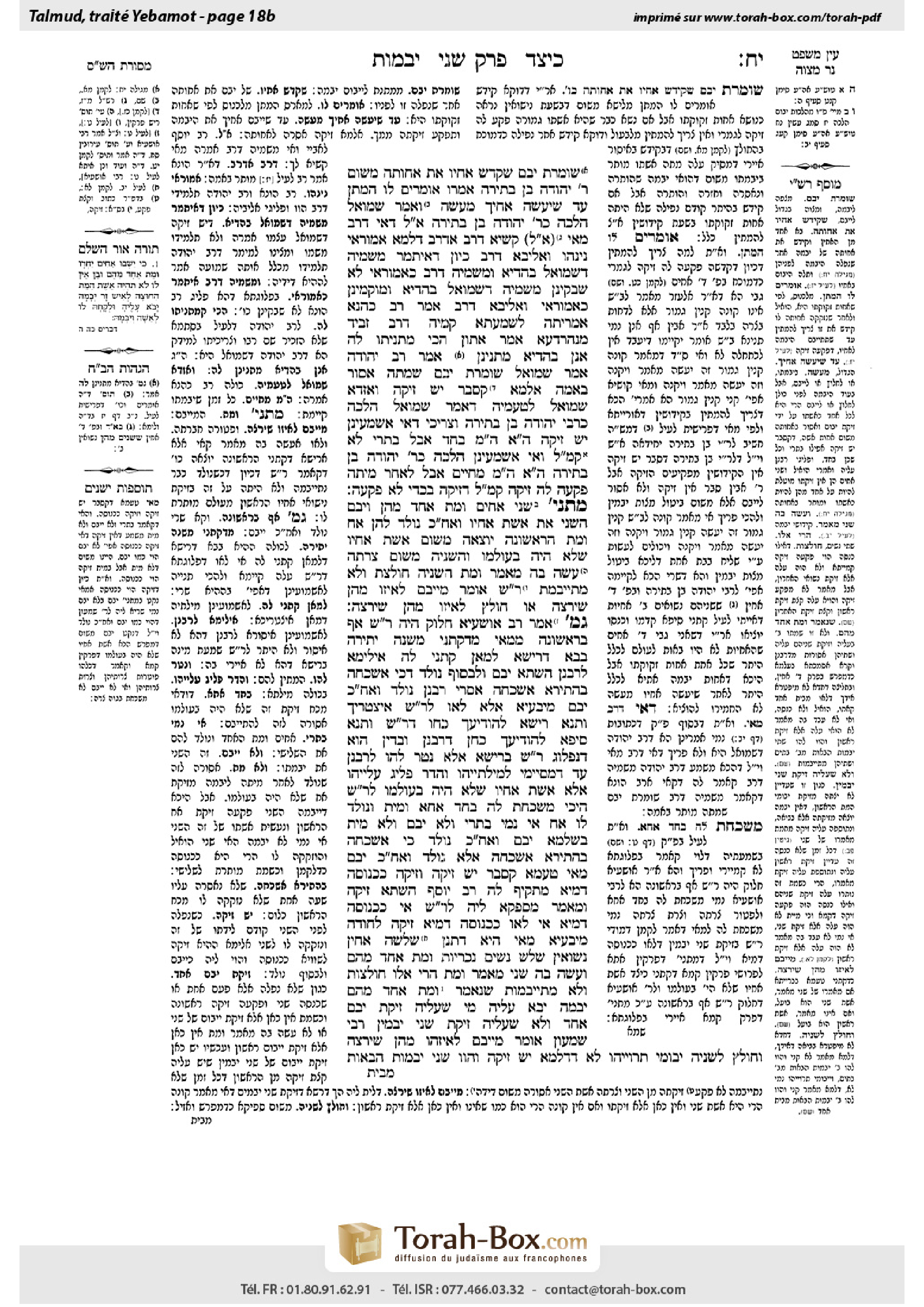
Yevamot 18b: Talmud study for Daf Yomi
Daf Yomi is the daily study of one Talmud folio. Explore 37 tractates with scans, Hebrew text, Sefaria English and AI-generated French translations where annotated.
Passage selection and English or AI-generated French translation are available where the scan has annotations. Daf Study is independent of Torah-Box and Sefaria.
Browse Yevamot · יבמות · All tractatesYevamot 18b text and translations
This page of Yevamot includes the Aramaic text, an English translation and an AI-generated French translation, alongside the scan above.
יבמות י״ח ב · Aramaic and Hebrew text
שׁוֹמֶרֶת יָבָם שֶׁקִּדֵּשׁ אָחִיו אֶת אֲחוֹתָהּ, מִשּׁוּם רַבִּי יְהוּדָה בֶּן בְּתִירָה אָמְרוּ: אוֹמְרִים לוֹ: הַמְתֵּן עַד שֶׁיַּעֲשֶׂה אָחִיךָ מַעֲשֶׂה. וְאָמַר שְׁמוּאֵל: הֲלָכָה כְּרַבִּי יְהוּדָה בֶּן בְּתִירָה.
אֲמַר לֵיהּ: דְּאִי דְּרַב מַאי? (אֲמַר לֵיהּ:) קַשְׁיָא דְּרַב אַדְּרַב! דִּלְמָא אָמוֹרָאֵי נִינְהוּ, וְאַלִּיבָּא דְּרַב. כֵּיוָן דְּאִיתְּמַר מִשְּׁמֵיהּ דִּשְׁמוּאֵל בְּהֶדְיָא, וּמִשְּׁמֵיהּ דְּרַב כְּאָמוֹרָאֵי — לָא שָׁבְקִינַן מִשְּׁמֵיהּ דִּשְׁמוּאֵל בְּהֶדְיָא וּמוֹקְמִינַן כְּאָמוֹרָאֵי וְאַלִּיבָּא דְּרַב.
אָמַר רַב כָּהֲנָא: אַמְרִיתַהּ לִשְׁמַעְתָּא קַמֵּיהּ דְּרַב זְבִיד מִנְּהַרְדְּעָא, אָמַר: אַתּוּן, הָכִי מַתְנִיתוּ לַהּ! אֲנַן, בְּהֶדְיָא מַתְנֵינַן. אָמַר רַב יְהוּדָה אָמַר שְׁמוּאֵל: שׁוֹמֶרֶת יָבָם שֶׁמֵּתָה — אָסוּר בְּאִמָּהּ. אַלְמָא קָסָבַר יֵשׁ זִיקָה. וְאַזְדָּא שְׁמוּאֵל לְטַעְמֵיהּ, דְּאָמַר שְׁמוּאֵל: הֲלָכָה כְּרַבִּי יְהוּדָה בֶּן בְּתִירָה.
וּצְרִיכִי, דְּאִי אַשְׁמְעִינַן יֵשׁ זִיקָה, הֲוָה אָמֵינָא: הָנֵי מִילֵּי בְּחַד, אֲבָל בִּתְרֵי — לָא, קָא מַשְׁמַע לַן. וְאִי אַשְׁמְעִינַן הֲלָכָה כְּרַבִּי יְהוּדָה בֶּן בְּתִירָה, הֲוָה אָמֵינָא: הָנֵי מִילֵּי מֵחַיִּים, אֲבָל לְאַחַר מִיתָה — פָּקְעָה לַהּ זִיקָה, קָא מַשְׁמַע לַן דְּזִיקָה בִּכְדִי לָא פָּקְעָה.
מַתְנִי׳ שְׁנֵי אַחִים, וּמֵת אֶחָד מֵהֶן, וְיִבֵּם הַשֵּׁנִי אֶת אֵשֶׁת אָחִיו, וְאַחַר כָּךְ נוֹלַד לָהֶן אָח, וּמֵת, הָרִאשׁוֹנָה יוֹצְאָה מִשּׁוּם אֵשֶׁת אָחִיו שֶׁלֹּא הָיָה בְּעוֹלָמוֹ, וְהַשְּׁנִיָּה — מִשּׁוּם צָרָתָהּ. עָשָׂה בָּהּ מַאֲמָר וּמֵת — הַשְּׁנִיָּה חוֹלֶצֶת וְלֹא מִתְיַיבֶּמֶת.
רַבִּי שִׁמְעוֹן אוֹמֵר: מְיַיבֵּם לְאֵיזוֹ מֵהֶן שֶׁיִּרְצֶה, אוֹ חוֹלֵץ לְאֵיזוֹ מֵהֶן שֶׁיִּרְצֶה.
גְּמָ׳ אָמַר רַב אוֹשַׁעְיָא: חָלוּק הָיָה רַבִּי שִׁמְעוֹן אַף בָּרִאשׁוֹנָה. מִמַּאי — מִדְּקָתָנֵי מִשְׁנָה יַתִּירָה.
בָּבָא דְרֵישָׁא לְמַאן קָתָנֵי לַהּ? אִילֵּימָא לְרַבָּנַן, הַשְׁתָּא יִבֵּם וּלְבַסּוֹף נוֹלַד, דְּכִי אַשְׁכְּחַהּ — בְּהֶתֵּירָא אַשְׁכְּחַהּ, אָסְרִי רַבָּנַן, נוֹלַד וְאַחַר כָּךְ יִבֵּם, מִיבַּעְיָא? אֶלָּא לָאו, לְרַבִּי שִׁמְעוֹן אִיצְטְרִיךְ,
וּתְנָא רֵישָׁא לְהוֹדִיעֲךָ כֹּחוֹ דְּרַבִּי שִׁמְעוֹן, וּתְנָא סֵיפָא לְהוֹדִיעֲךָ כֹּחָן דְּרַבָּנַן. וּבְדִין הוּא דְּנִפְלוֹג רַבִּי שִׁמְעוֹן בְּרֵישָׁא, אֶלָּא נָטַר לְהוּ לְרַבָּנַן עַד דִּמְסַיְּימִי לְמִילְּתַיְיהוּ, וַהֲדַר פְּלִיג עֲלַיְיהוּ.
אֶלָּא אֵשֶׁת אָחִיו שֶׁלֹּא הָיָה בְּעוֹלָמוֹ לְרַבִּי שִׁמְעוֹן הֵיכִי מַשְׁכַּחַתְּ לַהּ? בְּחַד אַחָא, וּמִית, וְנוֹלַד לוֹ אָח. אִי נָמֵי: בִּתְרֵי, וְלָא יִבֵּם, וְלָא מִית.
בִּשְׁלָמָא יִבֵּם וְאַחַר כָּךְ נוֹלַד, כִּי אַשְׁכְּחַהּ — בְּהֶתֵּירָא אַשְׁכְּחַהּ. אֶלָּא נוֹלַד וְאַחַר כָּךְ יִבֵּם — מַאי טַעְמָא? קָסָבַר: יֵשׁ זִיקָה, וְזִיקָה כִּכְנוּסָה דָּמְיָא.
מַתְקֵיף לַהּ רַב יוֹסֵף: הַשְׁתָּא זִיקָה וּמַאֲמָר מְסַפְּקָא לֵיהּ לְרַבִּי שִׁמְעוֹן אִי כִּכְנוּסָה דָּמְיָא אִי לָאו כִּכְנוּסָה דָּמְיָא, זִיקָה לְחוֹדַהּ מִיבַּעְיָא?
מַאי הִיא — דִּתְנַן: שְׁלֹשָׁה אַחִין נְשׂוּאִין שָׁלֹשׁ נָשִׁים נׇכְרִיּוֹת, וּמֵת אֶחָד מֵהֶם, וְעָשָׂה בָּהּ שֵׁנִי מַאֲמָר, וּמֵת — הֲרֵי אֵלּוּ חוֹלְצוֹת וְלֹא מִתְיַיבְּמוֹת.
שֶׁנֶּאֱמַר: ״וּמֵת אֶחָד מֵהֶם ... יְבָמָהּ יָבֹא עָלֶיהָ״, מִי שֶׁעָלֶיהָ זִיקַת יָבָם אֶחָד, וְלֹא שֶׁעָלֶיהָ זִיקַת שְׁנֵי יְבָמִין.
רַבִּי שִׁמְעוֹן אוֹמֵר: מְיַיבֵּם לְאֵיזֶהוּ מֵהֶן שֶׁיִּרְצֶה, וְחוֹלֵץ לַשְּׁנִיָּה. יַבּוֹמֵי תַּרְוַיְיהוּ לָא — דְּדִלְמָא יֵשׁ זִיקָה, וְהָווּ שְׁתֵּי יְבָמוֹת הַבָּאוֹת
Yevamot 18b · English translation
In the case of a widow waiting for her yavam to take her in levirate marriage or perform ḥalitza, if his brother betrothed her sister they said in the name of Rabbi Yehuda ben Beteira: They say to the brother who betrothed her: Wait and do not marry your betrothed until your brother performs the required action, either ḥalitza or levirate marriage. This is because until that time the levirate bond is still applicable and the woman betrothed to you is forbidden to you as the sister of a woman bonded to you. And Shmuel said: The halakha is in accordance with the opinion of Rabbi Yehuda ben Beteira. From here one may infer that Shmuel holds that the levirate bond is substantial.
Rav Yosef said to him: And if it were the opinion of Rav, what problem would there be? Abaye said to him: It is difficult because there would be a contradiction between the opinion of Rav and another statement of Rav, since Rav Huna cited Rav, and the conclusion from his statements was that the levirate bond is not substantial. He said to him: Rav Huna and Rav Yehuda each cited Rav. Perhaps they are amora’im and disagree in accordance with the opinion of Rav, i.e., with regard to his opinion? The Gemara answers: Since that which was stated in the name of Shmuel was explicit, while that said in the name of Rav must be explained as an amoraic dispute, we will not leave that statement said explicitly in the name of Shmuel and explain it as an amoraic dispute according to the opinion of Rav.
Rav Kahana said: I reported this discussion before Rav Zevid of Neharde’a. He said: That is how you teach this, without knowing for certain that Rav Yehuda was stating the halakha in the name of Shmuel. We learn it explicitly: Rav Yehuda said that Shmuel said: In the case of a widow waiting for her yavam who died before he could perform ḥalitza or levirate marriage, he is prohibited from marrying her mother. Apparently Shmuel holds that the levirate bond is substantial. And Shmuel conforms to his standard line of reasoning, as Shmuel also said: The halakha is in accordance with the opinion of Rabbi Yehuda ben Beteira.
The Gemara comments: Both statements by Shmuel on the subject are necessary and there was no redundancy here, as, if he were to teach us only the principle that the levirate bond is substantial, I would say that this applies only to the case of one yavam but not to a case of two yevamin, where the levirate bond is not as strong. This comes to teach us that even in the case of two yevamin there is a bond, and that is the conclusive halakha put forth by Rabbi Yehuda ben Beteira. And if he were to teach us only that the halakha is in accordance with the opinion of Rabbi Yehuda ben Beteira, I would say that this applies only in the case where the woman awaiting levirate marriage is living, but after her death the levirate bond is terminated and he is permitted to marry her relatives. This comes to teach us that the levirate bond is not terminated without cause but rather it is necessary to perform some act in order to exempt her from it.
MISHNA: If there were two brothers, and one died, and the second entered into levirate marriage with his brother’s wife while he was already married to another woman, and subsequently a third brother was born to them, and the second brother then died, whereby both of his wives happened before the third brother for levirate marriage, then the first woman, who was the wife of the first brother, is exempt due to the fact that she is the wife of a brother with whom the third brother did not coexist, and the second woman, who was the first wife of the second brother, is exempt due to her rival wife. If the second brother had performed only levirate betrothal with her and then died before fully marrying her, the second woman performs ḥalitza and may not enter into levirate marriage, as the levirate betrothal is not considered a sufficiently valid marriage so as to render her the rival wife of a relation forbidden to the third brother.
Rabbi Shimon says with regard to the first clause of the mishna: The third brother either enters into levirate marriage with whichever one he wishes, or he performs ḥalitza with whichever one he wishes. Since he was born after his second brother had already entered into levirate marriage with the first brother’s widow, she is considered the wife of a brother with whom he did coexist, not the wife of a brother with whom he did not coexist. Therefore, he may enter into levirate marriage with her.
GEMARA: Rav Oshaya said: Rabbi Shimon’s opinion differed even on the first mishna. That is, Rabbi Shimon disagreed not only in the case stated explicitly in this mishna, in which the newly born brother came into the world after the widow of his first brother had already married his second brother, but he also disagreed in the case of the first mishna in the chapter, where the third brother was born prior to his second brother entering into levirate marriage with the widow. From where is this derived? Rav Oshaya came to this conclusion from the fact that it teaches a superfluous mishna.
How so? In accordance with whose opinion is it teaching the section of the first clause, i.e., the previous mishna? If we say it is the opinion of the Rabbis, who prohibit marriage to the wife of a brother with whom one did not coexist in all cases, then let us look at the second mishna. Now that even in the case where the second brother entered into levirate marriage and afterward the third brother was born, such that when he found her, i.e., when he was born, she had a permitted status, as she was already married to the second brother, she was never in his lifetime the wife of a brother with whom he did not coexist but was in fact for him the wife of a living brother. Nevertheless, even under such circumstances, the Rabbis prohibit him from entering into levirate marriage with her. Is it necessary, then, to teach the case presented in the first mishna of a third brother who was born and subsequently the second brother entered into levirate marriage with the wife of the first brother? According to the opinion of the Rabbis, this first mishna is redundant. Rather, is it not that it was necessary to state this first mishna for the opinion of Rabbi Shimon?
If so, this is how it must be understood: The first mishna was taught in order to convey to you the far-reaching nature of the opinion of Rabbi Shimon, which allows even the case specified in the first mishna, and the latter clause, i.e., the present mishna, was taught to convey the far-reaching nature of the opinion of the Rabbis, that even if the third brother was born after levirate marriage to the second brother she remains forbidden to the third brother. And by right it should have explained that Rabbi Shimon disagrees even in the first mishna, but the author of the mishna waited until the Rabbis finished their words, and then he went back and wrote that Rabbi Shimon disagreed with them.
The Gemara asks: But according to the opinion of Rabbi Shimon, how can you find this case of the wife of a brother with whom he did not coexist? The Gemara answers: It is in the case of a single brother who died and subsequently another brother was born to him. Here, the widow would be the wife of a brother with whom he did not coexist, and she would not be required to perform ḥalitza or enter into levirate marriage with him. Alternatively, it can be found in the case of two brothers, one of whom died, and the remaining brother did not take the deceased brother’s wife in levirate marriage, and did not die, and in the meantime a third brother was born. She still has the levirate bond due to the deceased brother, who was a brother with whom the newly born brother did not coexist.
The Gemara proceeds to clarify Rabbi Shimon’s position: Granted, in the case when the second brother first performed levirate marriage and subsequently the third brother was born, it is possible to explain that when the third brother found her, i.e., when he was born, he found her in a permitted state because when he was born she was already the wife of a living brother with whom he coexisted. But if he was born and subsequently the second brother performed levirate marriage, what is the reason that Rabbi Shimon renders her permitted? The Gemara answers: One must say that Rabbi Shimon holds that the levirate bond is substantial, and that the bond itself created a tie of kinship. Moreover, a woman with a levirate bond is considered like a married woman. Since there is a bond between the yevama and the living brother it is as though she were already married to him. Accordingly, she is, for the new brother, like the wife of his brother with whom he coexisted.
Rav Yosef strongly objects to this: Now that in the case of a levirate bond and a levirate betrothal together Rabbi Shimon is uncertain as to whether she is similar to a married woman or an unmarried woman, is it necessary to say that by levirate bond alone she is not like a married woman? If so, how can the Gemara assume that for Rabbi Shimon, the levirate bond alone gives her the status of a married woman?
What is the proof that this is Rabbi Shimon’s opinion? As we learned in a mishna (31b): In the case of three brothers who were married to three unrelated women, and one of the brothers died, and the second brother performed levirate betrothal with the widow and subsequently died, then these women, both the first wife of the second brother and the betrothed widow of the first brother, must perform ḥalitza and may not enter into levirate marriage with the third brother.
What is the reason that the wife of the first brother is not eligible for levirate marriage? As it is stated: “And one of them dies…her brother-in-law will have intercourse with her and will take her to him to be his wife and consummate the levirate marriage” (Deuteronomy 25:5). From here it is derived: She who is subject to a levirate bond with a single yavam enters levirate marriage and not she who is subject to a levirate bond with two yevamin. This woman requires levirate marriage due to the death of the first brother, and also, due to the subsequent levirate betrothal, requires levirate marriage following the death of the second brother.
However, Rabbi Shimon says: Let him enter into levirate marriage with whichever he wishes and perform ḥalitza with the second. Rabbi Shimon does not accept the homiletical interpretation forbidding a woman who is subject to two levirate bonds. The Gemara explains his opinion: Rabbi Shimon does not allow him to take both in levirate marriage. Why not? Perhaps the levirate bond is substantial, and combined with the levirate bond to the second brother the woman might be considered to be already married to the second brother, and then these two women would be two yevamot who come
Yevamot 18b · Traduction française (IA)
Dans le cas d’une veuve qui attend que son yavam la prenne en mariage léviratique ou accomplisse la ḥalitsa, si son frère a fiancé la sœur de cette veuve, on a enseigné au nom de Rabbi Yehuda ben Beteira : On dit au frère qui l’a fiancée : « Attends et n’épouse pas ta fiancée avant que ton frère accomplisse l’acte requis, soit la ḥalitsa, soit le mariage léviratique. » En effet, jusque-là, le lien léviratique demeure, et la femme que tu as fiancée t’est interdite, car elle est la sœur d’une femme qui est liée à toi par ce lien. Et Shmuel a dit : La halakha suit l’opinion de Rabbi Yehuda ben Beteira. On peut en déduire que, selon Shmuel, le lien léviratique a une portée juridique.
Rav Yosef lui dit : Et si c’était l’opinion de Rav, quel serait le problème ? Abaye lui répondit : Cela pose difficulté, car il y aurait une contradiction entre l’opinion de Rav et une autre déclaration de Rav : Rav Huna a cité Rav, et l’on déduit de ses propos que le lien léviratique n’a pas de portée juridique. Il lui dit : Rav Huna et Rav Yehuda ont chacun cité Rav. Peut-être sont-ils des amoraïm en désaccord sur l’opinion de Rav, c’est-à-dire sur ce qu’il pensait ? La Guemara répond : Puisque la déclaration attribuée à Shmuel est explicite, tandis que celle attribuée à Rav doit être comprise comme l’objet d’un désaccord entre amoraïm, nous ne délaisserons pas cette déclaration explicitement attribuée à Shmuel pour l’interpréter comme un désaccord entre amoraïm sur l’opinion de Rav.
Rav Kahana dit : J’ai rapporté cette discussion devant Rav Zevid de Neharde’a. Il dit : C’est ainsi que tu l’enseignes, sans savoir avec certitude que Rav Yehuda énonçait la halakha au nom de Shmuel. Nous l’apprenons explicitement : Rav Yehuda a dit que Shmuel a dit : Dans le cas d’une veuve qui attend son yavam, lequel est mort avant d’avoir pu accomplir la ḥalitsa ou le mariage léviratique, il lui est interdit d’épouser la mère de cette veuve. Apparemment, selon Shmuel, le lien léviratique a une portée juridique. Et Shmuel est conforme à son raisonnement habituel, car il a également dit : La halakha suit l’opinion de Rabbi Yehuda ben Beteira.
La Guemara fait remarquer que les deux déclarations de Shmuel sur ce sujet sont nécessaires et qu’il n’y a là aucune redondance. En effet, s’il nous avait enseigné seulement que le lien léviratique a une portée juridique, j’aurais dit que cela ne s’applique qu’au cas d’un seul yavam, mais pas à celui de deux yevamim, où le lien léviratique est moins fort. Cela vient nous enseigner qu’il existe un lien même dans le cas de deux yevamim, et que telle est la halakha définitive énoncée par Rabbi Yehuda ben Beteira. Et s’il nous avait enseigné seulement que la halakha suit l’opinion de Rabbi Yehuda ben Beteira, j’aurais dit que cela ne s’applique que tant que la femme qui attend le mariage léviratique est en vie, mais qu’après sa mort, le lien léviratique prend fin et qu’il est permis d’épouser ses parentes. Cela vient nous enseigner que le lien léviratique ne prend pas fin sans raison : il faut accomplir un acte pour l’en libérer.
MICHNA : S’il y avait deux frères, que l’un mourut et que le second contracta un mariage léviratique avec la femme de son frère alors qu’il était déjà marié à une autre femme, puis qu’un troisième frère leur naquit, et que le deuxième frère mourut ensuite, de sorte que ses deux femmes se présentèrent au troisième frère pour le mariage léviratique, la première femme, qui était l’épouse du premier frère, est dispensée, car elle est l’épouse d’un frère avec lequel le troisième frère n’a pas coexisté ; la deuxième femme, qui était la première épouse du deuxième frère, est dispensée en raison de sa coépouse. Si le deuxième frère s’était contenté de la fiancer par lévirat, puis était mort avant de l’épouser pleinement, la deuxième femme accomplit la ḥalitsa et ne peut pas contracter de mariage léviratique, car les fiançailles léviratiques ne sont pas considérées comme un mariage suffisamment valide pour qu’elle devienne la coépouse d’une femme qui est une parente interdite au troisième frère.
Rabbi Shimon dit au sujet de la première partie de la Michna : Le troisième frère peut contracter un mariage léviratique avec celle qu’il veut, ou accomplir la ḥalitsa avec celle qu’il veut. Comme il est né après que son deuxième frère eut déjà contracté un mariage léviratique avec la veuve du premier frère, celle-ci est considérée comme l’épouse d’un frère avec lequel il a coexisté, et non comme l’épouse d’un frère avec lequel il n’a pas coexisté. Il peut donc contracter un mariage léviratique avec elle.
GUEMARA : Rav Oshaya dit : Rabbi Shimon était en désaccord même sur la première Michna. Autrement dit, Rabbi Shimon n’était pas seulement en désaccord dans le cas explicitement présenté dans cette Michna, où le frère nouvellement né était venu au monde après que la veuve du premier frère eut déjà épousé son deuxième frère ; il l’était également dans le cas de la première Michna du chapitre, où le troisième frère était né avant que son deuxième frère ne contracte un mariage léviratique avec la veuve. D’où le déduit-on ? Rav Oshaya est parvenu à cette conclusion parce que la Michna enseigne un cas superflu.
Comment cela ? Selon l’opinion de qui enseigne-t-elle la première partie, c’est-à-dire la Michna précédente ? Si l’on dit qu’il s’agit de l’opinion des Rabbins, qui interdisent dans tous les cas le mariage avec l’épouse d’un frère avec lequel on n’a pas coexisté, considérons la deuxième Michna. Même dans le cas où le deuxième frère a contracté un mariage léviratique, puis où le troisième frère est né, de sorte qu’en la trouvant — c’est-à-dire à sa naissance — il l’a trouvée dans une situation permise, car elle était déjà mariée au deuxième frère, elle n’a jamais été, de son vivant, l’épouse d’un frère avec lequel il n’a pas coexisté ; elle était au contraire, pour lui, l’épouse d’un frère vivant. Malgré cela, les Rabbins lui interdisent de contracter un mariage léviratique avec elle. Est-il donc nécessaire d’enseigner le cas présenté dans la première Michna, où le troisième frère est né, puis où le deuxième frère a contracté un mariage léviratique avec la femme du premier frère ? Selon l’opinion des Rabbins, cette première Michna est redondante. N’est-ce pas plutôt que cette première Michna était nécessaire pour présenter l’opinion de Rabbi Shimon ?
Dans ce cas, il faut comprendre les choses ainsi : la première Michna a été enseignée pour faire connaître la portée de l’opinion de Rabbi Shimon, qui permet même le cas décrit dans cette première Michna ; et la dernière partie, c’est-à-dire la Michna actuelle, a été enseignée pour faire connaître la portée de l’opinion des Rabbins : même si le troisième frère est né après le mariage léviratique avec le deuxième frère, elle lui demeure interdite. Il aurait dû expliquer que Rabbi Shimon était également en désaccord dans la première Michna, mais l’auteur de la Michna a attendu que les Rabbins aient terminé leur propos, puis il est revenu en arrière et a écrit que Rabbi Shimon était en désaccord avec eux.
La Guemara demande : Mais, selon l’opinion de Rabbi Shimon, dans quel cas peut-on trouver une situation où elle est l’épouse d’un frère avec lequel il n’a pas coexisté ? La Guemara répond : C’est le cas d’un frère unique qui est mort, après quoi un autre frère lui est né. La veuve serait alors l’épouse d’un frère avec lequel il n’a pas coexisté, et elle n’aurait pas à accomplir la ḥalitsa ni à contracter avec lui un mariage léviratique. On peut aussi trouver ce cas lorsqu’il y avait deux frères, que l’un est mort, que le frère survivant n’a pas pris la femme du défunt en mariage léviratique et n’est pas mort, et que, dans l’intervalle, un troisième frère est né. La femme demeure liée par le lien léviratique au frère défunt, avec lequel le frère nouvellement né n’a pas coexisté.
La Guemara poursuit en clarifiant la position de Rabbi Shimon : certes, dans le cas où le deuxième frère a d’abord contracté un mariage léviratique et où le troisième frère est né ensuite, on peut expliquer qu’en la trouvant — c’est-à-dire à sa naissance — le troisième frère l’a trouvée dans une situation permise, car à sa naissance elle était déjà l’épouse d’un frère vivant avec lequel il avait coexisté. Mais s’il est né, puis que le deuxième frère a contracté un mariage léviratique, pour quelle raison Rabbi Shimon la rend-il permise ? La Guemara répond : Il faut dire que, selon Rabbi Shimon, le lien léviratique a une portée juridique et que ce lien lui-même a créé un lien de parenté. De plus, une femme liée par un lien léviratique est considérée comme une femme mariée. Puisqu’il existe un lien entre la yevama et le frère vivant, c’est comme si elle était déjà mariée à celui-ci. Ainsi, pour le nouveau frère, elle est comme l’épouse de son frère avec lequel il a coexisté.
Rav Yosef s’y oppose vivement : Dès lors que, dans le cas d’un lien léviratique accompagné de fiançailles léviratiques, Rabbi Shimon hésite à déterminer si elle est semblable à une femme mariée ou à une femme non mariée, faut-il vraiment dire que, par le seul lien léviratique, elle n’est pas comme une femme mariée ? Dans ce cas, comment la Guemara peut-elle supposer que, selon Rabbi Shimon, le seul lien léviratique lui confère le statut de femme mariée ?
Quelle preuve a-t-on que telle est l’opinion de Rabbi Shimon ? Comme nous l’avons appris dans une Michna (31b) : Dans le cas de trois frères mariés à trois femmes qui ne sont pas parentes, l’un des frères meurt, le deuxième frère fiance par lévirat la veuve, puis meurt à son tour ; ces femmes, tant la première épouse du deuxième frère que la veuve du premier frère fiancée par lévirat, doivent accomplir la ḥalitsa et ne peuvent pas contracter de mariage léviratique avec le troisième frère.
Pour quelle raison l’épouse du premier frère ne peut-elle pas contracter de mariage léviratique ? Car il est dit : « Si l’un d’eux meurt… son beau-frère s’unira à elle et la prendra pour femme, accomplissant ainsi le mariage léviratique » (Deutéronome 25,5). On en déduit que celle qui est liée par un lien léviratique à un seul yavam contracte un mariage léviratique, mais non celle qui est liée par un lien léviratique à deux yevamim. Cette femme est tenue de contracter un mariage léviratique à la suite de la mort du premier frère et, du fait des fiançailles léviratiques ultérieures, elle est également tenue de contracter un mariage léviratique après la mort du deuxième frère.
Cependant, Rabbi Shimon dit : Qu’il contracte un mariage léviratique avec celle qu’il veut et accomplisse la ḥalitsa avec la seconde. Rabbi Shimon n’accepte pas l’interprétation homilétique qui interdit le mariage avec une femme liée par deux liens léviratiques. La Guemara explique sa position : Rabbi Shimon ne lui permet pas de prendre les deux en mariage léviratique. Pourquoi ? Peut-être le lien léviratique a-t-il une portée juridique et, combiné au lien léviratique avec le deuxième frère, la femme pourrait être considérée comme déjà mariée au deuxième frère ; ces deux femmes seraient alors deux yevamot qui se présentent
Traduction française générée par IA à partir de l’édition anglaise de Sefaria. Vérifie toujours un passage avec le texte source.
Text from Sefaria: William Davidson Edition - Vocalized Aramaic (CC BY NC); William Davidson Edition - English (CC BY NC).