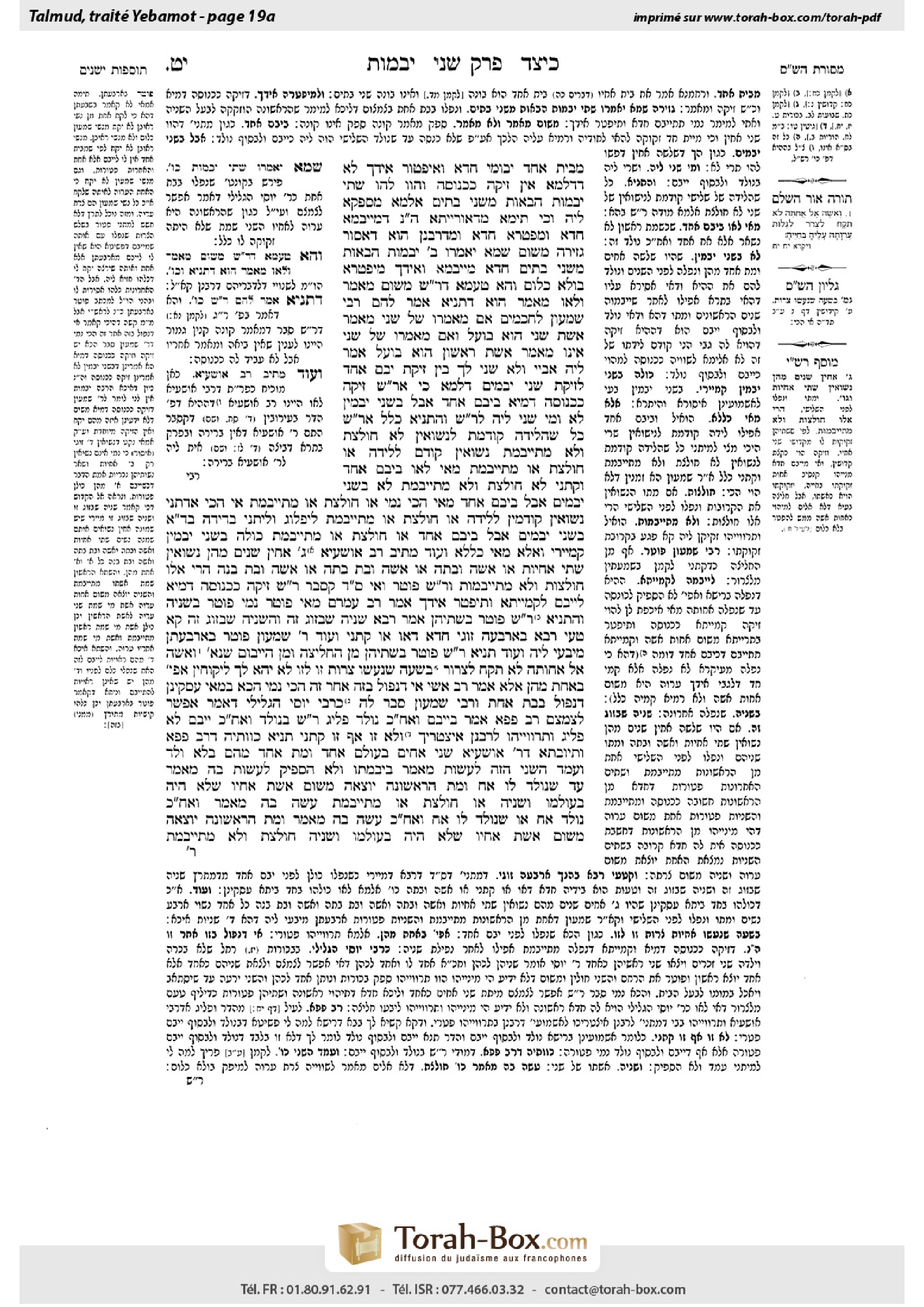
Yevamot 19a: Talmud study for Daf Yomi
Daf Yomi is the daily study of one Talmud folio. Explore 37 tractates with scans, Hebrew text, Sefaria English and AI-generated French translations where annotated.
Passage selection and English or AI-generated French translation are available where the scan has annotations. Daf Study is independent of Torah-Box and Sefaria.
Browse Yevamot · יבמות · All tractatesYevamot 19a text and translations
This page of Yevamot includes the Aramaic text, an English translation and an AI-generated French translation, alongside the scan above.
יבמות י״ט א · Aramaic and Hebrew text
מִבַּיִת אֶחָד. יַבּוֹמֵי חֲדָא וְאִיפְּטוֹרֵ[י] אִידַּךְ — לָא, דְּדִלְמָא אֵין זִיקָה כִּכְנוּסָה, וְהָווּ לְהוּ שְׁתֵּי יְבָמוֹת הַבָּאוֹת מִשְּׁנֵי בָתִּים. אַלְמָא מְסַפְּקָא לֵיהּ!
וְכִי תֵּימָא: מִדְּאוֹרָיְיתָא הָכִי נָמֵי דְּמִיַּיבְּמָא חֲדָא וּמִפַּטְרָא חֲדָא, וּמִדְּרַבָּנַן הוּא דְּאָסוּר, גְּזֵירָה מִשּׁוּם שֶׁמָּא יֹאמְרוּ שְׁתֵּי יְבָמוֹת הַבָּאוֹת מִשְּׁנֵי בָתִּים — חֲדָא מִיַּיבְּמָא, וְאִידַּךְ מִיפַּטְרָא בִּוְּלֹא כְּלוּם,
וְהָא טַעְמָא דְּרַבִּי שִׁמְעוֹן, מִשּׁוּם מַאֲמָר וְלָאו מַאֲמָר הוּא. דְּתַנְיָא, אָמַר לָהֶם רַבִּי שִׁמְעוֹן לַחֲכָמִים: אִם מַאֲמָרוֹ שֶׁל שֵׁנִי מַאֲמָר — אֵשֶׁת שֵׁנִי הוּא בּוֹעֵל.
וְאִם מַאֲמָרוֹ שֶׁל שֵׁנִי אֵינוֹ מַאֲמָר — אֵשֶׁת רִאשׁוֹן הוּא בּוֹעֵל.
אֲמַר לֵיהּ אַבָּיֵי: וְלָא שָׁנֵי לָךְ בֵּין זִיקַת יָבָם אֶחָד לְזִיקַת שְׁנֵי יְבָמִים? דִּלְמָא כִּי אָמַר רַבִּי שִׁמְעוֹן זִיקָה כִּכְנוּסָה דָּמְיָא — בְּיָבָם אֶחָד, אֲבָל בִּשְׁנֵי יְבָמִין — לָא.
וּמִי שָׁנֵי לֵיהּ לְרַבִּי שִׁמְעוֹן? וְהָתַנְיָא, כְּלָל אָמַר רַבִּי שִׁמְעוֹן: כׇּל שֶׁהַלֵּידָה קוֹדֶמֶת לַנִּשּׂוּאִין — לֹא חוֹלֶצֶת וְלֹא מִתְיַיבֶּמֶת, נִשּׂוּאִין (קודם) [קוֹדְמִין] לַלֵּידָה — אוֹ חוֹלֶצֶת אוֹ מִתְיַיבֶּמֶת.
מַאי לָאו בְּיָבָם אֶחָד, וְקָתָנֵי: לֹא חוֹלֶצֶת וְלֹא מִתְיַיבֶּמֶת. לָא, בִּשְׁנֵי יְבָמִים.
אֲבָל בְּיָבָם אֶחָד מַאי — הָכִי נָמֵי אוֹ חוֹלֶצֶת אוֹ מִתְיַיבֶּמֶת? אִי הָכִי, אַדְּתָנֵי: נִשּׂוּאִין קוֹדְמִין לַלֵּידָה — אוֹ חוֹלֶצֶת אוֹ מִתְיַיבֶּמֶת, לִיפְלוֹג וְלִיתְנֵי בְּדִידַהּ: בַּמֶּה דְּבָרִים אֲמוּרִים — בִּשְׁנֵי יְבָמִים, אֲבָל בְּיָבָם אֶחָד — אוֹ חוֹלֶצֶת אוֹ מִתְיַיבֶּמֶת.
כּוּלָּהּ בִּשְׁנֵי יְבָמִין קָמַיְירֵי. וְאֶלָּא מַאי כְּלָלָא?!
וְעוֹד, מֵתִיב רַב אוֹשַׁעְיָא: שְׁלֹשָׁה אַחִין, שְׁנַיִם מֵהֶן נְשׂוּאִין שְׁתֵּי אֲחָיוֹת, אוֹ אִשָּׁה וּבִתָּהּ, אוֹ אִשָּׁה וּבַת בִּתָּהּ, אוֹ אִשָּׁה וּבַת בְּנָהּ — הֲרֵי אֵלּוּ חוֹלְצוֹת וְלֹא מִתְיַיבְּמוֹת. וְרַבִּי שִׁמְעוֹן פּוֹטֵר.
וְאִי סָלְקָא דַעְתָּךְ קָסָבַר רַבִּי שִׁמְעוֹן זִיקָה כִּכְנוּסָה דָּמְיָא — לְיַיבֵּם לְקַמַּיְיתָא, וְתִיפְּטַר אִידַּךְ!
אָמַר רַב עַמְרָם: מַאי פּוֹטֵר, נָמֵי פּוֹטֵר בַּשְּׁנִיָּה. וְהָתַנְיָא: רַבִּי שִׁמְעוֹן פּוֹטֵר בִּשְׁתֵּיהֶן!
אָמַר רָבָא: שְׁנִיָּה שֶׁבְּזוּג זֶה, וְהַשְּׁנִיָּה שֶׁבְּזוּג זֶה.
קָא טָעֵי רָבָא בְּאַרְבְּעָה זוּגֵי: חֲדָא, דְּ״אוֹ״ ״אוֹ״ קָתָנֵי. וְעוֹד, ״רַבִּי שִׁמְעוֹן פּוֹטֵר בְּאַרְבַּעְתָּן״ מִיבְּעֵי לֵיהּ.
וְעוֹד תַּנְיָא: רַבִּי שִׁמְעוֹן פּוֹטֵר בִּשְׁתֵּיהֶן מִן הַחֲלִיצָה וּמִן הַיִּיבּוּם, שֶׁנֶּאֱמַר: ״וְאִשָּׁה אֶל אֲחוֹתָהּ לֹא תִקָּח לִצְרוֹר״, בְּשָׁעָה שֶׁנַּעֲשׂוּ צָרוֹת זוֹ לָזוֹ — לֹא יְהֵא לְךָ לִיקּוּחִין אֲפִילּוּ בְּאַחַת מֵהֶן!
אֶלָּא אָמַר רַב אָשֵׁי: אִי דִּנְפוּל בְּזֶה אַחַר זֶה — הָכִי נָמֵי, הָכָא בְּמַאי עָסְקִינַן — דִּנְפוּל בְּבַת אַחַת, וְרַבִּי שִׁמְעוֹן סָבַר לַהּ כְּרַבִּי יוֹסֵי הַגְּלִילִי, דְּאָמַר: אֶפְשָׁר לְצַמְצֵם.
רַב פָּפָּא אָמַר: בְּיִיבֵּם וְאַחַר כָּךְ נוֹלַד — פְּלִיג רַבִּי שִׁמְעוֹן, בְּנוֹלַד וְאַחַר כָּךְ יִיבֵּם — לָא פְּלִיג.
וְתַרְוַויְיהוּ לְרַבָּנַן אִיצְטְרִיךְ, וְלֹא זוֹ אַף זוֹ קָתָנֵי.
תַּנְיָא כְּווֹתֵיהּ דְּרַב פָּפָּא, וּתְיוּבְתָּא דְּרַבִּי אוֹשַׁעְיָא. שְׁנֵי אַחִים בְּעוֹלָם אֶחָד, וּמֵת אֶחָד מֵהֶם בְּלֹא וָלָד, וְעָמַד הַשֵּׁנִי הַזֶּה לַעֲשׂוֹת מַאֲמָר בִּיבִמְתּוֹ, וְלֹא הִסְפִּיק לַעֲשׂוֹת בָּהּ מַאֲמָר עַד שֶׁנּוֹלַד לוֹ אָח, וּמֵת — הָרִאשׁוֹנָה יוֹצְאָה מִשּׁוּם אֵשֶׁת אָחִיו שֶׁלֹּא הָיָה בְּעוֹלָמוֹ, וּשְׁנִיָּה — אוֹ חוֹלֶצֶת אוֹ מִתְיַיבֶּמֶת.
עָשָׂה בָּהּ מַאֲמָר, וְאַחַר כָּךְ נוֹלַד אָח, אוֹ שֶׁנּוֹלַד לוֹ אָח וְאַחַר כָּךְ עָשָׂה בָּהּ מַאֲמָר, וּמֵת — הָרִאשׁוֹנָה יוֹצְאָה מִשּׁוּם אֵשֶׁת אָחִיו שֶׁלֹּא הָיָה בְּעוֹלָמוֹ, וּשְׁנִיָּה — חוֹלֶצֶת וְלֹא מִתְיַיבֶּמֶת.
Yevamot 19a · English translation
from a single household, i.e., husband, and everyone agrees that only one wife from each household may be taken in levirate marriage, as the verse states: “To build his brother’s house,” which is interpreted to mean that the remaining brother may perform levirate marriage with only one wife of his late brother and not with two. To take one in levirate marriage and exempt the other without any procedure, he may not do, as perhaps the levirate bond is not substantial enough to make the first brother’s widow like a married woman to the second brother. In that case this woman whose husband died first remains the wife of the first brother, and the second woman is the wife of the second brother. Then there would be two separate levirate obligations, and one could not exempt the other; they would be two yevamot who come from two households. Therefore, apparently even when levirate betrothal was performed Rabbi Shimon is uncertain whether or not the levirate bond is substantial.
And if you would say that by Torah law, indeed, one of them may be taken in levirate marriage and thereby exempt the other, and this was prohibited only by rabbinic law, this would be a rabbinic decree due to the concern lest those who were not aware of the details mistakenly say that in general if two yevamot come from two households then one is taken in levirate marriage and the other is exempt without anything. One might have thought that the reason Rabbi Shimon required the other woman to perform ḥalitza is to avoid the possibility of such a mistake.
But this cannot be, as Rabbi Shimon’s reason is mentioned explicitly in the baraita, and there he does not state that this is a decree of the Sages. Rather, his reason is due to the question with regard to the strength of levirate betrothal, specifically whether the status of marriage is achieved by levirate betrothal or not achieved by levirate betrothal. As it is taught in a baraita: Rabbi Shimon said to the Rabbis in explanation of his opinion that one of the women could enter into levirate marriage: If the levirate betrothal of the second brother is indeed levirate betrothal and is considered as a fully valid marriage, then the third brother is engaging in relations with the wife of the second brother when he takes her in levirate marriage. That is, if the levirate betrothal by the second brother has the same status as full marriage, then she becomes the wife of this second brother, and all previous connections are no longer relevant.
But if the levirate betrothal of the second brother is not levirate betrothal, i.e., it does not have the full status of marriage, then there was never in fact any connection between the two. If she is then taken by the third brother in levirate marriage, he would be engaging in relations with the wife of the first brother. From here one can conclude that the basis for Rabbi Shimon’s uncertainty is related to the questions concerning the strength of the levirate betrothal.
Abaye said to him: From here you cannot prove what Rabbi Shimon’s opinion was. Is there no difference to you between a levirate bond to a single yavam and a bond to two yevamim? Perhaps when Rabbi Shimon said that a levirate bond is substantial enough to render her like a married woman, this applies only when there is a single yavam. If these were the circumstances of the case discussed, that when one brother died there remained only one yavam, then because the obligation of levirate marriage would apply only to him, she would be considered his wife. But perhaps he held that if there were two yevamin, then no, she would not be considered a married woman, as here the bond would apply to both at once. Accordingly, Rabbi Shimon’s uncertainty is with regard to the case of a levirate bond with two yevamin.
The Gemara challenges: Does Rabbi Shimon differentiate between the case of one yavam and the case of two yevamin in the matter of a wife of a brother with whom he did not coexist? But it is taught in a baraita with regard to the wife of a brother with whom he did not coexist: Rabbi Shimon stated a principle: Whenever the birth of the third brother precedes the levirate marriage of the second brother, if this second brother dies and the yevama falls before the third brother, she does not perform ḥalitza and she does not enter into levirate marriage. In such circumstances she is the wife of a brother with whom he did not coexist. But if the levirate marriage preceded his birth, she either performs ḥalitza or enters into levirate marriage.
What, is it not referring to the case of a single yavam, and it is taught in a baraita: She does not perform ḥalitza and she does not enter into levirate marriage. Even if there is only a single yavam this is not considered full marriage, and she remains forbidden as the wife of a brother with whom he did not coexist. Consequently, she who is subject to a levirate bond is not like a married woman. The Gemara answers: No. it refers to a case of two yevamin.
The Gemara asks: But what, then, is the ruling for a single yavam? So too, one should say she either performs ḥalitza or enters into levirate marriage, as the woman who requires levirate marriage is like the wife of the second brother for all purposes. If so, rather than teaching the case when the marriage of the second brother precedes the birth of the third brother, that if this second brother dies and she falls before the third brother, she either performs ḥalitza or enters into levirate marriage, let Rabbi Shimon distinguish and teach the distinction within the situation itself and say: In what case is this statement said? When there are two yevamin. But if there is one yavam, she either performs ḥalitza or enters into levirate marriage.
The Gemara rejects this: No, the entire baraita is in reference to two yevamin and differentiates between various cases involving two yevamin, namely, the case where the birth of the third brother preceded the marriage of the second brother and the case where the marriage of the second brother preceded the birth of the third brother. The Gemara asks: Rather, what is the principle in this matter? If Rabbi Shimon is speaking of two yevamin and not a single yavam, then it makes no sense to speak of a principle, as the halakha is different in the case of a single yavam.
Moreover, Rav Oshaya raised an objection from that which was taught in a mishna (28b): If there were three brothers, two of whom were married to two sisters, or to a woman and her daughter, or a woman and her daughter’s daughter, or a woman and her son’s daughter, who are, in each case, two women who may not be married to the same person simultaneously, and subsequently these brothers who were married to relatives died, then those two women must perform ḥalitza and may not enter into levirate marriage. Since they both have a levirate bond to the third brother at the same time and he is prohibited from marrying both, they cause one another to be unable to perform levirate marriage. And Rabbi Shimon exempts them even from ḥalitza.
And if it enters your mind that Rabbi Shimon held that a levirate bond is substantial enough to make her like a married woman, then let the third brother consummate the levirate marriage to the widow of the first husband to die, since as soon as her husband dies she has a levirate bond with the other brothers and should be considered to be like his wife, and let the other be exempt as a result, as her levirate bond began only with the death of the second husband.
Rav Amram said: What is really the meaning of the word exempt used by Rabbi Shimon? Only the second is exempt. The Gemara objects: But it is taught in a baraita: Rabbi Shimon exempts both. From here it is clear that in his opinion a woman subject to a levirate bond does not have the same status as a married woman.
Rava said: In the case mentioned in that baraita, there were three brothers, two of whom died. Each of the deceased brothers had four wives who were related to the wives of the other brother as described in the mishna. One wife of the first brother was the sister of a wife of the second brother. Another wife was the mother of a wife of the second brother. Another was the daughter of the daughter of a wife of the second brother. And another was the daughter of the son of a wife of the second brother. When these brothers died, all eight women happened before the remaining brother for levirate marriage. When Rabbi Shimon deemed both of them exempt, he was referring to the second from this pair and the second from that pair. That is, since one of them was bound to the third brother her relative became exempt as a forbidden relative, and the other of the pair was her rival wife in each of the cases.
The Gemara comments: Rava was mistaken about there being four pairs. He mistakenly understood that the mishna spoke of two brothers who married four pairs of relatives. Why does the Gemara assume that he was mistaken? One piece of evidence is that the mishna teaches the case using the expression: Or, or. The mishna teaches: Or to a woman and her daughter, or to a woman and her daughter’s daughter, or a woman and her son’s daughter, meaning that not all of the pairs happened before a single yavam for levirate marriage. And further, the baraita should have said: Rabbi Shimon exempts all four of them, i.e., the four women married to the second brother.
And further, it is taught explicitly in a baraita that Rabbi Shimon exempts both of them from both ḥalitza and levirate marriage, as it is stated: “And you shall not take a woman to her sister, to be a rival to her” (Leviticus 18:18). From here it is derived that when two sisters are about to become rival wives one to the other, that is, at the moment they fall before one brother for levirate marriage, you do not have the option of taking even one of them. In other words, levirate marriage to either of them is not permitted, and therefore both are exempt and not only the second. Thus Rava’s explanation is rejected.
Rather, Rav Ashi said an alternative answer to the Gemara’s challenge: If these yevamot happened before him for levirate marriage one after the other, indeed it is so that the first woman bound is like a married woman, and she exempts the second, who is her close relative. However, here we are dealing with a case when both brothers died at once and so both women happened before him at once. And Rabbi Shimon holds in accordance with the opinion of Rabbi Yosei HaGelili, who said: It is possible to be precise. He held, contrary to the opinion of the Rabbis, that it was possible to be exact about measurements of time. Therefore, it is possible for two things to truly occur at once, and it is possible that both brothers died simultaneously.
Until this point the Gemara dealt with Rav Oshaya’s opinion stating that according to Rabbi Shimon’s statement, even in the case of one who was born before his brother’s levirate marriage the ruling of a wife of a brother with whom one did not coexist would not apply. However, Rav Pappa said: Rabbi Shimon disagreed in the case where the second brother performed levirate marriage and after that the third brother was born; however, where the third brother was born after the death of the first brother and after that the second brother performed levirate marriage Rabbi Shimon did not disagree. He agreed that in this case she would be forbidden to the newly born brother as the wife of a brother with whom he did not coexist.
As for the question that Rav Oshaya raised with regard to the apparent redundancy of the similar rulings in both the first mishna of the chapter and the mishna on 18b, it can be explained that both were necessary for the opinion of the Rabbis who prohibited marriage to the wife of a brother with whom one did not coexist in every case. The difficulty raised concerning the apparent redundancy of the first mishna, given the greater scope of the opinion revealed in the second mishna, can be explained by saying that the tanna teaches the mishna employing the style: Not only this but also that. That is, the mishna follows the stylistic principle of first teaching the obvious case and continues by saying that this principle applies not only in the obvious case but even in the less obvious case. If so, there is no need to assume that there is an additional dispute with Rabbi Shimon.
The Gemara continues: It is taught in a baraita in accordance with the opinion of Rav Pappa, and this is a conclusive refutation of the opinion of Rabbi Oshaya: If there were two coexisting brothers, and one died childless, and the second was about to perform levirate betrothal with his yevama but did not manage to perform levirate betrothal before his brother was born, and then the second brother died, then the first woman goes out and is free to remarry without ḥalitza or levirate marriage due to the fact that she was the wife of a brother with whom the third brother did not coexist, and the second either performs ḥalitza or enters into levirate marriage. She was never the rival wife of the widow of the first brother.
If the second brother performed levirate betrothal with her and afterward his brother was born, or if his brother was born and then he performed the levirate betrothal, and then he died, the first goes out and is free to remarry as the wife of a brother with whom he did not coexist, and the second, the wife of the second brother, must perform ḥalitza and may not enter into levirate marriage. This is because, due to the levirate betrothal, she is considered by the Rabbis to be the rival wife of a wife of a brother with whom he did not coexist.
Yevamot 19a · Traduction française (IA)
issues d’un seul foyer, c’est-à-dire d’un même mari, et tous reconnaissent qu’on ne peut contracter le mariage léviratique qu’avec une seule épouse de chaque foyer, comme l’énonce le verset : « Pour édifier la maison de son frère », ce qui signifie que le frère survivant ne peut contracter le mariage léviratique qu’avec une seule épouse de son frère défunt, et non avec deux. Il ne peut pas en prendre une en mariage léviratique et dispenser l’autre sans aucune procédure, car il se peut que le lien léviratique ne soit pas assez fort pour rendre la veuve du premier frère semblable à une femme mariée au second frère. Dans ce cas, la femme dont le mari est mort le premier demeure l’épouse du premier frère, tandis que la seconde femme est l’épouse du second frère. Il y aurait alors deux obligations léviratiques distinctes, dont l’une ne pourrait pas dispenser l’autre ; ce seraient deux yevamot issues de deux foyers. Il semble donc que, même lorsqu’une consécration léviratique a eu lieu, Rabbi Shimon doute que le lien léviratique soit suffisamment fort.
Et si l’on disait qu’en vertu de la Torah, l’une peut effectivement être prise en mariage léviratique et ainsi dispenser l’autre, et que cela n’a été interdit que par décret rabbinique, ce décret aurait été pris par crainte que ceux qui ignorent les détails ne concluent à tort que, de manière générale, lorsque deux yevamot issues de deux foyers se présentent, l’une peut être prise en mariage léviratique et l’autre dispensée sans aucune procédure. On aurait pu penser que Rabbi Shimon exige que l’autre femme accomplisse la ḥalitsa afin d’éviter qu’une telle erreur ne se produise.
Mais cela ne peut pas être, car la raison de Rabbi Shimon est explicitement rapportée dans la baraïta, et il n’y dit pas qu’il s’agit d’un décret des Sages. Sa raison tient plutôt à la question de la force de la consécration léviratique : confère-t-elle le statut du mariage, ou ne le confère-t-elle pas ? En effet, il est enseigné dans une baraïta : Rabbi Shimon dit aux Rabbins, pour expliquer son opinion selon laquelle l’une des femmes pourrait contracter le mariage léviratique : « Si la consécration léviratique du second frère est effectivement une consécration léviratique et est considérée comme un mariage pleinement valide, alors le troisième frère, en la prenant en mariage léviratique, a des relations avec l’épouse du second frère. » Autrement dit, si la consécration léviratique accomplie par le second frère a le même statut qu’un mariage pleinement valide, elle devient l’épouse de ce second frère, et tous les liens antérieurs cessent d’être pertinents.
Mais si la consécration léviratique du second frère n’est pas une consécration léviratique, c’est-à-dire si elle n’a pas pleinement le statut du mariage, alors, en réalité, aucun lien ne s’est jamais établi entre eux. Si le troisième frère la prend ensuite en mariage léviratique, il aurait des relations avec l’épouse du premier frère. On peut en conclure que le doute de Rabbi Shimon porte sur les questions relatives à la force de la consécration léviratique.
Abayé lui dit : « Tu ne peux pas prouver par là quelle était l’opinion de Rabbi Shimon. Ne fais-tu aucune distinction entre le lien léviratique avec un seul yavam et le lien avec deux yevamim ? Peut-être Rabbi Shimon considérait-il que le lien léviratique était assez fort pour la rendre semblable à une femme mariée uniquement lorsqu’il n’y avait qu’un seul yavam. Si tel était le cas discuté — à savoir qu’à la mort d’un frère, il ne restait qu’un seul yavam —, alors, puisque l’obligation de mariage léviratique ne s’appliquait qu’à lui, elle serait considérée comme son épouse. Mais peut-être estimait-il que, s’il y avait deux yevamim, elle ne serait pas considérée comme une femme mariée, car le lien s’appliquerait simultanément aux deux. Par conséquent, le doute de Rabbi Shimon porte sur le cas d’un lien léviratique avec deux yevamim. »
La Guemara objecte : Rabbi Shimon fait-il une distinction entre le cas d’un yavam unique et celui de deux yevamim au sujet de l’épouse d’un frère avec lequel il n’a pas coexisté ? Or, il est enseigné dans une baraïta au sujet de l’épouse d’un frère avec lequel il n’a pas coexisté : Rabbi Shimon a énoncé un principe : chaque fois que la naissance du troisième frère précède le mariage léviratique du second frère, si ce second frère meurt et que la yevama échoit au troisième frère, elle n’accomplit pas la ḥalitsa et ne contracte pas le mariage léviratique. Dans de telles circonstances, elle est l’épouse d’un frère avec lequel il n’a pas coexisté. Mais si le mariage léviratique a précédé sa naissance, elle accomplit soit la ḥalitsa, soit le mariage léviratique.
N’est-il pas question du cas d’un yavam unique, alors que la baraïta enseigne : « Elle n’accomplit pas la ḥalitsa et ne contracte pas le mariage léviratique » ? Même s’il n’y a qu’un seul yavam, cela n’est pas considéré comme un mariage pleinement valide, et elle reste interdite en tant qu’épouse d’un frère avec lequel il n’a pas coexisté. Par conséquent, une femme liée par un lien léviratique n’est pas semblable à une femme mariée. La Guemara répond : Non, il s’agit du cas de deux yevamim.
La Guemara demande : Mais alors, quelle est la règle dans le cas d’un yavam unique ? Là aussi, il faudrait dire qu’elle accomplit soit la ḥalitsa, soit le mariage léviratique, puisque la femme qui requiert le mariage léviratique est à tous égards semblable à l’épouse du second frère. Si tel est le cas, au lieu d’enseigner le cas où le mariage du second frère précède la naissance du troisième frère — si ce second frère meurt et qu’elle échoit au troisième frère, elle accomplit soit la ḥalitsa, soit le mariage léviratique —, Rabbi Shimon aurait dû établir une distinction au sein même de cette situation et dire : « Dans quel cas cette déclaration s’applique-t-elle ? Lorsqu’il y a deux yevamim. Mais s’il n’y a qu’un seul yavam, elle accomplit soit la ḥalitsa, soit le mariage léviratique. »
La Guemara rejette cette réponse : Non, toute la baraïta concerne deux yevamim et distingue différents cas les impliquant, à savoir celui où la naissance du troisième frère précède le mariage du second frère et celui où le mariage du second frère précède la naissance du troisième frère. La Guemara demande : Mais alors, quel est le principe en la matière ? Si Rabbi Shimon parle de deux yevamim et non d’un seul yavam, il n’est pas logique de parler d’un principe, puisque la halakha diffère dans le cas d’un yavam unique.
De plus, Rav Ochaya soulève une objection à partir de ce qui est enseigné dans une Michna (28b) : s’il y avait trois frères, dont deux étaient mariés à deux sœurs, ou à une femme et sa fille, ou à une femme et la fille de sa fille, ou à une femme et la fille de son fils — dans chaque cas, deux femmes qui ne peuvent pas être mariées simultanément au même homme —, puis que les frères mariés à ces parentes mouraient, ces deux femmes doivent accomplir la ḥalitsa et ne peuvent pas contracter le mariage léviratique. Puisqu’elles sont simultanément liées par un lien léviratique au troisième frère, qui n’a pas le droit d’épouser les deux, chacune empêche l’autre de contracter le mariage léviratique. Et Rabbi Shimon les dispense même de la ḥalitsa.
Et si l’on pense que, selon Rabbi Shimon, le lien léviratique est assez fort pour la rendre semblable à une femme mariée, le troisième frère devrait consommer le mariage léviratique avec la veuve du premier mari décédé : dès la mort de son mari, elle est liée par un lien léviratique aux autres frères et devrait être considérée comme son épouse. L’autre serait alors dispensée, puisque son lien léviratique n’a commencé qu’à la mort du second mari.
Rav Amram dit : Que signifie réellement le terme « dispense » employé par Rabbi Shimon ? Seule la seconde est dispensée. La Guemara objecte : Mais une baraïta enseigne : « Rabbi Shimon les dispense toutes deux. » Il apparaît donc clairement qu’à son avis, une femme liée par un lien léviratique n’a pas le même statut qu’une femme mariée.
Rava dit : dans le cas mentionné dans cette baraïta, il y avait trois frères, dont deux moururent. Chacun des frères décédés avait quatre épouses apparentées aux épouses de l’autre frère de la manière décrite dans la Michna. Une épouse du premier frère était la sœur d’une épouse du second frère ; une autre était la mère d’une épouse du second frère ; une autre était la fille de la fille d’une épouse du second frère ; et une autre était la fille du fils d’une épouse du second frère. À la mort de ces frères, les huit femmes échurent toutes au frère survivant pour le mariage léviratique. Lorsque Rabbi Shimon les déclara toutes deux dispensées, il faisait référence à la seconde femme de cette paire et à la seconde femme de l’autre paire. Autrement dit, puisque l’une était liée au troisième frère, sa parente était dispensée en tant que parente interdite, et l’autre femme de la paire était sa coépouse dans chacun des cas.
La Guemara fait remarquer que Rava s’est trompé en comptant quatre paires. Il a compris à tort que la Michna parlait de deux frères ayant épousé quatre paires de parentes. Pourquoi la Guemara suppose-t-elle qu’il s’est trompé ? Un indice est que la Michna enseigne les cas au moyen de l’expression « ou… ou ». Elle enseigne : « Ou une femme et sa fille, ou une femme et la fille de sa fille, ou une femme et la fille de son fils », ce qui signifie que toutes les paires n’étaient pas échues au même yavam pour le mariage léviratique. En outre, la baraïta aurait dû dire : « Rabbi Shimon les dispense toutes les quatre », c’est-à-dire les quatre femmes mariées au second frère.
De plus, une baraïta enseigne explicitement que Rabbi Shimon les dispense toutes deux de la ḥalitsa comme du mariage léviratique, ainsi qu’il est dit : « Tu ne prendras pas une femme en plus de sa sœur, pour en faire sa rivale » (Lévitique 18,18). On en déduit que lorsque deux sœurs sont sur le point de devenir rivales l’une de l’autre, c’est-à-dire au moment où elles échoient à un même frère pour le mariage léviratique, il n’est pas possible d’en prendre ne serait-ce qu’une. Autrement dit, le mariage léviratique avec l’une ou l’autre est interdit ; elles sont donc toutes deux dispensées, et pas seulement la seconde. L’explication de Rava est ainsi rejetée.
Rav Ashi donne plutôt une autre réponse à l’objection de la Guemara : si ces yevamot lui étaient échues pour le mariage léviratique l’une après l’autre, alors, effectivement, la première femme liée serait semblable à une femme mariée et dispenserait la seconde, qui est sa proche parente. Mais ici, nous avons affaire à un cas où les deux frères sont morts au même instant, de sorte que les deux femmes lui sont échues simultanément. Rabbi Shimon suit l’opinion de Rabbi Yosse HaGelili, qui a dit : « Il est possible d’être précis. » Contrairement aux Rabbins, il estimait qu’il était possible de déterminer avec exactitude les mesures de temps. Il est donc possible que deux événements se produisent véritablement au même instant, et que les deux frères soient morts simultanément.
Jusqu’ici, la Guemara a examiné l’opinion de Rav Ochaya, selon laquelle, d’après la déclaration de Rabbi Shimon, même dans le cas d’un homme né avant le mariage léviratique de son frère, la règle relative à l’épouse d’un frère avec lequel il n’a pas coexisté ne s’appliquerait pas. Rav Pappa dit cependant : Rabbi Shimon était en désaccord dans le cas où le second frère avait contracté le mariage léviratique, puis où le troisième frère était né ; en revanche, lorsque le troisième frère était né après la mort du premier frère, et que le second frère avait ensuite contracté le mariage léviratique, Rabbi Shimon n’était pas en désaccord. Il reconnaissait que, dans ce cas, elle serait interdite au frère nouvellement né en tant qu’épouse d’un frère avec lequel il n’a pas coexisté.
Quant à la question soulevée par Rav Ochaya au sujet de la redondance apparente de règles semblables, à la fois dans la première Michna du chapitre et dans la Michna de 18b, on peut l’expliquer en disant que toutes deux étaient nécessaires pour exposer l’opinion des Rabbins, qui interdisent dans tous les cas le mariage avec l’épouse d’un frère avec lequel on n’a pas coexisté. La difficulté concernant la redondance apparente de la première Michna, compte tenu de la portée plus large de l’opinion exposée dans la seconde Michna, peut s’expliquer ainsi : le tanna enseigne la Michna selon la formule « non seulement ceci, mais aussi cela ». Autrement dit, la Michna suit le principe stylistique qui consiste à enseigner d’abord le cas évident, puis à préciser que le principe s’applique non seulement au cas évident, mais aussi au cas moins évident. Il n’est donc pas nécessaire de supposer qu’il existe un désaccord supplémentaire avec Rabbi Shimon.
La Guemara poursuit : une baraïta est enseignée conformément à l’opinion de Rav Pappa, ce qui constitue une réfutation décisive de l’opinion de Rav Ochaya : s’il y avait deux frères ayant coexisté, que l’un mourait sans enfant et que le second s’apprêtait à contracter une consécration léviratique avec sa yevama, mais n’avait pas eu le temps de le faire avant la naissance de son frère, puis que le second frère mourait, la première femme est libérée et peut se remarier sans ḥalitsa ni mariage léviratique, car elle était l’épouse d’un frère avec lequel le troisième frère n’avait pas coexisté ; quant à la seconde, elle accomplit soit la ḥalitsa, soit le mariage léviratique. Elle n’a jamais été la coépouse de la veuve du premier frère.
Si le second frère avait contracté une consécration léviratique avec elle et que son frère était né ensuite, ou si son frère était né puis qu’il avait contracté la consécration léviratique, et qu’il mourait ensuite, la première est libérée et peut se remarier en tant qu’épouse d’un frère avec lequel il n’a pas coexisté ; quant à la seconde, l’épouse du second frère, elle doit accomplir la ḥalitsa et ne peut pas contracter le mariage léviratique. En effet, du fait de la consécration léviratique, les Rabbins la considèrent comme la coépouse d’une épouse d’un frère avec lequel il n’a pas coexisté.
Traduction française générée par IA à partir de l’édition anglaise de Sefaria. Vérifie toujours un passage avec le texte source.
Text from Sefaria: William Davidson Edition - Vocalized Aramaic (CC BY NC); William Davidson Edition - English (CC BY NC).