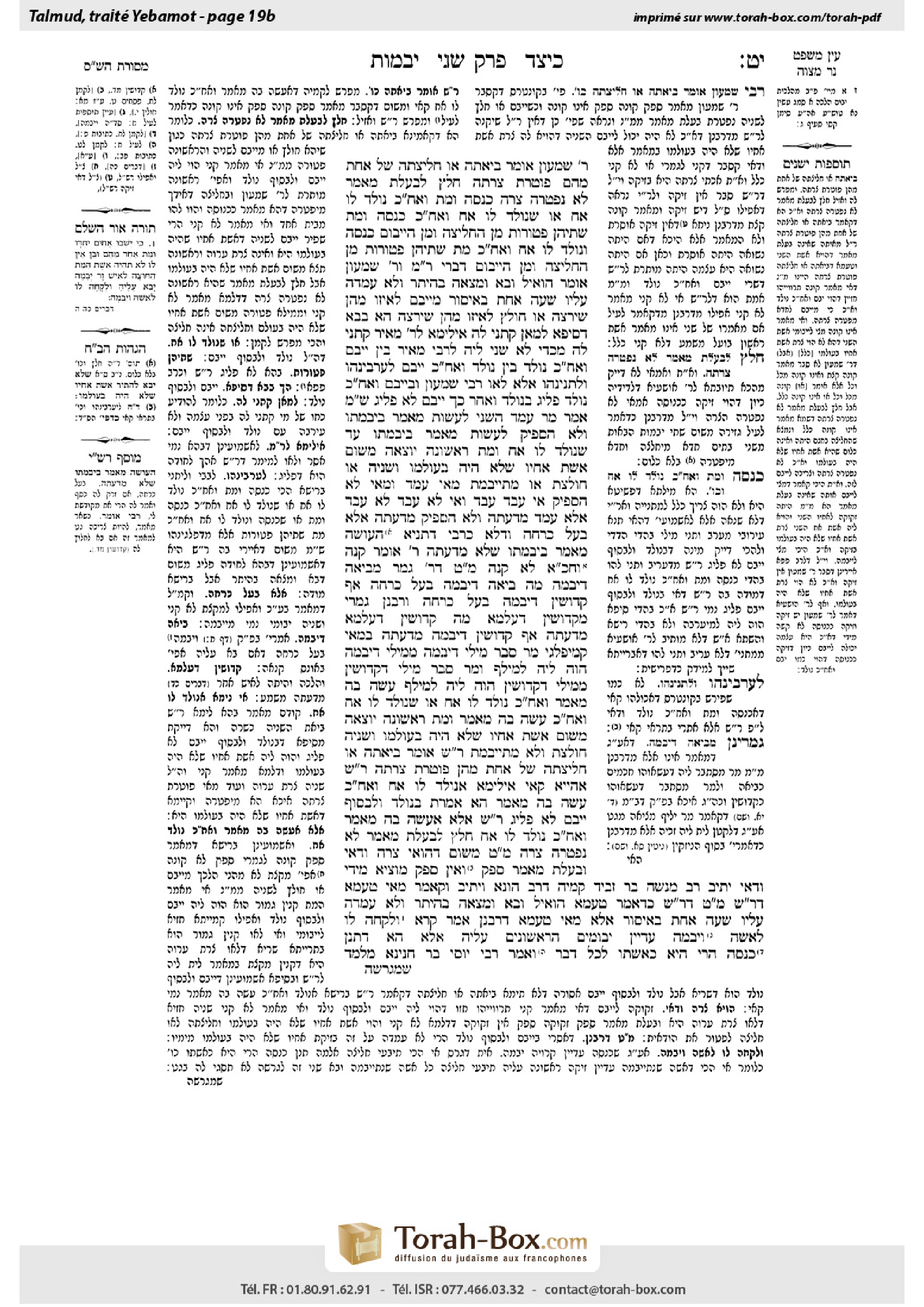
Yevamot 19b: Talmud study for Daf Yomi
Daf Yomi is the daily study of one Talmud folio. Explore 37 tractates with scans, Hebrew text, Sefaria English and AI-generated French translations where annotated.
Passage selection and English or AI-generated French translation are available where the scan has annotations. Daf Study is independent of Torah-Box and Sefaria.
Browse Yevamot · יבמות · All tractatesYevamot 19b text and translations
This page of Yevamot includes the Aramaic text, an English translation and an AI-generated French translation, alongside the scan above.
יבמות י״ט ב · Aramaic and Hebrew text
רַבִּי שִׁמְעוֹן אוֹמֵר: בִּיאָתָהּ אוֹ חֲלִיצָתָהּ שֶׁל אַחַת מֵהֶם פּוֹטֶרֶת צָרָתָהּ, חָלַץ לְבַעֲלַת מַאֲמָר — לֹא נִפְטְרָה צָרָה. כְּנָסָהּ וָמֵת, וְאַחַר כָּךְ נוֹלַד לוֹ אָח, אוֹ שֶׁנּוֹלַד לוֹ אָח וְאַחַר כָּךְ כְּנָסָהּ, וָמֵת — שְׁתֵּיהֶן פְּטוּרוֹת מִן הַחֲלִיצָה וּמִן הַיִּיבּוּם.
כְּנָסָהּ וְנוֹלַד לוֹ אָח, וְאַחַר כָּךְ מֵת — שְׁתֵּיהֶן פְּטוּרוֹת מִן הַחֲלִיצָה וּמִן הַיִּיבּוּם, דִּבְרֵי רַבִּי מֵאִיר. וְרַבִּי שִׁמְעוֹן אוֹמֵר: הוֹאִיל וּבָא וּמְצָאָהּ בְּהֶיתֵּר, וְלֹא עָמְדָה עָלָיו שָׁעָה אַחַת בְּאִיסּוּר — מְיַיבֵּם לְאֵיזוֹ מֵהֶן שֶׁיִּרְצֶה, אוֹ חוֹלֵץ לְאֵיזוֹ מֵהֶן שֶׁיִּרְצֶה.
הָא בָּבָא דְסֵיפָא לְמַאן קָתָנֵי לַהּ? אִילֵּימָא לְרַבִּי מֵאִיר קָתָנֵי לַהּ — מִכְּדִי לָא שָׁנֵי לֵיהּ לְרַבִּי מֵאִיר בֵּין יִיבֵּם וְאַחַר כָּךְ נוֹלַד בֵּין נוֹלַד וְאַחַר כָּךְ יִיבֵּם?! לְעָרְבִינְהוּ וְלִתְנִינְהוּ!
אֶלָּא לָאו רַבִּי שִׁמְעוֹן. וּבְיִיבֵּם וְאַחַר כָּךְ נוֹלַד — פְּלִיג, בְּנוֹלַד וְאַחַר כָּךְ יִיבֵּם — לָא פְּלִיג. שְׁמַע מִינַּהּ.
אָמַר מָר: עָמַד הַשֵּׁנִי לַעֲשׂוֹת מַאֲמָר בִּיבִמְתּוֹ, וְלֹא הִסְפִּיק לַעֲשׂוֹת מַאֲמָר בִּיבִמְתּוֹ עַד שֶׁנּוֹלַד לוֹ אָח, וָמֵת — רִאשׁוֹנָה יוֹצְאָה מִשּׁוּם אֵשֶׁת אָחִיו שֶׁלֹּא הָיָה בְּעוֹלָמוֹ, וּשְׁנִיָּה — אוֹ חוֹלֶצֶת אוֹ מִתְיַיבֶּמֶת. מַאי ״עָמַד״, וּמַאי ״לֹא הִסְפִּיק״? אִי עֲבַד — עֲבַד, וְאִי לָא עֲבַד — לָא עֲבַד!
אֶלָּא: ״עָמַד״ — מִדַּעְתָּהּ, וְ״לֹא הִסְפִּיק״ — מִדַּעְתָּהּ, אֶלָּא בְּעַל כׇּרְחָהּ, וּדְלָא כְּרַבִּי. דְּתַנְיָא: הָעוֹשֶׂה מַאֲמָר בִּיבִמְתּוֹ שֶׁלֹּא מִדַּעְתָּהּ, רַבִּי אוֹמֵר: קָנָה, וַחֲכָמִים אוֹמְרִים: לֹא קָנָה.
מַאי טַעְמָא דְּרַבִּי — גָּמַר מִבִּיאָה דִיבָמָה: מָה בִּיאָה דִיבָמָה — בְּעַל כׇּרְחָהּ, אַף קִדּוּשִׁין דִּיבָמָה — בְּעַל כׇּרְחָהּ. וְרַבָּנַן גָּמְרִי מִקִּדּוּשִׁין דְּעָלְמָא: מָה קִדּוּשִׁין דְּעָלְמָא — מִדַּעְתָּהּ, אַף קִדּוּשִׁין דִּיבָמָה — מִדַּעְתָּהּ.
בְּמַאי קָמִיפַּלְגִי? מָר סָבַר מִילֵּי דִיבָמָה מִמִּילֵּי דִיבָמָה הֲוָה לֵיהּ לְמֵילַף, וּמָר סָבַר: מִילֵּי דְקִדּוּשִׁין מִמִּילֵּי דְקִדּוּשִׁין הֲוָה לֵיהּ לְמֵילַף.
עָשָׂה בָּהּ מַאֲמָר וְאַחַר כָּךְ נוֹלַד לוֹ אָח, אוֹ שֶׁנּוֹלַד לוֹ אָח וְאַחַר כָּךְ עָשָׂה בָּהּ מַאֲמָר, וָמֵת — רִאשׁוֹנָה יוֹצְאָה מִשּׁוּם אֵשֶׁת אָחִיו שֶׁלֹּא הָיָה בְּעוֹלָמוֹ, וּשְׁנִיָּה — חוֹלֶצֶת וְלֹא מִתְיַיבֶּמֶת. רַבִּי שִׁמְעוֹן אוֹמֵר: בִּיאָתָהּ אוֹ חֲלִיצָתָהּ שֶׁל אַחַת מֵהֶן פּוֹטֶרֶת צָרָתָהּ.
רַבִּי שִׁמְעוֹן אַהֵיָיא קָאֵי? אִילֵּימָא אַנּוֹלַד לוֹ אָח וְאַחַר כָּךְ עָשָׂה בָּהּ מַאֲמָר — הָא אָמְרַתְּ בְּנוֹלַד וּלְבַסּוֹף יִיבֵּם לָא פְּלִיג רַבִּי שִׁמְעוֹן. אֶלָּא אַעָשָׂה בָּהּ מַאֲמָר וְאַחַר כָּךְ נוֹלַד לוֹ אָח.
חָלַץ לְבַעֲלַת מַאֲמָר לֹא נִפְטְרָה צָרָה. מַאי טַעְמָא — מִשּׁוּם דַּהֲוַאי צָרָה וַדַּאי, וּבַעֲלַת מַאֲמָר סָפֵק, וְאֵין סָפֵק מוֹצִיא מִידֵי וַדַּאי.
יָתֵיב רַב מְנַשֶּׁה בַּר זְבִיד קַמֵּיהּ דְּרַב הוּנָא וְיָתֵיב וְקָאָמַר: מַאי טַעְמָא דְּרַבִּי שִׁמְעוֹן? מַאי טַעְמָא דְּרַבִּי שִׁמְעוֹן?! כִּדְאָמַר טַעְמָא: הוֹאִיל וּבָא וּמְצָאָהּ בְּהֶיתֵּר, וְלֹא עָמְדָה עָלָיו שָׁעָה אַחַת בְּאִיסּוּר!
אֶלָּא: מַאי טַעְמָא דְּרַבָּנַן? אָמַר קְרָא: ״וּלְקָחָהּ לוֹ לְאִשָּׁה וְיִבְּמָהּ״, עֲדַיִין יִבּוּמִים הָרִאשׁוֹנִים עָלֶיהָ. אֶלָּא הָא דִּתְנַן: כְּנָסָהּ — הֲרֵי הִיא כְּאִשְׁתּוֹ לְכׇל דָּבָר. וְאָמַר רַבִּי יוֹסֵי בַּר חֲנִינָא: מְלַמֵּד
Yevamot 19b · English translation
Rabbi Shimon says: Intercourse or ḥalitza with one of them, i.e., the wife of the second brother, exempts her rival wife, but if he performed ḥalitza with the one who received the levirate betrothal, then her rival wife, i.e., the wife of the second brother, is not thereby exempt, since possibly levirate betrothal does not have the same strength as marriage. If the second brother married his deceased brother’s wife and then died himself, and afterward a brother was born, or if a brother was born and then he married her and died, the two wives are both exempt from ḥalitza and levirate marriage. In this case, one was the wife of a brother with whom he did not coexist and the other her rival wife.
The baraita continues: If he married his yevama and then a brother was born, and then he died, both the wife of the first deceased brother and the original wife of the yavam are exempt from ḥalitza and levirate marriage; this is the statement of Rabbi Meir. And Rabbi Shimon says: Since the third brother came and found her in a permitted state, and she was never for a moment prohibited to him, as when he was born she was already the wife of the second brother, who was still alive, he therefore takes whichever he wishes in levirate marriage, or performs ḥalitza with whichever he wishes.
The Gemara clarifies: The section of the latter clause of the baraita, which refers to the case of a brother born after the levirate marriage, according to whom is it taught? If we say it is taught for the purpose of clarifying the opinion of Rabbi Meir, it does not make sense, since it makes no difference to Rabbi Meir whether the levirate marriage preceded the birth or the birth preceded the levirate marriage. In his opinion under both circumstances she is the wife of a brother with whom he did not coexist. And if this were in fact taught for the purpose of clarifying his opinion it should have combined the cases and taught them together.
Rather, is it not that the latter segment was meant to clarify the opinion of Rabbi Shimon, since the different parts of the baraita enumerate different possibilities? And Rabbi Shimon disagrees in the case when the brother first performed levirate marriage and afterward his brother was born, but he does not disagree in the case where the younger brother was born and afterward the second brother performed levirate marriage. The Gemara summarizes: Conclude from this that Rabbi Shimon disagrees only here, as Rav Pappa explained.
§ The Gemara proceeds to discuss the baraita itself. The Master said: The second was about to perform levirate betrothal with his yevama, but did not manage to perform levirate betrothal with his yevama before his brother was born, and then the second brother died. The first woman goes out and is free to remarry without ḥalitza or levirate marriage due to the fact that she was the wife of a brother with whom the third brother did not coexist, and the second woman performs ḥalitza or enters into levirate marriage. The Gemara asks: What is the meaning of the phrase: Was about to, and what is the meaning of: Did not manage to perform levirate betrothal? The important issue is not his intention but his actions. If he did it, he did it; and if he did not do it, he did not do it.
Rather, the correct interpretation is: Was about to means that he was about to perform levirate betrothal with her consent. Did not manage means that he did not manage to perform it with her consent, but instead did it against her will. Consequently, it is understood that this baraita is not in accordance with the opinion of Rabbi Yehuda HaNasi, as it is taught in a baraita: With regard to one who performs levirate betrothal with his yevama without her consent, Rabbi Yehuda HaNasi says: He acquired her and the betrothal is fully valid, like a consensual levirate betrothal with his yevama; and the Rabbis say: He did not acquire her.
The Gemara explains: What is the reason for Rabbi Yehuda HaNasi’s opinion? He learned this from the case of a yavam engaging in intercourse with a yevama. Just as even non-consensual intercourse with the yevama renders her his wife, as the matter does not require her consent, so too, betrothal of a yevama can be non-consensual. But the Rabbis learned from the halakhot of betrothal in general; just as betrothal in general requires consent by the woman, so too, betrothal of a yevama for purposes of levirate marriage requires consent.
The Gemara explains: With regard to what principle do Rabbi Yehuda HaNasi and the Rabbis disagree? One Sage, Rabbi Yehuda HaNasi, holds that halakhic matters concerning yevamot must be inferred from matters concerning yevamot and not from other areas of halakha. And one Sage, the Rabbis, holds that halakhic matters concerning levirate betrothal must be inferred from matters concerning betrothal.
The Gemara clarifies another segment of the baraita. It is taught: If the second brother performed levirate betrothal with her, and afterward his brother was born, or if his brother was born and then he performed levirate betrothal and died, the first woman goes out and is free to remarry because she is the wife of a brother with whom he did not coexist, and the second, the wife of the second brother, performs ḥalitza but does not enter into levirate marriage. Rabbi Shimon says: Intercourse or ḥalitza with one of them exempts her rival wife.
The Gemara asks: To which case is Rabbi Shimon referring? If we say that he is referring to the case when his brother was born and then he performed levirate betrothal with her, didn’t you already say that Rabbi Shimon did not dispute the case where the brother was born and then ultimately he performed a levirate marriage, and she would be forbidden as the wife of a brother with whom he did not coexist. Rather, one must say that Rabbi Shimon disputed the case where he performed levirate betrothal with her and afterward his brother was born.
Later in the baraita it is taught: If the third brother performed ḥalitza with the wife of the first brother, to whom the second brother performed levirate betrothal, her rival wife is not exempt. The Gemara clarifies: What is the reason for this? It is because the rival wife, the widow of the second brother, has a definite legal status that requires an act to free her to remarry, as she is the wife of a brother with whom he did coexist, whereas the widow of the first brother with whom the second brother performed levirate betrothal had only an uncertain legal status, as it is not clear if she is to be considered truly the wife of the second brother by means of the levirate betrothal or not. And the principle is that an uncertainty does not override a certainty. Therefore, even if the third brother performs ḥalitza, since the status of the first woman’s obligation is uncertain, the status of the ḥalitza itself is uncertain, as it is possible that she did not require ḥalitza at all. Consequently, this ḥalitza is not sufficient to exempt her rival wife. This teaches that he must perform ḥalitza or levirate marriage with the woman who is definitely obligated, and then the other will be exempt.
Rav Menashe bar Zevid sat before Rav Huna. He sat and said: What is the reason that Rabbi Shimon allows the third brother to marry the wife of his brother with whom he did not coexist where she was taken in levirate marriage prior to his birth? The Gemara also wonders: What is Rabbi Shimon’s reason? The reason is as he stated in that same baraita: Since the third brother came and found her in a permitted state, and she was never for a moment prohibited to him he may perform levirate marriage with her.
Rather, the question was as follows: Rabbi Shimon gave such a persuasive explanation of his opinion that it raises the question: What is the reason for the Rabbis’ opinion? The Gemara answers that the verse states: “Her brother-in-law will…take her to him to be his wife and consummate the levirate marriage [veyibbema]” (Deuteronomy 25:5). This means that the first levirate bond is still upon her. Even after she is taken as a wife by the second brother, her earlier status as wife of her late first husband is still in effect. The Gemara challenges this: But what about that which we learn in a mishna (38a): If he took his yevama in marriage as his wife, then her legal status is that of his wife in every sense; and Rabbi Yosei bar Ḥanina said: This teaches
Yevamot 19b · Traduction française (IA)
Rabbi Shimon dit : Une relation conjugale ou la ḥalitza avec l’une d’elles, c’est-à-dire l’épouse du deuxième frère, dispense sa coépouse. Mais s’il a accompli la ḥalitza avec celle qui avait reçu les fiançailles léviratiques, sa coépouse, c’est-à-dire l’épouse du deuxième frère, n’en est pas dispensée, car il se peut que les fiançailles léviratiques n’aient pas la même force qu’un mariage. Si le deuxième frère a épousé la veuve de son frère défunt, puis qu’il est mort à son tour et qu’ensuite un frère est né, ou si un frère est né, puis que le deuxième frère a épousé la veuve et est mort, les deux femmes sont dispensées de la ḥalitza et du mariage léviratique. Dans ce cas, l’une était l’épouse d’un frère avec lequel le troisième frère n’a pas coexisté, et l’autre était sa coépouse.
La baraïta poursuit : S’il a épousé sa yevama, puis qu’un frère est né et qu’ensuite il est mort, l’épouse du premier frère défunt et l’épouse initiale du yavam sont toutes deux dispensées de la ḥalitza et du mariage léviratique ; telle est la position de Rabbi Meir. Rabbi Shimon dit : Puisque le troisième frère est arrivé et l’a trouvée dans une situation permise, et qu’elle ne lui a jamais été interdite, pas même un instant — car, au moment de sa naissance, elle était déjà l’épouse du deuxième frère, qui était encore vivant —, il prend en mariage léviratique celle qu’il souhaite ou accomplit la ḥalitza avec celle qu’il souhaite.
La Guemara précise : Selon l’opinion de qui la partie finale de la baraïta, qui traite du cas où un frère est né après le mariage léviratique, est-elle enseignée ? Si l’on dit qu’elle vise à clarifier l’opinion de Rabbi Meir, cela n’a pas de sens, car, pour Rabbi Meir, il ne fait aucune différence que le mariage léviratique ait précédé la naissance ou que la naissance l’ait précédé. Selon lui, dans les deux cas, elle est l’épouse d’un frère avec lequel le troisième frère n’a pas coexisté. Et si ce passage avait effectivement été enseigné pour clarifier son opinion, il aurait dû réunir les cas et les enseigner ensemble.
Ne faut-il pas plutôt dire que la dernière partie visait à clarifier l’opinion de Rabbi Shimon, puisque les différentes parties de la baraïta énumèrent diverses possibilités ? Rabbi Shimon est en désaccord dans le cas où le frère a d’abord contracté le mariage léviratique, puis où son frère est né, mais il ne l’est pas dans le cas où le frère cadet est né, puis où le deuxième frère a contracté le mariage léviratique. La Guemara conclut : Déduis-en que Rabbi Shimon n’est en désaccord que dans ce cas, comme Rav Pappa l’a expliqué.
§ La Guemara poursuit l’examen de la baraïta elle-même. Le Maître a dit : Le deuxième frère était sur le point de procéder aux fiançailles léviratiques avec sa yevama, mais il n’a pas réussi à les contracter avant que son frère ne naisse ; puis le deuxième frère est mort. La première femme est libérée et peut se remarier sans ḥalitza ni mariage léviratique, parce qu’elle était l’épouse d’un frère avec lequel le troisième frère n’a pas coexisté ; la deuxième femme accomplit la ḥalitza ou contracte le mariage léviratique. La Guemara demande : Que signifient les expressions « était sur le point de » et « n’a pas réussi à procéder aux fiançailles léviratiques » ? L’important n’est pas son intention, mais ses actes. S’il l’a fait, il l’a fait ; s’il ne l’a pas fait, il ne l’a pas fait.
Il faut plutôt comprendre ainsi : « Était sur le point de » signifie qu’il était sur le point de procéder aux fiançailles léviratiques avec son consentement. « N’a pas réussi » signifie qu’il n’a pas réussi à les contracter avec son consentement, mais qu’il l’a fait contre sa volonté. On comprend donc que cette baraïta ne suit pas l’opinion de Rabbi Yehuda HaNassi, car une baraïta enseigne : À propos de celui qui procède aux fiançailles léviratiques avec sa yevama sans son consentement, Rabbi Yehuda HaNassi dit : Il l’a acquise et les fiançailles sont pleinement valides, comme des fiançailles léviratiques contractées avec son consentement ; les Rabbins disent : Il ne l’a pas acquise.
La Guemara explique : Quel est le fondement de l’opinion de Rabbi Yehuda HaNassi ? Il la déduit du cas d’un yavam qui a une relation conjugale avec sa yevama. De même qu’une relation conjugale avec la yevama, même sans son consentement, fait d’elle son épouse, car son consentement n’est pas requis, de même les fiançailles léviratiques peuvent être contractées sans son consentement. Mais les Rabbins le déduisent des règles générales concernant les fiançailles : de même que les fiançailles en général requièrent le consentement de la femme, de même les fiançailles léviratiques requièrent son consentement.
La Guemara explique : Sur quel principe Rabbi Yehuda HaNassi et les Rabbins sont-ils en désaccord ? Rabbi Yehuda HaNassi estime que les questions de halakha concernant les yevamot doivent être déduites d’autres questions concernant les yevamot, et non d’autres domaines de la halakha. Les Rabbins, eux, estiment que les questions de halakha concernant les fiançailles léviratiques doivent être déduites des règles relatives aux fiançailles.
La Guemara précise un autre passage de la baraïta. Il est enseigné : Si le deuxième frère a procédé aux fiançailles léviratiques avec elle, puis que son frère est né, ou si son frère est né, puis qu’il a procédé aux fiançailles léviratiques et est mort, la première femme est libérée et peut se remarier, car elle est l’épouse d’un frère avec lequel le troisième frère n’a pas coexisté ; la deuxième femme, l’épouse du deuxième frère, accomplit la ḥalitza, mais ne contracte pas le mariage léviratique. Rabbi Shimon dit : Une relation conjugale ou la ḥalitza avec l’une d’elles dispense sa coépouse.
La Guemara demande : À quel cas Rabbi Shimon fait-il référence ? Si l’on dit qu’il fait référence au cas où son frère est né, puis où il a procédé aux fiançailles léviratiques avec elle, n’a-t-on pas déjà dit que Rabbi Shimon ne contestait pas le cas où le frère était né et où, par la suite, il avait contracté un mariage léviratique, auquel cas elle serait interdite en tant qu’épouse d’un frère avec lequel le troisième frère n’a pas coexisté ? Il faut plutôt dire que Rabbi Shimon contestait le cas où il avait procédé aux fiançailles léviratiques avec elle, puis où son frère était né.
Plus loin dans la baraïta, il est enseigné : Si le troisième frère a accompli la ḥalitza avec l’épouse du premier frère, avec laquelle le deuxième frère avait procédé aux fiançailles léviratiques, sa coépouse n’est pas dispensée. La Guemara précise : Pour quelle raison ? C’est que la coépouse, la veuve du deuxième frère, a un statut juridique certain qui exige un acte pour qu’elle puisse se remarier, puisqu’elle est l’épouse d’un frère avec lequel le troisième frère a coexisté, tandis que la veuve du premier frère, avec laquelle le deuxième frère avait procédé aux fiançailles léviratiques, n’a qu’un statut juridique incertain : on ne sait pas clairement si elle doit véritablement être considérée comme l’épouse du deuxième frère du fait des fiançailles léviratiques. Or, une incertitude ne l’emporte pas sur une certitude. Par conséquent, même si le troisième frère accomplit la ḥalitza, puisque l’obligation de la première femme est incertaine, le statut de la ḥalitza elle-même l’est aussi : il est possible qu’elle n’ait pas eu besoin de ḥalitza du tout. Cette ḥalitza ne suffit donc pas à dispenser sa coépouse. Cela enseigne qu’il doit accomplir la ḥalitza ou contracter le mariage léviratique avec la femme dont l’obligation est certaine ; l’autre sera alors dispensée.
Rav Menashe bar Zevid était assis devant Rav Huna. Il prit la parole et dit : Pour quelle raison Rabbi Shimon permet-il au troisième frère d’épouser la femme de son frère avec lequel il n’a pas coexisté, lorsqu’elle a été prise en mariage léviratique avant sa naissance ? La Guemara s’interroge également : Quel est le fondement de l’opinion de Rabbi Shimon ? C’est celui qu’il a énoncé dans cette même baraïta : Puisque le troisième frère est arrivé et l’a trouvée dans une situation permise, et qu’elle ne lui a jamais été interdite, pas même un instant, il peut contracter avec elle le mariage léviratique.
La question était plutôt la suivante : Rabbi Shimon a donné une explication si convaincante de son opinion qu’elle soulève la question : Quel est le fondement de l’opinion des Rabbins ? La Guemara répond que le verset dit : « Son beau-frère viendra… la prendra pour épouse et accomplira le mariage léviratique avec elle [veyibbema] » (Deutéronome 25:5). Cela signifie que le premier lien léviratique demeure sur elle. Même après qu’elle a été prise pour épouse par le deuxième frère, son statut antérieur d’épouse de son premier mari défunt reste en vigueur. La Guemara objecte : Mais qu’en est-il de ce que nous apprenons dans une Michna (38a) : S’il a pris sa yevama pour épouse, elle a alors le statut de son épouse à tous égards ; et Rabbi Yosei bar Ḥanina a dit : Cela enseigne
Traduction française générée par IA à partir de l’édition anglaise de Sefaria. Vérifie toujours un passage avec le texte source.
Text from Sefaria: William Davidson Edition - Vocalized Aramaic (CC BY NC); William Davidson Edition - English (CC BY NC).