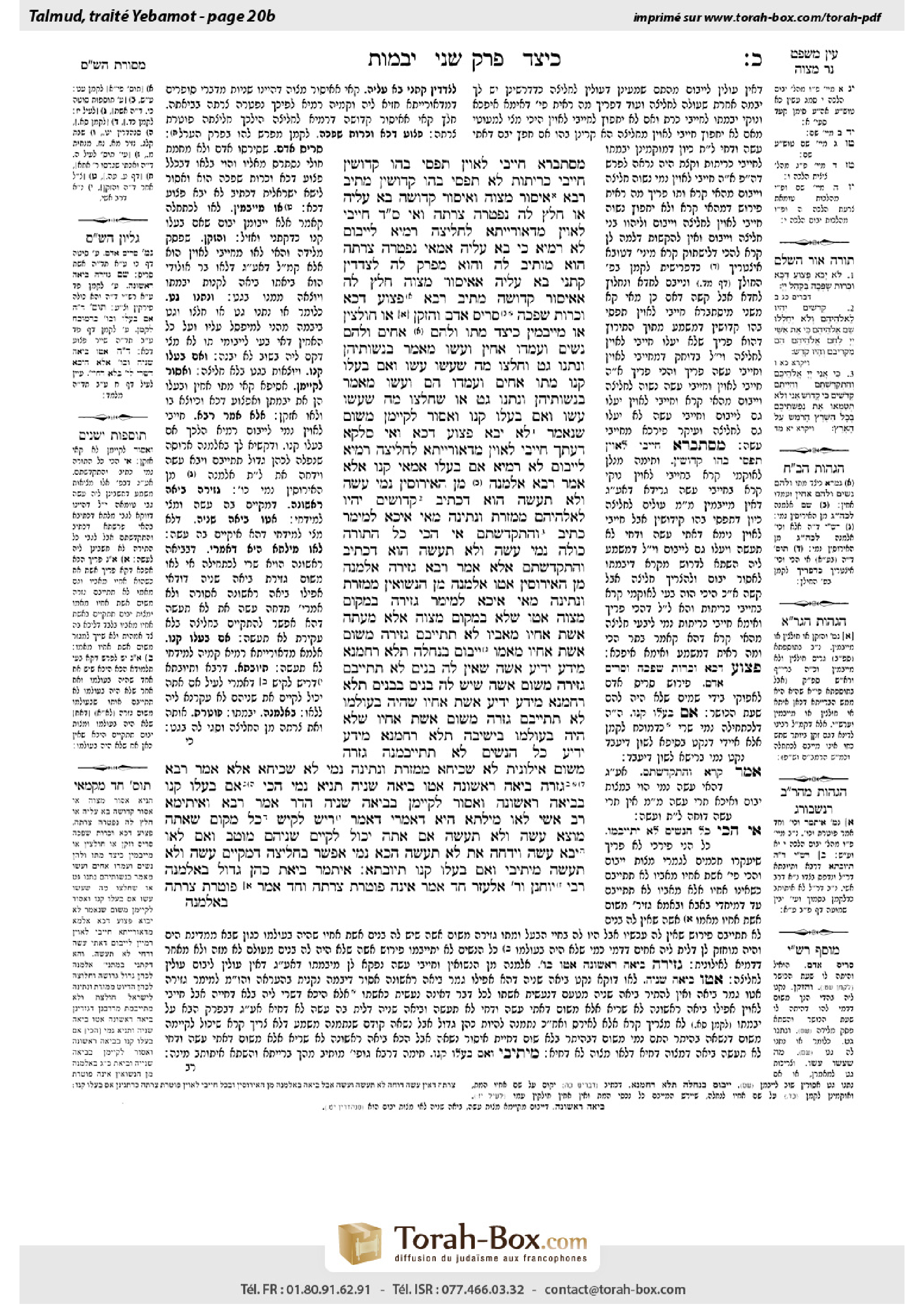
Yevamot 20b: Talmud study for Daf Yomi
Daf Yomi is the daily study of one Talmud folio. Explore 37 tractates with scans, Hebrew text, Sefaria English and AI-generated French translations where annotated.
Passage selection and English or AI-generated French translation are available where the scan has annotations. Daf Study is independent of Torah-Box and Sefaria.
Browse Yevamot · יבמות · All tractatesYevamot 20b text and translations
This page of Yevamot includes the Aramaic text, an English translation and an AI-generated French translation, alongside the scan above.
יבמות כ׳ ב · Aramaic and Hebrew text
מִסְתַּבְּרָא: חַיָּיבֵי לָאוִין — תָּפְסִי בְּהוּ קִדּוּשִׁין. חַיָּיבֵי כָּרֵיתוֹת — לָא תָּפְסִי בְּהוּ קִדּוּשִׁין.
מֵתִיב רָבָא: אִיסּוּר מִצְוָה וְאִיסּוּר קְדוּשָּׁה, בָּא עָלֶיהָ אוֹ חָלַץ לָהּ — נִפְטְרָה צָרָתָהּ. וְאִי סָלְקָא דַעְתָּךְ חַיָּיבֵי לָאוִין מִדְּאוֹרָיְיתָא לַחֲלִיצָה רַמְיָא, לְיִיבּוּם לָא רַמְיָא, כִּי בָּא עָלֶיהָ — אַמַּאי נִפְטְרָה צָרָתָהּ?
הוּא מוֹתֵיב לַהּ וְהוּא מְפָרֵק לַהּ: לִצְדָדִין קָתָנֵי. בָּא עָלֶיהָ — אַאִיסּוּר מִצְוָה. חָלַץ לָהּ — אַאִיסּוּר קְדוּשָּׁה.
מֵתִיב רָבָא: פְּצוּעַ דַּכָּא, וּכְרוּת שׇׁפְכָה, סְרִיס אָדָם, וְהַזָּקֵן — אוֹ חוֹלְצִין אוֹ מְיַיבְּמִין. כֵּיצַד? מֵתוּ, וְלָהֶם אַחִים וְלָהֶם נָשִׁים, וְעָמְדוּ אַחִין וְעָשׂוּ מַאֲמָר בִּנְשׁוֹתֵיהֶן, וְנָתְנוּ גֵּט, וְחָלְצוּ — מַה שֶּׁעָשׂוּ עָשׂוּ. וְאִם בָּעֲלוּ — קָנוּ.
מֵתוּ אַחִים, וְעָמְדוּ הֵם, וְעָשׂוּ מַאֲמָר בִּנְשׁוֹתֵיהֶן, וְנָתְנוּ גֵּט אוֹ שֶׁחָלְצוּ — מַה שֶּׁעָשׂוּ עָשׂוּ. וְאִם בָּעֲלוּ — קָנוּ, וְאָסוּר לְקַיְּימָן, מִשּׁוּם שֶׁנֶּאֱמַר: ״לֹא יָבֹא פְצוּעַ דַּכָּא״. וְאִי סָלְקָא דַּעְתָּךְ חַיָּיבֵי לָאוִין מִדְּאוֹרָיְיתָא לַחֲלִיצָה רַמְיָא, לְיִיבּוּם לָא רַמְיָא, אִם בָּעֲלוּ — אַמַּאי קָנוּ?
אֶלָּא אָמַר רָבָא: אַלְמָנָה מִן הָאֵירוּסִין נָמֵי, עֲשֵׂה וְלֹא תַעֲשֶׂה הוּא — דִּכְתִיב: ״קְדוֹשִׁים יִהְיוּ לֵאלֹהֵיהֶם״.
מַמְזֶרֶת וּנְתִינָה — מַאי אִיכָּא לְמֵימַר? כְּתִיב: ״וְהִתְקַדִּשְׁתֶּם״.
אִי הָכִי, כׇּל הַתּוֹרָה כּוּלָּהּ נָמֵי עֲשֵׂה וְלֹא תַעֲשֶׂה הוּא, דִּכְתִיב: ״וְהִתְקַדִּשְׁתֶּם״! אֶלָּא אָמַר רָבָא: גְּזֵירָה אַלְמָנָה מִן הָאֵירוּסִין אַטּוּ אַלְמָנָה מִן הַנִּשּׂוּאִין.
מַמְזֶרֶת וּנְתִינָה מַאי אִיכָּא לְמֵימַר! גְּזֵירָה בִּמְקוֹם מִצְוָה אַטּוּ שֶׁלֹּא בִּמְקוֹם מִצְוָה.
אֶלָּא מֵעַתָּה, אֵשֶׁת אָחִיו מֵאָבִיו לֹא תִּתְיַיבֵּם, גְּזֵירָה מִשּׁוּם אֵשֶׁת אָחִיו מֵאִמּוֹ! יִיבּוּם בְּנַחֲלָה תְּלָא רַחְמָנָא, מִידָּע יְדִיעַ.
אִשָּׁה שֶׁאֵין לָהּ בָּנִים לֹא תִּתְיַיבֵּם, גְּזֵירָה מִשּׁוּם אִשָּׁה שֶׁיֵּשׁ לָהּ בָּנִים! בְּבָנִים תְּלָא רַחְמָנָא, מִידָּע יְדִיעַ.
אֵשֶׁת אָחִיו שֶׁהָיָה בְּעוֹלָמוֹ לֹא תִּתְיַיבֵּם, גְּזֵרָה מִשּׁוּם אֵשֶׁת אָחִיו שֶׁלֹּא הָיָה בְּעוֹלָמוֹ! בִּישִׁיבָה תְּלָא רַחְמָנָא, מִידָּע יְדִיעַ.
כׇּל הַנָּשִׁים לֹא תִּתְיַיבֵּמְנָה, גְּזֵרָה מִשּׁוּם אַיְלוֹנִית! לָא שְׁכִיחָא. מַמְזֶרֶת וּנְתִינָה נָמֵי לָא שְׁכִיחָא!
אֶלָּא אָמַר רָבָא: גְּזֵרָה בִּיאָה רִאשׁוֹנָה אַטּוּ בִּיאָה שְׁנִיָּה.
תַּנְיָא נָמֵי הָכִי: אִם בָּעֲלוּ — קָנוּ בְּבִיאָה רִאשׁוֹנָה, וְאָסוּר לְקַיְּימָן בְּבִיאָה שְׁנִיָּה.
הֲדַר אָמַר רָבָא, וְאִיתֵּימָא רַב אָשֵׁי: לָאו מִילְּתָא הִיא דַּאֲמַרִי, דְּאָמַר רֵישׁ לָקִישׁ: כׇּל מָקוֹם שֶׁאַתָּה מוֹצֵא עֲשֵׂה וְלֹא תַעֲשֶׂה, אִם אַתָּה יָכוֹל לְקַיֵּים שְׁנֵיהֶם — מוּטָב, וְאִם לָאו, יָבֹא עֲשֵׂה וְיִדְחֶה אֶת לֹא תַעֲשֶׂה. הָכָא נָמֵי אֶפְשָׁר בַּחֲלִיצָה, דִּמְקַיֵּים עֲשֵׂה וְלֹא תַעֲשֶׂה.
מֵיתִיבִי: וְאִם בָּעֲלוּ קָנוּ. תְּיוּבְתָּא.
אִיתְּמַר: בִּיאַת כֹּהֵן גָּדוֹל בְּאַלְמָנָה. רַבִּי יוֹחָנָן וְרַבִּי אֶלְעָזָר, חַד אָמַר: אֵינָהּ פּוֹטֶרֶת צָרָתָהּ, וְחַד אָמַר: פּוֹטֶרֶת צָרָתָהּ.
Yevamot 20b · English translation
The Gemara answers: That stands to reason, since betrothal takes effect with those women who are forbidden and with whom he would be liable for the violation of a prohibition. That is, if a man betroths a woman who is forbidden to him and with whom he would be liable for the violation of a prohibition, then although he violates a prohibition in doing so, the betrothal is valid and cannot be ended without a bill of divorce. Therefore, such a woman also requires ḥalitza. In contrast, betrothal does not take effect at all with those who are forbidden and would be liable to receive the punishment of karet, and therefore in these cases the laws of levirate marriage and ḥalitza do not apply at all.
Rava raised an objection to the explanation of Rav: It is taught in a baraita with regard to a prohibition resulting from a mitzva and a prohibition stemming from sanctity that if he engages in intercourse with such a woman or performs ḥalitza with her, her rival wife is exempt, even though it was prohibited for him to have engaged in intercourse with her in the first place. If it enters your mind that women who are forbidden, as he would be liable for the violation of a prohibition, require ḥalitza by Torah law but do not require levirate marriage, then when he engages in intercourse with his yevama why is her rival wife exempt? If there is no biblical mitzva to engage in intercourse with her, his action would carry no halakhic validity and the rival wife should not be exempt.
Rava raised the objection and he resolved it: The baraita teaches it disjunctively; it did not all deal with the same case. When the baraita says: Engages in intercourse with her, it is referring to a prohibition resulting from a mitzva. If one engages in intercourse with a yevama prohibited to him by rabbinic law, since by Torah law levirate marriage with her is valid, then although his act involved the transgression of a rabbinic decree, he nevertheless fulfilled the Torah mitzva and the rival wife is thereby exempt. When the baraita says: Performs ḥalitza with her, it is referring to a prohibition stemming from sanctity, and by Torah law there is no option of levirate marriage because of the prohibited relation; therefore, only ḥalitza exempts her rival wife.
Rava raised an objection from that which was taught in the Tosefta (Yevamot 11:3): A man with crushed testicles or with other wounds to his genitals or one whose penis has been severed, one who is a eunuch caused by man and not from birth or by disease, or an elderly man, all of whom are incapable of fathering children, one either performs ḥalitza or levirate marriage. How so? If any of these infertile men died, and they had brothers and they also had wives, and they then died childless, and the brothers proceeded to perform levirate betrothal with their wives, or gave them a bill of divorce, or performed ḥalitza, whatever they did is done; i.e., their act was effective. And if any one of the brothers engaged in intercourse with the widow of one of those infertile men, he thereby acquired the woman as a wife according to the laws of levirate marriage.
The inverse is also true: If the brothers died childless, and the infertile men proceeded to perform levirate betrothal with their wives, or gave a bill of divorce, or performed ḥalitza, whatever they did is done and took effect. And if they engaged in intercourse with their yevama, they thereby acquired the yevama as their wife. However, it is forbidden to maintain them, i.e., allow them to continue to live as husband and wife, because it is stated: “One with crushed testicles or whose penis has been severed shall not enter into the assembly of the Lord” (Deuteronomy 23:2); they are prohibited from entering the congregation, i.e., marrying a Jew. And if it enters your mind that women who are forbidden, as he would be liable for the violation of a prohibition, require ḥalitza by Torah law but do not require levirate marriage, then one could ask: if they engaged in intercourse why are they acquired as wives even though there would be no mitzva of levirate marriage because the men are prohibited from marrying them?
Rather, Rav’s opinion is rejected, and Rava said an alternative explanation: The reason why a High Priest does not take a widow from betrothal in levirate marriage is because that relationship is also a violation of both a positive mitzva and a prohibition and therefore a different positive mitzva does not override it. How so? As it is written: “They shall be sacred to their God” (Leviticus 21:6), which teaches that there is a positive mitzva of sanctity associated with all prohibitions applying to priests. Therefore, any such prohibition contains both a positive and a negative mitzva.
The Gemara asks: This resolves the issue of priestly prohibitions, but what is there to say about a daughter born from an incestuous or adulterous relationship [mamzeret] or a Gibeonite woman, who are prohibited from entering the congregation due to considerations of sanctity? They too may not enter into levirate marriage despite the positive mitzva, which would ordinarily override a prohibition. The Gemara answers: It is written with regard to all of the mitzvot: “Sanctify yourselves, therefore, and be sacred” (Leviticus 11:44). This teaches that in addition to the prohibition, there is the positive mitzva of sanctity.
The Gemara raises an objection: If so, then every single prohibition in the entire Torah contains both a positive mitzva and a prohibition, as it is written: “Sanctify yourselves” (Leviticus 11:44). Rather, this reasoning must be rejected, and Rava stated a different reason: While in essence the mitzva of levirate marriage does apply here, nevertheless, a widow from betrothal is prohibited from entering into levirate marriage with the High Priest by rabbinic decree, due to the case of a widow from marriage.
The Gemara asks: What is there to say about the case of a mamzeret or a Gibeonite woman? There appears to be no reason for a rabbinic decree in such cases. The Gemara answers: There, one must say that intercourse with a mamzeret even when the mitzva of levirate marriage applies was prohibited by rabbinic decree due to cases when the mitzva of levirate marriage does not apply. The decree was issued lest one come to think that since in the case of levirate marriage a mamzeret is permitted, even in cases when there is no levirate marriage a mamzeret is similarly permitted.
The Gemara asks: However, if that is so, and the levirate marriage is prohibited lest it become confused with another case, then the wife of a paternal brother should not enter into levirate marriage; i.e., by the same logic, although the Torah allowed it, the Sages should have established a rabbinic decree requiring that she perform ḥalitza due to the case of the wife of a maternal brother, who always remains prohibited as a brother’s wife. The Gemara answers: The Merciful One made levirate marriage dependent upon inheritance, and it is well known by everyone that only patrilineal relatives inherit, so there is no likelihood of confusion.
The Gemara objects further: Then a childless woman should not enter into levirate marriage even though the mitzva applies to her; there should be a rabbinic decree due to the case of a woman who has children. The Gemara answers: The Merciful One made levirate marriage dependent upon children; it is well known by everyone that the entire purpose of levirate marriage is to establish one’s brother’s name and that levirate marriage applies only when there are no children. Here, too, there is no likelihood of error.
The Gemara challenges further: The wife of a brother with whom one did coexist should not enter into levirate marriage; there should be a rabbinic decree due to the case of the wife of a brother with whom he did not coexist. The Gemara responds: The Merciful One made levirate marriage dependent upon a common dwelling together and coexistence of brothers, and this is well known by everyone since the matter is explicit in the Torah.
The Gemara continues to object: No woman should enter into levirate marriage; there should be a rabbinic decree due to the case of an aylonit. Since an aylonit may not enter into levirate marriage, all other women should be prohibited by rabbinic decree from doing so to avoid confusion. The Gemara answers: The case of an aylonit is not commonplace, and the Sages did not institute rabbinic decrees on matters that are not common. The Gemara asks: If so, neither a mamzeret nor a Gibeonite woman is commonplace either. Therefore, since the likelihood of taking a mamzeret in levirate marriage is so small, there is no danger that one might think it is permitted to marry a mamzeret even where the mitzva does not apply.
Rather, Rava said that it is necessary to reject the previous suggestion and to offer a different reason: The first act of intercourse is prohibited by rabbinic decree due to the likelihood of a second act of intercourse. Although intercourse the first time with the yevama is the fulfillment of a positive mitzva, which does override the prohibition, once the mitzva is fulfilled with that act there is no longer any positive mitzva involved. Afterward, this yevama becomes prohibited because there is no longer a positive mitzva to override the prohibition. Therefore, due to the possibility that one might engage in intercourse a second time with this woman, the Sages decreed that even the first act is prohibited.
The Gemara comments: This is also taught in a baraita: If one of those yevamin who may not marry their yevama due to a prohibition engaged in intercourse with her, he acquired her with the first act of intercourse; however, it is prohibited to retain her for a second act of intercourse.
The Gemara continues with a retraction from Rava: Rava then said, and some say it was actually Rav Ashi who said: That which I said, that the reason for the rabbinic decree was to prevent a second act of intercourse, is not correct, as there is a simpler explanation. As Reish Lakish said about the same matter: In every place that you find a positive mitzva and a prohibition applying to the same matter, if you can fulfill both of them together, this is best, and the positive mitzva does not override the prohibition. And if there is not any possibility of fulfilling both, then let the positive mitzva come and override the prohibition. Here, too, in the case of levirate marriage, it is possible, by way of ḥalitza, to fulfill the positive mitzva and not to transgress the prohibition prohibiting marriage to these women.
The Gemara raises an objection to this last statement by Rava from that which is taught in a baraita: And if one of those yevamin engaged in intercourse, he acquired her as a wife. This shows that although it is possible to perform the mitzva by way of ḥalitza, if he nevertheless performs levirate marriage then the positive mitzva overrides the prohibition and the yevama is thereby acquired as his wife. The Gemara concludes: This is a conclusive refutation, and Rava’s last explanation is rejected. The previous explanation is the correct one: The prohibition is due to rabbinic decree.
§ On the same subject, it was stated with regard to the case of a High Priest who engaged in intercourse with a widow who was his yevama requiring levirate marriage that the amora’im Rabbi Yoḥanan and Rabbi Elazar disputed the matter. One said that intercourse does not exempt her rival wife who had also been married to the High Priest’s brother, since the act was prohibited, and one said that it does exempt her rival wife, because although intercourse was forbidden, it is nevertheless a valid enactment of levirate marriage, and so her rival wife is thereby exempt.
Yevamot 20b · Traduction française (IA)
La Guemara répond : Cela est logique, puisque les kiddouchin prennent effet avec les femmes qui lui sont interdites et pour lesquelles il serait passible de la peine prévue pour la transgression d’une interdiction. Autrement dit, si un homme épouse par kiddouchin une femme qui lui est interdite et pour laquelle il serait passible de cette peine, les kiddouchin sont valides, bien qu’il transgresse une interdiction, et ne peuvent être annulés sans acte de divorce. Une telle femme requiert donc également la ḥalitsa. En revanche, les kiddouchin ne prennent aucun effet avec les femmes qui lui sont interdites et pour lesquelles il serait passible de karet ; les lois du mariage léviratique et de la ḥalitsa ne s’appliquent donc pas du tout dans ces cas.
Rava soulève une objection contre l’explication de Rav : une baraïta enseigne, au sujet d’une interdiction découlant d’une mitsva et d’une interdiction liée à la sainteté, que si l’homme a des relations avec une telle femme ou accomplit la ḥalitsa avec elle, sa coépouse est dispensée, bien qu’il lui ait été interdit d’avoir des relations avec elle dès le départ. Si l’on devait penser que les femmes qui lui sont interdites et pour lesquelles il serait passible de la peine prévue pour la transgression d’une interdiction requièrent la ḥalitsa selon la Torah, mais pas le mariage léviratique, alors, s’il a des relations avec sa yevama, pourquoi sa coépouse est-elle dispensée ? S’il n’y a pas de mitsva biblique d’avoir des relations avec elle, son acte n’aurait aucune validité halakhique et sa coépouse ne devrait pas être dispensée.
Rava soulève l’objection, puis la résout : la baraïta présente les cas de manière disjonctive ; elle ne traite pas partout du même cas. Quand la baraïta dit : « A des relations avec elle », elle parle d’une interdiction découlant d’une mitsva. Si quelqu’un a des relations avec une yevama qui lui est interdite par la loi rabbinique, puisque le mariage léviratique avec elle est valide selon la Torah, il accomplit néanmoins la mitsva de la Torah, bien que son acte transgresse un décret rabbinique, et sa coépouse est ainsi dispensée. Quand la baraïta dit : « Accomplit la ḥalitsa avec elle », elle parle d’une interdiction liée à la sainteté. Selon la Torah, le mariage léviratique n’est alors pas une option en raison de l’union interdite ; seule la ḥalitsa dispense donc sa coépouse.
Rava soulève une objection à partir de ce qui est enseigné dans la Tossefta (Yevamot 11:3) : un homme aux testicules écrasés, un homme ayant d’autres blessures aux organes génitaux, un homme dont le pénis a été sectionné, un eunuque rendu tel par une intervention humaine — et non de naissance ou par une maladie — ou un homme âgé, tous incapables d’engendrer, peut soit accomplir la ḥalitsa, soit contracter un mariage léviratique. Comment cela s’applique-t-il ? Si l’un de ces hommes infertiles est mort en laissant des frères et des épouses, puis que ces frères sont morts sans enfants, et que les frères restants ont procédé aux kiddouchin léviratiques avec leurs veuves, leur ont remis un acte de divorce ou ont accompli la ḥalitsa avec elles, tout ce qu’ils ont fait est effectif. Autrement dit, leurs actes ont pris effet. Et si l’un des frères a eu des relations avec la veuve de l’un de ces hommes infertiles, il a ainsi acquis cette femme comme épouse conformément aux règles du mariage léviratique.
L’inverse est également vrai : si les frères sont morts sans enfants et que les hommes infertiles ont procédé aux kiddouchin léviratiques avec leurs veuves, leur ont remis un acte de divorce ou ont accompli la ḥalitsa avec elles, tout ce qu’ils ont fait est effectif et a pris effet. Et s’ils ont eu des relations avec leur yevama, ils l’ont ainsi acquise comme épouse. Toutefois, il leur est interdit de rester ensemble, c’est-à-dire de continuer à vivre comme mari et femme, car il est dit : « Celui dont les testicules sont écrasés ou dont le pénis a été sectionné n’entrera pas dans l’assemblée de l’Éternel » (Deutéronome 23:2) ; il leur est interdit d’entrer dans la communauté, c’est-à-dire d’épouser une Juive. Et si l’on devait penser que les femmes qui lui sont interdites et pour lesquelles il serait passible de la peine prévue pour la transgression d’une interdiction requièrent la ḥalitsa selon la Torah, mais pas le mariage léviratique, on pourrait alors demander : s’ils ont eu des relations, pourquoi les ont-ils acquises comme épouses, alors qu’il n’y aurait pas de mitsva de mariage léviratique puisque ces hommes n’ont pas le droit de les épouser ?
Il faut plutôt rejeter l’opinion de Rav, et Rava a proposé une autre explication : si un grand prêtre ne contracte pas de mariage léviratique avec une veuve de fiançailles, c’est parce que cette union transgresse à la fois une mitsva positive et une interdiction ; une autre mitsva positive ne peut donc pas l’emporter. Comment cela ? Car il est écrit : « Ils seront saints pour leur Dieu » (Lévitique 21:6), ce qui enseigne qu’une mitsva positive de sainteté est associée à toutes les interdictions qui s’appliquent aux prêtres. Toute interdiction de ce type comporte donc à la fois une mitsva positive et une mitsva négative.
La Guemara demande : Cette explication résout la question des interdictions sacerdotales, mais qu’en est-il d’une fille née d’une union incestueuse ou adultère [mamzeret], ou d’une femme guibonite, à qui l’accès à la communauté est interdit pour des raisons liées à la sainteté ? Elles non plus ne peuvent contracter de mariage léviratique malgré la mitsva positive, qui l’emporterait normalement sur une interdiction. La Guemara répond : au sujet de toutes les mitsvot, il est écrit : « Sanctifiez-vous donc et soyez saints » (Lévitique 11:44). Cela enseigne qu’en plus de l’interdiction, il existe une mitsva positive de sainteté.
La Guemara soulève une objection : dans ce cas, chaque interdiction de toute la Torah comporterait à la fois une mitsva positive et une interdiction, puisqu’il est écrit : « Sanctifiez-vous » (Lévitique 11:44). Il faut donc rejeter ce raisonnement, et Rava a donné une autre raison : en principe, la mitsva de mariage léviratique s’applique bien ici ; néanmoins, un décret rabbinique interdit à une veuve de fiançailles de contracter un mariage léviratique avec le grand prêtre, par crainte du cas d’une veuve dont le mariage a été consommé.
La Guemara demande : Qu’en est-il d’une mamzeret ou d’une femme guibonite ? Dans ces cas, rien ne semble justifier un décret rabbinique. La Guemara répond : il faut dire que les relations avec une mamzeret, même lorsque la mitsva de mariage léviratique s’applique, ont été interdites par décret rabbinique en raison des cas où cette mitsva ne s’applique pas. Le décret a été pris de peur que l’on en vienne à penser que, puisque la mamzeret est permise dans le cadre du mariage léviratique, elle l’est également dans les cas où il n’y a pas de mariage léviratique.
La Guemara demande : Toutefois, si tel est le cas et que le mariage léviratique est interdit de peur qu’on le confonde avec un autre cas, l’épouse d’un frère paternel ne devrait pas contracter de mariage léviratique. Autrement dit, selon la même logique, bien que la Torah l’ait permis, les Sages auraient dû instituer un décret rabbinique exigeant qu’elle accomplisse la ḥalitsa, à cause du cas de l’épouse d’un frère maternel, qui reste toujours interdite en tant qu’épouse du frère. La Guemara répond : le Miséricordieux a fait dépendre le mariage léviratique de l’héritage ; or chacun sait que seuls les parents par la lignée paternelle héritent, il n’y a donc aucun risque de confusion.
La Guemara objecte encore : une femme sans enfants ne devrait pas contracter de mariage léviratique, même si la mitsva s’applique à elle ; un décret rabbinique devrait être institué à cause du cas d’une femme qui a des enfants. La Guemara répond : le Miséricordieux a fait dépendre le mariage léviratique de l’absence d’enfants ; chacun sait que le mariage léviratique a pour but de perpétuer le nom du frère et qu’il ne s’applique qu’en l’absence d’enfants. Ici aussi, il n’y a pas de risque d’erreur.
La Guemara poursuit son objection : l’épouse d’un frère avec lequel on a vécu à la même époque ne devrait pas contracter de mariage léviratique ; un décret rabbinique devrait être institué à cause du cas de l’épouse d’un frère avec lequel il n’a pas vécu à la même époque. La Guemara répond : le Miséricordieux a fait dépendre le mariage léviratique du fait que les frères aient vécu ensemble à la même époque, et cela est connu de tous puisque la question est explicitement formulée dans la Torah.
La Guemara poursuit son objection : aucune femme ne devrait contracter de mariage léviratique ; un décret rabbinique devrait être institué à cause du cas d’une aylonit. Puisqu’une aylonit ne peut pas contracter de mariage léviratique, toutes les autres femmes devraient en être empêchées par décret rabbinique, afin d’éviter toute confusion. La Guemara répond : le cas d’une aylonit est peu courant, et les Sages n’ont pas institué de décrets rabbiniques pour des situations inhabituelles. La Guemara demande : dans ce cas, une mamzeret ou une femme guibonite n’est pas courante non plus. La probabilité qu’une mamzeret contracte un mariage léviratique étant si faible, il n’y a donc aucun risque que l’on pense qu’il est permis d’épouser une mamzeret même lorsque la mitsva ne s’applique pas.
Rava a plutôt dit qu’il fallait rejeter la suggestion précédente et donner une autre raison : le premier acte de relations est interdit par décret rabbinique en raison du risque d’un second acte. Bien que les premières relations avec la yevama accomplissent une mitsva positive, qui l’emporte effectivement sur l’interdiction, une fois la mitsva accomplie par cet acte, aucune mitsva positive n’est plus en jeu. Par la suite, cette yevama devient interdite, puisqu’il n’y a plus de mitsva positive pour l’emporter sur l’interdiction. Par crainte que l’on ait des relations une deuxième fois avec cette femme, les Sages ont donc décrété que même le premier acte est interdit.
La Guemara fait remarquer que cela est également enseigné dans une baraïta : si l’un de ces yevamin, à qui une interdiction interdit d’épouser leur yevama, a des relations avec elle, il l’acquiert par le premier acte ; toutefois, il lui est interdit de la garder pour avoir avec elle un second rapport.
La Guemara rapporte que Rava se rétracte : Rava a ensuite dit — et certains disent que c’est Rav Ashi qui l’a dit — : ce que j’ai déclaré, à savoir que le décret rabbinique visait à empêcher un second acte de relations, est inexact, car il existe une explication plus simple. En effet, Reish Lakish a dit à ce sujet : partout où une mitsva positive et une interdiction s’appliquent à la même situation, si l’on peut accomplir les deux à la fois, c’est préférable, et la mitsva positive ne l’emporte pas sur l’interdiction. S’il n’est pas possible d’accomplir les deux, alors la mitsva positive doit l’emporter sur l’interdiction. Ici aussi, dans le cas du mariage léviratique, il est possible, au moyen de la ḥalitsa, d’accomplir la mitsva positive sans transgresser l’interdiction d’épouser ces femmes.
La Guemara soulève une objection contre cette dernière déclaration de Rava à partir de ce qui est enseigné dans une baraïta : si l’un de ces yevamin a des relations avec elle, il l’acquiert comme épouse. Cela montre que, bien qu’il soit possible d’accomplir la mitsva au moyen de la ḥalitsa, s’il contracte néanmoins un mariage léviratique, la mitsva positive l’emporte sur l’interdiction et la yevama est ainsi acquise comme épouse. La Guemara conclut : c’est une réfutation définitive, et la dernière explication de Rava est rejetée. L’explication précédente est la bonne : l’interdiction découle d’un décret rabbinique.
§ Sur le même sujet, à propos d’un grand prêtre qui a eu des relations avec une veuve qui était sa yevama et devait contracter avec lui un mariage léviratique, il a été rapporté que les amoraïm Rabbi Yoḥanan et Rabbi Elazar étaient en désaccord. Selon l’un, les relations ne dispensent pas sa coépouse, qui avait également été mariée au frère du grand prêtre, puisque l’acte était interdit ; selon l’autre, elles dispensent sa coépouse, car, bien que les relations aient été interdites, elles constituent néanmoins une mise en œuvre valide du mariage léviratique, et sa coépouse est donc dispensée.
Traduction française générée par IA à partir de l’édition anglaise de Sefaria. Vérifie toujours un passage avec le texte source.
Text from Sefaria: William Davidson Edition - Vocalized Aramaic (CC BY NC); William Davidson Edition - English (CC BY NC).