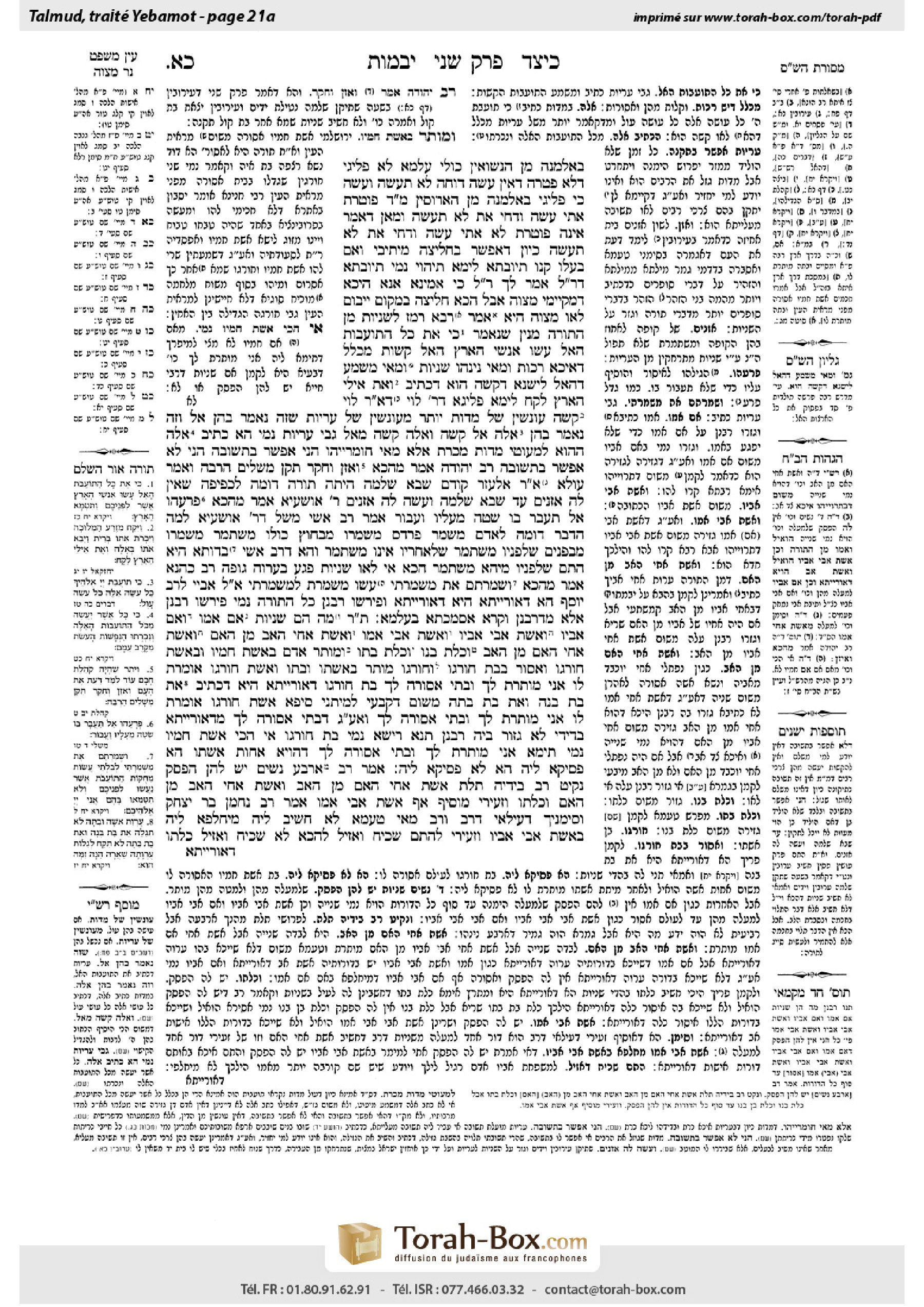
Yevamot 21a: Talmud study for Daf Yomi
Daf Yomi is the daily study of one Talmud folio. Explore 37 tractates with scans, Hebrew text, Sefaria English and AI-generated French translations where annotated.
Passage selection and English or AI-generated French translation are available where the scan has annotations. Daf Study is independent of Torah-Box and Sefaria.
Browse Yevamot · יבמות · All tractatesYevamot 21a text and translations
This page of Yevamot includes the Aramaic text, an English translation and an AI-generated French translation, alongside the scan above.
יבמות כ״א א · Aramaic and Hebrew text
בְּאַלְמָנָה מִן הַנִּשּׂוּאִין — כּוּלֵּי עָלְמָא לָא פְּלִיגִי דְּלָא פָּטְרָה, דְּאֵין עֲשֵׂה דּוֹחֶה לֹא תַעֲשֶׂה וַעֲשֵׂה. כִּי פְּלִיגִי בְּאַלְמָנָה מִן הָאֵרוּסִין. מַאן דְּאָמַר פּוֹטֶרֶת — אָתֵי עֲשֵׂה וְדָחֵי אֶת לֹא תַעֲשֶׂה. וּמַאן דְּאָמַר אֵינָהּ פּוֹטֶרֶת — לָא אָתֵי עֲשֵׂה וְדָחֵי אֶת לֹא תַעֲשֶׂה, כֵּיוָן דְּאֶפְשָׁר בַּחֲלִיצָה.
מֵיתִיבִי: וְאִם בָּעֲלוּ קָנוּ! תְּיוּבְתָּא.
לֵימָא תִּיהְוֵי נָמֵי תְּיוּבְתָּא דְּרֵישׁ לָקִישׁ?! אָמַר לָךְ רֵישׁ לָקִישׁ: כִּי אָמֵינָא אֲנָא — הֵיכָא דִּמְקַיְּימִי מִצְוָה, אֲבָל הָכָא, חֲלִיצָה בִּמְקוֹם יִיבּוּם — לָאו מִצְוָה הִיא.
אָמַר רָבָא: רֶמֶז לִשְׁנִיּוֹת מִן הַתּוֹרָה מִנַּיִן — שֶׁנֶּאֱמַר: ״כִּי אֶת כׇּל הַתּוֹעֵבוֹת הָאֵל עָשׂוּ אַנְשֵׁי הָאָרֶץ״, ״הָאֵל״ — קָשׁוֹת, מִכְּלָל דְּאִיכָּא רַכּוֹת, וּמַאי נִינְהוּ — שְׁנִיּוֹת.
וּמַאי מַשְׁמַע דְּ״הָאֵל״ לִישָּׁנָא דְקָשֶׁה הוּא — דִּכְתִיב: ״וְאֶת אֵילֵי הָאָרֶץ לָקָח״.
לֵימָא פְּלִיגָא דְּרַבִּי לֵוִי, דְּאָמַר רַבִּי לֵוִי: קָשֶׁה עוֹנְשָׁן שֶׁל מִדּוֹת יוֹתֵר מֵעוֹנְשָׁן שֶׁל עֲרָיוֹת, שֶׁזֶּה נֶאֱמַר בָּהֶן ״אֵל״, וְזֶה נֶאֱמַר בָּהֶן ״אֵלֶּה״! ״אֵל״ קָשֶׁה, וְ״אֵלֶּה״ קָשֶׁה מֵ״אֵל״.
גַּבֵּי עֲרָיוֹת נָמֵי הָא כְּתִיב ״אֵלֶּה״! הָהוּא לְמַעוֹטֵי מִדּוֹת מִכָּרֵת.
אֶלָּא מַאי חוּמְרַיְיהוּ? הָנֵי — אֶפְשָׁר בִּתְשׁוּבָה, הָנֵי — לָא אֶפְשָׁר בִּתְשׁוּבָה.
רַב יְהוּדָה אָמַר מֵהָכָא: ״וְאִזֵּן וְחִקֵּר תִּקֵּן מְשָׁלִים הַרְבֵּה״, וְאָמַר עוּלָּא אָמַר רַבִּי אֶלְעָזָר: קוֹדֶם שֶׁבָּא שְׁלֹמֹה, הָיְתָה תּוֹרָה דּוֹמָה לִכְפִיפָה שֶׁאֵין לָהּ אׇזְנַיִם, עַד שֶׁבָּא שְׁלֹמֹה וְעָשָׂה לָהּ אׇזְנַיִם.
רַבִּי אוֹשַׁעְיָא אָמַר מֵהָכָא: ״פְּרָעֵהוּ אַל תַּעֲבׇר בּוֹ שְׂטֵה מֵעָלָיו וַעֲבוֹר״.
אָמַר רַב אָשֵׁי: מָשָׁל דְּרַבִּי אוֹשַׁעְיָא לְמָה הַדָּבָר דּוֹמֶה — לְאָדָם מְשַׁמֵּר פַּרְדֵּס, מְשַׁמְּרוֹ מִבַּחוּץ — כּוּלּוֹ מִשְׁתַּמֵּר. מְשַׁמְּרוֹ מִבִּפְנִים, שֶׁלְּפָנָיו — מִשְׁתַּמֵּר, שֶׁלְּאַחֲרָיו — אֵינוֹ מִשְׁתַּמֵּר. וְהָא דְּרַב אָשֵׁי בְּדוּתָא הִיא. הָתָם, שֶׁלְּפָנָיו מִיהָא מִשְׁתַּמֵּר. הָכָא, אִי לָאו שְׁנִיּוֹת, פָּגַע בְּעֶרְוָה גּוּפַהּ.
רַב כָּהֲנָא אָמַר מֵהָכָא: ״וּשְׁמַרְתֶּם אֶת מִשְׁמַרְתִּי״ — עֲשׂוּ מִשְׁמֶרֶת לְמִשְׁמַרְתִּי.
אֲמַר לֵיהּ אַבָּיֵי לְרַב יוֹסֵף: הָא דְּאוֹרָיְיתָא הִיא! דְּאוֹרָיְיתָא, וּפֵירְשׁוּ רַבָּנַן. כׇּל הַתּוֹרָה נָמֵי פֵּירְשׁוּ רַבָּנַן! אֶלָּא: מִדְּרַבָּנַן, וּקְרָא אַסְמַכְתָּא בְּעָלְמָא.
תָּנוּ רַבָּנַן, מָה הֵם שְׁנִיּוֹת: אֵם אִמּוֹ, וְאֵם אָבִיו, וְאֵשֶׁת אֲבִי אָבִיו, וְאֵשֶׁת אֲבִי אִמּוֹ, וְאֵשֶׁת אֲחִי הָאָב מִן הָאֵם, וְאֵשֶׁת אֲחִי הָאֵם מִן הָאָב, וְכַלַּת בְּנוֹ, וְכַלַּת בִּתּוֹ. וּמוּתָּר אָדָם בְּאֵשֶׁת חָמִיו וּבְאֵשֶׁת חוֹרְגוֹ, וְאָסוּר בְּבַת חוֹרְגוֹ. וְחוֹרְגוֹ מוּתָּר בְּאִשְׁתּוֹ וּבִתּוֹ.
וְאֵשֶׁת חוֹרְגוֹ אוֹמֶרֶת לוֹ: אֲנִי מוּתֶּרֶת לְךָ, וּבִתִּי אֲסוּרָה לָךְ.
בַּת חוֹרְגוֹ דְּאוֹרָיְיתָא הִיא, דִּכְתִיב: ״אֶת בַּת בְּנָהּ וְאֶת בַּת בִּתָּהּ״! מִשּׁוּם דְּקָבָעֵי לְמִיתְנֵי סֵיפָא: אֵשֶׁת חוֹרְגוֹ אוֹמֶרֶת לוֹ: ״אֲנִי מוּתֶּרֶת לְךָ וּבִתִּי אֲסוּרָה לְךָ״, וְאַף עַל גַּב דְּבִתִּי אֲסוּרָה לְךָ מִדְּאוֹרָיְיתָא, בְּדִידִי לָא גְּזוּר בִּיה רַבָּנַן — תְּנָא רֵישָׁא נָמֵי בַּת חוֹרְגוֹ.
אִי הָכִי, אֵשֶׁת חָמִיו נָמֵי תֵּימָא: אֲנִי מוּתֶּרֶת לְךָ וּבִתִּי אֲסוּרָה לָךְ, דְּהָוְיָא אֲחוֹת אִשְׁתּוֹ! הָא פְּסִיקָא לֵיהּ, הָא לָא פְּסִיקָא לֵיהּ.
אָמַר רַב, אַרְבַּע נָשִׁים יֵשׁ לָהֶן הֶפְסֵק. נָקֵיט רַב בִּידֵיהּ תְּלָת: אֵשֶׁת אֲחִי הָאֵם מִן הָאָב, וְאֵשֶׁת אֲחִי הָאָב מִן הָאֵם, וְכַלָּתוֹ. וּזְעֵירִי מוֹסִיף אַף אֵשֶׁת אֲבִי אִמּוֹ. אָמַר רַב נַחְמָן בַּר יִצְחָק, וְסִימָנָיךְ: דְּעִילַּאי, דְּרַב.
וְרַב מַאי טַעְמָא לָא חָשֵׁיב לֵיהּ? מִיחַלְּפָא לֵיהּ בְּאֵשֶׁת אֲבִי אָבִיו.
וּזְעֵירִי? לְהָתָם שְׁכִיחַ וְאָזֵיל, לְהָכָא לָא שְׁכִיחַ וְאָזֵיל.
כַּלָּתוֹ
Yevamot 21a · English translation
As for a widow from marriage, everyone agrees that this does not exempt the rival wife, as a positive mitzva does not override a prohibition and a positive mitzva together. When they disagree, it is in the case of a widow from betrothal. The one who said that it exempts the rival wife holds that the positive mitzva of levirate marriage comes and overrides the prohibition against a High Priest marrying a widow. And the one who said that it does not exempt the rival wife held that a positive mitzva does not come and override a prohibition, since it is possible to perform ḥalitza.
The Gemara raises an objection to the opinion that the rival wife would not be exempt, from the previously cited baraita: If one of those yevamin engaged in intercourse, he acquired her as a wife. This shows that the act of levirate marriage is valid, even when prohibited. If so, in the case of the High Priest and a widow as well, her rival wife should be exempt. This is a conclusive refutation, and that opinion is rejected.
The Gemara asks: Shall we say that this is also a conclusive refutation of the opinion of Reish Lakish and therefore reject his principle? The Gemara answers: Reish Lakish could have said to you: When I say that in every place that you find a positive mitzva and a prohibition applying to the same matter, if you can fulfill both of them together without transgressing the prohibition, this is best, and the positive mitzva does not override the prohibition, this is applicable only when the mitzva is fulfilled properly; but here, ḥalitza in place of levirate marriage is not considered a proper fulfillment of the mitzva.
§ Rava said: Where is the prohibition against secondary forbidden relationships hinted at in the Torah? As it is stated at the end of the portion discussing forbidden incestuous relations: “For all these abominations have the men of the land done” (Leviticus 18:27). “These” must be understood to mean the harsh ones, i.e., the severe transgressions. This proves by inference that there are also lesser transgressions that are, as it were, soft ones. And what are those soft ones? They are secondary forbidden relationships.
The Gemara asks: From where may it be inferred that the word “these” [ha’el] is an expression meaning harsh? As it is written: “And the mighty [eilei] of the land he took away” (Ezekiel 17:13). The similarity of these words implies that “these” also has connotations of mighty or harsh.
The Gemara asks: Shall we say that this statement contradicts the opinion of Rabbi Levi? As Rabbi Levi said: The harshness of the punishment for using dishonest measures is more than the punishment for transgressing the prohibition of forbidden relationships, as with regard to this, forbidden relations, it is stated only: “These [el],” whereas with regard to that, dishonest measures, it is stated: “These [eleh]” with an additional letter heh as a suffix: “For all that do these [eleh] things, even all that do unrighteously, are an abomination unto the Lord your God” (Deuteronomy 25:16). This implies that the word eleh indicates harshness and not the word el. The Gemara answers: This does not contradict his opinion. The word el has the connotation of harsh, but eleh has the connotation of even harsher than el.
The Gemara asks: With regard to forbidden relationships the word eleh is also written: “For whosoever shall do any of these [eleh] abominations, even the souls that do them shall be cut off from among their people” (Leviticus 18:29). If so, why is the punishment for using dishonest measures considered harsher? The Gemara answers: That expression meaning these [eleh] in the context of forbidden relations does not emphasize their severity; rather, it comes to exclude one who uses deception in measures from the penalty of karet.
The Gemara asks: Rather, in what way is deception in measurements more severe than forbidden relations? The Gemara answers: Those who engage in forbidden relations have the possibility of repentance. If one engaged in relations with a forbidden relative he can rectify the sin through repentance. In the case of those who deceive the public with dishonest measures, it is not possible to repent fully because, having deceived the general public, they have no way of returning the money. Whereas generally a thief can return stolen property to its rightful owner, one who used dishonest measures with multiple customers has no way to track them all down in order to return the money.
Rav Yehuda said that the prohibition of secondary forbidden relationships is learned from here: As it says with regard to King Solomon: “He weighed [izzen] and sought out, and set in order many proverbs” (Ecclesiastes 12:9), and Ulla said that Rabbi Elazar said: Before Solomon came, the Torah was like a basket [kefifa] without handles [oznayim], until Solomon came and made handles for it. By means of his explanation and proverbs he enabled each person to understand and take hold of the Torah, fulfill its mitzvot, and distance himself from transgressions.
Rabbi Oshaya said that the prohibition of secondary forbidden relationships is learned from here: “Avoid it, pass not by it; turn from it, and pass on” (Proverbs 4:15). One must distance oneself from any prohibited act and not pass near a place of forbidden objects or situations.
Rav Ashi said a parable: To what is this matter, the opinion of Rabbi Oshaya, comparable? It is comparable to a man guarding an orchard; if he guards it from the outside, all of it is guarded. But if he guards it from the inside, only that which is in front of him that he can see is guarded, while that which is behind him is unguarded. The Gemara comments: And this parable of Rav Ashi is a mistake [beduta] and is not accurate. There, in his metaphor, that which is in front of him at least is guarded; here, in the case of forbidden relationships, were it not for the rabbinic decree against secondary forbidden relationships one would eventually encounter and transgress the biblically forbidden relationship itself. Guarding from the outside is not only preferable, it is essential.
Rav Kahana said that the prohibition of secondary forbidden relationships is alluded to from here, in the verse stated at the conclusion of the verses discussing the halakhot of forbidden relationships: “Therefore shall you protect [ushmartem] My prized possession [mishmarti], that you do not any of these abominable customs” (Leviticus 18:30). This means: Establish a safeguard [mishmeret] for My prized possession.
Abaye said to Rav Yosef: If the prohibition against secondary forbidden relationships is learned from here then it would be by Torah law, yet the prohibition against secondary forbidden relationships is by rabbinic law. He answered him: The requirement to add an additional safeguard itself is in fact by Torah law, and the Sages interpreted and defined where and when to apply this law. Abaye objected: But isn’t all of the Torah also interpreted by the Sages and yet has the force of Torah law? In that case, why are these laws considered to be rabbinic? Rather, the prohibition of secondary forbidden relationships was decreed by rabbinic law, and the verse is a mere support but does not indicate a Torah law.
§ The Sages taught in a baraita: What are the secondary forbidden relationships that were prohibited? His mother’s mother, and his father’s mother, and his father’s father’s wife, and his mother’s father’s wife, and the wife of his father’s maternal half brother, and the wife of his mother’s paternal half brother, and his son’s daughter-in-law, and his daughter’s daughter-in-law. A man is permitted to take his father-in-law’s former wife, provided she is not the mother of his wife, and his stepson’s wife, if the stepson died or divorced her. And he is prohibited from marrying the daughter of his stepson. And it is permitted for one’s stepson to marry the stepfather’s wife or daughter.
Due to these rabbinic decrees concerning stepsons, unusual situations might arise. For example: And his stepson’s wife says to him, i.e., her husband’s stepfather, I am permitted to you, but my daughter is forbidden to you, since she is your stepson’s daughter.
The Gemara challenges that which is stated in the baraita: His stepson’s daughter is not a secondary relation by rabbinic law. She is forbidden by Torah law, since the daughter of his stepson is the daughter of his wife’s son, as it is written: “You shall not take her son’s daughter or her daughter’s daughter” (Leviticus 18:17). The Gemara answers: This case was included because the baraita wanted to teach the latter clause, which states: His stepson’s wife says to him: I am permitted to you, but my daughter is forbidden to you. And although my daughter is forbidden to you by Torah law, nevertheless the Sages did not issue a decree forbidding me. Therefore, the case of his stepson’s daughter was also taught in the first clause, even though she is forbidden by Torah law and is not a secondary relation.
The Gemara raises an objection: If so, that the baraita wished to teach this peculiarity, then why did it not teach: His father-in-law’s wife also says: I am permitted to you and my daughter is forbidden to you, as she is his wife’s sister. The Gemara answers: This matter is conclusive for him. In other words, his stepson’s wife is forever permitted and his stepson’s daughter is always forbidden to him. But as for the matter of his father-in-law’s wife’s daughter, this is not conclusive for him. This ruling is not final and might change, since if his wife dies her sister is permitted to him.
Rav said that he received a tradition with regard to secondary forbidden relationships that four women have a conclusion; i.e., the prohibition does not continue to later generations but applies only to those women who were mentioned explicitly. Rav held three of them in his hand; he knew with certainty three of the four categories. They were: The wife of his mother’s paternal half brother, and the wife of his father’s maternal half brother, and his daughter-in-law. And Ze’eiri adds: Also the wife of his mother’s father. Rav Naḥman bar Yitzḥak said: And your mnemonic for remembering who said what is as follows: Ze’eiri adds an extra generation on top of the prohibitions of Rav, i.e., the wife of his mother’s father, which Rav did not mention.
The Gemara asks: And what is the reason that Rav did not reckon this category mentioned by Ze’eiri to be among those who have a conclusion? The Gemara answers: In his opinion, this category might be mistakenly switched with the category of the wife of his father’s father, which does not have a conclusion. With regard to the wife of his father, the prohibition applies equally to the wife of all ancestors in the father’s line. Therefore, according to Rav, the Sages also included the ancestors of the mother’s father’s wife as secondary forbidden relationships.
The Gemara asks: And why is Ze’eiri not concerned that the two categories will become confused? The Gemara answers: He is often found there, in his father’s father’s home, and goes there frequently, but here, to his mother’s household, he is not commonly found to go. Since he goes to his father’s home frequently, he knows that his father’s relatives are forbidden to him, and he will not confuse them with his mother’s relatives.
Among the women enumerated by Rav is his daughter-in-law.
Yevamot 21a · Traduction française (IA)
Quant à une veuve issue d’un mariage, tous s’accordent à dire que cela ne dispense pas sa coépouse, car une mitsva positive ne peut pas écarter à la fois une interdiction et une mitsva positive. Leur désaccord porte sur le cas d’une veuve issue de fiançailles. Selon celui qui dit que cela dispense sa coépouse, la mitsva positive du lévirat vient écarter l’interdiction faite à un grand prêtre d’épouser une veuve. Selon celui qui dit que cela ne dispense pas sa coépouse, une mitsva positive ne vient pas écarter une interdiction, puisqu’il est possible d’accomplir la ḥalitsa.
La Guemara soulève une objection contre l’avis selon lequel la coépouse ne serait pas dispensée, en s’appuyant sur la baraïta citée précédemment : si l’un des yevamin a eu des relations avec elle, il l’a acquise comme épouse. Cela montre que l’acte du lévirat est valide, même lorsqu’il est interdit. Si tel est le cas, dans la situation d’un grand prêtre et d’une veuve également, sa coépouse devrait être dispensée. C’est une réfutation définitive, et cet avis est rejeté.
La Guemara demande : Faut-il donc dire que cela constitue également une réfutation définitive de l’avis de Reish Lakish, et qu’il faut par conséquent rejeter son principe ? La Guemara répond : Reish Lakish aurait pu vous dire : lorsque j’affirme que partout où une mitsva positive et une interdiction s’appliquent au même sujet, si l’on peut accomplir les deux ensemble sans transgresser l’interdiction, c’est préférable, et que la mitsva positive n’écarte pas l’interdiction, cela ne vaut que lorsque la mitsva est accomplie correctement. Mais ici, la ḥalitsa à la place du lévirat n’est pas considérée comme un accomplissement correct de la mitsva.
§ Rava dit : Où l’interdiction des unions prohibées secondaires est-elle suggérée dans la Torah ? Comme il est dit, à la fin du passage consacré aux unions incestueuses interdites : « Car les hommes du pays ont commis toutes ces abominations » (Lévitique 18:27). « Ces » doit s’entendre comme désignant les sévères, c’est-à-dire les transgressions graves. On en déduit qu’il existe aussi des transgressions moins graves, pour ainsi dire plus douces. Et quelles sont ces transgressions plus douces ? Ce sont les unions prohibées secondaires.
La Guemara demande : D’où déduit-on que le mot « אלה » [ha’el] exprime la sévérité ? Comme il est écrit : « Et il emmena les puissants [eilei] du pays » (Ézéchiel 17:13). La similitude entre ces mots implique que « אלה » évoque également la puissance ou la sévérité.
La Guemara demande : Faut-il dire que cette déclaration contredit l’avis de Rabbi Levi ? Car Rabbi Levi a dit : La gravité de la punition pour l’emploi de mesures frauduleuses est supérieure à celle de la punition pour la transgression de l’interdiction des unions prohibées. En effet, à propos de ces dernières, les unions prohibées, il est seulement écrit : « אלה » [el], tandis qu’à propos des premières, les mesures frauduleuses, il est écrit : « אלה » [eleh], avec un hé supplémentaire en suffixe : « Car quiconque agit ainsi [eleh], quiconque commet une injustice, est une abomination pour l’Éternel ton Dieu » (Deutéronome 25:16). Cela implique que le mot eleh indique la sévérité, et non le mot el. La Guemara répond : Cela ne contredit pas son avis. Le mot el évoque la sévérité, mais eleh évoque une sévérité encore plus grande que celle de el.
La Guemara demande : Le mot eleh apparaît également à propos des unions prohibées : « Quiconque commet l’une de ces abominations [eleh], les personnes qui les commettent seront retranchées du milieu de leur peuple » (Lévitique 18:29). Si tel est le cas, pourquoi considère-t-on que la punition pour l’emploi de mesures frauduleuses est plus grave ? La Guemara répond : Dans le contexte des unions prohibées, cette expression signifiant « celles-ci » [eleh] ne souligne pas leur gravité ; elle vient plutôt exclure du châtiment du karet celui qui trompe sur les mesures.
La Guemara demande : En quoi la fraude dans les mesures est-elle donc plus grave que les unions prohibées ? La Guemara répond : Ceux qui commettent des unions prohibées ont la possibilité de se repentir. Si quelqu’un a eu des relations avec une parente qui lui est interdite, il peut réparer sa faute par le repentir. En revanche, ceux qui trompent le public au moyen de mesures frauduleuses ne peuvent pas se repentir pleinement, car, ayant trompé le grand public, ils n’ont aucun moyen de lui rendre l’argent. Alors qu’en général un voleur peut restituer le bien volé à son propriétaire légitime, celui qui a utilisé des mesures frauduleuses auprès de plusieurs clients ne peut pas tous les retrouver afin de leur rendre l’argent.
Rav Yehuda dit que l’interdiction des unions prohibées secondaires s’apprend de ce verset : à propos du roi Salomon, il est dit : « Il pesa [izzen], rechercha et mit en ordre de nombreux proverbes » (Ecclésiaste 12:9). Ulla dit au nom de Rabbi Elazar : Avant l’arrivée de Salomon, la Torah était comme un panier [kefifa] sans anses [oznayim], jusqu’à ce que Salomon vienne et lui ajoute des anses. Grâce à ses explications et à ses proverbes, il permit à chacun de comprendre et de saisir la Torah, d’accomplir ses mitsvot et de s’éloigner des transgressions.
Rabbi Oshaya dit que l’interdiction des unions prohibées secondaires s’apprend de ce verset : « Écarte-toi d’elle, ne passe pas près d’elle ; détourne-toi d’elle et passe ton chemin » (Proverbes 4:15). Il faut s’éloigner de tout acte interdit et ne pas s’approcher d’un lieu où se trouvent des objets ou des situations interdits.
Rav Ashi propose une parabole : À quoi peut-on comparer cette idée, celle de Rabbi Oshaya ? À un homme qui garde un verger : s’il le garde de l’extérieur, tout le verger est protégé. Mais s’il le garde de l’intérieur, seule la partie devant lui, qu’il peut voir, est protégée, tandis que ce qui se trouve derrière lui ne l’est pas. La Guemara commente : Cette parabole de Rav Ashi est erronée [beduta] et inexacte. Dans sa métaphore, au moins ce qui se trouve devant lui est protégé ; ici, concernant les unions prohibées, sans le décret rabbinique interdisant les unions secondaires, on finirait par rencontrer et transgresser l’union prohibée par la Torah elle-même. Il ne s’agit donc pas seulement de préférer une protection extérieure : celle-ci est indispensable.
Rav Kahana dit que l’interdiction des unions prohibées secondaires est suggérée par ce verset, qui conclut les versets consacrés aux halakhot des unions prohibées : « Vous garderez [ushmartem] ce qui m’est précieux [mishmarti], afin de ne pratiquer aucune de ces coutumes abominables » (Lévitique 18:30). Cela signifie : établissez une protection [mishmeret] pour ce qui m’est précieux.
Abaye dit à Rav Yosef : Si l’interdiction des unions prohibées secondaires s’apprend de ce verset, elle relèverait alors de la loi de la Torah, alors que cette interdiction relève de la loi rabbinique. Il lui répondit : L’obligation d’ajouter une protection supplémentaire relève effectivement de la loi de la Torah, et les Sages ont interprété et défini où et quand appliquer cette loi. Abaye objecta : Mais toute la Torah n’est-elle pas également interprétée par les Sages, tout en ayant force de loi de la Torah ? Dans ce cas, pourquoi ces lois sont-elles considérées comme rabbiniques ? En réalité, l’interdiction des unions prohibées secondaires a été décrétée par les rabbins, et le verset ne constitue qu’un appui ; il n’indique pas une loi de la Torah.
Les Sages enseignent dans une baraïta : Quelles sont les unions prohibées secondaires qui ont été interdites ? La mère de sa mère, la mère de son père, l’épouse de son grand-père paternel, l’épouse de son grand-père maternel, l’épouse du demi-frère utérin de son père, l’épouse du demi-frère consanguin de sa mère, la belle-fille de son fils et la belle-fille de sa fille. Un homme peut épouser l’ancienne épouse de son beau-père, à condition qu’elle ne soit pas la mère de son épouse, ainsi que l’épouse de son beau-fils, si celui-ci est mort ou a divorcé. Il lui est interdit d’épouser la fille de son beau-fils. En revanche, le beau-fils peut épouser l’épouse ou la fille de son beau-père.
En raison de ces décrets rabbiniques concernant les beaux-fils, des situations inhabituelles peuvent se présenter. Par exemple, l’épouse de son beau-fils dit à celui-ci — c’est-à-dire au beau-père de son mari : « Moi, je te suis permise, mais ma fille t’est interdite », puisqu’elle est la fille de son beau-fils.
La Guemara conteste ce qui est dit dans la baraïta : la fille de son beau-fils n’est pas une relation secondaire interdite par la loi rabbinique. Elle est interdite par la loi de la Torah, puisque la fille de son beau-fils est la fille du fils de son épouse, comme il est écrit : « Tu ne prendras pas la fille de son fils ni la fille de sa fille » (Lévitique 18:17). La Guemara répond : ce cas a été inclus parce que la baraïta voulait enseigner la clause suivante, qui dit : l’épouse de son beau-fils lui dit : « Moi, je te suis permise, mais ma fille t’est interdite. » Bien que ma fille te soit interdite par la loi de la Torah, les Sages n’ont cependant pas décrété que moi, je te sois interdite. C’est pourquoi le cas de la fille de son beau-fils a également été enseigné dans la première clause, bien qu’elle soit interdite par la loi de la Torah et ne constitue pas une relation secondaire.
La Guemara soulève une objection : si la baraïta souhaitait enseigner cette particularité, pourquoi n’a-t-elle pas également enseigné que l’épouse de son beau-père lui dit : « Moi, je te suis permise, mais ma fille t’est interdite », car celle-ci est la sœur de son épouse ? La Guemara répond : dans ce cas, la règle est définitive pour lui. Autrement dit, l’épouse de son beau-fils lui est toujours permise, et la fille de son beau-fils lui est toujours interdite. Mais, pour ce qui est de la fille de l’épouse de son beau-père, la règle n’est pas définitive pour lui. Elle peut changer, puisque si son épouse meurt, sa sœur lui devient permise.
Rav dit qu’il a reçu une tradition selon laquelle, parmi les unions prohibées secondaires, quatre femmes ne sont interdites que dans la génération mentionnée explicitement, sans que l’interdiction se prolonge aux générations suivantes. Rav en connaissait avec certitude trois des quatre catégories : l’épouse du demi-frère consanguin de sa mère, l’épouse du demi-frère utérin de son père et sa belle-fille. Ze’eiri en ajoute une : l’épouse du père de sa mère. Rav Naḥman bar Yitzḥak dit : Voici un moyen mnémotechnique pour retenir qui a dit quoi : Ze’eiri ajoute une génération aux interdictions énumérées par Rav, à savoir l’épouse du père de sa mère, que Rav n’a pas mentionnée.
La Guemara demande : Pourquoi Rav n’a-t-il pas compté cette catégorie mentionnée par Ze’eiri parmi celles dont l’interdiction ne s’étend pas aux générations suivantes ? La Guemara répond : Selon lui, cette catégorie pourrait être confondue par erreur avec celle de l’épouse du père de son père, dont l’interdiction s’étend aux générations suivantes. Pour l’épouse de son père, l’interdiction s’applique également à l’épouse de tous les ancêtres de la lignée paternelle. Par conséquent, selon Rav, les ancêtres de l’épouse du père de sa mère ont eux aussi été inclus par les Sages parmi les unions prohibées secondaires.
La Guemara demande : Et pourquoi Ze’eiri ne craint-il pas que ces deux catégories soient confondues ? La Guemara répond : Il se rend souvent chez son grand-père paternel, mais ne va pas habituellement chez sa famille maternelle. Comme il se rend fréquemment chez son père, il sait que les parentes de son père lui sont interdites et ne les confondra pas avec celles de sa mère.
Parmi les femmes énumérées par Rav figure sa belle-fille.
Traduction française générée par IA à partir de l’édition anglaise de Sefaria. Vérifie toujours un passage avec le texte source.
Text from Sefaria: William Davidson Edition - Vocalized Aramaic (CC BY NC); William Davidson Edition - English (CC BY NC).