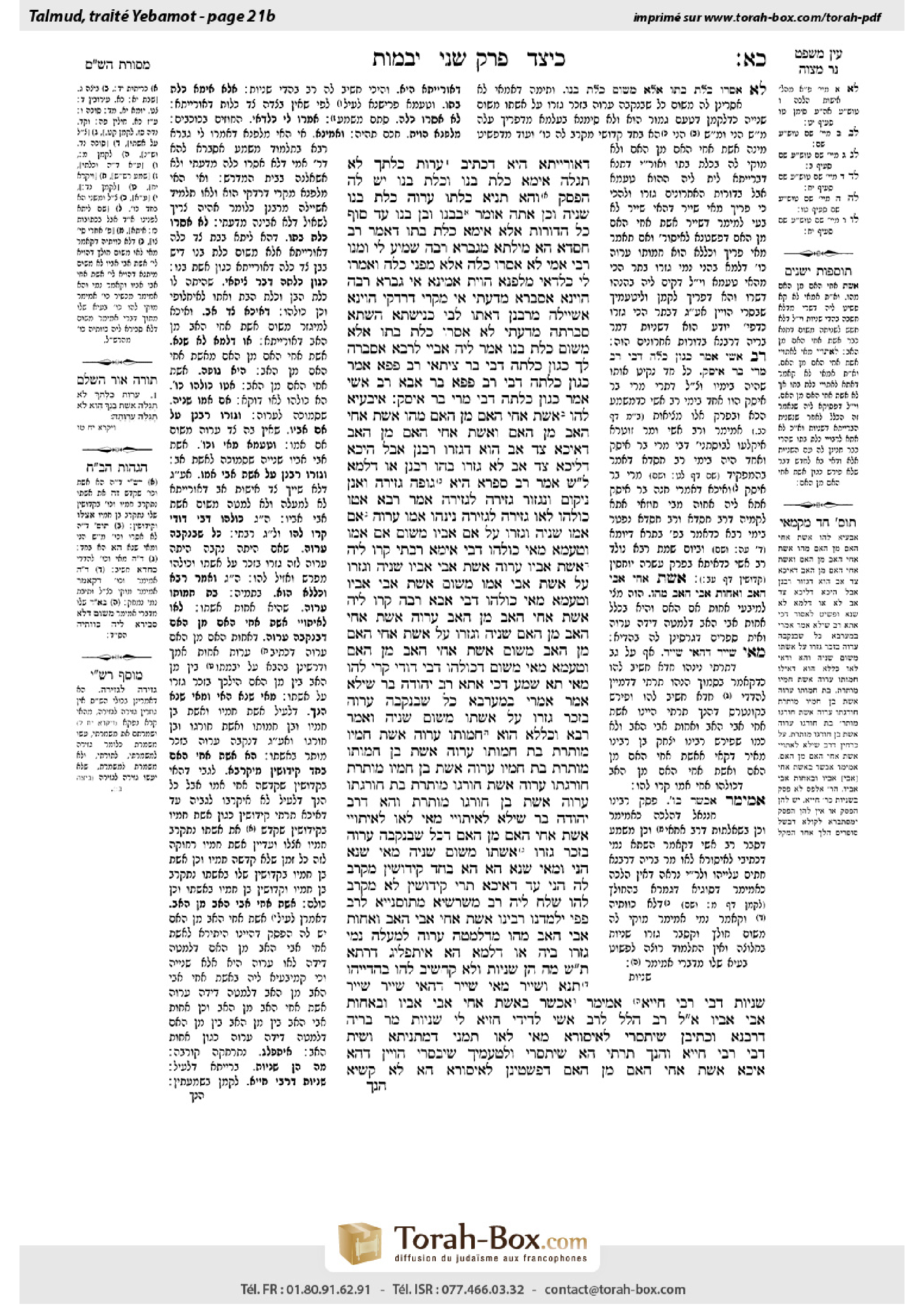
Yevamot 21b: Talmud study for Daf Yomi
Daf Yomi is the daily study of one Talmud folio. Explore 37 tractates with scans, Hebrew text, Sefaria English and AI-generated French translations where annotated.
Passage selection and English or AI-generated French translation are available where the scan has annotations. Daf Study is independent of Torah-Box and Sefaria.
Browse Yevamot · יבמות · All tractatesYevamot 21b text and translations
This page of Yevamot includes the Aramaic text, an English translation and an AI-generated French translation, alongside the scan above.
יבמות כ״א ב · Aramaic and Hebrew text
דְּאוֹרָיְיתָא הִיא, דִּכְתִיב: ״עֶרְוַת כַּלָּתְךָ לֹא תְגַלֵּה״! אֵימָא כַּלַּת בְּנוֹ. וְכַלַּת בְּנוֹ יֵשׁ לָהּ הֶפְסֵק? וְהָא תַּנְיָא: כַּלָּתוֹ עֶרְוָה, כַּלַּת בְּנוֹ שְׁנִיָּה, וְכֵן אַתָּה אוֹמֵר בִּבְנוֹ וּבֶן בְּנוֹ עַד סוֹף כׇּל הַדּוֹרוֹת. אֶלָּא אֵימָא: כַּלַּת בִּתּוֹ.
דְּאָמַר רַב חִסְדָּא: הָא מִילְּתָא מִגַּבְרָא רַבָּה שְׁמִיעַ לִי, וּמַנּוּ — רַבִּי אַמֵּי: לֹא אָסְרוּ כַּלָּה אֶלָּא מִפְּנֵי כַּלָּה. וַאֲמַרוּ לִי כַּלְדָּאֵי: מַלְּפָנָא הָוֵית.
אָמֵינָא: אִי גַּבְרָא רַבָּה הָוֵינָא — אֶסְבְּרַא מִדַּעְתַּי, אִי מַקְרֵי דַרְדְּקֵי הָוֵינָא — אֱשַׁיְּילַהּ מֵרַבָּנַן דְּאָתוּ לְבֵי כְנִישְׁתָּא. הַשְׁתָּא סְבַרְתַּהּ מִדַּעְתַּי: לֹא אָסְרוּ כַּלַּת בִּתּוֹ אֶלָּא מִשּׁוּם כַּלַּת בְּנוֹ.
אֲמַר לֵיהּ אַבָּיֵי לְרָבָא, אַסְבְּרַהּ לָךְ: כְּגוֹן כַּלָּתֵהּ דְּבֵי בַּר צֵיתַאי. רַב פָּפָּא אָמַר: כְּגוֹן כַּלָּתֵהּ דְּבֵי רַב פָּפָּא בַּר אַבָּא. רַב אָשֵׁי אָמַר: כְּגוֹן כַּלָּתֵהּ דְּבֵי מָרִי בַּר אִיסַק.
אִיבַּעְיָא לְהוּ: אֵשֶׁת אֲחִי הָאֵם מִן הָאֵם, מַהוּ? אֵשֶׁת אֲחִי הָאָב מִן הָאֵם וְאֵשֶׁת אֲחִי הָאֵם מִן הָאָב, דְּאִיכָּא צַד אָב — הוּא דִּגְזַרוּ רַבָּנַן, אֲבָל הֵיכָא דְּלֵיכָּא צַד אָב — לָא גְּזַרוּ בְּהוּ רַבָּנַן, אוֹ דִלְמָא לָא שְׁנָא?
אָמַר רַב סָפְרָא: הִיא גּוּפַהּ גְּזֵירָה, וַאֲנַן נֵיקוּם וְנִגְזוֹר גְּזֵירָה לִגְזֵירָה?! אָמַר רָבָא: אַטּוּ כּוּלְּהוּ לָאו גְּזֵירָה לִגְזֵירָה נִינְהוּ? אִמּוֹ — עֶרְוָה, אֵם אִמּוֹ — שְׁנִיָּה, וּגְזַרוּ עַל אֵם אָבִיו מִשּׁוּם אֵם אִמּוֹ. וְטַעְמָא מַאי — כּוּלְּהוּ ״דְּבֵי אִימָּא רַבָּתִי״ קָרוּ לַיהּ.
אֵשֶׁת אָבִיו — עֶרְוָה, אֵשֶׁת אֲבִי אָבִיו — שְׁנִיָּה, וּגְזַרוּ עַל אֵשֶׁת אֲבִי אִמּוֹ מִשּׁוּם אֵשֶׁת אֲבִי אָבִיו. וְטַעְמָא מַאי — כּוּלְּהוּ ״דְּבֵי אַבָּא רַבָּה״ קָרוּ לֵיהּ.
אֵשֶׁת אֲחִי הָאָב מִן הָאָב — עֶרְוָה, אֵשֶׁת אֲחִי הָאָב מִן הָאֵם — שְׁנִיָּה, וְגָזְרוּ עַל אֵשֶׁת אֲחִי הָאֵם מִן הָאָב מִשּׁוּם אֵשֶׁת אֲחִי הָאָב מִן הָאֵם. וְטַעְמָא מַאי — מִשּׁוּם דְּכוּלְּהוּ ״דְּבֵי דוֹדֵי״ קָרֵי לְהוּ.
מַאי? תָּא שְׁמַע, דְּכִי אֲתָא רַב יְהוּדָה בַּר שֵׁילָא, אֲמַר: אָמְרִי בְּמַעְרְבָא: כֹּל שֶׁבִּנְקֵבָה עֶרְוָה, בְּזָכָר גָּזְרוּ עַל אִשְׁתּוֹ מִשּׁוּם שְׁנִיָּה.
וְאָמַר רָבָא: וּכְלָלָא הוּא? חֲמוֹתוֹ עֶרְוָה, אֵשֶׁת חָמִיו מוּתֶּרֶת. בַּת חֲמוֹתוֹ עֶרְוָה, אֵשֶׁת בֶּן חֲמוֹתוֹ מוּתֶּרֶת. בַּת חָמִיו עֶרְוָה, אֵשֶׁת בֶּן חָמִיו מוּתֶּרֶת. חוֹרַגְתּוֹ עֶרְוָה, אֵשֶׁת חוֹרְגוֹ מוּתֶּרֶת. בַּת חוֹרַגְתּוֹ עֶרְוָה, אֵשֶׁת בֶּן חוֹרְגוֹ מוּתֶּרֶת!
וְהָא דְּרַב יְהוּדָה בַּר שֵׁילָא לְאֵיתוֹיֵי מַאי? לָאו לְאֵיתוֹיֵי אֵשֶׁת אֲחִי הָאֵם מִן הָאֵם, דְּכֹל שֶׁבִּנְקֵבָה עֶרְוָה, בְּזָכָר גָּזְרוּ אִשְׁתּוֹ מִשּׁוּם שְׁנִיָּה?
מַאי שְׁנָא הָנֵי, וּמַאי שְׁנָא הָא? הָא — בְּחַד קִידּוּשִׁין מְקָרֵב לַהּ, הָנֵי — עַד דְּאִיכָּא תְּרֵי קִידּוּשִׁין לָא מְקָרֵב לְהוּ.
שְׁלַח לֵיהּ רַב מְשַׁרְשְׁיָא מִתּוֹסַנְיָיא לְרַב פַּפֵּי: יְלַמְּדֵנוּ רַבֵּינוּ, אֵשֶׁת אֲחִי אֲבִי הָאָב, וַאֲחוֹת אֲבִי הָאָב, מַהוּ? מִדִּלְמַטָּה עֶרְוָה — לְמַעְלָה נָמֵי גְּזַרוּ בֵּיהּ, אוֹ דִלְמָא, הָא אִיתְפְּלִיג דָּרָתָא.
תָּא שְׁמַע ״מָה הֵן שְׁנִיּוֹת״, וְלָא קָחָשֵׁיב לְהוּ בַּהֲדַיְיהוּ!
תְּנָא וְשַׁיַּיר. מַאי שַׁיֵּיר דְּהַאי שַׁיַּיר? שַׁיַּיר שְׁנִיּוֹת דְּבֵי רַבִּי חִיָּיא.
אַמֵּימָר אַכְשַׁר בְּאֵשֶׁת אֲחִי אֲבִי אָבִיו וּבַאֲחוֹת אֲבִי אָבִיו. אָמַר לֵיהּ רַב הִלֵּל לְרַב אָשֵׁי: לְדִידִי חַזְיָא לִי שְׁנִיּוֹת מָר בְּרֵיהּ דְּרַבְנָא, וּכְתִיבָן שִׁיתַּסְרֵי לְאִיסּוּרָא. מַאי לָאו: תַּמְנֵי דְּמַתְנִיתָא, וְשֵׁית דְּבֵי רַבִּי חִיָּיא, וְהָנָךְ תַּרְתֵּי — הָא שִׁיתַּסְרֵי.
וּלְטַעְמָיךְ: שִׁיבְסְרֵי הָוְיָין, דְּהָא אִיכָּא אֵשֶׁת אֲחִי הָאֵם מִן הָאֵם, דְּפָשְׁטִינַן לְאִיסּוּרָא! הָא לָא קַשְׁיָא,
Yevamot 21b · English translation
The Gemara asks: Is this relationship not forbidden by Torah law? As it is written: “You shall not uncover the nakedness of your daughter-in-law” (Leviticus 18:15). The Gemara emends: Say instead his son’s daughter-in-law. The Gemara asks: And does the prohibition against having a relationship with his son’s daughter-in-law indeed have a conclusion? Isn’t it taught in a baraita: His daughter-in-law is a forbidden relation by Torah law, his son’s daughter-in-law is a secondary forbidden relation, and similarly, you say the daughter-in-law of his son and the daughter-in-law of his son’s son until the end of all generations are secondary forbidden relationships. Rather, say instead that Rav was referring to his daughter’s daughter-in-law.
As Rav Ḥisda said: I heard this matter from a great man, and who was that great man? It was Rabbi Ami, and he said: They prohibited a daughter-in-law only due to the daughter-in-law. Rav Ḥisda heard this in his youth but did not understand the meaning. The Chaldean astrologers said to me: You will be a teacher.
Rav Ḥisda further said: I said to myself: If the astrologers meant that I will become a great man and one who teaches the public, I will certainly be able to reason and understand this matter with my knowledge. If the astrologers meant that I will become the teacher of children, I will ask it of the Sages who come to the synagogue and in that way I will learn the meaning of Rabbi Ami’s teaching. Now I understand the matter on my own. Rabbi Ami meant: They prohibited his daughter’s daughter-in-law only due to his son’s daughter-in-law, to avoid confusion between these daughters-in-law. The rabbinic decree prohibited one’s daughter’s daughter-in-law but did not extend to subsequent generations.
Various Sages proceed to give contemporary examples of families where the halakhic status of the daughters-in-law of the sons and the daughters-in-law of the daughters could be confused with each other. Abaye said to Rava: I will explain to you with an example how one might become confused about these daughters-in-law. For example, this would be possible in the case of the daughter-in-law of the house of bar Tzitai, as there the children of the sons and the daughters of the same family lived together, and it was possible to confuse the halakhic status of the sons’ daughters-in-law and the daughters’ daughters-in-law. Rav Pappa said: For example, the daughter-in-law of the house of Rav Pappa bar Abba. Rav Ashi said: For example, the daughter-in-law of the house of Mari bar Isak.
§ A dilemma was raised before the Sages: What is the halakha with regard to the wife of one’s mother’s maternal half brother? The Gemara presents the different sides of the question: Both the wife of one’s father’s maternal half brother and the wife of one’s mother’s paternal half brother contain some aspect of a father, and perhaps this is the reason that the Sages enacted a prohibition. That is, they were both forbidden rabbinically to avoid confusion with the case of the wife of one’s father’s paternal half brother, who is forbidden by Torah law. But in the case of the wife of one’s mother’s maternal half brother, where there is no aspect of a father whatsoever, perhaps the Sages did not make a decree? Or perhaps this case is no different?
Rav Safra said: She herself, the wife of the mother’s paternal half brother, is forbidden by rabbinic decree, and will we then proceed to issue a decree to prevent violation of a decree? Rava said: Is that to say that all of these rabbinic decrees with regard to secondary relations are not decrees to prevent violation of a decree? For example, his mother is a forbidden relation by Torah law, and the Sages decreed that his mother’s mother is a secondary forbidden relationship. And they decreed that his father’s mother is also a secondary forbidden relationship due to his mother’s mother. And what is the reason? They are all called the house of the grandmother, and therefore people may confuse their halakhic status.
Rava continues: Similarly, his father’s wife is a forbidden relation by Torah law, and the Sages decreed that his father’s father’s wife is a secondary forbidden relationship. And they decreed that his mother’s father’s wife is also a secondary forbidden relationship due to his father’s father’s wife. And what is the reason? They are all called the house of the grandfather.
Also, the wife of his father’s paternal half brother, his uncle, who is mentioned explicitly in the Torah (Leviticus 18:16), is a forbidden relation by Torah law, and the Sages decreed that the wife of his father’s maternal half brother is a secondary forbidden relationship. And they decreed that the wife of his mother’s paternal half brother is also a secondary forbidden relationship due to the wife of his father’s maternal half brother. And what is the reason? It is because they are all called the house of the uncle; it seems that in the realm of forbidden relations the Sages did issue decrees to prevent violation of a decree, and Rav Safra’s claim is incorrect.
If so, then what is the halakha in this case of the wife of his mother’s maternal half brother? Come and hear: As when Rav Yehuda bar Sheila came from Eretz Yisrael to Babylonia, he said: In the West, Eretz Yisrael, they say this principle: For every female relative who is a forbidden relation by Torah law, the Sages decreed on the wife of the equivalent male relative due to her similarity to a secondary forbidden relationship.
And Rava said: Is this really an established principle? Isn’t his mother-in-law a forbidden relation by Torah law, while his father-in-law’s wife is permitted? Also, his mother-in-law’s daughter is a forbidden relation by Torah law, as she is his wife’s sister, yet his mother-in-law’s son’s wife is permitted. His father-in-law’s daughter is a forbidden relation by Torah law, yet the wife of his father-in-law’s son is permitted. His stepdaughter is a forbidden relation by Torah law, yet his stepson’s wife is permitted. His stepdaughter’s daughter, i.e., his wife’s granddaughter, is a forbidden relation, yet the wife of his stepson’s son is permitted.
The Gemara continues: If so, what did that statement of Rav Yehuda bar Sheila come to include? Since his principle is not true in every case, it must be intended to include a specific halakha. Does it not come to include the case of the wife of one’s mother’s maternal half brother, since for every female relative who is a forbidden relation by Torah law, such as his mother’s maternal half sister, the Sages decreed on the wife of the equivalent male relative, in this case his mother’s maternal half brother’s wife, due to her similarity to a secondary relation.
The Gemara asks: What is different with regard to these cases, the wife of his father-in-law or the wife of his mother-in-law’s son, who are permitted, and this case of the wife of a mother’s maternal half brother, who is prohibited? The Gemara answers: This, the wife of a mother’s maternal half brother, is related by a single act of betrothal. One’s mother’s brother is a blood relative, and his wife is therefore a secondary relation. In contrast, these other cases with regard to which the Sages did not issue a decree are related only when there are two acts of betrothal. For example, one’s father-in-law is related to one through one’s marriage to his own wife, and his father in law’s wife is related to him through his father-in-law’s marriage.
§ Rav Mesharshiyya from Tusneya sent a message to Rav Pappi: Let our Master teach us: What is the halakha with regard to the wife of a father’s father’s brother and the sister of a father’s father? Did the Sages prohibit these as secondary forbidden relations? The Gemara presents the different sides of the dilemma: Since one generation below is a forbidden relation, i.e., a father’s sister and the wife of a father’s paternal brother, who are both forbidden by Torah law, perhaps the Sages also decreed about the women one generation above. Or, perhaps the generations are separate and the women in the generation above are not considered to be forbidden relatives.
The Gemara attempts to answer: Come and hear from that baraita cited above, which taught: What are the secondary forbidden relationships that were prohibited? And these women, i.e., the wife of one’s father’s father’s brother and the sister of his father’s father were not reckoned among them. This implies that these women are permitted.
The Gemara replies that this is not conclusive. Perhaps the tanna of the baraita taught some examples and omitted other examples of secondary forbidden relations; i.e., perhaps the list is not exhaustive. The Gemara asks: What else did he omit that he omitted this? It cannot be that the tanna had an exhaustive list except for one case. He either left out more than one case or he included all possible cases. The Gemara answers: He omitted the list of secondary forbidden relationships that were enumerated by the school of Rabbi Ḥiyya, which is listed later. Therefore, this baraita is not conclusive, as the tanna left out many cases.
The Gemara states that Ameimar permitted the wife of one’s father’s father’s brother and the sister of one’s father’s father. Rav Hillel said to Rav Ashi, challenging Ameimar’s statement: I myself saw a list of secondary forbidden relationships written by Mar, son of Rabbana, and it was written there that sixteen women were forbidden. What, is it not that these sixteen must be the eight cases listed in the baraita, and six from the school of Rabbi Ḥiyya, and these two cases of the wife of one’s father’s father’s brother and one’s father’s father’s sister, and this totals sixteen?
Rav Ashi defended Ameimar’s opinion: And according to your reasoning, Rav Hillel, that these cases should be included, there are seventeen cases, as there is the additional case of the wife of a mother’s maternal half brother, whose status was resolved earlier, concluding that she is forbidden. If it is as you say, then there should be seventeen cases. The Gemara answers on behalf of Rav Hillel: This is not difficult.
Yevamot 21b · Traduction française (IA)
La Guemara demande : Cette relation n’est-elle pas interdite par la Torah écrite ? Comme il est écrit : « Tu ne découvriras pas la nudité de ta belle-fille » (Lévitique 18,15). La Guemara rectifie : dis plutôt la belle-fille de son fils. La Guemara demande : Mais l’interdiction concernant la belle-fille de son fils a-t-elle donc une limite ? N’est-il pas enseigné dans une baraïta : sa belle-fille est une parente interdite par la Torah écrite ; la belle-fille de son fils est une parente interdite à titre secondaire ; et de même, la belle-fille du fils de son fils et celle du fils de son petit-fils, jusqu’à la fin de toutes les générations, sont des parentes interdites à titre secondaire. Dis plutôt que Rav faisait référence à la belle-fille de sa fille.
Car Rav Ḥisda a dit : J’ai entendu cette chose d’un grand homme. Et qui était ce grand homme ? C’était Rabbi Ami, qui a dit : Ils n’ont interdit une belle-fille qu’en raison de la belle-fille. Rav Ḥisda avait entendu cela dans sa jeunesse, mais n’en comprenait pas le sens. Les astrologues chaldéens m’ont dit : Tu seras un enseignant.
Rav Ḥisda a ajouté : Je me suis dit : si les astrologues voulaient dire que je deviendrais un grand homme, quelqu’un qui enseigne au public, je devrais assurément pouvoir raisonner et comprendre cette question par mes propres moyens. Si les astrologues voulaient dire que je deviendrais maître d’école, je poserais la question aux Sages qui viennent à la synagogue et j’apprendrais ainsi le sens de l’enseignement de Rabbi Ami. À présent, je comprends la question par moi-même. Rabbi Ami voulait dire : ils ont interdit la belle-fille de sa fille uniquement en raison de la belle-fille de son fils, afin d’éviter toute confusion entre ces belles-filles. Le décret rabbinique a interdit la belle-fille de sa fille, mais ne s’est pas étendu aux générations suivantes.
Plusieurs Sages donnent des exemples de familles de leur époque où l’on pouvait confondre le statut halakhique des belles-filles des fils avec celui des belles-filles des filles. Abaye dit à Rava : Je vais t’expliquer par un exemple comment on pourrait confondre ces belles-filles. C’est possible, par exemple, dans le cas de la belle-fille de la maison de bar Tzitai, car les enfants des fils et les filles de cette même famille vivaient ensemble, et l’on pouvait confondre le statut halakhique des belles-filles des fils avec celui des belles-filles des filles. Rav Pappa dit : Par exemple, la belle-fille de la maison de Rav Pappa bar Abba. Rav Ashi dit : Par exemple, la belle-fille de la maison de Mari bar Isak.
§ Une question fut soumise aux Sages : quel est le statut de l’épouse du demi-frère utérin de sa mère ? La Guemara expose les différents aspects de la question : l’épouse du demi-frère utérin de son père et l’épouse du demi-frère consanguin de sa mère ont chacune un lien avec le père ; c’est peut-être la raison pour laquelle les Sages ont institué une interdiction. Autrement dit, elles ont toutes deux été interdites par décret rabbinique pour éviter qu’on les confonde avec l’épouse du demi-frère consanguin de son père, qui est interdite par la Torah écrite. Mais, dans le cas de l’épouse du demi-frère utérin de sa mère, où il n’y a absolument aucun lien avec un père, peut-être les Sages n’ont-ils pas décrété d’interdiction ? Ou peut-être ce cas ne diffère-t-il pas des autres ?
Rav Safra dit : L’épouse du demi-frère consanguin de sa mère est elle-même interdite par décret rabbinique ; va-t-on donc instituer un décret pour prévenir la transgression d’un décret ? Rava dit : Faut-il en conclure que tous ces décrets rabbiniques concernant les parentes interdites à titre secondaire ne visent pas à prévenir la transgression d’un décret ? Par exemple, sa mère est une parente interdite par la Torah écrite, et les Sages ont décrété que la mère de sa mère est une parente interdite à titre secondaire. Ils ont aussi décrété que la mère de son père est une parente interdite à titre secondaire, en raison de la mère de sa mère. Et pourquoi ? Elles sont toutes appelées « la maison de la grand-mère », et les gens risquent donc de confondre leur statut halakhique.
Rava poursuit : De même, l’épouse de son père est une parente interdite par la Torah écrite, et les Sages ont décrété que l’épouse du père de son père est une parente interdite à titre secondaire. Ils ont aussi décrété que l’épouse du père de sa mère est une parente interdite à titre secondaire, en raison de l’épouse du père de son père. Et pourquoi ? Elles sont toutes appelées « la maison du grand-père ».
De même, l’épouse du demi-frère consanguin de son père, son oncle, qui est mentionné explicitement dans la Torah écrite (Lévitique 18,16), est une parente interdite par la Torah écrite ; les Sages ont décrété que l’épouse du demi-frère utérin de son père est une parente interdite à titre secondaire. Ils ont aussi décrété que l’épouse du demi-frère consanguin de sa mère est une parente interdite à titre secondaire, en raison de l’épouse du demi-frère utérin de son père. Et pourquoi ? Parce qu’elles sont toutes appelées « la maison de l’oncle ». Il semble donc que, dans le domaine des parentes interdites, les Sages aient bien institué des décrets visant à prévenir la transgression d’un décret, et que l’affirmation de Rav Safra soit erronée.
Si tel est le cas, quel est donc le statut de l’épouse du demi-frère utérin de sa mère ? Écoute : lorsque Rav Yehuda bar Sheila vint d’Eretz Israël en Babylonie, il dit : En Occident, c’est-à-dire en Eretz Israël, on énonce ce principe : pour toute parente interdite par la Torah écrite, les Sages ont décrété une interdiction concernant l’épouse du parent masculin correspondant, en raison de sa ressemblance avec une parente interdite à titre secondaire.
Et Rava dit : Est-ce vraiment un principe établi ? Sa belle-mère n’est-elle pas une parente interdite par la Torah écrite, tandis que l’épouse de son beau-père est permise ? De même, la fille de sa belle-mère est interdite par la Torah écrite, puisqu’elle est la sœur de sa femme, alors que l’épouse du fils de sa belle-mère est permise. La fille de son beau-père est interdite par la Torah écrite, alors que l’épouse du fils de son beau-père est permise. Sa belle-fille est interdite par la Torah écrite, alors que l’épouse de son beau-fils est permise. La fille de sa belle-fille, c’est-à-dire la petite-fille de sa femme, est une parente interdite, alors que l’épouse du fils de son beau-fils est permise.
La Guemara poursuit : Si tel est le cas, qu’est-ce que la déclaration de Rav Yehuda bar Sheila venait inclure ? Puisque son principe ne s’applique pas à tous les cas, il doit viser à inclure une halakha particulière. Ne vise-t-il pas à inclure le cas de l’épouse du demi-frère utérin de sa mère ? En effet, pour toute parente interdite par la Torah écrite, telle que la demi-sœur utérine de sa mère, les Sages ont décrété une interdiction concernant l’épouse du parent masculin correspondant — en l’occurrence, l’épouse du demi-frère utérin de sa mère — en raison de sa ressemblance avec une parente interdite à titre secondaire.
La Guemara demande : En quoi ce cas diffère-t-il des autres, comme l’épouse de son beau-père ou l’épouse du fils de sa belle-mère, qui sont permises, alors que l’épouse du demi-frère utérin de sa mère est interdite ? La Guemara répond : Dans ce cas, celui de l’épouse du demi-frère utérin de sa mère, le lien se crée par un seul mariage. L’oncle maternel est un parent par le sang ; son épouse est donc une parente interdite à titre secondaire. En revanche, dans les autres cas où les Sages n’ont pas institué de décret, le lien n’existe qu’à la suite de deux mariages. Par exemple, on est lié à son beau-père par son mariage avec sa femme, et à l’épouse de son beau-père par le mariage de celui-ci.
§ Rav Mesharshiyya de Tusneya envoya un message à Rav Pappi : Que notre Maître nous enseigne : quel est le statut de l’épouse du frère du père de son père et de la sœur du père de son père ? Les Sages les ont-ils interdites comme parentes interdites à titre secondaire ? La Guemara expose les différents aspects de la question : puisqu’à la génération suivante se trouvent des parentes interdites — la sœur de son père et l’épouse du frère consanguin de son père, toutes deux interdites par la Torah écrite —, peut-être les Sages ont-ils aussi décrété une interdiction concernant les femmes de la génération précédente. Ou peut-être les générations sont-elles distinctes, et les femmes de la génération précédente ne sont-elles pas considérées comme des parentes interdites.
La Guemara tente de répondre : Écoute la baraïta citée plus haut, qui enseigne : Quelles sont les parentes interdites à titre secondaire qui ont été interdites ? Or ces femmes, c’est-à-dire l’épouse du frère du père de son père et la sœur du père de son père, n’ont pas été comptées parmi elles. Cela implique que ces femmes sont permises.
La Guemara répond que cela n’est pas concluant. Peut-être le tanna de la baraïta a-t-il donné quelques exemples et omis d’autres cas de parentes interdites à titre secondaire ; autrement dit, la liste n’est peut-être pas exhaustive. La Guemara demande : Qu’a-t-il omis d’autre pour avoir omis précisément ce cas ? On ne peut pas dire que le tanna ait donné une liste exhaustive, à l’exception d’un seul cas. Soit il a omis plus d’un cas, soit il a inclus tous les cas possibles. La Guemara répond : Il a omis la liste des parentes interdites à titre secondaire énumérées par l’école de Rabbi Ḥiyya, qui sera présentée plus loin. Cette baraïta n’est donc pas concluante, puisque le tanna a omis de nombreux cas.
La Guemara rapporte qu’Ameimar a permis l’épouse du frère du père de son père ainsi que la sœur du père de son père. Rav Hillel dit à Rav Ashi, contestant la déclaration d’Ameimar : J’ai moi-même vu une liste de parentes interdites à titre secondaire, rédigée par Mar, fils de Rabbana ; il y était écrit que seize femmes étaient interdites. Ces seize femmes ne sont-elles pas les huit cas énumérés dans la baraïta, auxquels s’ajoutent les six de l’école de Rabbi Ḥiyya, ainsi que ces deux cas — l’épouse du frère du père de son père et la sœur du père de son père —, ce qui fait un total de seize ?
Rav Ashi défendit l’opinion d’Ameimar : Mais selon ton raisonnement, Rav Hillel, si ces cas doivent être inclus, il y en a dix-sept, puisqu’il faut ajouter le cas de l’épouse du demi-frère utérin de sa mère, dont le statut a été tranché plus haut : elle est interdite. Si c’est comme tu le dis, il devrait donc y avoir dix-sept cas. La Guemara répond en faveur de Rav Hillel : Cela ne pose pas de difficulté.
Traduction française générée par IA à partir de l’édition anglaise de Sefaria. Vérifie toujours un passage avec le texte source.
Text from Sefaria: William Davidson Edition - Vocalized Aramaic (CC BY NC); William Davidson Edition - English (CC BY NC).