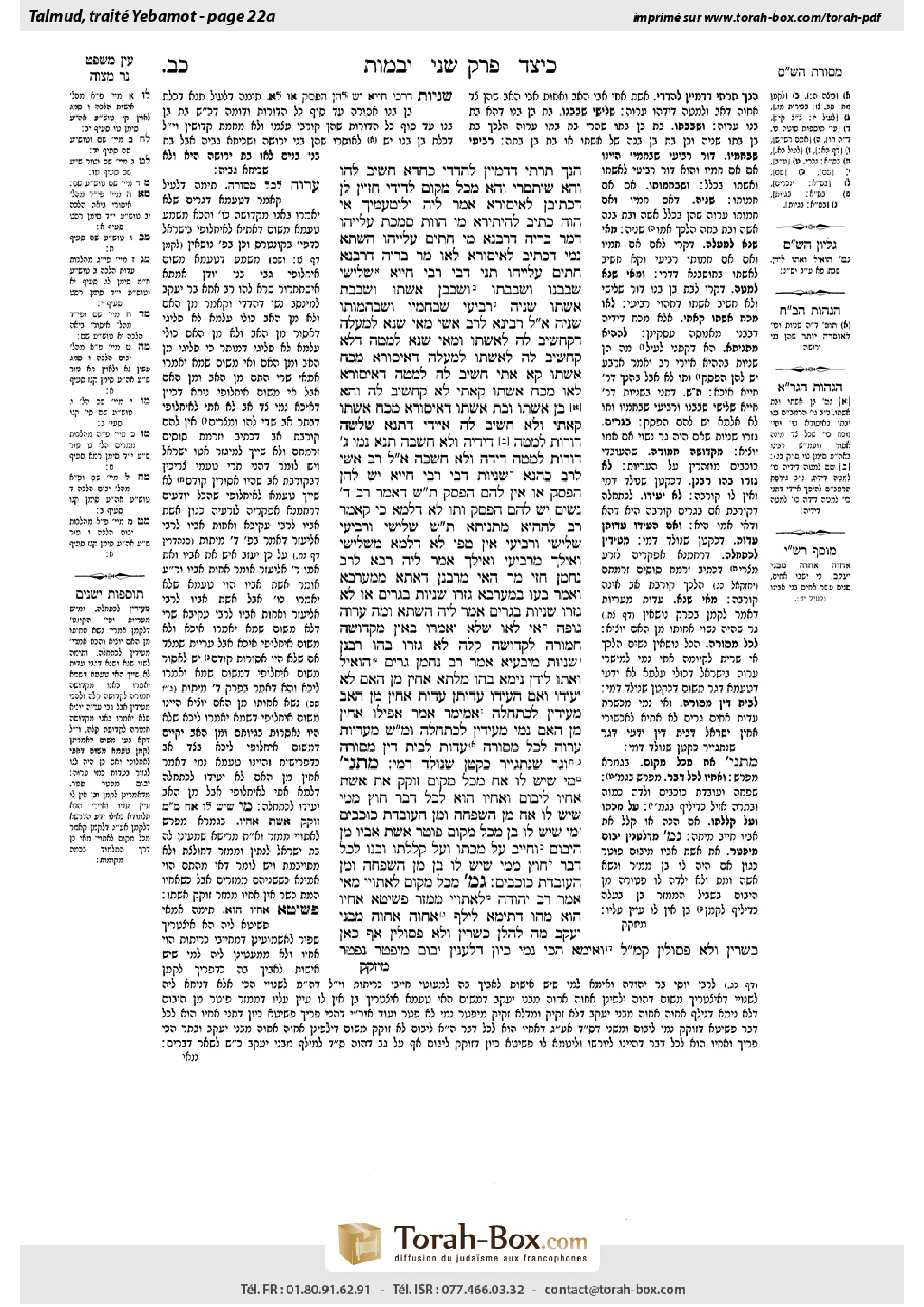
Yevamot 22a: Talmud study for Daf Yomi
Daf Yomi is the daily study of one Talmud folio. Explore 37 tractates with scans, Hebrew text, Sefaria English and AI-generated French translations where annotated.
Passage selection and English or AI-generated French translation are available where the scan has annotations. Daf Study is independent of Torah-Box and Sefaria.
Browse Yevamot · יבמות · All tractatesYevamot 22a text and translations
This page of Yevamot includes the Aramaic text, an English translation and an AI-generated French translation, alongside the scan above.
יבמות כ״ב א · Aramaic and Hebrew text
הָנָךְ תַּרְתֵּי דְּדָמְיָין לַהֲדָדֵי כַּחֲדָא חָשֵׁיב לְהוּ, וְהָא שִׁיתַּסְרֵי. וְהָא מִכׇּל מָקוֹם לְדִידִי חַזְיָין לַן דִּכְתִיבָן לְאִיסּוּרָא! אֲמַר לֵיהּ: וְלִיטַעְמָיךְ, אִי הֲוָה כְּתִיב לְהֶיתֵּירָא, מִי הֲוֵות סָמְכַתְּ עֲלַיְיהוּ? דְּמָר בְּרֵיהּ דְּרַבְנָא מִי חֲתִים עֲלַיְיהוּ? הַשְׁתָּא נָמֵי דִּכְתִיב לְאִיסּוּרָא — לָאו מָר בְּרֵיהּ דְּרַבְנָא חֲתִים עֲלַיְיהוּ.
תָּנֵי דְּבֵי רַבִּי חִיָּיא: שְׁלִישִׁי שֶׁבִּבְנוֹ וְשֶׁבְּבִתּוֹ וְשֶׁבְּבֶן אִשְׁתּוֹ וְשֶׁבְּבַת אִשְׁתּוֹ — שְׁנִיָּה. רְבִיעִי שֶׁבְּחָמִיו וְשֶׁבַּחֲמוֹתוֹ — שְׁנִיָּה.
אֲמַר לֵיהּ רָבִינָא לְרַב אָשֵׁי: מַאי שְׁנָא לְמַעְלָה דְּקָחָשֵׁיב לָהּ לְאִשְׁתּוֹ, וּמַאי שְׁנָא לְמַטָּה דְּלָא קָחָשֵׁיב לָהּ לְאִשְׁתּוֹ? לְמַעְלָה, דְאִיסּוּרָא מִכֹּחַ אִשְׁתּוֹ קָא אָתֵי — חָשֵׁיב לַהּ, לְמַטָּה, דְאִיסּוּרָא לָאו מִכֹּחַ אִשְׁתּוֹ קָאָתֵי — לָא קָחָשֵׁיב לַהּ.
וְהָא בֶּן אִשְׁתּוֹ וּבַת אִשְׁתּוֹ, דְּאִיסּוּרָא מִכֹּחַ אִשְׁתּוֹ קָאָתֵי, וְלָא חָשֵׁיב לַהּ! אַיְּידֵי דִּתְנָא שְׁלֹשָׁה דּוֹרוֹת לְמַטָּה דִּידֵיהּ וְלָא חַשְּׁבַהּ, תְּנָא נָמֵי שְׁלֹשָׁה דּוֹרוֹת לְמַטָּה דִּידַהּ וְלָא חַשְּׁבַהּ.
אֲמַר לֵיהּ רַב אָשֵׁי לְרַב כָּהֲנָא: שְׁנִיּוֹת דְּבֵי רַבִּי חִיָּיא, יֵשׁ לָהֶן הֶפְסֵק אוֹ אֵין לָהֶם הֶפְסֵק?
תָּא שְׁמַע, דְּאָמַר רַב: אַרְבַּע נָשִׁים יֵשׁ לָהֶם הֶפְסֵק, וְתוּ לָא. דִּלְמָא כִּי קָאָמַר רַב — לְהַהִיא מַתְנִיתָא. תָּא שְׁמַע: שְׁלִישִׁי וּרְבִיעִי. שְׁלִישִׁי וּרְבִיעִי — אִין, טְפֵי — לָא! דִּלְמָא מִשְּׁלִישִׁי וְאֵילָךְ, מֵרְבִיעִי וְאֵילָךְ.
אֲמַר לֵיהּ רָבָא לְרַב נַחְמָן: חֲזִי מָר הַאי מֵרַבָּנַן דַּאֲתָא מִמַּעְרְבָא וְאָמַר, בְּעוֹ בְּמַעְרְבָא: גָּזְרוּ שְׁנִיּוֹת בְּגֵרִים, אוֹ לֹא גָּזְרוּ שְׁנִיּוֹת בְּגֵרִים?
אֲמַר לֵיהּ: הַשְׁתָּא וּמָה עֶרְוָה גּוּפַהּ, אִי לָאו ״שֶׁלֹּא יֹאמְרוּ בָּאִין מִקְּדוּשָּׁה חֲמוּרָה לִקְדוּשָּׁה קַלָּה״, לָא גְּזַרוּ בְּהוּ רַבָּנַן — שְׁנִיּוֹת מִיבַּעְיָא?!
אָמַר רַב נַחְמָן: גֵּרִים, הוֹאִיל וַאֲתוֹ לְיָדָן, נֵימָא בְּהוּ מִלְּתָא: אַחִין מִן הָאֵם — לֹא יָעִידוּ, וְאִם הֵעִידוּ עֵדוּתָן עֵדוּת. אַחִין מִן הָאָב — מְעִידִין לְכַתְּחִלָּה. אַמֵּימָר אָמַר: אֲפִילּוּ אַחִין מִן הָאֵם נָמֵי מְעִידִין לְכַתְּחִלָּה.
וּמַאי שְׁנָא מֵעֲרָיוֹת? עֶרְוָה — לַכֹּל מְסוּרָה, עֵדוּת — לְבֵית דִּין מְסוּרָה, וְגֵר שֶׁנִּתְגַּיֵּיר כְּקָטָן שֶׁנּוֹלַד דָּמֵי.
מַתְנִי׳ מִי שֶׁיֵּשׁ לוֹ אָח מִכׇּל מָקוֹם — זוֹקֵק אֶת אֵשֶׁת אָחִיו לְיִבּוּם, וְאָחִיו הוּא לְכׇל דָּבָר, חוּץ מִמִּי שֶׁיֵּשׁ לוֹ אָח מִן הַשִּׁפְחָה וּמִן הַגּוֹיָה. מִי שֶׁיֵּשׁ לוֹ בֵּן מִכׇּל מָקוֹם — פּוֹטֵר אֵשֶׁת אָבִיו מִן הַיִּבּוּם, וְחַיָּיב עַל מַכָּתוֹ וְעַל קִלְלָתוֹ, וּבְנוֹ לְכׇל דָּבָר, חוּץ מִמִּי שֶׁיֵּשׁ לוֹ בֵּן מִן הַשִּׁפְחָה וּמִן הַגּוֹיָה.
גְּמָ׳ מִכׇּל מָקוֹם לְאֵתוֹיֵי מַאי? אָמַר רַב יְהוּדָה: לְאֵתוֹיֵי מַמְזֵר. פְּשִׁיטָא, אָחִיו הוּא! מַהוּ דְּתֵימָא, לֵילַף אַחְוָה אַחְוָה מִבְּנֵי יַעֲקֹב: מָה לְהַלָּן — כְּשֵׁרִין וְלֹא פְּסוּלִין, אַף כָּאן — כְּשֵׁרִין וְלֹא פְּסוּלִין, קָא מַשְׁמַע לַן.
וְאֵימָא הָכִי נָמֵי? כֵּיוָן דִּלְעִנְיַן יִבּוּם מִיפְטַר נִפְטָר,
Yevamot 22a · English translation
Those two, the wife of a father’s father’s brother and the sister of a father’s father, are similar to each other and are counted as a single case, and so there are sixteen. The Gemara restates Rav Hillel’s challenge to Ameimar’s opinion: But in any case I myself saw them written as prohibited. Rav Ashi said to Rav Hillel: And according to your reasoning, if in the list it was written that they were permitted, would you have relied on that? Is the signature of Mar, son of Rabbana, signed on it? Although you saw the list, you don’t know for certain who wrote it. Now too, that it is written that they are prohibited, the same holds true; the signature of Mar, son of Rabbana, is not signed on it, and so it cannot be relied upon to reject the opinion of Ameimar.
§ One of the Sages of the school of Rabbi Ḥiyya taught: The third generation from one’s son and one’s daughter, i.e., one’s great-grandchildren, and the third generation from his wife’s son and his wife’s daughter, i.e., one’s wife’s great-grandchildren, are all forbidden as secondary forbidden relationships. So too, the fourth generation from his father-in-law and from his mother-in-law, i.e., his wife’s great-grandmothers, are prohibited as secondary forbidden relationships.
Ravina said to Rav Ashi: What is different between the generations above, referring to his wife’s great-grandmothers, such that the Sage counts his wife as one of the generations and refers to them as the fourth generation, and what is different with regard to the generations below, referring to his great-granddaughters, such that he did not count his wife and referred to them as only the third generation? The Gemara answers: When counting above, the prohibition stems from his wife, as they are not his blood relatives but his wife’s. Therefore, she is counted. When counting below, however, the prohibition does not stem from his wife, as they are his own blood relatives, and so she was not counted.
The Gemara objects: But he includes the granddaughter of his wife’s son and his wife’s daughter in his list of those forbidden due to his wife, yet he does not count her and refer to this as the fourth generation. The Gemara answers: Since he already taught three generations below himself, i.e., his own great-granddaughter, and there he did not count from his wife because it is his own blood relative, he taught three generations below his wife and did not count her. Instead, he referred to her great-granddaughter also as three generations below to maintain the uniform style of his words.
Rav Ashi said to Rav Kahana: Do those secondary forbidden relationships taught by one of the Sages of the school of Rabbi Ḥiyya have a conclusion, or do they not have a conclusion? Are those specified cases alone forbidden, or are all generations above and below also forbidden?
Come and hear that which Rav said: Four women have a conclusion. This implies that it is only these four and no more. The Gemara rejects this: Perhaps when Rav said this he was referring only to the relationships listed in the baraita and not to all cases of secondary relationships. The Gemara suggests: Come and hear from the baraita itself, which states: The third generation from his son and his daughter and the fourth generation from his father-in-law and mother-in-law. This implies that with regard to the third and the fourth generations, yes, they are forbidden; but more than that, no. The Gemara rejects this: Perhaps this means from the third onward and from the fourth onward. The Gemara does not resolve this issue.
§ Rava said to Rav Naḥman: Did the Master see this one of the Sages who came from the West, Eretz Yisrael, who said: In the West they asked whether the Sages issued a decree prohibiting secondary forbidden relationships for converts, or whether they did not issue a decree prohibiting secondary forbidden relationships for converts?
Rav Naḥman did not answer whether he had seen this Sage, but said to him: Now, with regard to all the forbidden relationships themselves, were it not for the fact that if converts would find that as Jews they were permitted to enter into relationships that were forbidden to them as gentiles and would say that they went from a state of more stringent sanctity as gentiles to a state of lesser sanctity as Jews, then the Sages would not have decreed to prohibit these relationships. Without the rabbinic decree it would have been permitted for a convert to marry even a close female relative, even his twin sister, who also converted. This is because a convert has the legal status of a newborn, with no family ties. Is it necessary to state that the Sages did not extend that decree to include secondary forbidden relationships? The purpose of the rabbinic prohibitions is to protect the Torah prohibitions, but in the case of converts this particular Torah prohibition does not apply.
Rav Naḥman said: Since the issue of converts and their relatives has come to hand and is the topic of discussion, let us say a matter of halakha: Maternal half brothers who both convert may not testify together as a pair of witnesses before the court, but if they did testify, their testimony is valid. Although blood relatives are invalid as witnesses, converts are considered as though they have no relations. Paternal half brothers who both convert may testify together ab initio, since the halakha does not consider paternal half brothers of gentiles to be true relatives. Ameimar said: Even maternal half brothers may also testify together ab initio.
In what way is this case different from forbidden relations, where a convert may not marry his maternal sister due to rabbinic decree? The halakhot of forbidden relations are handed over to all, and every individual chooses his own wife. Therefore, the Sages issued a decree to prevent confusion between the status of a convert and that of a born Jew. However, testimony is handed over to the court, and the court knows to distinguish between the status of a born Jew and that of a convert. And the legal status of a convert who just converted is like that of a child just born, and all previous family ties become irrelevant.
MISHNA: In the case of anyone who has a brother of any kind, that brother creates a levirate bond causing his yevama to be required to perform levirate marriage if the first brother dies childless. And he is his brother in all respects, except for one who has a brother born from a Canaanite maidservant or from a gentile woman, as these do not have the legal status of brothers. Similarly, in the case of anyone who has a child of any kind, that child exempts his father’s wife from levirate marriage, since his father did not die childless. And that child is liable to receive capital punishment if he strikes his father or curses him. And he is his child in all respects, except for whoever has a child born from a Canaanite maidservant or from a gentile woman, as these do not have the halakhic status of children.
GEMARA: The Gemara asks: With regard to the statement that a brother of any kind causes his yevama to be required to perform levirate marriage, what additional case does this come to add? Rav Yehuda said: This adds the case of a mamzer, who, notwithstanding his status, is considered a brother. The Gemara wonders: But isn’t that obvious? He is his brother. The Gemara explains: This is necessary lest you say: Let us derive a verbal analogy between the word “brother” stated in the verse with regard to levirate marriage and “brother” stated with regard to the children of Jacob. Just as there, Jacob’s children are of unflawed lineage and not of flawed lineage and are not mamzerim, so too here, one might think that only brothers of unflawed lineage and not brothers of flawed lineage, i.e., mamzerim, obligate the yevama in levirate marriage. Therefore, this teaches us that a mamzer is considered a brother for the purposes of levirate marriage.
The Gemara asks: And say that is indeed the halakha. Perhaps a brother who is a mamzer does not obligate his yevama in levirate marriage. The Gemara answers: Since with regard to levirate marriage, if the husband had a child who was a mamzer he would exempt the wife from levirate marriage,
Yevamot 22a · Traduction française (IA)
Ces deux cas, celui de l’épouse du frère du grand-père paternel et celui de la sœur du grand-père paternel, se ressemblent et sont comptés comme un seul cas ; il y en a donc seize. La Guemara reformule l’objection de Rav Hillel à l’opinion d’Ameimar : Pourtant, en tout état de cause, j’ai vu moi-même qu’elles étaient inscrites comme interdites. Rav Ashi dit à Rav Hillel : Selon ton raisonnement, si la liste indiquait qu’elles étaient permises, t’y serais-tu fié ? La signature de Mar, fils de Rabbana, y figure-t-elle ? Bien que tu aies vu la liste, tu ne sais pas avec certitude qui l’a écrite. De même, maintenant qu’il y est écrit qu’elles sont interdites, il en va pareillement : la signature de Mar, fils de Rabbana, n’y figure pas, et on ne peut donc pas s’y fier pour rejeter l’opinion d’Ameimar.
§ Un des Sages de l’école de Rabbi Ḥiyya enseigna : La troisième génération après son fils et sa fille, c’est-à-dire ses arrière-petits-enfants, ainsi que la troisième génération après le fils et la fille de sa femme, c’est-à-dire les arrière-petits-enfants de sa femme, sont tous interdits au titre des unions prohibées secondaires. De même, la quatrième génération après son beau-père et sa belle-mère, c’est-à-dire les arrière-arrière-grands-mères de sa femme, est interdite au titre des unions prohibées secondaires.
Ravina dit à Rav Ashi : Quelle différence y a-t-il entre les générations au-dessus, c’est-à-dire les arrière-arrière-grands-mères de sa femme, pour que le Sage compte sa femme parmi les générations et les désigne comme la quatrième génération, et les générations au-dessous, c’est-à-dire ses arrière-petits-enfants, pour lesquelles il ne compte pas sa femme et les désigne comme la troisième génération seulement ? La Guemara répond : Dans le décompte des générations au-dessus, l’interdiction découle de sa femme, car ces femmes ne sont pas ses parentes par le sang, mais celles de sa femme. Il la compte donc. En revanche, dans le décompte des générations au-dessous, l’interdiction ne découle pas de sa femme, puisqu’elles sont ses propres parentes par le sang ; il ne la compte donc pas.
La Guemara objecte : Pourtant, il inclut dans sa liste, parmi les personnes interdites en raison de sa femme, la petite-fille du fils ou de la fille de sa femme, mais il ne compte pas sa femme et ne désigne pas cela comme la quatrième génération. La Guemara répond : Puisqu’il a déjà enseigné trois générations au-dessous de lui-même, c’est-à-dire jusqu’à son arrière-petite-fille, sans compter sa femme, car celle-ci est sa propre parente par le sang, il a enseigné trois générations au-dessous de sa femme sans la compter. Il a ainsi désigné son arrière-petite-fille à elle aussi comme étant trois générations au-dessous, afin de conserver une formulation uniforme.
Rav Ashi dit à Rav Kahana : Les unions prohibées secondaires enseignées par un des Sages de l’école de Rabbi Ḥiyya ont-elles une limite, ou n’en ont-elles pas ? Seuls les cas spécifiés sont-ils interdits, ou toutes les générations au-dessus et au-dessous le sont-elles également ?
Viens et entends ce que Rav a dit : Quatre femmes ont une limite. Cela implique qu’il ne s’agit que de ces quatre-là, et d’aucune autre. La Guemara rejette cette conclusion : Peut-être Rav ne parlait-il que des unions mentionnées dans la baraïta, et non de tous les cas d’unions prohibées secondaires. La Guemara propose : Viens et entends la baraïta elle-même, qui enseigne : la troisième génération après son fils et sa fille, et la quatrième génération après son beau-père et sa belle-mère. Cela implique que les troisième et quatrième générations sont interdites, mais pas au-delà. La Guemara rejette cette conclusion : Peut-être cela signifie-t-il à partir de la troisième génération et au-delà, et à partir de la quatrième génération et au-delà. La Guemara ne tranche pas cette question.
§ Rava dit à Rav Naḥman : Le Maître a-t-il vu ce Sage venu d’Occident, c’est-à-dire du pays d’Israël, qui a dit : En Occident, on a demandé si les Sages avaient décrété d’interdire les unions prohibées secondaires aux convertis, ou s’ils n’avaient pas pris un tel décret ?
Rav Naḥman ne répondit pas à la question de savoir s’il avait vu ce Sage, mais lui dit : En ce qui concerne les unions prohibées elles-mêmes, si les convertis, découvrant qu’en tant que Juifs ils étaient autorisés à contracter des unions qui leur étaient interdites en tant que non-Juifs, pouvaient dire qu’ils étaient passés d’un état de sainteté plus rigoureux en tant que non-Juifs à un état de sainteté moins rigoureux en tant que Juifs, les Sages n’auraient pas décrété d’interdire ces unions. Sans ce décret rabbinique, un converti aurait été autorisé à épouser même une proche parente, y compris sa sœur jumelle, qui se serait elle aussi convertie. En effet, un converti a le statut juridique d’un nouveau-né et n’a aucun lien de parenté. Est-il nécessaire de préciser que les Sages n’ont pas étendu ce décret aux unions prohibées secondaires ? Les interdictions rabbiniques ont pour but de protéger les interdictions de la Torah ; or, dans le cas des convertis, cette interdiction particulière de la Torah ne s’applique pas.
Rav Naḥman dit : Puisque la question des convertis et de leurs proches se présente à nous et fait l’objet de la discussion, énonçons une halakha : Deux demi-frères utérins qui se convertissent tous deux ne peuvent pas témoigner ensemble comme paire de témoins devant le tribunal ; toutefois, s’ils témoignent, leur témoignage est valide. Bien que les parents par le sang soient inaptes à témoigner, les convertis sont considérés comme s’ils n’avaient aucun lien de parenté. Deux demi-frères consanguins qui se convertissent tous deux peuvent témoigner ensemble a priori, puisque la halakha ne considère pas les demi-frères consanguins non juifs comme de véritables parents. Ameimar dit : Même deux demi-frères utérins peuvent témoigner ensemble a priori.
En quoi ce cas diffère-t-il des unions prohibées, dans lesquelles un converti ne peut épouser sa sœur utérine en raison d’un décret rabbinique ? Les règles relatives aux unions prohibées sont confiées à tous, et chacun choisit sa propre épouse. Les Sages ont donc décrété cette interdiction afin d’éviter toute confusion entre le statut d’un converti et celui d’un Juif de naissance. En revanche, les témoignages sont soumis au tribunal, qui sait distinguer le statut d’un Juif de naissance de celui d’un converti. De plus, le statut juridique d’un converti qui vient de se convertir est celui d’un nouveau-né, et tous ses liens familiaux antérieurs deviennent sans pertinence.
Michna : Dans le cas de toute personne ayant un frère, quel qu’il soit, ce frère crée un lien de lévirat qui oblige sa yevama à contracter un mariage léviratique si le premier frère meurt sans enfant. Ce frère est son frère à tous égards, à l’exception du frère né d’une servante cananéenne ou d’une femme non juive, car ces enfants n’ont pas le statut juridique de frères. De même, dans le cas de toute personne ayant un enfant, quel qu’il soit, cet enfant dispense l’épouse de son père du mariage léviratique, puisque son père n’est pas mort sans enfant. Cet enfant encourt également la peine capitale s’il frappe son père ou le maudit. Il est son enfant à tous égards, à l’exception de l’enfant né d’une servante cananéenne ou d’une femme non juive, car ces enfants n’ont pas le statut d’enfants selon la halakha.
Guemara : La Guemara demande : Que vient ajouter l’affirmation selon laquelle un frère, quel qu’il soit, oblige sa yevama à contracter un mariage léviratique ? Rav Yehuda dit : Elle ajoute le cas d’un mamzer, qui est considéré comme un frère malgré son statut. La Guemara s’étonne : Mais n’est-ce pas évident ? C’est son frère. La Guemara explique : Cette précision est nécessaire, de peur que tu ne dises : Tirons une analogie verbale entre le mot « frère », employé dans le verset relatif au mariage léviratique, et le mot « frère », employé à propos des fils de Jacob. De même que, dans ce dernier cas, les fils de Jacob sont de filiation irréprochable et non de filiation défectueuse, et ne sont pas des mamzerim, de même, pourrait-on penser, seuls des frères de filiation irréprochable, et non des frères de filiation défectueuse, c’est-à-dire des mamzerim, obligent la yevama à contracter un mariage léviratique. Cela nous enseigne donc qu’un mamzer est considéré comme un frère pour le mariage léviratique.
La Guemara demande : Et si c’était effectivement la halakha ? Peut-être qu’un frère mamzer n’oblige pas sa yevama à contracter un mariage léviratique. La Guemara répond : Puisqu’en matière de mariage léviratique, si le mari avait eu un enfant mamzer, celui-ci aurait dispensé son épouse du mariage léviratique,
Traduction française générée par IA à partir de l’édition anglaise de Sefaria. Vérifie toujours un passage avec le texte source.
Text from Sefaria: William Davidson Edition - Vocalized Aramaic (CC BY NC); William Davidson Edition - English (CC BY NC).