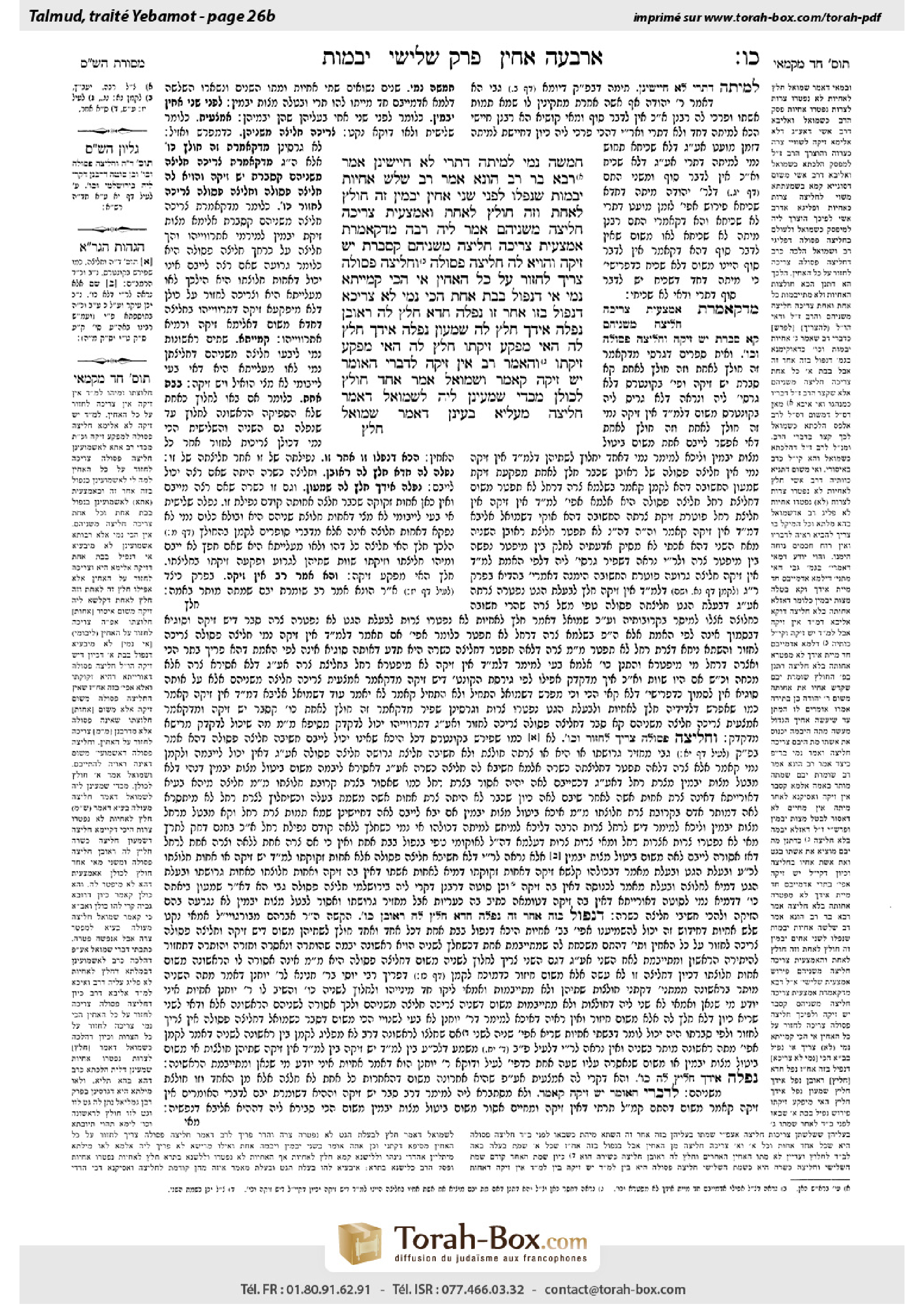
Yevamot 26b: Talmud study for Daf Yomi
Daf Yomi is the daily study of one Talmud folio. Explore 37 tractates with scans, Hebrew text, Sefaria English and AI-generated French translations where annotated.
Passage selection and English or AI-generated French translation are available where the scan has annotations. Daf Study is independent of Torah-Box and Sefaria.
Browse Yevamot · יבמות · All tractatesYevamot 26b text and translations
This page of Yevamot includes the Aramaic text, an English translation and an AI-generated French translation, alongside the scan above.
יבמות כ״ו ב · Aramaic and Hebrew text
חַמְשָׁה נָמֵי! לְמִיתָה דִּתְרֵי לָא חָיְישִׁינַן.
אָמַר רָבָא בַּר רַב הוּנָא אָמַר רַב: שָׁלֹשׁ אֲחָיוֹת יְבָמוֹת שֶׁנָּפְלוּ לִפְנֵי שְׁנֵי אַחִין יְבָמִין — זֶה חוֹלֵץ לְאַחַת וְזֶה חוֹלֵץ לְאַחַת, וְאֶמְצָעִית צְרִיכָה חֲלִיצָה מִשְּׁנֵיהֶם.
אֲמַר לֵיהּ רַבָּה: מִדְּקָאָמְרַתְּ אֶמְצָעִית צְרִיכָה חֲלִיצָה מִשְּׁנֵיהֶם, קָסָבְרַתְּ יֵשׁ זִיקָה, וְהָוְיָא לַהּ חֲלִיצָה פְּסוּלָה — וַחֲלִיצָה פְּסוּלָה צָרִיךְ לַחֲזוֹר עַל כׇּל הָאַחִין,
אִי הָכִי, קַמַּיְיתָא נָמֵי!
אִי דִּנְפוּל בְּבַת אַחַת — הָכִי נָמֵי. לָא צְרִיכָא: דִּנְפוּל בְּזוֹ אַחַר זוֹ.
נְפַלָה חֲדָא — חָלֵץ לַהּ רְאוּבֵן, נְפַלָה אִידַּךְ — חָלֵץ לַהּ שִׁמְעוֹן,
נְפַלָה אִידַּךְ, חָלֵץ לַהּ הַאי — מַפְקַע זִיקָתוֹ, חָלֵץ לַהּ הַאי — מַפְקַע זִיקָתוֹ.
וְהָאָמַר רַב: אֵין זִיקָה! לְדִבְרֵי הָאוֹמֵר יֵשׁ זִיקָה קָאָמַר.
וּשְׁמוּאֵל אָמַר: אֶחָד חוֹלֵץ לְכוּלָּן. מִכְּדִי שָׁמְעִינַן לֵיהּ לִשְׁמוּאֵל דְּאָמַר: חֲלִיצָה מְעַלְּיָא בְּעֵינַן, דְּאָמַר שְׁמוּאֵל:
Yevamot 26b · English translation
then this should also be true in a case of five brothers, two of whom were married to two sisters and died, and their wives happened before the three remaining brothers for levirate marriage. The Gemara answers: We are not concerned over the possibility of the death of two brothers in such a short period of time.
§ Rava bar Rav Huna said that Rav said: In a case where three sisters who were married to three brothers became yevamot and happened before two remaining brothers who were their yevamin for levirate marriage, then this one brother performs ḥalitza with one of the women, and that brother performs ḥalitza with another one of the women. And the middle, i.e., third, sister requires ḥalitza with both of the brothers.
Rabba said to them: From the fact that you say that the middle one requires ḥalitza with both of the brothers, it can be deduced that you hold that the levirate bond is substantial and creates a familial relationship, and similarly this ḥalitza performed by each of the brothers with the third sister is invalid ḥalitza. Since the third woman is the sister of a woman with whom he performed ḥalitza, it is not possible to consummate the levirate marriage with her. Therefore, the ḥalitza performed with her is not entirely valid and does not release her from the levirate bond between her and the two brothers. And there is a principle that invalid ḥalitza must be repeated by all of the brothers; each of them must perform an act of ḥalitza with this woman.
The Gemara asks: If that is so, the first two women should also require ḥalitza from each of the brothers because each act of ḥalitza was invalid, as each woman has the status of the sister of a woman with whom the man has a levirate bond, and it is therefore prohibited for the men to consummate the levirate marriage with them.
The Gemara responds: If the case is that they, i.e., the sisters, happened before the brothers simultaneously, it is indeed so that the two brothers would each be obligated to perform ḥalitza with each of the three sisters. This halakha is necessary only in the case where they happened before the brothers, one after the other.
How so? One sister happened before the brothers for levirate marriage and then Reuven, one of the brothers, performed valid ḥalitza with her. Another sister happened before the brothers for levirate marriage, and the brother Shimon performed ḥalitza with her. In this case, Shimon was allowed to consummate the levirate marriage with her if he so desired, as she had no family relationship to him at all. When Reuven performed ḥalitza with the first sister, he removed the levirate bond between her and the other brothers, such that Shimon has no relationship with the first sister at all and is free to marry the second sister. Therefore, when he performed ḥalitza, the act was valid.
Another third sister then happened before the brothers for levirate marriage. When this first brother performs ḥalitza with her, he terminates his levirate bond, and when this second brother performs ḥalitza with her, he terminates his levirate bond. However, neither brother can, by performing ḥalitza, terminate the other brother’s levirate bond because each brother’s ḥalitza is invalid, as each brother is unable to consummate the levirate marriage in this case. This is due to the woman’s status as the sister of a woman with whom he performed ḥalitza.
The Gemara asks: How can this statement be cited in the name of Rav? But didn’t Rav say: The levirate bond is not substantial. This halakha, however, was explained based on the assumption that the levirate bond is substantial. The Gemara answers: Indeed, according to Rav himself it is unnecessary to perform ḥalitza with multiple brothers. He, however, states this halakha in accordance with the statement of the one who says that the levirate bond is substantial, despite the fact that he does not hold this himself.
And with regard to the above case Shmuel said a different halakhic ruling: It is sufficient if one brother performs ḥalitza with each of the sisters. The Gemara raises a difficulty: But since we have heard that Shmuel said: We require a full-fledged ḥalitza, and invalid ḥalitza does not result in complete exemption, this ruling is difficult. It is not clear why the invalid ḥalitza in this case would be sufficient, as Shmuel said:
Yevamot 26b · Traduction française (IA)
Alors, cela devrait également être vrai dans le cas de cinq frères, dont deux étaient mariés à deux sœurs et moururent, et dont les veuves se présentèrent devant les trois frères restants pour le mariage léviratique. La Guemara répond : Nous ne tenons pas compte de la possibilité que deux frères meurent dans un intervalle aussi court.
§ Rava bar Rav Houna dit au nom de Rav : Dans le cas où trois sœurs, mariées à trois frères, devinrent des yevamot et se présentèrent devant les deux frères restants, leurs yevamin, pour le mariage léviratique, l’un des frères accomplit la ḥalitsa avec l’une des femmes, et l’autre frère accomplit la ḥalitsa avec une autre. Quant à la sœur du milieu, c’est-à-dire la troisième, elle doit accomplir la ḥalitsa avec chacun des deux frères.
Rabba leur dit : Du fait que vous dites que la sœur du milieu doit accomplir la ḥalitsa avec chacun des deux frères, on peut déduire que, selon vous, le lien léviratique est substantiel et crée un lien de parenté. De même, la ḥalitsa que chacun des frères accomplit avec la troisième sœur est invalide. Puisque cette troisième femme est la sœur d’une femme avec laquelle il a accompli la ḥalitsa, il ne peut pas contracter avec elle le mariage léviratique. Par conséquent, la ḥalitsa accomplie avec elle n’est pas pleinement valable et ne la libère pas du lien léviratique qui l’unit aux deux frères. Or, selon un principe, une ḥalitsa invalide doit être répétée par tous les frères : chacun d’eux doit accomplir la ḥalitsa avec cette femme.
La Guemara demande : Si tel est le cas, les deux premières femmes devraient elles aussi nécessiter la ḥalitsa de chacun des frères, puisque chaque acte de ḥalitsa était invalide : chacune de ces femmes a le statut de sœur d’une femme avec laquelle l’homme a un lien léviratique, et il est donc interdit aux hommes de contracter avec elles le mariage léviratique.
La Guemara répond : Si les sœurs se sont présentées devant les frères simultanément, c’est effectivement le cas : chacun des deux frères serait tenu d’accomplir la ḥalitsa avec chacune des trois sœurs. Cette halakha n’est nécessaire que dans le cas où elles se sont présentées devant les frères l’une après l’autre.
Comment cela ? Une sœur se présenta devant les frères pour le mariage léviratique, puis Reouven, l’un des frères, accomplit avec elle une ḥalitsa valable. Une autre sœur se présenta ensuite devant les frères pour le mariage léviratique, et Chimon, l’autre frère, accomplit la ḥalitsa avec elle. Dans ce cas, Chimon aurait pu contracter avec elle le mariage léviratique s’il l’avait souhaité, car il n’avait aucun lien de parenté avec elle. Lorsque Reouven accomplit la ḥalitsa avec la première sœur, il mit fin au lien léviratique qui l’unissait aux autres frères, de sorte que Chimon n’avait aucun lien avec la première sœur et était libre d’épouser la seconde. Par conséquent, lorsque Chimon accomplit la ḥalitsa, son acte était valable.
Une troisième sœur se présenta ensuite devant les frères pour le mariage léviratique. Lorsque le premier frère accomplit la ḥalitsa avec elle, il mit fin à son propre lien léviratique ; lorsque le second frère accomplit la ḥalitsa avec elle, il mit fin au sien. Cependant, aucun des frères ne peut, par la ḥalitsa qu’il accomplit, mettre fin au lien léviratique de l’autre, car la ḥalitsa de chacun est invalide : dans ce cas, aucun des deux ne peut contracter le mariage léviratique avec cette femme, qui a le statut de sœur d’une femme avec laquelle il a accompli la ḥalitsa.
La Guemara demande : Comment peut-on rapporter cette déclaration au nom de Rav ? Rav n’a-t-il pas dit que le lien léviratique n’est pas substantiel ? Or, cette halakha a été expliquée en supposant que le lien léviratique est substantiel. La Guemara répond : En effet, selon Rav lui-même, il n’est pas nécessaire d’accomplir la ḥalitsa avec plusieurs frères. Toutefois, il énonce cette halakha conformément à l’opinion de celui qui dit que le lien léviratique est substantiel, bien qu’il ne soutienne pas lui-même cette opinion.
Et concernant le cas évoqué plus haut, Chmouel énonce une autre décision halakhique : il suffit qu’un seul frère accomplisse la ḥalitsa avec chacune des sœurs. La Guemara soulève une difficulté : Puisque nous avons entendu Chmouel dire qu’une ḥalitsa pleinement valable est requise et qu’une ḥalitsa invalide ne produit pas une libération complète, cette décision est difficile à comprendre. On ne voit pas pourquoi la ḥalitsa invalide serait suffisante dans ce cas, puisque Chmouel a dit :
Traduction française générée par IA à partir de l’édition anglaise de Sefaria. Vérifie toujours un passage avec le texte source.
Text from Sefaria: William Davidson Edition - Vocalized Aramaic (CC BY NC); William Davidson Edition - English (CC BY NC).