Yevamot 27b: Talmud study for Daf Yomi
Daf Yomi is the daily study of one Talmud folio. Explore 37 tractates with scans, Hebrew text, Sefaria English and AI-generated French translations where annotated.
Passage selection and English or AI-generated French translation are available where the scan has annotations. Daf Study is independent of Torah-Box and Sefaria.
Browse Yevamot · יבמות · All tractatesYevamot 27b text and translations
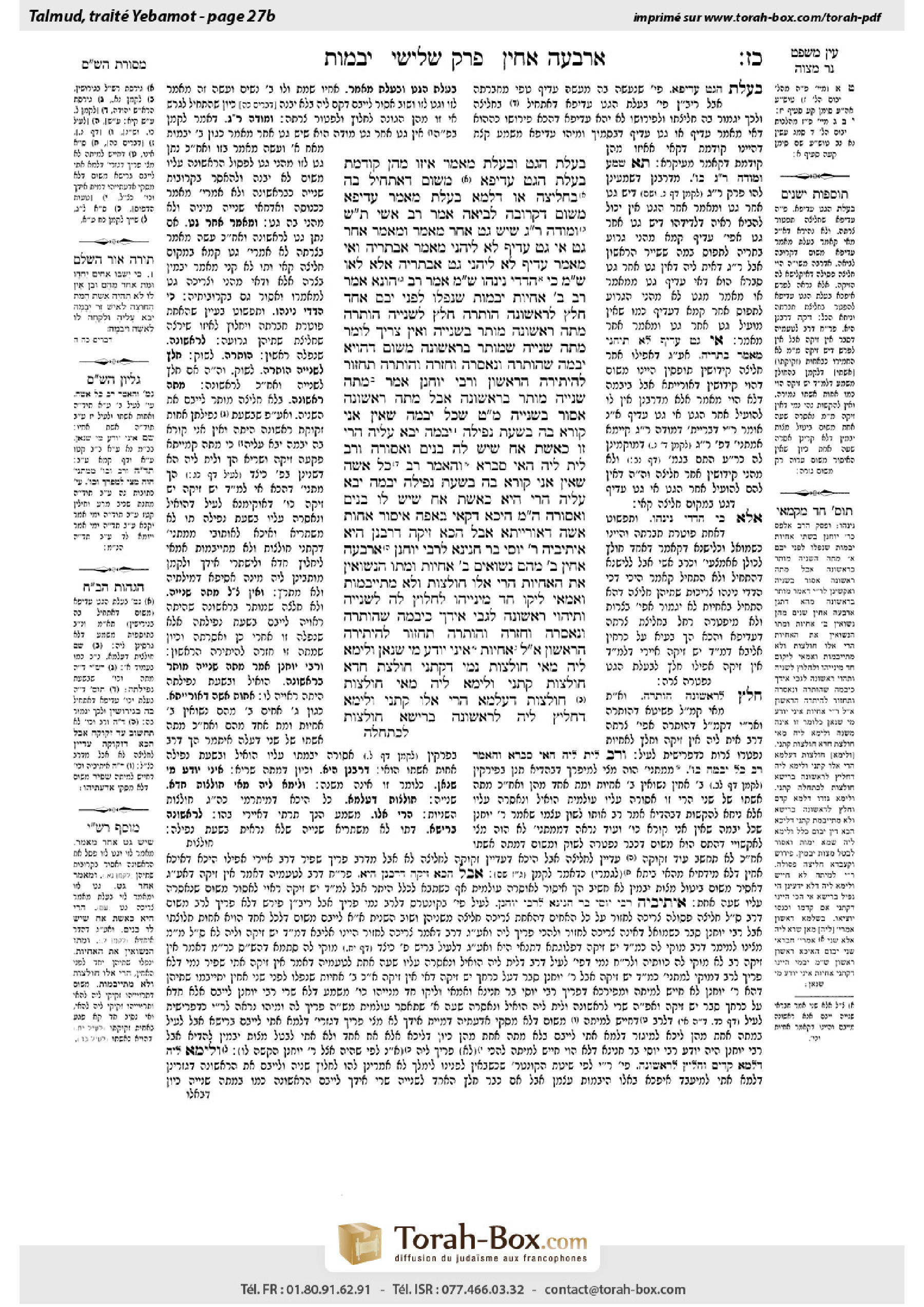
This page of Yevamot includes the Aramaic text, an English translation and an AI-generated French translation, alongside the scan above.
יבמות כ״ז ב · Aramaic and Hebrew text
בַּעֲלַת הַגֵּט וּבַעֲלַת מַאֲמָר, אֵיזוֹ מֵהֶן קוֹדֶמֶת? בַּעֲלַת הַגֵּט עֲדִיפָא, מִשּׁוּם דְּאַתְחֵיל בַּהּ בַּחֲלִיצָה, אוֹ דִלְמָא: בַּעֲלַת מַאֲמָר עֲדִיפָא, מִשּׁוּם דִּקְרוֹבָה לְבִיאָה.
אָמַר רַב אָשֵׁי, תָּא שְׁמַע: וּמוֹדֶה רַבָּן גַּמְלִיאֵל שֶׁיֵּשׁ גֵּט אַחַר מַאֲמָר, וּמַאֲמַר אַחֵר גֵּט.
אִי גֵּט עֲדִיף — לָא לַיהֲנֵי מַאֲמָר אַבָּתְרֵיהּ, וְאִי מַאֲמָר עֲדִיף — לָא לַיהֲנֵי גֵּט אַבָּתְרֵיהּ, אֶלָּא לָאו שְׁמַע מִינַּהּ: כִּי הֲדָדֵי נִינְהוּ, שְׁמַע מִינַּהּ.
אָמַר רַב הוּנָא אָמַר רַב: שְׁתֵּי אֲחָיוֹת יְבָמוֹת שֶׁנָּפְלוּ לִפְנֵי יָבָם אֶחָד, חָלַץ לָרִאשׁוֹנָה — הוּתְּרָה, חָלַץ לַשְּׁנִיָּיה — הוּתְּרָה.
מֵתָה רִאשׁוֹנָה — מוּתָּר בַּשְּׁנִיָּיה. וְאֵין צָרִיךְ לוֹמַר מֵתָה שְׁנִיָּיה שֶׁמּוּתָּר בָּרִאשׁוֹנָה, מִשּׁוּם דְּהָוְיָא יְבָמָה שֶׁהוּתְּרָה וְנֶאֶסְרָה וְחָזְרָה וְהוּתְּרָה — תַּחְזוֹר לְהֶיתֵּירָהּ הָרִאשׁוֹן.
וְרַבִּי יוֹחָנָן אָמַר: מֵתָה שְׁנִיָּיה — מוּתָּר בָּרִאשׁוֹנָה, אֲבָל מֵתָה רִאשׁוֹנָה — אָסוּר בַּשְּׁנִיָּיה. מַאי טַעְמָא? שֶׁכׇּל יְבָמָה שֶׁאֵין אֲנִי קוֹרֵא בָּהּ בִּשְׁעַת נְפִילָה ״יְבָמָהּ יָבֹא עָלֶיהָ״ — הֲרֵי זוֹ כְּאֵשֶׁת אָח שֶׁיֵּשׁ לָהּ בָּנִים, וַאֲסוּרָה.
וְרַב לֵית לֵיהּ הַאי סְבָרָא? וְהָאָמַר רַב: כׇּל אִשָּׁה שֶׁאֵין אֲנִי קוֹרֵא בָּהּ בִּשְׁעַת נְפִילָה ״יְבָמָהּ יָבֹא עָלֶיהָ״ — הֲרֵי הִיא כְּאֵשֶׁת אָח שֶׁיֵּשׁ לוֹ בָּנִים, וַאֲסוּרָה! הָנֵי מִילֵּי הֵיכָא דְּקָאֵי בְּאַפַּהּ אִיסּוּר אֲחוֹת אִשָּׁה דְּאוֹרָיְיתָא, אֲבָל הָכָא — זִיקָּה דְּרַבָּנַן הִיא.
אֵיתִיבֵיהּ רַבִּי יוֹסֵי בַּר חֲנִינָא לְרַבִּי יוֹחָנָן: אַרְבָּעָה אַחִין, שְׁנַיִם מֵהֶם נְשׂוּאִים שְׁתֵּי אֲחָיוֹת, וּמֵתוּ הַנְּשׂוּאִין אֶת הָאֲחָיוֹת — הֲרֵי אֵלּוּ חוֹלְצוֹת וְלֹא מִתְיַיבְּמוֹת. וְאַמַּאי? לֵיקוּ חַד מִינַּיְיהוּ, לַחְלוֹץ לָהּ לִשְׁנִיָּיה, וְתִיהְוֵי רִאשׁוֹנָה לְגַבֵּי אִידַּךְ כִּיבָמָה שֶׁהוּתְּרָה וְנֶאֶסְרָה וְחָזְרָה וְהוּתְּרָה — תַּחְזוֹר לְהֶיתֵּירָהּ הָרִאשׁוֹן!
אֲמַר לֵיהּ: אֲחָיוֹת אֵינִי יוֹדֵעַ מִי שְׁנָאָן. וְלֵימָא לֵיהּ: מַאי ״חוֹלְצוֹת״ נָמֵי דְּקָתָנֵי — חוֹלֶצֶת חֲדָא! ״חוֹלְצוֹת״ קָתָנֵי.
וְלֵימָא לֵיהּ: מַאי ״חוֹלְצוֹת״ — חוֹלְצוֹת דְּעָלְמָא! ״הֲרֵי אֵלּוּ״ קָתָנֵי. וְלֵימָא: דַּחֲלֵיץ לַיהּ לְרִאשׁוֹנָה בְּרֵישָׁא! ״חוֹלְצוֹת״
Yevamot 27b · English translation
If two women happened before a single yavam for levirate marriage, and one is a woman who received a bill of divorce and the other is a woman who received levirate betrothal, which has precedence for ḥalitza? Is the woman who received a bill of divorce preferred because he began the process of ḥalitza with her, as presenting a bill of divorce represents the first step separating the woman from him? Or perhaps the woman who received levirate betrothal is preferred, because she is closest to being able to enter into permitted sexual intercourse. The act of levirate betrothal is generally done just prior to levirate marriage and is equivalent to the act of betrothal in non-levirate contexts. As a result, levirate betrothal strengthens the connection between the woman and the yavam. For this reason, it may be preferable to perform ḥalitza with the woman who received levirate betrothal.
Rav Ashi said: Come and hear: The Sages disputed the ruling with regard to a yavam who performed levirate betrothal with one sister-in-law and then performed it with her rival wife as well, or conversely, gave both women a bill of divorce. In such cases, would the second levirate betrothal or bill of divorce be effective? It was taught: And Rabban Gamliel concedes that a bill of divorce is effective after levirate betrothal. Therefore, the bill of divorce that the yavam gave to one yevama after having performed levirate betrothal with the other yevama is effective to some degree. Similarly, Rabban Gamliel concedes that levirate betrothal performed after a bill of divorce is effective.
If the bill of divorce is preferred to levirate betrothal, then levirate betrothal performed afterward should not be effective. The opposite would hold true as well: And if levirate betrothal is preferred, then a bill of divorce given afterward should not be effective. Rather, must one not conclude from this statement that the two are equivalent to each other? The Gemara summarizes: Indeed, conclude from this statement that they are equivalent. Therefore, neither the woman who received a bill of divorce nor the woman who received levirate betrothal has precedence for ḥalitza.
§ Rav Huna said that Rav said: In a case of two sisters who became yevamot, i.e., the two sisters were married to two brothers who died, who happened before one yavam for levirate marriage, if he performed ḥalitza with the first sister, then she is permitted to marry any man. If he performed ḥalitza with the second sister, then she is permitted to do so as well.
If the first sister died before the yavam was able to perform ḥalitza with her, then he is permitted to take the second sister in levirate marriage, for even if he had actually been married to the first sister, one is permitted to marry the sister of his wife after his wife dies. And needless to say, if the second sister died, then he is permitted to take the first sister in levirate marriage because she would be considered a yevama who was permitted at the time that she happened before the yavam for levirate marriage; and then later forbidden as the sister of a woman with whom he has a levirate bond when the second sister happened before him for levirate marriage; and subsequently became permitted by the death of the second sister. Therefore, she can return completely to her original permitted status.
However, Rabbi Yoḥanan said: If the second sister dies, he is permitted to take the first. But if the first sister dies, he is prohibited from taking the second sister. What is the reason for this ruling? The reason is that any yevama to whom the verse “her brother-in-law will have intercourse with her” (Deuteronomy 25:5) cannot be applied at the time that she happens before him for levirate marriage because she was forbidden to him at that moment, is then forever considered to be like the wife of a brother who has children, and she is forbidden to him. Because the second sister was forbidden to the yavam at the time that she happened before him for levirate marriage, being the sister of a woman with whom he had a levirate bond, she can never again be permitted to him.
The Gemara asks: And does Rav not accept that reason? Didn’t Rav himself say the exact same words: Any woman to whom the verse “her brother-in-law will have intercourse with her” cannot be applied at the time that she happens before him for levirate marriage is then considered to be like the wife of a brother who has children, and she is forbidden to him? The Gemara answers: This applies only when the prohibition that stands before her and prevents the levirate marriage is the prohibition against marrying the sister of one’s wife, which is prohibited by Torah law. Therefore, if the woman who happens before the yavam for levirate marriage is his wife’s sister, he is prohibited from performing levirate marriage even if his wife dies afterward. But here the prohibition to marry the sister stems from a relationship created by a levirate bond. This prohibition is by rabbinic law, and therefore the bond does not render her forbidden to him forever.
Rabbi Yosei bar Ḥanina raised an objection to the opinion of Rabbi Yoḥanan from the mishna: In the case of four brothers, two of whom were married to two sisters, and those married to the sisters died, then those sisters must perform ḥalitza and may not enter into levirate marriage. And why does the mishna require ḥalitza? Let one of the brothers rise and perform ḥalitza with the second sister, i.e., the sister whose husband died later. As a result, the first would be like a yevama who was permitted at the time of her husband’s death but later became forbidden due to the bond that was created with her sister, and she then subsequently became permitted by means of ḥalitza performed with her sister, insofar as the other brother, i.e., he who did not perform ḥalitza, is concerned. Therefore, she should return to her original permitted status.
Rabbi Yoḥanan said to him: I do not know who taught: Sisters. Rabbi Yoḥanan was in doubt as to the correct version of this mishna, as he could not find any reasonable explanation of this mishna according to any known opinion. The Gemara asks: Why did Rabbi Yoḥanan respond in such an extreme manner. Let him say to him, to Rabbi Yosei bar Ḥanina, an alternate solution: What is the meaning of the ruling that the sisters perform ḥalitza, which the mishna teaches? The meaning is that one sister performs ḥalitza. The Gemara answers: Such a solution is untenable, as the mishna teaches the ruling using the words: Perform ḥalitza, in the plural.
The Gemara suggests: And let Rabbi Yoḥanan say to him: What is the meaning of the ruling to perform ḥalitza? They perform ḥalitza in general. Accordingly, the mishna teaches that in such cases the second woman performs ḥalitza. The Gemara responds: The mishna teaches: Then those women perform ḥalitza. The emphasis on the word: Those, indicates that it is specifically those two women who both perform ḥalitza. The Gemara asks further: And let him say that the mishna is referring only to the specific case where the yavam performed ḥalitza with the first sister first. As a result, there was no longer any possibility of rendering the second sister permitted, as Rabbi Yoḥanan permitted levirate marriage only in the case where ḥalitza was performed with the second sister first. The Gemara answers: This cannot be suggested either, for the phrase: Perform ḥalitza,
Yevamot 27b · Traduction française (IA)
Si deux femmes se présentent devant un seul yavam en vue du mariage léviratique, l’une ayant reçu un acte de divorce et l’autre ayant reçu des kiddouchin léviratiques, laquelle a priorité pour la ḥalitsa ? Faut-il préférer la femme qui a reçu un acte de divorce, parce qu’il a commencé avec elle le processus de ḥalitsa, puisque la remise d’un acte de divorce constitue la première étape de la séparation de la femme d’avec lui ? Ou peut-être faut-il préférer celle qui a reçu des kiddouchin léviratiques, car elle est la plus proche de pouvoir avoir avec lui des relations sexuelles permises. Les kiddouchin léviratiques sont généralement accomplis juste avant le mariage léviratique et équivalent à l’acte des kiddouchin dans les autres contextes. Par conséquent, les kiddouchin léviratiques renforcent le lien entre la femme et le yavam. Pour cette raison, il serait peut-être préférable d’accomplir la ḥalitsa avec la femme qui a reçu des kiddouchin léviratiques.
Rav Ashi dit : Viens et entends. Les Sages ont débattu de la décision concernant un yavam qui a accompli des kiddouchin léviratiques avec une yevama, puis avec sa coépouse, ou, inversement, a remis un acte de divorce aux deux femmes. Dans ces cas, les seconds kiddouchin léviratiques ou le second acte de divorce sont-ils efficaces ? Il a été enseigné : Rabban Gamliel reconnaît qu’un acte de divorce est efficace après des kiddouchin léviratiques. Par conséquent, l’acte de divorce que le yavam a remis à une yevama après avoir accompli des kiddouchin léviratiques avec l’autre yevama est efficace dans une certaine mesure. De même, Rabban Gamliel reconnaît que des kiddouchin léviratiques accomplis après la remise d’un acte de divorce sont efficaces.
Si l’acte de divorce a priorité sur les kiddouchin léviratiques, alors les kiddouchin léviratiques accomplis ensuite ne devraient pas être efficaces. L’inverse serait également vrai : si les kiddouchin léviratiques ont priorité, alors un acte de divorce remis ensuite ne devrait pas être efficace. Ne faut-il pas plutôt conclure de cette déclaration que les deux ont le même statut ? La Guemara résume : En effet, concluons de cette déclaration qu’ils ont le même statut. Par conséquent, ni la femme qui a reçu un acte de divorce ni celle qui a reçu des kiddouchin léviratiques n’a priorité pour la ḥalitsa.
§ Rav Houna dit au nom de Rav : Dans le cas de deux sœurs devenues yevamot — c’est-à-dire que les deux sœurs étaient mariées à deux frères qui sont morts — et qui se présentent devant un seul yavam en vue du mariage léviratique, s’il accomplit la ḥalitsa avec la première sœur, elle est alors autorisée à épouser n’importe quel homme. S’il accomplit la ḥalitsa avec la seconde sœur, elle aussi est autorisée à le faire.
Si la première sœur meurt avant que le yavam ait pu accomplir la ḥalitsa avec elle, il est autorisé à prendre la seconde sœur en mariage léviratique, car même s’il avait effectivement été marié à la première sœur, on est autorisé à épouser la sœur de sa femme après la mort de celle-ci. À plus forte raison, si la seconde sœur meurt, il est autorisé à prendre la première sœur en mariage léviratique, car celle-ci serait considérée comme une yevama qui était autorisée au moment où elle s’est présentée devant le yavam en vue du mariage léviratique, puis qui est devenue interdite en tant que sœur d’une femme avec laquelle il avait un lien léviratique lorsque la seconde sœur s’est présentée devant lui en vue du mariage léviratique, avant de redevenir autorisée à la mort de cette seconde sœur. Elle peut donc retrouver entièrement son statut initial d’autorisation.
Cependant, Rabbi Yoḥanan dit : Si la seconde sœur meurt, il est autorisé à prendre la première. Mais si la première sœur meurt, il lui est interdit de prendre la seconde sœur. Quelle est la raison de cette décision ? Toute yevama à laquelle le verset « son beau-frère s’unira à elle » (Deutéronome 25, 5) ne peut s’appliquer au moment où elle se présente devant lui en vue du mariage léviratique, parce qu’elle lui est alors interdite, est dès lors considérée à jamais comme l’épouse d’un frère qui a des enfants, et elle lui est interdite. Puisque la seconde sœur était interdite au yavam au moment où elle s’est présentée devant lui en vue du mariage léviratique, étant la sœur d’une femme avec laquelle il avait un lien léviratique, elle ne peut plus jamais lui être permise.
La Guemara demande : Rav n’accepte-t-il donc pas cette raison ? Rav lui-même n’a-t-il pas dit exactement la même chose : toute femme à laquelle le verset « son beau-frère s’unira à elle » ne peut s’appliquer au moment où elle se présente devant lui en vue du mariage léviratique est dès lors considérée comme l’épouse d’un frère qui a des enfants, et elle lui est interdite ? La Guemara répond : Cela ne s’applique que lorsque l’interdiction qui fait obstacle au mariage léviratique est celle d’épouser la sœur de sa femme, interdiction édictée par la Torah. Par conséquent, si la femme qui se présente devant le yavam en vue du mariage léviratique est la sœur de sa femme, il lui est interdit de l’épouser par mariage léviratique, même si sa femme meurt ensuite. Mais ici, l’interdiction d’épouser la sœur découle d’un lien créé par le lien léviratique. Cette interdiction relève de la loi rabbinique ; le lien ne la rend donc pas interdite à jamais.
Rabbi Yosei bar Ḥanina soulève une objection à l’opinion de Rabbi Yoḥanan à partir de la Michna : Dans le cas de quatre frères, dont deux étaient mariés à deux sœurs, et où les frères mariés aux sœurs sont morts, ces sœurs doivent accomplir la ḥalitsa et ne peuvent pas contracter de mariage léviratique. Pourquoi la Michna exige-t-elle la ḥalitsa ? Qu’un des frères se lève et accomplisse la ḥalitsa avec la seconde sœur, c’est-à-dire celle dont le mari est mort le plus tard. Ainsi, du point de vue de l’autre frère, celui qui n’a pas accompli la ḥalitsa, la première sœur serait comme une yevama qui était autorisée à la mort de son mari, mais qui est ensuite devenue interdite à cause du lien créé avec sa sœur, puis est redevenue autorisée grâce à la ḥalitsa accomplie avec sa sœur. Elle devrait donc retrouver son statut initial d’autorisation.
Rabbi Yoḥanan lui dit : Je ne sais pas qui a enseigné : « les sœurs ». Rabbi Yoḥanan doutait de la version correcte de cette Michna, car il ne trouvait aucune explication raisonnable à son sujet selon aucune opinion connue. La Guemara demande : Pourquoi Rabbi Yoḥanan a-t-il répondu de manière si catégorique ? Qu’il propose à Rabbi Yosei bar Ḥanina une autre solution : que signifie la décision de la Michna selon laquelle les sœurs accomplissent la ḥalitsa ? Cela signifie qu’une seule sœur accomplit la ḥalitsa. La Guemara répond : Une telle solution est intenable, car la Michna formule la décision au pluriel : « accomplissent la ḥalitsa ».
La Guemara propose : Rabbi Yoḥanan pourrait dire : que signifie la décision d’accomplir la ḥalitsa ? Elles accomplissent la ḥalitsa en général. Ainsi, la Michna enseignerait que, dans de tels cas, la seconde femme accomplit la ḥalitsa. La Guemara répond : La Michna enseigne : « Alors ces femmes accomplissent la ḥalitsa. » L’accent mis sur le mot « ces » indique que ce sont précisément ces deux femmes qui accomplissent toutes deux la ḥalitsa. La Guemara demande encore : Qu’il dise que la Michna ne vise que le cas particulier où le yavam a d’abord accompli la ḥalitsa avec la première sœur. Dès lors, il n’y avait plus aucune possibilité de rendre la seconde sœur autorisée, puisque Rabbi Yoḥanan n’autorisait le mariage léviratique que dans le cas où la ḥalitsa avait d’abord été accomplie avec la seconde sœur. La Guemara répond : Cela non plus ne peut être proposé, car l’expression « accomplissent la ḥalitsa »
Traduction française générée par IA à partir de l’édition anglaise de Sefaria. Vérifie toujours un passage avec le texte source.
Text from Sefaria: William Davidson Edition - Vocalized Aramaic (CC BY NC); William Davidson Edition - English (CC BY NC).