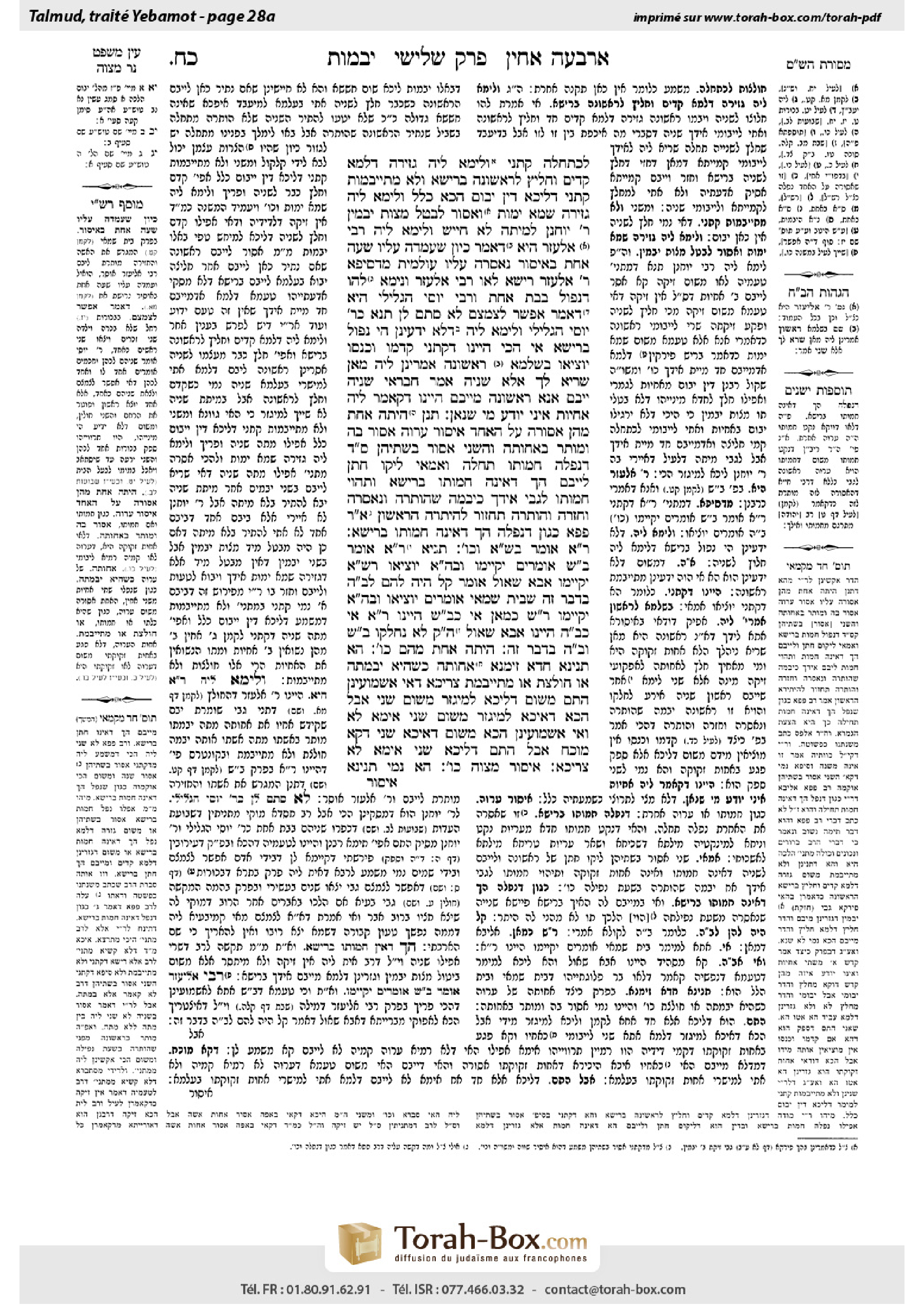
Yevamot 28a: Talmud study for Daf Yomi
Daf Yomi is the daily study of one Talmud folio. Explore 37 tractates with scans, Hebrew text, Sefaria English and AI-generated French translations where annotated.
Passage selection and English or AI-generated French translation are available where the scan has annotations. Daf Study is independent of Torah-Box and Sefaria.
Browse Yevamot · יבמות · All tractatesYevamot 28a text and translations
This page of Yevamot includes the Aramaic text, an English translation and an AI-generated French translation, alongside the scan above.
יבמות כ״ח א · Aramaic and Hebrew text
לְכַתְּחִלָּה קָתָנֵי. וְלֵימָא לֵיהּ: גְּזֵירָה דִּלְמָא קְדֵים וַחֲלֵיץ לְרִאשׁוֹנָה בְּרֵישָׁא! ״וְלֹא מִתְיַיבְּמוֹת״ קָתָנֵי, דְּלֵיכָּא דִּין יִבּוּם הָכָא כְּלָל.
וְלֵימָא לֵיהּ: גְּזֵירָה שֶׁמָּא יָמוּת, וְאָסוּר לְבַטֵּל מִצְוַת יְבָמִין! רַבִּי יוֹחָנָן לְמִיתָה לָא חָיֵישׁ.
וְלֵימָא לֵיהּ: רַבִּי אֶלְעָזָר הִיא, דְּאָמַר: כֵּיוָן שֶׁעָמְדָה עָלָיו שָׁעָה אַחַת בְּאִיסּוּר — נֶאֶסְרָה עָלָיו עוֹלָמִית. מִדְּסֵיפָא רַבִּי אֶלְעָזָר, רֵישָׁא לָאו רַבִּי אֶלְעָזָר.
וְנֵימָא לְהוּ: דִּנְפוּל בְּבַת אַחַת, וְרַבִּי יוֹסֵי הַגְּלִילִי הִיא, דְּאָמַר: אֶפְשָׁר לְצַמְצֵם! לָא סְתַם לַן תַּנָּא כְּרַבִּי יוֹסֵי הַגְּלִילִי.
וְלֵימָא לֵיהּ: דְּלָא יָדְעִינַן הֵי נְפוּל בְּרֵישָׁא.
אִי הָכִי — הַיְינוּ דְּקָתָנֵי קָדְמוּ וְכָנְסוּ יוֹצִיאוּ? בִּשְׁלָמָא רִאשׁוֹנָה, אָמְרִינַן לֵיהּ: מַאן שְׁרָא לָךְ? אֶלָּא שְׁנִיָּה, אָמַר: חַבְרַאי שְׁנִיָּה יַיבֵּם, אֲנָא רִאשׁוֹנָה מְיַיבֵּם.
הַיְינוּ דְּקָאָמַר לֵיהּ: אֲחָיוֹת אֵינִי יוֹדֵעַ מִי שְׁנָאָן.
תְּנַן: הָיְתָה אַחַת מֵהֶן אֲסוּרָה עַל הָאֶחָד אִיסּוּר עֶרְוָה — אָסוּר בָּהּ וּמוּתָּר בַּאֲחוֹתָהּ, וְהַשֵּׁנִי אָסוּר בִּשְׁתֵּיהֶן. סָלְקָא דַּעְתָּךְ דִּנְפַלָה חֲמוֹתוֹ תְּחִלָּה.
וְאַמַּאי? לֵיקוּ חָתָן לְיַיבֵּם הָךְ דְּאֵינָהּ חֲמוֹתוֹ בְּרֵישָׁא, וְתֶהֱוֵי חֲמוֹתוֹ לְגַבֵּי אִידַּךְ כִּיבָמָה שֶׁהוּתְּרָה וְנֶאֶסְרָה וְחָזְרָה וְהוּתְּרָה, תַּחְזוֹר לְהֶיתֵּרָהּ הָרִאשׁוֹן!
אָמַר רַב פָּפָּא: כְּגוֹן דִּנְפַלָה הָךְ דְּאֵינָהּ חֲמוֹתוֹ בְּרֵישָׁא.
רַבִּי אֱלִיעֶזֶר אוֹמֵר: בֵּית שַׁמַּאי אוֹמְרִים וְכוּ׳. תַּנְיָא, רַבִּי אֱלִיעֶזֶר אוֹמֵר, בֵּית שַׁמַּאי אוֹמְרִים: יְקַיְּימוּ, וּבֵית הִלֵּל אוֹמְרִים: יוֹצִיאוּ. רַבִּי שִׁמְעוֹן אוֹמֵר: יְקַיְּימוּ. אַבָּא שָׁאוּל אוֹמֵר: קַל הָיָה לָהֶם לְבֵית הִלֵּל בְּדָבָר זֶה, שֶׁבֵּית שַׁמַּאי אוֹמְרִים: יוֹצִיאוּ, וּבֵית הִלֵּל אוֹמְרִים: יְקַיְּימוּ.
רַבִּי שִׁמְעוֹן כְּמַאן? אִי כְּבֵית שַׁמַּאי — הַיְינוּ רַבִּי אֱלִיעֶזֶר. אִי כְּבֵית הִלֵּל — הַיְינוּ אַבָּא שָׁאוּל! הָכִי קָאָמַר: לֹא נֶחְלְקוּ בֵּית שַׁמַּאי וּבֵית הִלֵּל בְּדָבָר זֶה.
הָיְתָה אַחַת מֵהֶם כּוּ׳. הָא תְּנֵינָא חֲדָא זִימְנָא: אֲחוֹתָהּ כְּשֶׁהִיא יְבִמְתָּהּ — אוֹ חוֹלֶצֶת אוֹ מִתְיַיבֶּמֶת!
צְרִיכָא, דְּאִי אַשְׁמְועִינַן הָתָם: מִשּׁוּם דְּלֵיכָּא לְמִיגְזַר מִשּׁוּם שֵׁנִי, אֲבָל הָכָא, דְּאִיכָּא לְמִיגְזַר מִשּׁוּם שֵׁנִי — אֵימָא לָא.
וְאִי אַשְׁמוּעִינַן הָכָא: מִשּׁוּם דְּאִיכָּא שֵׁנִי דְּקָא מוֹכַח, אֲבָל הָתָם, דְּלֵיכָּא שֵׁנִי — אֵימָא לָא. צְרִיכָא.
אִיסּוּר מִצְוָה כּוּ׳. הָא נָמֵי תְּנֵינָא:
Yevamot 28a · English translation
implies that the mishna teaches a case in which ḥalitza is performed ab initio. This indicates that this is the first course of action and the only way to resolve the situation. The Gemara asks further: And let him say to him the following: The mishna prohibits levirate marriage ab initio in this case, due to a rabbinic decree lest he proceed and perform the ḥalitza with the first sister first, whereby it would be prohibited to consummate the levirate marriage with the second. Perhaps for this reason the Sages decreed that it is prohibited to consummate the levirate marriage even if ḥalitza was performed with the second sister. The Gemara answers: It teaches: They may not enter into levirate marriage. This indicates that the halakha of levirate marriage does not apply here at all. Accordingly, even after the fact, if he performed ḥalitza with the second sister, the halakha of levirate marriage would not apply to the first sister.
The Gemara asks: And let him say to him a different reason for the ruling of the mishna: It is due to a rabbinic decree lest the second brother die, and it is prohibited to negate the mitzva of levirate marriage. Perhaps for this reason it would be forbidden to consummate the levirate marriage in the case where two sisters happened before him for levirate marriage, and not due to the prohibition proscribing the sister of a woman with whom he has a levirate bond. The Gemara answers: Rabbi Yoḥanan was not concerned over the possibility of the death of a brother, and in his opinion there is no need to make a decree to address such cases.
The Gemara asks: And let Rabbi Yoḥanan say to him that this mishna is in accordance with the opinion of Rabbi Elazar, who said: Once the yevama stood before him at one time as forbidden, even if it was not at the time that she happened before him, she remains forbidden to him forever. Perhaps the mishna could be explained according to Rabbi Elazar’s opinion. The Gemara answers: Since the opinion of Rabbi Elazar is cited explicitly in the latter clause of the mishna, it can be deduced that the first clause is not according to the opinion of Rabbi Elazar. Therefore, this ruling cannot be attributed to Rabbi Elazar.
The Gemara asks: And let him say to him that here the reference is to a situation where the two brothers died at once, and consequently both of the women happened before the yevamin for levirate marriage at the same time. And this mishna is in accordance with the opinion of Rabbi Yosei HaGelili, who says: It is possible to be precise. It is possible to determine that two events occurred at exactly the same moment, where both sisters were forbidden at the time that they happened before the brothers-in-law. The Gemara answers: The tanna did not teach an unattributed mishna in accordance with the opinion of Rabbi Yosei HaGelili. Any time the mishna is cited in accordance with Rabbi Yosei HaGelili’s opinion, it is always attributed to him explicitly.
The Gemara asks: And let him say to him a different explanation for the ruling: This mishna is indeed addressing a case where the brothers died one after the other, yet we do not know which sister happened before the yevamin for levirate marriage first. In that case, it would be impossible to determine which sister would be permitted.
The Gemara answers: If so, that which the mishna teaches in the latter clause: And if they married their wives before consulting the court they should divorce them, is difficult. Why must they divorce their wives in this situation? Granted, the brother who took the first sister in levirate marriage must divorce her, as we say to him: Who permitted her to you? Indeed, she was forbidden as the sister of a woman with whom he had a levirate bond, and so he must divorce her. However, the brother who took the second sister could say: My fellow brother consummated the levirate marriage with the second sister, but I am consummating the levirate marriage with the first sister. It is possible that after the other brother consummated the levirate marriage with the second sister, the first sister would then be permitted to him after the fact, and he is not required to divorce her unless it is certain that he violated a prohibition.
The Gemara concludes: Indeed, this is what Rabbi Yoḥanan meant when he said to Rabbi Yosei bar Ḥanina: I do not know who taught: Sisters, for according to these considerations he cannot properly resolve the ruling of this mishna.
We learned in the mishna: If one of the sisters was forbidden to one of the brothers due to a prohibition against forbidden relatives because she was a relative of his wife or a relative from his mother’s side, then he is prohibited from marrying her but permitted to marry her sister. But the second brother, who is not a close relative of either sister, is prohibited from marrying both of them. It enters your mind to say that a forbidden woman, such as his mother-in-law, happened before the yavam for levirate marriage first.
Accordingly, the Gemara asks: And why would both women be forbidden to the second brother? Let the son-in-law rise and consummate the levirate marriage with the sister who is not his mother-in-law first. Consequently, with regard to the other brother, his mother-in-law would be considered a yevama who was permitted to perform levirate marriage at the time that she happened before him, and then forbidden when her sister happened before him for levirate marriage as well, and then subsequently became permitted when his brother consummated the levirate marriage with her sister. If so, the mother-in-law should return to her original permitted status and may enter into levirate marriage with him.
Rav Pappa said: The mishna is referring to a case where the woman who was not his mother-in-law happened before the brothers for levirate marriage first, in which case she was permitted to both of them. When her sister, i.e., the mother-in-law, happened before them for levirate marriage as well, both women were rendered forbidden to the second brother, as each one is the sister of a woman with whom he has a levirate bond. Because the mother-in-law was forbidden from the time that she happened before the yavam for levirate marriage, she can never be permitted to him.
§ With regard to the case of two brothers who married their wives before consulting the court, the mishna states that the women should be divorced. Rabbi Eliezer disagrees and says that this is a matter of dispute between Beit Shammai and Beit Hillel, as Beit Shammai say: They may maintain them as their wives, and Beit Hillel say: They should divorce them. An expanded version of this discussion is taught in the Tosefta (5:1): Rabbi Eliezer says that Beit Shammai say: They may maintain them as their wives, and Beit Hillel say: They should divorce them. Rabbi Shimon says: They may maintain them as their wives. Abba Shaul disagrees with Rabbi Eliezer and says: This was a matter of leniency for Beit Hillel. They were the ones who put forth a lenient ruling, as Beit Shammai say: They should divorce them, and Beit Hillel say: They may maintain them as their wives.
The Gemara asks about this baraita: In accordance with whose opinion is the statement of Rabbi Shimon? This matter is a dispute between Beit Hillel and Beit Shammai, with different versions of their opinions, and therefore Rabbi Shimon should not have formulated the halakha in this manner. Indeed, if he holds in accordance with the opinion of Beit Shammai, then that is the same as the opinion of Rabbi Eliezer. He would thereby conclude that the halakha is in accordance with the opinion of Beit Shammai, as per Rabbi Eliezer’s version. If so, he should have formulated his opinion in that way. If, however, he holds in accordance with the opinion of Beit Hillel, then that is the opinion of Abba Shaul. The Gemara responds: This is what he is saying: Rabbi Shimon actually maintains a third opinion: Beit Shammai and Beit Hillel did not dispute this matter; both agreed that the marriages may be maintained.
§ The mishna stated: If one of the sisters was forbidden to one of the brothers due to a prohibition against forbidden relations, then he is prohibited from marrying her but permitted to marry her sister. The Gemara asks: We already learned this on one occasion: When her sister, who is a forbidden relative to the yavam, is her yevama as well, she either performs ḥalitza or enters into levirate marriage.
The Gemara answers: It is necessary that this be said here as well, for if it taught us this halakha only there in its more general formulation (Yevamot 20a), then I might have said: The yavam is permitted to marry the sister because there is no reason to issue a rabbinic decree due to a second brother. There, there is only one yavam, to whom one sister is permitted and the other is forbidden. Here, however, in the case of two brothers, where there is reason to issue a rabbinic decree due to the second brother, lest he consummate the levirate marriage as well, I would say that we do not allow even the first brother to perform levirate marriage, and both sisters-in-law should be forbidden to both brothers.
And if the mishna had taught us the halakha only here, it would have been possible to say that the permissibility of levirate marriage here is because there is a second brother who indicates, by refraining from performing levirate marriage, that the sister of a woman bound by a levirate bond is forbidden. However, there, where there is not a second brother, I would say no, this halakha would not apply, due to a concern that people might wrongly conclude that the sister of a woman bound by a levirate bond is permitted. Therefore, it is necessary to state this halakha in both places.
It was taught in the mishna: If one of the sisters was forbidden to one of the brothers due to a prohibition resulting from a mitzva or due to a prohibition stemming from sanctity, then her sister must perform ḥalitza and may not enter into levirate marriage. The Gemara wonders: We already learned this as well:
Yevamot 28a · Traduction française (IA)
Cela implique que la Michna enseigne un cas où la ḥalitza est accomplie a priori. Cela indique que c’est la première démarche à entreprendre et le seul moyen de résoudre la situation. La Guemara demande encore : Pourquoi ne pas lui répondre ainsi ? La Michna interdit a priori le mariage léviratique dans ce cas, en raison d’un décret rabbinique, de crainte qu’il n’accomplisse d’abord la ḥalitza avec la première sœur, ce qui interdirait de consommer le mariage léviratique avec la seconde. C’est peut-être pour cette raison que les Sages ont décrété qu’il est interdit de consommer le mariage léviratique même si la ḥalitza a été accomplie avec la seconde sœur. La Guemara répond : La Michna enseigne : « Elles ne peuvent pas contracter de mariage léviratique. » Cela indique que les règles du mariage léviratique ne s’appliquent pas du tout ici. Par conséquent, même après coup, s’il a accompli la ḥalitza avec la seconde sœur, les règles du mariage léviratique ne s’appliqueraient pas à la première sœur.
La Guemara demande : Pourquoi ne pas lui donner une autre raison à la règle de la Michna ? Ce serait en raison d’un décret rabbinique, de crainte que le second frère ne meure, auquel cas il serait interdit d’annuler la mitsva du mariage léviratique. C’est peut-être pour cette raison qu’il serait interdit de consommer le mariage léviratique dans le cas où deux sœurs se sont présentées à lui pour le mariage léviratique, et non en raison de l’interdiction visant la sœur d’une femme avec laquelle il est lié par une obligation de mariage léviratique. La Guemara répond : Rabbi Yoḥanan ne se préoccupait pas de la possibilité qu’un frère meure et, selon lui, il n’est pas nécessaire d’édicter un décret pour répondre à de tels cas.
La Guemara demande : Pourquoi Rabbi Yoḥanan ne lui dit-il pas que cette Michna suit l’opinion de Rabbi Elazar, qui a dit : Dès lors que la yevama s’est trouvée devant lui, à un moment quelconque, dans une situation où elle lui était interdite — même si ce n’était pas au moment où elle s’est présentée à lui —, elle lui demeure interdite à jamais. La Michna pourrait peut-être s’expliquer selon l’opinion de Rabbi Elazar. La Guemara répond : Puisque l’opinion de Rabbi Elazar est citée explicitement dans la dernière partie de la Michna, on peut en déduire que la première partie ne suit pas son opinion. Cette règle ne peut donc pas être attribuée à Rabbi Elazar.
La Guemara demande : Pourquoi ne pas lui dire qu’il s’agit ici d’une situation où les deux frères sont morts au même moment et où, par conséquent, les deux femmes se sont présentées simultanément aux yevamin pour le mariage léviratique ? Cette Michna suivrait alors l’opinion de Rabbi Yosei HaGelili, qui dit : Il est possible d’être précis. Il est possible de déterminer que deux événements se sont produits exactement au même instant, de sorte que les deux sœurs étaient interdites au moment où elles se sont présentées aux beaux-frères. La Guemara répond : Le tanna n’a pas enseigné de Michna anonyme selon l’opinion de Rabbi Yosei HaGelili. Chaque fois qu’une Michna suit son opinion, elle la lui attribue explicitement.
La Guemara demande : Pourquoi ne pas lui donner une autre explication de cette règle ? Cette Michna traiterait bien d’un cas où les frères sont morts l’un après l’autre, mais où l’on ignore quelle sœur s’est présentée la première aux yevamin pour le mariage léviratique. Dans ce cas, il serait impossible de déterminer quelle sœur serait autorisée.
La Guemara répond : Dans ce cas, la règle enseignée par la Michna dans sa dernière partie est difficile : « Et s’ils ont épousé leurs femmes avant de consulter le tribunal, ils doivent divorcer d’elles. » Pourquoi doivent-ils divorcer de leurs femmes dans cette situation ? Il est compréhensible que le frère qui a pris la première sœur en mariage léviratique doive divorcer d’elle, car nous lui disons : « Qui t’a autorisé à l’épouser ? » En effet, elle lui était interdite en tant que sœur d’une femme avec laquelle il était lié par une obligation de mariage léviratique ; il doit donc divorcer d’elle. Mais le frère qui a pris la seconde sœur pourrait dire : « Mon frère a consommé le mariage léviratique avec la seconde sœur, tandis que moi, je le consomme avec la première. » Il se peut qu’après que l’autre frère a consommé le mariage léviratique avec la seconde sœur, la première sœur lui soit alors autorisée après coup ; il n’est donc pas tenu de divorcer d’elle, à moins qu’il ne soit certain d’avoir enfreint une interdiction.
La Guemara conclut : En effet, c’est ce que Rabbi Yoḥanan voulait dire lorsqu’il a dit à Rabbi Yosei bar Ḥanina : « Je ne sais pas qui a enseigné : “Sœurs”. » Selon ces considérations, il ne peut pas expliquer correctement la règle de cette Michna.
Nous avons appris dans la Michna : Si l’une des sœurs était interdite à l’un des frères en raison d’une interdiction portant sur les proches parents, parce qu’elle était apparentée à sa femme ou qu’elle était une parente du côté de sa mère, il lui est interdit de l’épouser, mais il lui est permis d’épouser sa sœur. En revanche, le second frère, qui n’est un proche parent d’aucune des deux sœurs, ne peut épouser ni l’une ni l’autre. On pourrait penser que la femme interdite, par exemple sa belle-mère, s’est présentée la première au yavam pour le mariage léviratique.
La Guemara demande donc : Pourquoi les deux femmes seraient-elles interdites au second frère ? Que le gendre se lève et consomme d’abord le mariage léviratique avec la sœur qui n’est pas sa belle-mère. Ainsi, pour l’autre frère, sa belle-mère serait considérée comme une yevama autorisée au mariage léviratique au moment où elle s’est présentée à lui, puis interdite lorsque sa sœur s’est également présentée à lui pour le mariage léviratique, et enfin de nouveau autorisée lorsque son frère a consommé le mariage léviratique avec sa sœur. Si tel est le cas, la belle-mère devrait retrouver son statut initial d’autorisation et pouvoir contracter un mariage léviratique avec lui.
Rav Pappa a dit : La Michna traite d’un cas où la femme qui n’était pas sa belle-mère s’est présentée la première aux frères pour le mariage léviratique ; elle était alors autorisée aux deux. Lorsque sa sœur, c’est-à-dire la belle-mère, s’est également présentée à eux pour le mariage léviratique, les deux femmes sont devenues interdites au second frère, chacune étant la sœur d’une femme avec laquelle il est lié par une obligation de mariage léviratique. Puisque la belle-mère était interdite dès le moment où elle s’est présentée au yavam pour le mariage léviratique, elle ne pourra jamais lui être autorisée.
§ Au sujet du cas des deux frères qui ont épousé leurs femmes avant de consulter le tribunal, la Michna indique que les femmes doivent divorcer. Rabbi Eliezer n’est pas d’accord et dit que cette question fait l’objet d’une controverse entre Beit Chammaï et Beit Hillel : Beit Chammaï disent qu’ils peuvent les garder pour femmes, tandis que Beit Hillel disent qu’ils doivent divorcer d’elles. Une version développée de cette discussion est enseignée dans la Tossefta (5:1) : Rabbi Eliezer dit que Beit Chammaï disent qu’ils peuvent les garder pour femmes, et que Beit Hillel disent qu’ils doivent divorcer d’elles. Rabbi Shimon dit : Ils peuvent les garder pour femmes. Abba Shaul contredit Rabbi Eliezer et dit : Il s’agissait d’une position indulgente de Beit Hillel. Ce sont eux qui ont formulé une décision indulgente, car Beit Chammaï disent qu’ils doivent divorcer d’elles, tandis que Beit Hillel disent qu’ils peuvent les garder pour femmes.
La Guemara interroge cette baraïta : Selon l’opinion de qui la déclaration de Rabbi Shimon est-elle formulée ? Cette question fait l’objet d’un désaccord entre Beit Hillel et Beit Chammaï, dont les opinions sont rapportées en deux versions différentes ; Rabbi Shimon n’aurait donc pas dû formuler la halakha de cette manière. En effet, s’il suit l’opinion de Beit Chammaï, son avis est identique à celui de Rabbi Eliezer. Il conclurait alors que la halakha suit l’opinion de Beit Chammaï, selon la version de Rabbi Eliezer. Dans ce cas, il aurait dû formuler son opinion ainsi. Mais s’il suit l’opinion de Beit Hillel, son avis est identique à celui d’Abba Shaul. La Guemara répond : Voici ce qu’il dit : Rabbi Shimon soutient en réalité une troisième opinion : Beit Chammaï et Beit Hillel n’ont pas été en désaccord sur cette question ; tous deux ont convenu que les mariages pouvaient être maintenus.
§ La Michna a déclaré : Si l’une des sœurs était interdite à l’un des frères en raison d’une interdiction portant sur les relations prohibées, il lui est interdit de l’épouser, mais il lui est permis d’épouser sa sœur. La Guemara demande : N’avons-nous pas déjà appris cela une fois ? Lorsque sa sœur, qui est une proche parente interdite au yavam, est également sa yevama, elle accomplit soit la ḥalitza, soit le mariage léviratique.
La Guemara répond : Il fallait également l’énoncer ici. En effet, si cette halakha n’avait été enseignée que là-bas, dans sa formulation plus générale (Yevamot 20a), j’aurais pu dire : Le yavam a le droit d’épouser la sœur parce qu’il n’y a aucune raison d’édicter un décret rabbinique en raison de la présence d’un second frère. Là-bas, il n’y a qu’un seul yavam, auquel l’une des sœurs est autorisée et l’autre interdite. Ici, en revanche, dans le cas de deux frères, où il y a lieu d’édicter un décret rabbinique en raison du second frère, de peur qu’il ne consomme lui aussi le mariage léviratique, j’aurais dit qu’on ne permet même pas au premier frère de contracter le mariage léviratique et que les deux belles-sœurs sont interdites aux deux frères.
Et si la Michna ne nous avait enseigné cette halakha qu’ici, on aurait pu dire que le mariage léviratique est autorisé ici parce qu’il y a un second frère qui montre, en s’abstenant de contracter le mariage léviratique, que la sœur d’une femme liée par une obligation de mariage léviratique est interdite. Mais là-bas, en l’absence d’un second frère, j’aurais dit que non, cette halakha ne s’applique pas, par crainte que les gens n’en concluent à tort que la sœur d’une femme liée par une obligation de mariage léviratique est autorisée. Il est donc nécessaire d’énoncer cette halakha dans les deux endroits.
Il a été enseigné dans la Michna : Si l’une des sœurs était interdite à l’un des frères en raison d’une interdiction résultant d’une mitsva ou d’une interdiction découlant de la sainteté, sa sœur doit accomplir la ḥalitza et ne peut pas contracter de mariage léviratique. La Guemara s’étonne : N’avons-nous pas déjà appris cela également ?
Traduction française générée par IA à partir de l’édition anglaise de Sefaria. Vérifie toujours un passage avec le texte source.
Text from Sefaria: William Davidson Edition - Vocalized Aramaic (CC BY NC); William Davidson Edition - English (CC BY NC).