Yevamot 28b: Talmud study for Daf Yomi
Daf Yomi is the daily study of one Talmud folio. Explore 37 tractates with scans, Hebrew text, Sefaria English and AI-generated French translations where annotated.
Passage selection and English or AI-generated French translation are available where the scan has annotations. Daf Study is independent of Torah-Box and Sefaria.
Browse Yevamot · יבמות · All tractatesYevamot 28b text and translations
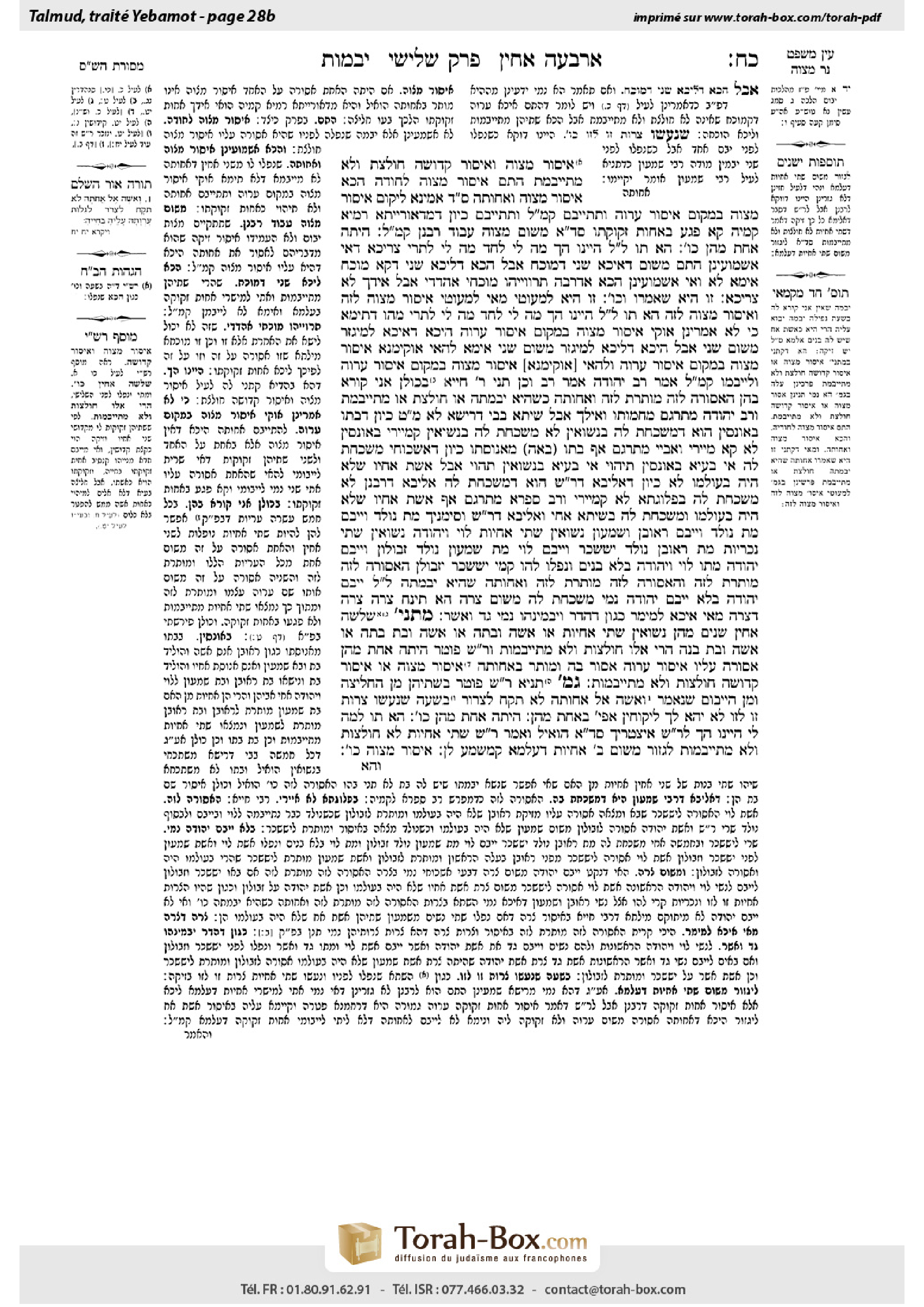
This page of Yevamot includes the Aramaic text, an English translation and an AI-generated French translation, alongside the scan above.
יבמות כ״ח ב · Aramaic and Hebrew text
אִיסּוּר מִצְוָה וְאִיסּוּר קְדוּשָּׁה — חוֹלֶצֶת וְלֹא מִתְיַיבֶּמֶת! הָתָם, אִיסּוּר מִצְוָה לְחוֹדַהּ, הָכָא, אִיסּוּר מִצְוָה, וַאֲחוֹתָהּ.
סָלְקָא דַּעְתָּךְ אָמֵינָא: לֵיקוּם אִיסּוּר מִצְוָה בִּמְקוֹם אִיסּוּר עֶרְוָה — וְתִתְיַיבֵּם, קָא מַשְׁמַע לַן.
וְתִתְיַיבֵּם? כֵּיוָן דְּמִדְּאוֹרָיְיתָא רַמְיָא קַמֵּיהּ, קָא פָגַע בַּאֲחוֹת זְקוּקָתוֹ. סָלְקָא דַּעְתָּךְ אָמֵינָא: מִשּׁוּם מִצְוָה עֲבוּד רַבָּנַן, קָא מַשְׁמַע לַן.
הָיְתָה אַחַת מֵהֶן כּוּ׳. הָא תּוּ לְמָה לִי, הַיְינוּ הָךְ: מָה לִי לְחַד מָה לִי לִתְרֵי?!
צְרִיכָא: דְּאִי אַשְׁמְועִינַן הָתָם, מִשּׁוּם דְּאִיכָּא שֵׁנִי דְּמוֹכַח, אֲבָל הָכָא, דְּלֵיכָּא שֵׁנִי דְּקָא מוֹכַח, אֵימָא לָא.
וְאִי אַשְׁמְועִינַן הָכָא: אַדְּרַבָּה, תַּרְוַויְיהוּ מוֹכְחִי אַהֲדָדֵי, אֲבָל אִידַּךְ — לָא, צְרִיכָא.
זוֹ הִיא שֶׁאָמְרוּ וְכוּ׳. ״זוֹ הִיא״ לְמַעוֹטֵי מַאי? לְמַעוֹטֵי אִיסּוּר מִצְוָה לָזֶה וְאִיסּוּר מִצְוָה לָזֶה.
הָא תּוּ לְמָה לִי, הַיְינוּ הָךְ: מָה לִי לְחַד, מָה לִי לִתְרֵי?!
מַהוּ דְּתֵימָא: כִּי לָא אָמְרִינַן אוֹקֵי אִיסּוּר מִצְוָה בִּמְקוֹם אִיסּוּר עֶרְוָה — הֵיכָא דְּאִיכָּא לְמִיגְזַר מִשּׁוּם שֵׁנִי, אֲבָל הֵיכָא דְּלֵיכָּא לְמִיגְזַר מִשּׁוּם שֵׁנִי, אֵימָא: לְהַאי אוֹקֵימְנָא אִיסּוּר מִצְוָה בִּמְקוֹם אִיסּוּר עֶרְוָה, וּלְהַאי [אוֹקֵימְנָא] אִיסּוּר מִצְוָה בִּמְקוֹם אִיסּוּר עֶרְוָה, וְלִיַּיבְּמוּ, קָא מַשְׁמַע לַן.
אָמַר רַב יְהוּדָה אָמַר רַב, וְכֵן תָּנֵי רַבִּי חִיָּיא: בְּכוּלָּן אֲנִי קוֹרֵא בָּהֶן, הָאֲסוּרָה לָזֶה מוּתֶּרֶת לָזֶה, וַאֲחוֹתָהּ כְּשֶׁהִיא יְבִמְתָּהּ — אוֹ חוֹלֶצֶת אוֹ מִתְיַיבֶּמֶת.
וְרַב יְהוּדָה מְתַרְגֵּם מֵחֲמוֹתוֹ וְאֵילָךְ, אֲבָל שִׁיתָּא בָּבֵי דְרֵישָׁא — לָא.
מַאי טַעְמָא — כֵּיוָן דְּבִתּוֹ בְּאוּנְסִין הוּא דְּמַשְׁכַּחַתְּ לַהּ, בְּנִשּׂוּאִין לָא מַשְׁכַּחַתְּ לַהּ.
בְּנִשּׂוּאִין קָמַיְירֵי, בְּאוּנְסִין לָא קָא מַיְירֵי.
וְאַבָּיֵי מְתַרְגֵּם אַף בִּתּוֹ (בָּאָה) מֵאֲנוּסָתוֹ, כֵּיוָן דְּאַשְׁכּוֹחֵי מַשְׁכַּחַתְּ לַהּ, אִי בָּעֲיָא — בְּאוּנְסִין תֶּיהְוֵי, אִי בָּעֲיָא — בְּנִשּׂוּאִין תִּהְוֵי. אֲבָל אֵשֶׁת אָחִיו שֶׁלֹּא הָיָה בְּעוֹלָמוֹ — לָא. כֵּיוָן דְּאַלִּיבָּא דְּרַבִּי שִׁמְעוֹן הוּא דְּמַשְׁכַּחַתְּ לַהּ, אַלִּיבָּא דְּרַבָּנַן לָא מַשְׁכַּחַתְּ לַהּ — בִּפְלוּגְתָּא לָא קָמַיְירֵי.
וְרַב סָפְרָא מְתַרְגֵּם אַף אֵשֶׁת אָחִיו שֶׁלֹּא הָיָה בְּעוֹלָמוֹ, וּמַשְׁכַּחַתְּ לַהּ בְּשִׁיתָּא אַחֵי וְאַלִּיבָּא דְּרַבִּי שִׁמְעוֹן. וְסִימָנָיךְ: מֵת נוֹלַד וְיִיבֵּם, מֵת נוֹלַד וְיִיבֵּם.
רְאוּבֵן וְשִׁמְעוֹן נְשׂוּאִין שְׁתֵּי אֲחָיוֹת, לֵוִי וִיהוּדָה נְשׂוּאִין שְׁתֵּי נׇכְרִיּוֹת. מֵת רְאוּבֵן, נוֹלַד יִשָּׂשכָר, וְיִיבֵּם לֵוִי. מֵת שִׁמְעוֹן, נוֹלַד זְבוּלֻן, וְיִיבֵּם יְהוּדָה. מֵתוּ לֵוִי וִיהוּדָה בְּלֹא בָּנִים, וְנָפְלוּ לְהוּ קַמֵּי יִשָּׂשכָר וּזְבוּלֻן.
הָאֲסוּרָה לָזֶה — מוּתֶּרֶת לָזֶה. וְהָאֲסוּרָה לָזֶה — מוּתֶּרֶת לָזֶה. וַאֲחוֹתָהּ שֶׁהִיא יְבִמְתָּהּ.
לְמָה לִי יִיבֵּם יְהוּדָה? בְּלָא יִיבֵּם יְהוּדָה נָמֵי מַשְׁכַּחַתְּ לַהּ!
מִשּׁוּם צָרָה. הָא תִּינַח צָרָה, צָרָה דְצָרָה מַאי אִיכָּא לְמֵימַר?
כְּגוֹן דַּהֲדַר וְיַבְּמִינְהוּ נָמֵי גָּד וְאָשֵׁר.
מַתְנִי׳ שְׁלֹשָׁה אַחִין, שְׁנַיִם מֵהֶן נְשׂוּאִין שְׁתֵּי אֲחָיוֹת, אוֹ אִשָּׁה וּבִתָּהּ, אוֹ אִשָּׁה וּבַת בִּתָּהּ, אוֹ אִשָּׁה וּבַת בְּנָהּ — הֲרֵי אֵלּוּ חוֹלְצוֹת וְלֹא מִתְיַיבְּמוֹת. וְרַבִּי שִׁמְעוֹן פּוֹטֵר.
הָיְתָה אַחַת מֵהֶן אֲסוּרָה עָלָיו אִיסּוּר עֶרְוָה — אָסוּר בָּהּ, וּמוּתָּר בַּאֲחוֹתָהּ. אִיסּוּר מִצְוָה אוֹ אִיסּוּר קְדוּשָּׁה — חוֹלְצוֹת וְלֹא מִתְיַיבְּמוֹת.
גְּמָ׳ תַּנְיָא: רַבִּי שִׁמְעוֹן פּוֹטֵר בִּשְׁתֵּיהֶן מִן הַחֲלִיצָה וּמִן הַיִּיבּוּם, שֶׁנֶּאֱמַר: ״וְאִשָּׁה אֶל אֲחוֹתָהּ לֹא תִקָּח לִצְרוֹר״. בְּשָׁעָה שֶׁנַּעֲשׂוּ צָרוֹת זוֹ לָזוֹ — לֹא יְהֵא לְךָ לִיקּוּחִין אֲפִילּוּ בְּאַחַת מֵהֶן.
הָיְתָה אַחַת מֵהֶן כּוּ׳. הָא תּוּ לְמָה לִי, הַיְינוּ הָךְ!
לְרַבִּי שִׁמְעוֹן אִיצְטְרִיךְ, סָלְקָא דַּעְתָּךְ אָמֵינָא: הוֹאִיל וְאָמַר רַבִּי שִׁמְעוֹן שְׁתֵּי אֲחָיוֹת לֹא חוֹלְצוֹת וְלֹא מִתְיַיבְּמוֹת, לִגְזוֹר מִשּׁוּם שְׁתֵּי אֲחָיוֹת דְּעָלְמָא, קָמַשְׁמַע לַן.
אִיסּוּר מִצְוָה כּוּ׳.
Yevamot 28b · English translation
If a prohibition resulting from a mitzva or a prohibition stemming from sanctity will be transgressed through the levirate marriage, then the woman must perform ḥalitza and she may not enter into levirate marriage. The Gemara answers: There is a novelty here: There, where the halakha is reviewed in general terms, it speaks of a prohibition due to a mitzva alone. One woman happened before the yavam for levirate marriage and it is only as a result of this prohibition that she is prevented from entering levirate marriage. Here, there is a prohibition resulting from a mitzva and, in addition, her sister happened before the yevamin for levirate marriage together with her.
It might enter your mind to say: Let the prohibition resulting from a mitzva stand in the same place, i.e., level of severity, as the prohibition against forbidden relatives. Consequently, the woman who is forbidden to the yavam is considered a forbidden relative and her sister is permitted to him. Despite the fact that the prohibition resulting from a mitzva is not as severe, here it is given equal status, and we might say: Let her sister enter into levirate marriage. Therefore, this comes to teach us that this is not the case.
The Gemara asks: And why in fact does her sister not enter into levirate marriage? The Gemara answers: Her sister is forbidden to him because by Torah law the prohibited woman is still set before the yavam for levirate marriage. Were he to take the sister in levirate marriage he would essentially be encountering the sister of the woman with whom he has a levirate bond. It might enter your mind to say that due to the mitzva of levirate marriage, the Sages did as they did and nullified their decree prohibiting the sister of a woman with whom the yavam has a levirate bond from entering levirate marriage, when the original sister is forbidden only as the result of a mitzva. Therefore, it teaches us that they did not cancel their decree in this situation.
It was taught in the mishna: If one of those women was forbidden to this one brother due to a prohibition against forbidden relatives and the second was forbidden to that second brother due to a prohibition against forbidden relatives, then she who is forbidden to this brother is permitted to that brother, and she who is forbidden to that brother is permitted to this one. The Gemara asks: Why do I need this halakha as well, for this is identical to that which was taught earlier, when the mishna stated that if one of the sisters was forbidden to one of the brothers due to a prohibition against forbidden relatives, then he is forbidden to marry her but permitted to marry her sister. However, the second brother, who is not a close relative of either sister, is prohibited from marrying both of them. Once the mishna taught that the yavam is permitted to marry the woman to whom he is not related, what is the difference to me if there is one brother or two brothers? If this happened to both brothers, clearly both should be allowed.
The Gemara answers: It is necessary to state this, for if it taught us the halakha only there, in the case where only one brother is permitted, one might have said: This is because there is a second brother who indicates that the sister of a woman bound by a levirate bond is forbidden to him by refraining from levirate marriage with her. However, here, where there is not a second brother who indicates this, as both brothers are performing levirate marriage, then I would say no; this halakha would not apply, due to the concern that people might wrongly conclude that the sister of a woman with whom the yavam has a levirate bond is permitted even in cases where the other woman is not a forbidden relative.
And the opposite could also be said: If it taught us the ruling only here, in the case of two brothers, one might have said: On the contrary, they both indicate the nature of each other’s status. Each of the brothers married a specific sister-in-law, i.e., the woman who was not his close relative, indicating he does not have a levirate bond with the other sister. But in the other case, where one brother is allowed to consummate the levirate marriage and the second brother is forbidden to both sisters, I might say that no, we would not allow marriage to the first brother either. Therefore, it is necessary to state the halakha in both instances.
It was taught in the mishna: And this is the case that was referred to when they said: When her sister is also her yevama, she either performs ḥalitza or enters into levirate marriage. The Gemara asks: What does the expression: This is, come to exclude? The Gemara answers: It excludes the case where there is a prohibition resulting from a mitzva for this one and a prohibition resulting from a mitzva for that one. Although each woman is forbidden to a different brother due to a prohibition resulting from a mitzva, they may not both enter into levirate marriage.
The Gemara asks: Why do I need this as well? This is identical to that which was taught previously, that if one of the sisters was forbidden to the yavam due to a prohibition resulting from a mitzva, then he is not permitted to consummate the levirate marriage with either of them. What difference is there to me if she happened before one brother or two?
The Gemara answers: Lest you say: There is only one instance when we do not say: Let the prohibition resulting from a mitzva stand in the same place, i.e., level of severity, as a prohibition against forbidden relatives. It occurs in a case where it is appropriate to issue a rabbinic decree due to the second brother, who is prohibited from marrying both sisters. But in a case where it is not appropriate to issue a rabbinic decree due to the second brother, as the second sister is permitted to the second brother as well, I might say: For this brother, let us stand the prohibition resulting from a mitzva in the same place as a prohibition against forbidden relatives, and for this brother let us stand the prohibition resulting from a mitzva in the same place as a prohibition against forbidden relatives, and as a result both brothers may consummate the levirate marriage. Therefore, it teaches us that this is not so.
§ Incidental to this halakha, the Gemara cites the following statement: Rav Yehuda said that Rav said, and similarly Rabbi Ḥiyya teaches in a baraita: With regard to all of those women enumerated in the first mishna of the tractate, who are forbidden to the yevamin as forbidden relatives, the following situation could arise: These women could also be two sisters who were married to two brothers who happen before their yevamin for levirate marriage while each one is a forbidden relative to one of the yevamin. In these situations, I could apply the ruling that she who is forbidden to this brother is permitted to that brother, as well as the ruling that when her sister is also her yevama she may either perform ḥalitza or enter into levirate marriage.
But Rav Yehuda interprets these principles as applying only to those cases found in the list from the mother-in-law of the yavam and onward, but not to the six cases at the beginning, which include his daughter, and his wife’s daughter, and their descendants.
What is the reason for Rav Yehuda’s distinction? This is because you find the scenario where two women who are candidates for levirate marriage are both sisters as well as the daughters of the two yevamin only in a case where the women are the daughters of the yevamin through rape, but you cannot find it in a case where they are his daughters through marriage. If one brother married a woman and had a daughter with her, then this woman, the wife of a brother who has children, is forbidden to all of his brothers. Therefore, it would be impossible for another brother to have a daughter with that same woman, and therefore the two daughters could never be sisters. The scenario of daughters who are also sisters is possible only when the first brother raped a woman and gave birth to a daughter, such that the woman is not forbidden to his brothers. If one of the brothers then had a daughter with this woman and both daughters married other brothers who then died, it is possible that these daughters would happen before their fathers for levirate marriage.
Rav Yehuda maintains that the current mishna deals with cases of marriage but does not deal with cases of rape, and therefore he does not apply the principles governing sisters to those cases.
And Abaye interprets these principles as applying even to his daughter from a woman he raped. Since you can find this scenario, if the statement wants to deal with cases of rape, let it; if it wants to deal with cases of marriage, let it. It is preferable to explain this matter with regard to cases of marriage, but if that is not possible, it can still be explained as dealing with cases of rape. However, it cannot be explained as referring to the wife of a brother with whom he did not coexist. Even according to the opinion of Abaye, this case cannot be included, since you can find a situation where two sisters happen before two brothers for levirate marriage while each woman is the wife of a brother with whom he did not coexist only according to the opinion of Rabbi Shimon, while such a case cannot be found according to the opinion of the Rabbis. And Rabbi Ḥiyya does not deal with cases that are subject to dispute.
And Rav Safra interprets these principles as applying to the wife of a brother with whom he did not coexist, and you can find this scenario in the case of the six brothers and according to the opinion of Rabbi Shimon. And your mnemonic to remember how this might come about is as follows: Died, born, consummated the levirate marriage; died, born, consummated the levirate marriage.
How could this come about? There were two brothers, Reuven and Shimon, who were married to two sisters. And there were two other brothers, Levi and Yehuda, who were married to two unrelated women. Reuven died, Yissakhar was born, and Levi consummated the levirate marriage with Reuven’s wife. Afterward, Shimon died, Zevulun was born, and Yehuda consummated the levirate marriage with Shimon’s wife. Later, Levi and Yehuda died childless and these two sisters happened before Yissakhar and Zevulun for levirate marriage.
In this scenario, the woman who had been Reuven’s wife is forbidden to this brother, Yissakhar, as the wife of a brother with whom he did not coexist, because he was not alive at the same time as Reuven, and yet she is nevertheless permitted to this brother, Zevulun, because when Zevulun was born this woman was already the wife of Levi, a brother with whom he did coexist. According to Rabbi Shimon, the fact that she had previously been the wife of Reuven, a brother with whom he did not coexist, is not taken into account. Similarly, with regard to Shimon’s wife, we find that she who is forbidden to this one is permitted to that one. Shimon’s wife is forbidden to Zevulun as the wife of a brother with whom he did not coexist, but she is nevertheless permitted to Yissakhar. Accordingly, the situation of her sister who is her yevama, i.e., two sisters who are yevamot and yet are allowed to perform levirate marriage, can be applied to this case as well.
The Gemara asks: Why do I need to assume that this is referring to a scenario where Yehuda consummated the levirate marriage? You can find this possibility in a case where Yehuda did not consummate the levirate marriage as well. This scenario can also take place with only five brothers and without Yehuda: Reuven and Shimon were married to two sisters, Reuven died, Yissakhar was born, and Levi consummated the levirate marriage with Reuven’s wife. Then Shimon died and Zevulun was born. If Levi then dies, Levi’s wife is forbidden to Yissakhar as the wife of his brother Reuven, with whom he did not coexist, but she would be permitted to Zevulun because she was already the wife of Levi when Zevulun was born. Shimon’s wife would be forbidden to Zevulun but permitted to Yissakhar.
The Gemara responds: This is due to the rival wife. It was taught in this way in order to make the principle applicable not only to the wives, but also to their rival wives. In this scenario, Levi and Yehuda were previously married to two sisters who then became the rival wives of a wife of a brother with whom one did not coexist. This allows the ruling to apply to the case of rival wives as well. The Gemara notes: This works out well if the mishna comes to include only a rival wife herself, but what can be said about the rival wife of a rival wife? How can this case explained? If one aims to include all of the details of the mishna in Rabbi Ḥiyya’s principle, then the mishna must be referring not only to a case involving the brothers’ rival wives, but also to the rival wives of those rival wives mentioned in the mishna.
The Gemara answers: Therefore, one must include a case where Gad and Asher subsequently consummated the levirate marriage with these women as well. That is, initially there were two other brothers, Gad and Asher, who consummated the levirate marriage with the previous wives of Levi and Yehuda, each of whom had taken one of the wives of Reuven and Shimon. Later, when Gad and Asher died, their previous wives, who are the rival wives of the rival wives of Reuven and Shimon’s wives, happen before Yissakhar and Zevulun for levirate marriage.
MISHNA: In the case of three brothers, two of whom were married to close relatives, e.g., two sisters; or a woman and her daughter; or a woman and her daughter’s daughter; or a woman and her son’s daughter, if the two brothers who were married to two close relatives died and their wives happened before a third brother for levirate marriage, then these two women must perform ḥalitza and may not enter into levirate marriage, as each of them is a relative of a woman with whom he has a levirate bond. And Rabbi Shimon exempts them even from the obligation to perform ḥalitza.
If one of them was forbidden to him, the third brother, due to a prohibition against forbidden relatives, then he is prohibited from marrying her but is permitted to marry her sister. Because the woman who is forbidden to him is not considered to be a woman who requires him for levirate marriage, there is only one woman who happens before him for levirate marriage. However, if one of the women was forbidden due to a prohibition resulting from a mitzva or a prohibition stemming from sanctity, then they must perform ḥalitza and may not enter into levirate marriage. This is because these prohibitions do not completely cancel the levirate bond.
GEMARA: It is taught in a baraita: Rabbi Shimon exempts both of them from ḥalitza and from levirate marriage, as it is stated: “And you shall not take a woman to her sister, to be a rival to her” (Leviticus 18:18). This indicates that at the time that a situation arises wherein they are to become rival wives to each other, e.g., two sisters happen before one yavam for levirate marriage, you shall not have the ability to take even one of them in marriage. In his opinion, both women are exempt from both levirate marriage and ḥalitza at the moment that they happen before the yavam, just as a forbidden relative is exempt from both levirate marriage and ḥalitza.
It was taught in the mishna: If one of them was forbidden to him due to a prohibition against forbidden relatives, he is prohibited from marrying her but is permitted to marry her sister. The Gemara asks: Why do I need this statement as well? This is identical to that which was taught in the previous mishna.
The Gemara answers: It was necessary to state this again here according to the opinion of Rabbi Shimon. It might enter your mind to say: Since Rabbi Shimon said that two sisters may not perform ḥalitza and may not enter into levirate marriage, as the very fact that they require levirate marriage from the same man and stand to become rival wives to each other renders them forbidden, we should issue a rabbinic decree in this case as well. Although in this case only one of the sisters is eligible for levirate marriage, as the other is a forbidden relative, perhaps there should be a rabbinic decree prohibiting the yavam from marrying the permitted sister, due to the similarity to the case of two sisters in general who happen before him for levirate marriage. This teaches us that even Rabbi Shimon does not hold that there is a rabbinic decree in this case.
It was taught in the mishna that if the wives are forbidden to the yavam due to a prohibition resulting from a mitzva or sanctity, they must perform ḥalitza and may not enter into levirate marriage.
Yevamot 28b · Traduction française (IA)
Si le mariage léviratique entraîne la transgression d’une interdiction résultant d’une mitsva ou d’une interdiction liée à la sainteté, la femme doit accomplir la ḥalitsa et ne peut pas contracter de mariage léviratique. La Guemara répond : Il y a ici une nouveauté. Là, où la halakha est enseignée de manière générale, il n’est question que d’une interdiction résultant d’une mitsva : une seule femme s’est présentée au yavam pour le mariage léviratique, et seule cette interdiction l’empêche de contracter ce mariage. Ici, il y a une interdiction résultant d’une mitsva et, en outre, sa sœur s’est présentée avec elle devant les yevamin pour le mariage léviratique.
On pourrait penser que l’interdiction résultant d’une mitsva est à mettre sur le même plan que l’interdiction relative aux proches parentes. Par conséquent, la femme interdite au yavam est considérée comme une proche parente, et sa sœur lui est permise. Bien que l’interdiction résultant d’une mitsva soit moins sévère, elle reçoit ici le même statut, et l’on pourrait dire : que sa sœur contracte le mariage léviratique. C’est pourquoi ce passage vient nous enseigner qu’il n’en est pas ainsi.
La Guemara demande : Et pourquoi, en réalité, sa sœur ne contracte-t-elle pas le mariage léviratique ? La Guemara répond : Sa sœur lui est interdite, car, selon la Torah, la femme interdite reste soumise au lien léviratique avec le yavam. S’il prenait sa sœur en mariage léviratique, il prendrait donc la sœur de la femme avec laquelle il est lié par un lien léviratique. On pourrait penser qu’en raison de la mitsva du mariage léviratique, les Sages ont annulé leur décret interdisant à la sœur d’une femme liée au yavam par un lien léviratique de contracter un mariage léviratique, lorsque l’interdiction frappant la sœur initiale ne résulte que d’une mitsva. Ce passage vient donc nous enseigner qu’ils n’ont pas annulé leur décret dans cette situation.
La Michna enseigne : Si l’une de ces femmes était interdite à un frère en raison d’une interdiction relative aux proches parentes, et la seconde à un autre frère pour la même raison, celle qui est interdite à ce frère est permise à l’autre frère, et celle qui est interdite à cet autre frère est permise au premier. La Guemara demande : Pourquoi cette halakha est-elle également nécessaire, puisqu’elle est identique à ce qui a été enseigné précédemment, lorsque la Michna a indiqué que si l’une des sœurs était interdite à l’un des frères en raison d’une interdiction relative aux proches parentes, celui-ci ne pouvait pas l’épouser, mais pouvait épouser sa sœur ? Quant au second frère, qui n’est proche parent d’aucune des deux sœurs, il lui est interdit de les épouser toutes les deux. Dès lors que la Michna a enseigné que le yavam peut épouser la femme qui n’est pas sa parente, quelle différence cela fait-il qu’il y ait un frère ou deux frères ? Si cette situation se présente aux deux frères, il est évident que tous deux devraient y être autorisés.
La Guemara répond : Il est nécessaire de l’enseigner, car si la halakha n’avait été enseignée que dans le cas précédent, où un seul frère est autorisé, on aurait pu dire que c’est parce qu’il y a un second frère, qui indique par son abstention de contracter le mariage léviratique avec elle que la sœur d’une femme liée au yavam par un lien léviratique lui est interdite. Mais ici, en l’absence d’un second frère qui indique cela, puisque les deux frères contractent un mariage léviratique, on aurait pu dire que cette halakha ne s’applique pas, par crainte que les gens n’en concluent à tort que la sœur d’une femme liée au yavam par un lien léviratique est permise même lorsque l’autre femme n’est pas une proche parente.
On pourrait aussi dire le contraire : si la règle n’avait été enseignée qu’ici, dans le cas de deux frères, on aurait pu dire qu’au contraire, ils indiquent chacun le statut de l’autre. Chacun des frères a épousé une belle-sœur en particulier, c’est-à-dire la femme qui n’était pas sa proche parente, indiquant ainsi qu’il n’a pas de lien léviratique avec l’autre sœur. Mais dans l’autre cas, où un frère est autorisé à consommer le mariage léviratique et où le second frère ne peut épouser aucune des deux sœurs, on aurait pu dire que le premier frère ne serait pas non plus autorisé à l’épouser. C’est pourquoi il est nécessaire d’enseigner la halakha dans les deux cas.
La Michna enseigne : Et c’est le cas auquel ils faisaient référence lorsqu’ils disaient : Lorsque sa sœur est aussi sa yevama, elle accomplit soit la ḥalitsa, soit contracte un mariage léviratique. La Guemara demande : Qu’exclut l’expression « c’est le cas » ? La Guemara répond : Elle exclut le cas où l’une est concernée par une interdiction résultant d’une mitsva et l’autre par une interdiction résultant d’une mitsva. Bien que chacune des femmes soit interdite à un frère différent en raison d’une interdiction résultant d’une mitsva, elles ne peuvent pas toutes deux contracter un mariage léviratique.
La Guemara demande : Pourquoi cela est-il également nécessaire ? C’est identique à ce qui a été enseigné précédemment : si l’une des sœurs était interdite au yavam en raison d’une interdiction résultant d’une mitsva, il ne pouvait contracter de mariage léviratique avec aucune des deux. Quelle différence cela fait-il qu’elles se soient présentées devant un seul frère ou devant deux frères ?
La Guemara répond : De peur que tu ne dises qu’il n’existe qu’un seul cas où l’on ne dit pas : « Mettons l’interdiction résultant d’une mitsva sur le même plan que l’interdiction relative aux proches parentes. » C’est le cas où il convient d’édicter un décret rabbinique à cause du second frère, auquel il est interdit d’épouser les deux sœurs. Mais dans un cas où il ne convient pas d’édicter un décret rabbinique à cause du second frère, puisque la seconde sœur lui est également permise, on aurait pu dire : Pour ce frère, mettons l’interdiction résultant d’une mitsva sur le même plan que l’interdiction relative aux proches parentes, et pour cet autre frère, mettons l’interdiction résultant d’une mitsva sur le même plan que l’interdiction relative aux proches parentes, de sorte que les deux frères puissent consommer le mariage léviratique. Ce passage vient donc nous enseigner qu’il n’en est pas ainsi.
§ À propos de cette halakha, la Guemara cite la déclaration suivante : Rav Yehouda a dit au nom de Rav, et Rabbi Ḥiyya enseigne de même dans une baraïta : Pour toutes ces femmes énumérées dans la première Michna du traité, qui sont interdites aux yevamin en tant que proches parentes, le cas suivant peut se présenter : elles peuvent aussi être deux sœurs mariées à deux frères qui se présentent devant leurs yevamin pour le mariage léviratique, alors que chacune est une proche parente de l’un des yevamin. Dans ces situations, on peut appliquer la règle selon laquelle celle qui est interdite à ce frère est permise à l’autre frère, ainsi que la règle selon laquelle, lorsque sa sœur est aussi sa yevama, elle peut soit accomplir la ḥalitsa, soit contracter un mariage léviratique.
Mais Rav Yehouda interprète ces principes comme ne s’appliquant qu’aux cas de la liste à partir de la belle-mère du yavam, et non aux six cas du début, qui comprennent sa fille, la fille de sa femme et leurs descendantes.
Quelle est la raison de la distinction établie par Rav Yehouda ? C’est qu’on ne trouve le cas de deux femmes candidates au mariage léviratique qui sont à la fois sœurs et filles des deux yevamin que lorsque les femmes sont les filles des yevamin issues d’un viol ; ce cas est impossible si elles sont leurs filles issues d’un mariage. Si un frère a épousé une femme et a eu une fille avec elle, cette femme, épouse d’un frère qui a des enfants, est interdite à tous ses frères. Il serait donc impossible qu’un autre frère ait une fille avec cette même femme ; les deux filles ne pourraient donc jamais être sœurs. Le cas de filles qui sont aussi sœurs n’est possible que si le premier frère a violé une femme et a eu une fille d’elle, de sorte que cette femme n’est pas interdite à ses frères. Si l’un des frères a ensuite eu une fille avec cette femme, et que les deux filles ont épousé d’autres frères qui sont morts par la suite, il est possible que ces filles se présentent devant leurs pères pour le mariage léviratique.
Rav Yehouda estime que la Michna actuelle traite de cas de mariage, mais pas de cas de viol ; il n’applique donc pas à ces cas les principes régissant les sœurs.
Abayé interprète ces principes comme s’appliquant même à la fille d’un homme issue d’une femme qu’il a violée. Puisque ce cas peut se présenter, si la déclaration entend traiter des cas de viol, qu’elle les traite ; si elle entend traiter des cas de mariage, qu’elle les traite. Il est préférable d’expliquer cette règle à propos des cas de mariage, mais si cela est impossible, elle peut tout de même s’expliquer à propos des cas de viol. En revanche, on ne peut pas l’expliquer au sujet de l’épouse d’un frère avec lequel il n’a pas coexisté. Même selon l’opinion d’Abayé, ce cas ne peut pas être inclus, puisque le cas de deux sœurs qui se présentent devant deux frères pour le mariage léviratique, chacune étant l’épouse d’un frère avec lequel l’un d’eux n’a pas coexisté, ne se trouve que selon l’opinion de Rabbi Shimon ; on ne le trouve pas selon l’opinion des Rabbins. Et Rabbi Ḥiyya ne traite pas des cas faisant l’objet d’une controverse.
Rav Safra interprète ces principes comme s’appliquant à l’épouse d’un frère avec lequel il n’a pas coexisté, et ce cas se trouve parmi les six frères, selon l’opinion de Rabbi Shimon. Voici le moyen mnémotechnique pour se rappeler comment cela peut se produire : il mourut, un frère naquit, le mariage léviratique fut consommé ; il mourut, un frère naquit, le mariage léviratique fut consommé.
Comment cela peut-il se produire ? Il y avait deux frères, Reouven et Shimon, mariés à deux sœurs. Il y avait aussi deux autres frères, Lévi et Yehouda, mariés à deux femmes sans lien de parenté. Reouven mourut, Issakhar naquit, et Lévi consomma le mariage léviratique avec l’épouse de Reouven. Ensuite, Shimon mourut, Zevouloun naquit, et Yehouda consomma le mariage léviratique avec l’épouse de Shimon. Plus tard, Lévi et Yehouda moururent sans enfant, et ces deux sœurs se présentèrent devant Issakhar et Zevouloun pour le mariage léviratique.
Dans ce cas, la femme qui avait été l’épouse de Reouven est interdite à Issakhar en tant qu’épouse d’un frère avec lequel il n’a pas coexisté, puisqu’il n’était pas en vie en même temps que Reouven. Elle est pourtant permise à Zevouloun, car, lorsque celui-ci est né, cette femme était déjà l’épouse de Lévi, un frère avec lequel il a coexisté. Selon Rabbi Shimon, on ne tient pas compte du fait qu’elle avait auparavant été l’épouse de Reouven, un frère avec lequel il n’a pas coexisté. De même, à propos de l’épouse de Shimon, nous trouvons que celle qui est interdite à l’un est permise à l’autre. L’épouse de Shimon est interdite à Zevouloun en tant qu’épouse d’un frère avec lequel il n’a pas coexisté, mais elle est néanmoins permise à Issakhar. Ainsi, le cas de sa sœur qui est sa yevama — c’est-à-dire de deux sœurs qui sont des yevamot et sont pourtant autorisées à contracter un mariage léviratique — s’applique également ici.
La Guemara demande : Pourquoi faut-il supposer qu’il s’agit d’un cas où Yehouda a consommé le mariage léviratique ? Cette possibilité existe aussi dans un cas où Yehouda ne l’a pas consommé. Ce scénario peut également se produire avec seulement cinq frères, sans Yehouda : Reouven et Shimon étaient mariés à deux sœurs ; Reouven mourut, Issakhar naquit et Lévi consomma le mariage léviratique avec l’épouse de Reouven. Puis Shimon mourut et Zevouloun naquit. Si Lévi meurt alors, l’épouse de Lévi est interdite à Issakhar en tant qu’épouse de son frère Reouven, avec lequel il n’a pas coexisté, mais elle serait permise à Zevouloun, car elle était déjà l’épouse de Lévi lorsque Zevouloun est né. L’épouse de Shimon serait interdite à Zevouloun, mais permise à Issakhar.
La Guemara répond : C’est à cause de la coépouse. Le cas a été enseigné de cette manière afin que le principe s’applique non seulement aux épouses, mais aussi à leurs coépouses. Dans ce scénario, Lévi et Yehouda avaient auparavant épousé deux sœurs, qui devinrent ensuite les coépouses d’une épouse d’un frère avec lequel l’un d’eux n’avait pas coexisté. Cela permet d’appliquer également la règle au cas des coépouses. La Guemara remarque : Cela convient si la Michna entend inclure la coépouse elle-même ; mais que dire de la coépouse d’une coépouse ? Comment expliquer ce cas ? Si l’on veut inclure tous les détails de la Michna dans le principe de Rabbi Ḥiyya, la Michna doit viser non seulement le cas des coépouses des frères, mais aussi celui des coépouses de ces coépouses mentionnées dans la Michna.
La Guemara répond : Il faut donc aussi inclure le cas où Gad et Asher ont ensuite consommé le mariage léviratique avec ces femmes. Autrement dit, au départ, deux autres frères, Gad et Asher, avaient consommé le mariage léviratique avec les anciennes épouses de Lévi et de Yehouda, qui avaient chacun pris l’une des épouses de Reouven et de Shimon. Plus tard, lorsque Gad et Asher moururent, leurs anciennes épouses — qui sont les coépouses des coépouses des épouses de Reouven et de Shimon — se présentèrent devant Issakhar et Zevouloun pour le mariage léviratique.
MICHNA : Dans le cas de trois frères, dont deux étaient mariés à des proches parentes, par exemple deux sœurs, ou une femme et sa fille, ou une femme et la fille de sa fille, ou une femme et la fille de son fils, si les deux frères mariés à ces deux proches parentes moururent et que leurs épouses se présentèrent devant le troisième frère pour le mariage léviratique, ces deux femmes doivent accomplir la ḥalitsa et ne peuvent pas contracter de mariage léviratique, car chacune d’elles est une parente de la femme avec laquelle il est lié par un lien léviratique. Rabbi Shimon les dispense même de l’obligation d’accomplir la ḥalitsa.
Si l’une d’elles lui était interdite, à lui, le troisième frère, en raison d’une interdiction relative aux proches parentes, il lui est interdit de l’épouser, mais il peut épouser sa sœur. La femme qui lui est interdite n’étant pas considérée comme une femme qui requiert de lui un mariage léviratique, une seule femme se présente devant lui pour le mariage léviratique. Toutefois, si l’une des femmes était interdite en raison d’une interdiction résultant d’une mitsva ou d’une interdiction liée à la sainteté, elles doivent accomplir la ḥalitsa et ne peuvent pas contracter de mariage léviratique. En effet, ces interdictions n’annulent pas complètement le lien léviratique.
GUEMARA : Il est enseigné dans une baraïta : Rabbi Shimon les dispense toutes deux de la ḥalitsa et du mariage léviratique, comme il est dit : « Tu ne prendras pas une femme avec sa sœur, pour en faire une rivale » (Lévitique 18,18). Cela indique qu’au moment où survient une situation dans laquelle elles pourraient devenir des coépouses l’une de l’autre — par exemple, lorsque deux sœurs se présentent devant un même yavam pour le mariage léviratique — il n’est permis d’en épouser aucune. Selon lui, dès qu’elles se présentent devant le yavam, les deux femmes sont dispensées à la fois du mariage léviratique et de la ḥalitsa, tout comme une proche parente est dispensée des deux.
La Michna enseigne : Si l’une d’elles lui était interdite en raison d’une interdiction relative aux proches parentes, il lui est interdit de l’épouser, mais il peut épouser sa sœur. La Guemara demande : Pourquoi cette déclaration est-elle également nécessaire ? Elle est identique à ce qui a été enseigné dans la Michna précédente.
La Guemara répond : Il était nécessaire de le répéter ici selon l’opinion de Rabbi Shimon. On aurait pu penser que, puisque Rabbi Shimon a dit que deux sœurs ne peuvent ni accomplir la ḥalitsa ni contracter un mariage léviratique, car le fait même qu’elles requièrent toutes deux un mariage léviratique du même homme et qu’elles soient susceptibles de devenir des coépouses l’une de l’autre les rend interdites, il faudrait également édicter un décret rabbinique dans ce cas. Bien qu’ici une seule des sœurs soit candidate au mariage léviratique, puisque l’autre est une proche parente, on pourrait peut-être interdire au yavam d’épouser la sœur permise, par analogie avec le cas général de deux sœurs qui se présentent devant lui pour le mariage léviratique. Cela nous enseigne que même Rabbi Shimon ne soutient pas qu’un décret rabbinique s’applique dans ce cas.
La Michna enseigne que si les épouses sont interdites au yavam en raison d’une interdiction résultant d’une mitsva ou d’une interdiction liée à la sainteté, elles doivent accomplir la ḥalitsa et ne peuvent pas contracter de mariage léviratique.
Traduction française générée par IA à partir de l’édition anglaise de Sefaria. Vérifie toujours un passage avec le texte source.
Text from Sefaria: William Davidson Edition - Vocalized Aramaic (CC BY NC); William Davidson Edition - English (CC BY NC).