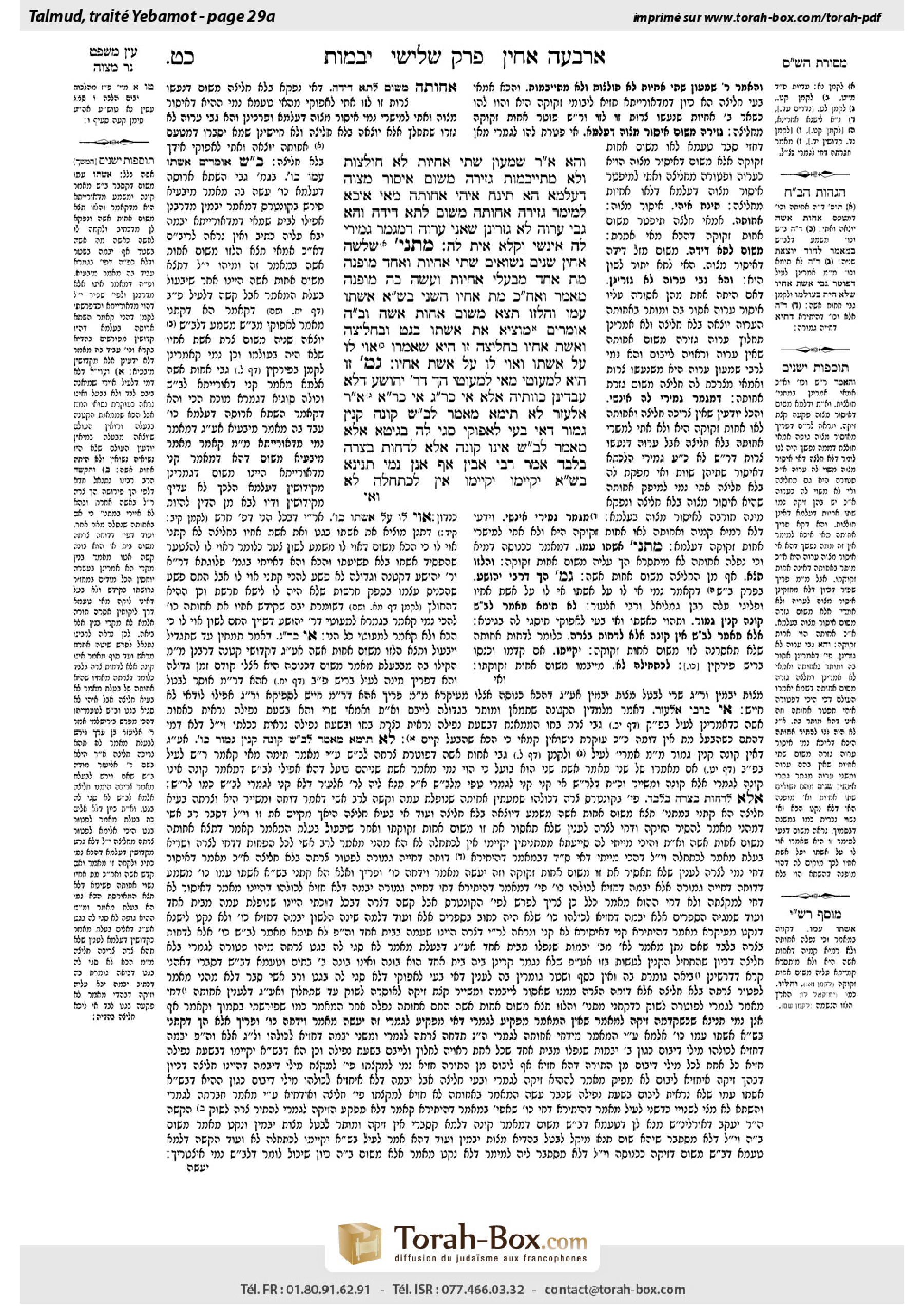
Yevamot 29a: Talmud study for Daf Yomi
Daf Yomi is the daily study of one Talmud folio. Explore 37 tractates with scans, Hebrew text, Sefaria English and AI-generated French translations where annotated.
Passage selection and English or AI-generated French translation are available where the scan has annotations. Daf Study is independent of Torah-Box and Sefaria.
Browse Yevamot · יבמות · All tractatesYevamot 29a text and translations
This page of Yevamot includes the Aramaic text, an English translation and an AI-generated French translation, alongside the scan above.
יבמות כ״ט א · Aramaic and Hebrew text
וְהָא אָמַר רַבִּי שִׁמְעוֹן: שְׁתֵּי אֲחָיוֹת לֹא חוֹלְצוֹת וְלֹא מִתְיַיבְּמוֹת!
גְּזֵירָה מִשּׁוּם אִיסּוּר מִצְוָה דְּעָלְמָא.
הָא תִּינַח אִיהִי, אֲחוֹתָהּ מַאי אִיכָּא לְמֵימַר? גְּזֵירָה אֲחוֹתָהּ מִשּׁוּם לַתָּא דִּידַהּ.
וְהָא גַּבֵּי עֶרְוָה לָא גָּזְרִינַן? שָׁאנֵי עֶרְוָה דְּמִגְמָר גְּמִירִי לַהּ אִינָשֵׁי, וְקָלָא אִית לַהּ.
מַתְנִי׳ שְׁלֹשָׁה אַחִין, שְׁנַיִם נְשׂוּאִים שְׁתֵּי אֲחָיוֹת וְאֶחָד מוּפְנֶה. מֵת אֶחָד מִבַּעֲלֵי אֲחָיוֹת, וְעָשָׂה בָּהּ מוּפְנֶה מַאֲמָר. וְאַחַר כָּךְ מֵת אָחִיו הַשֵּׁנִי —
בֵּית שַׁמַּאי אוֹמְרִים: אִשְׁתּוֹ עִמּוֹ, וְהַלֵּזוּ תֵּצֵא מִשּׁוּם אֲחוֹת אִשָּׁה. וּבֵית הִלֵּל אוֹמְרִים: מוֹצִיא אֶת אִשְׁתּוֹ בְּגֵט וּבַחֲלִיצָה, וְאֵשֶׁת אָחִיו בַּחֲלִיצָה. זוֹ הִיא שֶׁאָמְרוּ: אוֹי לוֹ עַל אִשְׁתּוֹ, וְאוֹי לוֹ עַל אֵשֶׁת אָחִיו.
גְּמָ׳ ״זוֹ הִיא״ לְמַעוֹטֵי מַאי? לְמַעוֹטֵי הָךְ דְּרַבִּי יְהוֹשֻׁעַ, דְּלָא עָבְדִינַן כְּווֹתֵיהּ. אֶלָּא אִי כְּרַבָּן גַּמְלִיאֵל, אִי כְּרַבִּי אֶלְעָזָר.
אָמַר רַבִּי אֶלְעָזָר: לָא תֵּימָא מַאֲמָר לְבֵית שַׁמַּאי קוֹנֶה קִנְיָן גָּמוּר, דְּאִי בָּעֵי לְאַפּוֹקֵי סַגִּי לַהּ בְּגִיטָּא, אֶלָּא מַאֲמָר לְבֵית שַׁמַּאי אֵינוֹ קוֹנֶה אֶלָּא לִדְחוֹת בַּצָּרָה בִּלְבָד.
אָמַר רַבִּי אָבִין: אַף אֲנַן נָמֵי תְּנֵינָא, בֵּית שַׁמַּאי אוֹמְרִים: יְקַיְּימוּ. יְקַיְּימוּ אִין — לְכַתְּחִלָּה לָא.
Yevamot 29a · English translation
This halakha was also taught in the previous mishna (26a), and it is cited in this mishna according to the opinion of Rabbi Shimon. The Gemara asks: But didn’t Rabbi Shimon say: Two sisters neither perform ḥalitza nor enter into levirate marriage? Because these women are eligible for levirate marriage according to Torah law, they are considered the sisters of a woman with whom he has a levirate bond. In this case, Rabbi Shimon exempts them from both ḥalitza and levirate marriage. Why, then, does the mishna require them to perform ḥalitza?
The Gemara answers: It is a rabbinic decree due to the general case of a prohibition resulting from a mitzva. If they did not perform ḥalitza in this case, where they are sisters, there is a concern that people would assume that their exemption from ḥalitza stemmed not from their status as sisters but rather due to the prohibition. This would lead to the mistaken conclusion that women who are forbidden due to a mitzva do not require ḥalitza. Therefore, the Sages issued a rabbinic decree requiring ḥalitza in this case.
The Gemara asks: This works out well for her, as she is forbidden due to the prohibition resulting from a mitzva. It is appropriate to require ḥalitza with her, to demonstrate that ḥalitza is generally applied in cases where there is a prohibition resulting from a mitzva. But with regard to her sister, what is there to say? Why must she perform ḥalitza as well? The Gemara answers: There is a rabbinic decree with regard to her sister due to her.
The Gemara asks: If Rabbi Shimon issues a decree in this case requiring ḥalitza for the sister, out of concern for confusion, then there is a difficulty: But, with regard to a forbidden relative we do not issue a decree requiring ḥalitza due to her sister; why does Rabbi Shimon issue a rabbinic decree requiring ḥalitza with a woman forbidden due to a prohibition resulting from a mitzva and not with a woman who is a forbidden relative? The Gemara answers: Forbidden relatives are different, as people learn the halakhot pertaining to them because they are stated explicitly in the Torah and are well known to all, and the ruling has publicity. Therefore, there is no concern lest people mistakenly confuse this case with cases of yevamot who are not sisters. Prohibitions resulting from mitzvot are not, however, explicit in the Torah, nor are they generally known.
MISHNA: In the case of three brothers, two of whom were married to two sisters, and one who was single, the following occurred: The husband of one of the sisters died childless, leaving behind his wife, and the single brother performed levirate betrothal [ma’amar] to this wife. The single brother performed an act of betrothal to the yevama but did not yet consummate the marriage by engaging in sexual intercourse. Afterward, the second brother died, and therefore the second brother’s wife, the sister of the betrothed, happened before the single brother for levirate marriage as well.
In this case, Beit Shammai say: His wife remains with him. The woman he betrothed is considered like his wife, and he is not required to divorce her. And this other woman leaves the yavam and is exempt from levirate marriage as the sister of a wife. Beit Hillel say: Being as he had not yet entered into marriage with the first woman, he is required to perform levirate marriage with both women. Therefore, he divorces his wife, i.e., the woman to whom he performed levirate betrothal, with a bill of divorce, which nullifies levirate betrothal, and by ḥalitza, which nullifies the levirate bond. And, he sends away the wife of his second brother with ḥalitza as well. They comment: This is the case that was referred to when the Sages said: Woe unto him for his wife and woe unto him for the wife of his brother. Due to the combination of circumstances, he loses them both.
GEMARA: The Gemara asks: What does the mishna’s formulation of the term: This is, which indicates limitation and exactitude, come to exclude? The Gemara answers: It excludes that statement of Rabbi Yehoshua (109a). There, Rabbi Yehoshua holds that if a man is married to a minor when her sister happens before him for levirate marriage, he must send both of the women away. He said there: Woe unto him for his wife and woe unto him for the wife of his brother. From the language in the mishna here, we learn that we do not act in accordance with his opinion. Rather, we act either in accordance with the opinion of Rabban Gamliel or in accordance with the opinion of Rabbi Elazar. According to the opinion of both of these tanna’im in the mishna (109a), despite the conflict between the brother’s marriage to the minor and the levirate bond with her sister, there is still a way for him to marry one of the women.
§ With regard to the main issue of levirate betrothal, it would seem from this mishna that Beit Shammai hold that levirate betrothal has the legal force of levirate marriage. However, Rabbi Elazar said: Do not say that levirate betrothal acquires the woman as a full-fledged acquisition according to the opinion of Beit Shammai, such that the first woman becomes his wife to the extent that if he wants to divorce her a bill of divorce would suffice without an act of ḥalitza. Rather, for Beit Shammai, levirate betrothal acquires the woman only insofar as it precludes a rival wife from entering levirate marriage. The legal force of levirate betrothal is limited to preventing the rival wife of the sister from performing levirate marriage; she is exempt from both levirate marriage and ḥalitza.
Rabbi Avin said: We, too, learn in the mishna a proof that levirate betrothal is not a full-fledged act of acquisition, even according to Beit Shammai. The mishna at the beginning of this chapter (26a) teaches that when two sisters who are yevamot happen before two brothers for levirate marriage, if the brothers married their wives before consulting the court, then Beit Shammai say: They may maintain them as their wives. From here it can be deduced: If they already married them, yes, they may maintain them. However, marrying them ab initio, no, this is prohibited due to the prohibition against marrying the sister of a woman with whom one has a levirate bond.
Yevamot 29a · Traduction française (IA)
Cette halakha a également été enseignée dans la Michna précédente (26a), et elle est citée dans cette Michna selon l’opinion de Rabbi Shimon. La Guemara demande : Mais Rabbi Shimon n’a-t-il pas dit que deux sœurs ne font ni la ḥalitsa ni le mariage léviratique ? Puisque, selon la Torah écrite, ces femmes sont susceptibles de contracter un mariage léviratique, elles sont considérées comme les sœurs d’une femme à laquelle il est lié par le lien léviratique. Dans ce cas, Rabbi Shimon les dispense à la fois de la ḥalitsa et du mariage léviratique. Pourquoi, alors, la Michna leur impose-t-elle la ḥalitsa ?
La Guemara répond : Il s’agit d’un décret rabbinique motivé par le cas général d’une interdiction découlant d’une mitsva. Si, dans ce cas, elles ne faisaient pas la ḥalitsa parce qu’elles sont sœurs, on pourrait craindre que les gens pensent qu’elles en sont dispensées non pas parce qu’elles sont sœurs, mais en raison de l’interdiction. Ils en concluraient à tort que les femmes interdites en raison d’une mitsva n’ont pas besoin de faire la ḥalitsa. Les Sages ont donc décrété que, dans ce cas, la ḥalitsa est obligatoire.
La Guemara demande : Cela se comprend pour elle, puisqu’elle est interdite en raison d’une interdiction découlant d’une mitsva. Il convient de lui imposer la ḥalitsa afin de montrer que, de manière générale, on recourt à la ḥalitsa dans les cas d’interdiction découlant d’une mitsva. Mais que dire de sa sœur ? Pourquoi doit-elle, elle aussi, faire la ḥalitsa ? La Guemara répond : Un décret rabbinique impose la ḥalitsa à sa sœur à cause d’elle.
La Guemara demande : Si Rabbi Shimon décrète, dans ce cas, que la sœur doit faire la ḥalitsa par crainte de confusion, une difficulté se pose : dans le cas d’une parente interdite, nous ne décrétons pourtant pas qu’elle doit faire la ḥalitsa à cause de sa sœur. Pourquoi Rabbi Shimon décrète-t-il la ḥalitsa pour une femme interdite en raison d’une interdiction découlant d’une mitsva, mais pas pour une femme qui est une parente interdite ? La Guemara répond : Les parentes interdites constituent un cas différent, car les gens connaissent les halakhot qui les concernent, puisqu’elles sont explicitement énoncées dans la Torah et bien connues de tous ; leur statut est donc notoire. Il n’y a par conséquent pas à craindre que les gens confondent ce cas avec celui de yevamot qui ne sont pas sœurs. En revanche, les interdictions découlant de mitsvot ne sont pas explicitement énoncées dans la Torah et ne sont pas non plus généralement connues.
MICHNA : Dans le cas de trois frères, dont deux étaient mariés à deux sœurs et le troisième était célibataire, les événements suivants se produisirent : le mari de l’une des sœurs mourut sans enfant, laissant sa femme, et le frère célibataire accomplit avec elle les fiançailles léviratiques [ma’amar]. Il accomplit un acte de fiançailles avec la yevama, mais ne consomma pas encore le mariage par des relations sexuelles. Ensuite, le deuxième frère mourut et, par conséquent, la femme de ce deuxième frère, sœur de la femme fiancée, se présenta elle aussi devant le frère célibataire pour le mariage léviratique.
Dans ce cas, Beit Shammaï disent : Sa femme reste avec lui. La femme à laquelle il s’est fiancé est considérée comme son épouse, et il n’est pas tenu de la répudier. L’autre femme quitte le yavam et est dispensée du mariage léviratique en tant que sœur de son épouse. Beit Hillel disent : Puisqu’il n’avait pas encore contracté mariage avec la première femme, il doit accomplir le mariage léviratique avec les deux femmes. Il répudie donc son épouse, c’est-à-dire la femme avec laquelle il a accompli les fiançailles léviratiques, au moyen d’un acte de divorce, qui annule ces fiançailles, et de la ḥalitsa, qui annule le lien léviratique. Il renvoie également la femme de son deuxième frère au moyen de la ḥalitsa. Ils commentent : C’est le cas auquel les Sages faisaient référence lorsqu’ils disaient : « Malheur à lui à cause de sa femme, et malheur à lui à cause de la femme de son frère. » En raison de cette combinaison de circonstances, il les perd toutes les deux.
GUEMARA : La Guemara demande : Qu’est-ce que la formulation de la Michna, « C’est le cas », qui indique une restriction et une précision, vient exclure ? La Guemara répond : Elle exclut l’enseignement de Rabbi Yehoshua (109a). Là, Rabbi Yehoshua estime que si un homme est marié à une mineure lorsque sa sœur se présente devant lui pour le mariage léviratique, il doit renvoyer les deux femmes. Il dit là-bas : « Malheur à lui à cause de sa femme, et malheur à lui à cause de la femme de son frère. » De la formulation de la Michna ici, nous apprenons que nous ne suivons pas son opinion. Nous suivons plutôt soit l’opinion de Rabban Gamliel, soit celle de Rabbi Elazar. Selon chacun de ces tannaïm dans la Michna (109a), malgré le conflit entre le mariage du frère avec la mineure et le lien léviratique avec sa sœur, il existe encore un moyen pour lui d’épouser l’une des deux femmes.
§ Concernant la question centrale des fiançailles léviratiques, cette Michna semble indiquer que, selon Beit Shammaï, les fiançailles léviratiques ont la force juridique d’un mariage léviratique. Cependant, Rabbi Elazar a dit : Ne dis pas que, selon l’opinion de Beit Shammaï, les fiançailles léviratiques constituent une acquisition complète de la femme, de sorte que la première femme devient son épouse au point qu’un acte de divorce suffirait à la répudier, sans qu’il ait besoin d’accomplir la ḥalitsa. Selon Beit Shammaï, les fiançailles léviratiques n’acquièrent la femme que dans la mesure où elles empêchent une épouse rivale de contracter un mariage léviratique. Leur force juridique se limite à empêcher la sœur rivale d’accomplir le mariage léviratique ; celle-ci est dispensée à la fois du mariage léviratique et de la ḥalitsa.
Rabbi Avin a dit : Nous aussi, nous trouvons dans la Michna une preuve que les fiançailles léviratiques ne constituent pas un acte d’acquisition complet, même selon Beit Shammaï. La Michna, au début de ce chapitre (26a), enseigne que lorsque deux sœurs qui sont des yevamot se présentent devant deux frères pour le mariage léviratique, si les frères ont épousé leurs femmes avant de consulter le tribunal, Beit Shammaï disent : Ils peuvent les garder comme épouses. On peut en déduire que s’ils les ont déjà épousées, oui, ils peuvent les garder. En revanche, les épouser d’emblée, non : cela est interdit en vertu de l’interdiction d’épouser la sœur d’une femme à laquelle on est lié par le lien léviratique.
Traduction française générée par IA à partir de l’édition anglaise de Sefaria. Vérifie toujours un passage avec le texte source.
Text from Sefaria: William Davidson Edition - Vocalized Aramaic (CC BY NC); William Davidson Edition - English (CC BY NC).