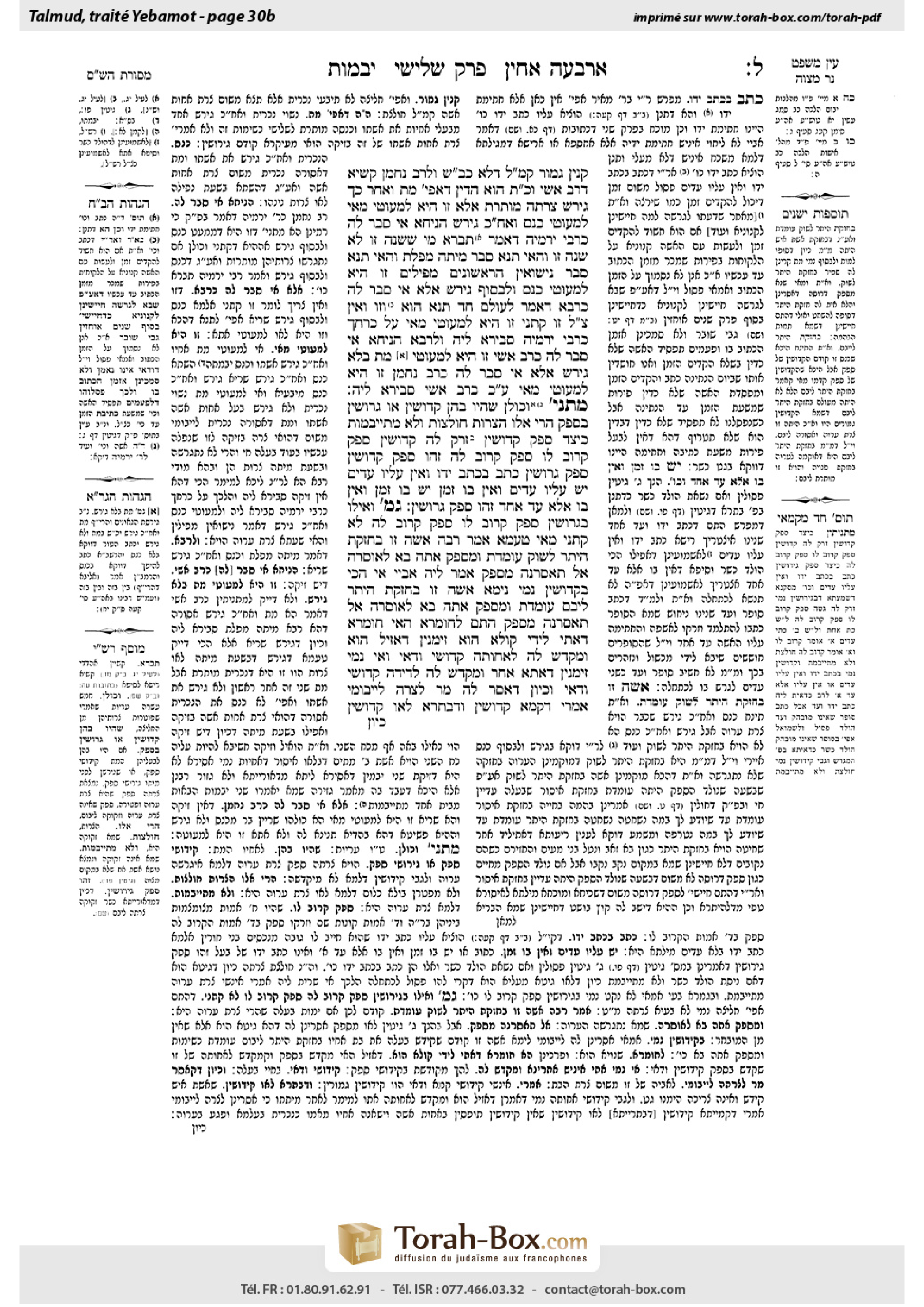
Yevamot 30b: Talmud study for Daf Yomi
Daf Yomi is the daily study of one Talmud folio. Explore 37 tractates with scans, Hebrew text, Sefaria English and AI-generated French translations where annotated.
Passage selection and English or AI-generated French translation are available where the scan has annotations. Daf Study is independent of Torah-Box and Sefaria.
Browse Yevamot · יבמות · All tractatesYevamot 30b text and translations
This page of Yevamot includes the Aramaic text, an English translation and an AI-generated French translation, alongside the scan above.
יבמות ל׳ ב · Aramaic and Hebrew text
קִנְיָן גָּמוּר, קָא מַשְׁמַע לַן דְּלָא כְּבֵית שַׁמַּאי.
וּלְרַב נַחְמָן — קַשְׁיָא דְּרַב אָשֵׁי! וְכִי תֵּימָא: הוּא הַדִּין דַּאֲפִילּוּ מֵת וְאַחַר כָּךְ גֵּירַשׁ — צָרָתָהּ מוּתֶּרֶת, אֶלָּא ״זוֹ הִיא״ לְמַעוֹטֵי מַאי? לְמַעוֹטֵי כָּנַס וְאַחַר כָּךְ גֵּירַשׁ.
הָנִיחָא אִי סָבַר לַהּ כְּרַבִּי יִרְמְיָה, דְּאָמַר: תַּבְרָא, מִי שֶׁשָּׁנָה זוֹ לֹא שָׁנָה זוֹ.
וְהַאי תַּנָּא סָבַר מִיתָה מַפֶּלֶת, וְהַאי תַּנָּא סָבַר נִישּׂוּאִין הָרִאשׁוֹנִים מַפִּילִים.
״זוֹ הִיא״ לְמַעוֹטֵי כָּנַס וּלְבַסּוֹף גֵּירַשׁ. אֶלָּא אִי סָבַר לַהּ כְּרָבָא, דְּאָמַר: לְעוֹלָם חַד תַּנָּא הוּא, וְ״זוֹ וְאֵין צָרִיךְ לוֹמַר זוֹ״ קָתָנֵי, ״זוֹ הִיא״ לְמַעוֹטֵי מַאי? עַל כׇּרְחָךְ כְּרַבִּי יִרְמְיָה סְבִירָא לֵיהּ.
וּלְרָבָא, הָנִיחָא אִי סָבַר לַהּ כְּרַב אָשֵׁי — ״זוֹ הִיא״ לְמַעוֹטֵי מֵת בְּלֹא גֵּירֵשׁ. אֶלָּא אִי סָבַר לַהּ כְּרַב נַחְמָן, ״זוֹ הִיא״ לְמַעוֹטֵי מַאי? עַל כׇּרְחָךְ כְּרַב אָשֵׁי סְבִירָא לֵיהּ.
מַתְנִי׳ וְכוּלָּן שֶׁהָיוּ בָּהֶן קִדּוּשִׁין אוֹ גֵרוּשִׁין בְּסָפֵק — הֲרֵי אֵלּוּ הַצָּרוֹת חוֹלְצוֹת וְלֹא מִתְיַיבְּמוֹת. כֵּיצַד סְפֵק קִדּוּשִׁין? זָרַק לָהּ קִדּוּשִׁין, סָפֵק קָרוֹב לוֹ סָפֵק קָרוֹב לָהּ — זֶהוּ סְפֵק קִדּוּשִׁין.
סְפֵק גֵּרוּשִׁין — כָּתַב בִּכְתַב יָדוֹ וְאֵין עָלָיו עֵדִים, יֵשׁ עָלָיו עֵדִים וְאֵין בּוֹ זְמַן, יֵשׁ בּוֹ זְמַן וְאֵין בּוֹ אֶלָּא עֵד אֶחָד, זֶהוּ סְפֵק גֵּרוּשִׁין.
גְּמָ׳ וְאִילּוּ בְּגֵרוּשִׁין, סָפֵק קָרוֹב לוֹ סָפֵק קָרוֹב לָהּ לָא קָתָנֵי.
מַאי טַעְמָא? אָמַר רַבָּה: אִשָּׁה זוֹ בְּחֶזְקַת הֶיתֵּר לַשּׁוּק עוֹמֶדֶת, וּמִסָּפֵק אַתָּה בָּא לְאוֹסְרָהּ — אַל תַּאַסְרֶנָּה מִסָּפֵק.
אֲמַר לֵיהּ אַבָּיֵי: אִי הָכִי, בְּקִדּוּשִׁין נָמֵי נֵימָא: אִשָּׁה זוֹ בְּחֶזְקַת הֶיתֵּר לַיָּבָם עוֹמֶדֶת, וּמִסָּפֵק אַתָּה בָּא לְאוֹסְרָהּ — אַל תַּאַסְרֶנָּה מִסָּפֵק!
הָתָם, לְחוּמְרָא.
הַאי — חוּמְרָא דְּאָתֵי לִידֵי קוּלָּא הוּא. זִימְנִין דְּאָזֵיל הוּא, וּמְקַדֵּשׁ לַהּ לַאֲחוֹתַהּ קִדּוּשֵׁי וַדַּאי.
וְאִי נָמֵי, זִימְנִין דְּאָתֵא אַחֵר וּמְקַדֵּשׁ לַהּ לְדִידַהּ קִדּוּשֵׁי וַדַּאי, וְכֵיוָן דְּאָסַר לַהּ מָר לְצָרָה לְיַיבּוֹמֵי, אָמְרִי: דְּקַמָּא — קִדּוּשִׁין, וּדְבָתְרָא — לָאו קִדּוּשִׁין!
Yevamot 30b · English translation
as a full-fledged acquisition. According to that opinion, the unrelated woman does not even require ḥalitza, since she is considered to be a rival wife of a forbidden relative. This mishna teaches us that the halakha is not in accordance with the opinion of Beit Shammai.
The Gemara raises a question from the opposite perspective: And according to Rav Naḥman, who deduced from the earlier mishna that the levirate bond is not substantial, the deduction of Rav Ashi that the levirate bond is substantial is difficult. And if you would try to resolve this in a similar manner and say: With regard to the ruling in the present mishna, which states that the sister’s rival wife, i.e., the unrelated woman, is permitted, the same is true even if Levi had died and then afterward the brother married to the other sister divorced his wife, there is a difficulty. If that is the case, then what does the phrase this is, cited at the end of the mishna, come to exclude? If we follow this explanation then the same ruling would hold true in all cases. The Gemara responds: It excludes the case where Shimon first married the unrelated woman and only afterward divorced the sister, as in such circumstances the unrelated woman is most certainly a rival wife of Reuven’s wife’s sister and is therefore not permitted.
The Gemara states: This works out well if he holds in accordance with the opinion of Rabbi Yirmeya, who said with regard to a seeming contradiction between this mishna and an earlier mishna (13a): The mishnayot are disjointed; he who taught this mishna did not teach that mishna. The earlier mishna established the principle that if a man was married to two women, one of whom was a forbidden relative, and he divorced the forbidden relative before he died, then the rival wife is no longer prohibited to the brothers.
This dispute is based upon the following: This tanna from the earlier mishna holds that death determines her status when she happens before the brothers, i.e., the crucial moment for determining whether the prohibition relating to rival wives applies is the moment at which the brother dies. In other words, whether the yevama is permitted to the yavam is determined by the status of the yevama at that given moment. Therefore, in the case where he had married a forbidden relative and later divorced her, the rival wife would be permitted. And this tanna of our present mishna holds that the original marriage determines her status when she happens before the brothers. If, at the time the woman was married to the deceased brother she was forbidden as a close relative, and her rival wife was likewise forbidden as the rival wife of a forbidden relative, then even though the status of the relative had changed at the time of the death of the brother, both she and her rival wife remain forbidden.
According to this opinion, it is indeed possible to state that the phrase this is comes to exclude the case where he married one woman and ultimately divorced the other. According to this mishna, in that case, the rival wives would be prohibited. However, if he holds in accordance with the opinion of Rava, who said: Actually, understand this to be the opinion of a single tanna, and he teaches the mishna employing the style: This, and it is unnecessary to say that, a difficulty remains. According to Rava, both mishnayot maintain the position that in the case where the yavam married one woman and ultimately divorced the other, the rival wife would be permitted. If that is the case, what does the phrase this is come to exclude? In what case would the rival wife be prohibited to the yavam? The Gemara responds: Perforce Rav Naḥman holds in accordance with the opinion of Rabbi Yirmeya with regard to his interpretation of the mishnayot.
The Gemara raises a question from a different perspective: And according to Rava, who maintains that in both cases the rival wife is permitted, this works out well if he holds in accordance with the opinion of Rav Ashi that the levirate bond is substantial. In that case the phrase this is comes to exclude the case where he died without divorcing his wife. In this case the rival wife is forbidden because the entire time she was the rival wife of a forbidden relative by levirate bond. If, however, he holds in accordance with the opinion of Rav Naḥman in this matter, what does the phrase this is come to exclude? The Gemara answers: Perforce Rava holds in accordance with the opinion of Rav Ashi. Accordingly, with regard to this halakha there is a connection between the various opinions as to how to interpret the mishnayot and the dispute.
MISHNA: And if any of these fifteen women who are prohibited as forbidden relatives had undergone a betrothal or divorce whose status is uncertain with the deceased brother, then those women who were their rival wives must perform ḥalitza and may not enter into levirate marriage since they are possibly the rival wives of forbidden relatives. The mishna elaborates: How could there be a situation of uncertainty with regard to betrothal? If in the public domain he threw her an item for the purpose of betrothal and there were eight cubits between them, and the item was possibly closer to him and did not enter into her domain, and possibly closer to her, i.e., within four cubits of her, whereby she could acquire the object, this is a case of uncertainty with regard to betrothal.
Uncertainty with regard to divorce occurs when, for instance, he wrote a bill of divorce in his handwriting but there are no signatures of witnesses on the document, or there are the signatures of witnesses on the document but there is no date written in it, or the date is written in it but there is only the signature of a single witness. Since there is doubt as to whether these three kinds of bills of divorce are valid, a woman who was divorced through them is only possibly divorced, and so this case is called uncertainty with regard to divorce.
GEMARA: The Gemara remarks: But yet when discussing divorce, it does not teach the case where it is uncertain if the bill of divorce is closer to him, and uncertain if it is closer to her. It would have been appropriate to describe this case, as it parallels the case involving the object of betrothal. He could have tossed it in such a way that it was not clear to whom the bill was closer.
The Gemara asks: What is the reason the mishna did not present this situation as well? Rabba said: When this type of uncertainty exists, the performance of ḥalitza is not mandatory, as this woman, the rival wife, has the presumptive status of being permitted to marry a man from the general public. At the time of her marriage she was rendered a rival wife of a forbidden relative. And due to an uncertainty alone would you render her forbidden to the general public until she performs ḥalitza, simply because it is unclear to us whether or not the forbidden relative had indeed been divorced? Do not render her forbidden due to an uncertainty. This is not, however, the case with the various bills of divorce mentioned in the mishna, for they are all certainly considered effective bills of divorce, even if the circumstances involved raise some questions or doubts.
Abaye said to him: If that is so, let us say in the case of betrothal as well that this woman, the rival wife, has the presumptive status of being permitted to the yavam before he betrothed the forbidden relative, and due to the uncertainty whether she is the rival wife of a forbidden relative would you come and render her forbidden? Do not render her forbidden due to an uncertainty. Consequently, you should permit her to enter into levirate marriage.
The Gemara explains: There, with regard to betrothal, the halakha follows the stringent ruling, because the rival wife is certainly his wife and requires levirate marriage. As there is uncertainty with regard to the betrothal with the forbidden relative, the ruling is stringent; she may not enter into levirate marriage and must only perform ḥalitza.
The Gemara objects: Yet this is a stringency that might bring about a leniency in another scenario. How so? Sometimes that same man who betrothed the forbidden relative might go and betroth her sister with a betrothal whose status is certain. If one says that due to a stringency the rival wife may not enter into levirate marriage due to her possible status as the rival wife of a forbidden relative, people might come to assume that the betrothal with the forbidden relative was a valid betrothal, and that the subsequent betrothal with her sister was not valid, since she is his wife’s sister. This would be assumed because they would not know that the status of the first betrothal was itself uncertain and that only due to a stringent ruling is the rival wife not allowed to enter into levirate marriage. In fact, the status of the betrothal with the sister of the forbidden relative is also uncertain. As a result of this ruling, however, people might be led to think that a man’s wife, i.e., the sister of the forbidden relative, is in fact permitted.
Alternatively, sometimes another man might come and betroth the forbidden relative herself with a betrothal whose status is certain, and since the Master rendered it prohibited for the rival wife to enter into levirate marriage, people would say that the betrothal of the first man, i.e., the deceased brother, was a fully effective betrothal, and that the betrothal of the latter man was not a valid betrothal. If she was married to the first man, then she is forbidden to the second as the man’s wife, and betrothal cannot take effect with her. However, since the status of her betrothal to the first man was uncertain, then she is also considered possibly betrothed to the second man and would require a divorce from him as well. As a result, one can find a situation that would lead people to think that a man’s wife is in fact permitted.
Yevamot 30b · Traduction française (IA)
comme une acquisition à part entière. Selon cette opinion, la femme sans lien de parenté n’a même pas besoin de la ḥalitza, puisqu’elle est considérée comme la coépouse d’une parente interdite. Cette Michna nous enseigne que la halakha ne suit pas l’opinion de Beit Shammaï.
La Guemara soulève une question du point de vue opposé : selon Rav Naḥman, qui a déduit de la Michna précédente que le lien de yiboum n’a pas de consistance, la déduction de Rav Ashi, selon laquelle le lien de yiboum a une consistance, pose problème. Et si l’on voulait résoudre cette difficulté de manière analogue en disant que, concernant la règle énoncée dans notre Michna — selon laquelle la coépouse de la sœur, c’est-à-dire la femme sans lien de parenté, est permise —, la même règle s’applique même si Lévi est mort, puis que le frère marié à l’autre sœur a divorcé de sa femme, une difficulté se présente. Dans ce cas, que vient exclure l’expression « c’est celle-ci », citée à la fin de la Michna ? Selon cette explication, la même règle s’appliquerait dans tous les cas. La Guemara répond : elle exclut le cas où Chimon a d’abord épousé la femme sans lien de parenté et n’a divorcé de la sœur qu’ensuite. Dans de telles circonstances, la femme sans lien de parenté est assurément la coépouse de la sœur de l’épouse de Réouven et n’est donc pas permise.
La Guemara dit : cela s’explique bien si l’on suit l’opinion de Rabbi Yirmeya, qui a dit, à propos d’une contradiction apparente entre cette Michna et une Michna précédente (13a) : les Michnayot sont disjointes ; celui qui a enseigné cette Michna n’a pas enseigné l’autre. La Michna précédente a établi le principe suivant : si un homme était marié à deux femmes, dont l’une était une parente interdite, et qu’il a divorcé de cette parente interdite avant de mourir, alors la coépouse n’est plus interdite aux frères.
Cette divergence repose sur le fait suivant : le tanna de la Michna précédente estime que c’est le décès qui détermine son statut lorsqu’elle se présente devant les frères, c’est-à-dire que le moment décisif pour déterminer si l’interdiction des coépouses s’applique est celui du décès du frère. Autrement dit, la permission pour la yevama d’épouser le yavam dépend de son statut à ce moment précis. Par conséquent, dans le cas où il avait épousé une parente interdite puis avait divorcé d’elle, la coépouse serait permise. Le tanna de notre Michna estime, quant à lui, que c’est le mariage initial qui détermine son statut lorsqu’elle se présente devant les frères. Si, au moment où la femme était mariée au frère défunt, elle était interdite en tant que parente proche et que sa coépouse était également interdite en tant que coépouse d’une parente interdite, alors, même si le statut de la parente avait changé au moment du décès du frère, elle-même et sa coépouse restent interdites.
Selon cette opinion, on peut effectivement dire que l’expression « c’est celle-ci » vient exclure le cas où il a épousé l’une des femmes et a finalement divorcé de l’autre. Selon cette Michna, dans ce cas, les coépouses seraient interdites. Cependant, s’il suit l’opinion de Rava, qui a dit : « En réalité, comprends qu’il s’agit de l’opinion d’un seul tanna, et qu’il enseigne la Michna selon le procédé : “celle-ci, et il n’est pas nécessaire de dire cela” », une difficulté subsiste. Selon Rava, les deux Michnayot soutiennent que, dans le cas où le yavam a épousé une femme et a finalement divorcé de l’autre, la coépouse serait permise. Dans ce cas, que vient exclure l’expression « c’est celle-ci » ? Dans quel cas la coépouse serait-elle interdite au yavam ? La Guemara répond : Rav Naḥman suit nécessairement l’opinion de Rabbi Yirmeya dans son interprétation des Michnayot.
La Guemara soulève une question d’un autre point de vue : selon Rava, qui soutient que, dans les deux cas, la coépouse est permise, cela s’explique bien s’il suit l’opinion de Rav Ashi, selon laquelle le lien de yiboum a une consistance. Dans ce cas, l’expression « c’est celle-ci » vient exclure le cas où il est mort sans avoir divorcé de sa femme. Dans ce cas, la coépouse est interdite, car, pendant toute cette période, elle était la coépouse d’une parente interdite en vertu du lien de yiboum. Mais s’il suit l’opinion de Rav Naḥman sur ce point, que vient exclure l’expression « c’est celle-ci » ? La Guemara répond : Rava suit nécessairement l’opinion de Rav Ashi. Ainsi, pour cette halakha, les différentes opinions concernant l’interprétation des Michnayot sont liées au désaccord.
MICHNA : Si l’une de ces quinze femmes interdites en tant que parentes avait été fiancée au frère défunt, ou si elle avait divorcé de lui par un acte dont la validité est incertaine, alors leurs coépouses doivent accomplir la ḥalitza et ne peuvent pas contracter le yiboum, puisqu’elles sont peut-être les coépouses de parentes interdites. La Michna précise : comment peut-il y avoir une incertitude concernant les fiançailles ? Si, dans le domaine public, il lui a lancé un objet en vue de la fiancer, alors qu’il y avait huit coudées entre eux, et que l’objet se trouvait peut-être plus près de lui, sans être entré dans son domaine, ou peut-être plus près d’elle, c’est-à-dire à moins de quatre coudées d’elle, auquel cas elle aurait pu acquérir l’objet, il s’agit d’un cas d’incertitude concernant les fiançailles.
L’incertitude concernant le divorce se présente, par exemple, lorsqu’il a rédigé un acte de divorce de sa propre main, mais que le document ne porte pas la signature de témoins ; ou lorsque le document porte la signature de témoins, mais qu’aucune date n’y est inscrite ; ou lorsque la date y est inscrite, mais qu’il ne porte que la signature d’un seul témoin. Puisqu’on doute de la validité de ces trois types d’actes de divorce, une femme divorcée au moyen de l’un d’eux n’est que possiblement divorcée ; c’est pourquoi ce cas est appelé « incertitude concernant le divorce ».
GUEMARA : La Guemara fait remarquer que, lorsqu’elle traite du divorce, la Michna ne mentionne pourtant pas le cas où l’on ne sait pas si l’acte de divorce se trouve plus près de lui ou plus près d’elle. Il aurait été approprié de décrire ce cas, puisqu’il est parallèle à celui de l’objet de fiançailles. Il aurait pu le lancer de telle manière qu’on ne puisse pas déterminer de qui l’acte était le plus proche.
La Guemara demande : pourquoi la Michna n’a-t-elle pas également présenté cette situation ? Rabba a dit : lorsqu’il existe ce type d’incertitude, la ḥalitza n’est pas obligatoire, car cette femme, la coépouse, a le statut présumé d’une femme autorisée à épouser un homme quelconque. Au moment de son mariage, elle a été rendue coépouse d’une parente interdite. Et sur la seule base d’un doute, la déclarerais-tu interdite à tout homme jusqu’à ce qu’elle accomplisse la ḥalitza, simplement parce que nous ne savons pas si la parente interdite avait effectivement divorcé ? Ne la déclare pas interdite en raison d’une incertitude. Il n’en va toutefois pas ainsi des différents actes de divorce mentionnés dans la Michna, car ils sont tous considérés comme des actes de divorce valides, même si les circonstances soulèvent des questions ou des doutes.
Abayé lui dit : si tel est le cas, disons aussi, à propos des fiançailles, que cette femme, la coépouse, a le statut présumé d’une femme autorisée à épouser le yavam avant qu’il ne fiance la parente interdite. En raison de l’incertitude quant au fait qu’elle soit la coépouse d’une parente interdite, viendrais-tu la déclarer interdite ? Ne la déclare pas interdite en raison d’une incertitude. Par conséquent, tu devrais lui permettre de contracter le yiboum.
La Guemara explique : dans le cas des fiançailles, la halakha suit la décision rigoureuse, car la coépouse est certainement son épouse et doit contracter le yiboum. Puisqu’il existe une incertitude concernant les fiançailles avec la parente interdite, la décision est rigoureuse : elle ne peut pas contracter le yiboum et doit seulement accomplir la ḥalitza.
La Guemara objecte : pourtant, cette rigueur pourrait entraîner une indulgence dans un autre cas. Comment cela ? Il arrive que ce même homme qui a fiancé la parente interdite aille ensuite fiancer sa sœur au moyen de fiançailles dont la validité est certaine. Si l’on dit que, par rigueur, la coépouse ne peut pas contracter le yiboum en raison de la possibilité qu’elle soit la coépouse d’une parente interdite, les gens pourraient en déduire que les fiançailles avec la parente interdite étaient valides et que les fiançailles ultérieures avec sa sœur ne l’étaient pas, puisque cette dernière est la sœur de son épouse. Ils le supposeraient parce qu’ils ne sauraient pas que la validité des premières fiançailles était elle-même incertaine et que seule une décision rigoureuse interdit à la coépouse de contracter le yiboum. En réalité, la validité des fiançailles avec la sœur de la parente interdite est également incertaine. Toutefois, cette décision pourrait amener les gens à penser qu’une épouse, c’est-à-dire la sœur de la parente interdite, est en fait permise.
Autre possibilité : il arrive qu’un autre homme vienne fiancer la parente interdite elle-même au moyen de fiançailles dont la validité est certaine. Puisque le Maître a interdit à la coépouse de contracter le yiboum, les gens diraient que les fiançailles du premier homme, c’est-à-dire du frère défunt, étaient pleinement valides, et que celles du second homme ne l’étaient pas. Si elle était mariée au premier homme, elle est alors interdite au second en tant qu’épouse du premier, et les fiançailles ne peuvent pas prendre effet à son égard. Cependant, puisque la validité de ses fiançailles avec le premier homme était incertaine, elle est également considérée comme possiblement fiancée au second homme et aurait aussi besoin d’un acte de divorce de sa part. Ainsi, on peut trouver une situation qui amènerait les gens à penser qu’une épouse est en fait permise.
Traduction française générée par IA à partir de l’édition anglaise de Sefaria. Vérifie toujours un passage avec le texte source.
Text from Sefaria: William Davidson Edition - Vocalized Aramaic (CC BY NC); William Davidson Edition - English (CC BY NC).