Yevamot 31a: Talmud study for Daf Yomi
Daf Yomi is the daily study of one Talmud folio. Explore 37 tractates with scans, Hebrew text, Sefaria English and AI-generated French translations where annotated.
Passage selection and English or AI-generated French translation are available where the scan has annotations. Daf Study is independent of Torah-Box and Sefaria.
Browse Yevamot · יבמות · All tractatesYevamot 31a text and translations
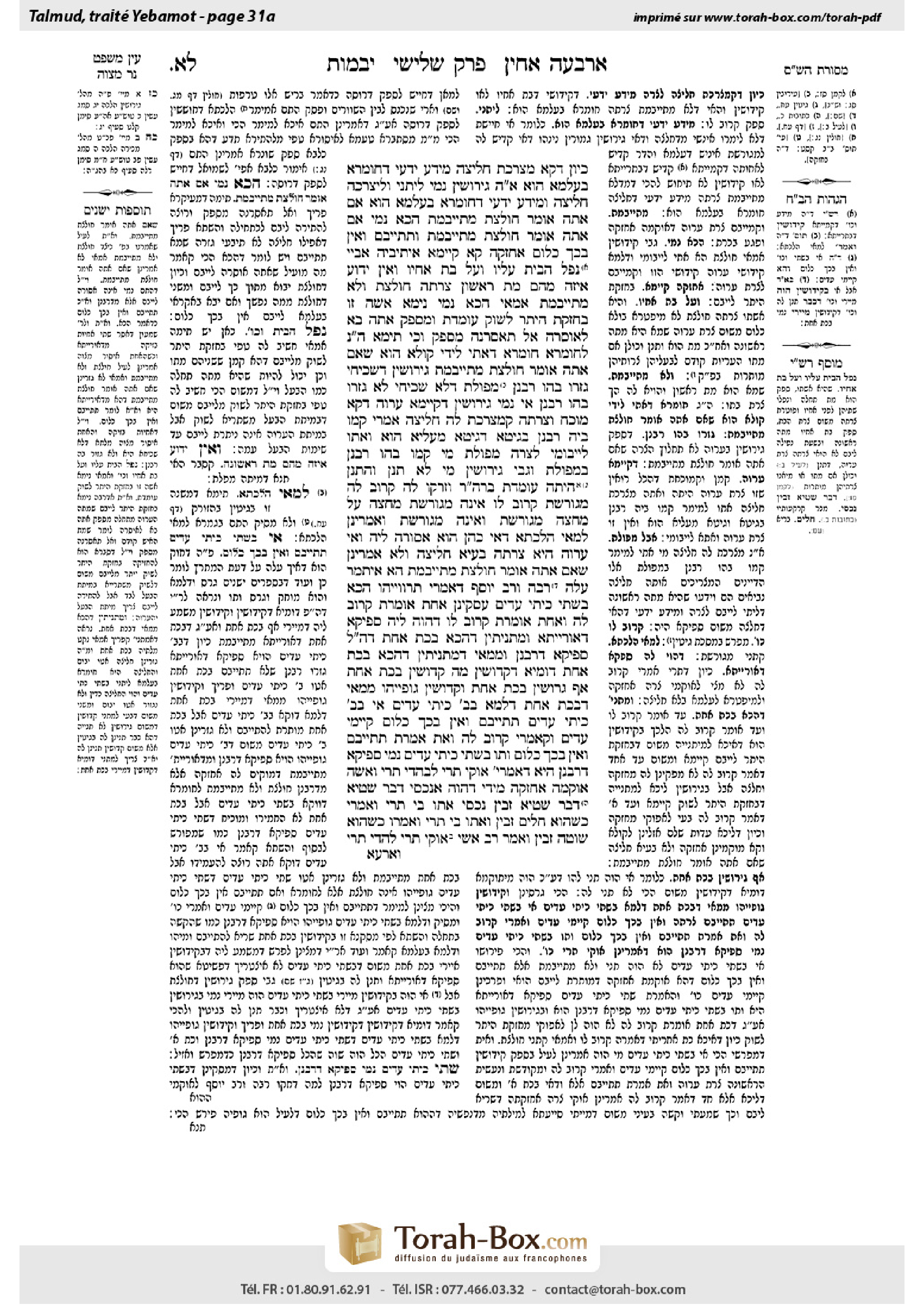
This page of Yevamot includes the Aramaic text, an English translation and an AI-generated French translation, alongside the scan above.
יבמות ל״א א · Aramaic and Hebrew text
כֵּיוָן דְּקָא מַצְרְכַתְּ חֲלִיצָה — מִידָּע יָדְעִי דְּחוּמְרָא בְּעָלְמָא הוּא. אִי הָכִי, גֵּירוּשִׁין נָמֵי לִיתְנֵי, וְלַיצְרְכַהּ חֲלִיצָה, וּמִידַּע יָדְעִי דְּחוּמְרָא בְּעָלְמָא הוּא!
אִם אַתָּה אוֹמֵר חוֹלֶצֶת, מִתְיַיבֶּמֶת. הָכָא נָמֵי, אִם אַתָּה אוֹמֵר חוֹלֶצֶת, מִתְיַיבֶּמֶת! וְתִתְיַיבֵּם, וְאֵין בְּכָךְ כְּלוּם — אַחֲזָקָה קָא קָיְימָא.
אֵיתִיבֵיהּ אַבָּיֵי: נָפַל הַבַּיִת עָלָיו וְעַל בַּת אָחִיו, וְאֵין יָדוּעַ אֵיזֶה מֵהֶם מֵת רִאשׁוֹן, צָרָתָהּ חוֹלֶצֶת וְלֹא מִתְיַיבֶּמֶת.
אַמַּאי? הָכָא נָמֵי, נֵימָא: אִשָּׁה זוֹ בְּחֶזְקַת הֶיתֵּר לַשּׁוּק עוֹמֶדֶת, וּמִסָּפֵק אַתָּה בָּא לְאוֹסְרָהּ — אַל תַּאַסְרֶנָּה מִסָּפֵק!
וְכִי תֵּימָא: הָכָא נָמֵי לְחוּמְרָא — חוּמְרָא דְּאָתֵי לִידֵי קוּלָּא הוּא: שֶׁאִם אַתָּה אוֹמֵר חוֹלֶצֶת, מִתְיַיבֶּמֶת! גֵּירוּשִׁין דִּשְׁכִיחִי — גְּזַרוּ בְּהוּ רַבָּנַן, מַפּוֹלֹת דְּלָא שְׁכִיחִי — לָא גְּזַרוּ בְּהוּ רַבָּנַן.
אִי נָמֵי: גֵּירוּשִׁין דְּקָיְימָא עֶרְוָה דְּקָא מוֹכְחָ[א], וְצָרָתָהּ קָמַצְרְכַתְּ לַהּ חֲלִיצָה, אָמְרִי: קָמוּ בֵּיהּ רַבָּנַן בְּגִיטָּא דְּגִיטָּא מְעַלְּיָא הוּא, וְאָתוּ לְיַיבּוֹמֵי לְצָרָה. מַפּוֹלֶת, מִי קָמוּ בְּהוּ רַבָּנַן בְּמַפּוֹלֶת?
וְגַבֵּי גֵירוּשִׁין מִי לָא תְּנַן? וְהָתְנַן: הָיְתָה עוֹמֶדֶת בִּרְשׁוּת הָרַבִּים וּזְרָקוֹ לָהּ, קָרוֹב לָהּ — מְגוֹרֶשֶׁת, קָרוֹב לוֹ — אֵינָהּ מְגוֹרֶשֶׁת. מֶחֱצָה עַל מֶחֱצָה — מְגוֹרֶשֶׁת וְאֵינָהּ מְגוֹרֶשֶׁת.
וְאָמְרִינַן: לְמַאי הִלְכְתָא? דְּאִי כֹּהֵן הוּא — אֲסִורָה לֵיהּ, וְאִי עֶרְוָה הִיא — צָרָתָהּ בָּעֲיָא חֲלִיצָה. וְלָא אָמְרִינַן: שֶׁאִם אַתָּה אוֹמֵר חוֹלֶצֶת, מִתְיַיבֶּמֶת!
הָא אִיתְּמַר עֲלַהּ, רַבָּה וְרַב יוֹסֵף דְּאָמְרִי תַּרְוַויְיהוּ: הָכָא בִּשְׁתֵּי כִּיתֵּי עֵדִים עָסְקִינַן, אַחַת אוֹמֶרֶת: קָרוֹב לָהּ, וְאַחַת אוֹמֶרֶת: קָרוֹב לוֹ, דְּהָוֵה לֵיהּ סְפֵיקָא דְאוֹרָיְיתָא. וּמַתְנִיתִין דְּהָכָא בְּכַת אַחַת, דְּהָוֵה לֵיהּ סְפֵיקָא דְרַבָּנַן.
וּמִמַּאי דְּמַתְנִיתִין דְּהָכָא בְּכַת אַחַת? דּוּמְיָא דְּקִדּוּשִׁין: מָה קִדּוּשִׁין בְּכַת אַחַת, אַף גֵּרוּשִׁין בְּכַת אַחַת. וְקִדּוּשִׁין גּוּפַיְיהוּ, מִמַּאי דִּבְכַת אַחַת? דִּלְמָא בִּשְׁתֵּי כִּיתֵּי עֵדִים? אִי בִּשְׁתֵּי כִּיתֵּי עֵדִים — תִּתְיַיבֵּם, וְאֵין בְּכָךְ כְּלוּם.
קָיְימִי עֵדִים וְקָאָמְרִי קָרוֹב לָהּ, וְאַתְּ אָמְרַתְּ תִּתְיַיבֵּם וְאֵין בְּכָךְ כְּלוּם?! וְתוּ — בִּשְׁתֵּי כִּיתֵּי עֵדִים נָמֵי, סְפֵיקָא דְרַבָּנַן הִיא, דְּאָמְרִינַן: אוֹקֵי תְּרֵי לְבַהֲדֵי תְּרֵי, וְאִשָּׁה אוֹקְמַהּ אַחֲזָקָה!
מִידֵּי דְּהָוֵה אַנִּכְסֵי דְּבַר שָׁטְיָא. דְּבַר שָׁטְיָא זַבֵּין נִכְסֵי. אֲתוֹ בֵּי תְרֵי וְאָמְרִי: כְּשֶׁהוּא חָלִים זַבֵּין, וְאָתוּ בֵּי תְרֵי וַאֲמַרוּ: כְּשֶׁהוּא שׁוֹטֶה זַבֵּין. וְאָמַר רַב אָשֵׁי: אוֹקֵי תְּרֵי לַהֲדֵי תְּרֵי,
Yevamot 31a · English translation
Rabba answered: Since you require ḥalitza and you do not exempt her completely, all will know that this is merely a stringency and that the Sages did not decide with certitude that the first betrothal was fully valid. Consequently, they would not come to disregard the other betrothal. Abaye raised a challenge: If so, let the mishna teach the case where it is uncertain whether the item is closer to him or closer to her with regard to divorce, and stipulate that she requires ḥalitza. And they would know that this is merely a stringency and not make a mistake.
He answered him: A mistake could in fact be made here, as, if you say that she must perform ḥalitza then she may also enter into levirate marriage. People might mistakenly think that if she is suitable for ḥalitza then she is also suitable for levirate marriage, and as a result the woman might enter into levirate marriage, despite the fact that it is forbidden for her to do so. Abaye objected: Here too, in the case of uncertain betrothal, the concern exists that if you say that she performs ḥalitza then she might also enter into levirate marriage. Rabba answered: So let her enter into levirate marriage, and there is no problem with that. In this instance she remains with her presumptive status as permitted because she was originally assumed to be permitted and was rendered forbidden only due to our concern. However, there would be no actual transgression involved even if she were to enter into levirate marriage.
Abaye raised an objection to Rabba by citing a case where even in places of doubt, the woman requires ḥalitza. As we learned in a mishna (67b): A house fell on him, on a certain man, and on his brother’s daughter to whom this man was married, and he was childless, and it is unknown which of them died first. If the deceased wife had a rival wife, then her rival wife must perform ḥalitza but may not enter into levirate marriage. If the man had died first, then at the time of his death the rival wife was forbidden to the yavam as the rival wife of his daughter and exempt from levirate marriage. If, however, the daughter had died first, then at the time of the husband’s death the second wife was not the rival wife of a forbidden relative, and requires levirate marriage. It is due to this doubt that she must perform ḥalitza and may not enter into levirate marriage.
And according to Rabba’s opinion, why is that so? Here too, let us say: This woman, the rival wife, has the presumptive status of being permitted to marry a man from the general public. This is because she was exempt from levirate marriage for the entire period of her marriage as the rival wife of a forbidden relative. And due to the uncertainty whether her rival wife was the first to die you come to render her forbidden and require that she perform ḥalitza. Do not render her forbidden due to an uncertainty.
And if you would say: Here too, we rule more stringently due to the uncertainty. Nevertheless, this would be a stringency that brings about a leniency, for if you say that she must perform ḥalitza, she may also enter into levirate marriage. However, it is forbidden for her to enter into levirate marriage, because she is possibly forbidden to the yavam as the rival wife of his daughter and therefore forbidden just like the daughter herself. Rabba replied: In cases of divorce, which are common, the Sages issued a rabbinic decree preventing her from performing ḥalitza due to a concern that if she were required to perform ḥalitza then she may enter into levirate marriage as well. In cases of collapse, which are not common, the Sages did not issue a rabbinic decree, because they did not introduce decrees with regard to uncommon matters.
Alternatively, there is another reason to differentiate between the cases. In the case of divorce where there is a forbidden relative who indicates that the rival wife is forbidden due to her status as the rival wife of a forbidden relative, and you require that her rival wife perform ḥalitza, people will say: The Sages determined that this bill of divorce is a full-fledged bill of divorce. Consequently, they required her rival wife to perform ḥalitza, and people may come to consummate the levirate marriage with the rival wife based on this mistaken assumption. In cases of collapse, however, could the Sages have determined who died first in the collapse? As it is known to all that there was a doubt that could not be clarified, it is clear that the Sages required the rival wife to perform ḥalitza only due to this uncertainty. Therefore, there is no concern that she would come to enter into levirate marriage because of this ḥalitza.
The Gemara asks: But did we not learn in a mishna about the case where it is uncertain whether the bill of divorce is closer to him or closer to her with regard to situations of divorce whose status is uncertain? And didn’t we learn in a mishna: In a case where his wife was standing in the public domain and he threw her the bill of divorce, if the bill landed closer to her, she is divorced. If it was closer to him, she is not divorced. If it was half and half, i.e., if the bill of divorce landed midway between the man and the woman, there is uncertainty whether she is divorced or whether she is not divorced.
And we say: With regard to what halakha was the ruling said that she is both divorced and not divorced? The Gemara explains that this affects two areas of halakha. The first is that if the man divorcing his wife is a priest, then his wife is forbidden to him due to the uncertainty that she may in fact be divorced through that bill of divorce. Consequently, he would then be unable to remarry her. The second ramification is that if the woman being divorced was a forbidden relative to her husband’s brother, and her husband died childless, then her rival wife would require ḥalitza. The mishna indicates that in this type of divorce whose status is uncertain as well, the Sages require the rival wife to perform ḥalitza, and we do not say that if you say that she must perform ḥalitza, she may enter into levirate marriage. Here there is no such concern.
The Gemara responds: But wasn’t it stated with regard to that mishna that this is referring to a very specific set of circumstances? It is Rabba and Rav Yosef who both say: The doubt here does not result from the facts of the case themselves, but from conflicting testimonies and an inability to decide between them. Here, we are dealing with two sets of witnesses, one of which says that the bill fell closer to her, and one of which says that it fell closer to him. This, then, is an uncertainty in matters of Torah law, for in this case there are two testimonies, each one complete by itself, yet they contradict one another. Such instances are deemed to have the status of an uncertainty with regard to Torah law, and therefore the ruling is stringent. But the mishna here is referring to one set of witnesses who were divided in their testimony or who could not clarify exactly what had occurred. This is considered to be an uncertainty in matters of rabbinic law alone, as there is only a single uncorroborated testimony, and in cases of uncertainty in matters of rabbinic law the ruling is lenient.
The Gemara asks: And from where is it known that the mishna here is referring to a case of uncertainty with one set of witnesses? The Gemara responds: It is similar to that of betrothal. Just as with regard to betrothal it is referring to a case of uncertainty with one set of witnesses, so too, with regard to divorce it is referring to a case of one set of witnesses. The Gemara wonders: And with regard to betrothal itself, from where is it known that the mishna is referring to a case of uncertainty that involves one set of witnesses? Perhaps it is referring to a case of two sets of witnesses? The Gemara answers: If the mishna is referring to a case of two sets of witnesses who contradict one another, then let her enter into levirate marriage, and there is no problem with that, as there are two witnesses testifying that there was never a betrothal. Therefore, both the cases of betrothal and divorce must be referring to a situation where there is one set of witnesses.
The Gemara challenges: How can one say that? After all, there are witnesses who are standing before us and saying that the object of betrothal fell closer to her. Accordingly, she was betrothed and her rival wife is the rival wife of a forbidden relative. And yet you say to let her enter into levirate marriage and there is no problem with that? And furthermore, with regard to the fundamental difference between two pairs of witnesses and a single pair, the case of two pairs of witnesses is also considered an uncertainty in matters of rabbinic law. This is not considered to be uncertainty with regard to the reality of what actually happened, which would be a case of uncertainty in matters of Torah law, but rather a contradiction between two opposing testimonies. In these cases we say: Place two witnesses against two witnesses, and let the two testimonies cancel each other out. Therefore, the halakha would be to let the woman remain in her original presumptive status. Accordingly, this type of uncertainty stems only from rabbinic law and not from Torah law.
The Gemara cites a proof for this: This is just as it is in the case concerning the property of a man named Bar Shatya, who was referred to by this name because he would occasionally go insane. The case is as follows: Bar Shatya sold property. Two witnesses came forward and said that he sold it when he was healthy and therefore the sale was valid. And two others came forward and said that he sold it when he was insane, and so the sale was void. Rav Ashi said with regard to this matter: Place two witnesses against two witnesses and let the testimonies cancel each other out. As there is no valid testimony to rely on,
Yevamot 31a · Traduction française (IA)
Rabba répondit : Puisque tu exiges qu’elle fasse la ḥalitsa et que tu ne l’exemptes pas complètement, tous sauront qu’il ne s’agit que d’une rigueur et que les Sages n’ont pas tranché avec certitude que les premières fiançailles étaient pleinement valides. Par conséquent, ils ne risqueront pas de négliger les autres fiançailles. Abayé objecta : Dans ce cas, que la Michna enseigne le cas où l’on ne sait pas si l’objet est plus près de lui ou d’elle en matière de divorce, et précise qu’elle doit faire la ḥalitsa. Ils sauraient alors qu’il ne s’agit que d’une rigueur et ne se tromperaient pas.
Il lui répondit : Une erreur pourrait effectivement se produire ici, car si tu dis qu’elle doit faire la ḥalitsa, elle pourrait aussi contracter un mariage léviratique. Les gens pourraient croire à tort que, si elle peut faire la ḥalitsa, elle peut également contracter un mariage léviratique ; la femme pourrait alors le faire, bien que cela lui soit interdit. Abayé objecta : Ici aussi, dans le cas de fiançailles incertaines, on craint que, si tu dis qu’elle doit faire la ḥalitsa, elle ne contracte également un mariage léviratique. Rabba répondit : Qu’elle contracte donc un mariage léviratique ; cela ne pose pas de problème. Dans ce cas, elle conserve son statut présumé de femme autorisée, puisqu’elle était considérée comme autorisée à l’origine et n’a été rendue interdite qu’en raison de notre crainte. Même si elle contractait un mariage léviratique, il n’y aurait en réalité aucune transgression.
Abayé objecta à Rabba en citant un cas où, même en présence d’un doute, la femme doit faire la ḥalitsa. En effet, nous avons appris dans une Michna (67b) : Une maison s’effondra sur un homme et sur la fille de son frère, qu’il avait épousée ; il n’avait pas d’enfant et l’on ignore lequel des deux mourut le premier. Si l’épouse défunte avait une coépouse, celle-ci doit faire la ḥalitsa, mais ne peut pas contracter de mariage léviratique. Si l’homme est mort le premier, au moment de sa mort, la coépouse était interdite au yavam en tant que coépouse de sa fille, et dispensée du mariage léviratique. En revanche, si la fille est morte la première, au moment de la mort de son mari, la seconde épouse n’était pas la coépouse d’une parente interdite et devait contracter un mariage léviratique. C’est en raison de ce doute qu’elle doit faire la ḥalitsa et ne peut pas contracter de mariage léviratique.
Or, selon l’opinion de Rabba, pourquoi en est-il ainsi ? Ici aussi, disons : cette femme, la coépouse, a le statut présumé d’une femme autorisée à épouser n’importe quel homme. En effet, pendant toute la durée de son mariage, elle était dispensée du mariage léviratique en tant que coépouse d’une parente interdite. Et c’est à cause du doute quant à savoir si sa coépouse est morte la première que tu viens la déclarer interdite et exiger qu’elle fasse la ḥalitsa. Ne la déclare pas interdite en raison d’un doute.
Et si tu dis : Ici aussi, nous statuons avec rigueur en raison du doute, cela reste néanmoins une rigueur qui entraîne une indulgence. En effet, si tu dis qu’elle doit faire la ḥalitsa, elle pourrait aussi contracter un mariage léviratique. Or, il lui est interdit de le faire, car il est possible qu’elle soit interdite au yavam en tant que coépouse de sa fille, et donc interdite comme la fille elle-même. Rabba répondit : Dans les cas de divorce, qui sont fréquents, les Sages ont édicté un décret rabbinique lui interdisant de faire la ḥalitsa, par crainte que, si on exigeait qu’elle la fasse, elle ne contracte également un mariage léviratique. En revanche, dans les cas d’effondrement, qui sont rares, les Sages n’ont pas édicté de décret rabbinique, car ils n’ont pas établi de décrets concernant des situations peu fréquentes.
On peut aussi distinguer les cas pour une autre raison. Dans le cas du divorce, où une parente interdite indique que la coépouse est interdite en raison de son statut de coépouse d’une parente interdite, si tu exiges que cette coépouse fasse la ḥalitsa, les gens diront : « Les Sages ont déterminé que cet acte de divorce est pleinement valide. » Par conséquent, ils ont exigé que la coépouse fasse la ḥalitsa, et les gens pourraient alors conclure à tort qu’ils peuvent consommer le mariage léviratique avec elle. En revanche, dans les cas d’effondrement, les Sages auraient-ils pu déterminer qui est mort le premier ? Puisque tous savent qu’il y avait un doute impossible à éclaircir, il est évident que les Sages ont exigé que la coépouse fasse la ḥalitsa uniquement en raison de ce doute. On ne craint donc pas qu’elle en vienne à contracter un mariage léviratique à cause de cette ḥalitsa.
La Guemara demande : Mais n’avons-nous pas appris dans une Michna le cas où l’on ne sait pas si l’acte de divorce est plus près de lui ou d’elle, parmi les situations où le statut du divorce est incertain ? N’avons-nous pas appris dans une Michna : Si sa femme se tenait dans le domaine public et qu’il lui lança l’acte de divorce, si celui-ci tomba plus près d’elle, elle est divorcée. S’il tomba plus près de lui, elle n’est pas divorcée. S’il tomba à mi-chemin, c’est-à-dire à égale distance de l’homme et de la femme, on ne sait pas si elle est divorcée ou non.
Et nous demandons : À quelle halakha s’applique-t-il, lorsqu’on enseigne qu’elle est à la fois divorcée et non divorcée ? La Guemara explique que cela a des conséquences dans deux domaines de la halakha. Premièrement, si le mari qui a divorcé sa femme est un prêtre, celle-ci lui est interdite, puisqu’il est possible qu’elle ait effectivement été divorcée par cet acte. Il ne pourrait donc pas la reprendre pour épouse. Deuxièmement, si la femme divorcée était une parente interdite pour le frère de son mari et que son mari est mort sans enfant, sa coépouse devrait faire la ḥalitsa. La Michna indique que, dans ce type de divorce au statut incertain également, les Sages exigent que la coépouse fasse la ḥalitsa, et nous ne disons pas que, si on l’exige, elle pourrait contracter un mariage léviratique. Ici, cette crainte n’existe pas.
La Guemara répond : Mais n’a-t-il pas été dit à propos de cette Michna qu’elle traite d’un ensemble de circonstances très précis ? Rabba et Rav Yossef disent tous deux : Le doute ici ne découle pas des faits eux-mêmes, mais de témoignages contradictoires entre lesquels il est impossible de trancher. Il s’agit de deux groupes de témoins : l’un affirme que l’acte est tombé plus près d’elle et l’autre qu’il est tombé plus près de lui. Il s’agit donc d’un doute portant sur une question de Torah, car il y a dans ce cas deux témoignages, chacun complet en soi, mais qui se contredisent. De telles situations sont considérées comme des doutes relevant de la Torah ; la décision est donc rigoureuse. Mais la Michna ici traite d’un seul groupe de témoins dont les membres étaient divisés dans leur témoignage ou n’ont pas pu préciser exactement ce qui s’était passé. Cela est considéré comme un doute portant uniquement sur une question rabbinique, puisqu’il n’y a qu’un seul témoignage non corroboré ; or, en cas de doute portant sur une question rabbinique, la décision est indulgente.
La Guemara demande : Et d’où sait-on que la Michna ici traite d’un cas de doute impliquant un seul groupe de témoins ? La Guemara répond : Le cas est analogue à celui des fiançailles. De même que, pour les fiançailles, il s’agit d’un cas de doute impliquant un seul groupe de témoins, de même, pour le divorce, il s’agit d’un cas impliquant un seul groupe de témoins. La Guemara s’interroge : Et concernant les fiançailles elles-mêmes, d’où sait-on que la Michna traite d’un cas de doute impliquant un seul groupe de témoins ? Peut-être traite-t-elle d’un cas impliquant deux groupes de témoins ? La Guemara répond : Si la Michna traite d’un cas où deux groupes de témoins se contredisent, alors qu’elle contracte un mariage léviratique ; cela ne pose pas de problème, car deux témoins attestent qu’il n’y a jamais eu de fiançailles. Par conséquent, les cas des fiançailles et du divorce doivent tous deux traiter d’une situation impliquant un seul groupe de témoins.
La Guemara objecte : Comment peut-on dire cela ? Après tout, des témoins se tiennent devant nous et affirment que l’objet des fiançailles est tombé plus près d’elle. Elle a donc été fiancée, et sa coépouse est la coépouse d’une parente interdite. Et pourtant, tu dis de la laisser contracter un mariage léviratique, sans que cela pose problème ? En outre, concernant la différence fondamentale entre deux paires de témoins et une seule paire, le cas de deux paires de témoins est lui aussi considéré comme un doute portant sur une question rabbinique. Il ne s’agit pas d’un doute sur la réalité de ce qui s’est effectivement passé — ce qui serait un doute portant sur une question de Torah —, mais d’une contradiction entre deux témoignages opposés. Dans de tels cas, nous disons : « Opposons deux témoins à deux témoins et laissons les deux témoignages s’annuler mutuellement. » La halakha serait donc de laisser la femme conserver son statut présumé initial. Ce type de doute relève ainsi uniquement du droit rabbinique, et non de la Torah.
La Guemara apporte une preuve à cela : c’est comme dans l’affaire concernant les biens d’un homme nommé Bar Shatya, ainsi appelé parce qu’il lui arrivait parfois de perdre la raison. Voici le cas : Bar Shatya vendit des biens. Deux témoins se présentèrent et dirent qu’il les avait vendus alors qu’il était sain d’esprit, et que la vente était donc valide. Deux autres se présentèrent et dirent qu’il les avait vendus alors qu’il était fou, et que la vente était donc nulle. Rav Ashi déclara à ce sujet : « Opposons deux témoins à deux témoins et laissons les témoignages s’annuler mutuellement. » Puisqu’il n’y a aucun témoignage valide sur lequel s’appuyer,
Traduction française générée par IA à partir de l’édition anglaise de Sefaria. Vérifie toujours un passage avec le texte source.
Text from Sefaria: William Davidson Edition - Vocalized Aramaic (CC BY NC); William Davidson Edition - English (CC BY NC).