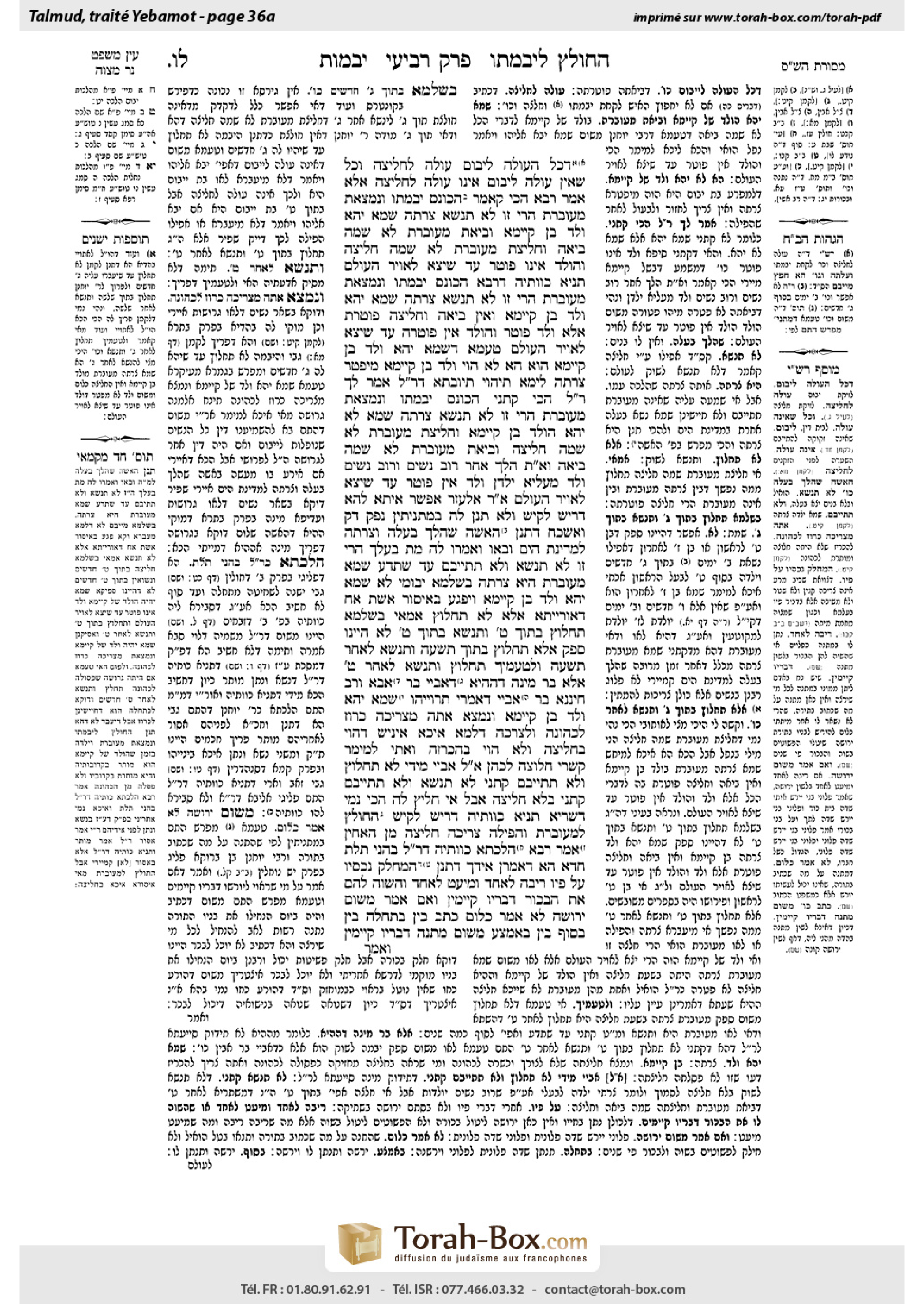
Yevamot 36a: Talmud study for Daf Yomi
Daf Yomi is the daily study of one Talmud folio. Explore 37 tractates with scans, Hebrew text, Sefaria English and AI-generated French translations where annotated.
Passage selection and English or AI-generated French translation are available where the scan has annotations. Daf Study is independent of Torah-Box and Sefaria.
Browse Yevamot · יבמות · All tractatesYevamot 36a text and translations
This page of Yevamot includes the Aramaic text, an English translation and an AI-generated French translation, alongside the scan above.
יבמות ל״ו א · Aramaic and Hebrew text
דְּכׇל הָעוֹלֶה לְיִבּוּם — עוֹלֶה לַחֲלִיצָה, וְכֹל שֶׁאֵין עוֹלֶה לְיִבּוּם — אֵינוֹ עוֹלֶה לַחֲלִיצָה.
אֶלָּא אָמַר רָבָא, הָכִי קָאָמַר: הַכּוֹנֵס יְבִמְתּוֹ וְנִמְצֵאת מְעוּבֶּרֶת — הֲרֵי זוֹ לֹא תִּנָּשֵׂא צָרָתָהּ, שֶׁמָּא יְהֵא וָלָד בֶּן קַיָּימָא. וּבִיאַת מְעוּבֶּרֶת לֹא שְׁמָהּ בִּיאָה, וַחֲלִיצַת מְעוּבֶּרֶת לֹא שְׁמָהּ חֲלִיצָה. וְהַוָּלָד אֵינוֹ פּוֹטֵר עַד שֶׁיֵּצֵא לַאֲוִיר הָעוֹלָם.
תַּנְיָא כְּווֹתֵיהּ דְּרָבָא: הַכּוֹנֵס יְבִמְתּוֹ וְנִמְצֵאת מְעוּבֶּרֶת — הֲרֵי זוֹ לֹא תִּנָּשֵׂא צָרָתָהּ, שֶׁמָּא יְהֵא וָלָד בֶּן קַיָּימָא, וְאֵין בִּיאָה וַחֲלִיצָה פּוֹטֶרֶת, אֶלָּא וָלָד פּוֹטֵר. וְהַוָּלָד אֵין פּוֹטְרָהּ עַד שֶׁיֵּצֵא לַאֲוִיר הָעוֹלָם.
טַעְמָא דְּשֶׁמָּא יְהֵא וָלָד בֶּן קַיָּימָא הוּא, הָא לָא הָוֵי וָלָד בֶּן קַיָּימָא מִיפַּטְרָא צָרָתָהּ, לֵימָא תֶּיהְוֵי תְּיוּבְתָּא דְּרֵישׁ לָקִישׁ!
אָמַר לָךְ רֵישׁ לָקִישׁ, הָכִי קָתָנֵי: הַכּוֹנֵס יְבִמְתּוֹ וְנִמְצֵאת מְעוּבֶּרֶת — הֲרֵי זוֹ לֹא תִּנָּשֵׂא צָרָתָהּ, שֶׁמָּא לֹא יְהֵא הַוָּלָד בֶּן קַיָּימָא, וַחֲלִיצַת מְעוּבֶּרֶת לֹא שְׁמָהּ חֲלִיצָה, וּבִיאַת מְעוּבֶּרֶת לֹא שְׁמָהּ בִּיאָה.
וְאִם תֹּאמַר: הַלֵּךְ אַחַר רוֹב נָשִׁים, וְרוֹב נָשִׁים וָלָד מְעַלְּיָא יָלְדָן, וָלָד אֵין פּוֹטֵר עַד שֶׁיֵּצֵא לַאֲוִיר הָעוֹלָם.
אָמַר רַבִּי אֶלְעָזָר: אֶפְשָׁר אִיתָא לְהָא דְּרֵישׁ לָקִישׁ וְלָא תְּנַן לָהּ בְּמַתְנִיתִין? נְפַק, דַּק וְאַשְׁכַּח, דִּתְנַן: הָאִשָּׁה שֶׁהָלַךְ בַּעְלָהּ וְצָרָתָהּ לִמְדִינַת הַיָּם, וּבָאוּ וְאָמְרוּ לָהּ ״מֵת בַּעְלִיךְ״ — הֲרֵי זוֹ לֹא תִּנָּשֵׂא וְלֹא תִּתְיַיבֵּם עַד שֶׁתֵּדַע שֶׁמָּא מְעוּבֶּרֶת הִיא צָרָתָהּ.
בִּשְׁלָמָא יַבּוֹמֵי לָא — שֶׁמָּא יְהֵא וָלָד בֶּן קַיָּימָא, וְיִפְגַּע בְּאִיסּוּר אֵשֶׁת אָח דְּאוֹרָיְיתָא, אֶלָּא: לֹא תַּחְלוֹץ, אַמַּאי? בִּשְׁלָמָא תַּחְלוֹץ בְּתוֹךְ תִּשְׁעָה וְתִנָּשֵׂא בְּתוֹךְ תִּשְׁעָה — לָא, הַיְינוּ סָפֵק.
אֶלָּא תַּחְלוֹץ בְּתוֹךְ תִּשְׁעָה, וְתִנָּשֵׂא לְאַחַר תִּשְׁעָה.
וּלְטַעְמָיךְ: תַּחְלוֹץ וְתִנָּשֵׂא לְאַחַר תִּשְׁעָה!
אֶלָּא, בַּר מִינַּהּ דְּהַהִיא. דְּאַבָּיֵי בַּר אַבָּא וְרַב חִינָּנָא בַּר אַבָּיֵי דְּאָמְרִי תַּרְוַיְיהוּ: שֶׁמָּא יְהֵא וָלָד בֶּן קַיָּימָא, וְנִמְצָא אַתָּה מַצְרִיכָהּ כָּרוֹז לַכְּהוּנָּה.
וְלַצְרְכַהּ! דִּלְמָא אִיכָּא אִינִישׁ דְּהָוֵי בַּחֲלִיצָה וְלָא הָוֵי בְּהַכְרָזָה, וְאָתֵי לְמֵימַר: קָשָׁרֵי חֲלוּצָה לְכֹהֵן.
אֲמַר לֵיהּ אַבָּיֵי: מִידֵּי ״לֹא תַּחְלוֹץ וְלֹא תִּתְיַיבֵּם״ קָתָנֵי? ״לֹא תִּנָּשֵׂא וְלֹא תִּתְיַיבֵּם״ קָתָנֵי, בְּלֹא חֲלִיצָה, אֲבָל אִי חָלֵיץ לַהּ — הָכִי נָמֵי דְּשַׁרְיָא.
תַּנְיָא כְּווֹתֵיהּ דְּרֵישׁ לָקִישׁ: הַחוֹלֵץ לִמְעוּבֶּרֶת וְהִפִּילָה — צְרִיכָה חֲלִיצָה מִן הָאַחִין.
אָמַר רָבָא: הִלְכְתָא כְּווֹתֵיהּ דְּרֵישׁ לָקִישׁ בְּהָנֵי תְּלָת: חֲדָא — הָא דַּאֲמַרַן. אִידַּךְ, דִּתְנַן: הַמְחַלֵּק נְכָסָיו עַל פִּיו, רִיבָּה לְאֶחָד וּמִיעֵט לְאֶחָד, וְהִשְׁוָה לָהֶם אֶת הַבְּכוֹר — דְּבָרָיו קַיָּימִין.
וְאִם אָמַר מִשּׁוּם יְרוּשָּׁה — לֹא אָמַר כְּלוּם. כָּתַב, בֵּין בַּתְּחִלָּה בֵּין בַּסּוֹף בֵּין בָּאֶמְצַע, מִשּׁוּם מַתָּנָה — דְּבָרָיו קַיָּימִין.
Yevamot 36a · English translation
that anyone who is eligible for levirate marriage is eligible for ḥalitza and anyone who is not eligible for levirate marriage is not eligible for ḥalitza. Therefore, the original understanding of Rabbi Yoḥanan’s opinion, that both the intercourse and the ḥalitza of a pregnant woman are valid, was accurate.
Rava therefore provides a different defense of Rabbi Yoḥanan’s opinion: Rather, Rava said that this is what the baraita is saying: In the case of one who consummates the levirate marriage with his yevama under the assumption that there is a mitzva to do so, and then she is found to have been pregnant at the time of the intercourse, a rival wife of this yevama may not marry lest the offspring be viable, and intercourse with a woman pregnant with viable offspring is not considered a valid consummation of levirate marriage through intercourse, and ḥalitza of a woman pregnant with viable offspring is not considered effective ḥalitza. And furthermore, even if the offspring is viable, it does not release her and her rival wives from the levirate bond until it comes into the air of the world, i.e., until it is actually born.
It is taught in a baraita in accordance with the opinion of Rava: In the case of one who consummates a levirate marriage with his yevama, and then she is found to have been pregnant at the time of the intercourse, a rival wife of this yevama may not marry lest the offspring be viable. This is because intercourse or ḥalitza with a woman pregnant with viable offspring does not release a yevama from the levirate bond; rather, the offspring releases her. And furthermore, even if the offspring is viable, it does not release her and her rival wives from the levirate marriage bond until it comes into the air of the world.
The Gemara explains that the baraita appears to contradict Reish Lakish’s opinion: According to the baraita, the only reason that levirate marriage with the pregnant yevama does not permit the rival wife to marry is as the baraita stated: Lest the offspring be viable. By inference, were the offspring not viable, her rival wife would be released from the levirate bond. If so, let us say that this baraita is a conclusive refutation of the opinion of Reish Lakish.
The Gemara defends Reish Lakish’s opinion: Reish Lakish could have said to you: This is what the baraita is teaching: In the case of one who consummates a levirate marriage with his yevama, and then she was found to have been pregnant at the time of the intercourse, a rival wife of this yevama may not marry lest the offspring not be viable, which would mean that all the rival wives are bound by the levirate bond. And even if one of those wives has intercourse or performs ḥalitza with the yavam, it would be ineffective in releasing them from the levirate bond because ḥalitza with a pregnant woman is not considered effective ḥalitza, and intercourse with a pregnant woman is not considered a valid consummation of levirate marriage through intercourse.
Reish Lakish explains the need for the final clause of the baraita: And even if you say: Let the wives marry without the need for any levirate marriage or ḥalitza because one should follow the majority of women, and the majority of women give birth to a full-fledged, i.e., viable, offspring, and therefore one should presume no levirate bond exists, to counter this claim the baraita concludes: Even if the offspring will be viable, an offspring does not release a yevama and her rival wives from the levirate bond until it comes into the air of the world.
Rabbi Elazar said: Is it possible that there is halakhic acceptance of this opinion of Reish Lakish and it was not hinted to by something taught in the Mishna? He went out of the study hall, carefully checked the mishnayot, and found one that supported Reish Lakish’s opinion, as we learned in a mishna: In the case of a woman whose husband and rival wife went overseas, and then witnesses came and said to her: Your husband died, and her husband had a brother, this woman may neither marry someone other than his brother, nor may she enter into levirate marriage with that brother, until she knows whether perhaps her rival wife is pregnant. If she discovers that her rival wife is not pregnant, she would then be able to perform levirate marriage or ḥalitza. If she discovers her rival wife is pregnant, she would have to wait to see if the pregnancy is viable. If it is found to be viable, only at that point would she be permitted to marry someone else.
Rabbi Elazar explains how this mishna supports Reish Lakish’s opinion: Granted, she may not enter levirate marriage as perhaps her rival wife is pregnant and the offspring will be viable, and therefore by consummating the levirate marriage the yavam would encounter the Torah prohibition against engaging in relations with one’s brother’s wife. But why may she not perform ḥalitza? Granted, she may not perform ḥalitza during the first nine months following her husband’s death and then proceed to also marry during those nine months; this is prohibited due to the fact that there is the uncertainty whether her rival wife is pregnant with viable offspring, in which case she would be released from the levirate bond.
But let her perform ḥalitza during the first nine months following her husband’s death and then wait to marry until after those nine months. By that point in time, even if the rival wife was pregnant she would have already given birth. If the offspring was viable, then it emerges that there was never a levirate bond, and if it is not viable, then she was released from her levirate bond through the ḥalitza she performed. Either way, she would now be permitted to remarry. Why, then, does the mishna not consider this possibility? Rabbi Elazar claims that the only explanation for this is if the mishna assumes that ḥalitza performed while one of the wives of the deceased is pregnant is not effective. As such, the mishna is a proof for Reish Lakish’s opinion.
The Gemara rejects Rabbi Elazar’s proof: But even according to your reasoning that ḥalitza with a pregnant woman is not effective, the mishna should have considered an additional possibility: Let her perform ḥalitza and marry, doing both after nine months have passed since the death of her husband. Doing so should be effective according to both Reish Lakish and Rabbi Yoḥanan.
Rather, the discussion of this topic should be held apart from that mishna, as the true reason for that mishna’s ruling is as it is Abaye bar Abba and Rav Ḥinnana bar Abaye who both say that she is prohibited from performing ḥalitza while one of the wives of the deceased is pregnant because perhaps the offspring will be viable, in which case any ḥalitza performed would be entirely unnecessary and therefore meaningless, and she would remain permitted to marry into the priesthood, as the opening mishna of the chapter rules. However, in this situation people might not realize that the ḥalitza she performed was meaningless, and they would think she is a ḥalutza, who is prohibited from marrying a priest. And it would therefore emerge that if she were allowed to perform ḥalitza while pregnant, it is possible that you will ultimately require a public announcement to be made for her to attest to the fact that she is in fact still permitted to marry into the priesthood.
The Gemara wonders why this poses a problem: But why not let her perform ḥalitza while still pregnant, and then if it becomes necessary, require a public announcement to be made for her? The Gemara explains why one should avoid having to rely on a public announcement: Perhaps there were some people who were present at the ḥalitza and were not present at the public announcement, and when the courts permit her to marry a priest they might come to say that they are permitting a ḥalutza to marry a priest.
Abaye suggests another rejection of Rabbi Elazar’s proof from that mishna: Abaye said to Rabbi Elazar: The very formulation of the mishna refutes Reish Lakish’s opinion, as does the mishna teach that she may neither perform ḥalitza nor enter into levirate marriage? No, the mishna teaches only that she may neither be married nor enter into levirate marriage, which implies only that she may not marry without first performing ḥalitza, but if the yavam performs ḥalitza with her, she would indeed be permitted to marry after nine months have passed since her husband’s death. This understanding of the mishna undermines the basis of Rabbi Elazar’s proof from the mishna.
Even if that mishna does not support Reish Lakish’s opinion, nevertheless it is taught in a baraita in accordance with the opinion of Reish Lakish: In the case of one who performs ḥalitza with a pregnant woman and she miscarries, she requires another ḥalitza with the brothers in order to release her from the levirate bond. The baraita assumes that the original ḥalitza is ineffective because it was done while she was still pregnant, which is in accordance with the opinion of Reish Lakish.
Rava said: The halakha is in accordance with the opinion of Reish Lakish in these three disputes: One, this dispute that we already stated with regard to the ḥalitza of a pregnant woman. The other dispute concerns that which we learned in a mishna: In the case of one who verbally divides up his possessions among his descendants, stating how he wishes his estate to be divided after his death, if he increases the proportion of his estate that should go to one of his children or decreases the proportion of his estate that should go to another one of his children, or if he equally distributes between them the double portion of the firstborn, then his words are binding.
But if he said explicitly that the receipt of those portions should be considered as an inheritance, then it as though the verbal division of his property that he said is nothing, i.e., it is non-binding, since his words directly contradict the halakhot of inheritance as they are written in the Torah. However, if he wrote a will and somewhere therein he wrote, whether at the beginning, whether at the end, or whether in the middle, that the receipt of the portions should be considered as a gift, as opposed to an inheritance, then his words are binding.
Yevamot 36a · Traduction française (IA)
que toute personne qui est apte au mariage léviratique est apte à la ḥalitsa, et que toute personne qui n’est pas apte au mariage léviratique n’est pas apte à la ḥalitsa. Par conséquent, l’interprétation initiale de l’opinion de Rabbi Yoḥanan, selon laquelle tant le rapport sexuel que la ḥalitsa d’une femme enceinte sont valides, était exacte.
Rava propose donc une autre défense de l’opinion de Rabbi Yoḥanan : il dit plutôt que voici ce qu’enseigne la baraïta : dans le cas d’un homme qui consomme le mariage léviratique avec sa yevama en pensant qu’il est tenu de le faire, puis découvre qu’elle était enceinte au moment du rapport sexuel, une épouse rivale de cette yevama ne peut pas se marier, de peur que l’enfant soit viable. En effet, le rapport sexuel avec une femme enceinte d’un enfant viable n’est pas considéré comme une consommation valide du mariage léviratique, et la ḥalitsa accomplie avec une femme enceinte d’un enfant viable n’est pas considérée comme une ḥalitsa efficace. En outre, même si l’enfant est viable, il ne libère la yevama et ses épouses rivales du lien léviratique qu’une fois venu au monde, c’est-à-dire lorsqu’il est effectivement né.
Une baraïta est enseignée conformément à l’opinion de Rava : dans le cas d’un homme qui consomme le mariage léviratique avec sa yevama, puis découvre qu’elle était enceinte au moment du rapport sexuel, une épouse rivale de cette yevama ne peut pas se marier, de peur que l’enfant soit viable. En effet, ni le rapport sexuel ni la ḥalitsa avec une femme enceinte d’un enfant viable ne libèrent une yevama du lien léviratique ; c’est l’enfant qui la libère. En outre, même si l’enfant est viable, il ne libère la yevama et ses épouses rivales du lien léviratique qu’une fois venu au monde.
La Guemara explique que la baraïta semble contredire l’opinion de Reish Lakish : selon la baraïta, la seule raison pour laquelle le mariage léviratique avec la yevama enceinte ne permet pas à son épouse rivale de se marier est celle qu’elle indique : de peur que l’enfant soit viable. On en déduit que si l’enfant n’était pas viable, son épouse rivale serait libérée du lien léviratique. Si tel est le cas, ne faut-il pas dire que cette baraïta réfute définitivement l’opinion de Reish Lakish ?
La Guemara défend l’opinion de Reish Lakish : celui-ci aurait pu te répondre que voici ce qu’enseigne la baraïta : dans le cas d’un homme qui consomme le mariage léviratique avec sa yevama, puis découvre qu’elle était enceinte au moment du rapport sexuel, une épouse rivale de cette yevama ne peut pas se marier, de peur que l’enfant ne soit pas viable, auquel cas toutes les épouses rivales restent soumises au lien léviratique. Même si l’une d’elles a un rapport sexuel avec le yavam ou accomplit la ḥalitsa, cela ne les libérerait pas du lien léviratique, car la ḥalitsa accomplie avec une femme enceinte n’est pas considérée comme efficace et le rapport sexuel avec une femme enceinte n’est pas considéré comme une consommation valide du mariage léviratique.
Reish Lakish explique pourquoi la clause finale de la baraïta est nécessaire : même si tu dis que les épouses peuvent se marier sans mariage léviratique ni ḥalitsa, puisqu’il faut suivre la majorité des femmes, qui donnent naissance à un enfant à terme, c’est-à-dire viable, et qu’il faut donc présumer qu’il n’existe pas de lien léviratique, la baraïta conclut pour réfuter cette affirmation : même si l’enfant est viable, il ne libère la yevama et ses épouses rivales du lien léviratique qu’une fois venu au monde.
Rabbi Elazar dit : est-il possible que cette opinion de Reish Lakish soit admise en halakha sans qu’elle soit suggérée par un enseignement de la Michna ? Il sortit de la maison d’étude, examina soigneusement les michnayot et en trouva une qui appuyait l’opinion de Reish Lakish, comme nous l’avons appris dans une Michna : dans le cas d’une femme dont le mari et l’épouse rivale sont partis outre-mer, puis à qui des témoins disent : « Ton mari est mort », et dont le mari avait un frère, elle ne peut ni épouser un autre homme ni contracter un mariage léviratique avec ce frère avant de savoir si son épouse rivale est peut-être enceinte. Si elle découvre que son épouse rivale n’est pas enceinte, elle pourra alors contracter un mariage léviratique ou accomplir la ḥalitsa. Si elle découvre que son épouse rivale est enceinte, elle devra attendre pour savoir si l’enfant sera viable. Si l’enfant s’avère viable, ce n’est qu’à ce moment-là qu’elle sera autorisée à épouser un autre homme.
Rabbi Elazar explique en quoi cette Michna appuie l’opinion de Reish Lakish : il est compréhensible qu’elle ne puisse pas contracter de mariage léviratique, car son épouse rivale est peut-être enceinte et l’enfant sera viable ; en consommant le mariage léviratique, le yavam enfreindrait alors l’interdiction de la Torah d’avoir des relations avec la femme de son frère. Mais pourquoi ne peut-elle pas accomplir la ḥalitsa ? Il est compréhensible qu’elle ne puisse pas accomplir la ḥalitsa pendant les neuf premiers mois suivant la mort de son mari puis se marier au cours de ces mêmes neuf mois ; cela est interdit parce qu’on ne sait pas si son épouse rivale est enceinte d’un enfant viable, auquel cas elle serait libérée du lien léviratique.
Mais qu’elle accomplisse la ḥalitsa pendant les neuf premiers mois suivant la mort de son mari, puis attende la fin de ces neuf mois pour se marier. À ce moment-là, même si l’épouse rivale était enceinte, elle aurait déjà accouché. Si l’enfant était viable, il s’ensuivrait qu’il n’y a jamais eu de lien léviratique ; s’il n’était pas viable, la femme aurait été libérée du lien léviratique par la ḥalitsa qu’elle avait accomplie. Dans les deux cas, elle serait désormais autorisée à se remarier. Pourquoi, alors, la Michna n’envisage-t-elle pas cette possibilité ? Rabbi Elazar affirme que la seule explication est que la Michna considère qu’une ḥalitsa accomplie alors que l’une des épouses du défunt est enceinte n’est pas efficace. Ainsi, la Michna constitue une preuve à l’appui de l’opinion de Reish Lakish.
La Guemara rejette la preuve de Rabbi Elazar : mais même selon ton raisonnement, à savoir que la ḥalitsa accomplie avec une femme enceinte n’est pas efficace, la Michna aurait dû envisager une autre possibilité : qu’elle accomplisse la ḥalitsa et se marie, les deux après que neuf mois se sont écoulés depuis la mort de son mari. Cette démarche serait efficace selon l’opinion de Reish Lakish comme selon celle de Rabbi Yoḥanan.
Il faut plutôt dissocier cette discussion de cette Michna, car la véritable raison de la règle qu’elle énonce est celle donnée par Abaye bar Abba et Rav Ḥinnana bar Abaye, qui disent tous deux qu’elle ne peut pas accomplir la ḥalitsa tant que l’une des épouses du défunt est enceinte, car l’enfant sera peut-être viable. Dans ce cas, toute ḥalitsa accomplie serait entièrement superflue et donc sans effet, et elle resterait autorisée à épouser un membre de la prêtrise, comme le stipule la Michna d’ouverture du chapitre. Cependant, dans cette situation, les gens pourraient ne pas comprendre que la ḥalitsa qu’elle a accomplie était sans effet et penser qu’elle est une ḥaloutsa, qui n’a pas le droit d’épouser un prêtre. Ainsi, si on lui permettait d’accomplir la ḥalitsa pendant la grossesse, il pourrait finalement être nécessaire de faire une annonce publique attestant qu’elle reste effectivement autorisée à épouser un membre de la prêtrise.
La Guemara s’interroge sur cette difficulté : pourquoi ne pas la laisser accomplir la ḥalitsa alors qu’elle est encore enceinte, puis, si nécessaire, faire une annonce publique à son sujet ? La Guemara explique pourquoi il faut éviter de s’en remettre à une annonce publique : certaines personnes pourraient avoir assisté à la ḥalitsa sans être présentes lors de l’annonce publique ; lorsque les tribunaux l’autoriseraient à épouser un prêtre, elles pourraient alors dire qu’ils autorisent une ḥaloutsa à épouser un prêtre.
Abaye propose une autre réfutation de la preuve que Rabbi Elazar tire de cette Michna. Il dit à Rabbi Elazar : la formulation même de la Michna réfute l’opinion de Reish Lakish. La Michna enseigne-t-elle qu’elle ne peut ni accomplir la ḥalitsa ni contracter un mariage léviratique ? Non, elle enseigne seulement qu’elle ne peut ni se marier ni contracter un mariage léviratique, ce qui implique seulement qu’elle ne peut pas se marier sans avoir d’abord accompli la ḥalitsa. Mais si le yavam accomplit la ḥalitsa avec elle, elle serait effectivement autorisée à se marier après que neuf mois se sont écoulés depuis la mort de son mari. Cette interprétation de la Michna sape le fondement de la preuve que Rabbi Elazar en tire.
Même si cette Michna n’appuie pas l’opinion de Reish Lakish, une baraïta est néanmoins enseignée conformément à cette opinion : dans le cas d’un homme qui accomplit la ḥalitsa avec une femme enceinte et que celle-ci fait une fausse couche, elle doit accomplir une nouvelle ḥalitsa avec les frères afin d’être libérée du lien léviratique. La baraïta suppose que la première ḥalitsa est sans effet parce qu’elle a été accomplie alors qu’elle était encore enceinte, conformément à l’opinion de Reish Lakish.
Rava dit : la halakha suit l’opinion de Reish Lakish dans ces trois différends. Le premier est celui que nous avons déjà mentionné, concernant la ḥalitsa d’une femme enceinte. L’autre différend concerne ce que nous avons appris dans une Michna : dans le cas d’un homme qui répartit verbalement ses biens entre ses descendants, en indiquant comment il souhaite que sa succession soit répartie après sa mort, s’il augmente la part destinée à l’un de ses enfants ou diminue celle destinée à un autre, ou s’il partage également entre eux la double part du premier-né, ses paroles sont contraignantes.
Mais s’il précise que la réception de ces parts doit être considérée comme un héritage, c’est comme si la répartition verbale de ses biens n’avait aucune valeur, c’est-à-dire qu’elle n’était pas contraignante, puisque ses paroles contredisent directement les lois de l’héritage telles qu’elles sont écrites dans la Torah. En revanche, s’il rédige un testament et y écrit quelque part, au début, à la fin ou au milieu, que les parts reçues doivent être considérées comme un don et non comme un héritage, ses paroles sont contraignantes.
Traduction française générée par IA à partir de l’édition anglaise de Sefaria. Vérifie toujours un passage avec le texte source.
Text from Sefaria: William Davidson Edition - Vocalized Aramaic (CC BY NC); William Davidson Edition - English (CC BY NC).