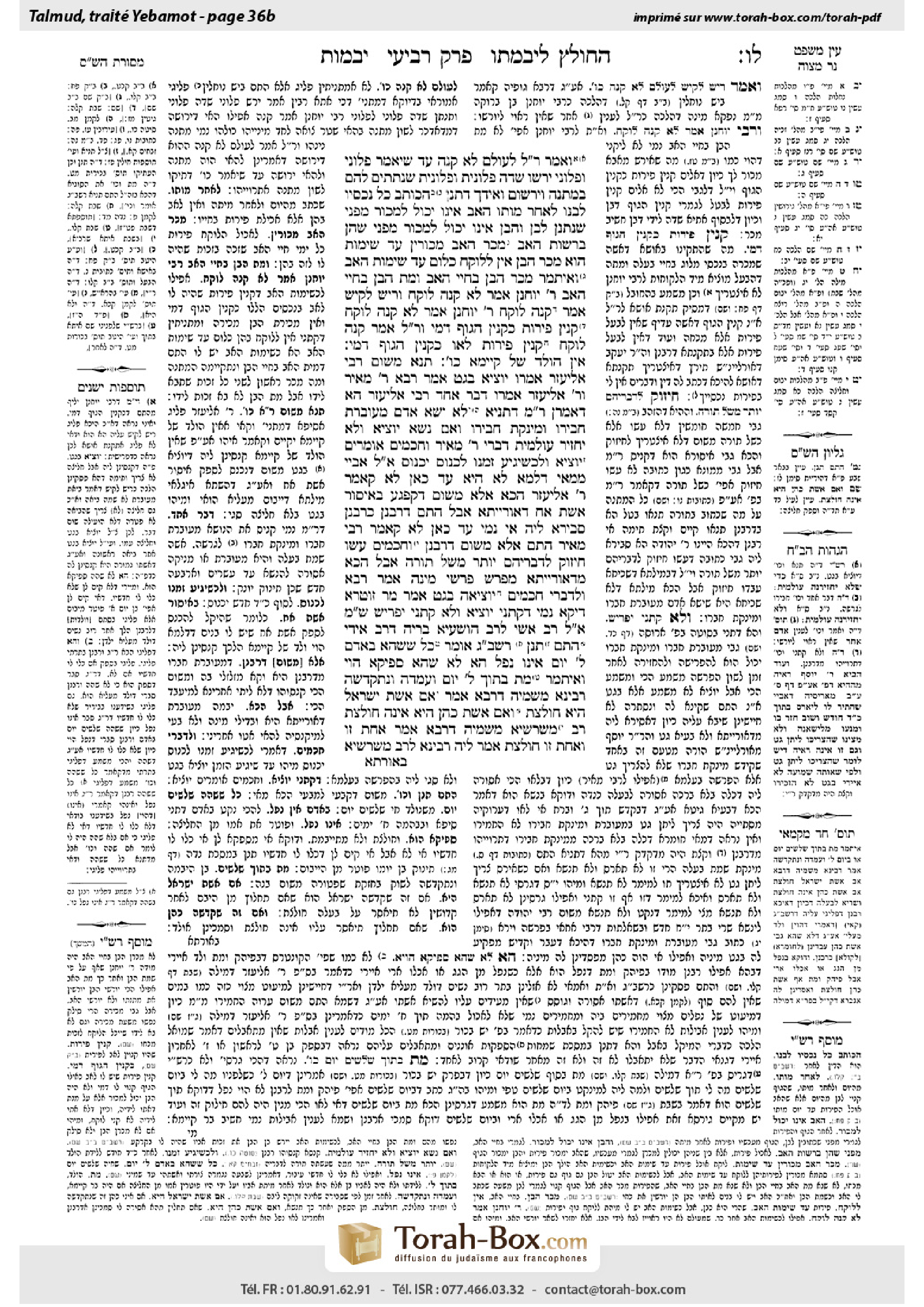
Yevamot 36b: Talmud study for Daf Yomi
Daf Yomi is the daily study of one Talmud folio. Explore 37 tractates with scans, Hebrew text, Sefaria English and AI-generated French translations where annotated.
Passage selection and English or AI-generated French translation are available where the scan has annotations. Daf Study is independent of Torah-Box and Sefaria.
Browse Yevamot · יבמות · All tractatesYevamot 36b text and translations
This page of Yevamot includes the Aramaic text, an English translation and an AI-generated French translation, alongside the scan above.
יבמות ל״ו ב · Aramaic and Hebrew text
וְאָמַר רֵישׁ לָקִישׁ — לְעוֹלָם לֹא קָנָה עַד שֶׁיֹּאמַר ״פְּלוֹנִי וּפְלוֹנִי יִרְשׁוּ שָׂדֶה פְּלוֹנִית וּפְלוֹנִית שֶׁנְּתַתִּים לָהֶם בְּמַתָּנָה וְיִרָשׁוּם״.
וְאִידַּךְ, דִּתְנַן: הַכּוֹתֵב כׇּל נְכָסָיו לִבְנוֹ לְאַחַר מוֹתוֹ, הָאָב אֵינוֹ יָכוֹל לִמְכּוֹר — מִפְּנֵי שֶׁנְּתָנָן לַבֵּן, וְהַבֵּן אֵינוֹ יָכוֹל לִמְכּוֹר — מִפְּנֵי שֶׁהֵן בִּרְשׁוּת הָאָב. מָכַר הָאָב — מְכוּרִין עַד שֶׁיָּמוּת הוּא, מָכַר הַבֵּן — אֵין לַלּוֹקֵחַ כְּלוּם עַד שֶׁיָּמוּת הָאָב.
וְאִיתְּמַר: מָכַר הַבֵּן בְּחַיֵּי הָאָב, וּמֵת הַבֵּן בְּחַיֵּי הָאָב. רַבִּי יוֹחָנָן אָמַר: לֹא קָנָה לוֹקֵחַ, וְרֵישׁ לָקִישׁ אָמַר: קָנָה לוֹקֵחַ.
רַבִּי יוֹחָנָן אָמַר לֹא קָנָה לוֹקֵחַ — קִנְיַן פֵּירוֹת כְּקִנְיַן הַגּוּף דָּמֵי.
וְרֵישׁ לָקִישׁ אָמַר קָנָה לוֹקֵחַ — קִנְיַן פֵּירוֹת לָאו כְּקִנְיַן הַגּוּף דָּמֵי.
אֵין הַוָּלָד שֶׁל קַיָּימָא כּוּ׳. תָּנָא: מִשּׁוּם רַבִּי אֱלִיעֶזֶר אָמְרוּ — יוֹצִיא בְּגֵט.
אָמַר רָבָא: רַבִּי מֵאִיר וְרַבִּי אֱלִיעֶזֶר אָמְרוּ דָּבָר אֶחָד: רַבִּי אֱלִיעֶזֶר הָא דַּאֲמַרַן.
רַבִּי מֵאִיר דְּתַנְיָא: לֹא יִשָּׂא אָדָם מְעוּבֶּרֶת חֲבֵירוֹ, וּמֵינֶקֶת חֲבֵירוֹ. וְאִם נָשָׂא — יוֹצִיא וְלֹא יַחְזִיר עוֹלָמִית, דִּבְרֵי רַבִּי מֵאִיר. וַחֲכָמִים אוֹמְרִים: יוֹצִיא, וְלִכְשֶׁיַּגִּיעַ זְמַנּוֹ לִכְנוֹס — יִכְנוֹס.
אֲמַר לֵיהּ אַבָּיֵי: מִמַּאי? דִּלְמָא לָא הִיא, עַד כָּאן לָא קָאָמַר רַבִּי אֱלִיעֶזֶר הָכָא, אֶלָּא מִשּׁוּם דְּקָפָגֵע בְּאִיסּוּר אֵשֶׁת אָח דְּאוֹרָיְיתָא, אֲבָל הָתָם דְּרַבָּנַן — כְּרַבָּנַן סְבִירָא לֵיהּ!
אִי נָמֵי: עַד כָּאן לָא קָאָמַר רַבִּי מֵאִיר הָתָם, אֶלָּא מִשּׁוּם דְּרַבָּנַן, וַחֲכָמִים עָשׂוּ חִיזּוּק לְדִבְרֵיהֶם יוֹתֵר מִשֶּׁל תּוֹרָה, אֲבָל הָכָא מִדְּאוֹרָיְיתָא — מִפְרָשׁ פָּרְשִׁי מִינַּהּ.
אָמַר רָבָא, וּלְדִבְרֵי חֲכָמִים: יוֹצִיאָהּ בְּגֵט. אָמַר מָר זוּטְרָא: דַּיְקָא נָמֵי, דְּקָתָנֵי: ״יוֹצִיא״, וְלָא קָתָנֵי: ״יַפְרִישׁ״. שְׁמַע מִינַּהּ.
אֲמַר לֵיהּ רַב אָשֵׁי לְרַב הוֹשַׁעְיָא בְּרֵיהּ דְּרַב אִידִי: הָתָם תְּנַן, רַבָּן שִׁמְעוֹן בֶּן גַּמְלִיאֵל אוֹמֵר: כׇּל שֶׁשָּׁהָא בְּאָדָם שְׁלֹשִׁים יוֹם — אֵינוֹ נֵפֶל. הָא לָא שְׁהָא — סְפֵיקָא הָוֵי.
וְאִיתְּמַר: מֵת בְּתוֹךְ שְׁלֹשִׁים יוֹם, וְעָמְדָה וְנִתְקַדְּשָׁה,
רָבִינָא מִשְּׁמֵיהּ דְּרָבָא אָמַר: אִם אֵשֶׁת יִשְׂרָאֵל הִיא — חוֹלֶצֶת, וְאִם אֵשֶׁת כֹּהֵן הִיא — אֵינָהּ חוֹלֶצֶת.
רַב מְשַׁרְשְׁיָא מִשְּׁמֵיהּ דְּרָבָא אָמַר: אַחַת זוֹ וְאַחַת זוֹ — חוֹלֶצֶת.
אֲמַר לֵיהּ רָבִינָא לְרַב מְשַׁרְשְׁיָא:
Yevamot 36b · English translation
Reish Lakish and Rabbi Yoḥanan dispute whether one must state that the receipt of the portions should be considered as a gift with regard to each recipient, or whether stating it with regard to one of them is enough to indicate that it is true for all. And Reish Lakish said: The inheritors will only ever acquire the portions as defined by the owner of the possessions once he says: So-and-so and so-and-so shall inherit such and such a field and such and such a field that I have given to them as a gift, and they shall inherit them, i.e., he must state explicitly for each recipient that their receipt of the portions should be considered a gift. Rava ruled that in this dispute as well, the halakha is in accordance with Reish Lakish.
And the other dispute concerns that which we learned in a mishna: In the case of one who writes a bill transferring ownership of all of his possessions to his son stating that the transfer should take effect immediately so that the son should gain the rights to use the possessions after his death, then although the father retained for himself the right to use the possessions until his death, he is unable to sell the possessions due to the fact that he gave them to the son, and the son is unable to sell the possessions due to the fact that they are still in the father’s possession. If the father sold the possessions, then they are sold to the extent that the purchaser may use them until the father dies. If the son sold the possessions during his father’s lifetime, the purchaser does not receive any rights to use the possessions until the father dies.
And an amoraic dispute was stated in the case in which the son sold the possessions during the father’s lifetime, and then the son died during the father’s lifetime, following which the father died as well. Rabbi Yoḥanan said: The purchaser does not acquire anything, and Reish Lakish said: The purchaser does acquire the possessions.
The Gemara explains their reasoning: Rabbi Yoḥanan said that the purchaser does not acquire anything, because he holds that the ownership of the rights to an item and its produce is tantamount to the ownership of the item itself, i.e., the actual title to it. Since the father retained the rights to use the possessions until his death, as long as he lives he is considered to hold the title to them. Therefore, the son’s sale can be effective only after the father’s death, at which point the son becomes the title owner. However, if the son dies first, then since he never gained the title to the items, his sale can never come to fruition.
And Reish Lakish said: The purchaser does acquire the possessions, as Reish Lakish holds that the ownership of the rights to an item and its produce is not tantamount to the ownership of the item itself, i.e., the actual title to it. Therefore, although the father is still alive, the son immediately gains the full title to the possessions, which he may sell to someone else. Nevertheless, since the father retains the rights to use the possessions, the purchaser may use the possessions he acquired only when the father dies.
§ The mishna states that if a yavam consummates a levirate marriage with his yevama while she is pregnant, if it emerges that the offspring is not viable then he may maintain her as his wife because his intercourse with her was a valid consummation of levirate marriage. An opposing opinion is taught in a baraita: In the name of Rabbi Eliezer they said: He must send her out with a bill of divorce. Although it emerged that the levirate marriage took effect, since at the time he consummated the levirate marriage it was prohibited to do so because the yevama was pregnant, he is therefore penalized and required to separate from her.
Rava said: Rabbi Meir and Rabbi Eliezer said the same thing, i.e., they both expressed the same opinion that if one marries a woman whom he is prohibited from marrying, he is penalized and required to divorce her, even if the reason for the prohibition no longer applies. Rabbi Eliezer’s opinion was expressed in this ruling we have just stated.
Where was Rabbi Meir’s opinion expressed? As it is taught in a baraita: A man may not marry a woman who is pregnant with the child of another man, nor a woman who is nursing the child of another man. And if he transgressed and married her, he is penalized for violating the prohibition, and he must divorce her with a bill of divorce, and he may never take her back; this is the statement of Rabbi Meir. And the Rabbis say: He must send her out, and when the time comes in which it is permitted to marry her, i.e., after the child is weaned, he may then marry her again.
Abaye said to him: From where do you deduce that they are of one opinion? Perhaps that is not so, as it is possible that Rabbi Eliezer states his ruling only here, in the case of a yavam who consummated a levirate marriage with his yevama while she was still pregnant, due to the fact that by doing so he risks the possibility that the offspring will be viable, in which case he encounters the Torah prohibition against engaging in relations with one’s brother’s wife. However, there, in the case where one married a woman who is pregnant with the child of another man, which is a rabbinic prohibition, it is possible that he holds in accordance with the opinion of the Rabbis who argue with Rabbi Meir.
Alternatively, it is also possible that Rabbi Meir states his ruling only there, in the case where one married a woman who is pregnant with the child of another man, due to the fact that doing so is a violation of a rabbinic prohibition, and therefore it is possible that this is one of the cases in which the Sages reinforced their pronouncements with greater severity than prohibitions of Torah law so that people would not treat them lightly. However, here, in the case of a yavam who consummated a levirate marriage with his yevama while she was still pregnant, where there was a risk of transgressing a prohibition written in the Torah, since people are generally careful to distance themselves from a Torah prohibition, there is no need to further penalize someone who nevertheless transgressed.
Rava said: According to the statement of the Rabbis who dispute Rabbi Meir and require one who married a pregnant woman to send her out, the intention is that he must send her out with a bill of divorce and not merely separate from her. Mar Zutra said: The language the Rabbis used is also precise, as they teach: He must send her out, and they do not teach: He must separate himself from her. Conclude from here that Rava’s claim is correct.
Rav Ashi said to Rav Hoshaya, son of Rav Idi: We learned in a baraita there that Rabban Shimon ben Gamliel says: Any human baby that survives for thirty days after its birth is not to be considered a stillbirth. Rather, the baby is considered to be viable, and so the wife of the baby’s father is never subject to any obligation of levirate marriage. But, by inference, were it not to survive for thirty days, there would be uncertainty whether the baby was viable or not.
And an amoraic dispute was stated in the case in which the only offspring of a man died during the first thirty days of its life, and the widow, under the misconception that she was exempt from any obligation of levirate marriage, arose and was betrothed.
Ravina said in the name of Rava: If she became the wife of an Israelite, i.e., the man who betrothed her was not a priest, then she performs ḥalitza with the yavam due to the uncertainty whether or not the offspring was viable, and then they may remain married. But if she became the wife of a priest, she does not perform ḥalitza with him because if she were to do so, she would become a ḥalutza and would therefore be prohibited from remaining married to her husband, who is a priest. Therefore, in this case, in order to allow her to remain married to her husband, the Sages did not require her to be concerned for the possibility that the offspring was not viable.
The Gemara cites a different version of Rav’s opinion: Rav Mesharshiyya said in the name of Rava: Both this woman and that woman perform ḥalitza, even though by doing so, if she was betrothed to a priest, she would become forbidden to him.
Ravina said to Rav Mesharshiyya:
Yevamot 36b · Traduction française (IA)
Reish Lakish et Rabbi Yoḥanan sont en désaccord sur la question de savoir s’il faut préciser, pour chaque bénéficiaire, que la réception de sa part doit être considérée comme un don, ou s’il suffit de le préciser pour l’un d’eux afin d’indiquer que cela vaut pour tous. Reish Lakish a dit : Les héritiers n’acquerront les parts selon les modalités définies par le propriétaire des biens qu’une fois qu’il aura dit : « Un tel et un tel hériteront de tel champ et de tel champ que je leur ai donnés en cadeau, et ils en hériteront » ; autrement dit, il doit préciser pour chaque bénéficiaire que la réception de sa part doit être considérée comme un don. Rava a statué que, dans ce désaccord également, la halakha suit l’avis de Reish Lakish.
L’autre désaccord porte sur ce que nous avons appris dans une Michna : celui qui rédige un acte transférant tous ses biens à son fils et précise que le transfert prend effet immédiatement, afin que le fils ait le droit d’utiliser les biens après sa mort, ne peut pas les vendre, bien que le père se soit réservé le droit de les utiliser jusqu’à sa mort, puisqu’il les a donnés à son fils ; et le fils ne peut pas les vendre, puisqu’ils sont encore en possession de son père. Si le père a vendu les biens, la vente est valable en ce que l’acheteur peut les utiliser jusqu’à la mort du père. Si le fils a vendu les biens du vivant de son père, l’acheteur n’obtient aucun droit de les utiliser avant la mort du père.
Un désaccord entre amoraïm a été formulé dans le cas où le fils a vendu les biens du vivant de son père, puis est mort avant son père, après quoi le père est également mort. Rabbi Yoḥanan a dit : L’acheteur n’acquiert rien. Reish Lakish a dit : L’acheteur acquiert les biens.
La Guemara explique leur raisonnement : Rabbi Yoḥanan a dit que l’acheteur n’acquiert rien, car il estime que la propriété du droit d’usage d’un bien et de ses fruits équivaut à la propriété du bien lui-même, c’est-à-dire à la propriété effective de celui-ci. Puisque le père s’est réservé le droit d’utiliser les biens jusqu’à sa mort, tant qu’il est en vie, il est considéré comme en détenant la propriété. La vente du fils ne peut donc prendre effet qu’après la mort du père, lorsque le fils en devient propriétaire. Toutefois, si le fils meurt le premier, puisqu’il n’a jamais acquis la propriété des biens, sa vente ne peut jamais aboutir.
Reish Lakish a dit : L’acheteur acquiert les biens, car Reish Lakish estime que la propriété du droit d’usage d’un bien et de ses fruits n’équivaut pas à la propriété du bien lui-même, c’est-à-dire à la propriété effective de celui-ci. Ainsi, bien que le père soit encore en vie, le fils acquiert immédiatement la pleine propriété des biens et peut les vendre à quelqu’un d’autre. Néanmoins, puisque le père conserve le droit de les utiliser, l’acheteur ne peut utiliser les biens qu’il a acquis qu’après la mort du père.
§ La Michna enseigne que si un yavam consomme le mariage léviratique avec sa yevama alors qu’elle est enceinte, et qu’il s’avère que l’enfant n’est pas viable, il peut la garder pour épouse, car son rapport avec elle constituait une consommation valable du mariage léviratique. Une opinion contraire est enseignée dans une baraïta : Au nom de Rabbi Eliezer, ils ont dit : Il doit la renvoyer avec un acte de divorce. Bien qu’il se soit avéré que le mariage léviratique a pris effet, puisqu’au moment où il l’a consommé, il était interdit de le faire parce que la yevama était enceinte, il est donc sanctionné et doit se séparer d’elle.
Rava a dit : Rabbi Meïr et Rabbi Eliezer ont exprimé la même opinion, à savoir que si quelqu’un épouse une femme qu’il lui est interdit d’épouser, il est sanctionné et doit divorcer d’elle, même si la raison de l’interdiction ne s’applique plus. L’opinion de Rabbi Eliezer a été exprimée dans la décision que nous venons de citer.
Où l’opinion de Rabbi Meïr a-t-elle été exprimée ? Dans cette baraïta : Un homme ne peut épouser une femme enceinte de l’enfant d’un autre homme, ni une femme qui allaite l’enfant d’un autre homme. S’il a enfreint cette règle et l’a épousée, il est sanctionné pour avoir violé l’interdiction, doit divorcer d’elle avec un acte de divorce et ne peut jamais la reprendre. Telle est la déclaration de Rabbi Meïr. Les Sages disent : Il doit la renvoyer et, lorsque le moment où il est permis de l’épouser sera venu, c’est-à-dire après le sevrage de l’enfant, il pourra alors l’épouser de nouveau.
Abaye lui a dit : D’où déduis-tu qu’ils partagent le même avis ? Peut-être n’en est-il pas ainsi : il est possible que Rabbi Eliezer ne formule sa décision qu’ici, dans le cas d’un yavam qui a consommé le mariage léviratique avec sa yevama alors qu’elle était encore enceinte, parce qu’en agissant ainsi il risque que l’enfant soit viable, auquel cas il enfreindrait l’interdiction de la Torah d’avoir des relations avec la femme de son frère. Mais là-bas, dans le cas où quelqu’un a épousé une femme enceinte de l’enfant d’un autre homme, ce qui relève d’une interdiction rabbinique, il est possible qu’il partage l’avis des Sages qui s’opposent à Rabbi Meïr.
Autre possibilité : il se peut aussi que Rabbi Meïr ne formule sa décision que là-bas, dans le cas où quelqu’un a épousé une femme enceinte de l’enfant d’un autre homme, parce qu’il s’agit de la violation d’une interdiction rabbinique. Il est donc possible que ce soit l’un des cas où les Sages ont renforcé leurs décrets plus sévèrement que les interdictions de la Torah, afin que les gens ne les prennent pas à la légère. Mais ici, dans le cas d’un yavam qui a consommé le mariage léviratique avec sa yevama alors qu’elle était encore enceinte, il y avait un risque de transgresser une interdiction écrite dans la Torah. Puisque les gens prennent généralement soin de s’éloigner des interdictions de la Torah, il n’est pas nécessaire de sanctionner davantage celui qui a néanmoins transgressé.
Rava a dit : Selon les Sages qui s’opposent à Rabbi Meïr et exigent de celui qui a épousé une femme enceinte qu’il la renvoie, il faut comprendre qu’il doit la renvoyer avec un acte de divorce, et non simplement se séparer d’elle. Mar Zutra a dit : Le choix des termes des Sages est lui aussi précis, car ils enseignent : « Il doit la renvoyer », et non : « Il doit se séparer d’elle ». Il faut en conclure que l’affirmation de Rava est correcte.
Rav Ashi a dit à Rav Hoshaya, fils de Rav Idi : Nous avons appris dans une baraïta, là-bas, que Rabban Shimon ben Gamliel dit : Tout enfant humain qui survit trente jours après sa naissance n’est pas considéré comme un mort-né. Au contraire, l’enfant est considéré comme viable, de sorte que l’épouse de son père n’est jamais soumise à l’obligation du mariage léviratique. Mais on peut en déduire que s’il ne survivait pas trente jours, il y aurait incertitude quant à savoir si l’enfant était viable ou non.
Un désaccord entre amoraïm a été formulé dans le cas où l’unique enfant d’un homme est mort au cours des trente premiers jours de sa vie, et où la veuve, croyant à tort être dispensée de toute obligation de mariage léviratique, s’est levée et s’est fiancée.
Ravina a dit au nom de Rava : Si elle est devenue l’épouse d’un Israélite, c’est-à-dire si l’homme qui s’est fiancé avec elle n’était pas un prêtre, elle accomplit la ḥalitsa avec le yavam en raison de l’incertitude quant à la viabilité de l’enfant, puis elle et son époux peuvent rester mariés. Mais si elle est devenue l’épouse d’un prêtre, elle n’accomplit pas la ḥalitsa avec lui, car si elle le faisait, elle deviendrait une ḥaloutsa et ne pourrait donc pas rester mariée à son époux, qui est prêtre. Par conséquent, dans ce cas, afin de lui permettre de rester mariée à son époux, les Sages ne lui ont pas imposé de tenir compte de la possibilité que l’enfant n’ait pas été viable.
La Guemara cite une autre version de l’opinion de Rav : Rav Mesharshiyya a dit au nom de Rava : Cette femme comme cette autre femme accomplissent la ḥalitsa, même si, ce faisant, celle qui s’était fiancée à un prêtre deviendrait interdite à son époux.
Ravina a dit à Rav Mesharshiyya :
Traduction française générée par IA à partir de l’édition anglaise de Sefaria. Vérifie toujours un passage avec le texte source.
Text from Sefaria: William Davidson Edition - Vocalized Aramaic (CC BY NC); William Davidson Edition - English (CC BY NC).