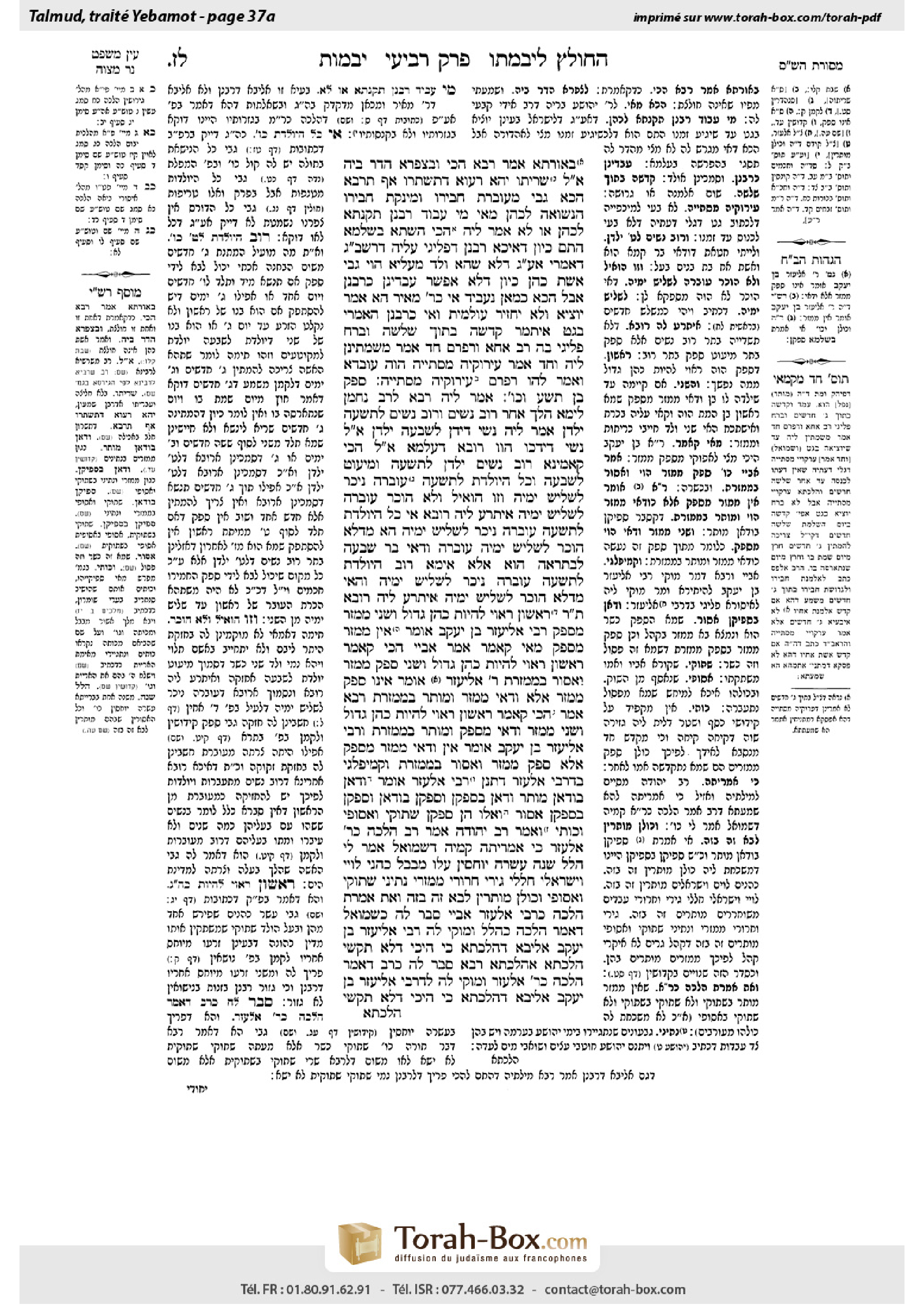
Yevamot 37a: Talmud study for Daf Yomi
Daf Yomi is the daily study of one Talmud folio. Explore 37 tractates with scans, Hebrew text, Sefaria English and AI-generated French translations where annotated.
Passage selection and English or AI-generated French translation are available where the scan has annotations. Daf Study is independent of Torah-Box and Sefaria.
Browse Yevamot · יבמות · All tractatesYevamot 37a text and translations
This page of Yevamot includes the Aramaic text, an English translation and an AI-generated French translation, alongside the scan above.
יבמות ל״ז א · Aramaic and Hebrew text
בְּאוּרְתָּא אֲמַר רָבָא הָכִי, וּבְצַפְרָא הֲדַר בֵּיהּ. אֲמַר לֵיהּ: שְׁרִיתוּהָ? יְהֵא רַעֲוָא דְּתִשְׁ(תְּ)רוֹ אַף תַּרְבָּא.
הָכָא גַּבֵּי מְעוּבֶּרֶת חֲבֵירוֹ וּמֵינֶקֶת חֲבֵירוֹ הַנְּשׂוּאָה לְכֹהֵן, מַאי? מִי עֲבוּד רַבָּנַן תַּקַּנְתָּא לְכֹהֵן, אוֹ לָא.
אֲמַר לֵיהּ: הָכִי הַשְׁתָּא? בִּשְׁלָמָא הָתָם, כֵּיוָן דְּאִיכָּא רַבָּנַן דִּפְלִיגִי עֲלֵיהּ דְּרַבָּן שִׁמְעוֹן בֶּן גַּמְלִיאֵל, דְּאָמְרִי: אַף עַל גַּב דְּלָא שְׁהָא וָלָד מְעַלְּיָא הָוֵי, גַּבֵּי אֵשֶׁת כֹּהֵן כֵּיוָן דְּלָא אֶפְשָׁר — עָבְדִינַן כְּרַבָּנַן,
אֲבָל הָכָא, כְּמַאן נַעֲבֵיד? אִי כְּרַבִּי מֵאִיר, הָא אָמַר: יוֹצִיא וְלֹא יַחְזִיר עוֹלָמִית, וְאִי כְּרַבָּנַן — הָאָמְרִי בְּגֵט.
אִיתְּמַר: קִדְּשָׁהּ בְּתוֹךְ שְׁלֹשָׁה וּבָרַח, פְּלִיגִי בַּהּ רַב אַחָא וְרַפְרָם, חַד אָמַר: מְשַׁמְּתִינַן לֵיהּ, וְחַד אָמַר: עֵירוּקֵיהּ מִסָּתְיֵיהּ. הֲוָה עוֹבָדָא וַאֲמַר לְהוּ רַפְרָם: עֵירוּקֵיהּ מִסָּתְיֵיהּ.
סָפֵק בֶּן תֵּשַׁע וְכוּ׳. אֲמַר לֵיהּ רָבָא לְרַב נַחְמָן: לֵימָא הַלֵּךְ אַחַר רוֹב נָשִׁים, וְרוֹב נָשִׁים לְתִשְׁעָה יָלְדָן!
אֲמַר לֵיהּ: נְשֵׁי דִּידַן, לְשִׁבְעָה יָלְדָן. אֲמַר לֵיהּ: נְשֵׁי דִּידְכוּ הָווּ רוּבָּא דְּעָלְמָא?
אֲמַר לֵיהּ, הָכִי קָאָמֵינָא: רוֹב נָשִׁים יָלְדָן לְתִשְׁעָה, וּמִיעוּט לְשִׁבְעָה, וְכׇל הַיּוֹלֶדֶת לְתִשְׁעָה, עוּבָּרָהּ נִיכָּר לִשְׁלִישׁ יָמֶיהָ. וְזוֹ, הוֹאִיל וְלֹא הוּכַּר עוּבָּרָהּ לִשְׁלִישׁ יָמֶיהָ — אִיתְּרַע לֵיהּ רוּבָּא.
אִי כׇּל הַיּוֹלֶדֶת לְתִשְׁעָה עוּבָּרָהּ נִיכָּר לִשְׁלִישׁ יָמֶיהָ, הָא מִדְּלֹא הוּכַּר לִשְׁלִישׁ יָמֶיהָ, עוּבָּרָהּ וַדַּאי בַּר שִׁבְעָה לְבָתְרָאָה הוּא! אֶלָּא אֵימָא: רוֹב הַיּוֹלֶדֶת לְתִשְׁעָה — עוּבָּרָהּ נִיכָּר לִשְׁלִישׁ יָמֶיהָ, וְהַאי מִדְּלֹא הוּכַּר לִשְׁלִישׁ יָמֶיהָ — אִיתְּרַע לֵיהּ רוּבָּא.
תָּנוּ רַבָּנַן: רִאשׁוֹן רָאוּי לִהְיוֹת כֹּהֵן גָּדוֹל, וְשֵׁנִי מַמְזֵר מִסָּפֵק. רַבִּי אֱלִיעֶזֶר בֶּן יַעֲקֹב אוֹמֵר: אֵין מַמְזֵר מִסָּפֵק.
מַאי קָאָמַר? אָמַר אַבָּיֵי, הָכִי קָאָמַר: רִאשׁוֹן רָאוּי לִהְיוֹת כֹּהֵן גָּדוֹל, וְשֵׁנִי סְפֵק מַמְזֵר, וְאָסוּר בְּמַמְזֶרֶת. רַבִּי אֱלִיעֶזֶר אוֹמֵר: אֵינוֹ סְפֵק מַמְזֵר, אֶלָּא וַדַּאי מַמְזֵר, וּמוּתָּר בְּמַמְזֶרֶת.
רָבָא אָמַר, הָכִי קָאָמַר: רִאשׁוֹן רָאוּי לִהְיוֹת כֹּהֵן גָּדוֹל, וְשֵׁנִי מַמְזֵר וַדַּאי מִסָּפֵק וּמוּתָּר בְּמַמְזֶרֶת. וְרַבִּי אֱלִיעֶזֶר בֶּן יַעֲקֹב אוֹמֵר: אֵין וַדַּאי מַמְזֵר מִסָּפֵק. אֶלָּא סְפֵק מַמְזֵר, וְאָסוּר בְּמַמְזֶרֶת.
וְקָמִיפַּלְגִי בִּדְרַבִּי אֶלְעָזָר. דִּתְנַן, רַבִּי אֶלְעָזָר אוֹמֵר: וַדָּאָן בְּוַדָּאָן — מוּתָּר, וַדָּאָן בִּסְפֵקָן, וּסְפֵקָן בְּוַדָּאָן, וּסְפֵקָן בִּסְפֵקָן — אָסוּר.
וְאֵלּוּ הֵן סְפֵקָן: שְׁתוּקִי וַאֲסוּפִי וְכוּתִי.
וְאָמַר רַב יְהוּדָה אָמַר רַב: הֲלָכָה כְּרַבִּי אֶלְעָזָר. כִּי אַמְרִיתַהּ קַמֵּיהּ דִּשְׁמוּאֵל, אֲמַר לִי: הִלֵּל שָׁנָה — עֲשָׂרָה יוּחֲסִין עָלוּ מִבָּבֶל: כָּהֲנֵי, לְוִיֵּי, וְיִשְׂרְאֵלֵי, חֲלָלֵי, גֵּירֵי, חֲרוֹרֵי, מַמְזֵרֵי, נְתִינֵי, שְׁתוּקֵי וַאֲסוּפֵי. וְכוּלָּן מוּתָּרִין לָבֹא זֶה בָּזֶה.
וְאַתְּ אָמְרַתְּ הֲלָכָה כְּרַבִּי אֶלְעָזָר!
אַבָּיֵי סָבַר לַהּ כִּשְׁמוּאֵל, דְּאָמַר: הֲלָכָה כְּהִלֵּל, וּמוֹקֵי לַהּ רַבִּי אֱלִיעֶזֶר בֶּן יַעֲקֹב אַלִּיבָּא דְהִלְכְתָא, כִּי הֵיכִי דְּלָא תִּקְשֵׁי הִלְכְתָא אַהִלְכְתָא.
רָבָא סָבַר לַהּ כְּרַב, דְּאָמַר: הֲלָכָה כְּרַבִּי אֶלְעָזָר. וּמוֹקֵי לַהּ לִדְרַבִּי אֱלִיעֶזֶר בֶּן יַעֲקֹב אַלִּיבָּא דְּהִלְכְתָא, כִּי הֵיכִי דְּלָא תִּקְשֵׁי
Yevamot 37a · English translation
In the evening Rava stated this ruling in accordance with the way you cited him, but in the morning he retracted his opinion and ruled as I cited him. Rav Mesharshiyya said to him: Do you really permit her to marry without ḥalitza? He added sarcastically: May it be God’s will that you will even permit forbidden fats [tarba] as well. In Rav Mesharshiyya’s opinion, the prohibition against the widow remarrying without ḥalitza was as obvious as the prohibition of forbidden fats.
After citing this dispute, Rav Ashi said to Rav Hoshaya, son of Rav Idi: According to Rava’s citation of Rav, when a woman is married to a priest, the Sages were more lenient in order to allow the couple to remain married. Here, with regard to a woman who is pregnant with the child of another man or a woman who is nursing the child of another man, who is married to a priest, what is the halakha? Did the Sages enact an ordinance for the benefit of a priest and say that it is sufficient for him to separate from his wife and he does not need to divorce her, or not?
He said to him: How can these cases be compared? Granted, there, in the case where the offspring died during its first thirty days of life, since there are the Rabbis who disagree with Rabban Shimon ben Gamliel concerning it, as they say that although the offspring did not survive for thirty days it is nevertheless considered a full-fledged, i.e., viable, offspring, therefore, with regard to the wife of a priest, since it is not possible for her to perform ḥalitza and remain permitted to her husband, we will be lenient and act in accordance with the opinion of the Rabbis.
However, here, in the case of a woman who is pregnant with or nursing the child of another man, in accordance with whose opinion should we act? If we act in accordance with the opinion of Rabbi Meir, it will be of no benefit to the priest because Rabbi Meir said even with regard to the wife of an Israelite that he must divorce her and may never take her back. And if we act in accordance with the opinion of the Rabbis, it will also be of no benefit to the priest because they say he must send her out with a bill of divorce and only remarry her at a later point. Since there is no opinion that does not require a bill of divorce to be given, there is no possibility to be lenient in this case by not requiring a bill of divorce to be given.
A pregnancy is generally noticeable only after three months have passed. Therefore, during the first three months after a woman is divorced or widowed, she may not remarry due to the possibility that she is pregnant. The Sages decreed that even betrothing her during that time is prohibited, lest one also marry her (see 41a). Concerning this, an amoraic dispute was stated: In a case in which a man betrothed a woman during the three months following her divorce or her husband’s death, and then he fled, Rav Aḥa and Rafram disagree over what should be done. One said: We excommunicate him for violating the prohibition. And the other one said: His flight is sufficient for him, since it proves that he does not intend to marry her until it is determined that she is not pregnant. Therefore, there is no need to penalize him further. The Gemara relates: There was an incident like that, and Rafram said to those who asked what to do: His flight is sufficient for him.
§ The mishna states that if a yevama consummated the levirate marriage and gave birth seven months later, there is an uncertainty whether the child is nine months old, counting from conception, and is the offspring of the first husband, i.e., the deceased brother, or whether the child is only seven months old and is the offspring of the second husband. If it is the child of the first husband, then there was never any obligation of levirate marriage, and the supposed consummation was in fact forbidden by penalty of karet. Due to that possibility, both the man and the woman are obligated to bring a guilt-offering for uncertainty. Rava said to Rav Naḥman: How can they bring a guilt-offering for uncertainty? Let us say: Follow the majority of women, and since the majority of women give birth after nine months, it should be presumed that the child is the offspring of the deceased brother. Accordingly, the couple would be obligated to bring a certain sin-offering, not a guilt-offering for uncertainty.
Rav Naḥman said to him: The women of our family regularly give birth after seven months. Therefore, how can you presume that this woman gave birth after nine months? Rava said to him: Do the women of your family constitute the majority of the women of the world? Ultimately, the majority of women give birth after nine months, and one should therefore presume accordingly in a case of uncertainty.
Rav Naḥman said to him: This is what I am saying: Although it is true that the majority of women give birth after nine months and only a minority give birth after seven, still, in the case of every woman who gives birth after nine months, her fetus is already recognizable after a third of her days, i.e., in the third month of her pregnancy. Accordingly, in the case of this woman, since her fetus was not recognizable after a third of her days, as were it already recognizable at that point then it would be obvious that the child was the offspring of the first husband, therefore, the ability to presume she is like the majority of women is compromised, and the uncertainty as to who the father of the child is remains. Consequently, the yavam and yevama should each bring a guilt-offering for uncertainty.
The Gemara asks: If it is true that in the case of every woman who gives birth after nine months, her fetus is already recognizable after a third of her days, then with regard to this woman, from the fact that her fetus was not recognized after a third of her days, it follows that her fetus was certainly only seven months old and is the offspring of the latter husband, i.e., the yavam. If so, it is clear the yavam is the father of the child and there should be no need to bring an offering at all. Rather, one must emend Rav Naḥman’s words and say: In the majority of cases, with regard to a woman who gives birth after nine months, her fetus is already recognizable after a third of her days, and with regard to this woman, from the fact that her fetus was not recognized after a third of her days, the ability to presume she is like the majority of women is compromised.
§ The mishna states that the child of the yevama has unflawed lineage since regardless of whether it is the offspring of the deceased husband or the yavam, there was no transgression involved in its conception. With regard to this case, the Sages taught in a baraita: The first child is even fit to become a High Priest. However, since it is possible that the child is the offspring of the deceased husband, in which case the widow remains forbidden to the yavam as his brother’s wife, if she has a second child with her yavam then that child is a mamzer due to an uncertainty with regard to his status. Rabbi Eliezer ben Ya’akov says: One is not rendered a mamzer due to uncertainty.
The meaning of Rabbi Eliezer ben Ya’akov’s statement and how he differs from the first tanna is unclear. The Gemara clarifies: What is the baraita saying? Abaye said: This is what it is saying: The first child is even fit to become a High Priest. And if she has a second child, his status as a mamzer is uncertain and therefore he is both prohibited from marrying an Israelite woman of unflawed lineage, since he might actually be a mamzer, and he is also prohibited from marrying a mamzeret, since he might not be a mamzer. Rabbi Eliezer ben Ya’akov says: He is not treated like one whose status as a mamzer is uncertain; rather, due to the uncertainty concerning his status he is treated like one who is definitely a mamzer, and he is permitted to marry a mamzeret. In other words, Rabbi Eliezer ben Ya’akov holds that even one whose status as a mamzer is uncertain is permitted to marry one who is definitely a mamzeret.
Rava said: This is what the baraita is saying: The first child is even fit to become a High Priest. And if she has a second child, he is treated as though he is definitely a mamzer due to the uncertainty concerning his status, and therefore he is permitted to marry a mamzeret, i.e., this tanna holds that even one whose status as a mamzer is uncertain is permitted to marry one who is definitely a mamzeret. And Rabbi Eliezer ben Ya’akov says: He is not treated as though he is definitely a mamzer due to an uncertainty concerning his status; rather, his status as a mamzer is uncertain and he is treated accordingly, and therefore he is both prohibited from marrying an Israelite woman of unflawed lineage since he might be a mamzer, and he is also prohibited from marrying a mamzeret since he might not be a mamzer.
The Gemara explains: And Abaye and Rava disagree with regard to whether the halakha is decided in accordance with the opinion of Rabbi Elazar. As we learned in a mishna (Kiddushin 74a): With regard to the prohibition against marrying people with certain types of flawed lineage, Rabbi Elazar said: The marriage of those people whose flawed lineage status is certain to those whose status is certain is permitted, but the marriage of those whose status is certain to those whose status is uncertain, and the marriage of those whose status is uncertain to those whose status is certain, and even the marriage of those whose status is uncertain to those whose status is uncertain, is prohibited.
The mishna concludes: And these are those who are considered to have an uncertain status: A child of unknown paternity [shetuki], although his mother’s identity is known; and a foundling who was found abandoned in the streets; and a Samaritan [Kuti], who is possibly a mamzer since the Samaritans do not accept and abide by the halakhot of marriage.
And with regard to this mishna Rav Yehuda said that Rav said: The halakha is in accordance with the opinion of Rabbi Elazar. But when I said this halakha of Rav’s in the presence of Shmuel, he said to me: Hillel taught in a baraita that ten categories of lineage came up from Babylon to Eretz Yisrael: Priests; Levites; and Israelites; priests disqualified due to flawed lineage [ḥalallim]; converts; freed slaves; mamzerim; Gibeonites; shetukei; and foundlings. And it is permitted for all men and women in these categories to marry one another, i.e., the list is arranged such that the marriage between people in any two categories that are adjacent to one another is permitted. This is possible only if one assumes that it is permitted for one whose flawed lineage status is uncertain to marry one whose flawed lineage status is certain.
After citing the baraita taught by Hillel, which assumes that it is permitted for one whose flawed lineage status is uncertain to marry one whose flawed lineage status is certain, Shmuel concluded: The halakha is certainly decided in accordance with the opinion of Hillel, and yet you, Rabbi Yehuda, said the halakha is in accordance with the opinion of Rabbi Elazar, which states that a marriage between two people whose flawed lineage status is uncertain is prohibited; your ruling is incorrect.
The Gemara proceeds to explain the dispute between Abaye and Rava: Abaye holds in accordance with the opinion of Shmuel, who said that the halakha is decided in accordance with the opinion of Hillel that it is permitted for one whose flawed lineage status is uncertain to marry one whose flawed lineage status is certain. Therefore, Abaye establishes that opinion of Rabbi Eliezer ben Ya’akov to be in accordance with this halakha, in order that there should not be a contradiction between one halakha, i.e., that the halakha is always decided in accordance with the opinion of Hillel, and another halakha, i.e., that the halakha is always decided in accordance with the opinion of Rabbi Eliezer ben Ya’akov.
Rava, however, holds in accordance with the opinion of Rav, who said: The halakha is decided in accordance with the opinion of Rabbi Elazar that the marriage of those whose status is certain to those whose status is uncertain is prohibited. Therefore, Rava establishes that opinion of Rabbi Eliezer ben Ya’akov to be in accordance with this halakha, so that there should not be a contradiction between
Yevamot 37a · Traduction française (IA)
Le soir, Rava énonça cette décision conformément à la manière dont vous l’aviez cité, mais le matin, il revint sur son opinion et trancha conformément à la manière dont je l’avais cité. Rav Mesharshiyya lui dit : « Permets-tu vraiment à cette femme de se remarier sans ḥalitza ? » Il ajouta avec ironie : « Puisse Dieu vouloir que tu permettes aussi les graisses interdites [tarba] ! » Selon Rav Mesharshiyya, l’interdiction faite à la veuve de se remarier sans ḥalitza était aussi évidente que l’interdiction de consommer des graisses interdites.
Après avoir rapporté cette discussion, Rav Ashi dit à Rav Hoshaya, fils de Rav Idi : « Selon la citation de Rav par Rava, lorsque la femme est mariée à un prêtre, les Sages se sont montrés plus indulgents afin de permettre au couple de rester marié. Ici, concernant une femme mariée à un prêtre qui est enceinte de l’enfant d’un autre homme ou qui allaite l’enfant d’un autre homme, quelle est la halakha ? Les Sages ont-ils institué une mesure en faveur du prêtre et décidé qu’il suffit qu’il se sépare de sa femme, sans avoir à divorcer d’elle, ou non ? »
Il lui répondit : « Comment peut-on comparer ces cas ? Certes, dans le cas où l’enfant meurt au cours de ses trente premiers jours de vie, des Rabbins sont en désaccord avec Rabban Shimon ben Gamliel, puisqu’ils disent que, même si l’enfant n’a pas vécu trente jours, il est néanmoins considéré comme un enfant à part entière, c’est-à-dire viable. Par conséquent, concernant l’épouse d’un prêtre, puisqu’elle ne peut pas accomplir la ḥalitza tout en restant autorisée à son mari, nous serons indulgents et suivrons l’opinion des Rabbins.
Mais ici, dans le cas d’une femme enceinte de l’enfant d’un autre homme ou qui allaite cet enfant, quelle opinion devons-nous suivre ? Si nous suivons l’opinion de Rabbi Meir, cela ne servira à rien au prêtre, car Rabbi Meir dit que même l’époux israélite doit divorcer de sa femme et ne peut jamais la reprendre. Et si nous suivons l’opinion des Rabbins, cela ne servira pas non plus au prêtre, car ils disent qu’il doit la renvoyer au moyen d’un acte de divorce et ne la reprendre qu’ultérieurement. Puisqu’aucune opinion ne dispense de lui remettre un acte de divorce, il est impossible de se montrer indulgent dans ce cas en n’exigeant pas un tel acte.
Une grossesse ne devient généralement apparente qu’après trois mois. C’est pourquoi, durant les trois premiers mois suivant son divorce ou son veuvage, une femme ne peut pas se remarier, en raison de la possibilité qu’elle soit enceinte. Les Sages ont décrété qu’il lui est également interdit de se fiancer pendant cette période, de peur qu’on ne l’épouse aussi (voir 41a). À ce sujet, un désaccord entre amoraïm fut rapporté : dans le cas où un homme s’est fiancé avec une femme au cours des trois mois suivant son divorce ou le décès de son mari, puis s’est enfui, Rav Aḥa et Rafram sont en désaccord sur la conduite à tenir. L’un dit : « Nous le mettons au ban pour avoir enfreint l’interdiction. » L’autre dit : « Sa fuite suffit, puisqu’elle prouve qu’il n’a pas l’intention de l’épouser avant qu’il soit établi qu’elle n’est pas enceinte. Il n’est donc pas nécessaire de lui infliger une autre sanction. » La Guemara rapporte : un cas de ce genre s’est produit, et Rafram répondit à ceux qui lui demandaient quoi faire : « Sa fuite suffit. »
§ La Michna enseigne que si une yevama a consommé le mariage léviratique et accouche sept mois plus tard, on ne sait pas si l’enfant a neuf mois, en comptant depuis la conception, et est issu du premier mari, c’est-à-dire du frère défunt, ou s’il n’a que sept mois et est issu du second mari. S’il est l’enfant du premier mari, l’obligation de mariage léviratique n’a jamais existé, et la relation supposée était en réalité interdite sous peine de karet. En raison de cette possibilité, l’homme et la femme sont tous deux tenus d’apporter un sacrifice de culpabilité pour incertitude. Rava dit à Rav Naḥman : « Comment peuvent-ils apporter un sacrifice de culpabilité pour incertitude ? Disons plutôt : suivons la majorité des femmes ; puisque la majorité accouche après neuf mois, il faut présumer que l’enfant est issu du frère défunt. Le couple serait donc tenu d’apporter un sacrifice expiatoire certain, et non un sacrifice de culpabilité pour incertitude. »
Rav Naḥman lui dit : « Les femmes de notre famille accouchent habituellement après sept mois. Comment peux-tu donc présumer que cette femme a accouché après neuf mois ? » Rava lui dit : « Les femmes de ta famille constituent-elles la majorité des femmes du monde ? » En fin de compte, la majorité des femmes accouchent après neuf mois ; dans un cas d’incertitude, il faut donc présumer que c’est le cas.
Rav Naḥman lui dit : « Voici ce que je veux dire : bien qu’il soit vrai que la majorité des femmes accouchent après neuf mois et qu’une minorité seulement accouche après sept mois, dans le cas de toute femme qui accouche après neuf mois, son fœtus est déjà reconnaissable au tiers de la durée de la grossesse, c’est-à-dire au troisième mois. Par conséquent, dans le cas de cette femme, puisque son fœtus n’était pas reconnaissable au tiers de la durée de la grossesse — car, s’il l’avait déjà été à ce moment-là, il aurait été évident que l’enfant était issu du premier mari —, la possibilité de présumer qu’elle est comme la majorité des femmes s’en trouve compromise, et le doute quant à l’identité du père de l’enfant subsiste. Le yavam et la yevama doivent donc apporter chacun un sacrifice de culpabilité pour incertitude. »
La Guemara demande : « S’il est vrai que, dans le cas de toute femme qui accouche après neuf mois, son fœtus est déjà reconnaissable au tiers de la durée de la grossesse, alors, pour cette femme, le fait que son fœtus n’ait pas été reconnaissable au tiers de cette durée signifie que son fœtus n’avait certainement que sept mois et qu’il est issu du dernier mari, c’est-à-dire du yavam. Dès lors, il est clair que le yavam est le père de l’enfant et qu’il n’est nullement nécessaire d’apporter un sacrifice. Il faut donc plutôt corriger les paroles de Rav Naḥman et dire : dans la majorité des cas, chez une femme qui accouche après neuf mois, son fœtus est déjà reconnaissable au tiers de la durée de la grossesse ; et pour cette femme, le fait que son fœtus n’ait pas été reconnaissable au tiers de cette durée compromet la possibilité de présumer qu’elle est comme la majorité des femmes. »
§ La Michna enseigne que l’enfant de la yevama a une filiation sans défaut, car, qu’il soit issu du mari défunt ou du yavam, sa conception n’a impliqué aucune transgression. À propos de ce cas, les Sages enseignèrent dans une baraïta : « Le premier enfant peut même devenir grand prêtre. » Toutefois, puisqu’il est possible que l’enfant soit issu du mari défunt, auquel cas la veuve reste interdite au yavam en tant qu’épouse de son frère, si elle a un second enfant avec son yavam, cet enfant est un mamzer en raison d’une incertitude quant à son statut. Rabbi Eliezer ben Ya’akov dit : « On ne devient pas mamzer en raison d’une incertitude. »
Le sens de la déclaration de Rabbi Eliezer ben Ya’akov et la manière dont il diverge du premier tanna ne sont pas clairs. La Guemara précise : que dit la baraïta ? Abaye dit qu’elle signifie ceci : « Le premier enfant peut même devenir grand prêtre. Et si elle a un second enfant, son statut de mamzer est incertain ; il lui est donc interdit d’épouser une Israélite de filiation sans défaut, puisqu’il pourrait être mamzer, et il lui est également interdit d’épouser une mamzeret, puisqu’il pourrait ne pas être mamzer. Rabbi Eliezer ben Ya’akov dit : on ne le traite pas comme quelqu’un dont le statut de mamzer est incertain ; au contraire, en raison du doute sur son statut, on le traite comme un mamzer certain, et il lui est permis d’épouser une mamzeret. » Autrement dit, Rabbi Eliezer ben Ya’akov estime que même une personne dont le statut de mamzer est incertain est autorisée à épouser une personne qui est certainement mamzeret.
Rava dit que la baraïta signifie ceci : « Le premier enfant peut même devenir grand prêtre. Et si elle a un second enfant, on le traite comme un mamzer certain en raison du doute sur son statut ; il lui est donc permis d’épouser une mamzeret. » Autrement dit, ce tanna estime que même une personne dont le statut de mamzer est incertain est autorisée à épouser une personne qui est certainement mamzeret. « Rabbi Eliezer ben Ya’akov dit : on ne le traite pas comme un mamzer certain en raison d’un doute sur son statut ; son statut de mamzer demeure incertain et on le traite en conséquence. Il lui est donc interdit d’épouser une Israélite de filiation sans défaut, puisqu’il pourrait être mamzer, et il lui est également interdit d’épouser une mamzeret, puisqu’il pourrait ne pas être mamzer. »
La Guemara explique : Abaye et Rava sont en désaccord sur la question de savoir si la halakha est tranchée conformément à l’opinion de Rabbi Elazar. Comme nous l’avons appris dans une Michna (Kiddushin 74a) : concernant l’interdiction d’épouser des personnes dont la filiation présente certains types de défauts, Rabbi Elazar a dit : « L’union de personnes dont le statut de filiation défectueuse est certain est permise ; en revanche, l’union de personnes dont le statut est certain avec des personnes dont le statut est incertain, l’union de personnes dont le statut est incertain avec des personnes dont le statut est certain, et même l’union de personnes dont le statut est incertain entre elles, est interdite. »
La Michna conclut : « Voici les personnes dont le statut est incertain : un enfant de paternité inconnue [shetuki], bien que l’identité de sa mère soit connue ; un enfant trouvé abandonné dans la rue ; et un Samaritain [Kuti], qui peut être mamzer puisque les Samaritains n’acceptent ni ne respectent les halakhot du mariage. »
À propos de cette Michna, Rav Yehuda a dit au nom de Rav : « La halakha est conforme à l’opinion de Rabbi Elazar. » Mais lorsque j’ai énoncé cette halakha de Rav en présence de Shmuel, il m’a dit : « Hillel a enseigné dans une baraïta que dix catégories de filiation sont montées de Babylone en Eretz Israël : les prêtres, les Lévites et les Israélites ; les prêtres dont la filiation est disqualifiée [ḥalallim] ; les convertis ; les esclaves affranchis ; les mamzerim ; les Gabaonites ; les shetukei ; et les enfants trouvés. Il est permis aux hommes et aux femmes de toutes ces catégories de se marier entre eux ; autrement dit, la liste est agencée de telle sorte que l’union entre des personnes de deux catégories adjacentes est permise. » Cela n’est possible que si l’on considère qu’une personne dont le statut de filiation défectueuse est incertain est autorisée à épouser une personne dont le statut est certain.
Après avoir cité la baraïta enseignée par Hillel, qui considère qu’une personne dont le statut de filiation défectueuse est incertain est autorisée à épouser une personne dont le statut est certain, Shmuel conclut : « La halakha est certainement tranchée conformément à l’opinion de Hillel. Pourtant, toi, Rabbi Yehuda, tu as dit que la halakha est conforme à l’opinion de Rabbi Elazar, selon laquelle l’union de deux personnes dont le statut de filiation défectueuse est incertain est interdite. Ta décision est erronée. »
La Guemara poursuit en expliquant le désaccord entre Abaye et Rava : Abaye suit l’opinion de Shmuel, qui a dit que la halakha est tranchée conformément à l’opinion de Hillel, selon laquelle une personne dont le statut de filiation défectueuse est incertain est autorisée à épouser une personne dont le statut est certain. Abaye interprète donc l’opinion de Rabbi Eliezer ben Ya’akov de manière à la rendre conforme à cette halakha, afin qu’il n’y ait pas de contradiction entre une halakha — à savoir que la halakha est toujours tranchée conformément à l’opinion de Hillel — et une autre halakha — à savoir que la halakha est toujours tranchée conformément à l’opinion de Rabbi Eliezer ben Ya’akov.
Rava, en revanche, suit l’opinion de Rav, qui a dit : « La halakha est tranchée conformément à l’opinion de Rabbi Elazar, selon laquelle l’union de personnes dont le statut est certain avec des personnes dont le statut est incertain est interdite. » Rava interprète donc l’opinion de Rabbi Eliezer ben Ya’akov de manière à la rendre conforme à cette halakha, afin qu’il n’y ait pas de contradiction entre
Traduction française générée par IA à partir de l’édition anglaise de Sefaria. Vérifie toujours un passage avec le texte source.
Text from Sefaria: William Davidson Edition - Vocalized Aramaic (CC BY NC); William Davidson Edition - English (CC BY NC).