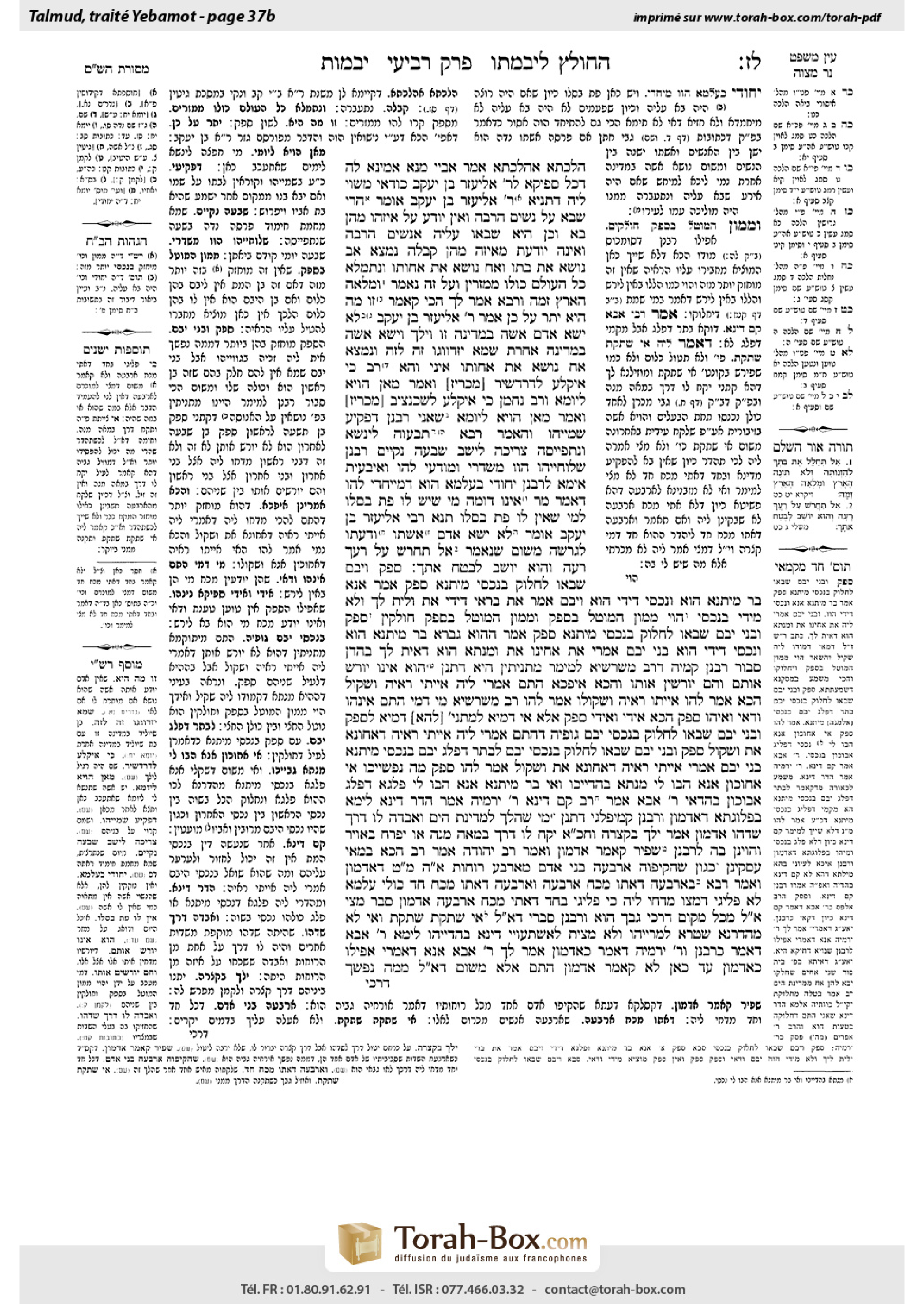
Yevamot 37b: Talmud study for Daf Yomi
Daf Yomi is the daily study of one Talmud folio. Explore 37 tractates with scans, Hebrew text, Sefaria English and AI-generated French translations where annotated.
Passage selection and English or AI-generated French translation are available where the scan has annotations. Daf Study is independent of Torah-Box and Sefaria.
Browse Yevamot · יבמות · All tractatesYevamot 37b text and translations
This page of Yevamot includes the Aramaic text, an English translation and an AI-generated French translation, alongside the scan above.
יבמות ל״ז ב · Aramaic and Hebrew text
הִלְכְתָא אַהִלְכְתָא.
אָמַר אַבָּיֵי: מְנָא אָמֵינָא לַהּ דְּכֹל סְפֵיקָא לְרַבִּי אֱלִיעֶזֶר בֶּן יַעֲקֹב — כְּוַדַּאי מְשַׁוֵּי לֵיהּ,
דְּתַנְיָא, רַבִּי אֱלִיעֶזֶר בֶּן יַעֲקֹב אוֹמֵר: הֲרֵי שֶׁבָּא עַל נָשִׁים הַרְבֵּה וְאֵין יוֹדֵעַ עַל אֵיזוֹ מֵהֶן בָּא, וְכֵן הִיא שֶׁבָּאוּ עָלֶיהָ אֲנָשִׁים הַרְבֵּה, וְאֵינָהּ יוֹדַעַת מֵאֵיזֶה מֵהֶן קִבְּלָה — נִמְצָא אָב נוֹשֵׂא אֶת בִּתּוֹ, וְאָח נוֹשֵׂא אֶת אֲחוֹתוֹ, וְנִתְמַלֵּא כָּל הָעוֹלָם כּוּלּוֹ מַמְזֵרִין. וְעַל זֶה נֶאֱמַר: ״וּמָלְאָה הָאָרֶץ זִמָּה״.
וְרָבָא אָמַר לָךְ, הָכִי קָאָמַר: ״זוֹ מָה הִיא״.
יָתֵר עַל כֵּן, אָמַר רַבִּי אֱלִיעֶזֶר בֶּן יַעֲקֹב: לֹא יִשָּׂא אָדָם אִשָּׁה בִּמְדִינָה זוֹ וְיֵלֵךְ וְיִשָּׂא אִשָּׁה בִּמְדִינָה אַחֶרֶת, שֶׁמָּא יִזְדַּוְּוגוּ זֶה לָזֶה, וְנִמְצָא אָח נוֹשֵׂא אֶת אֲחוֹתוֹ.
אִינִי? וְהָא רַב כִּי אִיקְּלַע לְדַרְדְּשִׁיר, [מַכְרֵיז] וְאָמַר: מַאן הָוְיָא לְיוֹמָא. וְרַב נַחְמָן כִּי אִיקְּלַע לְשַׁכְנְצִיב, [מַכְרֵיז] וְאָמַר: מַאן הָוְיָא לְיוֹמָא!
שָׁאנֵי רַבָּנַן, דִּפְקִיעַ שְׁמַיְיהוּ.
וְהָאָמַר רָבָא: תְּבָעוּהָ לִינָּשֵׂא וְנִתְפַּיְּיסָה — צְרִיכָה לֵישֵׁב שִׁבְעָה נְקִיִּים?
רַבָּנַן שְׁלוּחַיְיהוּ הֲווֹ מְשַׁדְּרִי וּמוֹדְעִי לְהוּ. וְאִיבָּעֵית אֵימָא: לְרַבָּנַן, יַחוֹדֵי בְּעָלְמָא הוּא דִּמְיַיחֲדִי לְהוּ, דְּאָמַר מָר: אֵינוֹ דּוֹמֶה מִי שֶׁיֵּשׁ לוֹ פַּת בְּסַלּוֹ לְמִי שֶׁאֵין לוֹ פַּת בְּסַלּוֹ.
תָּנָא, רַבִּי אֱלִיעֶזֶר בֶּן יַעֲקֹב אוֹמֵר: לֹא יִשָּׂא אָדָם אִשְׁתּוֹ וְדַעְתּוֹ לְגָרְשָׁהּ, מִשּׁוּם שֶׁנֶּאֱמַר: ״אַל תַּחֲרֹשׁ עַל רֵעֲךָ רָעָה וְהוּא יוֹשֵׁב לָבֶטַח אִתָּךְ״.
סָפֵק וְיָבָם שֶׁבָּאוּ לַחֲלוֹק בְּנִכְסֵי מִיתָנָא,
סָפֵק אָמַר: אֲנָא בַּר מִיתָנָא הוּא, וְנִכְסֵי דִּידִי (הוּא) [נִינְהוּ]. וְיָבָם אָמַר: אַתְּ בְּרַאי דִּידִי אַתְּ, וְלֵית לָךְ וְלָא מִידֵּי בְּנִכְסֵי. הָוֵי מָמוֹן הַמּוּטָּל בְּסָפֵק, וּמָמוֹן הַמּוּטָּל בְּסָפֵק — חוֹלְקִין.
סָפֵק וּבְנֵי יָבָם שֶׁבָּאוּ לַחֲלוֹק בְּנִכְסֵי מִיתָנָא, סָפֵק אָמַר: הָהוּא גַּבְרָא בַּר מִיתָנָא הוּא, וְנִכְסֵי דִּידִי (הוּא) [נִינְהוּ]. בְּנֵי יָבָם אָמְרִי: אַתְּ (אַחֵינוּ) [אֲחוּנָא] אַתְּ, וּמְנָתָא הוּא דְּאִית לָךְ בַּהֲדַן.
סְבוּר רַבָּנַן קַמֵּיהּ דְּרַב מְשַׁרְשְׁיָא לְמֵימַר: מַתְנִיתִין הִיא, דִּתְנַן: הוּא אֵינוֹ יוֹרֵשׁ אוֹתָם, וְהֵם יוֹרְשִׁין אוֹתוֹ.
וְהָכָא אִיפְּכָא. הָתָם אָמְרִי לֵיהּ: אַיְיתִי רְאָיָה וּשְׁקוֹל,
הָכָא אֲמַר לְהוּ: אַיְיתוֹ רְאָיָה וּשְׁקוּלוּ.
אֲמַר לְהוּ רַב מְשַׁרְשְׁיָא: מִי דָּמֵי? הָתָם, אִינְהוּ וַדַּאי וְאִיהוּ סָפֵק. הָכָא, אִידֵּי וְאִידֵּי סָפֵק.
אֶלָּא, אִי דָּמְיָא לְמַתְנִיתִין — [לְהָא] דָּמְיָא: לְסָפֵק וּבְנֵי יָבָם שֶׁבָּאוּ לַחְלוֹק בְּנִכְסֵי יָבָם גּוּפֵיהּ, דְּהָתָם אָמְרִי לֵיהּ: אַיְיתִי רְאָיָה דַּאֲחוּנָא אַתְּ וּשְׁקוֹל.
סָפֵק וּבְנֵי יָבָם שֶׁבָּאוּ לַחְלוֹק בְּנִכְסֵי יָבָם, לְבָתַר דִּפְלַג יָבָם בְּנִכְסֵי מִיתָנָא,
בְּנֵי יָבָם אָמְרִי: אַיְיתִי רְאָיָה דַּאֲחוּנָא אַתְּ וּשְׁקוֹל. אָמַר לְהוּ סָפֵק: מָה נַפְשַׁיְיכוּ, אִי אֲחוּכוֹן אֲנָא — הַבוּ לִי מְנָתָא בַּהֲדַיְיכוּ, וְאִי בַּר מִיתָנָא אֲנָא — הַבוּ לִי פַּלְגָא דִּפְלַג אֲבוּכוֹן בַּהֲדַאי.
רַבִּי אַבָּא אָמַר רַב: קָם דִּינָא. רַבִּי יִרְמְיָה אָמַר: הָדַר דִּינָא.
לֵימָא בִּפְלוּגְתָּא דְּאַדְמוֹן וְרַבָּנַן קָמִיפַּלְגִי, דִּתְנַן: מִי שֶׁהָלַךְ לִמְדִינַת הַיָּם וְאָבְדָה לוֹ דֶּרֶךְ שָׂדֵהוּ — אַדְמוֹן אָמַר: יֵלֵךְ בִּקְצָרָה. וַחֲכָמִים אוֹמְרִים: יִקַּח לוֹ דֶּרֶךְ בְּמֵאָה מָנֶה, אוֹ יִפְרַח בָּאֲוִיר.
וְהָוֵינַן בַּהּ: לְרַבָּנַן שַׁפִּיר קָאָמַר אַדְמוֹן? וְאָמַר רַב יְהוּדָה אָמַר רַב: הָכָא בְּמַאי עָסְקִינַן — כְּגוֹן שֶׁהִקִּיפוּהָ אַרְבָּעָה בְּנֵי אָדָם מֵאַרְבַּע רוּחוֹת.
אִי הָכִי, מַאי טַעְמָא דְּאַדְמוֹן? וְאָמַר רָבָא: בְּאַרְבְּעָה דְּאָתוּ מִכֹּחַ אַרְבְּעָה, וְאַרְבְּעָה דְּאָתוּ מִכֹּחַ חַד — כּוּלֵּי עָלְמָא לָא פְּלִיגִי דְּמָצוּ מְדַחֵי לֵיהּ.
כִּי פְּלִיגִי, בְּחַד דְּאָתֵי מִכֹּחַ אַרְבְּעָה. אַדְמוֹן סָבַר, מָצֵי אָמַר לֵיהּ: מִכׇּל מָקוֹם דַּרְכַּי גַּבָּךְ הוּא. וְרַבָּנַן סָבְרִי דַּאֲמַר לֵיהּ: אִי שָׁתְקַתְּ — שָׁתְקַתְּ, וְאִי לָא, מַהְדַּרְנָא שְׁטָרָא לְמָרַיְיהוּ, וְלָא מָצֵית לְאִשְׁתַּעוֹיֵי דִּינָא בַּהֲדַיְיהוּ.
לֵימָא רַבִּי אַבָּא דְּאָמַר כְּרַבָּנַן.
וְרַבִּי יִרְמְיָה דְּאָמַר כְּאַדְמוֹן.
אָמַר לָךְ רַבִּי אַבָּא: אֲנָא דַּאֲמַרִי אֲפִילּוּ כְּאַדְמוֹן, עַד כָּאן לָא קָאָמַר אַדְמוֹן הָתָם, אֶלָּא מִשּׁוּם דְּאָמַר לֵיהּ: מִמָּה נַפְשָׁךְ
Yevamot 37b · English translation
one halakha, i.e., that the halakha in this case is in accordance with the opinion of Rav, and another halakha, i.e., that the halakha is always decided in accordance with the opinion of Rabbi Eliezer ben Ya’akov.
Abaye said: From where do I say that concerning anyone whose status as a mamzer is uncertain, according to the opinion of Rabbi Eliezer ben Ya’akov they are treated equivalently to one who is definitely a mamzer?
As it is taught in a baraita that Rabbi Eliezer ben Ya’akov says: With regard to one who engaged in intercourse with and impregnated many women, but he does not know with which women he had intercourse, and similarly, with regard to a woman, if many men had intercourse with her and she became pregnant, but she does not know from which man she received the seed that caused her to become pregnant, since the identities of the parents of those children are not known, it could emerge that a father marries his daughter, and a brother marries his sister. And in this way, the entire world could become filled with mamzerim. And concerning this, it is stated: “And lest the land become full of lewdness” (Leviticus 19:29). Abaye demonstrates his claim from the fact that even though it is not certain that the children in this situation are mamzerim, nevertheless, Rabbi Eliezer ben Ya’akov labels them as mamzerim and not as those whose status as a mamzer is uncertain.
And Rava could have said to you: This is what the verse is saying: The word “lewdness [zima]” can be understood as an acronym of the words: Zo ma hi, meaning: What is this. It is plausible to say that Rabbi Eliezer ben Ya’akov’s citation of this verse indicates that he regards their status to be uncertain.
The Gemara cites the continuation of the baraita: Furthermore, Rabbi Eliezer ben Ya’akov said that even in marriage, one should be careful not to create a situation that could lead to the birth of mamzerim. Therefore, a man should not marry a woman in this country and then go and marry another woman in a different country, lest a son from one marriage and a daughter from the other, unaware that they are both children of the same father, unite with one another, and it could emerge that a brother marries his sister, the children of whom would be mamzerim.
The Gemara asks: Is that so; is there really such a prohibition? But didn’t Rav, when he happened to come to Dardeshir, make a public announcement saying: Which woman will be my wife for the day, i.e., for the duration of his visit? Since his wife did not accompany him to Dardeshir, he wished to be married to another woman while he was there, in order to avoid a situation that could lead him to having forbidden thoughts. And also Rav Naḥman, when he happened to come to Shakhnetziv, made a public announcement saying: Which woman will be my wife for the day? It would appear, from the fact that both Sages married wives in two different places, that there is no prohibition in doing so.
The Gemara rejects the proof: Sages are different, as their names are renowned, and therefore their children are always identified by their connection to their father. Therefore, Rabbi Eliezer ben Ya’akov’s concern does not apply to them.
The Gemara examines Rav and Rav Naḥman’s actions: But didn’t Rava say: With regard to a woman who had an offer of marriage and accepted, the emotional excitement may have caused her to have a flow of menstrual blood, which would make her ritually impure and prohibit her from engaging in intercourse. Even if she was unaware of any flow, she must consider the possibility that it occurred. To purify herself, she needs to wait seven consecutive days that are clean from any flow of menstrual blood and then immerse in a ritual bath. Only then may she marry. If so, how could Rav and Rav Naḥman marry women on the day they arrived?
The Gemara explains: These Sages would send messengers seven days ahead of their arrival and they would inform the women of the Sage’s arrival. In this way, the woman who agreed to marry the Sage would have time to count the seven clean days. And if you wish, say that the Sages’ intentions were merely to be in seclusion [meyaḥadi] with the woman but not to engage in intercourse with her. Therefore, it was permitted to marry her even if she became ritually impure. Being in seclusion with a woman was sufficient to help the Sages avoid any forbidden thoughts, as the Master said: One who has bread in his basket is incomparable to one who does not have bread in his basket, i.e., just as the knowledge that food is readily available is sufficient to psychologically alleviate one’s feelings of hunger, so too, the knowledge that one’s sexual desires could be met lessens the strength of the desire itself.
The Gemara cites an additional statement of Rabbi Eliezer ben Ya’akov: It is taught in a baraita that Rabbi Eliezer ben Ya’akov says: A man should not marry his wife when at the same time his intention is to divorce her, because it is stated: “Do not devise evil against your neighbor, as he dwells securely with you” (Proverbs 3:29). It is wrong for one to intend to undermine the feelings of security that another has with him.
§ The mishna raises a case in which a yavam consummated the levirate marriage with his yevama and seven months later she gave birth. With respect to that child, there is an uncertainty whether he is the child of the deceased brother or whether he is the child of the yavam. The Gemara discusses the ramifications of this uncertainty in a dispute concerning inheritance. The case concerns one whose identity as the son of the deceased is uncertain, and a yavam who consummated the levirate marriage with the yevama, who both came to divide up the possessions of the deceased brother and each one claims to be the sole heir.
The one of uncertain descent said: I am the son of the deceased, and therefore, as the only heir, his possessions are mine. And the yavam said to him: You are my son, and you have absolutely no rights to the possessions; rather, by virtue of the fact that I consummated the levirate marriage with the widow of the deceased, I should inherit him. The Gemara rules on this case: This is a case of property of uncertain ownership, as there is no way to determine who is the rightful heir, and the halakha is that property of uncertain ownership the claimants divide up between them.
The Gemara brings another case, that of one concerning whom there is uncertainty whether he is the son of the deceased or of the yavam and the sons of the yavam, who consummated the levirate marriage with the yevama and has since died, who came to divide up the possessions of the deceased, and each one makes claim to the inheritance. The one of uncertain descent said: That man, referring to himself, is the son of the deceased, and therefore, as his sole heir, his possessions are mine. And the sons of the yavam said to him: You are our brother, and our uncle, the deceased, was not survived by any offspring and so by virtue of our father’s levirate marriage he inherited our uncle’s possessions, and now that our father has died and we are dividing up his possessions you have a right to inherit only a portion of the inheritance together with us.
The Rabbis who studied before Rav Mesharshiyya thought to say: This case is analogous to a case in a mishna, as we learned a similar case in a mishna (100a) in which a woman gave birth shortly after remarrying and there is uncertainty whether the child’s father is the first or second husband. The mishna considers a case in which the husbands died and were each survived by a set of sons: If a son from either set died, the other sons of that set will inherit from him because as brothers they have an uncontested claim to the inheritance. However, he, the son of uncertain descent, does not inherit from them because his claim as a brother is uncertain and is therefore not powerful enough to allow him to take part of the inheritance from the other sons. However, if the son of uncertain descent died, they, the sons of both husbands, will jointly inherit from him. The claims of each set of sons to be his brothers are equally uncertain; therefore, since there is no one who has a definite claim to his inheritance, his possessions are split between them.
The Rabbis qualify their comparison of the cases: But here, the positions are in reverse, as follows: There, in the case of the mishna, when one of the sons dies, they, the other sons of that set, can say to him, the son of uncertain descent: Bring proof that you are actually a son of our father and only then can you take a portion. Since he cannot prove this, he will not receive any of the inheritance.
However, here, in the case where the son of uncertain descent is in dispute with the sons of the yavam, he, the son of uncertain descent, can say to them: Bring proof that I am not the son of the deceased, and only then can you take a portion together with me. The Rabbis claim that the principle in both cases is identical: When one party has an uncontested claim to the inheritance, and another party advances a claim to receive part of the inheritance that is based on an uncertainty, the uncertain claim is not accepted. In the mishna’s case, it is the son of uncertain descent who has an uncertain claim. The Rabbis suggest that the reverse is true in the Gemara’s case: The son of uncertain descent has an uncontested claim to the inheritance because whether he is the son of the first or second husband, he certainly has a right to some inheritance. It is the sons of the yavam who have an uncertain claim because they have a right to the inheritance only if the son of uncertain descent is actually their brother.
Rav Mesharshiyya said to them: Is the case in the mishna really comparable? There, in the mishna’s case, when one of the sons dies, they, the other sons in that set, have a definite claim to the inheritance, since their claim is based on the fact that they are the dead son’s brothers, which is certainly true, and he, the son of uncertain descent, only has an uncertain claim. However, here, each party has only an uncertain claim. Although the son of uncertain descent claims that ultimately, whatever the nature of his relationship with the deceased is, he should have the right to inherit, nevertheless, since it is not actually known what that relationship is, his claim in reality is merely a composite of uncertain claims.
Having rejected the analogy offered by the Rabbis, Rav Mesharshiyya offers his own analogy to the case in the mishna that the Rabbis cited: Rather, if there is a case that is analogous to the case in the mishna, then it is to this following case that it is analogous: It is comparable to a case in which following the levirate marriage a son was born, and there is uncertainty whether he is the son of the deceased or of the yavam, and that son of uncertain descent and the sons of the yavam come to divide up the possessions of the yavam himself. As there, those who are unquestionably the sons of the yavam have a definite claim; therefore, they can say to him, the son of uncertain descent: Bring proof that you are actually our brother and only then can you take a portion. Since he cannot prove this, he will not receive any of the inheritance.
The Gemara brings yet another case, that of one concerning whom there is an uncertainty whether he is the son of the deceased or of the yavam and the sons of the yavam, i.e., the sons of the man who consummated the levirate marriage with the yevama and has since died, who came to divide up the possessions of the yavam after the yavam had already divided up the possessions of the deceased brother between himself and the son of uncertain descent, as per the Gemara’s ruling in the first case above.
The yavam then died and his sons and the son of uncertain descent each made a claim to the inheritance: The sons of the yavam say to the son of uncertain descent: Bring proof that you are our brother, and only then can you take a portion. The son of uncertain descent said to them: Whichever way you look at it, I should receive a portion of the inheritance. If you assume that I am your brother, then give me a portion of the inheritance together with all of you, and if you assume that I am the son of the deceased, then give me the half of the possessions that your father took when he divided up the possessions with me upon the deceased’s death, because if you assume I am his son, then I am his sole heir and your father never had any rights to his possessions.
The son of uncertain descent’s claim assumes that the original verdict to divide up the possessions of the deceased between the two sides may be reexamined in light of later developments. This assumption, however, is subject to a dispute: Rabbi Abba said that Rav said: The original verdict stands, i.e., the original division of the deceased’s possessions is considered a closed matter, and the new dispute concerning the possessions of the yavam is considered independently of it. Accordingly, the son of uncertain descent’s claim cannot succeed, and so he receives no portion of the inheritance of the yavam. Rabbi Yirmeya said: The original verdict is reconsidered in light of the new circumstances, and therefore in this case the son of uncertain descent can put forward his undeniable claim to some of the possessions of the yavam based on the original uncertainties that existed with regard to the division of the deceased’s possessions.
Let us say that Rabbi Abba and Rabbi Yirmeya disagree over the dispute between Admon and the Rabbis. As we learned in a mishna (Ketubot 109b): With regard to one who owns a field and has the rights to a path that passes through land belonging to another, and he traveled to a country overseas, and when he returned the path to his field was lost, i.e., he forgot where the path was located, Admon says: He may go only on the shortest path to his field, as although it is not known where the path is, he definitely did have a path, and therefore at the very least he has a right to the shortest path. The Rabbis say: He must either purchase for himself a new path for whatever price is asked, even if it is one hundred dinars, or he will have to fly through the air to reach his field, i.e., as long as he cannot prove where the original path was, he has no rights to any other path.
And we discussed the mishna and thereby established the parameters of the dispute as follows: It is difficult for the Rabbis because Admon is saying well, i.e., the logic of his opinion would seem to be compelling. And in defense of the Rabbis’ opinion, Rav Yehuda said that Rav said: With what are we dealing here? It is with a case where his field was surrounded by four individuals who owned the land on each of its four sides. Therefore, he cannot demand a path from any one of the surrounding owners, since each one can deflect his claim by suggesting that the path might have passed through one of the other owners’ land.
However, this creates a further difficulty: If so, that the surrounding land is owned by different people, what is Admon’s rationale for ruling that the owner of the field has a claim to the shortest path? And in order to justify Admon’s opinion, Rava said: With regard to a case in which there are four current owners who came to own their land on the basis of purchase from four previous owners, i.e., each of the current owners acquired their land from a different previous owner, and also in a case in which there are four current owners who came to own their land on the basis of purchase from one previous owner who originally owned all four pieces of land, everyone agrees that the current owners are able to deflect him and his claim to a path.
When they disagree, it is in a case in which there is only one current owner of all four pieces of land, who came to own his land on the basis of purchase from four previous owners. Admon holds that the owner of the field can say to the current owner of the surrounding land: Whichever way you construe the case, my path to my field is somewhere with you in the surrounding land. And the Rabbis hold that the owner of the surrounding land can deflect this claim because he can say to him: If you do not press your claim and are silent, then be silent, and I will sell you a path at a reasonable price. But if not, and you insist on pressing your claim, then I will return the bills of purchase of the land to their previous owners, and then you will not be able to successfully engage in a legal dispute with them, as each one could claim that the path went through one of the other pieces of land not owned by them.
Having established the parameters of the dispute, the Gemara suggests: Let us say that the statement of Rabbi Abba, who said that the original verdict stands, is in accordance with the opinion of the Rabbis. When the owner of the field forgot where his path was located, the surrounding land was owned by four different owners, and therefore at that time the verdict was that he had no ability to successfully claim his path. The Rabbis apparently assume that that verdict stands, and therefore the field owner is considered to have lost any rights to the path. Consequently, even if the surrounding pieces of land are later purchased by a single person, the owner of the field cannot make a claim for his path.
The Gemara continues: And the statement of Rabbi Yirmeya, who said that the original verdict is repealed, is in accordance with the opinion of Admon. Admon apparently assumes that although the original verdict was that the field owner has no ability to successfully claim his path, nevertheless, that does not mean he loses his rights to the path. Rather, once the situation changes and the surrounding pieces of land are purchased by a single person, the original uncertainty is revived to allow him to make a claim for at least the shortest path to his field.
The Gemara rejects the comparison: Rabbi Abba could have said to you: When I stated my ruling, it was even in accordance with the opinion of Admon. Admon states his ruling only there, in the case of the lost path, because the field owner said to the owner of the surrounding land: Whichever way you look at it,
Yevamot 37b · Traduction française (IA)
une halakha, à savoir que, dans ce cas, la halakha suit l’avis de Rav, et une autre halakha, à savoir que la halakha est toujours tranchée conformément à l’avis de Rabbi Eliezer ben Ya’akov.
Abaye dit : D’où est-ce que je déduis que toute personne dont le statut de mamzer est incertain est traitée, selon l’avis de Rabbi Eliezer ben Ya’akov, comme un mamzer avéré ?
Comme il est enseigné dans une baraïta que Rabbi Eliezer ben Ya’akov dit : S’agissant d’un homme qui a eu des rapports avec de nombreuses femmes et les a rendues enceintes, mais qui ignore avec lesquelles il a eu des rapports, et de même, s’agissant d’une femme avec laquelle de nombreux hommes ont eu des rapports et qui est tombée enceinte, mais qui ignore de quel homme elle a reçu la semence qui l’a rendue enceinte, puisque l’identité des parents de ces enfants est inconnue, il pourrait arriver qu’un père épouse sa fille et qu’un frère épouse sa sœur. Ainsi, le monde entier pourrait se remplir de mamzerim. À ce sujet, il est dit : « De peur que le pays ne se remplisse de débauche » (Lévitique 19:29). Abaye étaye son affirmation par le fait que, bien qu’il ne soit pas certain que les enfants dans cette situation soient des mamzerim, Rabbi Eliezer ben Ya’akov les qualifie néanmoins de mamzerim et non de personnes dont le statut de mamzer est incertain.
Rava aurait pu te répondre : Voici ce que dit le verset : le mot « débauche [zima] » peut être compris comme un acronyme des mots Zo ma hi, qui signifient : « Qu’est-ce que cela ? » Il est plausible de dire que la citation de ce verset par Rabbi Eliezer ben Ya’akov indique qu’il considère leur statut comme incertain.
La Guemara cite la suite de la baraïta : En outre, Rabbi Eliezer ben Ya’akov dit que même dans le cadre du mariage, il faut veiller à ne pas créer une situation qui pourrait conduire à la naissance de mamzerim. Un homme ne doit donc pas épouser une femme dans ce pays, puis aller en épouser une autre dans un autre pays, de peur qu’un fils issu de l’un des mariages et une fille issue de l’autre, ignorant qu’ils ont le même père, ne s’unissent ; il pourrait alors arriver qu’un frère épouse sa sœur, et que leurs enfants soient des mamzerim.
La Guemara demande : Est-ce vraiment ainsi ? Une telle interdiction existe-t-elle réellement ? Rav, lorsqu’il lui arriva de se rendre à Dardeshir, n’a-t-il pas fait une annonce publique en disant : « Quelle femme sera mon épouse pour la journée », c’est-à-dire pendant la durée de son séjour ? Comme son épouse ne l’avait pas accompagné à Dardeshir, il souhaitait être marié à une autre femme pendant son séjour, afin d’éviter une situation susceptible de l’amener à avoir des pensées interdites. Rav Naḥman, lui aussi, lorsqu’il lui arriva de se rendre à Shakhnetziv, fit une annonce publique en disant : « Quelle femme sera mon épouse pour la journée ? » Le fait que ces deux Sages aient épousé des femmes dans deux endroits différents semble montrer qu’il n’est pas interdit d’agir ainsi.
La Guemara écarte cette preuve : les Sages font exception, car leurs noms sont connus, et leurs enfants sont donc toujours identifiés par leur lien avec leur père. La préoccupation de Rabbi Eliezer ben Ya’akov ne s’applique donc pas à eux.
La Guemara examine les actes de Rav et de Rav Naḥman : Mais Rava n’a-t-il pas dit qu’une femme à qui l’on a proposé le mariage et qui a accepté peut, sous l’effet de l’émotion, avoir un écoulement de sang menstruel, ce qui la rendrait rituellement impure et lui interdirait d’avoir des rapports ? Même si elle n’a remarqué aucun écoulement, elle doit envisager cette possibilité. Pour se purifier, elle doit attendre sept jours consécutifs sans aucun écoulement de sang menstruel, puis s’immerger dans un bain rituel. Ce n’est qu’alors qu’elle peut se marier. Dans ce cas, comment Rav et Rav Naḥman ont-ils pu épouser des femmes le jour de leur arrivée ?
La Guemara explique : Ces Sages envoyaient des messagers sept jours avant leur arrivée pour informer les femmes de la venue du Sage. Ainsi, la femme qui acceptait d’épouser le Sage avait le temps de compter les sept jours de pureté. Et si tu le souhaites, dis plutôt que les Sages avaient seulement l’intention de s’isoler [meyaḥadi] avec la femme, sans avoir de rapports avec elle. Il était donc permis de l’épouser même si elle était devenue rituellement impure. Le fait d’être seul avec une femme suffisait à aider les Sages à éviter toute pensée interdite, car le Maître a dit : « Celui qui a du pain dans son panier n’est pas comparable à celui qui n’en a pas dans son panier. » Autrement dit, de même que savoir que la nourriture est à portée de main suffit à apaiser psychologiquement la faim, savoir que ses désirs sexuels pourraient être satisfaits atténue la force du désir lui-même.
La Guemara cite un autre enseignement de Rabbi Eliezer ben Ya’akov : Il est enseigné dans une baraïta que Rabbi Eliezer ben Ya’akov dit : Un homme ne doit pas épouser une femme alors qu’il a l’intention de divorcer d’elle, car il est dit : « Ne prépare pas le mal contre ton prochain, alors qu’il demeure en sécurité auprès de toi » (Proverbes 3:29). Il est mal d’avoir l’intention de saper le sentiment de sécurité qu’une autre personne éprouve auprès de soi.
§ La Michna évoque le cas où un yavam a consommé le mariage léviratique avec sa yevama et où, sept mois plus tard, elle a accouché. On ignore si cet enfant est le fils du frère décédé ou celui du yavam. La Guemara examine les conséquences de cette incertitude dans le cadre d’un litige successoral. Il s’agit d’un homme dont on ignore s’il est le fils du défunt et d’un yavam qui a consommé le mariage léviratique avec la yevama ; tous deux se présentent pour se partager les biens du frère décédé, et chacun prétend être son unique héritier.
Celui dont la filiation est incertaine dit : « Je suis le fils du défunt et, par conséquent, comme je suis son unique héritier, ses biens me reviennent. » Le yavam lui dit : « Tu es mon fils et tu n’as absolument aucun droit sur ces biens ; c’est moi qui dois hériter du défunt, puisque j’ai consommé le mariage léviratique avec sa veuve. » La Guemara statue sur ce cas : il s’agit de biens dont la propriété est incertaine, puisqu’il est impossible de déterminer qui en est l’héritier légitime. La halakha est que les biens dont la propriété est incertaine sont partagés entre les prétendants.
La Guemara présente un autre cas : un homme dont on ignore s’il est le fils du défunt ou du yavam, et les fils du yavam, qui a consommé le mariage léviratique avec la yevama puis est mort, se présentent pour se partager les biens du défunt et chacun revendique l’héritage. Celui dont la filiation est incertaine dit : « Cet homme », en parlant de lui-même, « est le fils du défunt ; par conséquent, comme il est son unique héritier, ses biens me reviennent. » Les fils du yavam lui disent : « Tu es notre frère ; notre oncle, le défunt, n’a laissé aucun descendant, et notre père a donc hérité de ses biens en consommant le mariage léviratique avec sa veuve. Maintenant que notre père est mort et que nous nous partageons ses biens, tu as droit à une part de l’héritage avec nous, mais pas davantage. »
Les rabbins qui étudiaient auprès de Rav Mesharshiyya pensèrent dire : ce cas est analogue à celui d’une Michna, car nous avons appris un cas similaire dans une Michna (100a), où une femme accouche peu après s’être remariée et où l’on ignore si le père de l’enfant est son premier ou son second mari. La Michna envisage le cas où les maris sont morts et où chacun a laissé un groupe de fils : si un fils de l’un ou l’autre groupe meurt, les autres fils de ce groupe héritent de lui, car, en tant que frères, leur droit à l’héritage ne fait aucun doute. Lui, le fils dont la filiation est incertaine, n’hérite toutefois pas d’eux, car son droit en tant que frère est incertain et ne suffit donc pas à lui permettre de recevoir une part de l’héritage des autres fils. En revanche, si le fils dont la filiation est incertaine meurt, les fils des deux maris héritent conjointement de lui. Le droit de chacun des deux groupes de fils à être ses frères est tout aussi incertain ; par conséquent, puisque personne ne peut revendiquer avec certitude son héritage, ses biens sont partagés entre eux.
Les rabbins nuancent leur comparaison entre les cas : Mais ici, les positions sont inversées, comme suit. Là, dans le cas de la Michna, lorsqu’un des fils meurt, les autres fils du même groupe peuvent dire au fils dont la filiation est incertaine : « Apporte la preuve que tu es réellement le fils de notre père, et alors seulement tu pourras recevoir une part. » Comme il ne peut pas le prouver, il ne recevra rien de l’héritage.
En revanche, ici, dans le cas où le fils dont la filiation est incertaine est en litige avec les fils du yavam, il peut leur dire : « Apportez la preuve que je ne suis pas le fils du défunt, et alors seulement vous pourrez prendre une part avec moi. » Les rabbins affirment que le principe est identique dans les deux cas : lorsqu’une partie a un droit incontestable à l’héritage et qu’une autre partie revendique une part de l’héritage sur la base d’une incertitude, la prétention incertaine n’est pas acceptée. Dans le cas de la Michna, c’est le fils dont la filiation est incertaine qui a une prétention incertaine. Les rabbins suggèrent que, dans le cas de la Guemara, la situation est inversée : le fils dont la filiation est incertaine a un droit incontestable à l’héritage, car, qu’il soit le fils du premier ou du second mari, il a certainement droit à une part d’un héritage. Ce sont les fils du yavam qui ont une prétention incertaine, puisqu’ils n’ont droit à l’héritage que si le fils dont la filiation est incertaine est effectivement leur frère.
Rav Mesharshiyya leur dit : Le cas de la Michna est-il vraiment comparable ? Là, dans le cas de la Michna, lorsqu’un des fils meurt, les autres fils du même groupe ont un droit certain à l’héritage, puisque leur prétention repose sur le fait qu’ils sont les frères du fils décédé, ce qui est certainement vrai ; le fils dont la filiation est incertaine, lui, n’a qu’un droit incertain. Ici, en revanche, chaque partie n’a qu’un droit incertain. Même si le fils dont la filiation est incertaine prétend qu’en définitive, quelle que soit la nature de son lien avec le défunt, il devrait avoir le droit d’hériter, comme on ignore en réalité quelle est cette relation, sa prétention n’est en fait qu’un assemblage de prétentions incertaines.
Après avoir rejeté l’analogie proposée par les rabbins, Rav Mesharshiyya propose sa propre analogie avec le cas de la Michna qu’ils ont cité : il existe plutôt un cas analogue à celui de la Michna, à savoir le cas suivant. Après le mariage léviratique, un fils est né ; on ignore s’il est le fils du défunt ou du yavam, et ce fils dont la filiation est incertaine et les fils du yavam se présentent pour se partager les biens du yavam lui-même. Dans ce cas, ceux qui sont incontestablement les fils du yavam ont un droit certain ; ils peuvent donc dire au fils dont la filiation est incertaine : « Apporte la preuve que tu es réellement notre frère, et alors seulement tu pourras recevoir une part. » Comme il ne peut pas le prouver, il ne recevra rien de l’héritage.
La Guemara présente encore un autre cas : un homme dont on ignore s’il est le fils du défunt ou du yavam, et les fils du yavam, c’est-à-dire les fils de l’homme qui a consommé le mariage léviratique avec la yevama puis est mort, se présentent pour se partager les biens du yavam, après que celui-ci a déjà partagé les biens du frère décédé entre lui-même et le fils dont la filiation est incertaine, conformément à la décision de la Guemara dans le premier cas exposé plus haut.
Le yavam mourut alors et ses fils ainsi que le fils dont la filiation est incertaine revendiquèrent chacun l’héritage. Les fils du yavam disent au fils dont la filiation est incertaine : « Apporte la preuve que tu es notre frère, et alors seulement tu pourras recevoir une part. » Le fils dont la filiation est incertaine leur dit : « Quel que soit le cas, j’ai droit à une part de l’héritage. Si vous supposez que je suis votre frère, donnez-moi une part de l’héritage avec vous tous ; et si vous supposez que je suis le fils du défunt, donnez-moi la moitié des biens que votre père a prise lorsqu’il les a partagés avec moi à la mort du défunt. Car si vous supposez que je suis son fils, je suis son unique héritier et votre père n’avait aucun droit sur ses biens. »
La prétention du fils dont la filiation est incertaine suppose que la décision initiale de partager les biens du défunt entre les deux parties peut être réexaminée à la lumière des événements ultérieurs. Cette hypothèse fait toutefois l’objet d’un désaccord. Rabbi Abba dit au nom de Rav : « La décision initiale demeure en vigueur », c’est-à-dire que le partage initial des biens du défunt est considéré comme une affaire close, et le nouveau litige concernant les biens du yavam est examiné indépendamment de celui-ci. Par conséquent, la prétention du fils dont la filiation est incertaine ne peut aboutir et il ne reçoit donc aucune part de l’héritage du yavam. Rabbi Yirmeya dit : « La décision initiale est réexaminée à la lumière des nouvelles circonstances » ; dans ce cas, le fils dont la filiation est incertaine peut donc faire valoir son droit incontestable à une partie des biens du yavam, en se fondant sur les incertitudes initiales concernant le partage des biens du défunt.
Disons que Rabbi Abba et Rabbi Yirmeya sont en désaccord au sujet du différend entre Admon et les rabbins. En effet, nous avons appris dans une Michna (Ketoubot 109b) : À propos de quelqu’un qui possède un champ et a un droit de passage à travers le terrain d’autrui, qui s’est rendu dans un pays d’outre-mer et qui, à son retour, a perdu l’emplacement du chemin menant à son champ, c’est-à-dire qu’il a oublié où il se trouvait, Admon dit : « Il ne peut emprunter que le chemin le plus court pour rejoindre son champ. » En effet, même si l’emplacement du chemin est inconnu, il est certain qu’il avait un chemin et qu’il a donc, au minimum, droit au chemin le plus court. Les rabbins disent : « Il doit soit acheter un nouveau chemin au prix qu’on lui demande, même s’il s’agit de cent dinars, soit voler dans les airs pour rejoindre son champ. » Autrement dit, tant qu’il ne peut pas prouver où se trouvait le chemin initial, il n’a aucun droit à un autre chemin.
Nous avons discuté de la Michna et défini ainsi les limites du désaccord : la position des rabbins pose problème, car Admon a raison, c’est-à-dire que le raisonnement qui sous-tend son avis semble convaincant. Pour défendre l’avis des rabbins, Rav Yehouda dit au nom de Rav : « De quel cas s’agit-il ici ? » D’un cas où le champ était entouré de terrains appartenant à quatre propriétaires différents, chacun possédant le terrain situé sur l’un des quatre côtés. Le propriétaire du champ ne peut donc exiger un chemin d’aucun des propriétaires voisins, puisque chacun peut écarter sa demande en suggérant que le chemin passait peut-être sur le terrain d’un autre propriétaire.
Toutefois, cela soulève une difficulté supplémentaire : si les terrains voisins appartiennent à des personnes différentes, quelle est donc la raison de la décision d’Admon, selon laquelle le propriétaire du champ a droit au chemin le plus court ? Pour justifier l’avis d’Admon, Rava dit : Dans un cas où les quatre propriétaires actuels ont acquis leurs terrains auprès de quatre propriétaires précédents, c’est-à-dire que chacun des propriétaires actuels a acquis son terrain auprès d’un propriétaire précédent différent, et également dans un cas où les quatre propriétaires actuels ont acquis leurs terrains auprès d’un seul propriétaire précédent, qui possédait à l’origine les quatre parcelles, tous s’accordent à dire que les propriétaires actuels peuvent écarter sa demande de droit de passage.
Le désaccord porte sur le cas où il n’y a qu’un seul propriétaire actuel des quatre parcelles, qui les a acquises auprès de quatre propriétaires précédents. Admon estime que le propriétaire du champ peut dire au propriétaire actuel des terrains voisins : « Quelle que soit la manière dont tu présentes le cas, mon chemin vers mon champ se trouve forcément quelque part dans les terrains voisins que tu possèdes. » Les rabbins estiment que le propriétaire des terrains voisins peut écarter cette prétention en lui disant : « Si tu renonces à ta demande et te tais, alors tais-toi, et je te vendrai un chemin à un prix raisonnable. Mais si tu insistes pour faire valoir ta demande, je rendrai les actes d’achat des terrains à leurs anciens propriétaires ; tu ne pourras alors pas mener à bien un litige avec eux, car chacun pourrait prétendre que le chemin passait par l’une des autres parcelles, qui ne lui appartenait pas. »
Après avoir défini les limites du désaccord, la Guemara suggère : Disons que l’énoncé de Rabbi Abba, selon lequel la décision initiale demeure en vigueur, correspond à l’avis des rabbins. Lorsque le propriétaire du champ a oublié où se trouvait son chemin, les terrains voisins appartenaient à quatre propriétaires différents ; la décision rendue à ce moment-là était donc qu’il ne pouvait pas faire valoir son droit de passage. Les rabbins semblent considérer que cette décision demeure en vigueur et que le propriétaire du champ est donc réputé avoir perdu tout droit au chemin. Par conséquent, même si les parcelles voisines sont ensuite achetées par une seule personne, le propriétaire du champ ne peut pas revendiquer son chemin.
La Guemara poursuit : l’énoncé de Rabbi Yirmeya, selon lequel la décision initiale est annulée, correspond à l’avis d’Admon. Admon semble considérer que, même si la décision initiale était que le propriétaire du champ ne pouvait pas faire valoir son droit de passage, cela ne signifie pas pour autant qu’il perd ce droit. Au contraire, une fois la situation modifiée et les parcelles voisines achetées par une seule personne, l’incertitude initiale renaît et lui permet de réclamer au moins le chemin le plus court jusqu’à son champ.
La Guemara rejette la comparaison : Rabbi Abba aurait pu te répondre : « Lorsque j’ai énoncé ma décision, c’était même conformément à l’avis d’Admon. Admon ne rend sa décision que là, dans le cas du chemin perdu, parce que le propriétaire du champ dit au propriétaire des terrains voisins : “Quelle que soit la manière dont tu envisages la situation,” »
Traduction française générée par IA à partir de l’édition anglaise de Sefaria. Vérifie toujours un passage avec le texte source.
Text from Sefaria: William Davidson Edition - Vocalized Aramaic (CC BY NC); William Davidson Edition - English (CC BY NC).