Yevamot 38a: Talmud study for Daf Yomi
Daf Yomi is the daily study of one Talmud folio. Explore 37 tractates with scans, Hebrew text, Sefaria English and AI-generated French translations where annotated.
Passage selection and English or AI-generated French translation are available where the scan has annotations. Daf Study is independent of Torah-Box and Sefaria.
Browse Yevamot · יבמות · All tractatesYevamot 38a text and translations
This page of Yevamot includes the Aramaic text, an English translation and an AI-generated French translation, alongside the scan above.
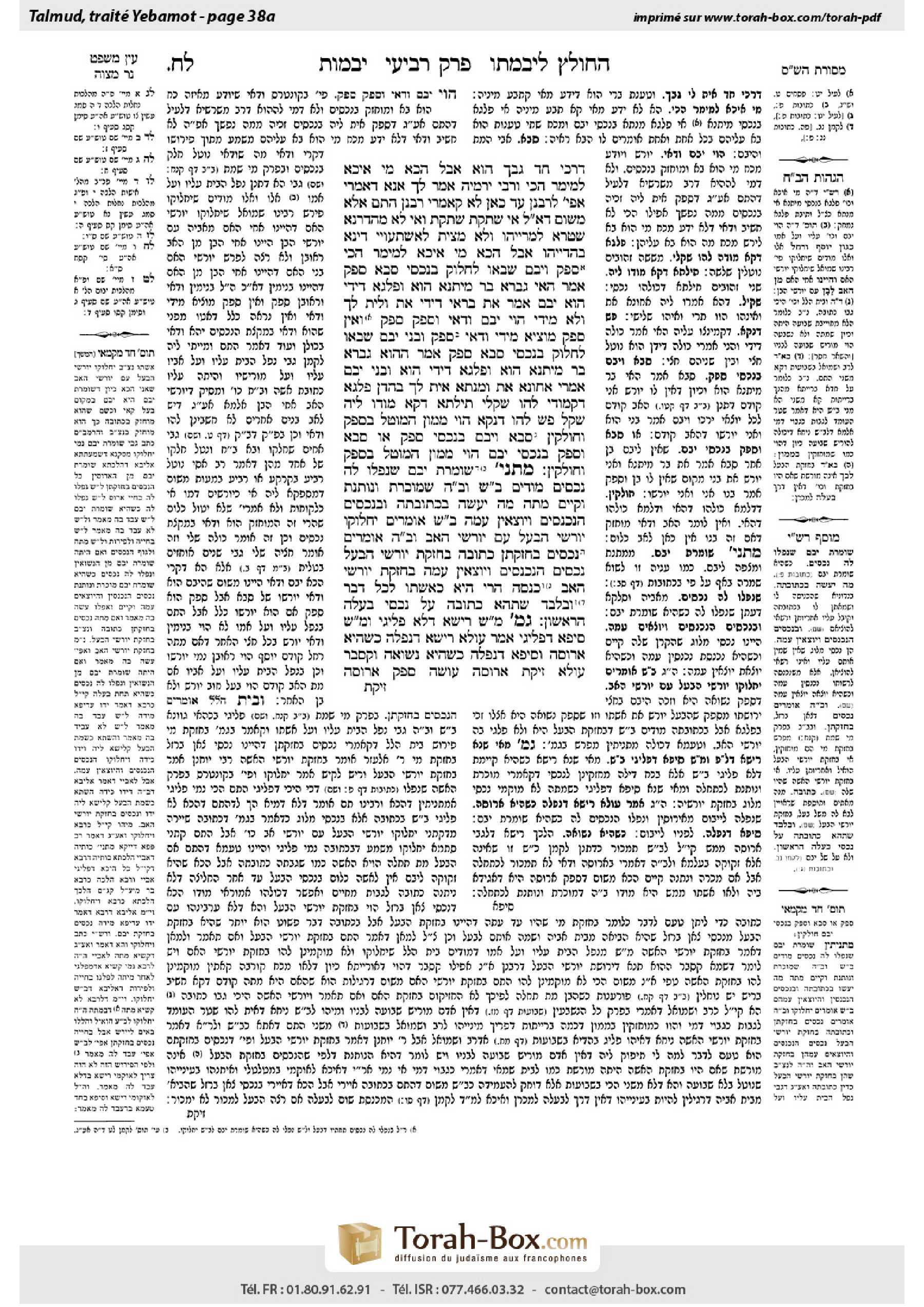
יבמות ל״ח א · Aramaic and Hebrew text
דַּרְכַּי (חַד גַּבָּךְ) [גַּבֵּי חַד] הוּא. אֲבָל הָכָא, מִי אִיכָּא לְמֵימַר הָכִי?
וְרַבִּי יִרְמְיָה אָמַר לָךְ: אֲנָא דַּאֲמַרִי אֲפִילּוּ לְרַבָּנַן, עַד כָּאן לָא קָאָמְרִי רַבָּנַן הָתָם, אֶלָּא מִשּׁוּם דְּאָמַר לֵיהּ: אִי שָׁתְקַתְּ — שָׁתְקַתְּ. וְאִי לָא, מַהְדַּרְנָא שְׁטָרָא לְמָרַיְיהוּ וְלָא מָצֵית לְאִשְׁתַּעוֹיֵי דִּינָא בַּהֲדַיְיהוּ, אֲבָל הָכָא — מִי אִיכָּא לְמֵימַר הָכִי?
סָפֵק וְיָבָם שֶׁבָּאוּ לַחֲלוֹק בְּנִכְסֵי סָבָא. סָפֵק אָמַר: הַאי גַּבְרָא בַּר מִיתָנָא הוּא, וּפַלְגָא דִּידִי הוּא. יָבָם אָמַר: אַתְּ, בְּרַאי דִּידִי אַתְּ, וְלֵית לָךְ וְלָא מִידֵּי.
הָוֵי יָבָם וַדַּאי, וְסָפֵק סָפֵק, וְאֵין סָפֵק מוֹצִיא מִידֵי וַדַּאי.
סָפֵק וּבְנֵי יָבָם שֶׁבָּאוּ לַחֲלוֹק בְּנִכְסֵי סָבָא. סָפֵק אָמַר: הָהוּא גַּבְרָא בַּר מִיתָנָא הוּא, וּפַלְגָא דִּידִי הוּא. וּבְנֵי יָבָם אָמְרִי: אֲחוּנָא אַתְּ וּמְנָתָא אִית לָךְ בַּהֲדַן.
פַּלְגָא דְּקָמוֹדֵי לְהוּ — שָׁקְלִי. תִּילְתָּא דְּקָא מוֹדוּ לֵיהּ — שָׁקֵל. פָּשׁ לְהוּ דַּנְקָא — הָוֵי מָמוֹן הַמּוּטָּל בְּסָפֵק וְחוֹלְקִין.
סָבָא וְיָבָם בְּנִכְסֵי סָפֵק. אוֹ סָבָא וְסָפֵק בְּנִכְסֵי יָבָם —
הָוֵי מָמוֹן הַמּוּטָּל בְּסָפֵק וְחוֹלְקִין.
מַתְנִי׳ שׁוֹמֶרֶת יָבָם שֶׁנָּפְלוּ לָהּ נְכָסִים — מוֹדִים בֵּית שַׁמַּאי וּבֵית הִלֵּל שֶׁמּוֹכֶרֶת וְנוֹתֶנֶת, וְקַיָּים.
מֵתָה, מָה יַעֲשֶׂה בִּכְתוּבָּתָהּ, וּבִנְכָסִים הַנִּכְנָסִים וְיוֹצְאִין עִמָּהּ? בֵּית שַׁמַּאי אוֹמְרִים: יַחְלוֹקוּ יוֹרְשֵׁי הַבַּעַל עִם יוֹרְשֵׁי הָאָב. וּבֵית הִלֵּל אוֹמְרִים: נְכָסִים בְּחֶזְקָתָן. כְּתוּבָּה — בְּחֶזְקַת יוֹרְשֵׁי הַבַּעַל, נְכָסִים הַנִּכְנָסִים וְיוֹצְאִין עִמָּהּ — בְּחֶזְקַת יוֹרְשֵׁי הָאָב.
כְּנָסָהּ — הֲרֵי הִיא כְּאִשְׁתּוֹ לְכׇל דָּבָר. וּבִלְבַד שֶׁתְּהֵא כְּתוּבָּ[תָ]הּ עַל נִכְסֵי בַּעְלָהּ הָרִאשׁוֹן.
גְּמָ׳ מַאי שְׁנָא רֵישָׁא דְּלָא פְּלִיגִי, וּמַאי שְׁנָא סֵיפָא דִּפְלִיגִי?
אָמַר עוּלָּא: רֵישָׁא דְּנָפְלָה כְּשֶׁהִיא אֲרוּסָה, וְסֵיפָא דְּנָפְלָה כְּשֶׁהִיא נְשׂוּאָה.
וְקָסָבַר עוּלָּא: זִיקַּת אֲרוּסָה עוֹשָׂה סְפֵק אֲרוּסָה,
Yevamot 38a · English translation
my one path is with you in one of your pieces of land. Since his claim is based on facts that are clear and certain, his claim is successful. However, here, in the dispute over the inheritance, is the son of uncertain descent able to state a claim like this? Although the son of uncertain descent claims that ultimately, whatever the nature of his relationship with the deceased is, he should have the right to inherit, nevertheless, since it is not actually known what that relationship is, his claim in reality is merely a composite of uncertain claims.
And Rabbi Yirmeya could have said to you: I stated my ruling even in accordance with the opinion of the Rabbis, since perhaps the Rabbis state their ruling only there, in the case of the lost path, because the owner of the surrounding land said to the field owner: If you do not press your claim and are silent, then be silent and I will sell you the path at a reasonable price; but if not, then I will return the bills of purchase of the pieces of land to their previous owners and then you will not be able to successfully engage in a legal dispute with them. He is successful with this claim because it is within his power to return the fields and thereby recreate the original circumstances in which the owner of the field would forfeit the path. However, here, are the sons of the yavam able to state a claim like this? The original circumstance, in which the inheritance of the deceased had still not been divided, cannot be recreated. Therefore, a claim based on that circumstance will be unsuccessful.
The Gemara brings another case, that of one of uncertain descent, who is either the son of the deceased or the son of the yavam, and the yavam who came to divide up the possessions of the grandfather, i.e., the father of the yavam and the deceased, and each one made a claim to the inheritance. The son of uncertain descent said: That man, referring to himself, is the son of the deceased, and therefore half of the possessions are mine because the inheritance should be split between the two sons, i.e., the deceased and the yavam, and since I am the sole heir of the deceased, I should receive his portion. The yavam said to him: You are my son, and therefore you have absolutely no rights to the possessions; rather, I should receive all the inheritance. One half is mine because I am the grandfather’s son, and the other half, which would have gone to my deceased brother, I should receive by virtue of the fact that I consummated the levirate marriage with his widow.
The Gemara rules on this case: This is a case in which the yavam has a definite claim because he is the grandfather’s son, and the son of uncertain descent has only an uncertain claim, and the halakha is that one with an uncertain claim cannot extract property from one who has a definite claim to it. Therefore, the yavam receives all the inheritance.
The Gemara raises yet another case, that of one of uncertain descent, who is either the son of the deceased or the son of the yavam, and the sons of the yavam who came to divide up the possessions of the grandfather, and each one made a claim to the inheritance. The son of uncertain descent said: That man, referring to himself, is the son of the deceased, and therefore half of the possessions are mine because the inheritance should be split between the two sons, i.e., the deceased and the yavam, and since I am the lone heir of the deceased I should receive his portion. And the sons of the yavam said: You are our brother, and therefore you should receive only a portion together with us.
The Gemara rules on this case: The half of the grandfather’s possessions that the son of uncertain descent concedes belongs to them, the sons of the yavam, they take for themselves. By claiming to be the son of the brother who died first, he forfeits any rights to the other brother’s portion. The third of the grandfather’s possessions that the sons of the yavam concede belong to him, the son of uncertain descent, he takes for himself. By claiming he is their brother, they admit that he should at least receive an equal portion to them, which would mean one-third if they are three. This leaves them with one-sixth [danka] of the possessions that is property of uncertain ownership, and so they should divide it up between them.
The Gemara presents two additional cases. One is a case where a son of uncertain descent, who is either the son of the deceased or the son of the yavam, died, and the grandfather and the yavam come to divide up the possessions of the son of uncertain descent. In the absence of any children, a father inherits from his son. The grandfather claims that the son of uncertain descent was actually the son of the deceased, and since the deceased has already died, the grandfather should be next in line to inherit from him. The yavam claims that the son of uncertain descent was his own son, and therefore he should inherit from him. Or, the second case is one in which the yavam died and the grandfather and the son of uncertain descent come to divide up the possessions of the yavam. The son of uncertain descent claims to be the lone son of the yavam and therefore he should inherit, whereas the grandfather claims that the son of uncertain descent was the son of the deceased and that the yavam died childless, and therefore the grandfather, who is the father of the yavam, should inherit from him.
The Gemara rules in these cases: This is a case of property of uncertain ownership, and so they should divide up the possessions between them.
MISHNA: With regard to a widow waiting for her yavam to either consummate a levirate marriage or perform ḥalitza with her, i.e., a yevama, to whom property was bequeathed: Beit Shammai and Beit Hillel both agree that she may sell or give away that property ab initio, and that if she did, the transfer is valid. Since she has only a levirate bond with the yavam, she retains total control of the property. This is in contrast to a betrothed woman, concerning whom Beit Hillel rule that she may not sell such property because her betrothed also has rights to it (Ketubot 78a).
If she died, what should be done with the money assured to her in her marriage contract by her deceased husband and with her property that enters and leaves the marriage with her, in which a husband only ever has a usufructuary interest? Beit Shammai say: The husband’s heirs, i.e., the yavam, who stands to inherit from the husband when he consummates the levirate marriage, should divide up the property together with her father’s heirs, i.e., the woman’s family. And Beit Hillel say: The property retains its previous ownership status. Therefore, money assured to her in her marriage contract remains in the possession of the husband’s heirs. Since it was to be paid from the husband’s own property, the money is retained by his estate and passes to his heirs. And her property that enters and leaves the marriage with her remains in the possession of the father’s heirs. Since those properties belonged to her, upon her death they are inherited by her father or his heirs.
If the yavam consummated the levirate marriage with her, then her legal status is that of his wife in every sense, and therefore the yavam has the same rights to her property as in a regular marriage. And the only exception to this is that her marriage contract will still be payable from the property of her first husband and not from the property of the yavam.
GEMARA: The Gemara asks: What is different about the first clause, concerning a yevama who is still alive, that Beit Shammai do not disagree with Beit Hillel that the woman has full possession of the property since there is only a levirate bond but no marriage, and what is different about the latter clause that Beit Shammai disagree with Beit Hillel and rule that the yavam does take a share of the property, which would imply that the levirate bond alone is sufficient to afford the yavam rights over her property?
Ulla said: The two clauses concern different cases: The first clause concerns a case where she happened before her yavam for levirate marriage at a time when she was a betrothed woman and only then did she come into the possession of property. Since when she was betrothed her husband did not have any rights to the property, neither does the yavam. And the latter clause concerns a case where she happened before her yavam at a time when she was a married woman. In such a case, were her husband still alive, he would have full rights to the property; therefore, so does the yavam.
The Gemara explains: And Ulla holds that a levirate bond formed with a betrothed woman affords her a status equivalent to a woman about whom there is an uncertainty whether she is betrothed,
Yevamot 38a · Traduction française (IA)
« Mon seul recours est de réclamer l’un de tes terrains. » Puisque sa revendication repose sur des faits clairs et certains, elle aboutit. Mais ici, dans le litige portant sur l’héritage, le fils à la filiation incertaine peut-il formuler une revendication de ce genre ? Bien qu’il soutienne qu’en définitive, quelle que soit la nature de son lien avec le défunt, il devrait avoir le droit d’hériter, comme on ignore en réalité quelle est cette nature, sa revendication n’est en fait qu’un ensemble de revendications incertaines.
Et Rabbi Yirmeya aurait pu te répondre : « J’ai formulé ma décision même selon l’opinion des Rabbins, car peut-être les Rabbins ne se prononcent-ils ainsi que là-bas, dans le cas du chemin perdu, parce que le propriétaire du terrain environnant dit au propriétaire du champ : “Si tu ne fais pas valoir ta revendication et gardes le silence, alors tais-toi et je te vendrai le chemin à un prix raisonnable ; sinon, je rendrai les actes d’achat des parcelles à leurs anciens propriétaires, et tu ne pourras alors pas avoir gain de cause dans un litige avec eux.” » Sa revendication aboutit, car il est en son pouvoir de rendre les champs et de rétablir ainsi la situation initiale, dans laquelle le propriétaire du champ perdrait le chemin. Mais ici, les fils du yavam peuvent-ils formuler une revendication de ce genre ? Il est impossible de rétablir la situation initiale, où l’héritage du défunt n’avait pas encore été partagé. Une revendication fondée sur cette situation ne peut donc aboutir.
La Guemara présente un autre cas : celui d’un homme à la filiation incertaine, qui est soit le fils du défunt, soit le fils du yavam, et du yavam, qui viennent partager les biens de leur grand-père, c’est-à-dire du père du yavam et du défunt, et revendiquent chacun l’héritage. L’homme à la filiation incertaine dit : « Cet homme » — en parlant de lui-même — « est le fils du défunt ; la moitié des biens me revient donc, car l’héritage doit être partagé entre les deux fils, c’est-à-dire le défunt et le yavam, et, puisque je suis l’unique héritier du défunt, je dois recevoir sa part. » Le yavam lui dit : « Tu es mon fils, et tu n’as donc absolument aucun droit sur ces biens ; c’est moi qui dois recevoir tout l’héritage. La moitié me revient parce que je suis le fils du grand-père, et l’autre moitié, qui serait revenue à mon frère défunt, me revient parce que j’ai contracté avec sa veuve le mariage léviratique. »
La Guemara tranche dans ce cas : le yavam a une revendication certaine, puisqu’il est le fils du grand-père, tandis que l’homme à la filiation incertaine n’a qu’une revendication incertaine. Or, selon la halakha, celui dont la revendication est incertaine ne peut retirer un bien à celui qui en revendique la propriété de manière certaine. Le yavam reçoit donc tout l’héritage.
La Guemara soulève encore un autre cas : celui d’un homme à la filiation incertaine, qui est soit le fils du défunt, soit le fils du yavam, et des fils du yavam, qui viennent partager les biens de leur grand-père et revendiquent chacun l’héritage. L’homme à la filiation incertaine dit : « Cet homme » — en parlant de lui-même — « est le fils du défunt ; la moitié des biens me revient donc, car l’héritage doit être partagé entre les deux fils, c’est-à-dire le défunt et le yavam, et, puisque je suis l’unique héritier du défunt, je dois recevoir sa part. » Les fils du yavam lui disent : « Tu es notre frère, et tu ne dois donc recevoir qu’une part avec nous. »
La Guemara tranche dans ce cas : la moitié des biens du grand-père, dont l’homme à la filiation incertaine reconnaît qu’elle leur appartient, revient aux fils du yavam, qui la prennent. En prétendant être le fils du frère mort le premier, il renonce à tout droit sur la part de l’autre frère. Le tiers des biens du grand-père, dont les fils du yavam reconnaissent qu’il lui appartient, revient à l’homme à la filiation incertaine, qui le prend. En prétendant qu’il est leur frère, ils reconnaissent qu’il doit au moins recevoir une part égale à la leur, ce qui représente un tiers s’ils sont trois. Il reste un sixième [danka] des biens dont la propriété est incertaine ; ils doivent donc se le partager.
La Guemara présente deux autres cas. Le premier est celui d’un homme à la filiation incertaine, qui est soit le fils du défunt, soit le fils du yavam, et qui est mort ; le grand-père et le yavam viennent alors partager ses biens. En l’absence d’enfants, un père hérite de son fils. Le grand-père affirme que l’homme à la filiation incertaine était en réalité le fils du défunt et que, puisque le défunt est déjà mort, le grand-père est le prochain à hériter de lui. Le yavam affirme que l’homme à la filiation incertaine était son propre fils et qu’il doit donc hériter de lui. Le second cas est celui où le yavam est mort et où le grand-père et l’homme à la filiation incertaine viennent partager les biens du yavam. L’homme à la filiation incertaine affirme être l’unique fils du yavam et devoir ainsi hériter de lui, tandis que le grand-père affirme que l’homme à la filiation incertaine était le fils du défunt et que le yavam est mort sans enfant ; le grand-père, qui est le père du yavam, doit donc hériter de lui.
La Guemara tranche dans ces cas : il s’agit de biens dont la propriété est incertaine ; ils doivent donc se les partager.
MICHNA : Au sujet d’une veuve qui attend que son yavam contracte avec elle un mariage léviratique ou accomplisse la ḥalitza — une yevama — et qui a reçu des biens en héritage : Beit Shammaï et Beit Hillel conviennent tous deux qu’elle peut vendre ou donner ces biens d’emblée, et que, si elle l’a fait, le transfert est valable. Comme elle n’est liée au yavam que par le lien léviratique, elle conserve le plein contrôle de ses biens. Cela contraste avec le cas d’une femme fiancée, au sujet de laquelle Beit Hillel statue qu’elle ne peut pas vendre de tels biens, car son fiancé a lui aussi des droits sur eux (Ketoubot 78a).
Si elle meurt, que faut-il faire de la somme qui lui est garantie par son contrat de mariage avec son mari défunt et de ses biens qui entrent dans le mariage et en sortent avec elle, sur lesquels le mari n’a jamais qu’un usufruit ? Beit Shammaï dit : les héritiers du mari, c’est-à-dire le yavam, qui est appelé à hériter du mari s’il contracte avec elle le mariage léviratique, partageront les biens avec les héritiers de son père, c’est-à-dire la famille de la femme. Et Beit Hillel dit : les biens conservent leur statut de propriété antérieur. Par conséquent, la somme qui lui est garantie par son contrat de mariage reste entre les mains des héritiers du mari. Comme elle devait être payée sur les biens propres du mari, elle demeure dans sa succession et passe à ses héritiers. Quant aux biens qui entrent dans le mariage et en sortent avec elle, ils restent entre les mains des héritiers de son père. Comme ces biens lui appartenaient, à sa mort ils sont hérités par son père ou par les héritiers de celui-ci.
Si le yavam a contracté avec elle le mariage léviratique, elle a alors le statut de son épouse à tous égards ; le yavam a donc sur ses biens les mêmes droits que dans un mariage ordinaire. La seule exception est que la somme due au titre de son contrat de mariage restera payable sur les biens de son premier mari, et non sur ceux du yavam.
GUEMARA : La Guemara demande : En quoi la première partie, qui traite d’une yevama encore en vie, diffère-t-elle, puisque Beit Shammaï ne conteste pas à Beit Hillel que la femme possède pleinement les biens, étant donné qu’il n’existe qu’un lien léviratique et non un mariage ? Et en quoi la dernière partie diffère-t-elle, puisque Beit Shammaï conteste Beit Hillel et statue que le yavam reçoit bien une part des biens, ce qui implique que le seul lien léviratique suffit à conférer au yavam des droits sur les biens de la femme ?
Oulla a dit : les deux parties concernent des cas différents. La première traite du cas où elle est échue à son yavam pour le mariage léviratique alors qu’elle était encore fiancée, et où elle n’a reçu des biens qu’ensuite. Comme son fiancé n’avait aucun droit sur ces biens lorsqu’elle était fiancée, le yavam n’en a pas non plus. La dernière partie traite du cas où elle est échue à son yavam alors qu’elle était mariée. Dans ce cas, si son mari était encore en vie, il aurait pleinement droit à ces biens ; le yavam y a donc droit lui aussi.
La Guemara explique : Oulla considère qu’un lien léviratique avec une femme fiancée lui confère un statut équivalent à celui d’une femme dont on ne sait pas avec certitude si elle est fiancée,
Traduction française générée par IA à partir de l’édition anglaise de Sefaria. Vérifie toujours un passage avec le texte source.
Text from Sefaria: William Davidson Edition - Vocalized Aramaic (CC BY NC); William Davidson Edition - English (CC BY NC).