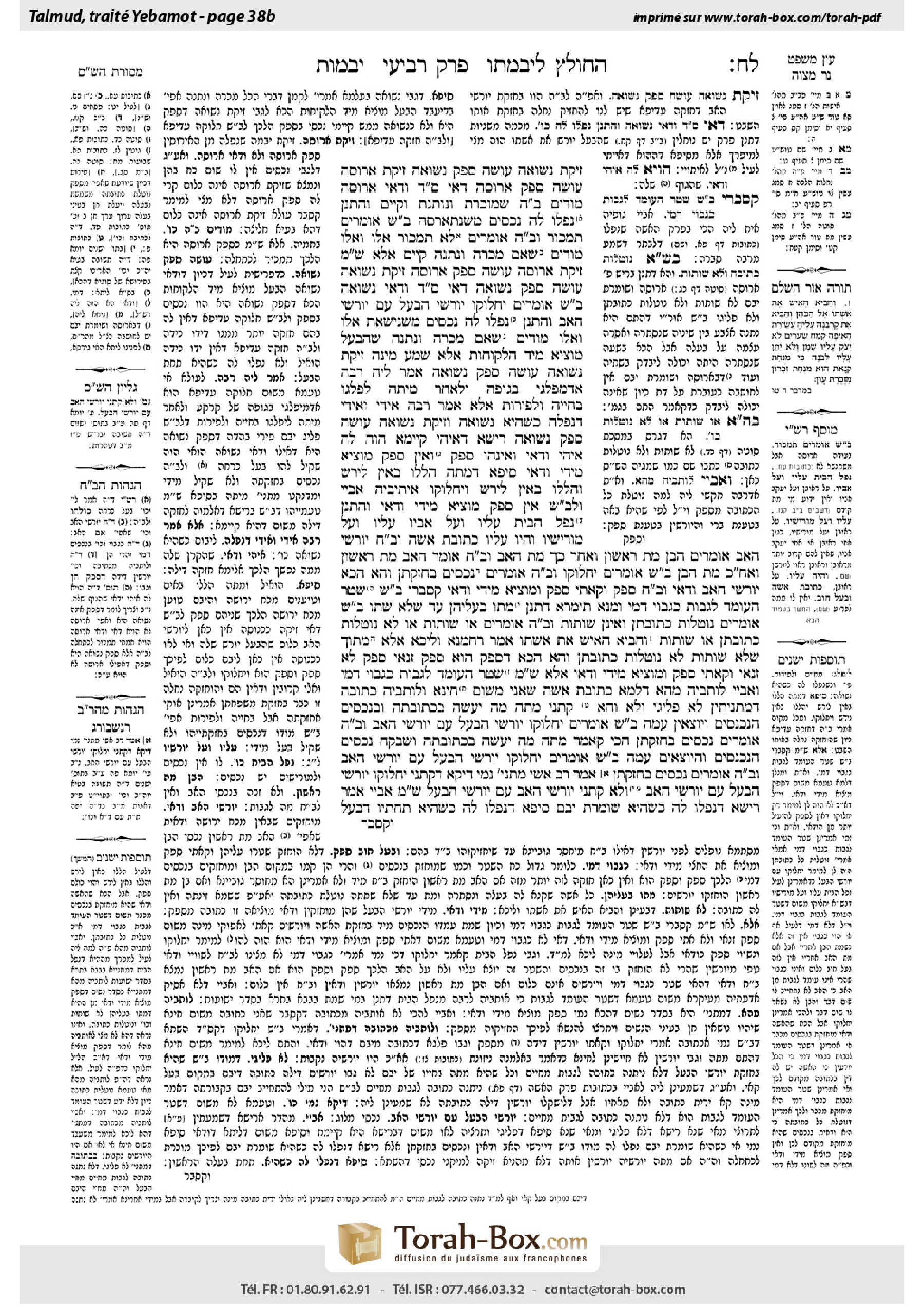
Yevamot 38b: Talmud study for Daf Yomi
Daf Yomi is the daily study of one Talmud folio. Explore 37 tractates with scans, Hebrew text, Sefaria English and AI-generated French translations where annotated.
Passage selection and English or AI-generated French translation are available where the scan has annotations. Daf Study is independent of Torah-Box and Sefaria.
Browse Yevamot · יבמות · All tractatesYevamot 38b text and translations
This page of Yevamot includes the Aramaic text, an English translation and an AI-generated French translation, alongside the scan above.
יבמות ל״ח ב · Aramaic and Hebrew text
זִיקַּת נְשׂוּאָה עוֹשָׂה סְפֵק נְשׂוּאָה.
זִיקַּת אֲרוּסָה עוֹשָׂה סְפֵק אֲרוּסָה — דְּאִי סָלְקָא דַעְתָּךְ וַדַּאי אֲרוּסָה, מוֹדִים בֵּית הִלֵּל שֶׁמּוֹכֶרֶת וְנוֹתֶנֶת וְקַיָּים?
וְהָתְנַן: נָפְלוּ לָהּ נְכָסִים מִשֶּׁנִּתְאָרְסָה, בֵּית שַׁמַּאי אוֹמְרִים: תִּמְכּוֹר, וּבֵית הִלֵּל אוֹמְרִים: לֹא תִּמְכּוֹר. אֵלּוּ וְאֵלּוּ מוֹדִים שֶׁאִם מָכְרָה וְנָתְנָה — קַיָּים. אֶלָּא שְׁמַע מִינַּהּ: זִיקַּת אֲרוּסָה עוֹשָׂה סְפֵק אֲרוּסָה.
זִיקַּת נְשׂוּאָה עוֹשָׂה סְפֵק נְשׂוּאָה. דְּאִי סָלְקָא דַעְתָּךְ וַדַּאי נְשׂוּאָה, בֵּית שַׁמַּאי אוֹמְרִים יַחְלוֹקוּ יוֹרְשֵׁי הַבַּעַל עִם יוֹרְשֵׁי הָאָב?
וְהָתְנַן: נָפְלוּ לָהּ נְכָסִים מִשֶּׁנִּישֵּׂאת, אֵלּוּ וָאֵלּוּ מוֹדִים שֶׁאִם מָכְרָה וְנָתְנָה — שֶׁהַבַּעַל מוֹצִיא מִיַּד הַלָּקוֹחוֹת. אֶלָּא שְׁמַע מִינַּהּ: זִיקַּת נְשׂוּאָה עוֹשָׂה סְפֵק נְשׂוּאָה.
אֲמַר לֵיהּ רַבָּה: אַדְּמִפַּלְגִי בְּגוּפַהּ וּלְאַחַר מִיתָה, לִפַּלְגוּ בְּחַיֶּיהָ וּלְפֵירוֹת!
אֶלָּא אָמַר רַבָּה: אִידֵּי וְאִידֵּי דְּנָפְלָה כְּשֶׁהִיא נְשׂוּאָה, וְזִיקַּת נְשׂוּאָה עוֹשָׂה סְפֵק נְשׂוּאָה. רֵישָׁא דְּאִיהִי קָיְימָא — הָוְיָא לַהּ אִיהִי וַדַּאי וְאִינְהוּ סָפֵק, וְאֵין סָפֵק מוֹצִיא מִידֵי וַדַּאי.
סֵיפָא דְּמֵתָה, הַלָּלוּ בָּאִין לִירַשׁ, וְהַלָּלוּ בָּאִין לִירַשׁ — וְיַחְלוֹקוּ.
אֵיתִיבֵיהּ אַבָּיֵי: וּלְבֵית שַׁמַּאי אֵין סָפֵק מוֹצִיא מִידֵי וַדַּאי? וְהָתְנַן: נָפַל הַבַּיִת עָלָיו וְעַל אָבִיו, עָלָיו וְעַל מוֹרִישָׁיו, וְהָיוּ עָלָיו כְּתוּבַּת אִשָּׁה וּבַעַל חוֹב.
יוֹרְשֵׁי הָאָב אוֹמְרִים: הַבֵּן מֵת רִאשׁוֹן, וְאַחַר כָּךְ מֵת הָאָב, וּבַעַל חוֹב אוֹמֵר: הָאָב מֵת רִאשׁוֹן, וְאַחַר כָּךְ מֵת הַבֵּן —
בֵּית שַׁמַּאי אוֹמְרִים: יַחְלוֹקוּ, וּבֵית הִלֵּל אוֹמְרִים: נְכָסִים בְּחֶזְקָתָן.
וְהָא הָכָא, יוֹרְשֵׁי הָאָב וַדַּאי, וּבַעַל חוֹב סָפֵק, וְקָאָתֵי סָפֵק וּמוֹצִיא מִידֵי וַדַּאי!
קָסָבְרִי בֵּית שַׁמַּאי: שְׁטָר הָעוֹמֵד לִגְבּוֹת כְּגָבוּי דָּמֵי.
וּמְנָא תֵּימְרָא, דִּתְנַן: מֵתוּ בַּעֲלֵיהֶן עַד שֶׁלֹּא שָׁתוּ — בֵּית שַׁמַּאי אוֹמְרִים: נוֹטְלוֹת כְּתוּבָּתָן וְאֵינָן שׁוֹתוֹת. וּבֵית הִלֵּל אוֹמְרִים: אוֹ שׁוֹתוֹת אוֹ לֹא נוֹטְלוֹת כְּתוּבָּתָן.
אוֹ שׁוֹתוֹת?! ״וְהֵבִיא הָאִישׁ אֶת אִשְׁתּוֹ״ אָמַר רַחֲמָנָא, וְלֵיכָּא! אֶלָּא: מִתּוֹךְ שֶׁלֹּא שׁוֹתוֹת לֹא נוֹטְלוֹת כְּתוּבָּתָן.
וְהָא הָכָא, דְּסָפֵק הוּא: סָפֵק זַנַּאי סָפֵק לָא זַנַּאי, וְקָאָתֵי סָפֵק וּמוֹצִיא מִידֵי וַדַּאי! אֶלָּא שְׁמַע מִינַּהּ: שְׁטָר הָעוֹמֵד לִגְבּוֹת כְּגָבוּי דָּמֵי.
וְאַבָּיֵי, לוֹתְבֵיהּ מֵהָא! דִּלְמָא כְּתוּבַּת אִשָּׁה שָׁאנֵי, מִשּׁוּם חִינָּא.
וְלוֹתְבֵיהּ כְּתוּבָּה דְמַתְנִיתִין!
לָא פְּלִיגִי. וְלָא?! וְהָא קָתָנֵי: מֵתָה, מָה יַעֲשֶׂה בִּכְתוּבָּתָהּ וּבִנְכָסִים הַנִּכְנָסִים וְיוֹצְאִין עִמָּהּ — בֵּית שַׁמַּאי אוֹמְרִים: יַחְלוֹקוּ יוֹרְשֵׁי הַבַּעַל עִם יוֹרְשֵׁי הָאָב, וּבֵית הִלֵּל אוֹמְרִים: נְכָסִים בְּחֶזְקָתָן.
הָכִי קָאָמַר: מֵתָה, מָה יַעֲשֶׂה בִּכְתוּבָּתָהּ, וְשַׁבְקַהּ. נְכָסִים הַנִּכְנָסִים וְהַיּוֹצְאִים עִמָּהּ — בֵּית שַׁמַּאי אוֹמְרִים: יַחְלוֹקוּ יוֹרְשֵׁי הַבַּעַל עִם יוֹרְשֵׁי הָאָב, וּבֵית הִלֵּל אוֹמְרִים: נְכָסִים בְּחֶזְקָתָן.
אָמַר רַב אָשֵׁי: מַתְנִיתִין נָמֵי דַּיְקָא — דְּקָתָנֵי: יַחְלוֹקוּ יוֹרְשֵׁי הַבַּעַל עִם יוֹרְשֵׁי הָאָב. וְלָא קָתָנֵי: יוֹרְשֵׁי הָאָב עִם יוֹרְשֵׁי הַבַּעַל. שְׁמַע מִינַּהּ.
אַבָּיֵי אָמַר: רֵישָׁא דְּנָפְלוּ לָהּ כְּשֶׁהִיא שׁוֹמֶרֶת יָבָם, סֵיפָא דְּנָפְלוּ לָהּ כְּשֶׁהִיא תַּחְתָּיו דְּבַעַל.
Yevamot 38b · English translation
and a levirate bond formed with a married woman affords her a status equivalent to that of a woman for whom there is an uncertainty whether she is married, i.e., when her husband dies, the same level of relationship that existed with the first husband is created with the yavam. However, since the new relationship exists only by virtue of a levirate bond, it exists to a lower degree, and so the rights afforded to the yavam are more limited than those the first husband would have enjoyed; the rights granted to the yavam are equivalent to the rights of husband in a case where there is uncertainty whether that level of relationship exists at all.
The Gemara proceeds to demonstrate this: It must be that a levirate bond formed with a betrothed woman affords her a status equivalent to that of a woman for whom there is an uncertainty whether she is betrothed, because if it enters your mind to suggest that her status is equivalent to that of a definitely betrothed woman, would Beit Hillel concede that she may sell or give away her property ab initio, and that if she does the transfer is valid?
But didn’t we learn in a mishna (Ketubot 78a): If property was bequeathed to a woman after she was betrothed, Beit Shammai say: She may sell that property, and Beit Hillel say: She may not sell that property. However, both agree that if she sold it or gave it away, the transfer is valid. The mishna clearly states that according to Beit Hillel, a woman who is definitely betrothed may not sell the property ab initio. Rather, conclude from here, from the fact that here Beit Hillel permit the yevama to sell her property ab initio, that a levirate bond formed with a betrothed woman affords her a status equivalent to that of a woman for whom there is an uncertainty whether she is betrothed.
Similarly, it must be that a levirate bond formed with a married woman affords her a status equivalent to that of a woman for whom there is an uncertainty whether she is married, because if it enters your mind to suggest that her status is equivalent to that of a definitely married woman, would Beit Shammai say that the husband’s heirs should divide up the property together with the father’s heirs?
But didn’t we learn in a mishna (Ketubot 78a): If property was bequeathed to a woman after she was married, both Beit Hillel and Beit Shammai agree that if she sold the property or gave it away, then the husband repossesses it from the purchasers. Rather, conclude from here, from the fact that here Beit Shammai assume the rights of the yavam are limited, that a levirate bond formed with a married woman affords her a status equivalent to a woman for whom there is an uncertainty whether she is married.
Rabba challenges Ulla’s understanding of the mishna: Rabba said to him: If your explanation is correct, then in the latter clause, instead of disagreeing with regard to who has the rights to the property itself, which necessitates considering the case after her death, let Beit Hillel and Beit Shammai disagree with regard to the more immediate case when she is still alive and dispute who has the rights to the use and produce of the property.
Rather, Rabba said a different resolution to the apparent inconsistency in Beit Shammai’s rulings: Both this first clause and that latter clause of the mishna concern a case in which she happened before her yavam for levirate marriage once she was already a married woman, and a levirate bond formed with a married woman affords her a status equivalent to that of a woman about whom there is an uncertainty whether she is married. The distinction between the two clauses is as follows: In the first clause, where she is alive, she has a certain claim to the property, while they, i.e., the yavam, are considered to have only an uncertain claim to the property, as she has the status of a woman for whom there is an uncertainty whether she is married. And since one who has an uncertain claim cannot extract property from one who has a definite claim to it, she therefore retains full possession of the property.
In the latter clause, however, where she died, neither party has a definite claim; rather, these heirs of the father come to inherit, and those heirs of the husband come to inherit, and therefore they should divide up the property.
Abaye raised an objection to Rabba’s opinion: But is it true that according to Beit Shammai, one with an uncertain claim cannot extract property from one who has a definite claim to it? Didn’t we learn in a mishna (Bava Batra 157a): In a case where a house collapsed upon a person and upon his father, or upon him and upon those from whom he stood to inherit, and there were outstanding debts against that person from his wife’s marriage contract and to a creditor, but he had no money with which to pay those debts, and it is not known who died first, the following situation arises: If the father died first, then before the son died he had already inherited the father’s property and therefore the son’s creditors gained a lien over that property and have the rights to collect their debts from that property even after the son’s death.
Accordingly, the father’s heirs and the creditor offer opposing claims: The father’s heirs say: The son died first and only afterward the father died. Therefore, the creditor never gained any rights to collect from the property. And the creditor says: The father died first and only afterward the son died. Therefore, the father’s property was liened to the son’s debts, and the creditor has a right to collect.
The mishna continues: Beit Shammai say: They should divide up the property between them. And Beit Hillel say: The property retains its previous ownership status, which in this case means that since the last known possessor was the father, so the father’s heirs gain full rights to it.
Abaye explains his proof: Isn’t it the case here that the father’s heirs have a definite claim and the creditor has only an uncertain claim? Therefore, since Beit Shammai rule that the property should be divided up, it is apparent that they hold that one with an uncertain claim can extract property from one who has a definite claim to it.
Rabba rejects the proof: Beit Shammai’s ruling in this case cannot be adduced as a proof because Beit Shammai hold: A debt recorded in a bill of debt that is awaiting collection is as though it was already collected to the extent that the creditor is considered to be in possession of the debt. Therefore, the creditor is considered to be in possession of the property to the same extent as the father’s heirs; consequently, the property is divided between them.
And from where do you say that Beit Shammai hold this opinion? As we learned in a mishna (Sota 24a): A married woman who secluded herself with another man after her husband had warned her not to do so is suspected of having committed adultery. To establish her guilt or innocence she is brought to the Temple, where she drinks the bitter waters. With regard to such women, if their husbands died before they drank the bitter waters, Beit Shammai say: They collect the money assured to them in their marriage contracts and do not drink the waters. And Beit Hillel say: Either they drink, and if they survive they collect their marriage contracts, or they do not drink and they cannot collect their marriage contracts, and all the husband’s property passes to his heirs.
The Gemara clarifies the statement of Beit Hillel: Did Beit Hillel really mean: Either they drink, which implies they may actually choose to drink? But doesn’t the Merciful One state: “And the man shall bring his wife” (Numbers 5:15), which indicates that the ritual of drinking the bitter waters applies only when the husband is still alive, and in this case there is no husband to do so; consequently, she should not be able to drink. Rather, Beit Hillel’s intent is as follows: The only means by which a suspected adulteress is able to collect her marriage contract is by drinking the bitter waters and proving her innocence. Therefore, where this is not possible due to the death of the husband, since the wives do not drink, they cannot collect their marriage contracts.
Rabba explains his proof from this mishna: Isn’t it the case here that the wife’s claim to her marriage contract is uncertain because there is uncertainty whether she was unfaithful or whether she was not unfaithful, and so it would appear that one with an uncertain claim is coming and undermining the definite claim of the husband’s heirs? This is untenable, as even were one to hold that someone with an uncertain claim can extract property from someone who has a definite claim to it, that would only allow for the money to be divided between the two sides, whereas in this case Beit Shammai rule that the creditor collects the entire debt. Rather, conclude from that mishna that Beit Shammai hold that a debt recorded in a bill of debt that is awaiting collection is considered as though it were already collected to the extent that the one who is owed the money is considered to be in possession of the debt. It is due to this reason that she is empowered to be able to collect her marriage contract.
The Gemara asks: And why did Abaye object to Rabba’s opinion based on the mishna in tractate Bava Batra? Let him object to Rabba’s opinion based on this mishna in tractate Sota since based on Abaye’s assumption that a bill of debt is not considered as though it were already collected, this mishna perforce demonstrates that Beit Shammai hold that one with an uncertain claim can extract property from one who has a definite claim to it. The Gemara answers: Abaye did not object based on this mishna because he reasoned that perhaps a woman’s marriage contract is different from a regular bill of debt in that the Sages uniquely reinforced a woman’s hold over the debt in her marriage contract due to the increased desirability that this would bring her when trying to remarry. This would ensure that she would bring some money with her into a new marriage.
The Gemara asks again concerning Abaye’s decision to object to Rabba’s opinion based on the mishna in Bava Batra: Let him object to Rabba’s opinion based on the case of the marriage contract in the mishna here (38a). In its latter clause, the mishna states that if a widow waiting for her yavam dies, Beit Shammai rule that her marriage contract and other property are divided between her father’s heirs and the yavam. In that case, the yavam has certain possession of that property, and the father’s heirs come with an uncertain claim to collect the value of the marriage contract. The fact that Beit Shammai rule that they should divide up the value of the marriage contract between them demonstrates that they hold that one with an uncertain claim can extract property from one who has a definite claim to it.
The Gemara responds: In truth, Beit Shammai do not disagree on that point. The Gemara challenges this claim: Do they not disagree? But it is explicitly taught in the mishna that they disagree in that case: If the widow waiting for her yavam died, what should be done with the money assured to her in her marriage contract, and with her property that enters and leaves the marriage with her? Beit Shammai say: The husband’s heirs should divide up the property together with the father’s heirs. And Beit Hillel say: The property retains its previous ownership status.
The Gemara answers: This is what that mishna is saying: If she died, what should be done with the money assured to her in her marriage contract? And the tanna then left this question unanswered, and addressed an additional case: What should be done with her property that enters and leaves the marriage with her? Beit Shammai say: The husband’s heirs should divide up the property together with the father’s heirs. And Beit Hillel say: The property retains its previous ownership status.
Rav Ashi said: The language of the mishna is also precise according to this interpretation, as it teaches: Beit Shammai say that the husband’s heirs should divide up the property together with the father’s heirs, which implies that the father’s heirs had de facto possession of the property and the husband’s heirs then came and divided that property with them. This is true with regard to her property that enters and leaves the marriage with her. And the mishna does not teach using the reverse formulation: Beit Shammai say that the father’s heirs should divide up the property together with the husband’s heirs, which would imply that the husband’s heirs had de facto possession of the property; this is true with regard to the payment of the marriage contract. Conclude from here that Beit Shammai did not rule what should be done with the payment of the marriage contract, as the Gemara claimed.
The Gemara presents a third resolution to the apparent inconsistency in Beit Shammai’s rulings in the mishna: Abaye said: The first clause concerns a case in which property was bequeathed to her when she was still a widow waiting for her yavam to perform levirate marriage or ḥalitza, and the latter clause concerns a case in which property was bequeathed to her when she was still under, i.e., married to, her first husband, before he died.
Yevamot 38b · Traduction française (IA)
et un lien de yiboum formé avec une femme mariée lui confère un statut équivalent à celui d’une femme dont le mariage est incertain : lorsque son mari meurt, le même degré de lien qui existait avec le premier mari se crée avec le yavam. Toutefois, puisque cette nouvelle relation n’existe qu’en vertu d’un lien de yiboum, elle est de degré inférieur ; les droits du yavam sont donc plus limités que ceux dont aurait bénéficié le premier mari. Les droits accordés au yavam équivalent à ceux dont bénéficierait un mari dans un cas où l’existence même de ce degré de lien est incertaine.
La Guemara entreprend de le démontrer : il faut que le lien de yiboum formé avec une femme fiancée lui confère un statut équivalent à celui d’une femme dont les fiançailles sont incertaines. Car, si l’on envisageait que son statut équivaut à celui d’une femme certainement fiancée, Beit Hillel concéderaient-ils qu’elle peut vendre ou donner ses biens dès le départ, et que le transfert serait valide si elle le faisait ?
Mais n’avons-nous pas appris dans une Michna (Ketoubot 78a) : si un bien a été légué à une femme après ses fiançailles, Beit Shammaï disent qu’elle peut le vendre, et Beit Hillel disent qu’elle ne le peut pas. Toutefois, tous conviennent que, si elle l’a vendu ou donné, le transfert est valide. La Michna affirme clairement que, selon Beit Hillel, une femme certainement fiancée ne peut pas vendre le bien de prime abord. Il faut donc en conclure que, dans le cas présent, puisque Beit Hillel permettent à la yevama de vendre ses biens de prime abord, le lien de yiboum formé avec une femme fiancée lui confère un statut équivalent à celui d’une femme dont les fiançailles sont incertaines.
De même, il faut que le lien de yiboum formé avec une femme mariée lui confère un statut équivalent à celui d’une femme dont le mariage est incertain. Car, si l’on envisageait que son statut équivaut à celui d’une femme certainement mariée, Beit Shammaï diraient-ils que les héritiers du mari doivent partager les biens avec les héritiers du père ?
Mais n’avons-nous pas appris dans une Michna (Ketoubot 78a) : si un bien a été légué à une femme après son mariage, Beit Hillel et Beit Shammaï conviennent tous deux que, si elle l’a vendu ou donné, le mari le reprend aux acquéreurs. Il faut donc en conclure que, dans le cas présent, puisque Beit Shammaï considèrent que les droits du yavam sont limités, le lien de yiboum formé avec une femme mariée lui confère un statut équivalent à celui d’une femme dont le mariage est incertain.
Rabba conteste l’interprétation de la Michna proposée par Oula. Rabba lui dit : « Si ton explication est juste, alors, dans la dernière partie, au lieu de discuter de la personne qui a droit aux biens eux-mêmes — ce qui oblige à envisager le cas après sa mort —, pourquoi Beit Hillel et Beit Shammaï ne discuteraient-ils pas du cas plus immédiat où elle est encore en vie, et de la personne qui a droit à l’usage des biens et à leurs revenus ? »
Rabba propose plutôt une autre solution à l’apparente contradiction entre les décisions de Beit Shammaï : la première partie et la dernière partie de la Michna concernent toutes deux un cas où elle est tombée devant son yavam pour le yiboum alors qu’elle était déjà mariée ; le lien de yiboum formé avec une femme mariée lui confère un statut équivalent à celui d’une femme dont le mariage est incertain. La distinction entre les deux parties est la suivante : dans la première, où elle est en vie, elle a un droit certain sur les biens, tandis qu’eux, c’est-à-dire le yavam, n’ont qu’un droit incertain sur ceux-ci, puisqu’elle a le statut d’une femme dont le mariage est incertain. Or celui qui a un droit incertain ne peut pas reprendre des biens à celui qui a un droit certain ; elle conserve donc la pleine possession des biens.
Dans la dernière partie, en revanche, où elle est morte, aucune des parties n’a de droit certain : les héritiers du père viennent hériter, et les héritiers du mari viennent eux aussi hériter. Ils doivent donc partager les biens.
Abaye soulève une objection contre l’opinion de Rabba : est-il vrai que, selon Beit Shammaï, celui qui a un droit incertain ne peut pas reprendre des biens à celui qui a un droit certain ? N’avons-nous pas appris dans une Michna (Bava Batra 157a) : dans le cas où une maison s’est effondrée sur une personne et sur son père, ou sur elle et sur ceux dont elle devait hériter, et où cette personne avait des dettes au titre de la ketouba de sa femme ainsi qu’envers un créancier, mais ne possédait pas d’argent pour les payer, sans que l’on sache qui est mort en premier, voici la situation : si le père est mort en premier, le fils avait déjà hérité des biens de son père avant de mourir. Les créanciers du fils ont donc acquis un droit de gage sur ces biens et peuvent recouvrer leurs créances sur ceux-ci, même après la mort du fils.
Les héritiers du père et le créancier présentent donc des revendications opposées. Les héritiers du père disent : « Le fils est mort en premier, et le père n’est mort qu’ensuite. Le créancier n’a donc jamais acquis le droit de recouvrer sa créance sur ces biens. » Le créancier, lui, dit : « Le père est mort en premier, et le fils n’est mort qu’ensuite. Les biens du père étaient donc grevés par les dettes du fils, et le créancier a le droit de recouvrer sa créance. »
La Michna poursuit : Beit Shammaï disent qu’ils doivent partager les biens. Beit Hillel disent que les biens conservent leur statut de propriété antérieur ; dans ce cas, puisque le dernier possesseur connu était le père, ses héritiers en obtiennent tous les droits.
Abaye explique la preuve qu’il en tire : dans ce cas, les héritiers du père n’ont-ils pas un droit certain, tandis que le créancier n’a qu’un droit incertain ? Puisque Beit Shammaï statuent que les biens doivent être partagés, il apparaît qu’ils considèrent que celui qui a un droit incertain peut reprendre des biens à celui qui a un droit certain.
Rabba rejette cette preuve : on ne peut pas invoquer la décision de Beit Shammaï dans ce cas comme preuve, car Beit Shammaï considèrent qu’une dette consignée dans un acte de créance et en attente de recouvrement équivaut à une dette déjà recouvrée, en ce sens que le créancier est considéré comme étant en possession de la créance. Le créancier est donc considéré comme étant en possession des biens au même titre que les héritiers du père ; les biens sont par conséquent partagés entre eux.
Et d’où sait-on que Beit Shammaï soutiennent cette opinion ? Comme nous l’avons appris dans une Michna (Sota 24a) : une femme mariée qui s’est isolée avec un autre homme après que son mari lui a interdit de le faire est soupçonnée d’avoir commis l’adultère. Pour établir sa culpabilité ou son innocence, elle est amenée au Temple, où elle boit les eaux amères. Si le mari d’une telle femme meurt avant qu’elle ait bu les eaux amères, Beit Shammaï disent qu’elle perçoit la somme qui lui est garantie par sa ketouba et ne boit pas les eaux. Beit Hillel disent, eux, qu’elle boit et que, si elle survit, elle perçoit sa ketouba ; ou bien qu’elle ne boit pas, auquel cas elle ne peut pas percevoir sa ketouba et tous les biens du mari passent à ses héritiers.
La Guemara précise la déclaration de Beit Hillel : voulaient-ils vraiment dire : « Soit elles boivent », ce qui laisse entendre qu’elles peuvent effectivement choisir de boire ? Mais le Miséricordieux ne dit-il pas : « L’homme amènera sa femme » (Nombres 5:15), ce qui indique que le rituel des eaux amères ne s’applique que lorsque le mari est encore en vie ; or, dans ce cas, il n’y a pas de mari pour le faire. Elle ne devrait donc pas pouvoir boire. Il faut plutôt comprendre l’intention de Beit Hillel ainsi : le seul moyen pour une femme soupçonnée d’adultère de percevoir sa ketouba est de boire les eaux amères et de prouver son innocence. Par conséquent, lorsque cela est impossible en raison de la mort du mari, les femmes ne boivent pas et ne peuvent donc pas percevoir leur ketouba.
Rabba explique la preuve qu’il tire de cette Michna : le droit de la femme à sa ketouba n’est-il pas incertain, puisqu’on ne sait pas si elle a été infidèle ou non ? Il semblerait donc qu’une personne ayant un droit incertain vienne porter atteinte au droit certain des héritiers du mari. Cela ne tient pas, car même si l’on soutenait que celui qui a un droit incertain peut reprendre des biens à celui qui a un droit certain, cela ne permettrait que de partager la somme entre les deux parties, alors que, dans ce cas, Beit Shammaï statuent que la créancière perçoit la totalité de la dette. Il faut donc conclure de cette Michna que Beit Shammaï considèrent qu’une dette consignée dans un acte de créance et en attente de recouvrement équivaut à une dette déjà recouvrée, en ce sens que la personne à qui l’argent est dû est considérée comme étant en possession de la créance. C’est pour cette raison qu’elle est en mesure de percevoir sa ketouba.
La Guemara demande : pourquoi Abaye a-t-il contesté l’opinion de Rabba en se fondant sur la Michna du traité Bava Batra ? Qu’il la conteste plutôt en se fondant sur cette Michna du traité Sota, car, selon l’hypothèse d’Abaye qu’un acte de créance n’équivaut pas à une dette déjà recouvrée, cette Michna démontre nécessairement que Beit Shammaï considèrent que celui qui a un droit incertain peut reprendre des biens à celui qui a un droit certain. La Guemara répond : Abaye n’a pas soulevé d’objection à partir de cette Michna, car il s’est dit que la ketouba d’une femme diffère peut-être d’un acte de créance ordinaire : les Sages ont spécialement renforcé le droit de la femme à la créance inscrite dans sa ketouba, car cela la rend plus désirable lorsqu’elle cherche à se remarier. Ainsi, elle pourrait apporter une certaine somme dans son nouveau mariage.
La Guemara pose de nouveau une question sur la décision d’Abaye de contester l’opinion de Rabba en se fondant sur la Michna de Bava Batra : qu’il la conteste plutôt à partir du cas de la ketouba dans la Michna présente (38a). Dans sa dernière partie, la Michna dit que, si une veuve qui attend son yavam meurt, Beit Shammaï statuent que sa ketouba et ses autres biens sont partagés entre les héritiers de son père et le yavam. Dans ce cas, le yavam possède ces biens de façon certaine, tandis que les héritiers du père viennent réclamer la valeur de la ketouba en vertu d’un droit incertain. Le fait que Beit Shammaï statuent que la valeur de la ketouba doit être partagée entre eux démontre qu’ils considèrent que celui qui a un droit incertain peut reprendre des biens à celui qui a un droit certain.
La Guemara répond : en réalité, Beit Shammaï ne sont pas en désaccord sur ce point. La Guemara conteste cette affirmation : ne sont-ils pas en désaccord ? Pourtant, la Michna enseigne explicitement qu’ils le sont dans ce cas : si la veuve qui attend son yavam meurt, que faut-il faire de la somme qui lui est garantie par sa ketouba et de ses biens qui entrent dans le mariage avec elle et en sortent avec elle ? Beit Shammaï disent que les héritiers du mari doivent partager les biens avec les héritiers du père. Beit Hillel disent que les biens conservent leur statut de propriété antérieur.
La Guemara répond : voici ce que dit cette Michna : si elle est morte, que faut-il faire de la somme qui lui est garantie par sa ketouba ? Le tanna laisse ensuite cette question sans réponse et aborde un autre cas : que faut-il faire de ses biens qui entrent dans le mariage avec elle et en sortent avec elle ? Beit Shammaï disent que les héritiers du mari doivent partager les biens avec les héritiers du père. Beit Hillel disent que les biens conservent leur statut de propriété antérieur.
Rav Ashi dit : la formulation de la Michna est elle aussi précise selon cette interprétation, car elle enseigne que Beit Shammaï disent que les héritiers du mari doivent partager les biens avec les héritiers du père, ce qui implique que les héritiers du père étaient de fait en possession des biens, puis que les héritiers du mari sont venus les partager avec eux. Cela concerne ses biens qui entrent dans le mariage avec elle et en sortent avec elle. La Michna n’emploie pas la formulation inverse — Beit Shammaï disent que les héritiers du père doivent partager les biens avec les héritiers du mari —, ce qui impliquerait que les héritiers du mari étaient de fait en possession des biens ; cette formulation conviendrait au paiement de la ketouba. Il faut en conclure que Beit Shammaï n’ont pas statué sur ce qu’il faut faire du paiement de la ketouba, contrairement à ce que la Guemara a affirmé.
La Guemara présente une troisième solution à l’apparente contradiction entre les décisions de Beit Shammaï dans la Michna : Abaye dit que la première partie concerne un cas où un bien lui a été légué alors qu’elle était encore une veuve qui attendait que son yavam accomplisse le yiboum ou la ḥalitsa, tandis que la dernière partie concerne un cas où un bien lui a été légué alors qu’elle était encore sous l’autorité de son premier mari, c’est-à-dire mariée à lui, avant sa mort.
Traduction française générée par IA à partir de l’édition anglaise de Sefaria. Vérifie toujours un passage avec le texte source.
Text from Sefaria: William Davidson Edition - Vocalized Aramaic (CC BY NC); William Davidson Edition - English (CC BY NC).