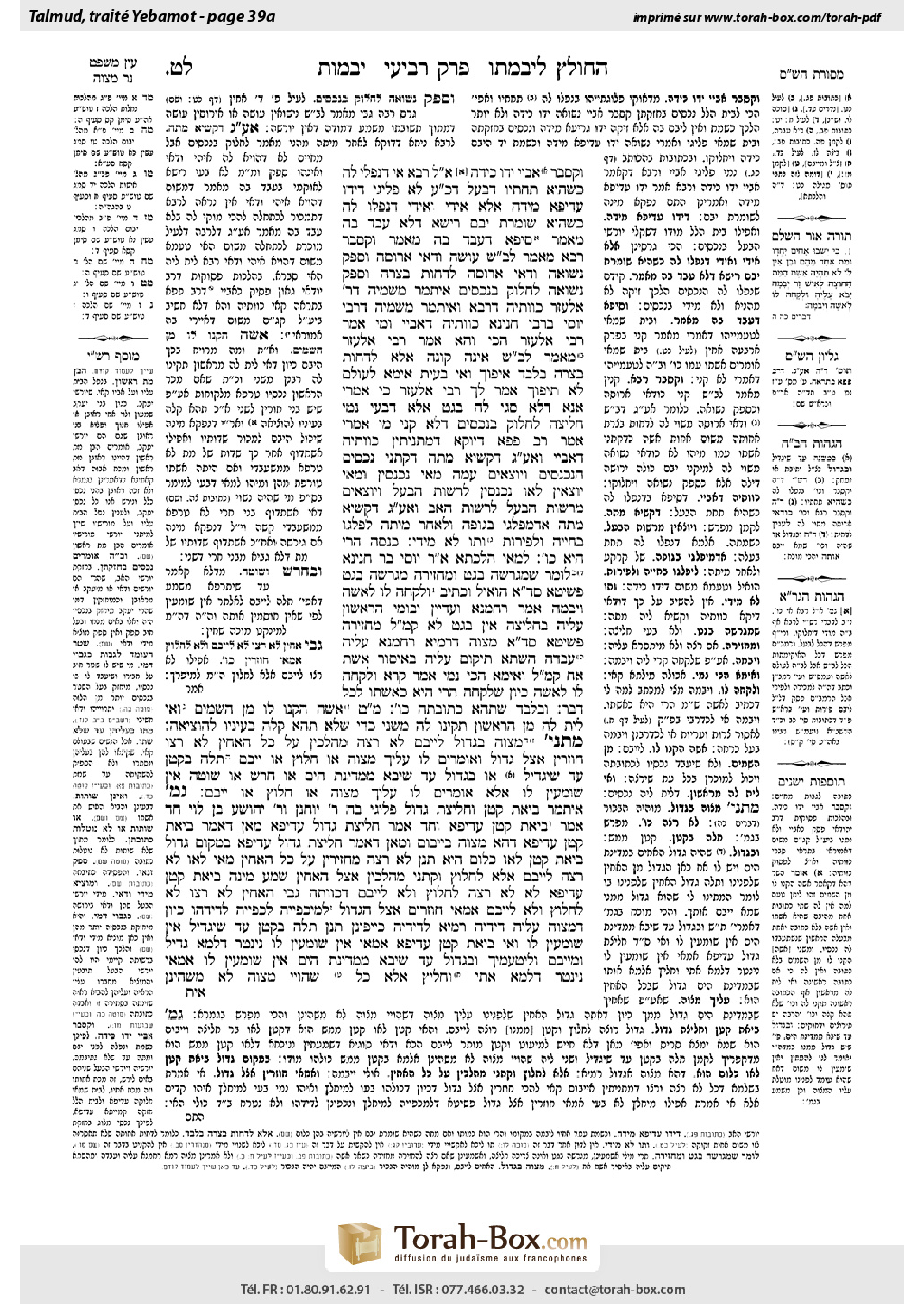
Yevamot 39a: Talmud study for Daf Yomi
Daf Yomi is the daily study of one Talmud folio. Explore 37 tractates with scans, Hebrew text, Sefaria English and AI-generated French translations where annotated.
Passage selection and English or AI-generated French translation are available where the scan has annotations. Daf Study is independent of Torah-Box and Sefaria.
Browse Yevamot · יבמות · All tractatesYevamot 39a text and translations
This page of Yevamot includes the Aramaic text, an English translation and an AI-generated French translation, alongside the scan above.
יבמות ל״ט א · Aramaic and Hebrew text
וְקָסָבַר אַבָּיֵי יָדוֹ כְּיָדָהּ.
אֲמַר לֵיהּ רָבָא: אִי דְּנָפְלִי לָהּ כְּשֶׁהִיא תַּחְתָּיו דְּבַעַל — דְּכוּלֵּי עָלְמָא לָא פְּלִיגִי דְּיָדוֹ עֲדִיפָא מִיָּדָהּ.
אֶלָּא אִידֵּי וְאִידֵּי דְּנָפְלוּ לָהּ כְּשֶׁהִיא שׁוֹמֶרֶת יָבָם. רֵישָׁא דְּלָא עֲבַד בַּהּ מַאֲמָר, סֵיפָא דַּעֲבַד בַּהּ מַאֲמָר.
וְקָסָבַר רָבָא מַאֲמָר לְבֵית שַׁמַּאי עוֹשֶׂה וַדַּאי אֲרוּסָה וּסְפֵק נְשׂוּאָה. וַדַּאי אֲרוּסָה — לִדְחוֹת בַּצָּרָה, וּסְפֵק נְשׂוּאָה — לַחְלוֹק בַּנְּכָסִים.
אִיתְּמַר מִשְּׁמֵיהּ דְּרַבִּי אֶלְעָזָר כְּווֹתֵיהּ דְּרָבָא, וְאִיתְּמַר מִשְּׁמֵיהּ דְּרַבִּי יוֹסֵי בְּרַבִּי חֲנִינָא כְּווֹתֵיהּ דְּאַבָּיֵי.
וּמִי אָמַר רַבִּי אֶלְעָזָר הָכִי? וְהָא אָמַר רַבִּי אֶלְעָזָר: מַאֲמָר לְבֵית שַׁמַּאי אֵינוֹ קוֹנֶה אֶלָּא לִדְחוֹת בַּצָּרָה בִּלְבָד!
אֵיפוֹךְ. וְאִי בָּעֵית אֵימָא: לְעוֹלָם לָא תֵּיפוֹךְ — אָמַר לָךְ רַבִּי אֶלְעָזָר: כִּי אֲמַרִי אֲנָא, דְּלָא סַגִּי לַהּ בְּגֵט אֶלָּא דְּבָעֵי נָמֵי חֲלִיצָה. לַחְלוֹק בַּנְּכָסִים דְּלָא קָנֵי — מִי אֲמַרִי?
אָמַר רַב פָּפָּא: דִּיּוּקָא דְּמַתְנִיתִין כְּווֹתֵיהּ דְּאַבָּיֵי, וְאַף עַל גַּב דְּקַשְׁיָא ״מֵתָה״.
דְּקָתָנֵי: נְכָסִים הַנִּכְנָסִים וְיוֹצְאִים עִמָּהּ, מַאי ״נִכְנָסִין״ וּמַאי ״יוֹצְאִין״? לָאו ״נִכְנָסִין״ — לִרְשׁוּת הַבַּעַל, וְ״יוֹצְאִים״ — מֵרְשׁוּת הַבַּעַל לִרְשׁוּת הָאָב,
וְאַף עַל גַּב דְּקַשְׁיָא ״מֵתָה״, אַדְּמִפַּלְגִי בְּגוּפַהּ וּלְאַחַר מִיתָה, לִפַּלְגוּ בְּחַיֶּיהָ וּלְפֵירוֹת.
וְתוּ לָא מִידֵּי.
כְּנָסָהּ הֲרֵי הִיא כּוּ׳. לְמַאי הִלְכְתָא? אָמַר רַבִּי יוֹסֵי בַּר חֲנִינָא: לוֹמַר שֶׁמְּגָרְשָׁה בְּגֵט וּמַחְזִירָהּ.
מְגָרְשָׁה בְּגֵט, פְּשִׁיטָא? סָלְקָא דַּעְתָּךְ אָמֵינָא, הוֹאִיל וּכְתִיב: ״וּלְקָחָהּ לוֹ לְאִשָּׁה וְיִבְּמָהּ״ — אָמַר רַחֲמָנָא: וַעֲדַיִין יִבּוּמֵי הָרִאשׁוֹן עָלֶיהָ, בַּחֲלִיצָה — אִין, בְּגֵט — לָא, קָא מַשְׁמַע לַן.
מַחְזִירָהּ. פְּשִׁיטָא? סָלְקָא דַּעְתָּךְ אָמֵינָא, מִצְוָה דְּרַמְיָא רַחֲמָנָא עֲלֵיהּ — עַבְדַּהּ, הַשְׁתָּא תֵּיקוּם עֲלֵיהּ בְּאִיסּוּר אֵשֶׁת אָח, קָא מַשְׁמַע לַן.
וְאֵימָא הָכִי נָמֵי? אָמַר קְרָא: ״וּלְקָחָהּ לוֹ לְאִשָּׁה״, כֵּיוָן שֶׁלְּקָחָהּ — הֲרֵי הִיא כְּאִשְׁתּוֹ לְכׇל דָּבָר.
וּבִלְבַד שֶׁתְּהֵא כְּתוּבָּתָהּ כּוּ׳. מַאי טַעְמָא — אִשָּׁה הִקְנוּ לוֹ מִן הַשָּׁמַיִם.
וְאִי לֵית לַהּ מִן הָרִאשׁוֹן — תַּקִּינוּ לַהּ מִשֵּׁנִי, כְּדֵי שֶׁלֹּא תְּהֵא קַלָּה בְּעֵינָיו לְהוֹצִיאָהּ.
מַתְנִי׳ מִצְוָה בְּגָדוֹל לְיַיבֵּם. לֹא רָצָה — מְהַלְּכִין עַל כׇּל הָאַחִין. לֹא רָצוּ — חוֹזְרִין אֵצֶל גָּדוֹל וְאוֹמְרִים לוֹ, עָלֶיךָ מִצְוָה: אוֹ חֲלוֹץ, אוֹ יַיבֵּם.
תָּלָה בְּקָטָן עַד שֶׁיַּגְדִּיל, אוֹ בַּגָּדוֹל עַד שֶׁיָּבֹא מִמְּדִינַת הַיָּם, אוֹ חֵרֵשׁ אוֹ שׁוֹטֶה — אֵין שׁוֹמְעִין לוֹ, אֶלָּא אוֹמְרִים לוֹ: עָלֶיךָ מִצְוָה, אוֹ חֲלוֹץ אוֹ יַיבֵּם.
גְּמָ׳ אִיתְּמַר: בִּיאַת קָטָן, וַחֲלִיצַת גָּדוֹל — פְּלִיגִי בַּהּ רַבִּי יוֹחָנָן וְרַבִּי יְהוֹשֻׁעַ בֶּן לֵוִי, חַד אָמַר: בִּיאַת קָטָן עֲדִיפָא, וְחַד אָמַר: חֲלִיצַת גָּדוֹל עֲדִיפָא.
מַאן דְּאָמַר בִּיאַת קָטָן עֲדִיפָא — דְּהָא מִצְוָה בְּיִיבּוּם. וּמַאן דְּאָמַר חֲלִיצַת גָּדוֹל עֲדִיפָא: בִּמְקוֹם גָּדוֹל — בִּיאַת קָטָן לָאו כְּלוּם הִיא.
תְּנַן: לֹא רָצָה — מַחְזִירִין עַל כׇּל הָאַחִין. מַאי לָאו: לֹא רָצָה לְיַיבֵּם אֶלָּא לַחְלוֹץ, וְקָתָנֵי: מְהַלְּכִין אֵצֶל הָאַחִין, שְׁמַע מִינַּהּ בִּיאַת קָטָן עֲדִיפָא!
לָא, לֹא רָצָה לַחְלוֹץ וְלֹא לְיַיבֵּם, דִּכְווֹתַהּ גַּבֵּי הָאַחִין: לֹא רָצוּ לֹא לַחְלוֹץ וְלֹא לְיַיבֵּם. אַמַּאי חוֹזְרִים אֵצֶל הַגָּדוֹל? לְמִיכְפְּיֵיהּ (לִכְפְּיֵיהּ) [לִיכְפִּינְהוּ] לְדִידְהוּ! כֵּיוָן דְּמִצְוָה עֲלֵיהּ דִּידֵיהּ רַמְיָא — לְדִידֵיהּ כָּיְיפִינַן.
תְּנַן: תָּלָה בְּקָטָן עַד שֶׁיַּגְדִּיל אֵין שׁוֹמְעִין לוֹ. וְאִי בִּיאַת קָטָן עֲדִיפָא, אַמַּאי אֵין שׁוֹמְעִין לוֹ? נִינְטַר דִּלְמָא גָּדֵיל וּמְיַיבֵּם!
וְלִיטַעְמָיךְ, וּבְגָדוֹל עַד שֶׁיָּבֹא מִמְּדִינַת הַיָּם אֵין שׁוֹמְעִין לוֹ, אַמַּאי? נִינְטַר דִּלְמָא אָתֵי וְחָלֵיץ? אֶלָּא כֹּל שַׁהוֹיֵי מִצְוָה לָא מְשַׁהֵינַן.
Yevamot 39a · English translation
And Abaye holds that according to Beit Hillel, with regard to the husband’s rights to his wife’s property, his hand is like her hand, but not any stronger. Accordingly, the yavam has a weaker hand in her property than she does, because the rights of a yavam are always weaker than those of the husband himself. Therefore, she is considered to be in possession of the property, and when she dies, her heirs, i.e., her father and his heirs, inherit it. However, Beit Shammai assume that the husband’s hand is stronger than his wife’s hand. Therefore, the hand of the yavam, which is weaker than the husband’s hand, is nevertheless equally as strong as the hand of the yevama, and therefore they rule that if she dies, the yavam and her heirs divide up the property.
Rava said to him: I hold that if the property was bequeathed to her when she was still under the first husband, everyone, i.e., both Beit Hillel and Beit Shammai, agrees that his hand is stronger than her hand, and therefore the hand of the yavam will be equally as strong as that of the yevama, and if she dies the property will be divided between the two sides.
Therefore, Rava presents his own resolution to the apparent inconsistency in Beit Shammai’s rulings in the mishna: Rather, both this first clause and that latter clause concern cases in which property was bequeathed to her when she was a widow waiting for her yavam. The first clause concerns a case in which the yavam had not performed a levirate betrothal with her, and the latter clause concerns a case in which he had performed a levirate betrothal with her.
The Gemara explains the rationale behind Rava’s explanation: And Rava holds that according to Beit Shammai a levirate betrothal with a yevama affords her a status equivalent in some aspects to a woman who is definitely betrothed and in other aspects to a woman about whom there is uncertainty whether she is married. The Gemara elucidates: She is similar to a woman who is definitely betrothed with regard to nullifying the levirate bond of her rival wife, so that the rival wife need not perform levirate marriage or ḥalitza. And she is similar to a woman about whom there is uncertainty whether she is married with regard to empowering the yavam to divide up the property that she attained while she was waiting for her yavam.
The Gemara notes: An interpretation of the mishna was stated in the name of Rabbi Elazar that is in accordance with the opinion of Rava. And an interpretation of the mishna was stated in the name of Rabbi Yosei, son of Rabbi Ḥanina that is in accordance with the opinion of Abaye.
The Gemara objects: And did Rabbi Elazar actually state this interpretation that is in accordance with the opinion of Rava? But didn’t Rabbi Elazar say: According to Beit Shammai a levirate betrothal acquires the yevama only with regard to nullifying the levirate bond of a rival wife so that she need not perform levirate marriage or ḥalitza? This implies that it does not acquire her with regard to enabling the yavam to inherit from her. This, then, stands in contrast to Rava’s interpretation.
The Gemara offers two possible solutions: Reverse the opinions, so that Rabbi Elazar is in accordance with Abaye, and Rabbi Yosei, son of Rabbi Ḥanina, is in accordance with Rava. And if you wish, say instead: Actually, do not reverse the opinions, since Rabbi Elazar can be understood to be in accordance with the opinion of Rava, as Rabbi Elazar could have said to you: When I said the statement that implies that a levirate betrothal acquires in a very limited sense, the intention was only that its acquisition is limited in that giving her a bill of divorce is still insufficient for her in order to release her from the levirate bond; rather, she also needs to perform ḥalitza. But to suggest that he does not acquire her with regard to dividing up the property she attained, did I say that? Certainly not, as in fact a levirate betrothal acquires her to that extent as well, as Rava assumes.
Rav Pappa said: The precise formulation of the mishna is in accordance with the opinion of Abaye, even though according to his opinion it is difficult that the mishna discusses the case in which she died.
The Gemara explains Rav Pappa’s statement: The precise formulation of the mishna is in accordance with the opinion of Abaye, as it teaches: Her property that enters and leaves the marriage with her. What is the meaning of: That enters, and what is the meaning of: That leaves? Is it not: That enters into the domain of the husband and leaves the domain of the husband when she dies, and then enters into the domain of the father? Interpreted in this way, the mishna explicitly considers the period in which she was still married to her first husband, and likewise, the case in which she came into the possession of property should be understood as referring to a case in which she did so while still married. This is consonant with Abaye’s interpretation, but not with Rava’s.
And when Rav Pappa said: Even though according to his opinion it is difficult that the mishna discusses the case in which she died, he meant as follows: Instead of disputing who has the rights to the property itself, which necessitates considering the case after her death, let Beit Hillel and Beit Shammai dispute the more immediate case when she is still alive and dispute who has the rights to the use and produce of the property.
The Gemara concludes: And there is nothing more to say concerning this matter, i.e., as Rav Pappa noted, while it is undeniable that the mishna’s formulation supports Abaye’s interpretation, it is equally true that the case discussed by the mishna would appear to challenge his interpretation.
§ The mishna states: If the yavam consummated the levirate marriage with her, then her legal status is that of his wife in every sense. The Gemara asks: With regard to what halakha is this said? Rabbi Yosei bar Ḥanina said: It is to say that once they have consummated the levirate marriage, the only way to legally dissolve the marriage is if he divorces her with a bill of divorce, but ḥalitza is of no avail, and after divorcing her, he is permitted to take her back to be his wife, as the prohibition against engaging in relations with one’s brother’s wife does not apply to her.
The Gemara examines the first clause of Rabbi Yosei bar Ḥanina’s statement: Isn’t it obvious that to sever his relationship with her, he divorces her with a bill of divorce? The Gemara explains: It is necessary to teach this because it could enter your mind to say that since it is written: “And take her to him to be his wife and consummate the levirate marriage with her” (Deuteronomy 25:5), continuing to refer to the marriage as a levirate marriage even after the verse has stated that he took her as a wife, one might claim the Merciful One is saying that the original levirate bond continues to be upon her, and therefore, with ḥalitza, yes, they can sever the relationship, but with a bill of divorce, no, the relationship would not be severed. Therefore, the mishna teaches us that she is considered to be his wife to the extent that the relationship can be severed with a bill of divorce alone.
The Gemara examines the second clause: Isn’t it obvious that after divorcing her, he is permitted to take her back to be his wife? The Gemara explains: It is necessary to teach this because it could enter your mind to say that the mitzva that the Merciful One imposes upon him, he has performed, and therefore now that there is no longer any mitzva to marry her, she should once again be established as forbidden to him by the prohibition against engaging in relations with one’s brother’s wife. To dispel this notion, the mishna teaches us that she is considered to be his wife to the extent that there is no longer any prohibition against remarrying her.
The Gemara challenges this ruling: But why not say that this is indeed so, that she should be forbidden to him? The Gemara explains: The verse states: “And take her to him to be his wife” (Deuteronomy 25:5), indicating that once he has taken her, her legal status is that of his wife in every sense.
§ The mishna states: The only exception to this is that her marriage contract will still be payable from the property of her first husband and not from the property of the yavam. The Gemara asks: What is the reason for this? The Gemara explains: A wife was acquired to him by Heaven, and since he did not choose her as a wife, he did not obligate himself to pay her marriage contract.
The Gemara qualifies the mishna’s ruling: And if she has no ability to collect her marriage contract from the first husband, since he died without leaving any property with which to pay it, the Sages instituted an ordinance for her benefit that she must receive a new marriage contract from her second husband, i.e., the yavam. This was instituted so that she will not be demeaned in his eyes such that he will easily divorce her, since doing so would incur a financial burden on his part.
MISHNA: The mitzva of levirate marriage is for the eldest of the brothers to consummate the levirate marriage. If the eldest does not want to do so, the court goes to each of the other brothers and requires them to do so. If they do not want to do so, the court returns to the eldest brother and says to him: The mitzva is incumbent upon you; either perform ḥalitza or consummate the levirate marriage.
If a brother made his decision dependent upon the possibility that one of his other brothers will eventually consummate the levirate marriage, saying that he will do so only if they do not, then whether he makes it dependent upon a brother who is currently a minor, meaning that the yevama should wait until he matures, or upon his eldest brother, who is not currently present, meaning the yevama should wait until he comes from overseas, or upon a brother who is a deaf-mute or an imbecile, as perhaps they will recover from their disability, the court does not listen to him; rather, the judges of the court say to him: The mitzva is incumbent upon you; either perform ḥalitza or consummate the levirate marriage.
GEMARA: An amoraic dispute was stated: Rabbi Yoḥanan and Rabbi Yehoshua ben Levi disagree with regard to a case in which there is the choice between consummation of the levirate marriage by a younger brother [katan] or ḥalitza performed by the eldest brother. One said: The consummation of the levirate marriage by a younger brother is preferable, and the other one said: Ḥalitza performed by the eldest brother is preferable.
The Gemara explains: With regard to the one who said that consummation of the levirate marriage by a younger brother is preferable, this is due to the fact that the mitzva of levirate marriage is through the actual consummation of the levirate marriage, and therefore preference is always given to consummation over the performance of ḥalitza. And the one who said ḥalitza performed by the eldest brother is preferable, this is because in the presence of the eldest brother, the consummation of the levirate marriage by a younger brother is considered nothing.
The Gemara suggests proof for the first opinion: We learned in the mishna: If the eldest does not want to consummate the levirate marriage, the court goes to each of the other brothers and requires them to do so. The Gemara suggests: What, is it not that he does not want to consummate the levirate marriage but is willing to perform ḥalitza? And yet the mishna teaches: The court goes to each of the other brothers and requires them to consummate the levirate marriage. If so, conclude from here that the consummation of the levirate marriage by a younger brother is preferable.
The Gemara rejects the proof: No, the mishna might concern a case where the eldest does not want either to perform ḥalitza or to consummate the levirate marriage, and it is only because he is unwilling to do either that the other brothers are considered. The Gemara asks: If this is so, then in the corresponding situation in the mishna in which the brothers do not want to do so, the case must be that they do not want either to perform ḥalitza or to consummate the levirate marriage. But if so, why should the court invest the extra effort to return to the eldest brother to force him to fulfill his duty? Let the court force the other brothers to fulfill their duty. The Gemara responds: Since the mitzva is incumbent upon the eldest brother ab initio, it is he who is forced.
The Gemara suggests another proof: We learned in the mishna: If a brother makes his decision dependent upon a brother who is currently a minor, the court does not listen to him. The Gemara suggests: And if the consummation of the levirate marriage by a minor is preferable, why shouldn’t the court listen to him? Let the court wait, as perhaps he will mature and consummate the levirate marriage. Rather, it would appear that the mishna assumes that consummation by a younger brother is not preferable.
The Gemara responds: But even according to your reasoning that ḥalitza performed by an elder brother is preferable, what about the next case in the mishna, where a brother asks to wait until the eldest brother comes from overseas? In that case, as well, the mishna rules: They do not listen to him; but why shouldn’t they listen to him? Let the court wait, as perhaps he will come and at the very least perform ḥalitza. Rather, it is clear that the reason for the mishna’s ruling is that we do not delay the performance of any mitzva; therefore, if one of the brothers is currently unable to perform the mitzva, he is not considered at all. Consequently, no proof can be derived from the mishna.
Yevamot 39a · Traduction française (IA)
Abaye considère que, selon Beit Hillel, en ce qui concerne les droits du mari sur les biens de son épouse, sa main est égale à la sienne, mais ne lui est pas supérieure. Par conséquent, le yavam a moins de droits sur ses biens qu’elle-même, car les droits d’un yavam sont toujours inférieurs à ceux du mari lui-même. Elle est donc considérée comme étant en possession des biens et, lorsqu’elle meurt, ses héritiers — c’est-à-dire son père et les héritiers de celui-ci — en héritent. Beit Shammai, en revanche, supposent que la main du mari est plus forte que celle de son épouse. Par conséquent, la main du yavam, bien que plus faible que celle du mari, est néanmoins aussi forte que celle de la yevama ; ils statuent donc qu’à sa mort, le yavam et ses héritiers se partagent les biens.
Rava lui dit : Je considère que si les biens lui ont été légués alors qu’elle était encore sous l’autorité de son premier mari, tous — c’est-à-dire Beit Hillel comme Beit Shammai — conviennent que la main du mari est plus forte que la sienne. La main du yavam sera donc aussi forte que celle de la yevama et, si elle meurt, les deux parties se partageront les biens.
Rava propose donc sa propre résolution à l’apparente contradiction entre les décisions de Beit Shammai dans la Michna : en réalité, la première comme la dernière clause concernent des cas où les biens lui ont été légués alors qu’elle était veuve et attendait son yavam. La première clause concerne un cas où le yavam ne l’avait pas fiancée par des fiançailles léviratiques, tandis que la dernière concerne un cas où il l’avait fiancée de cette manière.
La Guemara explique le fondement de l’explication de Rava : celui-ci considère que, selon Beit Shammai, des fiançailles léviratiques confèrent à la yevama un statut équivalent, à certains égards, à celui d’une femme certainement fiancée et, à d’autres égards, à celui d’une femme dont le statut matrimonial est incertain. La Guemara précise : elle est semblable à une femme certainement fiancée en ce qui concerne l’annulation du lien léviratique de sa rivale, qui n’a alors besoin ni de contracter un mariage léviratique ni de subir la ḥalitsa. Elle est semblable à une femme dont le statut matrimonial est incertain en ce qui concerne le droit du yavam de se partager les biens qu’elle a acquis pendant qu’elle attendait son yavam.
La Guemara note : une interprétation de la Michna conforme à l’opinion de Rava a été rapportée au nom de Rabbi Elazar, et une interprétation conforme à l’opinion d’Abaye a été rapportée au nom de Rabbi Yosei, fils de Rabbi Ḥanina.
La Guemara objecte : Rabbi Elazar a-t-il réellement énoncé cette interprétation conforme à l’opinion de Rava ? Rabbi Elazar n’a-t-il pas dit : selon Beit Shammai, des fiançailles léviratiques acquièrent la yevama uniquement en ce qui concerne l’annulation du lien léviratique de sa rivale, de sorte que celle-ci n’a besoin ni de contracter un mariage léviratique ni de subir la ḥalitsa ? Cela implique que ces fiançailles ne l’acquièrent pas au point de permettre au yavam d’hériter d’elle. Cela contredit donc l’interprétation de Rava.
La Guemara propose deux solutions possibles : intervertir les opinions, de sorte que Rabbi Elazar soit conforme à Abaye et Rabbi Yosei, fils de Rabbi Ḥanina, à Rava. Ou bien, si tu préfères, dire plutôt : en réalité, il ne faut pas intervertir les opinions, car on peut comprendre que Rabbi Elazar est conforme à l’opinion de Rava. En effet, Rabbi Elazar aurait pu te répondre : lorsque j’ai formulé cette déclaration, qui laisse entendre que les fiançailles léviratiques n’acquièrent la yevama que dans une mesure très limitée, je voulais seulement dire que cette acquisition est limitée en ce que lui donner un acte de divorce ne suffit pas à la libérer du lien léviratique ; elle doit aussi subir la ḥalitsa. Mais ai-je dit qu’il ne l’acquiert pas en ce qui concerne le partage des biens qu’elle a acquis ? Certainement pas : en réalité, des fiançailles léviratiques l’acquièrent également à cet égard, comme le suppose Rava.
Rav Pappa dit : la formulation précise de la Michna correspond à l’opinion d’Abaye, même si, selon cette opinion, il est difficile de comprendre pourquoi la Michna traite du cas où elle est morte.
La Guemara explique la déclaration de Rav Pappa : la formulation précise de la Michna correspond à l’opinion d’Abaye, car elle enseigne : « Ses biens qui entrent avec elle dans le mariage et en sortent avec elle. » Que signifie « entrent », et que signifie « sortent » ? N’est-ce pas qu’ils entrent dans le domaine du mari et en sortent à la mort de la femme, puis entrent dans le domaine du père ? Selon cette interprétation, la Michna considère explicitement la période où elle était encore mariée à son premier mari ; de même, le cas où elle est entrée en possession de biens doit être compris comme désignant une situation où elle était encore mariée. Cela concorde avec l’interprétation d’Abaye, mais non avec celle de Rava.
Lorsque Rav Pappa dit : « même si, selon cette opinion, il est difficile de comprendre pourquoi la Michna traite du cas où elle est morte », il voulait dire ceci : au lieu de discuter de la personne qui a des droits sur les biens eux-mêmes — ce qui oblige à envisager le cas après sa mort —, que Beit Hillel et Beit Shammai discutent du cas plus immédiat où elle est encore en vie, et débattent de la personne qui a droit à l’usage des biens et à leurs fruits.
La Guemara conclut : il n’y a rien de plus à dire sur cette question ; comme Rav Pappa l’a relevé, s’il est indéniable que la formulation de la Michna étaye l’interprétation d’Abaye, il est tout aussi vrai que le cas traité par la Michna semble contredire cette interprétation.
§ La Michna enseigne : si le yavam a consommé le mariage léviratique avec elle, son statut juridique est celui de son épouse à tous égards. La Guemara demande : à propos de quelle halakha cela est-il énoncé ? Rabbi Yosei bar Ḥanina dit : cela signifie qu’une fois le mariage léviratique consommé, la seule manière de dissoudre légalement le mariage est qu’il la divorce au moyen d’un acte de divorce ; la ḥalitsa ne sert à rien. Après l’avoir divorcée, il est autorisé à la reprendre pour épouse, car l’interdit d’avoir des relations avec la femme de son frère ne s’applique pas à elle.
La Guemara examine la première partie de la déclaration de Rabbi Yosei bar Ḥanina : n’est-il pas évident que, pour rompre son lien avec elle, il doit la divorcer au moyen d’un acte de divorce ? La Guemara explique : il était nécessaire de l’enseigner, car on aurait pu penser que, puisqu’il est écrit : « Qu’il la prenne pour épouse et consomme avec elle le mariage léviratique » (Deutéronome 25,5), le verset continue de parler de mariage léviratique même après avoir dit qu’il l’a prise pour épouse. On aurait donc pu soutenir que le lien léviratique initial demeure sur elle, selon la volonté du Miséricordieux ; dès lors, ils pourraient certes rompre leur relation par la ḥalitsa, mais non par un acte de divorce. La Michna nous enseigne donc qu’elle est considérée comme son épouse au point que leur relation peut être rompue par un simple acte de divorce.
La Guemara examine la seconde partie : n’est-il pas évident qu’après l’avoir divorcée, il est autorisé à la reprendre pour épouse ? La Guemara explique : il était nécessaire de l’enseigner, car on aurait pu penser qu’il a accompli la mitsva que le Miséricordieux lui impose et que, par conséquent, maintenant qu’il n’a plus la mitsva de l’épouser, elle devrait de nouveau être considérée comme lui étant interdite en vertu de l’interdit d’avoir des relations avec la femme de son frère. Pour écarter cette idée, la Michna nous enseigne qu’elle est considérée comme son épouse au point qu’il n’est plus interdit de l’épouser à nouveau.
La Guemara conteste cette décision : mais pourquoi ne pas dire qu’il en est effectivement ainsi et qu’elle devrait lui être interdite ? La Guemara explique : le verset dit : « Qu’il la prenne pour épouse » (Deutéronome 25,5), ce qui indique qu’une fois qu’il l’a prise, son statut juridique est celui de son épouse à tous égards.
§ La Michna enseigne : la seule exception est que sa ketouba restera payable sur les biens de son premier mari et non sur ceux du yavam. La Guemara demande : quelle en est la raison ? La Guemara explique : le Ciel lui a attribué une épouse et, puisqu’il ne l’a pas choisie, il ne s’est pas engagé à lui payer sa ketouba.
La Guemara précise la décision de la Michna : si elle ne peut pas recouvrer sa ketouba auprès de son premier mari, parce qu’il est mort sans laisser de biens permettant de la payer, les Sages ont institué en sa faveur qu’elle reçoive une nouvelle ketouba de son second mari, c’est-à-dire du yavam. Cette mesure a été instituée afin qu’elle ne soit pas dévalorisée à ses yeux, au point qu’il puisse la divorcer facilement, puisque cela lui imposerait une charge financière.
MICHNA : La mitsva du mariage léviratique consiste à ce que le plus âgé des frères le consomme. Si l’aîné ne le souhaite pas, le tribunal s’adresse à chacun des autres frères et leur demande de le faire. S’ils ne le souhaitent pas, le tribunal revient vers le frère aîné et lui dit : la mitsva t’incombe ; accomplis la ḥalitsa ou consomme le mariage léviratique.
Si un frère subordonne sa décision à la possibilité que l’un de ses autres frères consomme ultérieurement le mariage léviratique, en disant qu’il ne le fera que si eux ne le font pas — qu’il subordonne sa décision à celle d’un frère actuellement mineur, ce qui signifierait que la yevama devrait attendre qu’il grandisse, à celle de son frère aîné, actuellement absent, ce qui signifierait que la yevama devrait attendre son retour d’outre-mer, ou à celle d’un frère sourd-muet ou atteint de déficience mentale, dans l’espoir qu’ils se remettent de leur handicap —, le tribunal ne l’écoute pas. Les juges du tribunal lui disent plutôt : la mitsva t’incombe ; accomplis la ḥalitsa ou consomme le mariage léviratique.
GUEMARA : Une controverse entre amoraïm a été rapportée : Rabbi Yoḥanan et Rabbi Yehoshua ben Levi divergent au sujet d’un cas où il faut choisir entre la consommation du mariage léviratique par un frère cadet [katan] et la ḥalitsa accomplie par le frère aîné. L’un dit que la consommation du mariage léviratique par un frère cadet est préférable, et l’autre dit que la ḥalitsa accomplie par le frère aîné est préférable.
La Guemara explique : celui qui dit que la consommation du mariage léviratique par un frère cadet est préférable le dit parce que la mitsva du mariage léviratique consiste à consommer effectivement le mariage ; on préfère donc toujours sa consommation à l’accomplissement de la ḥalitsa. Quant à celui qui dit que la ḥalitsa accomplie par le frère aîné est préférable, c’est parce qu’en présence du frère aîné, la consommation du mariage léviratique par un frère cadet ne compte pour rien.
La Guemara propose une preuve en faveur de la première opinion : nous avons appris dans la Michna : si l’aîné ne veut pas consommer le mariage léviratique, le tribunal s’adresse à chacun des autres frères et leur demande de le faire. La Guemara suggère : n’est-ce pas qu’il ne veut pas consommer le mariage léviratique, mais qu’il est disposé à accomplir la ḥalitsa ? Pourtant, la Michna enseigne que le tribunal s’adresse à chacun des autres frères et leur demande de consommer le mariage léviratique. Il faut donc en conclure que la consommation du mariage léviratique par un frère cadet est préférable.
La Guemara rejette cette preuve : non, la Michna pourrait traiter du cas où l’aîné ne veut ni accomplir la ḥalitsa ni consommer le mariage léviratique ; c’est uniquement parce qu’il refuse de faire l’un ou l’autre que l’on envisage les autres frères. La Guemara demande : si tel est le cas, dans la situation correspondante de la Michna où les frères ne veulent pas le faire, il doit s’agir d’un cas où ils ne veulent ni accomplir la ḥalitsa ni consommer le mariage léviratique. Mais alors, pourquoi le tribunal ferait-il l’effort supplémentaire de revenir vers le frère aîné pour le contraindre à remplir son devoir ? Que le tribunal contraigne les autres frères à remplir leur devoir. La Guemara répond : puisque la mitsva incombe au frère aîné d’emblée, c’est lui que l’on contraint.
La Guemara propose une autre preuve : nous avons appris dans la Michna que, si un frère subordonne sa décision à celle d’un frère actuellement mineur, le tribunal ne l’écoute pas. La Guemara suggère : si la consommation du mariage léviratique par un mineur est préférable, pourquoi le tribunal ne l’écouterait-il pas ? Qu’il attende, car le mineur pourrait grandir et consommer le mariage léviratique. Il semble donc plutôt que la Michna considère que la consommation par un frère cadet n’est pas préférable.
La Guemara répond : mais même selon ton raisonnement, selon lequel la ḥalitsa accomplie par un frère aîné est préférable, que dire du cas suivant de la Michna, où un frère demande d’attendre le retour de son frère aîné d’outre-mer ? Dans ce cas aussi, la Michna statue qu’on ne l’écoute pas. Mais pourquoi ne l’écouterait-on pas ? Que le tribunal attende, car l’aîné pourrait revenir et accomplir au moins la ḥalitsa. Il est donc clair que la raison de la décision de la Michna est que nous ne retardons l’accomplissement d’aucune mitsva ; par conséquent, si l’un des frères est actuellement incapable d’accomplir la mitsva, on ne le prend pas du tout en considération. On ne peut donc tirer aucune preuve de la Michna.
Traduction française générée par IA à partir de l’édition anglaise de Sefaria. Vérifie toujours un passage avec le texte source.
Text from Sefaria: William Davidson Edition - Vocalized Aramaic (CC BY NC); William Davidson Edition - English (CC BY NC).